

More
agentic AI
December 19, 2025
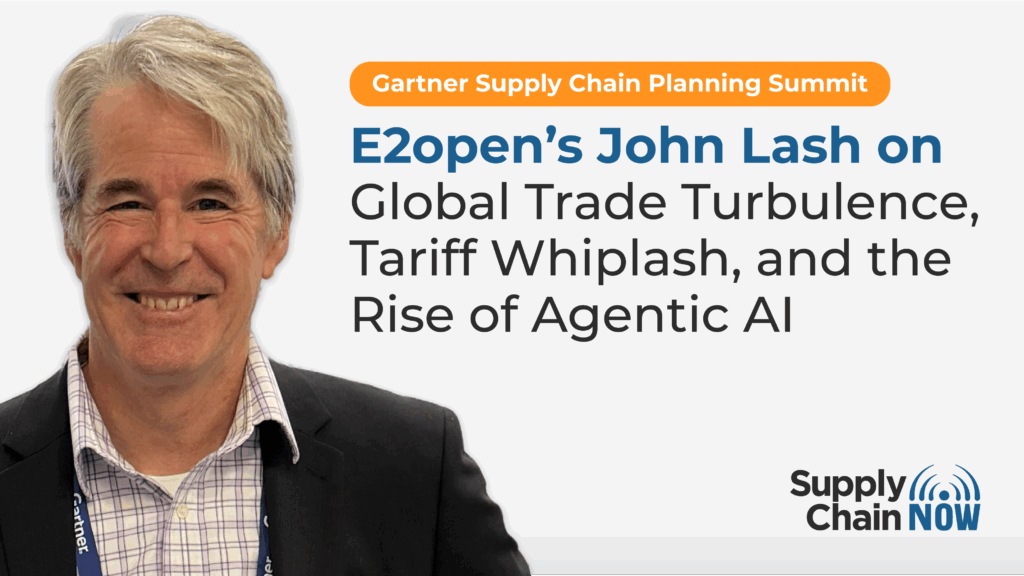
E2open’s John Lash on Global Trade Turbulence, Tariff Whiplash, and the Rise of Agentic AI
At the 2025 Gartner Supply Chain Planning Summit in Denver, Scott Luton met with John Lash, who leads strategy and vision at e2open, a WiseTech Global Group company. E2open is a global platform powering the entire lifecycle of making, moving, and selling goods, with capabilities spanning planning, logistics, global trade, supply management, and procurement. The platform is designed not just for enterprise visibility but for true end-to-end coordination across extended supply chain ecosystems. Lash emphasized that disruptions rarely originate within a company’s four walls. “Your sub-tiers are where most of the risk lives,” he explained. “That’s where your day-to-day operations—and your long-term strategy—are truly shaped.” It’s a lesson sharply reinforced during the pandemic, which reminded leaders worldwide that no one does supply chain alone. Old Challenges Intensified by New Realities When Luton asked about the biggest challenges facing planning teams today, Lash pointed immediately to constraints—supply constraints, manufacturing constraints, and now, the added layer of global trade volatility. Trade policies that once shifted every few years now change weekly, daily, or even hourly. Lash offered a striking example: Brazilian coffee duties jumped from 10% to 50% this summer—before returning to 0%. “How do you plan through that?” he asked.…

sustainable supply chain
August 29, 2024
Eco-Friendly Innovations: How Sustainable Practices Are Reshaping Supply Chains
Scope 3 emissions reportedly account for more than 70% of businesses’ carbon footprints. That huge percentage gives an indication of just how critical supply chain sustainability efforts are to the planet. Thankfully, a growing number of eco-friendly innovations are helping reshape global supply chains. Supply Chain Sustainability: An Industry Imperative in a Changing World It is becoming increasingly important for companies to accurately calculate their supply chain emissions and create an information-sharing ecosystem, according to Matthew Gardner, co-founder and managing partner of Sustainserv, a consulting firm that helps businesses implement sustainability strategies. Gardner said accounting for supply chain-related greenhouse gas emissions includes such challenges as: Data gathering of “materials, manufacturing processes, activities of second- and third-tier suppliers, and overall data governance and quality.” Calculation methodology that “reflects the realities of raw material sourcing, product manufacturing, transportation and distribution, and other life-cycle impacts that may affect reported greenhouse gas totals.” Supplier relationships, which can be strained as a result of emissions assessments. Businesses also need to keep in mind their relationships with consumers. PDI Technologies said 80% of U.S. consumers it surveyed were willing to pay more for sustainable products. “Between these statistics and the regulatory conversations that are happening in…