Intro/Outro (00:03):
Welcome to Supply Chain. Now the voice of global supply chain Supply chain now focuses on the best in the business for our worldwide audience, the people, the technologies, the best practices, and today’s critical issues, the challenges and opportunities. Stay tuned to hear from Those Making Global Business happen right here on supply chain now.
Scott Luton (00:32):
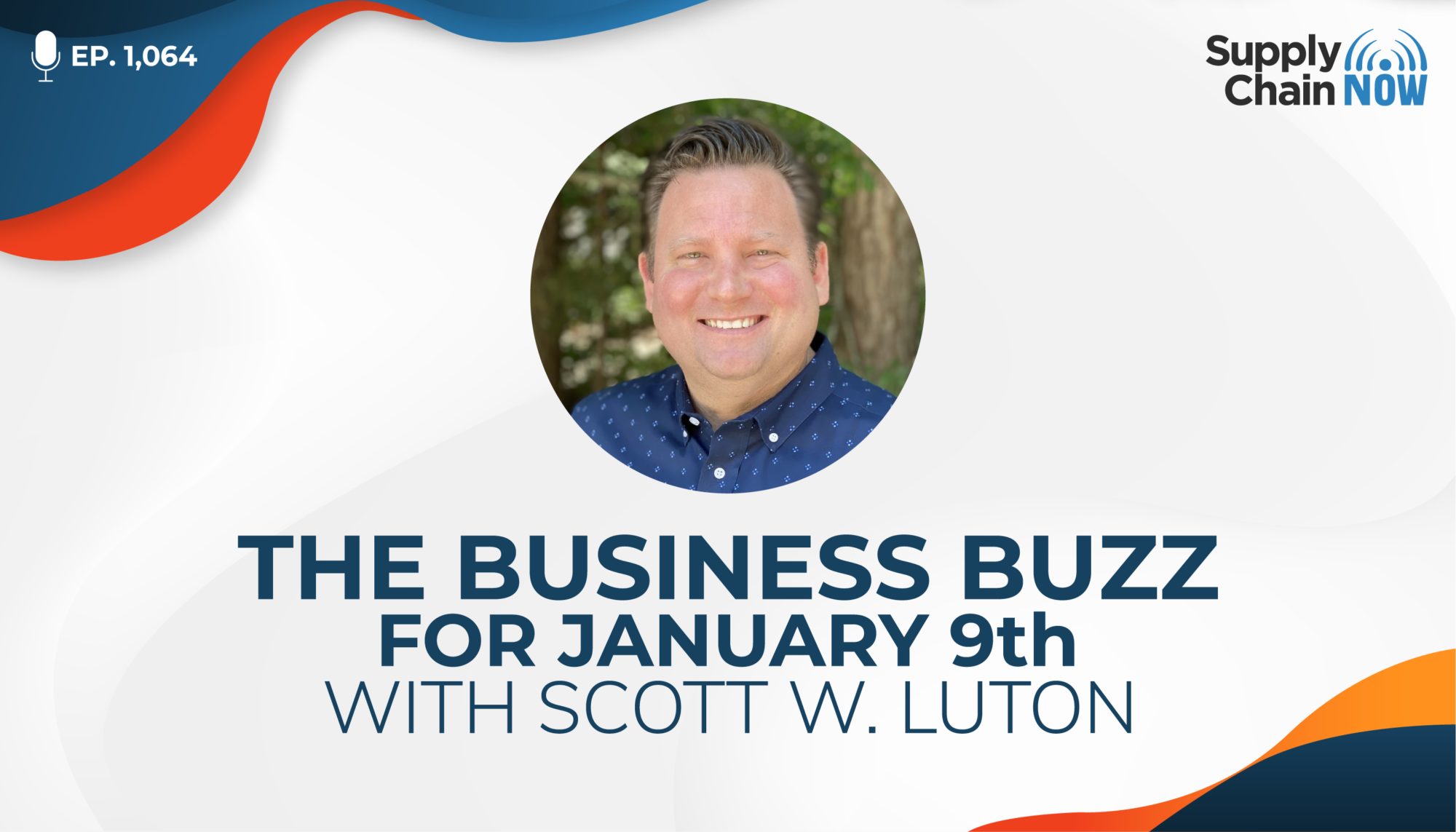
Hey, good morning. Welcome to the Business Buzz here on Supply Chain. Now this is Scott Luton, your host. Here I’ll be sharing a variety of business observations and interesting news stories from across the business world. So welcome to the Business Buzz for January 9th, 2023. Let’s dive on in
Scott Luton (00:52):
In item number one today. Let’s look at the labor market here in the us. It might just be a bit Ros, your Than You Expected. As reported by market watch leading payroll processor, ADP says their data shows a gain. In December, 2022 of 235,000 jobs, the forecast for the month, at least by the economists pulled by the Wall Street Journal, was forecasting a gain of only 153,000 jobs. Now, as you might expect, the majority of the new hiring was found in the services sector where Americans are spending a ton of money these days. Yet at the same time, we’ve seen a continued slew of layoffs impacting the tech sector. Recently, layoff announcements have been made by companies such as Vimeo, Salesforce, buzzfeed, and even Amazon. Item number two, today, as we all know, many companies have been using enhanced automation to navigate a wide variety of labor market challenges.
Scott Luton (01:56):
One recent example is online pet retailer Chewy, who will continue to build out automated fulfillment centers to support its growth while adding efficiencies to the bottom line. Chewy has opened three such centers since 2020, and plans to open two more, at least by mid 2024. Chewy’s, C F O, Mario Marte was quoted as saying the objective behind the initiative is to significantly reduce the time spent by workers finding, picking and packing products. The Wall Street Journal reports that Chewy has 13 fulfillment centers total, and the company quote expects a 50% improvement in labor productivity in its automated sites, as well as a 25% increase in throughput capacity per square foot. And you can count Greg White amongst Chewy’s fans. Greg says, quote, this company imagined and manifested a world where they deliver faster, better, and cheaper. No need to pick only two. Speaking of automation, check out these numbers as part of item number three here on the business bus.
Scott Luton (03:13):
Walmart made a recent announcement that stated that the retailer had made over 6,000 deliveries in the US using drones. In 2022, Amazon kicked off its drone delivery in December, focused on small markets in California and Texas, and in fact, consulting Giant McKenzie estimates that some 1.5 million deliveries in 2022 globally were made with drones. Now, that’s up from under a half million in 2021. For item number four, here’s a fun factoid that might have you reconsidering what you do with that Coke or beer can once you’re done. According to Tom Finn and E ESG targets via Twitter, who is reviewing all corporation data when it comes to aluminum can recycling rates by country globally. Did you know that the US is almost the worst in the world when it comes to recycling aluminum cans? Only about 46% of these cans are recycled in the us. The South American country of Chile comes in last at 33%. Now, compare those rates with a 99% aluminum can recycling rate in Germany, 97% in Mexico, and even 82% in the United Kingdom. Hey, hey, that sounds like an opportunity <laugh>.
Scott Luton (04:45):
By the way, you can connect with Tom Finn via Twitter. His handle is at only learn once. Now for item number five, according to Reuters and Nick came, Dell Technologies intends to stop using all China made semiconductor chips by 2024. The company stated quote, we continuously explore supply chain diversification across the globe that makes sense for our customers and our business. The same report states that Dell’s competitor and fellow tech giant HP is also looking at plans to move production and assembly out of China with item number six. Today, I wanna take a minute to recognize January being named the National Human Trafficking Prevention Month. Here in the US globally modern slavery, forced labor and human trafficking are all critical issues of our time. Now, did you know that according to the International Labor Organization, 27.6 million people around the world are in situations of forced labor on any given day?
Scott Luton (06:03):
And unfortunately, it’s growing as it’s been estimated that about 150 billion are made each year from modern slavery. I wanted to offer up a few resources so that you can learn more and most importantly, do something about it. So Hope for Justice is one of the world’s leading nonprofits, and it’s on a mission to eradicate modern slavery and human trafficking. You can learn more@hopeforjustice.org. Also, Mary Kate Saliva who leads our Veteran Voices podcast here at Supply Chain. Now, while she’s just founded the Guam Human Rights Initiative, it is a collaborative research nonprofit that is advancing human rights and Guam and throughout the Pacific. You can learn more at guam h r i.org. And finally, today on the Business Buzz, let’s all gain some peace of mind in this faith and humanity segment. The recent blizzard and nasty winter weather in the US unfortunately and very sadly led to dozens of deaths across the country and as reported by NBC News and The Today Show.
Scott Luton (07:14):
Had it not been for one individual nicknamed Merry Christmas Jay, there would’ve been a lot more casualties. About 8:00 PM Eastern Time on Friday, December 23rd, Jay with these’s truck ran outta fuel in Cheektowaga, New York, small city just east of Buffalo. Now, initially Jay attempted to stick it out in his truck, huddle up, stay warm and wait for help. But as the minutes ticked by, Jay realized there were a lot more folks worse off than him right there in the local vicinity. So Jay hopped out of his truck, fought the brutal conditions, and led 24 people and two dogs to safety. He would later tell NBC News, my mission was just to keep going out and grabbing as many people as I can and to just keep going. I just kept walking and I walked until I cried and I couldn’t walk any further. I was just beat in.
Scott Luton (08:15):
Quote, Jay led those two dozen folks and a couple of hounds into Pine Hill School, which he broke into so that his group could be safe, warm, and even nourished. Jay Withy would leave a note behind apologizing for his break in crime of passion, and he signed it. Merry Christmas. Jay, the local Chi Toga police Department would hunt Jay down, but not to arrest him, but rather to thank him for his extraordinary actions that saved the lives of the people he met that blustery evening. So, hey, join me in celebrating the Jay Withy that we all meet along our journey, the world and our collective faith in humanity is certainly better off with them. Well, that does it for this week’s edition of The Business Buzz here. This is Scott Luton, and on behalf of the entire team here at Supply Chain now, we wish you a wonderful week ahead. Hey, Dugood, give forward and be the change that’s needed. And on that note, we’ll see next time right back here at The Business Buzz on Supply Chain now. Thanks everybody.
Intro/Outro (09:24):
Thanks for being a part of our supply chain now community. Check out all of our programming@supplychainnow.com and make sure you subscribe to Supply Chain now, anywhere you listen to podcasts. And follow us on Facebook, LinkedIn, Twitter, and Instagram. See you next time on Supply Chain. Now.