

More
April 15, 2020
Manufacturing Toolbox for Next-Level Productivity
The story of the manufacturing industry has been one of progress. Few manufacturers continue to produce the same products as they did in their infancy years. In order to remain competitive, manufacturers must continue to evolve their products to meet the demands of the marketplace. But meeting consumer demand is only half the battle — the other half is staying up to speed with industry advancements. New technology brings a host of changes that manufacturers must recognize. For example, increasing dependence on automation leads to the need for more skilled workers who understand these advanced systems. If workers cannot adapt successfully, organizations could find themselves struggling to keep up with the rest of the industry. To remain competitive in this dynamic environment, organizations should have several tools at their disposal that go beyond the physical equipment and technology innovations used in their facilities. These tools are ideas manufacturers can keep in their toolbox and use to produce next-level productivity. For example, one tool can be an investment in regular maintenance, which can ensure that machinery stays in service for as long as possible. This results in higher productivity and fewer costly downtime periods. For more ideas manufacturing companies should keep…
agentic AI
January 19, 2026
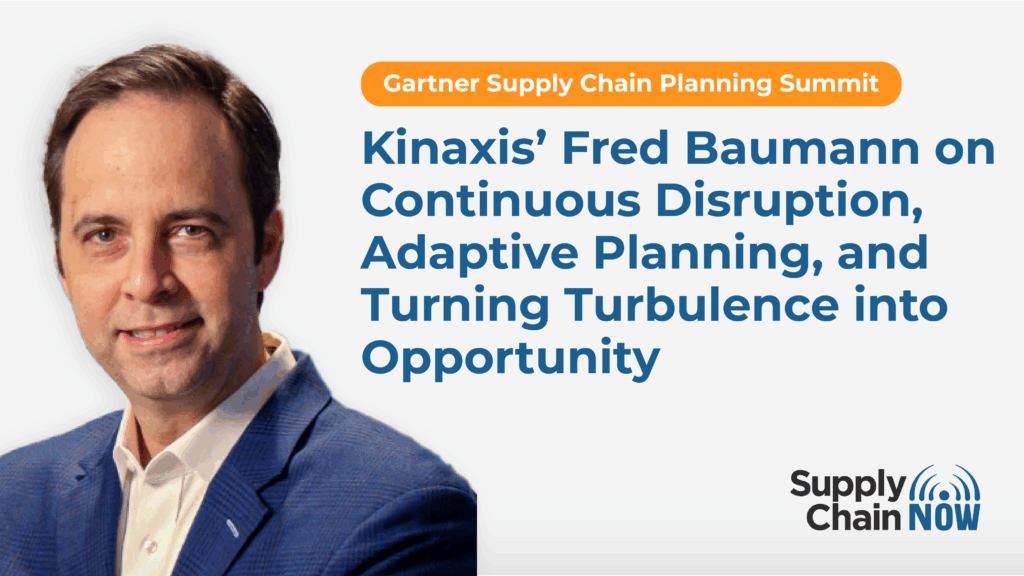
Kinaxis’ Fred Baumann on Continuous Disruption, Adaptive Planning, and Turning Turbulence into Opportunity
At the 2025 Gartner Supply Chain Planning Summit in Denver, Scott Luton sat down with Fred Baumann, Senior Industry Principal at Kinaxis, one of the world’s most recognized leaders in supply chain planning and orchestration. Kinaxis has spent over four decades shaping the planning landscape and has been named to the Gartner Leaders Quadrant an extraordinary 11 consecutive times—a testament to its execution strength and long-term vision. Baumann’s role at Kinaxis centers on helping chief supply chain officers and senior leaders shape their strategic transformation roadmaps, quantify value, and build the business cases necessary to achieve breakthrough outcomes. From Episodic Disruptions to Continuous Turbulence When asked about old and new challenges facing supply chain planning teams, Baumann observed a major shift: disruption is no longer episodic—it’s continuous. Historically, companies faced major disruptions every few years. Today, volatility and constraint-related challenges—whether driven by tariffs, sourcing changes, geopolitical shifts, or supply shortages—are unfolding weekly or even daily. This environment demands a new way of working. The speed of global business is accelerating, and uncertainty is at historic highs. As Baumann noted, organizations must now adjust their supply chains “much faster than they had to even last year.” The shift isn’t only…