

More
agentic AI
December 19, 2025
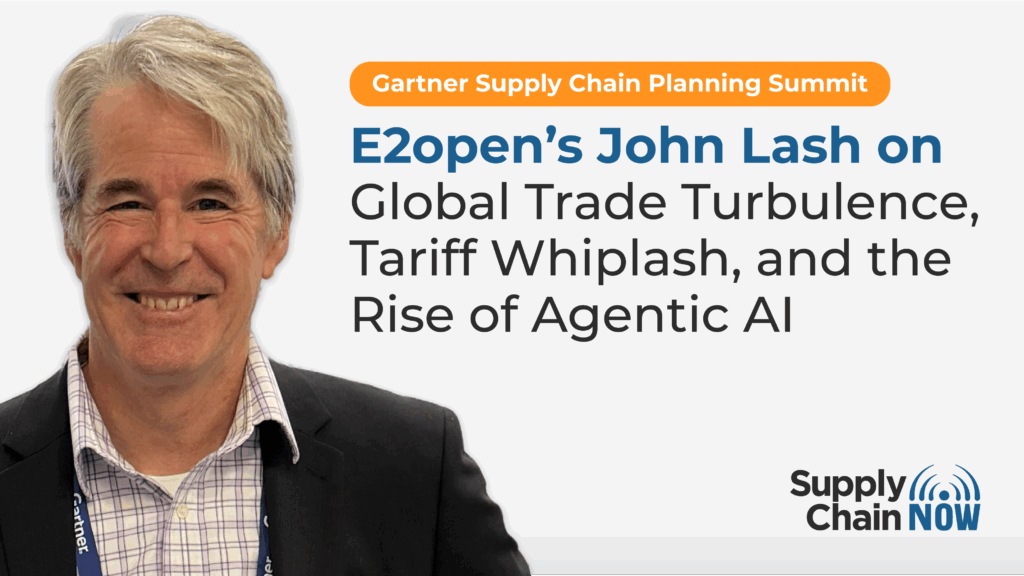
E2open’s John Lash on Global Trade Turbulence, Tariff Whiplash, and the Rise of Agentic AI
At the 2025 Gartner Supply Chain Planning Summit in Denver, Scott Luton met with John Lash, who leads strategy and vision at e2open, a WiseTech Global Group company. E2open is a global platform powering the entire lifecycle of making, moving, and selling goods, with capabilities spanning planning, logistics, global trade, supply management, and procurement. The platform is designed not just for enterprise visibility but for true end-to-end coordination across extended supply chain ecosystems. Lash emphasized that disruptions rarely originate within a company’s four walls. “Your sub-tiers are where most of the risk lives,” he explained. “That’s where your day-to-day operations—and your long-term strategy—are truly shaped.” It’s a lesson sharply reinforced during the pandemic, which reminded leaders worldwide that no one does supply chain alone. Old Challenges Intensified by New Realities When Luton asked about the biggest challenges facing planning teams today, Lash pointed immediately to constraints—supply constraints, manufacturing constraints, and now, the added layer of global trade volatility. Trade policies that once shifted every few years now change weekly, daily, or even hourly. Lash offered a striking example: Brazilian coffee duties jumped from 10% to 50% this summer—before returning to 0%. “How do you plan through that?” he asked.…
foundational industries investment
February 23, 2026
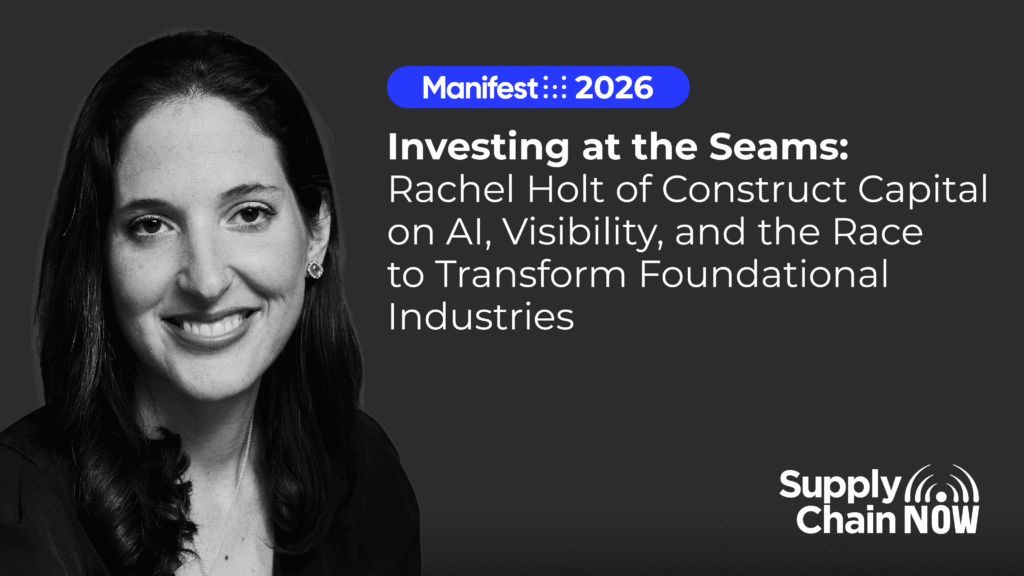
Investing at the Seams: Rachel Holt of Construct Capital on AI, Visibility, and the Race to Transform Foundational Industries
From Uber to Foundational Industries At Manifest 2026, Scott Luton sat down with Rachel Holt, Co-Founder and Managing Partner of Construct Capital, to explore how venture capital is fueling the next era of supply chain innovation. Construct Capital, now six years old, was founded in early 2020 with a bold thesis: transform foundational industries that represent nearly half of GDP: supply chain, logistics, manufacturing, mobility, infrastructure, and defense. When the fund launched, Holt recalls many skeptics asking whether supply chain and logistics were truly venture-scale opportunities. It echoed what she heard when she joined Uber in 2011, when transportation was considered slow moving and heavily regulated. Yet Uber went on to redefine personal logistics. Her final years at Uber brought a pivotal lesson. While the rides business operated with second-by-second visibility, the company’s e-bike and scooter supply chain operated in near darkness. Products shipped from China would disappear for weeks at sea, briefly reappear at ports, then stall again in customs. “We had no visibility, we had no ability to reroute,” Holt shared, as this Eureka moment would go on to help shape her investment focus. The Visibility Gap at the Seams Supply chain, Holt emphasized, is not monolithic.…