

More
supply chain analytics
August 25, 2026
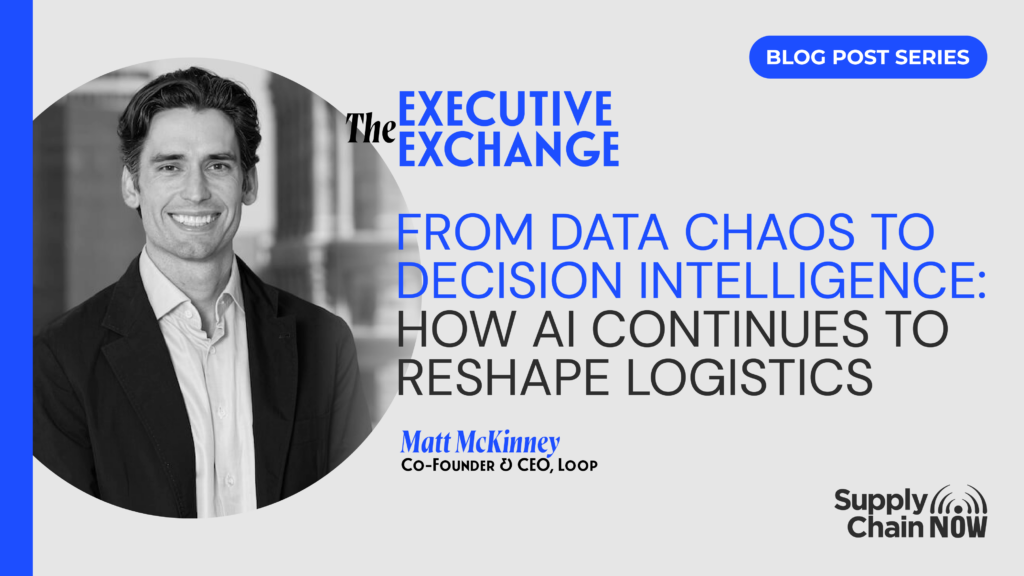
From Data Chaos To Decision Intelligence: How AI Continues To Reshape Logistics
Supply chain organizations have never lacked data. What they have often lacked is the ability to connect it, normalize it, trust it, and turn it into better decisions. That was one of the central themes in a recent conversation between Scott Luton and Matt McKinney, Co-Founder and CEO of Loop. Drawing on his experience helping build Uber Freight and now leading a logistics technology company, McKinney offered a clear-eyed view of where AI is already creating value, as well as why the data foundation still matters more than the model itself. The Real Problem Is Not Data Volume McKinney traces Loop’s origins back to a recurring problem he and his co-founder (Shaosu Liu) saw at Uber Freight: rapid growth on the revenue side paired with a back office still dependent on people manually reconciling invoices, contracts, proofs of delivery, and surcharges. The bigger realization was that this was not unique to Uber. “The thing people miss is that the value isn’t in the quantity of data, it’s in the utility of it,” McKinney explained. “Most companies have plenty of data. What they don’t have is data that connects.” That disconnect is especially painful in logistics, where data is scattered across…
planning
April 22, 2026
From Planning to Decision Making
Supply chains are more volatile and interconnected than ever, but many planning processes still rely on disconnected systems, manual analysis, and spreadsheet-based interventions. This white paper explores how network optimization, supported by advances in optimization technology, workflow design, cloud computing, and AI, can help planning teams evaluate cross-functional trade-offs, respond faster to change, and move from static plans to continuous, decision-driven supply chain planning. Inside the White Paper: – Why traditional planning systems and network optimization evolved separately, and why that separation limits decision quality in today’s supply chains. – How network optimization helps evaluate cross-functional trade-offs across sourcing, production, inventory, transportation, fulfillment, service, cost, and capacity. – Why continuous network optimization is different from one-time strategic modeling, and how it can support recurring tactical and operational planning decisions. – How AI and configurable workflows can make optimization more usable for planners without requiring them to become modeling experts. – How planning systems and network optimization can work together in a feedback loop that improves decisions over time. Click here to download