Share:

The Power of Partnership in Supply Chain Automation

Key Takeaways from the Supply Chain Now Webinar with Bastian Solutions

In today’s fast-changing world of logistics and manufacturing, one truth is clear: there’s no hiding from automation. Whether you’re a global enterprise or a growing regional player, success depends on choosing the right technology—and, just as importantly, the right partner.

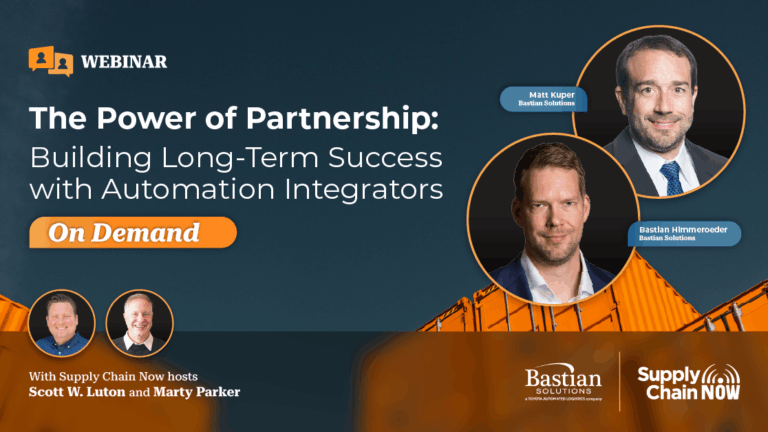
In a recent Supply Chain Now webinar, The Power of Supply Chain Partnerships, hosts Scott Luton and Marty Parker sat down with Matt Kuper and Bastian Himmeroeder from Bastian Solutions, a Toyota Automated Logistics company, for an in-depth conversation about how to unlock the true potential of automation through strong integrator relationships.

Here are a few key takeaways that stood out:

1. Strategic Partnerships Trump One-Off Projects

According to Bastian, the age of “one-and-done” automation projects is over. Today’s complexity demands long-term, strategic relationships between companies and their integrators—ones built on transparency, shared values, and a deep understanding of each other’s goals.

2. Culture Fit Matters as Much as Technology

Matt emphasized that cultural alignment is the first critical element in selecting an integrator. Shared values, open communication, and mutual respect ensure that the partnership thrives well beyond implementation.

3. Experience and Support Drive Success

Choosing a partner with the right industry experience and a commitment to aftercare and continuous improvement can make the difference between a system that simply works and one that evolves with your business. As Marty noted, “You get what you pay for—and aftercare is where that really shows.”

4. Plan for Quick Wins and Long-Term Growth

From retrofitting existing facilities to launching fully automated greenfield sites, Bastian Solutions shared how to balance measurable short-term gains with scalable long-term strategy—all without disrupting the customer experience.

5. Don’t Fear Healthy Debate

Perhaps the most refreshing insight? Great partnerships aren’t about constant agreement. True collaboration means challenging each other’s ideas to find better, smarter solutions.

Want to learn more?
Watch the full conversation for real-world examples of automation done right, including a case study with Polaris that tripled SKU capacity and boosted pick rates by over 50%.

Watch on demand: Register to view the webinar replay »
Related resource: Download Bastian’s Warehouse Operations Strategy Guide »

More Blogs
logistics
Blogs
July 10, 2025

Five Questions I Wished People Asked Me About Public Sector Supply Chains

Special Guest Blog Post written by Gary Smith, CPIM-F, CSCP-F, CLTD-F, Author of “The Bridge,” Supply Chain Engineer, and Educator   1. Do Supply Chains exist in the public sector? The short answer is “YES!” I spent the first 25 years of my career in the private sector where I worked in warehouse operations, industrial engineering, and consulting, all in the logistics andsupply chain area. I cut my teeth on retail, automotive, chemical, food and beverage, publishing, and manufacturing. During that time, I also completed projects for the public sector in education and for the Department of Defense. In 2005 I was named Director of Supply Chain Operations for the New York City Housing Authority (NYCHA). We operated a 200,000 sq. ft. warehouse that shipped repair material to 335 developments in New York’s five boroughs. In 2013, I was named Vice President of Supply Logistics for New York City Transit, the largest public transportation organization in North America. We operated over 1.5 million sq. ft. of warehouse space covering all of New York City. Several years ago, I was on a national committee for the Association for Supply Chain Management (ASCM). We created this elevator speech to describe Supply Chain…
logistics
Blogs
October 23, 2025

Taming Inbound Logistics: A Playbook for Multisupplier Sourcing

Special Guest Blog Post from Emo Trans The unpredictable economic landscape has produced unprecedented challenges within inbound logistics. Company leaders must navigate global disruptions and shifting consumer demands as they reshape their supply chains. Amidst the adversity, multisupplier sourcing has become a strategic advantage instead of a contingency plan. Follow this approach to equip business leaders with actionable insights. What Is Multisupplier Sourcing? Multisupplier sourcing involves purchasing products or services from two or more suppliers. This strategy differs from organizations using just one supplier. Diversifying the base requires establishing and managing relationships with multiple vendors. A robust network lets you be more agile as the market changes. Multisupplier sourcing has gained traction in the last five years. A 2022 McKinsey survey said 81% of companies implemented dual-sourcing strategies — an increase of 26 percentage points since 2020. Sixty-nine percent of respondents said this approach will continue to be relevant through the decade. The survey noted changes in inventory, sourcing and regionalization to boost resilience. Why Businesses Use Multisupplier Sourcing Increasingly complex supply chains have made businesses reevaluate traditional sourcing models. Multisupplier sourcing has emerged as a popular strategy to improve operational efficiency and resilience. Here are three key benefits that…