[00:00:00] Heather Shilt: It’s an interesting contradiction when you see that freight volumes are down significantly, but then you have that clear signal of weaker demand, but our spending is up as as shippers, so that tells me we’re not really hauling less. But what we’re. Falling is actually costing more
[00:00:20] Voiceover: Welcome to Supply Chain Now, the number one voice of supply chain.
[00:00:24] Voiceover: Join us as we share critical news, key insights, and real supply chain leadership from across the globe, one conversation at a time.
[00:00:32] Scott W. Luton: Hey, good morning, good afternoon, good evening, wherever you may be. Scott Luton and Kim Reuter with you here on Supply Chain Now. Well, hey Kim, how you doing today?
[00:00:41] Kimberly Reuter: I’m doing great.
[00:00:42] Kimberly Reuter: Thanks for having me back.
[00:00:43] Scott W. Luton: Oh, terrific. Hey, I couldn’t miss it. Uh, you, you’re a big get and I’ll tell ya, you come yesterday, you spent 12 hours out in the Oyster Farms in beautiful Virginia weather. Man, I can’t see how we would better that day yesterday, huh? It,
[00:00:58] Kimberly Reuter: it was exhausting. It was a great day, but, uh, it was a 12 hour photo shoot and, uh, it was, it’s probably the longest I’ve done, but it was great.
[00:01:07] Kimberly Reuter: We got a lot of great footage, beautiful weather. Could not have been easier.
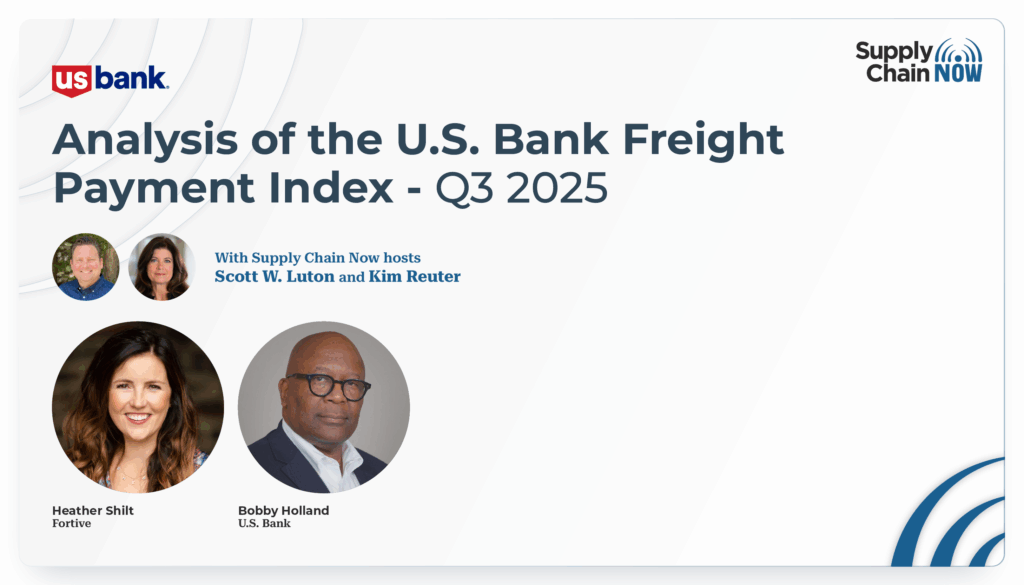
[00:01:10] Scott W. Luton: Outstanding seafood supply chain. More to come, but folks, today we continue a long running quarterly series, a popular informative series that we get a ton of feedback around. We’re gonna be sharing key insights from the latest quarterly edition of one of the leading transportation industry resources is the U.S. Bank Freight Payment Index.
[00:01:29] Scott W. Luton: This time for Q3 2025, this is one of my favorite ongoing shows because it, mm-hmm. Is incredible. It’s incredibly informative. Number one, it provides in the know market analysis that you can’t find a lot of places. And not only do we share what’s going on from a data standpoint, but we marry that with boots on the ground in market, executive practitioner.
[00:01:49] Scott W. Luton: Perspective from Kim and our guests Get Ready folks. And we’re not only gonna get a good sense of what transpired in third quarter, 2025, but we’re gonna be sharing a few nuggets that’s gonna help you prep for where we are now, where we’re heading. And I’ll tell you, Kim, as you know, a lot of business leaders and supply chain practitioners lean on resources like the Freight Paint Index to identify trends.
[00:02:11] Scott W. Luton: Plan, project, create productive conversations and much, much more. Mm-hmm. Great show coming up. One last nugget. You wanna know why it’s such a great resource? Well, because U.S. Bank processed $43 billion worth of transactions in 2024 alone, and that’s what provides the data. The data, which is central to today’s show and the freight payment index and all those data-driven insights.
[00:02:36] Scott W. Luton: Exceptional commentary, well. That’s what we’re providing here today. Kim. Lots of golden nuggets here today. Huh?
[00:02:43] Kimberly Reuter: Always a good one. This is one of my favorite shows. I’ve gotten the privilege to do it a few times before and I love that it is so data-driven. That’s my, as you guys know, the queen of data. So, uh, that’s my favorite part about it, is we get to actually look at some real data.
[00:02:57] Scott W. Luton: I’m with you. I’m with you and folks. Um, interesting to note. The U.S. Bank Freight Payment Index is released each quarter and it’s free to sign up. Uh, alright, so Kim. I want to introduce our wonderful guest here today. I know you’re ready ’cause you’re always ready, so I’m gonna dive right in. Let’s welcome in.
[00:03:13] Scott W. Luton: Bobby Holland, Director of Freight Business Analytics at U.S. Bank and backed by proper demand. Heather Shilt, Director, Global Logistics with Fortive. Hey. Hey, Bobby. Great to have you again. How are you doing? Doing well. Great to be back. As always, you’re bringing incredible business leaders and a repeat guest with you, Heather, welcome, welcome.
[00:03:33] Scott W. Luton: I tell you, you hit it outta the park last time you were with us. It’s so great to have you back on the show here today.
[00:03:38] Heather Shilt: Thank you. Thank you.
[00:03:40] Scott W. Luton: Um, okay, so I wanna do this. As Kim knows, we like starting with fun, warm questions and Bobby certainly knows by now. Heather, we’ll start with you. You have had some incredible business travel this year.
[00:03:52] Scott W. Luton: You’ve gone to at least France and Germany. I’m so jealous. Tell us if you would, about just one of your many highlights of that, those great trips.
[00:04:02] Heather Shilt: Yeah, so I had the opportunity to go to both countries. I also went to Sweden, which I forgot about, and Mexico. So, but all for work. I always feel so blessed to be able to travel for our company.
[00:04:16] Heather Shilt: But the highlight really was, uh, first time to all of those locations, all of those sites, and was able to engage with our team there, build relationships, and we did logistics workshops and all of those locations to identify. Cost savings, opportunities, challenges, and walked away like reenergized with a plan, with a plan, and a path forward.
[00:04:40] Scott W. Luton: Oh, I love it. I love it. I can’t wait to learn more. You and I are gonna have to grab a sandwich so I can dive into all those conversations. Now Bobby just got back from Rome. Oh my gosh. Bobby, what was one of your many favorite memories from a great trip to Italy?
[00:04:57] Bobby Holland: Uh, probably going to Florence and having the.
[00:05:01] Bobby Holland: World renowned steak Florentine. Really?
[00:05:06] Scott W. Luton: Yeah. Okay, man. Uh, was it, uh, was it better than what you thought it would be? It
[00:05:14] Bobby Holland: was definitely better than what I thought it would be. I’ve been through Rome in the airports a few times, uh, but I wasn’t really that impressed. But we had family that just got back, uh, and had a blast, so we decided to make that our home base.
[00:05:28] Bobby Holland: And then we took a side trip to Florence. And also to bologna. So it was cool to get to see, you know, three areas of Italy that I hadn’t seen yet. Primarily, we usually go to Sicily. In Tuscany when we go, Hey,
[00:05:41] Scott W. Luton: you see Kim, we start asking Bobby more questions. We learn more about these incredible adventures.
[00:05:46] Scott W. Luton: He’s been, oh man, I’m jealous. Alright, so Kim, my question to you is a tough one. As we heard Tether and Bobby’s world travels, which we learned so much from these wonderful world travels, so Italy, France, or Germany. If we offered you Kim Reuter, a fully paid week long trip leaving today, where are you going?
[00:06:05] Kimberly Reuter: I’m gonna go to Italy. I’m not gonna lie about it. I love art. I, I’ve been to Italy before. It’s a beautiful country, has so much diversity. The food is amazing. The wine is amazing. It would be Italy, hands down.
[00:06:17] Scott W. Luton: Okay. I, Hey, I can’t argue with that at all and uh, it sounds great. Let’s leave. We’re leaving at 4 0 5.
[00:06:23] Scott W. Luton: Okay. Exactly.
[00:06:25] Kimberly Reuter: Okay, great.
[00:06:26] Scott W. Luton: Alright, we got a lot to get to here today, Heather, Bobby and Kim a lot to dive into. Um, and I wanna start with this Bobby Truckload. Insights and takeaways coming on time in full. But if you had, that’s, you know, I love my dad. Supply chain jokes adjust, but, um, if you had to pack it all into like a one sentence theme here today, what would it be?
[00:06:48] Scott W. Luton: Bobby?
[00:06:50] Bobby Holland: Well, basically we see freight volumes are down, even though costs are rising. Uh, basically it looks like the transportation market continues to tighten in the third quarter.
[00:07:00] Scott W. Luton: Okay. All right. Uh, and we’re gonna dive a lot more beyond just the one sentence headline, so get ready. But that was a good theme for what we capture.
[00:07:07] Scott W. Luton: And again, before we get into nine Yeah, that’s right. Count ’em nine critical takeaways from the U.S. Bank Freight Payment Index for Q3 2025. Double down on some context. So Heather, as I mentioned, it is wonderful to have you back with us here today, but let’s make sure folks know a little bit about you, our new audience members know about you and what the Fortive team does in a nutshell.
[00:07:31] Heather Shilt: Hi everyone. Pleasure to be back with the team here. So I’m Heather Shilt. I lead logistics globally for Fortive, I am entering my 20th year wow. In logistics. Uh, have the college reunion on deck this weekend. But, uh, 13 of those years have been with Fortive. And in addition to my day job with Fortive leading logistics, I also sit on a number of councils and advisory boards where I like connecting with other shippers and try to share and LinkedIn.
[00:07:59] Heather Shilt: So we were founded in 2016 off the heels and the legacy of Dana. We are all about, as you can see here, safety technology. We like to say that we innovate essential technologies to keep our world safe and productive. We have intelligent operating solutions and advanced healthcare solutions where we want to make an impact on fields like workplace safety.
[00:08:25] Heather Shilt: Environments in healthcare.
[00:08:27] Scott W. Luton: Mm. Heather, that is outstanding. And I love the missional aspect of all that, the purposeful aspect of your mission, I should say. And, uh, we need more companies like Fortive and more incredible leaders like Heather. So thanks again. For being here. Um, okay, so Kim, let’s do this. We’re about to dive in.
[00:08:46] Scott W. Luton: Bob’s about to tell us for our new audience members how the U.S. Bank Freight Payment Index works and all. But let’s get your perspective. How do industry leaders like yourself utilize resources like the Freight payment index? Tell us more, Kim.
[00:09:00] Kimberly Reuter: So, as I’ve said, this is one of my favorite calls because of all the data that’s provided.
[00:09:04] Kimberly Reuter: Um, as we know, the index isn’t necessarily predictive, but it gives us really good, uh, quarterly data. Um. I don’t wanna say near time, but pretty close to the end of quarter. So it’s actionable, I think is what I’m getting at here, is that it’s not stale data. It’s not six months old. We’re getting it on a regular basis.
[00:09:23] Kimberly Reuter: So I love the data and how I use it, and I encourage my clients to use it is use it for trending. What’s going on? What may we expect in the next quarter? Do we have certain regions that may be struggling and perhaps we can take advantage of a software market somewhere. Those are how, that’s how I use these tools.
[00:09:39] Scott W. Luton: I love it. And you know, we, we can learn. Some powerful lessons by better understanding the past, particularly in business and supply chain management. So good stuff there, Kim. Mm-hmm. Um, okay, Bobby, I’m gonna bring you back in here, and especially for our new audience members. You know, we’ve been working together probably five or six years unpacking all of this supply chain goodness.
[00:10:00] Scott W. Luton: But for our new audience members, would you share briefly what the U.S. Bank Freight Payment Index is? What it analyzes, and of course, how it works.
[00:10:08] Bobby Holland: Uh, freight payment Index is U.S. Bank’s view of the truck freight marketplace. Uh, as you pointed out earlier, $43 billion annually in transactions. Uh, payments, transactions generates a lot of data, so it enables us to, uh, provide, uh, what we consider to be a different view of the marketplace.
[00:10:28] Bobby Holland: It’s a chain based quarterly measurement of changes in the market on both shipments and spend. It’s another set of data points for the user community, the truck freight market to use in making business decisions. And I appreciate the way that Kim put it when she mentioned the fact that we have the national overview, but we also have the regional perspective because when we state what is happening nationally, those effects can trickle down and affect each region differently.
[00:10:56] Bobby Holland: So that’s what we provide to the, to the customers.
[00:10:59] Scott W. Luton: Outstanding. And of course, also in a new addition here in recent months. Incredible freight rate data powered by our friends at DAT makes. Uh, it makes it even better. That is outstanding. Uh, Bobby. Okay, so now we are going to dive deeper into nine. Yes.
[00:11:18] Scott W. Luton: Count them nine key takeaways from the Q3 2025 U.S. Bank Freight Payment Index, and we’re gonna start nationally, right? We’ve got four key takeaways from the national market and Bobby, give us those four key takeaways.
[00:11:33] Bobby Holland: Okay, so nationally the US freight market declined, as we stated, largely due to tariffs in manufacturing contraction.
[00:11:41] Bobby Holland: And this is what, uh, led to the reduced volumes as well as being affected by housing starts and consumer spending slowing. And this basically, like I said, resulted from our viewpoint in Titan capacity, which drove up shipping costs. The second one is that freight volumes and spending trends in quarter three reflected ongoing industry pressures.
[00:12:02] Bobby Holland: More recent policy changes. Again, tariffs are top of mind. A lot of other things that affect, uh, truckers with national declines being offset by regional strength in the northeast and the west regions. The third one is that shipments have declined more than 40% since 2020. Apart from a brief uptick in Q2 of this year, shipment volumes have dropped each quarter for the last three years.
[00:12:24] Bobby Holland: And then the, finally the fourth one there was modest increases in spot in contract rates as well as. Fuel costs in the third quarter. And these are also elements that contribute to higher costs that we saw in the third quarter.
[00:12:37] Scott W. Luton: Okay. Outstanding. And I love, love Bobby’s approach. Him and the team. They give you the nine key takeaways.
[00:12:43] Scott W. Luton: If you forget everything else, you gotta have that front and center on your radar. I wanna add one more. This is not part of the nine, but this is certainly, uh, a big thing that was at play in third quarter and really for years. So check this out. This was reported by the World Economic Forum, the global.
[00:12:59] Scott W. Luton: Economic Policy uncertainty index. Yes, there is one. As we try to quantify this historic record, levels of uncertainty here in the US and across the globe, not just in third quarter, but really for years now. And all of that, of course was a major factor in the freight market and everything else. And look at that spike.
[00:13:16] Scott W. Luton: In August. Oh my goodness. Um, okay, so let’s do this Heather, when you heard some of Bobby’s key takeaways nationally speaking and you think about what you’re seeing as a global leader in supply chain logistics, your thoughts?
[00:13:32] Heather Shilt: Yeah, so I try to look at it from a shipper’s lens ’cause I’m in it every day and I think it’s an interesting contradiction when you see that rate volumes are down significantly.
[00:13:43] Heather Shilt: But then you have that clear signal of weaker demand. But our spending is up as as shippers. So that tells me we’re not really hauling less, but what we’re hauling is actually costing more. And I think what Bobby touched on with, you know, things that are going on in the market with capacity driver, equipment availability, all the trade and tariff pressures, like this is something that.
[00:14:10] Heather Shilt: I’m dealing with and other shippers are dealing with on a daily basis. And I was thinking that what could shippers do in a market, like, you know, what we’re seeing right now in Q3 and uh, I kind of put together kind of a few, a few things, but, you know, review carrier contracts. And that regional perspective, which we’ll get into later, you know, to understand how things may be shifting, making sure that you have a good carrier, mix with depth, so you’ve gotta mix of smaller carriers, alternate modes, intermodal trucking, like, and just really understanding like your cost per lane.
[00:14:46] Heather Shilt: And then continuing to monitor everything that’s going on with trade and tariffs, those outside factors. That are influencing what’s taking place.
[00:14:56] Scott W. Luton: Heather. I love it. You come with solutions. You come with solutions. I love it. Uh, Kim, she also touched on pressures. Bobby touched on pressures. Where is David Bowie and Freddie Mercury right now because they seeing the supply chain theme.
[00:15:11] Scott W. Luton: What do you think? What are your observations nationally?
[00:15:14] Kimberly Reuter: So what I see is a lot of confusion and we kind of see a little bit in the data, right? Prices are going up, but actual loads are softening. So we see a lot of this sort of weird behavior though obviously Northeast and the West, those are shipping lanes.
[00:15:27] Kimberly Reuter: That’s why they continue to stay strong. I’m very worried about the Southwest, ’cause that’s a lot of like construction and manufacturing, and we’re supposed to be able to make that better. So, um, you know, that’s what I’m seeing or those are my concerns, I would say as far as shippers and trucking companies, they’re just, they’re, everybody’s just trying to figure it out.
[00:15:45] Kimberly Reuter: It’s a day-to-day basis right now.
[00:15:46] Scott W. Luton: Yep. We’re all day to day, as I think ESPN SportsCenter said at some point in time. It’s not just athletes. Supply chain. Pros are all day to day businesses.
[00:15:57] Kimberly Reuter: Day to day.
[00:15:57] Scott W. Luton: Well, so Kim, Kim, your perfect segue. You mentioned one of the regions, and this is really my favorite part of this quarterly discussion and, and the analysis you’ll find in the U.S. Bank Freight Payment Index.
[00:16:08] Scott W. Luton: We’re going region by region, coast to coast to to identify some of those regional nuances in particulars impacting the freight market in the broader industry. And up first, we are going out. To the west. So Bobby, let’s talk about, um, your key takeaway or two from the West region.
[00:16:28] Bobby Holland: Okay. So as we talked about before, you know, the regional perspective helps to kind of put the national view in perspective.
[00:16:36] Bobby Holland: So when you look at the national shipments, were down 2.9% over the quarter and spend was up 2% over that same period. But when we look at the west region. Uh, the numbers are both up. Uh, shipments were up 4.4% and spend was up 9% over the last quarter. And we see that the West region experienced significant growth in both shipments and spend, um, during the third quarter.
[00:17:02] Bobby Holland: And this is generally driven by increased imports, strong housing starts, and then it’s the largest sequential gain. In four years.
[00:17:11] Scott W. Luton: Hmm. Largest sequential gain in four years. And Bobby mentioned lots of things that played there in the west region. Heather, I am dying to get your take. What do you see out in the West?
[00:17:25] Heather Shilt: And I think, yeah, the West is a, a key player and Kent mentioned it too, just based on the, the location of the port and the importance of the port. Um. I think, you know, we’re starting to see those moderate improvements as the port volumes and then also as shipper shippers assess like their inventory levels.
[00:17:42] Heather Shilt: You know, we did a lot of stocking ahead, like for tariffs and then, you know, where, where are we out at now with those replenishment levels and has that started to stabilize? I think that shippers using the West Coast gateways might find that capacity is improving, as we said, but just continue to watch.
[00:18:02] Heather Shilt: For those, that volatility, like if we see any shifts in imports there.
[00:18:08] Scott W. Luton: Yep. Heather, again, I love your approach. You’re come with observations and things that, things that, uh, folks have have on their radar. Kim, you, you always do the same. Uh, I think you and Heather might be second cousins, who knows? What do you see out out the west?
[00:18:23] Kimberly Reuter: Well, I don’t know. Our cousins, we’re both from East coast. Uh, it’s possible, but we are definitely supply chain sisters. That’s right. We can definitely say that. Um, so, you know, we talk about the west and I think the thing that I heard in there was about housing starts and that is definitely contributing, but we have to recognize that that came out of some pretty bad stuff.
[00:18:44] Kimberly Reuter: The housing building going on on the west coast is a result of all the fires. And while it’s driving the freight industry, it is sad on how it happened.
[00:18:53] Scott W. Luton: Yeah, no doubt. Um, alright, so, and we all of course hope that continued recovery takes place for all the families out there, all the families in Jamaica and all of the points.
[00:19:03] Scott W. Luton: Uh,
[00:19:04] Kimberly Reuter: yeah, that’s,
[00:19:05] Scott W. Luton: man, uh, it’s been, it’s been something weather wise. Okay. So I wanna touch on something. You know, manufacturing is at play across. Coast to coast and, and all the different regions as well. And I’ve got these great nuggets that I mine from the National Association of Manufacturers.
[00:19:25] Scott W. Luton: So, um, they put out regular surveys, kind of pulse checks of manufacturing leaders and check this out. Uh. For third quarter 2025. They pulsed a lot of manufacturing leaders here in the US and let’s see, hiring sluggish orders of solved productionists, seen some upticks margins have been challenged, all that, generally speaking.
[00:19:44] Scott W. Luton: But look at this, the NAM had two key findings from their polling. Number one, the leaders’ business outlook for the months ahead. What rose from two, uh, from second quarter last year? I’ll take any good news wherever I can find it. And it was a pretty significant jump there. Uh, almost 10 full points. And then the second thing that’s probably not gonna surprise anybody, the top business challenge in the manufacturing sector, which certainly we see play out in the domestic, uh, freight market trade uncertainties.
[00:20:15] Scott W. Luton: Raise your hand if you have trade uncertainties. Folks. Check out all the full report on the survey over at nam.org. Okay. We are going from the west to the southwest, right? The southwest region, uh, which makes up four states. Really important. I think Kim’s already mentioned, uh, the Southwest. Alright, so Bob, let’s start with you though, key takeaway or two related to the Southwest region.
[00:20:41] Bobby Holland: So the Southwest region saw the sharpest region of drop in freight volume. Chippers space, increased cost due to tighten capacity driven by policy changes and economic weakness, which impacted trade, labor and construction. We see this reflected in the numbers where shipments were down for the last quarter, 15.7%.
[00:20:59] Bobby Holland: Spend was up, uh, a very modest, uh, third of a percent. So interesting numbers for that, that read those.
[00:21:05] Scott W. Luton: Undoubtedly, all these numbers are always interesting, uh, especially to process ’em and to kind of, uh, marry them with, uh, boots on the ground, leadership perspectives. And Heather, uh, your thoughts and what you’re seeing in the Southwest.
[00:21:20] Heather Shilt: Yeah, so like Bobby said, with the Southwest being one of the softest regions with the volumes declining. I, I think about the trade lanes there with border trade, and if you’re a shipper operating in that area, you’ll wanna keep an eye out for, you know, different routing options and capacity availability.
[00:21:40] Heather Shilt: You know, I think like why the regional view on something like this is important is because if you are operating in or sourcing from one of these weaker regions, then you may face like steeper risk or service, um,
[00:21:55] Scott W. Luton: issues. Yep. We gotta challenge all assumptions. We gotta challenge all assumptions. This is one of the kind of main themes you’re urging us here today.
[00:22:05] Scott W. Luton: Carrier mix lanes, you name it. Alright, Kim Southwest, what are you seeing?
[00:22:09] Kimberly Reuter: I obviously a lot of softness, which is very concerning. I’m a little bit perplexed about what’s causing it, to be honest with you. Um, manufacturing, a lot of that is happening in the southwest, so that’s what I’m thinking is causing the softness, but it’s troubling.
[00:22:24] Kimberly Reuter: For sure
[00:22:25] Scott W. Luton: it is Kim. It is. Well, you know, I’m gonna touch on one thing that certainly is always a factor. And that’s construction activity, right? Mm-hmm. You’re gonna hear us reference housing starts, uh, quite regularly throughout the conversation. Always a factor in the domestic freight market. Well, think about it.
[00:22:40] Scott W. Luton: New housing requires all sorts of materials that’s gotta be made and shipped to the site, and high volumes, especially for those multifamily developments, right? Lumber, steel, cement, drywall, windows, HVAC systems, you name it. Well check this out. According to the latest published US Census Bureau information for August, 2025, US housing starts across the country.
[00:23:01] Scott W. Luton: Were down in August from July, activity month over month. About 8.5% and they were down year over year from August, 2024. Uh, about 6%. Now if you look at further upstream though housing permits, right, which of course has to happen. So they tell me, uh, before housing starts happen, permits were down 3.7% in July.
[00:23:24] Scott W. Luton: Um, and they were down 11% year over year in August 20, 20, 25 from August, 2024. So we’ll probably see. Based on that permit data, uh, fourth quarter housing start numbers, it’ll play in, factor into that. And of course freight activity. Now, one last note. A lot of this data is delayed because we gotta get the, um, the government back up and running.
[00:23:47] Scott W. Luton: ’cause if you go looking for data. Those folks are out right now, which is painful all the way around. Um, okay, so let’s do this. Let’s talk about the Midwest, right? The Midwest region, which is the heart of the country, I would reckon. Bobby, tell us what you saw key takeaway wise from the Midwest.
[00:24:09] Bobby Holland: Well, because of reduced consumer demand, fewer Canadian border crossings, and again, the overall manufacturing weakness that we’ve discussed.
[00:24:18] Bobby Holland: We saw numbers in the Midwest, you know, shipments were down 2.2% over last quarter and spend was down 1.4% over last quarter. So modest numbers, but still, you know, not the direction that we’d like to see them go.
[00:24:32] Scott W. Luton: That’s right. That is right. Alright, so Heather, when we think of the Midwest beautiful places to visit up there, what do you see in domestic freight market wise?
[00:24:44] Heather Shilt: I think, you know, as Bobby said, the. Midwest remains under pressure. We’ve got that manufacturing softness, we’ve got muted freight demand that are keeping volumes down. The upside for shippers is maybe the rates might become more favorable, but you’ve gotta watch for service consistency, which could be a challenge if, say, carriers realize there’s performance issues in this, this region, and then they choose to reposition their assets elsewhere.
[00:25:12] Heather Shilt: Yep. So that will just be a watch point there. Okay.
[00:25:15] Scott W. Luton: Uh, I’ve got a, I’m up to about 12 watch points from you so far, Heather, uh, full truckload, uh, Kim, when it comes to the Midwest, what are you seeing?
[00:25:25] Kimberly Reuter: So, the Canadian imports are probably one of the biggest impact that we have here, but we also have to remember, we have a lot of manufacturing in the Midwest.
[00:25:32] Kimberly Reuter: All of our car manufacturers, we’ve seen a softening in that manufacturing because of the tariffs. I would say that the Midwest is probably getting hit the hardest with the tariffs. Yep.
[00:25:42] Scott W. Luton: Yep. Alright. And one other thing that Bobby touched on, uh, I think in each of these regions, consumer spending, which is something we always keep our finger on the pulse of, it’s one of those watch points that Heather mentioned earlier.
[00:25:53] Scott W. Luton: So get this according to a. Third quarter, 2025. Survey of US online adults by Forrester Research. Uh, it shows that 40% expect to spend less on large household appliances in the months ahead, and 39% are gonna be spending less on furniture and home furnishing, uh, furnishings. So we’ll see how those consumer trends will impact the freight market in the months ahead.
[00:26:18] Scott W. Luton: Um, okay. So from the Midwest to the northeast, a region that never sleeps. Maybe, uh, Bobby, your key takeaways from the northeast?
[00:26:28] Bobby Holland: Well, the Northeast, it saw increased freight shipments and spending in the third quarter. And this is largely driven by some manufacturing growth, but higher consumer spending.
[00:26:37] Bobby Holland: And so this was reflected in the numbers. We had a modest improvement in shipments of 0.6% and spend was up 5%. So again, interesting numbers, but. Northeast is always, uh, an interesting one to watch because it’s the smallest region, but because of the population density, it, it reads like a, like a larger, like a larger area of the country.
[00:26:58] Bobby Holland: So
[00:26:58] Scott W. Luton: yes, one little tick of that needle based on that population can really, uh, be felt northeast. Heather, what are you seeing?
[00:27:09] Heather Shilt: So with those shipments and spending both. Holding up better than other regions. This tells me that maybe this part of the country, as Bobby said, is seeing stronger freight activity by those consumer demand increases.
[00:27:25] Heather Shilt: And also just with the ports being there. I think for shippers, you know, this means that capacity could tighten there. So this is something we would wanna watch for and really stay ahead on planning our loads and also making sure that we’ve got contracts in place with the carriers.
[00:27:42] Scott W. Luton: That’s right. Uh, and we revisit those contracts and we lean into technology, some incredible things that technology is doing with load planning and overall, uh, transportation management.
[00:27:52] Scott W. Luton: Kim, the northeast. Your thoughts
[00:27:56] Kimberly Reuter: first? I’m not. Sure if West Virginia is gonna consider itself northeast, but we can decide that, talk about that later. Um, but you know, I kind of, Heather, uh, echo what Heather said is that the ports are really kinda keeping the freight demand going on there. And high population, as Bobby has said, nothing, you know, this is pretty typical for the Northeast where they mimic what’s going on in the west.
[00:28:17] Scott W. Luton: Yep. That is right. Uh, and you know what? We’ll, y’all weigh in, is it West Virginia? What? Bobby. Bobby, uh, we’ll see. But I wanna touch on one more thing I hit last time on consumer spending. It’s. Close neighbor retail sales. So y’all check this out. So data released by the C-N-B-C-N-R-F retail monitor shows that nationally retail sales dropped a bit in September.
[00:28:40] Scott W. Luton: A lot of data shows that back to school spending was either flat or even decreased this year. However, as you can see here, overall year over year retail spending has remained solid throughout uh, three Q 2025 and looking ahead. Some analysts say retail spending may well weaken through the rest of 2025, and that malaise may linger moving into 2026.
[00:29:03] Scott W. Luton: Amongst many things, some of the spending headwinds include inflation and price pressures. I think that’s one of the big themes this, uh, here today and slower, uh, slower job and income growth. Okay. We are going to bring it home, at least for some of us. I hail in the metro Atlanta area. So let’s talk about the southeast region.
[00:29:25] Scott W. Luton: My favorite, Bobby, your key takeaways of what you’re seeing there.
[00:29:29] Bobby Holland: Well, in the Southeast shipments were down 2.1% spend was up 1.6%. The things that we’re impacting in the southeast region are a soft labor market, reduced household spending, weaker manufacturing, and something that’s been of note for the longest is decreased tourism.
[00:29:45] Bobby Holland: Yep. Another impact, pipeline impact of, uh, the tariffs. Perhaps it has
[00:29:50] Scott W. Luton: Bobby. That’s right. I was looking at, uh, Metro Atlanta tourist data and, um, international tourism in particular is down despite being home of the world’s busiest airport. And of course, I was in Vegas earlier this quarter. And of course Vegas has been hit, uh, as well.
[00:30:04] Scott W. Luton: Ho Hotel occupancies are really down. Heather, when it comes to the southeast region, what are you seeing?
[00:30:11] Heather Shilt: Southeast still sluggish. We saw in the report minimum volume games, but in those year over year numbers remain weak. So I would say if you’re shipping out of this region, there’s could be some opportunity for cost savings, but.
[00:30:27] Heather Shilt: Obviously as a shipper, you have to balance that with making sure you’ve got reliable and strong carrier partnerships.
[00:30:34] Scott W. Luton: That is right. Relationships matter. Always have, always will. Especially for folks that invest in them rather than treat them very transactionally. Good stuff. Heather. Kim in the southeast, which I’m looking hard on the map.
[00:30:47] Scott W. Luton: And you know what, uh, well, Virginia is northeast. Hey, what do you see in the southeast?
[00:30:54] Kimberly Reuter: So I live in Virginia, so, uh, close in the Southeast. Uh, we’re all southeastern today. Um, and so again, we’re seeing a decline in softening the market. You know, we are greatly apol. We. The Southeast has a lot of impact with, um, politics.
[00:31:10] Kimberly Reuter: So, um, all the uncertainty around layoffs and the firings and all of this stuff has been happening with our government employees. The Southeast has a very large percentage of government employees, so I think that is contributing to what we’re seeing here.
[00:31:26] Scott W. Luton: Yep. Good stuff. Uh, Kim. Well, well, uh, great analysis.
[00:31:31] Scott W. Luton: Yeah, all good stuff. Good stuff. Um, okay. And I wanna double down on, you know, Bobby touched on the labor market’s come up a lot of times in, in really all the regions. Bobby referenced it in the Southeast, and I want to bring in. This data here, uh, this is the conference board Employment Trends Index. It’s a terrific regular measurement of payroll employment in the us So get this.
[00:31:53] Scott W. Luton: I am not an economist. I’m a quote one, okay. The economy was not my forte in college, but Mitchell Barnes is an economist at the conference board, and he spoke on the August 20, uh, 2025 index saying, quote, the ETI, which is this index slid further in August, reaching its lowest level since early 2021. The ETI peaked two or three years ago and has been falling ever since, where the decline likely, likely captured normalization of the distorted post pandemic labor market, not necessarily weakness.
[00:32:24] Scott W. Luton: However, the degree of weakness among August’s. Components is disconcerting and Mid Mitchell continued. Layoffs and unemployment remain low as companies navigate through con uh, continued uncertainty. But tariff pressures are expected to intensify raising inflation and reducing consumption, which could restrain activity and dampen future hiring.
[00:32:46] Scott W. Luton: End quote. So. The labor market. I’ll tell you, it’s interesting to dive in and slice it up and from a variety of perspectives. Um, alright, so we’ve tackled now nine key takeaways thanks to Bobby Holland and the team over at U.S. Bank and of course the freight payment index. Uh, and we’re also going through five regions and gotten Bobby, Heathers and, and Kim’s perspectives there.
[00:33:07] Scott W. Luton: Heather, here’s an interesting question for you. So we have created a new position, a new universal position of authority. If you were the world president of Global Supply chain for a day, what would you like to see? And feel free to offer any prognostications, either one. Your thoughts, Heather?
[00:33:25] Heather Shilt: I think this is a great idea for a new world pool.
[00:33:29] Heather Shilt: Uh, not, not for me personally, for someone else. This is a big, stressful job, but I try to break it down. I put thought into this question on. More balance, like we were talking about, less uncertainty. And so for that piece, just we’ve got a lot of disruption going on in geopolitical stability and trade routes, the tariff environments shaking things up.
[00:33:54] Heather Shilt: So companies like myself and other shippers are really having to rethink our sourcing, shifting our trade lanes, buying creative ways to mitigate our cost. And so. It’d be good if we could get back to more stability and you know, keeping trade policy in place but having more stable environment. I also thought like big picture, I mean I think that consumers and business leaders now appreciate the value of supply chain more than ever.
[00:34:23] Heather Shilt: You know, all the past few years what we’ve gone through has really shunk that and you know, the supply chain is really what keeps. Economy running and communities running for that matter. And then big picture also, I was thinking, you know, supply chain is such an important field and just wanna see like continuing inspiring the next generation to help like young people like see, we talked earlier about how data driven this field is and like the tech piece and where we’re all we’re going with AI and analytics and.
[00:35:00] Heather Shilt: Just, you know how like it’s just an exciting time to be part of this industry and to just. Keep that piece of it going.
[00:35:09] Scott W. Luton: Very, very well said. And just, just to clarify, so if we extend the offer to you to become world president global supply chain, you it down right?
[00:35:21] Heather Shilt: I, I, I had some recommendations for others.
[00:35:25] Heather Shilt: I have work gauge like
[00:35:27] Scott W. Luton: that role that would ever pay enough. That role would never pay enough. Yeah, sure. No matter what it is at a zero or two, um, Kim? Yeah. Kind of a different question for you and feel free to all weigh in as a as world president of global supply chain for a day. But what do you see may be taking place in the freight market in the months ahead?
[00:35:44] Scott W. Luton: I
[00:35:44] Kimberly Reuter: talk about a lot about ocean freight too, and they’re tightly linked, as we know, as we saw West Coast and Northeast. I think we’re gonna continue to see a softening in the market, unfortunately, and I think we’re gonna start to see it in the northeast and the West, where, where it’s been somewhat insulated.
[00:35:57] Kimberly Reuter: You know, as Heather touched on, most retailers have stocked their shelves by, or their warehouses by now. A lot of people pre-bought and panic bought. While the tariffs were, you know, going around and round and around on a daily basis. And so I don’t see us seeing a, a big uptake in Q4 in any freight, and I think it’s gonna continue to soften and I think into Q1, it’s gonna continue to soften.
[00:36:22] Scott W. Luton: Kim, uh, I tend to agree with you and Heather, if I can put you on the spot when you think of that prognostication, and if you’d rather not, that’s perfectly fine. Would you tend to agree with, uh, what Kim is seeing in, in the months ahead?
[00:36:35] Heather Shilt: Yes, I agree. I think she summed it up.
[00:36:38] Scott W. Luton: Yeah. Very well. Um, you know, in big news, I wish it wasn’t true.
[00:36:42] Kimberly Reuter: Like I’m not, I’m not excited about that. Yeah. I, I wish this was not the case, but is, you know. Yeah.
[00:36:50] Scott W. Luton: As my dear friend Karin Bura, who’s joined us last time, Bobby, if you remember Karin Bursa joining us.. I love her saying. Facts, not feelings. And can Kim goes to exactly what you’re talking about? Yeah. We’ve got the deal in facts as, uh, in supply chain.
[00:37:04] Scott W. Luton: That’s how stuff gets done. Uh, none of us like some of those facts from time to time, but it’s where we are, right? We gotta, we gotta be brokers of reality. Um, okay, so Bobby, I want to make sure folks know, um, how to find the freight, a U.S. Bank Freight payment index, how to subscribe to it, you name it. Bobby, what would be your advice there?
[00:37:28] Bobby Holland: Again, freight.usbank.com and fill in a little bit of information, tells us who you are, and it’ll be delivered to your inbox or your email inbox every quarter.
[00:37:39] Scott W. Luton: And it is just that easy folks, and again, you know, Kim, I wanna ask you something really quick. Actually, you and Heather, really quick, when we go back to some of these central visuals I’ve got.
[00:37:51] Scott W. Luton: The addition, here’s a region by the high level region by region. You’ll see a full breakdown of each region in analysis in the freight payment index, but this a new edition of freight rate insights from the team at DAT Kim. I think this is a, this is like golden and it makes so much sense to, to bake this into the, uh, quarterly report.
[00:38:12] Scott W. Luton: Huh?
[00:38:13] Kimberly Reuter: I love this that you guys include this, uh, every single trucker out there is upset about this because it’s the question like, how much should I be paying? Because you don’t know unless, unless you have the, unless you’re using one of the many amazing apps and software out there who collect, uh, freight rates.
[00:38:31] Kimberly Reuter: Other than that, you’re just making dozens of phone calls and, and you don’t know, like, is it right, is it wrong? I have no idea. So this is great that we’re giving a, a snapshot. I do find it interesting that it’s fairly stable. Oh.
[00:38:44] Scott W. Luton: Mm. Interesting, interesting. And Heather, not to put you on the spot, but there’s a lot of value in that new vehicle, new, uh, addition to the freight payment.
[00:38:55] Heather Shilt: Yeah. I would say as a shipper, we at afforded, for example, always challenge ourselves to say, are we buying best? Right? Are we getting the best, the best service, the best cost? And so something like that gives us at least a little visibility into the market to compare. Our rates, how we’re paying versus what the market, I think, you know, seeing it then taking another level down regionally, um, you know, to give you those, those dynamics.
[00:39:25] Heather Shilt: ’cause we know that there’s capacity and all kind of, uh, changes when you start looking at it regionally. Um, agree. Super helpful.
[00:39:34] Scott W. Luton: Yeah, no doubt. Uh, so Bobby, we’ll see what you got up your sleeve, uh, with the next, uh, freight payment index, but kudos to you and the team, uh, for the great work you do and the, and the conversations that you.
[00:39:46] Scott W. Luton: Help to create. Right. Alright, so Heather, let’s do this. I wanna circle back to the great work that you and the Fortive team are doing. I really admire your mission and I admire your approach here today, as well as I gotta find out about those logistics workshops that you’re putting on around the globe.
[00:39:59] Scott W. Luton: But how can our audience connect with you and the Fortive team?
[00:40:03] Heather Shilt: Yep. So I’m pretty active on LinkedIn. I kind of like realized a couple years ago, like, I have a pretty, really cool job and I get to do, I get to travel, I get to meet with our stakeholders, and, uh, so you’ll see me posting on LinkedIn and about the great work that we’re doing, and I was just, again, try to like tie it back to the value that we’re we’re getting by being together and a lot of the projects that we’re working on.
[00:40:31] Heather Shilt: So yeah, LinkedIn’s probably the best, the best way to. To get me and then we can go from there.
[00:40:37] Scott W. Luton: Outstanding. Well, uh, thanks again for Carbon time out to be here with us and appreciate what you do. Folks, go find and follow or connect with Heather Shilt with Fortive especially on LinkedIn. Alright, Kim, talking about folks that are dropping outstanding perspective and, and challenging leadership on uh, LinkedIn.
[00:40:57] Scott W. Luton: Y’all gotta follow and connect with Kim Reuter too. The patented key takeaway, Kim, that’s a tough question. What’s one thing that folks gotta take from today’s conversation?
[00:41:07] Kimberly Reuter: So, and this is a hard one. Normally it’s really easy because we’re not, uh, focused on all of this data, and it’s easier, uh, for me to come up with something.
[00:41:15] Kimberly Reuter: But I think the thing that really struck out for me today, and, and. Going through the report and digesting all that information is that is how much housing starts is really playing a part of this impact. I don’t know when the last time we saw housing having such an impact on manufacturing of freight, and I know that it does, but I’m just saying the percentage in the heft of that impact seems to me to start to really outweigh some of the other things that are going on.
[00:41:45] Scott W. Luton: Well said. And Kim, I’m gonna throw this charter back up there. I’m not, I’m not confused by, uh, to be a mathematician, but if I had to put a trend line on, say, from 2021, you know, it kind of illustrates the point you’re making. Right. And this is just starts, we talked, touched on the Yes. Uh, the lowering data in terms of the new permits.
[00:42:05] Scott W. Luton: Yes. Or something folks. We gotta keep on our radar. And as Heather mentioned, the watch list. I think the watch out list maybe is what Heather mentioned. We’re gonna have to have a big watch out list, uh, as we make a global supply chain happen. Um, okay. Uh, Bobby Holland, director Freight Business Analytics at U.S. Bank.
[00:42:24] Scott W. Luton: Bobby, uh, you hit another home run. You and the team, thank you so much for being here and sharing your nine key takeaways from the Q3 Freight payment Index. Thank you.
[00:42:35] Bobby Holland: Glad to be here.
[00:42:36] Scott W. Luton: Thank you for your, your help. Uh, well, I, I look forward to hearing more about your global travels, uh, next quarter. Me jealous.
[00:42:43] Scott W. Luton: Uh, all right, so Heather Shilt, speaking of Global Travels, man, uh, what a great year. Heather Shilt, director Global Logistics with Fortive, uh, leading an incredible mission there. Heather, thanks so much for being here and hope you have a great time at your, uh, col Collegiate reunion this weekend.
[00:43:00] Heather Shilt: Thank you.
[00:43:00] Heather Shilt: Yeah, and thank you for having me. And also thank you for U.S. Bank for putting out this content for carrier shippers and the lights to get a good indication on what’s taking place in the market.
[00:43:13] Scott W. Luton: That is right. We, we gotta have more resources. Again, facts, not feelings. Hat to Karin and Kim Reuter, Always a pleasure.
[00:43:21] Scott W. Luton: You bring it like few do, uh, always keeping it real and thanks so much for spending some time with us here today.
[00:43:28] Kimberly Reuter: Thank you. Love being here.
[00:43:30] Scott W. Luton: I do too. Alright, so folks, we had some good stuff from Bobby and Heather and Kim. You may agree with them, you may disagree with them. You may agree with me, you may disagree with me.
[00:43:38] Scott W. Luton: We’d love to hear from you. Give us your observations. What are you seeing out in the market? We would welcome that and we’ll try to roll up some of those findings and drop ’em in the next newsletter. But for now, you know the challenge that we like to, to wrap our shows with. I tell you, Bobby and Heather and Kim brought it, there’s so much actionable perspective here.
[00:43:57] Scott W. Luton: Take one thing, just one thing you heard here from Heather, Bobby, and Kim here today. Share it with the team. Let’s turn these opportunities into and insights into actions, right? And better outcomes. And you know, we do that via deeds, not words. That’s how all works. So with all that said, Scott, here, challenging you on behalf of the whole Supply Chain Now team, do good, give forward, be the change that’s needed, and we’ll see next time right back here on Supply Chain Now. Thanks everybody.
[00:44:24] Voiceover: Join the Supply Chain Now community for more supply chain perspectives, news and innovation, check out supplychainnow.com. Subscribe to Supply Chain Now on YouTube and follow and listen to Supply Chain Now wherever you get your podcasts.