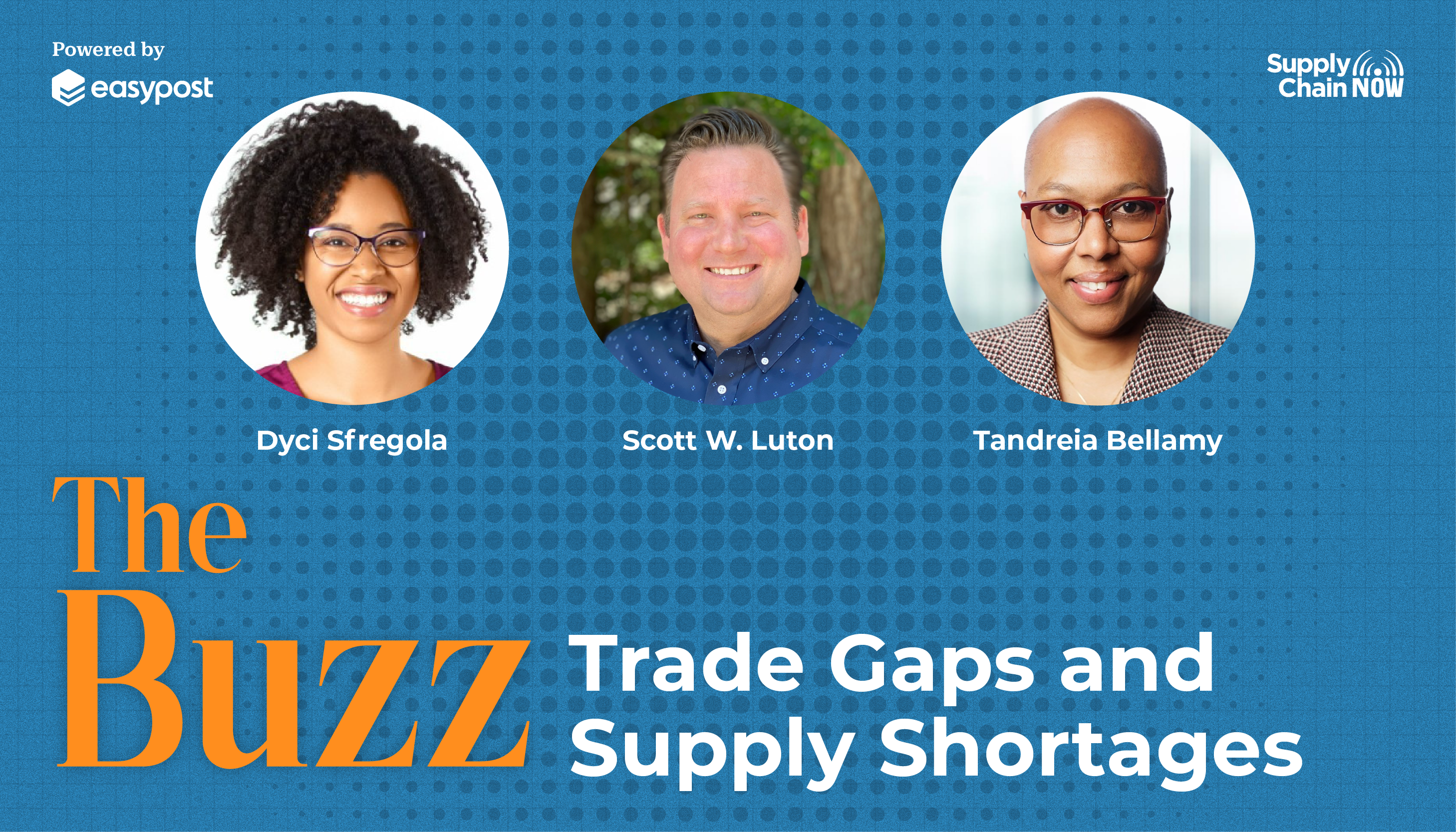
Intro/Outro (00:02):
Welcome to Supply Chain. Now the number one voice of supply chain. Join us as we share critical news, key insights and real supply chain leadership from across the globe. One conversation at a time.
Scott Luton (00:14):
Hey, good morning, good afternoon, good evening, wherever you may be. Scott Luton into one and only Tania. Be here with you on supply chain now welcome to today’s live stream, Tania, how you doing today?
Tandreia Bellamy (00:24):
I’m great Scott, and so glad to be buzzing with you again.
Scott Luton (00:29):
Yes, we got to do this in person next time, but it’s great to have you back. I know you’ve been busy. I was getting an update from you in the green room. We may touch on that later today. But folks you know on today’s show to Tania’s comments, it’s the buzz where every Monday at 12 noon eastern time, we discuss a variety of news and developments across global supply chain, across global business. Really news that matters is what we like to call it. The buzz folks is powered by our friends at Easy Post who help make shipping easy. Oh, we can all use easy shipping, flexible shipping, scalable shipping. You can learn more about how you can simplify your shipping operations and delight your customers at EasyPost do com. Okay, tantra, it’s the first Monday in February. It’s hard to believe. Super Bowl is right around the corner. Yesterday of course, and you were telling me about a special event in Atlanta. We kicked off Black History Month 2026 here in the US where there’s a lot to reflect on and then celebrate for sure. Tan, really quick, you went to a special event yesterday in the Roswell area. What was that?
Tandreia Bellamy (01:23):
Yes, Roswell Roots has been a, this is now, its 25th year and there are just various activities that go on throughout the month. Last night was a music production that was history to hip hop and it just traced a history of black music from Negro spirituals and the slave fields up to present day and it was very well done.
Scott Luton (01:46):
I love it. And you gave me a tip, you’re a big gospel music, a listener amongst other things, and Jonathan McReynolds was the singer you put on my radar. Is that right?
Tandreia Bellamy (01:54):
That’s right. Great lyricist, I mean as a lyrics just really, really touched your heart
Scott Luton (01:59):
Folks, check it out. Let us know what you think. But hey, from a business perspective here today, we’ve got a big show teed up Trade Deficit News that Tan will say and maybe DC will as well. It might be click Bish, we’ll see a warehouse market update. We’re going to take a look at a few predictive shortages and cost increases in 2026. We’ll even talk about the big problem that the reverse logistics and returns management space has, and if they’ve got a big problem, it means we all have a big problem, all that and much, much more. And in about 12 minutes or so, we’re bringing in a great guest, a long time friend of the show, DC it’s frag with new gen Architects. You’re going to enjoy her perspective here today. So big Chra, did you take your vitamins are ready to go eat your Wheaties this morning.
Tandreia Bellamy (02:37):
Let’s go Scott. Let’s go
Scott Luton (02:39):
Folks. Buckle up for a big edition of the Buzz Powered by Easy Post right here today. Alright, so before we bring on DC, want to cover three quick things starting with our latest edition of With That said, published right here over the weekend. Now in this edition we’ve got a variety as always, news notes, resources including some of our upcoming live events. Touched on a couple things here. This is a picture tan of a bunch of University of Georgia students, talented students learning about how they do operations at a big golf tournament that’s hosted in Augusta. You may know the one I’m talking about. So that was really good. We shared the news on a social network platform that’s been created solely for AI agents Tan, like my rhetorical question there says what could possibly go wrong? Then we also touched on the American Logistics Aid Network.
(03:27):
Our friends over there do great work, wonderful nonprofit, action oriented nonprofit. We’re including some of their priority needs each week in our newsletter. And folks, if you can contribute to those needs, we publish each week, come back and reach out to us. We want to celebrate that. Amplify your good deeds. And then finally Tan, Andrea, you were with us last year, April 29th, national Supply Chain Day. It’s that time again. Plan to join us at 12 New Eastern Time for a virtual event that will feature a wide range of supply chain leaders, including my colleague, the Fearless President here at Supply Chain now, Mary Kate Love. So folks, all that is in the most recent edition of With that said, now Tania, did you get a chance? I know you had a busy weekend. Did you get a chance to check out? With that said, I
Tandreia Bellamy (04:06):
Did. But instead of going into any of the articles, we really, really have to hype and get the word out on National Supply Chain Day. This country doesn’t run, no country runs without the supply chain and the good people who were involved with it. It is something that really, really should get more recognition and just more thought put into it. There’s so much that goes on under the umbrella of supply chain and making that day just more prominent is something that all of our supply chain professionals should help us do.
Scott Luton (04:40):
Well said, especially the people as we both know and love and appreciate all the people and make global supply chain happen and give us all these modern conveniences. We’re spoiled to death in many ways. Alright, so Tan, Tricia, is Johnny on the spot here today? She’s dropped a link to what that said and she’s also dropped a link to National Supply Chain Day. Check it out and we’d love for y’all to join us. Let’s see here. Now you also shared Tan a really interesting note on only LinkedIn a week or two ago. Check this out folks, if you’re watching us here today, seven Sins of CEOs. I’m going to hit these really quick because Tan added an eighth. One seven sins here and this comes from Eric Parters. I think I said that right. Founder and CEO accelerator. Number one, micromanaging your team. Number two, lack of transparency. Number three, avoiding tough decisions. Number four, neglecting toxic culture. Number five, resisting change. Number six, taking on too much. Number seven, not investing in your people. So Tania, you added an eighth one though. Tell us about that one.
Tandreia Bellamy (05:39):
Not listening to your team. You assembled a team, generally a talented people. Most of the time you’ve chosen these people, you’ve got to give them a voice. One of the best managers, leaders that I ever had, we were in a meeting and he said, if there’s six of us in this meeting and we all agree, I don’t need five of you. You need diversity of thought, you need input from other people. That’s the only way that you can possibly have the highest performing, most motivated team is to allow and actually listen to the input from the team members.
Scott Luton (06:18):
Yes, well said Tan. And I got to tell you, our team members are a lot smarter than me. So if I don’t listen to them to what they do, we’re really in trouble. But kidding aside, we probably all have worked with or for folks that just don’t listen, right? And they find out the hard way a lot of times. But a great list Tan, and thanks so much for sharing that with your social network and with us here today. Speaking of thanks, Hey, this is Andrew Andrew’s back with us. Great to see you here today. I know you’ve had some big news with your business. Robert is back with us. Hey Robert, great to see you. Remind me what part of the world you’re in. I promise it’ll stick after you Share with me one more time, maybe Tan. Andrea. There’s one more thing I want to share before we bring on ragula and that is Folks Manifest is back next week.
(07:02):
It keeps getting bigger and bigger and I’m looking forward to see everyone out in Vegas. I’ll be interviewing, I’ve got a panel session and connecting hopefully with a bunch of folks. And perhaps if you’re headed to manifest this year, you may be feeling some of the pressure out in the market, a lot more Automation solutions. Which one do we get? More releases, more integrations, but less room for failure. But you know, the teams moving fastest are not testing more, they’re testing smarter. All this is why our friends at Cycle Labs will be at Manifest 2026, which runs again from February 9th through the 11th in Vegas is just around the corner now. Cycle Labs will be at Booth 10 95 meeting with supply chain ERP and WMS teams who all need to validate change without slowing the business down. We got no time for that. And folks, when the show floor gets too loud for you, we can probably all relate to that. The good news is that Cycle Labs is creating a space for nice, easy and real conversations. Get this tan drinks and darts, that’s a dangerous combination with Reba blue yonder and tequila tasting. That can be dangerous too with I think a slim con. No demos folks. Just real conversations with peers that are facing the same testing challenges. You can plan ahead by visiting link in the comments to schedule time to meet with our friends at Cycle Labs. Are you a tequila fan?
Tandreia Bellamy (08:12):
Yes, Scott?
Scott Luton (08:13):
Yes. Do you have a certain type that is your go-to for special occasions or are you just kind of a generic?
Tandreia Bellamy (08:19):
I’m still a novice, so I’m in the experimental phase and different ones depending on if it’s going to be for sipping or mixing in a margarita.
Scott Luton (08:31):
Okay. I do mainly the latter. And my margaritas, they got to be on the rocks with no salt.
Tandreia Bellamy (08:38):
No salt, definitely
Scott Luton (08:39):
It gives more heartburn. Just I’m not a big fan of that. I hadn’t even really learned a different highfalutin styles of tequila. So maybe I’ll have to go check out this event there at Manifest. And folks, if you want to do that, any of those events or stop by the booth, you can check out the link right there. And Robert,
(08:55):
I should have known you’re from South Africa. Great to see you again. We’ve shared that before and great to have you back here on the Buzz Powered by our friends at EasyPost. Okay, tan Andrea, I’m delighted to have a great guest and longtime friend of the show here on the Buzz today. DC’s Ragula has spent years helping manufacturers, builders, and public sector leaders stand up resilient operating systems. So plans connect, execution and project finish on time, on budget and with less waste. We could all use more of that, huh? She’s also an advisor, a trainer, and the author, where’s my copy of a new book came out last year, next level Construction management, leveraging Digital Supply Chain Fundamentals for Project Success. Please join me in welcoming DC’s frag, founder and CEO of Newgen Architects. Hey. Hey DC How you doing?
Dyci Sfregola (09:42):
Hello. Good afternoon. I’m doing well. Happy Monday.
Scott Luton (09:46):
Happy Monday. Great to see a s. We were talking pre-show DC just got back from a big trip where you were in Kenya I think, and a really quick there and back, is that right?
Dyci Sfregola (09:55):
Yes. 20 hours there was there for 40 hours, 20 hours back.
Scott Luton (10:00):
Wow. You’re in demand and folks everywhere, supply chain leaders everywhere need guidance and best practices. But we’re going to talk more about your book in a second and some other things. DC and Tania, this is where I want to start. Fun warmup question. So today’s Groundhog Day, no word yet on what happened to Ground dog Groundhog. We’ll see it is California Kiwi Fruit Day. It’s grape day, it’s national Taylor to day give me McDonald’s french fries, only tots and it’s national heavenly hash day. Now to me that is ice cream, right? Chocolate marshmallows, almonds and other good stuff in it. So to that end here on national heavenly hashtag dc, what is one of your favorite ice creams out there and where do you go get
Dyci Sfregola (10:40):
It? It’s called Aina.
Scott Luton (10:41):
Okay.
Dyci Sfregola (10:42):
It’s a Spanish cherry that it’s mixed with ate, which is like Italian version of vanilla. It’s a little bit different. And my favorite spot to get, it used to be a cute little Ria ice cream shop, Puerto Milano in Milan. And they closed, I think just couldn’t make it during COVID. So now I get it around the corner from my mother-in-law’s house and I’ve tried to make it at home with, how do you say it? Marino cherries. Marino cherries. If you put a stone bowl in the freezer and then try to, it’s not the same. But I try, I try TC gets
Scott Luton (11:22):
My man that is the most highfalutin ice cream I’ve heard in a long time. And it sounds my stomach is now growling Tan, tan, Andrea, that’s going to be tough to beat. What is your go-to ice cream?
Tandreia Bellamy (11:35):
I’m a chocolate almond ice cream fan and it’s not in a lot of places fast and Robins used to carry it but only in the fall. So I would have to do a cold stone type of concoction in order to get it. So Maggie moves their dark chocolate with almonds in it or cold stone creamer eat or ice cream with almonds in it. But give me chocolate ice cream with nuts and I’m happy.
Scott Luton (11:57):
Okay, that sounds pretty good too. I love plain almonds, raw almonds. I eat those all the time. A good snack, healthy a snack. Unfortunately I also snack on Oreo ice cream quite a bit. The real stuff. DC and Ria. I don’t like generic cookies and cream. Right. It’s got to be the real deal. Oreo and I’ll tell you, Oreo came out with its own like official ice cream. That stuff is so good. DC and tan. Alright, well now that we are absolutely starving and I’m going to to get some ice cream tonight, it’s great to have you with us DC It’s been too long and tan, it’s great to have you back here on the buzz. Let’s get to work and dive into some news stories here on the Buzz Powered by Easy Post. And we’re going to start with what TRIA shared in the pre-show might be a little bit of clickbait.
(12:38):
So I’m going to unpack this news story right quick. Then we’re going to get DC and Tan to weigh in. So CNBC reported on new US trade data last week. The US trade deficit, which is the difference between our imports and exports, almost doubled in November according to Census Bureau data. October, 2025, the month prior was the lowest level that our trade deficit had been at in the US since 2009. But November was a good bit of a different story as the tariff turmoil has really started to, we feel it a lot more, I think we’ll see where the months ahead lead us. Not only did it almost double from October to November, but the trade deficit was 4% higher than November, 2024. So year over year about one third of the gain was caused by trade changes with the European Union where US exports dropped by over 11 billion from October two November. Alright, so DC I wish we could start with good news. Oh, we started with the ice cream, so that’s good news, but your thoughts on what we’re seeing here DC
Dyci Sfregola (13:35):
Well it’s interesting to me how little we understand about trade if you’re not really in trade and reading this article made me think about a conference I went to in 2024 where a political scientist presented some findings about voter behavior and just the topics that voters really care about. And global trade was the last thing.
(14:00):
And I thought that’s so wild because it impacts us so much as consumers. And then when I started reading this article, I was like, wait, I didn’t realize the budget was that much had a deficit and then I read more. I was like, no, no, I remember the trade deficit and the federal budget deficit are not the same. And then I also, as you start to read, you start to really look at what is driving that deficit. And then I started to think, but doesn’t, this one month doesn’t, that’s not what we really look at to say, oh this is what I’m going to use as a data point to make decisions. You really want a three month average to see what the trends are, what’s causing that trade deficit. And it’s really more of an indicator of where we’re investing, what we’re bringing in for imports. And it’s a macro mirror of the demand and investment within the us but I’m interested to know, I didn’t catch the clickbait part of it, so I’m interested to hear Tan’s perspective on the clickbait piece of it.
Scott Luton (15:05):
Same tan your thoughts here.
Tandreia Bellamy (15:07):
It’s the 94% the
(15:10):
Saying that it almost doubled. And again, like DC said, you can’t use one month as a data point to make any type of decision on. So the deficit was 56.8 billion in November 29.4 the previous month. That was a 16 year low as you said. But the three months prior to that were 48, 1 55 6 and 74 4. So that 56.8 is really not an anomaly. The 29.4 is, and the concentration should be on how’d you drop so much in one month and why? And were there artificial things that really pushed that number down and as you look at what the average is and how the trends have been going, the 56.8 that was highlighted as this 94% increase really wasn’t out of alignment with what had been happening all of the previous months of the year.
Scott Luton (16:10):
Well said, well said and we’ll see. I’m really curious to see what December and January it’ll be a little while, but that three month average is a great point. DC and Tania and I tell you I know about y’all, but the headaches and the uncertainty and the heartburn and more from the ever-changing trade policies, that’s no good. No bueno. Alright, really quick. Hey Jeremy, maybe gaming metrics, maybe Jeremy great to see you and he says happy candle. That’s right. I got think today is candle. Great to see you. And also Haley from Cape Town South Africa. Great to see you here today. I’d love to get any of y’alls thoughts on trade or any of the topics we talk about here today. One more last note because this ice cream is lingering, Amanda says, I got an in creamy last year for Christmas. We love making tart frozen yogurt or homemade coffee ice cream.
(17:01):
Also love Cherry Garcia if I’m grabbing it from the store. Oh that Cherry Garcia is to die for. Alright, so we’re going to shift over to the warehousing sector DC and Tania. The Wall Street Journal was reporting that the world’s largest owner of industrial real estate says demand for warehouse space is increasing after a long period of sluggishness, Prologis shared that warehouse rental demand started out pretty soft in the first part of 25, but improved especially in the second half of the year. As it says, some corporations were refocusing on longer term supply chain needs. Prologis leased 228 million square feet of warehouse space globally last year, its biggest year since 21 here in the us. Cushman and Wakefield said that the average warehouse vacancy rate was at an 11 year high of seven 1% in the fourth quarter of 25. The firm also reports that companies leased about six 65 million square feet of warehouse space in the US in 25.
(18:00):
That’s the highest total since 2022. Warehouse rents we’re still depressed in 2025 down 3.7% globally and 4.5% across the US Get this new warehouse completions globally are expected to bring 474 million square feet of warehouse space online in 2026. Sounds like a lot, but that would be the smallest amount of new space come online since 2018. One final note, tan in dc There’s a quote here in this article from Prologis CEO Daniel letter, and I really wish I felt this quote in more conversations I’m having, but this is what he said, customers are making long-term decisions with greater conviction. Okay, practical optimism perhaps dc Your thoughts on what we’re seeing in warehousing?
Dyci Sfregola (18:45):
It’s whiplash. As a supply chain planner, we didn’t have any space then there was a surplus, now we’re rebounding. And it’s interesting, I was just talking a couple of weeks ago with a planning team and we were talking about how we need to bring warehouse utilization metrics into our planning to really look at everything from a holistic perspective. And it’s so interesting that we touch on this warehouse market recovery topic after the deficit conversation because a deficit doesn’t necessarily mean our economy is losing within the us it could reflect strong domestic demand, which if you look at what we’re saying now with warehousing space rebounding, that could very well be the case. Which is why as supply chain planners, as demand planners, as you’re doing your network design and you’re doing your strategic procurement, it’s so important to look at so many different data points. And again, it’s kind of like whiplash. It’s hard to keep up with it. Especially my focus as a strategist a lot of times is the longer term plan, if you need to increase warehouse space, if you need to increase manufacturing and production capacity, you need to find a new supplier. You don’t do that overnight. You can’t say, oh I need to do this next week, I need to do this tomorrow. So you have to look at these 3, 4, 5 year plans and an infrastructure and construction that could also look like 10 to 15 year plans.
(20:21):
So what are we even doing? I dunno trying to keep up, but when I read Trade Deficit and then I read Warehouse Market Recovery, I’m like, wait, what do I do? What do I do? It’s just really, you really have to look at from a holistic perspective, look at every data point. It’s really important to also, we talk about so much technology, this is really where the decision comes from a human and you have to really understand all the different levers, your trade offs, your scenario planning from the, and then make decisions from that way. But yeah, it’s great to see those contrasting headlines.
Scott Luton (21:03):
And as both you and Tan both have mentioned a couple of times here, we got to get past the headlines right. Got to get to the real story Tan. I’m really curious as someone that most of our audience members may know, you had an incredible career with UPS and as I like to say, we’re still auditing, but you’ve been in and out of millions of warehouses during your career. Your thoughts on the story here?
Tandreia Bellamy (21:23):
I think some, it just has to go to what we’ve been talking about most of the morning, a level of uncertainty. Uncertainty with supplies, uncertainty with tariffs. Uncertainty will lead you to have larger inventory level tend not to be as much on the just in time when there’s a large level of uncertainty. Also, as you build up inventory levels, you’re probably going to see some places where they start to reduce the number of skews so they’re not left with overstocks. But I think the uncertainty that we’ve talked about will definitely need to people building up inventories which will require more warehouse space.
Dyci Sfregola (22:03):
Also, I’d say just for the audience, we’re talking to supply chain practitioners, we’re talking to supply chain leaders and I say very often with my clients and different teams, inventory alone is not a strategy. Anything you’re looking to increase warehouse space to bring in more inventory and use it as a buffer. But anything can happen to that inventory. One container falls off the ship, you get a quality batch of inventory and that strategy, that buffer is out the window. You can’t only look at inventory as a strategy, especially in industries where shelf life is an issue. So you bring it in and then if you don’t use it, well now you’re also writing off. And just from a sustainability holistic perspective, you’re producing products that is essentially going to go to waste. So it’s so much to look at and to really think about, but that’s where I was talking about the trade-offs and as warehouse space is less available, inventory holding costs are going to increase.
Scott Luton (23:06):
Yes.
Dyci Sfregola (23:06):
So you’re now also looking at your total landed cost increasing. So it’s a lot of different things that you have to manage as a supply chain planner.
Scott Luton (23:15):
It ain’t easy and it’s not for the faint of heart. I wrote that down. DC inventory alone is not a strategy. Ria. I like that. It’s quite a quote, huh?
Tandreia Bellamy (23:24):
Absolutely.
Scott Luton (23:25):
Yeah. Alright, check out a couple comments here. DC and Ria, I like we can have a whole conversation around this one. I think. Not that one. Nothing wrong with selling out of an item. It kind of inspires demand. Jeremy, we got to talk. That’s an interesting perspective. I bet you have some folks that might disagree with you. Kelvin, great to see you from Zambia via LinkedIn. Let us know what you think here today, and I think this is Andrew, I think correct me if I’m wrong, Amanda and Tricia. Andrew says, I hadn’t had ice cream for a year. It’s called the sea diet. No ice cream, no cheese, no direct cheese, no chocolate, no cider. It is the sea diet. Yes, that is Andrew. Let’s know with the results, Andrew, if it’s worth all of the cause, the struggle is real if it’s worth all that. I love all those things. Trisha also dropped, I’m think the same thing. Trisha dropped the Prologis story and she also dropped her earlier article as well. So y’all check that out. So DC and Tanea, I burned my finger on some very hot chicken broth a day or two ago and right, that was
Dyci Sfregola (24:29):
Really, really hot chicken broth.
Scott Luton (24:30):
Oh it was plain as I learned I was getting it for the dogs and I failed miserably. It burned around the tip and of course you use the same finger you use for your phone, your mouse mouse typing and I feel like I’ve got like nine fingers right now. So I’m going to try to keep up with these comments and I hope I didn’t just violate any hipaa HIPAA laws. Alright, so let’s move from warehousing and I want to talk about this story here from supply chain dive. I thought this was a good one and it’ll probably spur some great conversation here. They really focus on some potential supply chain shortages and rising costs that they’re tracking on their radar. So for starters, they predict that you’re going to hear this. What’s old is new. Again, they predict that here in 2026, companies will seek to strengthen relationships with their supply chain ecosystem, but particularly with those suppliers that are willing to tangibly invest in collaboration, innovation and joint problem solving.
(25:29):
All that typically helps optimize reliability and resilience, reduce risk, and ideally get out ahead of some of the curve balls that are coming around the corner. But nevertheless, supply chain dive has its eye on copper critical minerals. Medical supplies are going to cost more projections from Vizient when it comes to medical supplies. Says inflation on medical and surgical supplies will reach 2.58% in 2026, increased 2.58% and drug prices, it’s going to rise another 3.35%. Man, there will be an even tighter market for memory chips with automotive manufacturers getting squeezed a bit. As I saw it quoted in here, the highest bidder is where the chips will be going and we can’t even catch a break. Folks, Tanger and DC on our weekend stake coming on the heels of a 75 year low in cattle herds last year. Cattle shortages are likely to be persistent as ranchers battle a variety of concerns from droughts to economics to screw worms, which is something new I learned here today in the article. So DC is a lot there. What are you seeing out there?
Dyci Sfregola (26:34):
So there are two things that really stand out to me here. The first or three, I guess procurement teams are up for challenges. The headlines
(26:42):
Because procurement teams normally don’t have challenges. I feel like procurement teams are always in challenges. It’s the nature of procurement. I work with a lot of sourcing and procurement managers and I do not envy, I do not envy them, but that stood out to me. The other one is the pay to play dynamic and it reminds me of when we had the Panama Canal blockage and whoever could pay got their ships through. So we really get back around to cash and cashflow is king when you’re working in these scarce environments, it’s kind of going to less of a disruption, whack-a-mole story and more of scarcity really driven by structural constraints, trade policy, and then the competition driven by AI materials and capacity needed for that. So we’ll see how that unfolds in 2026. But it also made me think about what Tania said earlier about how just supply chain is really how the world goes round. I mean we’re talking everything from medical agriculture and food. Automotive supply chain really does. It’s the lifeblood of everything we do. And yeah, this is just another example of that. I know that also with the copper, the US has been looking at the libido corridor as investment and the gentleman from Zambia I saw he was hearing a lot of that has to do with Zambia.
(28:05):
But one of the biggest things is that these are really long-term strategies
(28:13):
Because where you source the minerals from as a secondary source really trying to find somewhere different, similar to what I said with construction, increasing capacity. You don’t just go and say, oh there’s a mineral in this country work. Get it from there. You have to have the mine, you have to have the refinery, you have to have the infrastructure and the energy to be able to do the processing and to move it and the port, it’s not something that you just say we’re going to go get it from this other place,
Scott Luton (28:41):
Right? We’re not parked and this going to happen tomorrow. Well maybe, and gosh, I’m getting a masterclass from y’all two here today. Maybe they’ll take all the pennies and smell those suckers down and smelt those suckers down and we’ll have a little higher copper supply. I’m only kidding, I’m not sure pennies are made of copper or not tan. Alright, so DC shared a lot of her take on this great read from supply chain dive about shortages and rising costs, your thoughts.
Tandreia Bellamy (29:07):
I think this goes also to making sure that whatever the organization is, the corporation is that they really do have a long-term strategy that involves all of their different functions. If you’re going to run into a situation where a primary product that you have is going to become either extremely difficult or extremely expensive to produce, it may be time to think of alternate products, alternate revenue streams, not just alternate supplies. So because as DC has said on a couple of occasions, these aren’t short-term decisions that are being made, long-term strategies need to be more engaging with supply chain so that they understand what the end game is going to be in different manners than we have in the past. And now with the rise of AI and so much going on from a supercomputing standpoint, really investing in those technologies to help with long-term decision making could definitely help in this arena.
Scott Luton (30:12):
Yeah, no doubt. Tanger a lot of stuff there. Really quick, I want to point out Tricia Drops, don’t take our word for it on any of these reads. Trisha drops a link there so you can check it out. Your one click away if you’ve got a better finger than I do today, one click away and let us know your take. Jeremy Trust is an axiom of relationship and trust of course is the foundational principle. It’s one of them of global supply chain. Good stuff there. This is Andrew, he’s down 18 pounds,
(30:39):
The C Diet over a year, but he says I’m still fat Andrew, come on, you got to be more practically optimistic and confident. 18 pounds is terrific
Dyci Sfregola (30:48):
Progress over perfection always
Scott Luton (30:49):
Right? That’s right. And yes, it was the C diet. Andrew is the one that shared and there was one of the comment I wanted to hit, but I lost it there. I’ll come back and revisit. Alright, one thing that was missing in that article was energy, specifically electricity. Because tell you what we’ve got in the states and really around the world, we’ve got our work cut out for us and it’s not just data centers, but data centers is a big part of it. But we’ve got really our work cut out for us to meet the demand, especially for electricity and I think rising costs and who’s going to pay for the infrastructure investments that we need, we’re going to see. Okay, I want to share one note from our friends at Easy Post folks Manifest, as we’ve said, it’s just almost here. Easy post can be on the ground having all sorts of real conversations, real conversations.
(31:36):
They’re really good at keeping it real, especially about ai. We invite you to join Lori Boyer and Tom Butt’s session. We’ll dive into how LLMs are changing the shipping game. Then you can swing by booth 7, 7, 7. How about that? For a booth number in Vegas, go by booth 7, 7, 7 to say hello and see what’s new at Easy Post. I hear they’re going to be giving away some really cool prizes and when you stop by, say hello to Laurie, Tom and Kevin and the game maybe, who knows, maybe they’ll have some ice cream. We shall see Booth seven seven, an
Dyci Sfregola (32:05):
Ice cream booth at Manifest last year
Scott Luton (32:08):
I knew that. I knew there was a Rose Rose for the all day or something. Oh
Dyci Sfregola (32:12):
There was a Rose all day. Also, what I really love about Manifest is that it’s a big family reunion where you really get to see so many people that you connect with on LinkedIn or virtually or that you haven’t seen in a long time.
Scott Luton (32:27):
Yes,
Dyci Sfregola (32:28):
I did enjoy my time last year. I just can’t make it out from Atlanta this year.
Scott Luton (32:34):
That’s a great segue because you’ve been very busy, very busy. And we got to get you out to Vegas. When was the last time you went to Vegas? Tan Bellamy?
Tandreia Bellamy (32:41):
Two years ago.
Scott Luton (32:42):
Oh yeah. Actually we need to do a study on the vacancy rates in the market out in Vegas. It’s been interesting to see what’s transpired over the last couple of years, but we’ll save that for another show. Alright, so Tan and dc, DC you have been busy. Which one reason why you may not be in Vegas this year. Be back next year. I bet. And congrats as I mentioned on this new book that I’ve got to get signed next time we meet in person. And I got to ask you, you don’t see my dogeared notes and my scribbles in here, I’ll show you when we hook back up, but what’s been some of your favorite feedback related to your book, which came out last year? Is that right? DC?
Dyci Sfregola (33:19):
Yes, about six months ago.
Scott Luton (33:20):
Okay, so
Dyci Sfregola (33:21):
What have you heard past year? Well, my favorite feedback came from my dad, who you expect to be my biggest fan of course, but he is not in supply chain. So it was very interesting to get his perspective and he called me when he finished it. I remember I was over near the five guys in East Cop on Roswell and he said, I just have to say, and I’m saying this not as your father, but just as a person, this is so good. It just makes so much sense and it’s something that you can understand its impact in business, not necessarily just supply chain. And I remember thinking, okay, if he gets it, anyone can get it. Not a knock to my dad. It’s just not his world. It’s not his world. And I have a client, when I was telling her about it, she said, oh, so it’s a technical read. And I said, well no, it’s not a technical read. It’s important for everyone. And she said, but if someone who wasn’t in your field started to read it, would they understand? I said, well, yeah, I don’t know, maybe not. So it was good to get that perspective from him
(34:39):
Of really number one, understanding it not having the supply chain or manufacturing or construction background because the title is related to the construction industry, but it’s really evergreen supply chain concept. And it’s really my way of telling construction leaders, especially as we start to see more offsite and prefab construction, that there are so many fundamentals from manufacturing supply chains, from pharmaceutical supply chains, retail supply chains that can be applied to construction. And we really have to stop just accepting that things are going to be delayed and accepting that things are going to go over budget because there are ways to plan properly and execute properly. So that’s what I really like that feedback from my dad.
Scott Luton (35:33):
I love it. What’s your dad’s name?
Dyci Sfregola (35:35):
His name is James.
Scott Luton (35:36):
James. James Manns. Thanks so much James. We’ll have James on maybe sometime learn more what he does in industry folks. He can’t
Dyci Sfregola (35:44):
Talk to you much about it.
Scott Luton (35:49):
Oh, okay. That’s fascinating.
Dyci Sfregola (35:51):
Yes, that makes demand. He’s an engineer by education and by trade
Scott Luton (35:57):
Folks. Check out, Trisha has dropped a link to acquire your own copy via Amazon. I’m sure it’s available to other places. Tan your thoughts shared a lot there and I loved the feedback from Mr. Mans fathers can be our number one advocate. I don’t know, twin fathers and mothers. I’m not sure who’s a bigger advocate for us, but tan your thoughts there on what we just heard from dc
Tandreia Bellamy (36:20):
I’m just looking forward to getting the book. Yes. So great advertisement and so less support.
Scott Luton (36:28):
Well chapter 13 on data governance DC I’m kind of getting above my pay grade with that chapter, but I’ll come to you in case I need mentoring. We’ll figure it all out really quick before we move on to a couple more. Actually I’m going to touch on one more thing DC before we talk AI before we talk reverse logistics is your LinkedIn learning. You’ve been doing a ton of LinkedIn learning. I think what’s next in that horizon DC
Dyci Sfregola (36:54):
On the LinkedIn front, LinkedIn learning course front. I’m not sure. We did the first initial course for the supply chain foundations for snop. And that’s gotten a lot of really good feedback as well from both supply chains and non supply chains alike. And they always tell people, if you are not in supply chain, this is a perfect course for you. If you’re in supply chain, send it to your marketing friends, your finance friends, your engineering friends, your logistics friends. Anyone who may or may not know what S-O-P-I-B-P and SNOE actually is because that’s what it’s really for, to communicate the impact that really strong collaborative processes have on the business. And it’s traditionally been a process that’s owned by the supply chain,
(37:42):
But it’s a process that we need all functions to be engaged in for it to actually work. And it kind of goes back to tan Andrea’s point earlier about getting everyone involved in collaboration and really bringing supply chain in as early as the idea of product design. What are you thinking about making? What materials are you thinking about using and having supply chain advise and provide and start to think about the strategies that are going to be required to source and develop the network and things like that. So that’s the point of the course and I’ve really been trying to leverage the book and the LinkedIn learning course to design more workshops for executive leadership teams and senior leadership teams to help them understand the impact of their decisions are lack thereof, their vision, communication or lack thereof, their guidance or lack thereof, right? I did two SP workshops last year and they’re not recorded, they’re in person, small group. And people clearly felt very comfortable to say how you really feel. And what came out of that. A lot of it was our leaders are the problem. We get directives, not guidance. So it’s like, oh yeah, go figure out ai, go figure out s&p with no resourcing, with no real change to operating models, with no real change to budgets for workforce planning or reskilling and upskilling. It just doesn’t work if you don’t have the right executive sponsorship. So I’m looking to use all of these insights to really create to a space for those executive leaders to be able to say this is a safe space. But with that said, get it together guys. That’s right man. Get it together guys. Come on.
Scott Luton (39:40):
So Tantra, really quick on the front end of DC’s comments there. She talked about bringing supply chain in early, right? Absolutely. And how that can be a big time differentiator and it can also help avoid, actually improve and find opportunities, but also avoid headaches. But what else did you hear there from DC Tan
Tandreia Bellamy (39:57):
Again, the importance of communication. Not only avoid headaches, avoid cost overruns, avoid product shortages. There are a host of issues that can be avoided by engaging the right people at the right time in the process.
Scott Luton (40:13):
Good stuff. Tan. Andrea. Let’s see here. Jeremy’s on a role, I want to pick one thing out. Requirements analysis, I’m not bad at it. He mentioned earlier how supply chain management is our thing and he is, maybe y’all know these acronyms. They didn’t strike me earlier. BPR and O, CM BPR and OOC M. So Jeremy, we’re going to have to have you on and you can tell us all about it. Alright, let’s talk AI for a minute. Now these, I enjoy your regular takes on ai. Some of the funny things you see out in the industry on social and especially on LinkedIn. And there’s an interesting story here that I thought would give us an opportunity to share some perspective and it focuses on the topic that was news everywhere in the last week or two. Davos, I hope to make it one day to the highfalutin Davos conferences from our friends at the World Economic Forum comes this interesting read on how hard it is to scale AI and what leaders can do about it.
(41:09):
Now this is a deep read. We’re going to just hit high level here today, folks go check it out. Trisha’s already dropped the link. It’s been estimated by Gartner that $1.5 trillion was invested in AI alone last year in 2025. Wow. But those didn’t deliver. The expected has surveys there have found that about two thirds of those 2000 companies have not scaled their AI projects across enterprise, which shouldn’t surprise probably any of us here. Some of the companies at Davos have successfully scaled their AI initiatives and they pointed to some of the key requirements, new strategies, capabilities in organizational designs. Get this meta’s Chief Global Affairs officer, Joel Kaplan. I need a chief global affairs officer. That’s got to be a cool role. Joel Kaplan spoke about how critical it’s for leaders to think deeply about how AI will change company workflows as well as the sheer nature of work.
(42:09):
That thinking and strategizing and preparing cannot be delayed while the work will be reimagined and redesigned. Give this Accenture’s chair and CEO, Julie Sweet said that we’ve got to keep a human touch. She said human in the lead, not human in the loop. And folks, there’s also some great examples I thought of how companies are leveraging AI in a wide variety of ways. So check it out. So DC can’t have a conversation about talking about ai and I wasn’t there in the room at Davos, so I had to drew a lot of conclusions from this article here. But your thoughts on not just getting return on AI but then scaling across enterprise.
Dyci Sfregola (42:44):
For me it’s same issue, different day. And actually I might venture as much to say if we had the ability to quickly pull up the first time I was on supply chain now like six years ago,
(42:57):
I think you were saying the exact same thing about control towers or technology in general. And we always go for the silver bullet. This is going to be the thing that changes and you have to fundamentally look like change management is not just training of where to click, how to use it, et cetera. I know plenty of people if you look and say AI adoption, sure, we’re using copilot, other companies are using chat GPT, you’re asking for some quick answers here and there. You have AI transcribing meetings now and following up meeting facilitator, let me know if you have questions. But what they talked about at Daon with this article talks about is that the fundamental need to change the operating model of how you do business, how decisions are made. You have ai, you have this technology, you have this data, but how do you get out of pilot mode and in one team or one department and really scale that across the business? And that doesn’t happen just from doing implementation and flipping the switch at go live. You really have to look at, and I think OCM, if Jeremy is referring to what I know, organizational change management,
(44:10):
What does the organizational structure look like? How does it change now that someone who was previously doing this piece of technology that’s doing that part, what do they now have time to do? So what’s changing what we’re going to stop doing? Because we don’t have do that anymore. We’re not looking at that perspective when we’re implementing AI or any other technology. It’s interesting to see, I’ve read about not to give away my age, but when email came out, when Excel came out, how it really changed the way that businesses I read about it didn’t experience it. But now AI is like that next big thing that everyone is really investing in and it’s no surprise that it hasn’t picked up. I do think that it’ll pick up. It takes time. Humans are creatures of habit. Change is hard. It’s good to see that there is this investment and this willingness from leadership to say, yes, we want to try to figure out how to make this work and now it’s just going to take some time to figure out how to make it work. It doesn’t happen overnight.
Scott Luton (45:19):
It’s a leadership issue. A big chunk of it in my perspective, but good stuff there. DC tan your thoughts.
Tandreia Bellamy (45:26):
I think it will pick up over time. It’s like digitalization. When we first started talking about digitizing things, it’s like what are we even speaking of, what difference does it make? How does that help business? I’m old. I’ve been around a while. When I started with UPS, everything was on paper. Drivers when they went out to deliver packages, had clipboards and carbon paper. When we were talking about digitizing everything, had no idea what the end game was going to be, didn’t know what the possibilities were going to be, but did know we had to move forward with it. And it was a true learn as you go.
(46:10):
Looking back, we would’ve been eons behind had we not taken the first steps, even if the first steps had some uncertainty surrounding them. So with ai, I think it’s going to be the same thing. I think there’s cases where people just don’t really know what the possibilities are. So that overarching strategy of what the end game is going to be so you can build towards it, really hasn’t been laid out because they don’t really know what the end game is going to be. So it will be a learn as you go and the different discoveries are really opening the eyes to what the different possibilities can be. So it’s going to be interesting to watch as it just continues to unfold, that education system needs to figure out how to get on board because instead of just penalizing kids and billing them when they’re using ai, figure out ways to incorporate AI to get them to think more critically as opposed to using it to avoid work. So we need to back up and go back to the foundation. So as AI grows, we grow with it.
Scott Luton (47:18):
It’s not just about cutting corners, it’s about changing business, changing. I hate to sound dramatic, but changing humanity, addressing challenges that we successfully address. We’re going to have to have this conversation on the next episode because we’re running right out of time. And I hate to do it because appreciated both of y’all’s perspectives, not just on ai, but all the topics here today. Before we make sure folks how to connect with DC and I got to make one more quick plug folks, if you haven’t checked out the resource hub over at the new supply chain now.com, do it. It’s got some really good stuff, including this new piece that Deborah Dole put together as she ventured up to NRF Rev, which is probably the largest gathering of reverse logistics leaders and returns management leaders. And she explored this massive challenge talking about education Tanger, the large education gap that’s in place when it comes to reverse logistics, whereas Tony Shero has called it for decades.
(48:12):
The dark side, right? And as I did a quick Google this morning, I found two schools that offered a bachelor’s degree in reverse logistics. Just two. We need a whole bunch more, right? But folks, check out a lot of perspective from folks in the industry, which you’ll find over at resource, the resource hub at supply chain now com. Okay? And Tricia, thank you. I’ll tell you, she’s dropped about 27 links. You’re on it on this Monday morning. Thank you so much Tricia and Amanda and yes, Jeremy Education can break that inertia. Well said. Alright, so DC great to have you here. It can’t be another six years before you come back, so we’ll make a mental note to change that. But if folks want to reach out to you on anything you’ve shared here today, right? What’s the easiest way to make that happen? DC
Dyci Sfregola (48:57):
LinkedIn for sure. LinkedIn is the easiest way. And then also on my website, dc mans.com, D-Y-C-I-M-A-N-N-S com. There’s actually a calendar link, especially related to any conversations around potential training needs, workshop design and certifications. Also, we’re an authorized knowledge partner for ia. So we do certified supply chain analyst certification exam prep, which is really just your baby’s first introduction to supply chain. It’s really great for students, it’s really great for career changers. It’s really great for, again, those people who don’t realize they’re in supply chain. If you’re in business and you’re in supply chain. So for marketing resources, finance, consumer insights, commercial to really good, not a lot of time require introductory course to understand supply chain and understand their role in supply chain.
Scott Luton (49:56):
Oh, everybody needs to go through that. Everybody needs to go through that course. I love that dc appreciate the great work you’re doing. I continue to do out in the industry and I look forward to this follow up. Every great book will have a, well, I guess doesn’t, what do I know? I dunno anything about writing book, but I bet there’s another book coming based on the success of this one. Tan Bellamy, great to have you back. You continue to move up the charts and the appearance charts here at supply chain now. Love that. I bet your top five tan. How can folks connect with you on anything you’ve shared here today?
Tandreia Bellamy (50:28):
Just like dc, LinkedIn is the easiest, quickest, most efficient way to get ahold of me.
Scott Luton (50:33):
It’s just that easy. And we’ve dropped link, we actually dropped DC’s and Tanger is linked right there. So you’re one click away. We try to make things very easy and some folks are saying they’ve already connected or followed. Wonderful. Alright, so I hate to leave it here. There’s so much more we can get into, but as DC mentioned earlier, hey, we’ve got a lot of work to do. So I want to first thank everybody, DC’s founder and CEO of New Gen Architects DC Thanks so much for being here today.
Dyci Sfregola (51:00):
Thanks for having me.
Scott Luton (51:02):
You bet. Look forward to having you back soon. Tan Bellamy, my Esteem co-host. You make all these conversations a lot smarter. We just need to go all meetings together, tan. Can we figure a way to make that happen?
Tandreia Bellamy (51:14):
Sure. Scott Beck call. Just lemme know.
Scott Luton (51:19):
It’d be a lot smarter conversation than we can make that happen. Anyway, tan, always a pleasure to connect with you and co-host with you. Big thanks to our friends at EasyPost powering the buzz all month long in February. Again, they’re making shipping easier and more flexible and more scalable. Learn more EasyPost, do. Big thanks to Amanda and Tricia behind the scenes and most importantly, big thanks to our global audience for being here with us today. Alright, so folks, you know your homework, DC and Tan brought a lot to the table here today. A lot of actionable perspective. That’s the best kind. Only kind. Take one thing you heard here from DC or tan, put it into practice deeds, not words. Do something with it folks. And with that said, on behalf of the entire supply chain now, team Scott Lutton challenging you, do good, give forward, be the change that’s needed. We’ll see you next time, right back here on Supply Chain now. Thanks. Bye.
Intro/Outro (52:05):
Join the supply chain now community. For more supply chain perspectives, news and innovation, check out supply chain now.com. Subscribe to supply chain now on YouTube and follow and listen to supply chain now wherever you get your podcasts.