Transcription
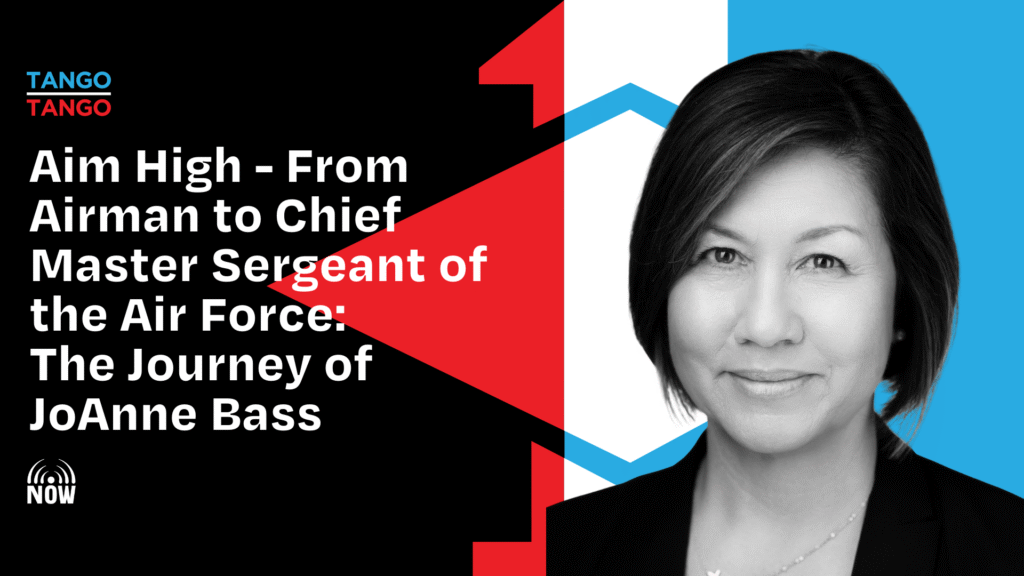
SUPPLY CHAIN NOW | SUPPLY CHAIN NOW | JOANNE BASS
Episode Transcript
This has been generated by AI and optimized by a human.
[00:00:00] JoAnne Bass: Nobody trains and educates better than the military. So when corporate America asked me, Hey, how do we develop people? I’m like, hire a veteran, like, and let them build your leadership development programs.
[00:00:12] Voiceover: Welcome to the Tango Tango podcast, real raw and unfiltered conversations with veterans and those who support them, tune in, be inspired, and walk away stronger.
[00:00:27] Lloyd Knight: Welcome to the Tango Tango podcast. And as you can see, I’m wearing my Air Force colors today. Aim high, fly, fight and win. And, and doing that ’cause I have an amazing guest today and never thought in a million years I would have her on the show. But please welcome, uh, retired Chief Master Sergeant of the Air Force and hey, army brat.
[00:00:51] Lloyd Knight: We have that in common. A uh, Jo Bass, a Jo, welcome to the podcast.
[00:00:56] JoAnne Bass: Thanks so much Lloyd, and it’s really a treat to spend time with you. You know, I tell people all the time that the one thing about the military that is so awesome is regardless of how long you were in, we’re all part of this military family, and so it feels like I’m hanging out with family.
[00:01:11] JoAnne Bass: And so I’m very excited to spend some time with you and your audience.
[00:01:15] Lloyd Knight: Well, I appreciate that, uh, Jo and I was reading your, your bio and, and looking around and I, I already knew a lot of things. I I know you’re an Army brat, so, uh, like me, you’re married to a, an army, uh, veteran and like me, you attended a bunch of schools, but you graduated in a high school in Hawaii, but before you got to Hawaii and kind of had some stability, where are some of the other places you lived as an army brat?
[00:01:42] JoAnne Bass: So we did, I did grow up all over. Um, you know, I remember my dad being stationed at Fort Sheridan, um, in Illinois. We spent time, I think two tours in Germany as a kid. We spent time in Utah. He was assigned there on his last tour in Germany on my senior year. He pcsd with orders to Hawaii. And so that’s what took me there at, on my senior year.
[00:02:10] JoAnne Bass: And I tell people that all the time because life as a military kid certainly isn’t easy, right? Like we don’t have a say so in when our parents have to change their assignment. And so that takes a little bit of appreciation as we ask communities and people to really just understand the level of commitment and sacrifice that our military families give.
[00:02:33] JoAnne Bass: So that’s me.
[00:02:34] Lloyd Knight: So yeah, my, my oldest son, three high schools, three different states. So the, uh, yeah, but, you know, it was tough for him, but it, it did build some resiliency. So do you remember where you were a, um, where your dad was station on in Germany, where you were at?
[00:02:49] JoAnne Bass: I do. He was, uh, some of those bases are closed down.
[00:02:52] JoAnne Bass: You know, he was stationed at Heidelberg at one point. Okay. He was stationed at a place called Schwäbisch Gmünd. We were also stationed in Würzburg in, in fact, that’s where I started high school. Got my first job working for a fees at a pizza place at 15 and a half years old. Back in the day when, you know, parents didn’t give their kids money.
[00:03:15] JoAnne Bass: And so, because I had to cry to get $5, I remember thinking, man, I’ve got a five. I’ve gotta get a job. Yeah. So pizza place for a fees is where I worked. And that was in Würzburg.
[00:03:25] Lloyd Knight: Yeah. That’s great. So, uh, and then we will get into it later on. You, you were able to spend quite a bit of time stationed in Germany as your, uh, in your Air Force career, which is, I I kind of did the same thing.
[00:03:38] Lloyd Knight: I, my mom’s German, my dad was in the Army, spent half of my life in, in Germany and then had the really the pleasure to go back. In the, uh, in air Mobility command, the, uh, at, at Ramstein. So I know you were in the 86, but before we get there, let’s just the, uh, take it the, uh, back to your high school. So you’re in Hawaii, you’re starting a high school, a was it a high school with a lot of veterans kids, a lot, a lot of army brats, or was it kind of a local high school?
[00:04:08] JoAnne Bass: So not a ton. Right. I graduated high school from Mililani High School in Hawaii. There were certainly some military kids, which every military kid typically tries to go find the other military kids because we’re used to being, you know, new and, and figuring out how to made, make friends. And so there were some but not a ton.
[00:04:29] JoAnne Bass: There were mostly local kids at my high school there. I also feel like Lloyd, I’m like, I feel like you’ve done some digging in my past life because Jo Bass was not a, a great. High schooler in, in Hawaii. You know, there’s a, as I served and I never shared a lot of background while I was serving, and then a, as I became a chief, I started to share more.
[00:04:56] JoAnne Bass: And I remember telling a story about. I think I was talking to a group of maintainers, but I was sharing a story about how in my, the year before I joined the United States Air Force, I’m on, on the island of Oahu and there’s not a ton to do there. And certainly as a military brat you can get in a lot of trouble.
[00:05:18] JoAnne Bass: And trouble is what I got into and enough trouble that I was actually banned from every military installation Hawaii. So, so imagine that, right? Wow. Wow.
[00:05:30] Lloyd Knight: Really?
[00:05:31] JoAnne Bass: Oh, oh by the way, my, my dad’s right an army warrant officer. So it was just bad news beers. And I’ll never forget, he told me, you know, I was in delayed enlistment by the way.
[00:05:42] JoAnne Bass: I’d already graduated high school and waiting for my time to come up. And my dad was like, do not tell your recruiter you’re going to the mainland until your time is up. And so, so I joined the Air Force. Never told anybody that I was banned from a military installation in Hawaii. And so, you know, I only share that story because I tell people, you too can be a Chief Master Sergeant in the Air Force, right?
[00:06:04] JoAnne Bass: Like there is promise out there. And when I share that story, I’ll never forget. ’cause the aircraft maintainers were like, she’s one of us, right? So anyway, it was a great story, but I feel like. Knew something, and I’m like, man, why is he into Hawaii?
[00:06:22] Lloyd Knight: The uh, that’s absolutely wonderful. You have a little spice to you.
[00:06:26] Lloyd Knight: You know, I, in high school, I, I wasn’t a troublemaker, but I was a poor student. And for those of my viewers and listeners know that it wasn’t for my late wife, I would’ve probably not made it through that final year of a high school. She or would’ve barely scraped by. She, she really helped me out a lot.
[00:06:43] Lloyd Knight: Um, but then with my kids, they were like, Hey dad, we see your report cards. You were terrible. And then I show ’em like, Hey, I got 46 as in a row in college. So the, uh, you know, the Air Force taught me how to be a great student. They, uh, taught me discipline. And then I imagine you have kind of the same story.
[00:07:02] Lloyd Knight: It sounds like you were lacking a little bit of discipline a as a Yeah, a teenager in Hawaii. And on the late enlistment, you go back to the mainland, you joined the Air Force and what career field they, uh, were you.
[00:07:16] JoAnne Bass: So I came into the Air Force Open General.
[00:07:18] Lloyd Knight: Oh,
[00:07:18] JoAnne Bass: did you? Okay. That was back when you didn’t know what your job was gonna be and you get a job when you’re in basic training and, and so I came in as a two, formerly A 2 7 1, 1 Charlie Zero.
[00:07:29] JoAnne Bass: But what that means to everybody is I was aviation management, so I was an ops person, but. One thing that you made me think about is most of us have all heard somebody say four years in the military, never heard anybody. And that was really why I joined. I heard my dad always say, four years in the military, never heard anybody.
[00:07:52] JoAnne Bass: And I, at that point in my life, I was not mature enough yet to go to college. I was accepted to college, but I wasn’t mature enough yet to go to college. My dad was not gonna pay for college, by the way. And so I needed to figure out life. And so I took, you know, held him to his word, which is four years, never heard anybody.
[00:08:10] JoAnne Bass: And that is really what caused me to join and then become aviation manager in the ops world, which I think was so helpful for me, that particular career field, because what I learned from that career field was operations. But I also understood the significance of support. And so I could understand in totality.
[00:08:35] JoAnne Bass: Where everybody fits into the mission and how you can’t do the mission without your support folks. And that lesson has continued on even, you know, as chief master in the Air Force. And then certainly in this new chapter for me, as I spend time with, with corporate leaders, I’m like, it’s all about the people.
[00:08:54] Lloyd Knight: That’s, that’s wonderful. A and as a first sergeant, you know, retired, first sergeant, you know, I love the, the motto of the Air Force First Sergeant is people are our business. And I’ve taken that to corporate America and in my community service and it’s served me very well. But I absolutely love the lesson.
[00:09:12] Lloyd Knight: You learn that there’s all those parts that you know, that are needed to accomplish a mission. It took me a long time to figure that out. I was a aircraft load master for most of my career, the first three years operationally in Charleston. And then I went into flight test for eight years. And, and then it took me an assignment outside of flight tests.
[00:09:31] Lloyd Knight: I went into the Talley, which they call CRGs mail, and then I started deploying and holy cow, I figured out that cargo in the back of the airplane is important. And, and they, uh, and that really bld me and really loved flying in the first half of my Air Force career. And in the second half, I can say I love the Air Force.
[00:09:53] Lloyd Knight: Because of being able to piece those things together. And then the, yeah, the icing on the cake was becoming a first sergeant and actually stepping away from aviation and then, and into a, uh, a medical group of all places and then a comm squad. And so I absolutely love that perspective. But, but getting back to you, so you, you go through tech school and your, your first assignment is, if I remember right, a uh, North Carolina Fort Bragg.
[00:10:20] JoAnne Bass: My first assignment was indeed, uh, Pope Air Force Base, right near Fort Bragg, North Carolina at the time. And what’s interesting is being an army brat, never having been stationed on the East coast. I even know like where Fort Bragg or Pope Air Force Base was. I was like, you know, you could have said I was going to the moon.
[00:10:41] JoAnne Bass: I just, I didn’t know. And I’ll never forget being in tech training and I’m like, you know, where is this place? And everybody’s like, oh man. They’re like, you’re going to no hope Pope, you’re going to Vietnam. And everybody’s like, you’re gonna hate it. Yeah, right. Like, and so I’m a little stressed out. I’m this 18-year-old who’s hearing all of this.
[00:11:03] JoAnne Bass: And what I learned is, you know, you have to take, you know, take that kind of feedback with a grain of salt because fast forward I go to Pope and what I learned is that Pope is actually, there’s a lot of hope at Pope. And I had a phenomenal time and I met my spouse there and I had phenomenal supervisors there.
[00:11:22] JoAnne Bass: And we had a strong mission and you know, and I was there at a time where I needed to start to create the foundation. Of who I was and, um, it was the exact place that I was supposed to be and, and I couldn’t have been more excited for being stationed there.
[00:11:39] Lloyd Knight: Awesome. So you met your husband there. Tell me a little bit about your husband,
[00:11:44] JoAnne Bass: Ron Bass.
[00:11:45] JoAnne Bass: Uh, so he, he is an 82nd airborne guy. We met like, literally the weeks, or maybe it was two weeks after I got there, but this is, you know, Lloyd, this is early nineties. This is when we still had NCO clubs. And for your audience who maybe doesn’t know what that means, I mean, back then there was more community going on, on base, right?
[00:12:11] JoAnne Bass: And so, so we hung out on base, still getting in, not a lot of, you know, still doing what we do, right? Like, so I went from. From getting in trouble at 18 years old before I joined the military to, you know, I’m still not too far removed. All of the Air Force started giving me core values and telling me I’m part of an Air Force family and all this.
[00:12:33] JoAnne Bass: But anyway, we meet at the Fort Bragg NCO Club. Not proud of it, but it is where we met and, and we dated for several years and then got married. And, and the other real big fun thing is, you know, like we, we started going to church on base there, the chapel and. And those folks just bring you in and, and suck you in.
[00:12:53] JoAnne Bass: And then I started talking like I was from North Carolina and so all the things, but Ron, Ron was an 82nd airborne paratrooper. I met him when he was a private first class. In fact, when he used to come and visit me on Pope Air Force Base, he used to drive his Humvee, which I’m pretty sure is an authorized, but he’d come in as Humvee and it would say PFC bass.
[00:13:14] JoAnne Bass: And you know, we were young then. We didn’t necessarily have cars. And almost 30 years later, we’re still together.
[00:13:20] Lloyd Knight: Yeah, I love it. I love, uh, when you post a, uh, pictures of Ron Bass on LinkedIn and pictures the of, of the family. So the, uh, and I, I always have, I, I’ve always thought that’s a, uh, it just showcases who you are and a, uh, you know, a family is important.
[00:13:38] Lloyd Knight: Church isn’t 14. They, uh, love that. And, and how many kids.
[00:13:43] JoAnne Bass: We have two kiddos, two girls, 25 and 19-year-old. Okay. Um, and they’re really the joy. And in this next chapter that I, this chapter I’m in right now is really just special because I’m able to pour back into the kiddos where, you know, I, I really didn’t as much.
[00:14:01] Lloyd Knight: Yeah. Awesome. We got that in common too. My kids are, my sons are six years a, uh, apart. And they, uh, I have a, uh, really cool thing is that I’m a, I’m a granddad now, so I have a, uh, I have a five-year-old. Congratulations and grandkids are so much better than kids. So
[00:14:19] JoAnne Bass: well, we kind know what we’re doing now.
[00:14:21] JoAnne Bass: So
[00:14:22] Lloyd Knight: although I do have this sinus infection, I, uh, from my grandson, I was up in Chicago this last weekend and they, uh, you know, he’s a walking CDC lab, but he, he gets over very quickly and us older adults suffer with it for weeks, but it’s, it, it’s worth it.
[00:14:38] JoAnne Bass: Yeah.
[00:14:39] Lloyd Knight: So, um,
[00:14:39] JoAnne Bass: yeah.
[00:14:40] Lloyd Knight: So you spent a considerable amount of time in Fort Bragg, cope, air Force Base.
[00:14:44] Lloyd Knight: Did you and Ron ever have any assignments where you were not together?
[00:14:48] JoAnne Bass: Yeah. You know, for all of our career, we were very. Blessed, very fortunate to primarily stay together. Um, and when I say that, I mean relatively close. Anytime you get married, when you’re in the military, you kind of ha ha, ha have an understanding of its needs of the Air Force or needs of the Army.
[00:15:10] JoAnne Bass: And we knew on our case it was needs of both. So we were stationed together most of our career until we started getting senior. And that doesn’t mean though, that we weren’t like an hour or sometimes even two apart, like our time, especially during our first tour in Germany. He was about an hour and a half away from Ramstein, and, and we had figured out, well, we’ll just do our best to live in the middle in Germany.
[00:15:39] JoAnne Bass: And so I’ll drive 30 minutes and he’ll drive maybe about 50 minutes and we’ll figure that out. And, you know, it’s tough. There’s sacrifice associated with that because at the end of the day, like military life for any branch of service isn’t easy. The deal being a load master, right? Like our hours and being an ops person, our hours aren’t, you know, nine to five.
[00:16:00] JoAnne Bass: And so all those, those years of being together and, and sometimes being two hours apart or an hour apart, were really formative to who we were as a couple and as a, as a family. Because, because of sometimes those challenges made us stronger, but our kids were always the ones who were at the child development center at daycare until like exactly six o’clock, right?
[00:16:27] JoAnne Bass: Like my, my kids were the ones who were in their, you know, coats and waiting for us to come pick ’em up. And, and there might have been one or two times where Ron and I are calling each other and like, do you have the kids? Do you have the kids? And nobody had the kids. So it, you know. That was us. But there were a few times, by and large, we were almost always together until our senior, kind of more senior tenures and, and then it just got too hard and we were in different states.
[00:16:56] JoAnne Bass: Yeah. And that wasn’t helpful.
[00:16:57] Lloyd Knight: I bet. So Ramstein, what was your first assignment at Ramstein? What’d you do?
[00:17:03] JoAnne Bass: Man, you’re making me go way back. You should have told me to go look up my military records. So, first assignment, you know, I did a quick stint at I think the flight records office, but that didn’t last long because if I recall, an email went out back then we had emailed to you, but an email went out and said, Hey, there’s a job.
[00:17:23] JoAnne Bass: Opening at the time, USAFE Amoc, and that was Ear Mobility Operations Control Center and essentially to all your non-military folks or or your military folks. That was just where we A MC led. But it was where our ops center was to be able to control all the ear assets that are in and out of the European Theater.
[00:17:45] JoAnne Bass: So a job ad, if you will, or or request for personnel comes out. And I remember everybody in my career field was like, Nope, not it. Right? Like, do not apply for that. We’ll never see you. You’re gonna go over and work on, you know, kind of a higher headquarters level and, and we never see you. Like, don’t do it.
[00:18:07] JoAnne Bass: But I’ve never shied away from opportunities that other people have said. No. And so for me, it kind of intrigued me and I thought, okay, I’ll kind of throw my name in the hat. And I, I ended up getting picked up for the amoc and that was a game changer. I, I think I served there for about three years where I was a airlift, sch scheduler, a db airlift scheduler.
[00:18:28] JoAnne Bass: So I, I took care of supporting all the distinguished visitors, getting in and out of the new safety, the European and Africa and, and kind of, as well as Middle East area, we would put them on C 20 ones, C 37. I think we had a C 40 at the time. And so that was pretty fun. It was a, a bit of a offshoot for my career field.
[00:18:55] JoAnne Bass: But I learned a lot. I learned a lot about kind of scaling airlift at a larger scale and not just what I might’ve learned if I stayed in a unit and worked kind of a smaller operations.
[00:19:09] Lloyd Knight: Yeah, that’s very cool. So did you ever guess in a million years when you were scheduling DV airplanes that you’d be on the other end of that and having people schedule airplanes for you?
[00:19:21] JoAnne Bass: No, but it was kind of good background to have because when they would tell me whether or not they had aircraft, I’m like, oh, I know they have aircraft. Right? Like so, so it was, it was kind of cool. I could have scheduled my own dip clearances and landing, you know, all all of that stuff. ’cause I know how to do that.
[00:19:41] JoAnne Bass: But ne never in a million years, and I say that Lloyd, because at that time, you know, I’m a new mom, I’m a spouse, I’m a brand new, non-commissioned officer at the time. And at that season in life, I was just trying to survive. You know? You’re just trying to survive. You don’t necessarily know what’s next.
[00:20:06] JoAnne Bass: That was also during nine 11, and I’ll never forget that period. So, right. Like you, you just didn’t, you know, I didn’t plan out 20 years ahead of time. Yeah. Plan through that assignment, and then, you know, if the assignment was good and, and you’re still able to serve and you’re still loving life, then you reenlist and and you keep serving.
[00:20:29] Lloyd Knight: Yeah, that’s a another thing we have in common. I was, uh, at Ramstein with my late wife and family during nine 11. Did you go to the NTL Academy over there?
[00:20:39] JoAnne Bass: I did, yeah. Did you?
[00:20:41] Lloyd Knight: Yeah. When did you go?
[00:20:44] JoAnne Bass: I don’t know. You guys can look that up on Wikipedia. Although Wikipedia is not, Wikipedia is not always true for your audience.
[00:20:50] JoAnne Bass: I, I
[00:20:50] Lloyd Knight: know that. So
[00:20:52] JoAnne Bass: remind me to share that story when we get there, but I’ll share the how I know everything’s not
[00:20:57] Lloyd Knight: true. Yeah. So I actually went to the NCO Academy, my entire unit deployed after nine 11. And they, uh, yeah. And not me, they sent me the NCO Academy. So the, so I went to the NC Academy that date, I’ll never forget, I’m horrible on dates, but that was October of 2001 and I, I was really angry that I didn’t get to go with my unit.
[00:21:17] Lloyd Knight: Wow. Did it really, again, re blew me. I, I came in there and got to spend time with, again, a bunch of other career fields, gained confidence in myself. I was like, wow, I’m, I’m a pretty good student. Um, I can, I can speak and did really well on, on the, uh, commandant Award and, and DG and those are the first awards I had ever won and really set me up for a great foundation for later on.
[00:21:45] Lloyd Knight: After you spent a, a considerable amount of time in Germany, what was your next assignment?
[00:21:50] JoAnne Bass: So my next assignment out of Germany was actually right back at Fort Bragg. Right. And so met my husband was stationed at Pope Air Force Base. Went to Germany for five years. We were actually only supposed to go for three years, but we kept extending ’cause we loved it so much.
[00:22:07] JoAnne Bass: So we did five years in Germany. And then got picked up to go right back to a data mask unit in the Fort Bragg area. And so that’s all I can say about that tour.
[00:22:19] Lloyd Knight: We can kind of get you that. So if you don’t know data mask, uh, go to Chad GVT so the, uh, and then you can kind of figure out. Very, very cool. So I won’t ask you any questions about that because I Yeah, we, I don’t need any, any calls from anybody.
[00:22:34] Lloyd Knight: So at, at this point, you’re starting to grow as, as a leader, I imagine, and, and you’re starting to get airman and a, uh, what was that like, that transition from being a, a, a staff sergeant where you might have one or two troops to, to now, you know, you’re making of the senior NCO and you Yeah. You’re directly or indirectly supervising and managing dozens of people.
[00:22:58] JoAnne Bass: Yeah. You know, I, um, I went in Germany. I went from senior Airman to staff sergeant to tech sergeant, and when I made Tech Sergeant, we’re just gonna rewind just a little bit in Germany, when I made Tech Sergeant, I remember going, I was still at that op center. I remember reaching out to my functional manager and asking them if they could put me down at the wing again, because I felt like if I’m gonna be a technical sergeant, a technical expert, if you will.
[00:23:28] JoAnne Bass: I need to get back to my roots and be in the career field and understand the majority of the career field if I’m gonna lead, right? Like and any career that you have in the Air Force, you can sometimes spend years away from your actual career field, but it’ll make it tough on you at in the future. And so I knew that.
[00:23:48] JoAnne Bass: So I asked if I could come back to the career field from that ops assignment and they agreed. And so I went on and I was the NCYC of the flight records office, which I was probably keeping your flight record Lloyd. And so. That was helpful because it was there in Germany where I started to learn what it was like again, to supervise and kind of supervise a people who were taking care of a mission set.
[00:24:15] JoAnne Bass: That was huge, right? We, we, we used to share in the military, we would share with people all the time, if you want to grow leaders, send them to Ramstein or, or, or a place like Cadina. You send ’em to these large bases where we’re doing everything overseas and so you’re able to understand all those functions.
[00:24:31] JoAnne Bass: So that’s where I really started to hone the supervisory skillsets because I was a non-com officer. In charge of that, I ended up making master sergeant, so senior and CO, and I can’t remember the timing of that when I went to the data mass unit. I wanna say that I might have pinned on like literally a week before I got there, or maybe it was right afterward.
[00:24:54] JoAnne Bass: But in any case, what I learned very quickly. Is when you become a senior NCO in any branch of service, people don’t care if you had it on for a week or if you’ve been a senior NCO for five years, they expect you to know your stuff and it’s not gonna be given to you. And so you have to learn really quickly how to be resourceful and reach out to your network to be able to become the person who who has the answers.
[00:25:24] JoAnne Bass: And I remember having my own little private pity parties where I’m like, woe is me. You know, I’m a brand new master sergeant staff in a function that they want me to. I’ll never forget that the commander was like, Hey, we need you to submit a ES staff summary sheet and it’s gotta get to headquarters, air Force, the Pentagon.
[00:25:44] JoAnne Bass: And he said it like. No big deal, right? And I’m like, staff summary all the way up to the Pentagon, like, you gotta create a package and you actually have to know what you’re doing. And so that was daunting, but what it forced me to do is to, again, network, learn the ways and know my stuff. And so that was one thing that I remember about, um, becoming a senior NCO.
[00:26:07] Lloyd Knight: Yeah, networking is so important. The, uh, holy account when you become a senior, NCO and, and then become a a, a First Sergeant, the, uh, as well is, is leaning on those around you in different units that can, that can, uh, you can reach out to and get advice and guidance. I remember when I pinned on my, my Diamond as a First Sergeant.
[00:26:29] Lloyd Knight: I think one of the first, the, uh, meetings I had with the, uh, room full of officers, I, I started talking and they started writing down what I was saying and I was like, oh, holy cow. With great responsibility comes great responsibility. I better be very careful with what I say and, and, and, and what I do. Um, so let, let’s take it back to, you know, you, you talked about networking.
[00:26:51] Lloyd Knight: Who are some of the mentors that you, that helped you grow as a leader?
[00:26:56] JoAnne Bass: I love that you asked that question and here’s why. I think I had a lot of mentors throughout my career. What’s interesting is the majority of them never even knew they were my mentor.
[00:27:10] Lloyd Knight: Yeah, me
[00:27:10] JoAnne Bass: too. Right? Like, it,
[00:27:12] Lloyd Knight: it, it,
[00:27:13] JoAnne Bass: mentorship wasn’t really a word when I was coming up in the military.
[00:27:19] JoAnne Bass: Like it just became. A thing somewhere in the two thousands and it became a awkward thing because, you know, we mentored for years and years and years and it was just something that people did, right? Yeah. Like no frills, no charge. They kind of put their arm around you and they were like, Hey, here’s what you need to do.
[00:27:38] JoAnne Bass: Here’s how to ha how to succeed in your career. And so I had a ton of mentors that mentored me in different spaces. You know, I had some that I watched how they, they communicated and, and I thought, man, you know, I wanna learn how to communicate like that verbally and written. There were some that mentored me because I appreciated how maybe I saw them parent, or how I saw them engage their network.
[00:28:04] JoAnne Bass: And so there were so many mentors, too many to count, and they never knew who they were. But I will say that probably the, if I had to pinpoint one person, I would again, give credit to my husband, who I don’t give enough credit to, because he, at the same time, had a separate career in the United States Army.
[00:28:23] JoAnne Bass: And I tell people all the time, he, he’s a way better NCO than I’ll ever be. He just has strong leadership skills. And so he taught me a lot of fundamental principles about playing the long game and not making decisions based off how I feel and take the hard right, and not the easy left. And, and all all of those things he taught me to help me be a better leader.
[00:28:48] JoAnne Bass: And so I, I’d say my husband was probably my biggest mentor.
[00:28:53] Lloyd Knight: Awesome. Maybe a featured guest on a, uh, on a technical podcast. So absolutely love that. And I do recall seeing that in a LinkedIn post that, that I thought was absolutely phenomenal. So, so now you have these a, um. You, you have these great mentors.
[00:29:08] Lloyd Knight: You go into a position where you get a, um, technically proficient. You start to build yourself up. You’re now a senior NCO. Talk a little bit about the, the progression to, we’re not even gonna get the chief master Sergeant in the Air Force yet, but the progression to become a, a, a Chief Master Sergeant.
[00:29:27] JoAnne Bass: Yep. So this is now at the. Previous unit that I was talking about five years, and we end up getting an assignment. In fact, I think my husband first got the assignment back to Germany and I’m like, are you kidding me? Like, yes, we’d love to go back to Germany. So we went again, started our trek back to Germany.
[00:29:51] JoAnne Bass: Now this time I’m going as a senior master sergeant, and now instead of being the non-commissioned, non-commissioned officer in charge of the flight records office, now I’m coming back as the superintendent in the SEL, which then I also wore another hat and I was the squadron senior enlisted leader. And so that was really formative for me as well, because I came back, knew the mission already.
[00:30:19] JoAnne Bass: Just took on more responsibility and then also had to take on the responsibility of leading the entire organization. And I know, you know Lloyd, before everybody, I was the senior enlisted leader of an operational support squadron. And so those are your air traffic controllers, your base ops, your weather folks.
[00:30:38] JoAnne Bass: So everybody that makes a flying mission happen falls under that squadron, if you will, in
[00:30:44] Lloyd Knight: one of the, in one of the busiest Air Force base in the entire world as well.
[00:30:50] JoAnne Bass: Yes. And so it was really cool because I started to learn, you know, how to lead at scale. Lots of different career fields and career fields that are to some degree siloed out.
[00:31:01] JoAnne Bass: So how do you then start to create a organizational culture, bringing in people from different silos and becoming a happy family? At the same time learning what my role was to support my commander and make sure that the commander succeeds. And that’s what I tell people all the time. Like our, our roles, our jobs should be that we help our bosses succeed.
[00:31:25] JoAnne Bass: Because if they succeed then, right, the organization’s winning. And so that was a really, um, important time. And I’ll never forget, by the way, when I got in that position, the previous person shared with me, have fun on your assignment here. Nobody ever makes Chief outta here. And I thought, well, thank you for that, you know, welcome.
[00:31:46] JoAnne Bass: Um, and, and what that showed me, ’cause I did make Chief out of there, is you can never listen. You know, you can let other people kind of limit your own. Goals and et cetera, right? What’s meant for you is meant for you, and that’s what’s gonna happen. And so, so I did make chief out of there and I fleeted up from being the squadron chief then to the ops group chief.
[00:32:11] JoAnne Bass: Phenomenal opportunity as a group chief because now you’re interacting with all the other group chiefs on base and you’re really starting to understand how an installation and a wing mission happens. And you’re also learning a lot about peer influence and peer leadership. Um, and if you can lead your peers and you can lead anything, and, and I was also part of some professional organizations that helped me develop those leadership skills because again, one of the.
[00:32:43] JoAnne Bass: Toughest cohorts of leadership is typically your own cohort. In fact, I used to tell people all the time when they’d say, Hey, what’s your biggest challenge? I was like, other chiefs are my biggest challenge. Right. But, but when you can learn how to, how to jointly partner and lead with your peers, that’s the best network ever.
[00:33:05] Lloyd Knight: Yeah, that’s, that’s pretty neat. I, when I was a, I was the acting first Sergeant for headquarters air mobility command for a little bit, and I think I had 16 airmen and 35 chiefs. So that was an interesting and, uh, environment. So, yeah. So that’s absolutely, uh, wonderful. So, so your next step up, you become a chief master Sergeant.
[00:33:29] Lloyd Knight: So for the, those of you who might not be familiar in the US Air Force, only 2% of the force is a E eight or Senior Master sergeant. Then only 1% of. That our total force is an E nine or, or Chief Master Sergeant. Then within the Chief Master Sergeant you have different levels and different assignments of responsibilities.
[00:33:50] Lloyd Knight: So you could be at an individual unit that we call squadrons, and then you can work your way up the groups and, and wings and numbered Air Forces and, and commands. So what was your first a, um, kind of assignment, uh, above the, um, squadron level?
[00:34:06] JoAnne Bass: So I went on from being a squadron chief to the group chief.
[00:34:11] JoAnne Bass: And then after that assignment I competed, well, I got selected to, to be a command chief. And then you compete for assignments? I competed for assignments and I got picked up to go be the command chief at Goodfellow Air Force Base in San Angelo, Texas. And that was a really cool opportunity. So now I am.
[00:34:33] JoAnne Bass: I’m in a kind of command, um, pathway, if you will, and I, I were, you know, we had been in our second tour in Germany, you know, after five years. And I share with my husband, I’m like, okay, now my, you know, track is going this way. And the Army had to kind of figure out what they were gonna do with Ron if I was getting picked up to go to San Angelo.
[00:34:55] JoAnne Bass: And so they were great and they said, Hey, we don’t have anything close by, but we’ll send them to Fort Bliss. Oh, no, no, no, no. I’m sorry to Fort Hood at the time. And so he goes to Fort Hood, which is, I don’t know, I think about a three hour drive and. At that time, we were like, well, I’ll be in San Angelo, he’ll be in Killeen, Texas.
[00:35:16] JoAnne Bass: We’ll see each other every week. Right? Like, we made all these plans and then we get to our respective basis and life happens and you’re exhausted by Friday. So we really saw each other probably at least every three weeks is what it was. The kids came with me. He went to Killeen. He served as Army First Sergeant there, and, and I’m on the command chief track, and it was all the things, right?
[00:35:42] JoAnne Bass: Like I, I loved the opportunity to lead at that level. Good, good. Fellow Air Force Base is known for training our intelligence professionals as, as well as all of Department of Defense firefighters. So it was a training base and to, to get in the, to get in a training environment. There’s nothing more special ’cause you’re with folks that are so excited to serve their nation that it’s just inspiring.
[00:36:10] JoAnne Bass: At the same time, it was super taxing because again, you know, my husband’s stationed about three hours away. I’ve got the kiddos at that time. I think the one of mine was in high school, the other one was in middle school. I have probably one of the most, in my mind, stressful jobs out there and I’m single parenting it.
[00:36:30] JoAnne Bass: I had to find somebody who could pick my kiddos and take them to their sports practices and all those things. And although it was one of the most rewarding jobs I’ve ever done and, and I learned a ton and I think I served well. It took its toll on me personally. And nobody ever knew Lloyd except my own kids.
[00:36:51] JoAnne Bass: Like they knew that I was mentally exhausted, physically exhausted, because when you’re mentally exhausted, the first thing that pops off is your own PT and, and your own sleep and your own eating well. And so nobody knew that, um, except my kids because. When I went to work, I put the mask on and like life was good.
[00:37:13] JoAnne Bass: And so that was an interesting time for me. And it only lasted 14 months. Wow. Before I got the notorious phone call from the chief’s group that says, Hey, the Chief Master Sergeant, the Air Force at that time wants you to come to the Pentagon and lead professional military education. So that was, that was interesting.
[00:37:34] JoAnne Bass: And I remember calling my husband up at the time saying, dude, like I’m about to retire. Right? Like this. Like nobody, nobody serves for 20 something years and then says, send me the Pentagon. Like that’s just not like. It’s not what people do. And again, my, my mentor husband, Sage advice, he’s like, you know, don’t get it twisted.
[00:37:56] JoAnne Bass: He is like, the Air Force isn’t sending you to, to the Pentagon. The good Lord is so you’re gonna accept and, and you’re gonna go. And I’m like, fine. Right? Like, okay. So I go to the Pentagon and, and every, and I’m being told all these things like the, you know, we’ll make sure that your husband gets stationed there too.
[00:38:15] JoAnne Bass: They couldn’t make that promise. Yeah, right. Like the army’s, like, he just got to Killeen, Texas, we’re not moving him. We don’t care what the wife is doing. And so now here’s my husband in, in, in Fort Hood, here I am in the Pentagon with the kids again. And so it was at that time we had to make the decision on, on what to do.
[00:38:35] JoAnne Bass: And he felt like, you know, my career was going fast. And so he said, Hey, I’ve, I’ve, at that time served 27 years. So he chose to retire and then, um, became full-time dad and realized. Like life was amazing. He’s like, I should have retired a long time ago. So anyway, so that was, that was kind of the good fellow phase
[00:38:57] Lloyd Knight: perhaps.
[00:38:57] Lloyd Knight: So in addition now to having a, uh, husband that had availability to really directly support you in, in person.
[00:39:06] JoAnne Bass: Yeah.
[00:39:06] Lloyd Knight: Uh, going back to that burnout, I mean, you’re, you had that burnout and you’re getting ready to step into a huge job. As Chief Master Sergeant of the Air Force, were you able to develop any tools or, or, uh, to help you kind of prevent from getting back to that, uh, for your Nexus Army?
[00:39:24] JoAnne Bass: That’s, that’s two your, your two jobs ahead of me.
[00:39:28] Lloyd Knight: Yeah.
[00:39:28] JoAnne Bass: So when I go to the Pentagon, that time, I wasn’t going to be Chief Master in the Air Force. I was actually going to be the chief of PME, which is still a huge job. Yeah. Because to be honest, right, like you’re an ops person. I’m an ops person. I remember telling my husband like, I don’t know how.
[00:39:47] JoAnne Bass: They even found my name to be the chief of PME. I said, I don’t even love PME. Right? Like, uh, sorry, sorry, Jim Cody. But anyway, I like, I don’t even love PME, but, but, but now I do, and so I’ll share why. Right? Like as an ops girl, I did not appreciate the deliberate development. Because I didn’t know. I didn’t know the deliberate development that the military does to ensure that their service members are the best trained, most educated, best developed people, which is why when we say our NCO Corps is our competitive advantage or the backbone of the military, it’s true, but it doesn’t happen by accident.
[00:40:37] JoAnne Bass: It happens because we develop and we train and we educate. So now I’m the person who’s in in charge of that. But what’s pretty cool is my background for the last 20 plus years helped me come into it with a different site picture where I understand that. The role of education, but I also understand the role of what the military does operationally and they all have to compliment each other.
[00:41:06] JoAnne Bass: And so I got a chance to work at the Pentagon for two full years. And I’m not gonna lie, Lord, like it sucked, right? Like Pentagon life is not fun. Like your parking life three miles down the road by the time you get into your cubicle at the Pentagon, like you feel like you worked a full day. Like it’s a whole thing.
[00:41:25] JoAnne Bass: But what it did do is teach me how to make enterprise level change. It taught me how to you, you know, move the machine around. And it taught me just scale of developing the force, which then, so after two years of that primed me for my job before Chief Master in the Air Force, which was at Keesler Air Force Base’s second Air Force.
[00:41:50] Lloyd Knight: So, yeah. Um. Neat. I, I, I think the Air Force does such a good job with PME. When I moved into corporate America, some of the ideas I had, they were like, oh, Murphy C this is incredible. What amazing idea. And I was like, are you kidding me? We, we teach at the Senior Airman that Airman Leadership School. Right?
[00:42:09] JoAnne Bass: I know. I, no, nobody trains and educates better than the military. So when corporate America asked me, Hey, how do we develop people? I’m like, hire a veteran, like, and let them build your leadership development programs. But you said something before, I kind of went on a bit of a tangent. You, you said, how did you learn from the resiliency piece?
[00:42:31] JoAnne Bass: Correct. From Goodfellow not being very resilient and, and, and not doing the things that I need to do to take care of me. It was an eyeopener to come to the Pentagon mostly because. That assignment allowed me to have some bandwidth. ’cause now I’m a staff person. I’m not at a wing. And being a staff person, I had some more time with my family and they were really able to show me and tell me.
[00:43:00] JoAnne Bass: And they told me before, I just was so busy that I didn’t listen, but they were able to tell me that you’re not doing a good job taking care of yourself and you’re not doing a good job taking care of us, so you’ve gotta fix that. And so it hit me just like that, that if I’m going to be my best, if I’m gonna be my best airman leader, chief, I’ve got to take care of myself and I have to do it physically, mentally, socially, and spiritually.
[00:43:26] JoAnne Bass: It has to become habit. It has to become my default routine and I shouldn’t feel bad about it. And so it was that assignment and I was, had already been in the military about 24 years where I first started to learn how to take care of myself so that I can be better for everybody else.
[00:43:45] Lloyd Knight: Yeah. I’d say, um, in the Air Force, I’m this old, I was in the Air Force when they came out with the core values and they, uh, and service before self was always an interesting topic of your discussion.
[00:43:57] Lloyd Knight: And, and then one of the things we’d always get into is like, Hey, you’ve gotta take care of yourself, like right. And you know, if you’re not taking care of yourself, you’re not gonna be able to do all those other things and you’re not gonna be able to, to manage the surface component of it.
[00:44:12] JoAnne Bass: Yeah. Yeah, for sure.
[00:44:14] JoAnne Bass: I agree. You know, I would say that I tell people all the time that service before self doesn’t mean despite yourself.
[00:44:21] Lloyd Knight: Yeah.
[00:44:21] JoAnne Bass: You know, it means kind of service before your own selfish ambitions, but you, you still gotta take care of yourself and it certainly doesn’t mean service before family.
[00:44:30] Lloyd Knight: Absolutely.
[00:44:31] Lloyd Knight: So I wanna, uh, fast forward just for time sake and because when you came, uh, you know, my listeners and the years know I graduated from the, uh, Bush Institute Veterans Leadership Program and you’re one of the, the wonderful speakers that came down and I, I absolutely loved your story about becoming the Chief Master Sergeant in the Air Force.
[00:44:51] Lloyd Knight: And I asked the sergeant major of the army, retired Princeton, his story, and, and really want to dig into yours. ’cause I think it’s absolutely wonderful and. Absolutely horrible and you know, some of the things that, that happened and, and, and appalling, but I really think it, it showed that resiliency you were able to, to build.
[00:45:12] Lloyd Knight: And, and, um, so let’s just go back to that. When did you get the, in initial, like call and who called you that you were in kind of the shortlist to become the next Chief Master Sergeant of the Air Force?
[00:45:27] JoAnne Bass: So it was COVID timeframe 2020 when the process for the next Chief Master Sergeant in the year force started.
[00:45:36] JoAnne Bass: And I’ll just fast forward ’cause we could talk about this a lot, but I’ll just fast forward to, you know, it went from like quite a few people to short list and when I was on the short list of, there’s three of us left and we had went through numerous kind of interview processes with, during the time, I remember my exec at KE Air Force Base telling me that, hey, we got a phone call from the soon to be chief of staff of the Air Force’s office, and he’s going to notify whoever it was on that short list whether or not they’re gonna be the next chief.
[00:46:14] JoAnne Bass: It so happens that, that was June 15th, 2020, my birthday. And I remember thinking, oh, okay, well now it got real. Okay, I like today’s the day we’re gonna find out. And it was lunchtime. I was like, well, I’m gonna go to lunch. You know, I live on base. And so I went home and you know, and it occurred to me that, man, you better think about what you’re about to say when the soon to be chief of staff calls you and tells you you’re not it.
[00:46:41] JoAnne Bass: Right? Like, because in my mind I’m like, there’s, you know, there’s no way because I know of the other. Candidates and they are some of the best leaders that the Air Force has. So I’m thinking it’s not it. So I kind of, you know, mentally prepare like, okay, here’s what I’m gonna say. You know, if he calls whenever he calls and like, so all of a sudden the phone rings and I’m like, holy crap.
[00:47:03] JoAnne Bass: Right? Okay, so answer the phone. And it was General CQ Brown and he tells me, Hey Chief, I just wanna say congratulations, you know, you’re going to be the next Chief Master Sergeant of the Air Force. I didn’t plan on what to say when he said that, so, so I think I blacked out for a minute, you know, and, and the only thing that I could think to say is, general Brown, sir, you made the right damn decision.
[00:47:32] JoAnne Bass: Um. You know, phone, you hang, we hang up and because, well, it was an emotional time for me. ’cause again, I’m not thinking in a million years. I mean, I came from humble beginnings back in 1993. Never, I mean, banned from every military installation fight to, here I am at Keesler Air Force Base, getting the news that I’m about to be the next chief master in the Air Force.
[00:48:00] JoAnne Bass: And so, you know, I had to hold on the, the news for about five days until it became official. And so it was that Friday. That it actually became news and the announcement went out, and that was a very pivotal day because all things changed, right? Like I was just a normal chief, a normal Joe sitting on Keesler Air Force base to all of a sudden there’s news articles written about me from the Air Force, and then media picks up.
[00:48:30] JoAnne Bass: And so that day, even within my, you know, my exec starts getting phone calls from media outlets across the globe, and she’s like, chief, these media outlets wanna know what kind of Asian are you? And, and all, all, like, it just got weird. And the next day my, my sister calls me up and she’s like, dude, you’re in Wikipedia.
[00:48:51] JoAnne Bass: And I’m like, who? Put me in Wikipedia? And oh, by the way, everything’s wrong. That’s what I wanted to tell you about that, you know, like, and. My dad’s calling me up and hey, you know, Wikipedia is saying, I’m a colonel. I retired as a warrant officer. Can you fix that? And I’m like, dude, like, I’m like, I have more things going on because you all of a sudden become kind of this overnight figure and you don’t get a playbook.
[00:49:15] Lloyd Knight: No.
[00:49:15] JoAnne Bass: Right. Like, you’re just a normal leader who loves their nation, who loves the people, and now all of a sudden you become somebody’s news topic. And that was, I think I shared with y’all, um, Lloyd, during that time, that that was when I learned, like, as a leader, you have to be very cautious in guy guarding your eyes and ears, because that’s the first time that I learned Don’t read the comments.
[00:49:39] Lloyd Knight: Yeah.
[00:49:39] JoAnne Bass: Right. Like, yeah.
[00:49:41] Lloyd Knight: Yeah. So, and, and, and then chief bass is became the, the, the first ever female, the, uh, senior, you know, chief. And any of the branches of service, which is a trendsetter. But with that came a a lot more unfair. A, uh, BS and e even even Sergeant Major of the Army grin tells us, uh, this story that, you know, when he’s announced he’s going to pick up his uniforms and he, he’s wearing like shorts, you know, like cutoffs in the T-shirt.
[00:50:11] Lloyd Knight: And he takes his daughter to the, um, the, the food court and they’re having a lunch and somebody takes their picture and he po post it. And they’re like, what a slob. And then says all kinds of mean things with the, with the woman next to him, which the woman next to him was actually his teenage daughter.
[00:50:27] Lloyd Knight: So the, so that kind of BS just unfortunately in today’s society, it happens. And, and then when you’re an amazing, like, friends setter icon, you know, this big thing you did, unfortunately, you get a, a, a, a lot of that scrutiny, but um, you were able to handle it with grace. So the, I I saw personally how you handled it.
[00:50:49] Lloyd Knight: I was far retired by the way, but I, uh, I, I remember following it and, and just thinking, wow, what, what an amazing job she’s doing. And then I kind of, I remember thinking she, she must be leaning on faith as well. I remember having, having that thought and, and to hear that you were is, is pretty cool. So now you’re, you’re the chief Mass sergeant of the Air Force.
[00:51:12] Lloyd Knight: What did that look like in the weeks before the job? Did the, the former chief Mass sergeants of the Air Force, did you have any relationships with any of ’em? Did they reach out the kind of help mentor.
[00:51:25] JoAnne Bass: Yeah, they sure did. And for me, I knew that I needed to hear their perspectives, and so I made it a point to call every single one of them and just spend some time listening to them about when they served, what advice do they have for me based off of their time and service.
[00:51:44] JoAnne Bass: And so I spoke to every single former Chief Master Sergeant in the Air Force. I spent a lot of time reaching out to current serving Air Force leaders to help understand the landscape in a way that would be helpful when I went to the Pentagon. And then I’ll never forget driving from Mississippi to the Pentagon.
[00:52:07] JoAnne Bass: My husband’s in one car, I’m in another car, and we’re going up 95, and we have the discussion on how do we make sure. On this particular tour that we’re told how hard it is on families and how, I mean, you know, technically chief master in the Air Force is on the road a lot. So the question that we had for each other is how do we fortify our family so that through this we can still come out on top.
[00:52:36] JoAnne Bass: And that was one of the, kind of the going and goals also was for us that if we can show today’s modern military family that you can still serve and still be a spouse and still be a parent, like that was winning for us. Because in the past we, the bass family certainly didn’t look like, we didn’t look like what the mold was before, right?
[00:53:02] JoAnne Bass: Like we were dual working, um, dual military kids still in the house. And I’ve seen the shift in my 30 years of more single service members to what we know now is more dual working, more dual military, more single parents, more all the things. So it was important to us that we were able to model that as a family and still come out on top.
[00:53:27] JoAnne Bass: So those are some of the discussions that we had leading up into. And then of course, some discussions I had with General Brown to make sure that I understood his mission and vision and priorities so that we could line up
[00:53:39] Lloyd Knight: many
[00:53:39] JoAnne Bass: and I had to build my team.
[00:53:40] Lloyd Knight: Yeah. How many days did you spend on the road each year in that role?
[00:53:46] JoAnne Bass: You know, I don’t know. I probably need to ask my team. I think, I think it was somewhere around between two and 300.
[00:53:53] Lloyd Knight: Wow. That’s, that’s even more than the load master. Holy cow. That’s a lot. So the, uh, so what did you love about that job?
[00:54:00] JoAnne Bass: So I love the fact that I was able to help shape the trajectory of the United States Air Force and do so with our airmen in mind, with our airmen and their families in mind.
[00:54:13] JoAnne Bass: And so I, you know, one core principle that has always been with me has never forget where you came from. And so all of the lessons that I learned and, and all the experiences that I had helped shape me so that I could then shape the trajectory of what we needed to do. And some of the focus areas I had is we’ve got to change the way we look at talent management and people operations.
[00:54:40] JoAnne Bass: And that’s kind of all a one stuff. And, and, and the people operations piece I would offer is applicable to any organization in the world. You’re still doing HR practices and the way that you’ve done in the nineties, then we’re probably wrong. And by and large, our Air Force, while we’re the best Air Force in the world, a lot of our people stuff was still things like it was when I grew up, right?
[00:55:08] JoAnne Bass: Like even the way that we educate, you know, with Airman Leadership School, NCO Academy, senior NCO Academy, like it, you know, it was fundamentally the same when I came in. And so if we don’t change the way that we look at assignments, if we don’t change the way that we look at promotions, if we don’t change the way we look at recruiting, again, all people stuff to make sure that it makes sense in, in the year that we’re in.
[00:55:35] JoAnne Bass: We’re gonna lose talent. And so the, in order for our military to continue being the strongest military in the world, we have to create a place where people are excited to join and our people policies are there and they, they create an environment where people wanna stay in.
[00:55:55] Lloyd Knight: Yeah, that’s, that’s amazing.
[00:55:58] Lloyd Knight: So, beside being on the road 300 days a year, what was some of the toughest elements of that job?
[00:56:05] JoAnne Bass: Goodness. The, some of the toughest elements were, obviously you can’t control certain things like suicide, right? Like you can help set the conditions and policies and things like that, but you can’t directly.
[00:56:24] JoAnne Bass: Stop it. And so that was tough aggregating all of those things and not feeling like you can really do something. So that, that stuck with me. The other thing that was probably really challenging was, you talked about it, the information digital space. Yeah. We’re in a environment where anybody and everybody can be a keyboard warrior.
[00:56:45] JoAnne Bass: In fact, they were right. Like there were times where people would say, Hey, she doesn’t care about suicide. Right? Like, and I’m like, that’s complete garbage. Yeah. But those keyboard warriors, and I had my fair share of bullying. In fact, I didn’t even really think until I became Chief Master in the Air Force.
[00:57:05] JoAnne Bass: I hadn’t paid much attention to misogyny. I didn’t even fully believe probably that it was a thing, right? Like I, I grew up old school where just keep your head down, right? Assimilate and blah, blah, blah, blah. But what I learned is there are actually people in the world who do not like me. Because I’m a woman.
[00:57:24] JoAnne Bass: Yeah. There are people in the world who do not want to see a woman leading or a woman executing and accomplishing anything. And that was a reality, that was a shock. I mean, I had websites built about me. Yeah. Like just horrible things, if nothing. But because I was a woman, so it helped me understand the landscape a a little bit so that I can make sure that we ’cause addressed it because I, we don’t hide behind stuff.
[00:57:57] JoAnne Bass: We’ve gotta just put it out in the open and bring some light to it. And so I led during a time where we had to start to create some cyber policies and give people some right and left boundaries because by and large, if you serve in the military, you understand respect on duty and off duty. We all know that.
[00:58:17] JoAnne Bass: We understand respect in uniform and outta uniform. We understand that. What we didn’t get is understanding respect online versus offline. And so that is where we needed to spend some time to tell our service members. You are always an ambassador, whether you’re in uniform, outta uniform, online, offline, like customs, courtesies, respect, all matter.
[00:58:44] Lloyd Knight: That was a gap in the Air Force and the military as a whole for a very, very long time. So the, uh, I, I was glad to see it addressed and I think you were able to a, through your actions and through your leadership and you and General Brown. You were able to, to, to showcase what true leadership looked like, and they, uh, overcome those haters that, that were out there.
[00:59:08] Lloyd Knight: So, so kudos on you. What about testifying in front of Congress? I know Sergeant Major, the Army grin, that was like his, like we had an opportunity to, to go to dinner together and meet. He talked about how horrible it was and the, um, he, he talked about it in the podcast and he’s gonna be at the Atlanta Summit here next week, and I’m sure we’re gonna talk about it as well with him.
[00:59:31] Lloyd Knight: Was it as horrible for you?
[00:59:34] JoAnne Bass: Yes, but our goal was to make sure that all the questions went to the Army. Um, because if pointing that way, then Ton was taking all of it. Um. No, it, it actually wasn’t. I’m a little bit strange where, and maybe it’s now because I’m two, almost two years removed, that it all seems glorious.
[00:59:56] JoAnne Bass: Certainly there’s a lot of preparation and that is not fun. Like preparing for testimony is like no other test you’ve ever done because the stakes are high. And why I say that is for me. When I prepared for testimony, I am essentially there on behalf of all of the men and women who serve in the Air Force, and I’ve got to do right by them.
[01:00:21] JoAnne Bass: And so that means you’ve gotta be prepared to answer questions regarding infrastructure, regarding childcare, regarding healthcare, anything, you name it. And so you have to essentially be an expert in all of those things, or at least be very well versed and familiar with it. The other thing is you’re talking with congressional leaders who by and large love and support their military, but they also have, you know, a community that they’ve got to support.
[01:00:50] JoAnne Bass: And so you saw some level of theatrics, right? And I remember during one of my testimonies just getting cussed out by one of the folks about base housing, and I’m like. Jo Bass does not control base housing and mold. Right. But I got it. Yeah. And I learned that again, that they’re great Americans. You know, it’s, it’s kind of just what it is.
[01:01:13] JoAnne Bass: But I loved the opportunity to be bold and to share truth with those congressional leaders so that they can make, help, make a difference, and also point out when they weren’t being helpful. Yeah. And so I appreciated an opportunity because again, I grew up old school, especially in special ops communication, even if it’s feisty and testy is better than no communication at all.
[01:01:39] JoAnne Bass: And so I’d rather have the opportunity to share truth with those leaders. And so, so we did. But again, the, the, uh, one goal is to again, make sure that Sergeant Major of the Army Grinston got, got all the, um,
[01:01:52] Lloyd Knight: ask him. So, yeah. A, uh, great answer. So you, you have this amazing stint as. Uh, chief Master Sergeant of the Air Force.
[01:02:03] Lloyd Knight: And now I want to talk about life after the Air Force for you. So you retire. What, um, did you guys stay in the DC area? Did you move somewhere else?
[01:02:12] JoAnne Bass: Yeah, no, we did. We, um, stayed in the area. What’s interesting is everybody used to always ask me, you know, what do you wanna do when you get out and you’re retired?
[01:02:23] JoAnne Bass: And I, I don’t know that I felt like I had a great answer. I didn’t know necessarily what I wanted to do, but I know what I didn’t wanna do and I tend to like to reflect and write down my thoughts and I bend them out and my thoughts into kind of three things. And what I learned that everything that I did in the future would, would fall in all three of these bins.
[01:02:47] JoAnne Bass: They would have to be something that I’m good at doing. Something that I love to do and something that makes a difference. And so for me, when I thought about the things that I would do post military, if it wasn’t something I was good at or love to do or made a difference and I just wasn’t gonna do it.
[01:03:07] JoAnne Bass: And so that’s kind of how I’ve gauged whether I stay involved in something or not, I haven’t changed in in my passion. I’m still very focused on national security and I’m still very focused on people. And so that’s really the space that I’m in. All things kind of lead to how do we continue to make sure that we have a safe and secure and prosperous nation for your children, for my children, and then how do we grow and develop the people, whether you’re in uniform or at a uniform, whether you’re in fifth grade or not.
[01:03:40] JoAnne Bass: How do we grow the people? To help with national security. And so that’s, that’s kind of the space that I’m in and, and I love it. And so I do a lot of nonprofit work as well as strategic advising. Uh, university, shout out to Columbia Southern University. And then I do some advising to C-Suite leaders.
[01:04:01] Lloyd Knight: Very nice.
[01:04:02] Lloyd Knight: So what do you in Iran like to do for fun?
[01:04:05] JoAnne Bass: We like to go to Barnes and Noble and breed. That is what, what’s sad is I’m like, you know, that’s something we’ve done since Fort Bragg days. And we’re like, how have we become so lame that like the perfect date for us is literally like going to Barnes and Noble, going to their cafe, grabbing a drink and reading a bunch of books or magazines like that.
[01:04:27] JoAnne Bass: That is literally what we love to do, but we also love to travel. Okay. So I’m doing. A ton of traveling in this, in this time, and I’m spreading it out. Like I’ve, I took my daughters to Hawaii twice last year. We’re doing quite a few vacations this year. Um, so we are, we are traveling and living our best life.
[01:04:47] JoAnne Bass: Lloyd.
[01:04:47] Lloyd Knight: Yeah. Awesome. Well, I’m going to Scotland for the Edinburgh tattoo in a, uh, August with a, uh, Mark Riley, which I think you might know, mark, who
[01:04:57] JoAnne Bass: I do know are
[01:04:58] Lloyd Knight: ones the Washington Tattoo. So you guys are welcome to join us. We’re making it a, uh, we’re gonna make it a big event and have a group of people.
[01:05:07] JoAnne Bass: Oh yeah. You need to tell me about those details. We are, I’ll be in, um, Scotland doing a Yom with the Robert Irvine Foundation in June. So if you wanna yom 25, 30, or 50 miles, you just let me know.
[01:05:24] Voiceover: The Tango Tango Podcast is proudly sponsored by Supply Chain Now. Join the Tango Tango community. For more inspiring stories, follow us on Facebook, X and LinkedIn.
[01:05:39] Voiceover: Subscribe to the Tango Tango YouTube channel, and follow. And listen to Tango Tango wherever you get your podcasts.