[00:00:00] Angelina Cumba: I’m very passionate about supply chain winning, uh, the Africa Supply Chain excellence. Our work was not about the trophy. It meant something because it shows that the way we do strengthening public health sector VillageReach truly made us. It was a recognition that the real change is possible when we, um, work together, when we improve our system in a structured and in management way.
[00:00:26] Angelina Cumba: And at the end of the day, supply chain for me is not about tracks who out? It’s about people.
[00:00:34] Voiceover: Welcome to Supply Chain Now, the number one voice of supply chain. Join us as we share critical news, key insights, and real supply chain leadership from across the globe. One conversation at a time.
[00:00:46] Scott W. Luton: Hey, good morning, good afternoon, good evening, wherever you may be.
[00:00:49] Scott W. Luton: Scott Luton and special guest host friend for life dynamo, industry dynamo, Jenny Froome with you here on Supply Chain Now. Welcome to today’s show. Hey Jenny, how you doing?
[00:01:00] Jenny Froome: Doing really well, and after that introduction, I’m doing even better. Thank you very much. It’s great to be back.
[00:01:07] Scott W. Luton: It is great to have you back.
[00:01:09] Scott W. Luton: I’ve really enjoyed your appearances, but also our collaborations over the years and I’m really excited to dive into this show here today because folks, as part of our ongoing Supply Chain Leadership Across Africa series, which Jenny and I started forever ago, we welcome a wonderful conversation and panel.
[00:01:27] Scott W. Luton: To the show, all that are helping to innovate and celebrate the supply chain industry. Really ac all across the globe, but certainly across the vibrant African continent. Now in today’s conversation, we’re gonna be dialing in on some of the top supply chain trends impacting industry. Today we’re gonna be talking about.
[00:01:45] Scott W. Luton: The Africa Supply Chain Excellence Awards, which is celebrating its big fifth anniversary this year. And we’re gonna be talking about some of the critical elements to supply chain leadership no matter where your organization is. Jenny, all that much more should be a great show, huh?
[00:02:01] Jenny Froome: It’s gonna be fantastic.
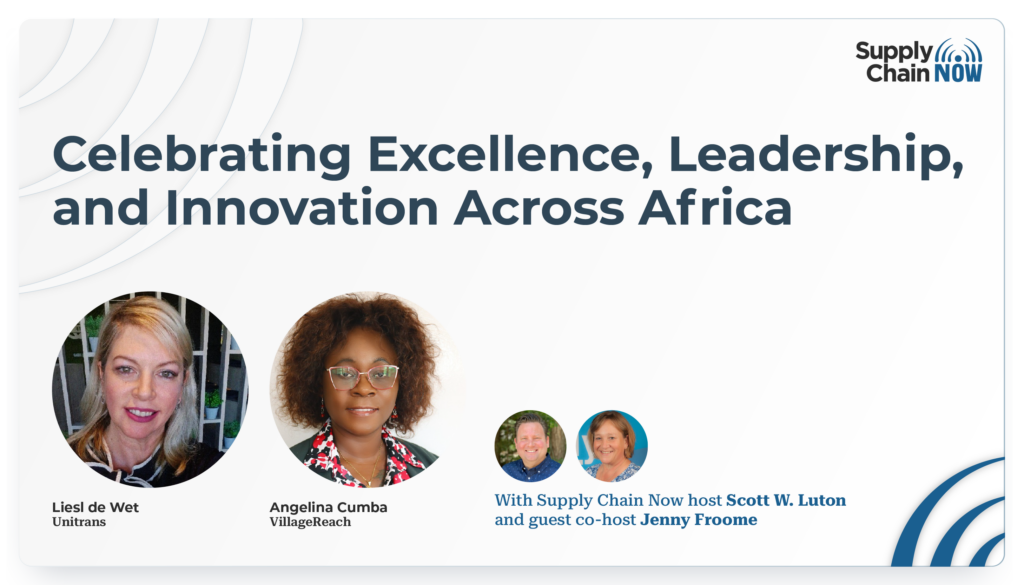
[00:02:02] Scott W. Luton: Alright, so help putting us with the conversation here today. We are joined Jenny and I by a couple of wonderful guests and friends, starting with Liesl de Wet. Director. Uh, and a big champion of the Africa Supply Chain Excellence Awards and Head of Accelerated Organizational Sustainability with Unitran. So it’s great to have Liesl join us, and she’s joined by Angelina Cumba.
[00:02:26] Scott W. Luton: Manager access to health products for one of our favorite nonprofits out there. VillageReach, and also a past winner of the Africa Supply Chain Excellence Awards in the humanitarian supply chain leadership category. Liesl, how you doing today?
[00:02:41] Liesl de Wet: Ah, Scott, I’m good. And you?
[00:02:43] Scott W. Luton: Wonderful. Uh, even better now that we have all y’all joining us here today.
[00:02:47] Scott W. Luton: And Angelina great to see you again. How you doing?
[00:02:51] Angelina Cumba: Thank you, Scott, Doing fine. Thank you so much for the invitation.
[00:02:54] Scott W. Luton: You bet, Jenny. Now, uh, uh, while Angelina and Liesl are friends of mine, y’all go way back, uh, Jenny, I think with these two Dynamos, uh, you ready for a great conversation and, and what do you expect from Liesl and Angelina here?
[00:03:11] Jenny Froome: I, yes, I’m very much looking forward to it. Yes, I go back a long way with both inspiring ladies, um, but I am expecting everyone listening to leave with one thing that is going to inspire them to be better, do better, and just learn from these incredible supply chain leaders.
[00:03:33] Scott W. Luton: I’m with you. And you know what?
[00:03:35] Scott W. Luton: I think you’re low balling with one. I’m, I’m expecting 17 things here today. Yep. From Liesl and Angelina and Jenny. So we’ll see. Uh, but hey, we’ll start with a fun warmup question and uh, Liesl. I’m so jealous ’cause you shared this in the green room. Uh, I love penguins. The couple times I’ve been to Cape Town, I’ve been con um, Jenny’s friends have been kind enough to take us to, uh, the Penguin Rescue Centers.
[00:04:02] Scott W. Luton: Uh, Ken, Ken Tetanus, by the way, shout out to Ken. Mm-hmm. And Liz, one of your hobbies is adopting penguins. Tell us more.
[00:04:09] Liesl de Wet: Absolutely. Well, um, SANCCOB, the South African National Conservation of Coastal Birds in South Africa. You can adopt a penguin. Anyone can go and adopt it. And it’s basically they allocate one of their rescue penguins to you virtually.
[00:04:23] Liesl de Wet: So you don’t actually take the penguin home, sadly. But you pay for the rehabilitation of that. Penguin and the funding then goes towards the rehabilitation of other penguins. And there’s lots of things you can do. You can adopt an egg, you can adopt a hatchling, you can provide, adopt, pay for some food for them.
[00:04:41] Liesl de Wet: And they’re really, you know, our penguins are, and they’re critically endangered wildlife list, and they’re such an important part of our biodiversity, and that’s what they represent to me. Uh, they’re a very important key. And I stay close to Simons town and you know, I get to go and walk on the boardwalk there, get to see the penguins in their natural habitat.
[00:05:02] Liesl de Wet: It’s just an amazing thing to see. And I think that’s one of the great things about living in Cape Town. You sort of immersed in that biodiversity, which makes the mission and the passion around sustainable supply chain very tangible for me.
[00:05:15] Scott W. Luton: Oh my gosh, Jenny Froome. I love all of that and, and quite a picture that Liesl paints and plus, come on, it’s penguins.
[00:05:23] Scott W. Luton: Who, who doesn’t like penguins? Your thoughts are Jenny,
[00:05:26] Angelina Cumba: gorgeous. A
[00:05:27] Jenny Froome: hundred percent. And having been there myself and seen them in their natural environment and doing the site visit to SANCCOB a couple of years ago at the SAPICS conference, and hearing everybody’s inspiration about the work that these people do to preserve the lives of this valuable animals on our planet, it’s really very, very, very humbling.
[00:05:53] Jenny Froome: And it makes us realize that we all need to do more to protect this, these species while they’re still alive.
[00:06:01] Scott W. Luton: Jenny well said. You see the difference between me and Jenny, all you gotta say is Penguins with me, Liesl. And I feel like a 5-year-old. Again, Jenny, as always, is poetic and challenging us to a leadership, uh, uh, initiative and imperative that we should all accept.
[00:06:16] Scott W. Luton: So, Jenny, well said, as always. And folks, if you go to Cape Town, uh, you gotta go to the beaches and see the penguins, but you also gotta go to the nonprofit organizations that rescue, uh, these penguins because that really is just, uh, remarkable. Okay. So we’re gonna shift from penguins to some of where Angelina spends her time, her, her free time when she’s not doing big things in supply chain, singing and cooking.
[00:06:41] Scott W. Luton: Angelina, I love the combination, so thank Tell us more.
[00:06:47] Angelina Cumba: Yes, that’s, uh, I love pink. Me, unfortunately. Done thanking in Mozambique. Uh, but I love sinking. Uh, sinking is the opposite of my day-to-day life. It allows me to slow down, breathe. And simply be present. It’s not about performance metrics, about expression and joy and cooking on the other side.
[00:07:09] Angelina Cumba: I love cooking give for people. It’s deeply personal. I love exploring different flavors and dishes special from different culture. Uh, food tell stories, so about identity, history, and community. I always like to try different types, so there’s something powerful, but it’s just. Taking simple ingredients and transform them into a meal that brings people together around table conversation happens, laughter happens.
[00:07:34] Angelina Cumba: So these are the two things that really brings me to that space in many ways. So sinking it quickly, keep me balanced. They remind me that while structuring is important, supply chain is important in my way, creativity, connection, but I just as a sunshine life. So that’s my two things, cooking and singing.
[00:07:53] Scott W. Luton: I love that Angelina, and as you said there, food does indeed tell stories that brings folks together. Yes. And yes. You also painted quite a, a table. And I should just say that I enjoyed singing and cooking and, and then Amanda that made me stop singing and then stop cooking. Uh, so, but Angeline, quick follow up question before I get Jenny’s take.
[00:08:14] Scott W. Luton: You mentioned some of the food you like, right? A diverse culinary styles and, and types of food. Yes. Singing. What, what do you sing? What’s your favorite genre?
[00:08:22] Angelina Cumba: Oh my God. Yeah. I love syncing gospel music.
[00:08:27] Scott W. Luton: I do too.
[00:08:28] Angelina Cumba: I like gospel. Yes, I like singing gospel music. I think it’s my own way of con confessing with God.
[00:08:34] Angelina Cumba: My own way of talking to God, talking to the universe, or talking to high power. Like I, it’s really, it’s because I’ve be thinking from my soul and I, I love, I connect and I’m there that moment. So because each and every word, it’s like I’m communicating to someone. So I’m like it. F
[00:08:51] Scott W. Luton: Fantastic. Fantastic. All right.
[00:08:53] Scott W. Luton: So, uh, we heard a lot from Liesl and Angelina, but Jenny, your quick comments first, do you sing, uh, why and why You Cook as well? Jenny?
[00:09:02] Jenny Froome: No, apparently I’m a really bad singer, but I think, I think I sound like Olivia Newton John, which is the, the My Idol. And I always wanted to be just like her, but sadly, apparently not.
[00:09:15] Jenny Froome: My brother has a tape of me aged about 14 singing, uh, hopelessly Devoted to You, which I think he’s. Still has and threatens to bring out every man again. So no, singing is not my thing. Cooking, I wanted to be a cookery teacher, um, home economics teacher, and because of that, I hate cooking now. So interesting.
[00:09:39] Jenny Froome: Just as well, I never became that teacher.
[00:09:42] Scott W. Luton: Well, well, on a related note though. Because one of the themes here, and we’ve talked about, uh, really over the years is that work life balance. And no matter if you’re seeing or you cook or you take care of penguins or many other things, just important that you find that your, your, your thoughts here, Jenny.
[00:09:59] Jenny Froome: Yeah, so very, very near and dear to my heart right at the moment. I’m in recovery from, uh, quite a serious, um, brain bleed back in June, and I realized that I really don’t have any hobbies because I have spent the last 30 years working and promoting. Supply chain management, and now every time I switch on the television, everyone’s talking about supply chain management.
[00:10:27] Jenny Froome: You can’t escape it. So I urge every single supply chain professional out there. Find a hobby now, so that should, God forbid anything bad happen to you. You’ve got something that takes your mind off. Anything negative, you’ve got somewhere to escape to. You can sing like Angelina or you can walk on boardwalk with penguins, but find that hobby because it’s just so important not to lose the, the passion for something other than your work.
[00:10:59] Scott W. Luton: Well said, and
[00:11:00] Angelina Cumba: Greg
[00:11:01] Scott W. Luton: well said, right said. And there, there’s one actionable. That’s the first actionable piece of advice you’re gonna get from this awesome panel here today. So, uh, Jenny, well said, and great to see you, uh, back up in Adam and doing what you do. So, uh, Jenny, Angelina and Liesl, look forward to a great conversation here today.
[00:11:17] Scott W. Luton: Now. We gotta get into business and supply chain. That’s what we do. So before we start talking about the Africa Supply Chain Excellence Awards and the program and the opportunity in some of the winners, like we got one here today, I want to get all of y’all’s observations on some of the top trends impacting supply chains, really across the African continent.
[00:11:37] Scott W. Luton: We can talk global if you’d like, or you can talk, uh. Different parts of Africa, different countries, as we all know, is a continent field of wonderful, uh, nations and communities and traditions and people. So, Liz, I wanna start with you. When you think of a couple of top trends or topics that’s front and center here today, at least maybe from your per uh, purview.
[00:11:58] Scott W. Luton: What would you share with us?
[00:12:00] Liesl de Wet: So for me, obviously something close to my heart with the portfolio I’m in is sustainability within supply chains. And I’m not talking financials, well, financial sustainability for sure, but definitely the impact of climate change and climate related weather on supply chains.
[00:12:17] Liesl de Wet: I think it’s become quite a risk we’ve had. A lot of hectic weather globally, even from the beginning of this year. We have geopolitical issues potentially impacting our supply chains. And the resilience and the adaptability is, is essential now. And I think we, we are heading into a world where we’re gonna have a lot.
[00:12:36] Liesl de Wet: More disruptions and how we negotiate that. How do we move goods around if there’s not enough fuel? You know, what alternatives are there in order for us to transition to cleaner energy. That’s really important and I think Africa has got a great advantage here in terms of leapfrogging already what’s happening in more developed nations and building.
[00:12:57] Liesl de Wet: Starting off on a, on a correct note, the role of technology is another massive. Game changer. And that’s evolving as, as time is continuing. But you know, we’ve got AI coming in now, what does that look like? We’ve got robots and warehouses. There’s all sorts of exciting developments. But what does that mean for us?
[00:13:16] Liesl de Wet: And I think especially in a continent such as Africa, what does that look like? What does it mean when a lot of households don’t even have access to basic electricity and water? You know, how do you navigate that and bring that into the, the supply chain? So those. To me are, are, are two big game changers.
[00:13:33] Liesl de Wet: I think technology will change a lot of things and. You know, just getting the fundamentals right, you know, there’s some simple solutions that one can actually embed in supply chains, especially in African supply chains that might not be happening, like a cold storage or cold chain solution, which.
[00:13:53] Liesl de Wet: Enables product to get to market in a better condition will enable the solution to be more sustainable. That needs to be focused on. So I think we shouldn’t lose sight of getting those fundamentals right, getting um, those processes right. That’s key critical as well.
[00:14:10] Scott W. Luton: Liesl, uh, uh, what a terrific macro view of so many things that, that, um, of course are impacting supply chains across Africa.
[00:14:18] Scott W. Luton: But a lot, every part of the world, uh, from technology to climate change, to of course how organizations are, um, kind of trying to unlock the sustainability imperative that’s out there. And I would argue that some folks may say that, ah, it’s taking a back seat, I think. A lot of leading organizations.
[00:14:35] Liesl de Wet: Definitely
[00:14:35] Scott W. Luton: not. Uh, it hasn’t, yeah. Liesl also, you, you mentioned, um, of course, uh, the fundamentals, right? In this golden age of supply chain tech, there’s still so many process and human driven fundamentals that could unlock big, big gains, uh, with any organization. So, good stuff there. Liesl. Jenny, I want you to get you to comment really quick before I shift over to Angelina.
[00:14:59] Scott W. Luton: What was your favorite observation there that we heard from Liesl?
[00:15:04] Jenny Froome: Yeah, I think everybody is immediately attracted to the bright blingy solution or the bright blingy process, or we forget the fundamentals. We forget the basics, and I think especially here. In, well, I’m talking from a South African perspective, but also an African perspective.
[00:15:23] Jenny Froome: There are so many basics that people don’t even think are basics, and I know Angelina can talk more to that from the work that the community health worker has to do, that VillageReaches such a great supporter of, um, they, they have to magic. Supply chain processes out of nothing that forget ai, forget anything.
[00:15:48] Jenny Froome: So there’s, there’s, there’s a, a, a heap of fundamentals that we, a, mustn’t forget, and B, the people part of that process is still phenomenally important.
[00:16:00] Scott W. Luton: That’s right, Jenny. That’s right. And by the way, Angelina, I’m coming to you. Uh, folks. Go run. And go check out VillageReach.org and learn more about the mission that, uh, Jenny mentioned.
[00:16:10] Scott W. Luton: Uh, it’s a terrific, terrific organization. Angelina, same question. Trends that you’re seeing impact, uh, you’re, you’re part of the world.
[00:16:19] Angelina Cumba: Yes. Thank you. Uh, think you, Scott. So what I see supply chain across Africa are the turning point. We are moving away from seeing logistics as a transitional activity, simply moving good from point a, point B.
[00:16:34] Angelina Cumba: But we are seeing towards viewing supply chain as a strategic system design. So this shift is very important because system determine outcome, right? When the structure improve, performance improve, and when performance improve, slice improve. So we are seeing, for example, we are seeing the recognition that supply chain requires trained professionals special.
[00:16:55] Angelina Cumba: Human health workers as, uh, Jane shared like governance from where structured performance management, it’s no longer an administrating afterthought. And we also see that government now are increasing exploring private sector engagement, having structured public private partner. Not as a shortcut, but as a strategic for efficience and also caught, uh, transparent.
[00:17:20] Angelina Cumba: I think one of the thing also that I’m seeing more special post COVID, uh, Scott supply chain resilient is not understood as a national security and in public health sector where I’m working, resilient is directly linked to equity. So it’s a question of who received the medicine on time. And who doesn’t.
[00:17:39] Angelina Cumba: So the biggest shift is that supply chain is now seen as a development accelerator. Uh, not just as a one of the technical thing, but I think we are really moving the right direction. And I just comment on what Liz said about the sustainability. It’s not only environmentally, it’s also about operational and financial.
[00:17:59] Angelina Cumba: You know, it’s not, it’s a system. If a system is sustainable, when it come, it can continue functionally effective over the time. Even under pressure. It’s, it’s, it’s very sustainable. And also as technology plays a big role right now, it just talks about ai. So digital tools can improve it. Ability, uh, also strengthen focusing, but it needs to fit into the reality.
[00:18:23] Angelina Cumba: It needs to make sense. So Africa is in the right direction, but we need to make sure that we have the right leadership, right mindset, and the right culture and the right, uh. Regulation and policy that allows to integrate these new beautiful things that are happening in supply chain.
[00:18:41] Scott W. Luton: Angelina, well said.
[00:18:42] Scott W. Luton: Uh, a couple of my favorite parts there. We heard there, uh, from Angelina, Jenny. It’s really interesting to see some of the innovative relationships and partnerships between the public and the private sectors. Right? And Angelina and VillageReach has got lots of examples of that. Uh, folks who have to reach out.
[00:18:58] Scott W. Luton: And then secondly. Uh, the holistic definition of sustainability. I think a lot of times as humans, our brain goes to very certain portions of the sustainability equation, just without even thinking. And I liked her very holistic, um, thoughts there on what sustainability really means to organizations. Uh, your thoughts, uh, Jenny?
[00:19:17] Jenny Froome: Yeah. I think that, you know, for me, sustainability has always been about the training of supply chain professionals and making sure that there is a constant. Pipeline of people who, A, know what the profession is, and B, how to do it no matter what industry or sector they decide to go into. Because without that then supply chain management is itself, is not sustainable.
[00:19:45] Scott W. Luton: Hmm. Interesting. Jenny Froome. Uh, Liesl, Angelina, Jenny. Good stuff. Um, alright, so I, I really wish we had a couple hours just to explore what all three of y’all shared in just your observations of industry. But we gotta celebrate the Africa Supply Chain Excellence Awards. And I’m gonna, we’re gonna get to the why first, and then we’re gonna get, uh, we’re gonna celebrate Angelina’s.
[00:20:07] Scott W. Luton: Uh, award is one of the winners, uh, uh, last year, I believe. So let’s start with the why first, Jenny, let’s start with you and then we’ll get Liesl’s, uh, take here. But when did the ASCEA start and why did it start?
[00:20:21] Jenny Froome: So I blame Liesl Devet entirely for this, um, over tea. One day she challenged me to partner with her in starting up ASCEA, as we affectionately call it, because.
[00:20:37] Jenny Froome: Supply chain management across Africa needs to be celebrated or excellence. And for me that was, you know, at the time working with Saex and Champion, championing, you know, that word were all through, through constantly. It was a natural platform for us to progress to and to help set up. And from that moment it has.
[00:21:02] Jenny Froome: Been such a privilege. And the judges that we work with, and I’m sure Lisa will talk more about them, but the, the experience I think we worked out, there’s like 500 years worth of supply chain experience. Wow. Between them, um, it, it’s, it’s outstanding, it’s exceptional. And anybody who. Old people can’t bring things to the table.
[00:21:26] Jenny Froome: Doesn’t know our, not that they’re old, but the experience that they bring and the, the, the mentorship and the advice and just everything that they bring to these awards is absolutely outstanding. So five years ago, that’s where it started. The why is because we wanted to celebrate supply chain excellence across the continent and the how is by collaborating with really, really clever, exceptionally talented individuals who are as passionate about supply chain management in Africa as we.
[00:21:59] Scott W. Luton: Outstanding. So, Lisa, before I get your take here, uh, I wanna share this with folks. Folks, we wanna learn more about Askia. How about that ASCEA, the Africa Supply Chain Excellence Awards go to ascea.co.za or some folks say “zed” A, uh, you can go find the URL and A wealth of information and nominate, nominate, nominate Liesl.
[00:22:26] Scott W. Luton: What would you add to that, uh, origin story that Jenny just shared?
[00:22:29] Liesl de Wet: No, just I had a passion for supply chains. We’d just come out of COVID and we wanted to bring something back to the industry. We wanted to uplift, you know, the, the supply chains took a, a big knock under COVID and, you know, we wanted to give something back and look at Africa because Africa defines resilience.
[00:22:49] Liesl de Wet: You know, there’s a saying that Africa’s not for sissies, and it’s very true. You know, you, you need to know your staff in Africa and. Simplistic supply chain or even a complicated supply chain model looks very different than a European one, for example. And I wanted to celebrate that. And we wanted to create something.
[00:23:09] Liesl de Wet: And our, one of our taglines is by the industry, for the industry, a culmination, a group of supply chain professionals who’ve been in the industry for many, many years getting together and saying, right, let’s evaluate these entries. Let’s see, you know, where they’re, what they’re excellent at, and. Let’s share the stories.
[00:23:29] Liesl de Wet: Let’s share the stories and the conversations to inspire and highlight things that worked well in, in this space. And I’m delighted that we, five years down the track, I mean, there were years there that I thought, geez, like how are we gonna keep this going? But it’s just every year we get these most incredible entries in that are so inspiring and it’s, it’s one of my favorite things at the moment, is to listen to some of these great supply chain stories, and that’s why we do it.
[00:23:57] Scott W. Luton: Hmm, Liesl. I love it. And clearly you and Jenny and the team approaches this as a, um, um, a project of passion and that comes across and how both of y’all spoke to it. So Angelina, hearing that from Jenny and Liesl, you know, kind the why, the how, the, the what and all that good stuff and the need I would add to that.
[00:24:18] Scott W. Luton: What’s your observations there, Angelina?
[00:24:21] Angelina Cumba: So for me, I always say everyone loves me. I’m very passionate about supply chain. So for me, winning, uh, the Africa Supply Chain Excellence, our work was not about the trophy. It meant something because it shows that the work we do, strengthening public health sectors, VillageReached truly matters.
[00:24:40] Angelina Cumba: It was a recognition that the real changes possible when we,
[00:24:45] Jenny Froome: um,
[00:24:47] Angelina Cumba: work together, we improve our system in a structured and in management way. And at the end of the day, supply chain for me is not about tracks who are out. It’s about people. It’s about whether the clinic has vaccine or children has vaccine.
[00:25:03] Angelina Cumba: It’s about whether the mother can receive treatment or not. It’s about trust in the health system. So this program, people, they really need to see that. It’s just, it’s beyond. Tools, processes. These are new people. These are the, this a program that really bring solution for Africa and you wouldn’t need to embrace it.
[00:25:23] Scott W. Luton: Angelina, you know, one of the things I heard there in your response beyond, you know, there’s certainly a big need to celebrate. Yeah. And recognize and, and yeah. Um, you know, uh, call time out for a second, uh, amongst all the work and leadership we do and, and celebrate those folks of making a, you know, that are driving industry forward.
[00:25:41] Scott W. Luton: But one of the things I heard in your response there, Angelina, is. The power to, to share these stories and these ideas and these outcomes and how, and how they’re generated with the rest of industry. Uh, so it helps to drive innovation no matter where again, your organization may be or what industry you may be in.
[00:26:00] Scott W. Luton: Yes. And does that, is that one of the things you were communicating there?
[00:26:03] Angelina Cumba: Yes. That’s one thing that I would communicate. And I also wanted also to, to say that the AWA reminded us that, I don’t know, can you hear me? I’m hearing some echo. Uh, the, the award reminded us that Africa has the talent and capability, you know, to design really strong solution.
[00:26:19] Angelina Cumba: So what actually we need is discipline, courage, and improve what is working with confidence in our own solution. So this program really bring the work that is being done, talking from the VillageReach. When the system becomes clear, more organized will save lives, your planning progress, your control cost, be.
[00:26:41] Angelina Cumba: Most important, you increase access, especially for the rural and underserved community. So for my personal, that is why I do this work because behind every distribution plan, behind every process, there are real people waiting.
[00:26:57] Scott W. Luton: So clearly Angelina Cumba and VillageReach are certainly one of our favorite winners in stories and organizations doing great work serving a noble mission.
[00:27:08] Scott W. Luton: And that really begs a question, Liesl and Jenny, and it’s not a fair question because we’d be here all day talking about some of your favorite stories of winners and nominees over the years. But Liz, I’m come back to you first. What are a couple of those that you’d share that were some of your favorites?
[00:27:25] Liesl de Wet: So I actually wanna highlight two that are, that are my favorites. The one was from SA Harvest. There’s a lot of hungry people in South Africa particularly. I mean, the number is quite staggering. I used to work for an NGO many years ago in my career, and then as we were talking about a million children go to bed hungry.
[00:27:44] Liesl de Wet: Now the numbers jumped to more than that and. It’s quite, it’s, it’s significant. And they had a solution which used reverse logistics and also their own supply chain solution to feed over a hundred thousand meals a day. I mean, that’s significant. And not only that, from an environmental perspective, by avoiding food to landfill, they saved about, I think the number has 53,000 tons of carbon emissions avoidance landfill.
[00:28:10] Liesl de Wet: So it’s, it’s a. Great story of not only addressing a, a societal need, but then also addressing an environmental need that came together using circular economy principles, which is great. Such as reverse logistics. My second one is we have a university here called the University of Stellenbosch, and they partnered with a EV bike company called Roam.
[00:28:34] Liesl de Wet: And created a bike and actually traveled from Nairobi, from to Nairobi on this bike and charged along the way with solar charging power and, and looked at that microgrid of EV bikes. And it’s so exciting. And, and how they could carry loads and ’cause it’s amazing what, what. Happens on bikes, uh, especially within the African context, the type of things they move, even livestock and, you know, a lot of wood and heavy stuff like that.
[00:29:01] Liesl de Wet: And they tested it out on the bikes and they got to meet the communities they drove through. In fact, they’re actually gonna be doing a documentary on, on this trip, in this journey. But it was done by, by students and very exciting, you know, testing that and partnering, understanding how. They run in these kind of conditions, maybe with a road infrastructure, it’s not as good as what it could be.
[00:29:24] Liesl de Wet: And I really love that. It’s an, it’s a cleaner alternative. So that was a great story as well.
[00:29:29] Scott W. Luton: Love both of those. And there’s many, many more where those two came from and where Angelina came from. So many
[00:29:34] Liesl de Wet: more.
[00:29:35] Scott W. Luton: Uh, so folks, again, you’ll have to plug in. And Jenny, uh, again, it’s an unfair question, but a couple of your favorites that come to mind.
[00:29:42] Scott W. Luton: And by the way, I should just check in with you that University of Stellenbosch, that Liesl mentioned. Is a term of endearment there. Is it tel? Is that what I’ve heard you say earlier? Is that right?
[00:29:52] Jenny Froome: Yeah.
[00:29:52] Scott W. Luton: Yeah. Alright. So Jenny, I love that, uh, we love nicknames around here. What’s a couple of your favorite stories?
[00:29:58] Scott W. Luton: Winners, you name it.
[00:30:00] Jenny Froome: So for me, and, and I still call myself a nons supply chain person because I’ve never been in the thick of it. I, I know running an event is equivalent to supply chain management, but it’s not the real nuts and bolts of it. But there have been so many. Different ones over the five years, and they’re all actually on the website.
[00:30:21] Jenny Froome: So if you wanna take a look, anybody who’s listening, who is interested, they really are. And they range from railway improvements, which is critical, especially in, in our country and across Africa. To the manufacture of explosives, to the oil and gas and all those industries that we traditionally equate with supply chain management and supply chain management efficiencies.
[00:30:52] Jenny Froome: My particular heart. Felt favorite from last year. Was it last year? No, year before, sorry. Was um, the Luke Foundation, the Luke Commission, which is an organization in Eswatini, formerly Swaziland, and they were exceptionally badly hit. During COVID, they run a hospital and they call their patients very, very important, their VIPs, and they just do everything with compassion and their supply chains on all levels.
[00:31:26] Jenny Froome: Not only are they life. Saving the whole drone deliveries that have had a fantastic result in black mamba snake bite deaths by getting the anti-venom people quickly in difficult situations, but also when during COVID, they couldn’t import oxygen because they imported from South Africa. What did they do?
[00:31:51] Jenny Froome: They built an oxygen. Manufacturing plant. And you know, that for me is just so symbolic of what, what we were talking about with African supply chains and resilience. And so that one definitely, I mean, long before the awards hearing their story was quite amazing. And sadly, as a. Of the, the funding cuts, et cetera.
[00:32:15] Jenny Froome: They’ve had a particularly hard time of it. But again, going back to resilience and passion and commitment, they continue to, to, to do the work that they were put there to do. And I’m full of admiration for everything that, that they do, but also what supply chain professionals do in general. And to be able to have a platform like.
[00:32:39] Jenny Froome: Um, the Askia is just so exceptional and I’m hopeful that we can shine the light brightly, brightly on Addis Ababa airport at the moment to learn, um, that that is going to be taking so much flack from Dubai, so not flack. So much of the, of the load from Dubai and from Doha, and people will hopefully understand what an amazing hub it actually is that I think that, you know, if we’re gonna try and find positives out of like negatives, looking closely at select supply chain solutions is definitely one that can do.
[00:33:18] Scott W. Luton: Well said. I completely agree. And I wanna go back to the Luke Commission. We enjoyed meeting, um, uh, I think it was Echo. Echo, Vanderwal, echo.
[00:33:26] Voiceover: Yeah.
[00:33:26] Scott W. Luton: Yeah. Um, so folks, if you wanna learn more about the Luke Commission and the incredible work they’re doing at Sini and probably through this region, you can go to luke commission.org and if you’re in a position to donate and help support the mission, please do.
[00:33:39] Scott W. Luton: Um, okay. So, uh, Angelina, until we get your quick comment, we heard some great stories there from Liesl and Jenny, some of their faves, and, and there’s so many, and folks, you have to go to the website to learn more. But Angelina, what stood out to you? What what’d you love about, uh, their stories there?
[00:33:55] Angelina Cumba: So these are stories, but first flight, these are your stories, real experience, and it really shows that, you know, with love and passion and working together, you know, as a continent, as a country.
[00:34:09] Angelina Cumba: We can really come up with solutions that can easily help our community without putting burden into the system. That’s why I was saying from, if you hear me from my comment when I was like, one of the things that we need to I give, like if you add advance to the leadership, I said leadership really require the confidence to examine the existing systems and ask whether they’re fit for the death reality.
[00:34:38] Angelina Cumba: Many of our system, we are designing different contents under different constraints. As environment involves, leaders must also be willing to adapt and improve them, and respectfully and collaborative of course. So it’s really very important that we see supply chain as a live serving,
[00:34:59] Scott W. Luton: living and breathing, right?
[00:35:01] Angelina Cumba: Yes.
[00:35:01] Scott W. Luton: Living. Yeah.
[00:35:02] Angelina Cumba: Yes, yes, so, so strong supply chain really depends on a consistent attention to day-to-day data that helps to make decision performance. What is working, what is not working. Like you ask yourself, you know, when you’re designing a process or a strategy, you ask yourself very practical question, like, who is responsible when something goes wrong?
[00:35:22] Angelina Cumba: Where did delay usually happens? Who cares the risk when performance this week? What happens when the donor funding ends? So everything that Liz and Jen is saying, it really speaks volume and we really need to think outside the box because if those basic questions are not cleared and not answered, problem, repeat itself.
[00:35:42] Angelina Cumba: But we are seeing that most of the companies and organization last, my organization, I been thinking after the box is the story that, uh, Jen shared really tells us that we just need to breathe and really think. And we can find a solution together.
[00:35:59] Scott W. Luton: Uh, completely agree. And, you know, challenge all assumptions.
[00:36:02] Scott W. Luton: You know, there’s several things there Yeah. Mm-hmm. In your response. But, uh, you know. There’s Ron Popeil was a, uh, famous American infomercial king, and he came up with a variety of products over the years. And one of his trademark phrases that I’ve talked about a lot because it in, in part of my upbringing, was he had this device where he’d cook chicken and the rotisserie and his cat, his tagline was, set it.
[00:36:27] Scott W. Luton: And forget it, meaning the chicken would’ve a timer and all that stuff. Well, I’ve always thought about that in supply chain terms, especially here in the modern age where there’s very little when it comes to supply chain management that we can set it and forget it. And that kind of goes to one of the themes you were talking about there, Angelina.
[00:36:43] Scott W. Luton: Um, all right. So, uh, and rest in peace one. Dear Ron Popeil. Uh, alright, so let’s do this. I wanna share a couple images ’cause you, you folks, you need to get a, uh, kind of a look and feel. There’s lots of energy and love and passion and I’m gonna share a couple pictures. I think from 2024. I think y’all correct me if I’m wrong here.
[00:37:02] Scott W. Luton: Uh, but lots. Hey, enjoying Angelina, did you cook any of that? Um,
[00:37:06] Angelina Cumba: no, no. I’m glad to. I’ve glad to, but no,
[00:37:11] Scott W. Luton: I’m only kidding. Only kidding. I know your, uh, your passion for all things culinary, but lots of kindred spirits, lots of collaboration, lots of, yeah. Um, uh, camaraderie and fellowship, and you are talking about lights.
[00:37:24] Scott W. Luton: Jenny, man, look at the lights, the spectrum of lights in that gorgeous room there. And we want to just encourage folks, this is what you’re gonna find at the top. When you go venture over to uh, ASCEA.co.za, celebrate Africa’s supply chain excellence by the industry, for the industry, and o entries are currently open.
[00:37:49] Scott W. Luton: They’re all due April 30th, if I’ve got that right. So that’s just a month and some change. By the time this publishes a month and a half month way. So act now. Okay. I like Ron Pope there a little bit. Uh, Lisa Liesl and Jenny and Angelina, uh, channeling my inner infomercial maybe. So Lisa, I’ll circle back to you and I wanna talk about what’s new for ASCEA in 2026.
[00:38:19] Scott W. Luton: Uh, what comes to mind? Liesl.
[00:38:22] Liesl de Wet: Well, we definitely getting a higher standard of entry than what we got before and earlier, which is great. You know, usually it’s like a last minute.com, everything comes flying towards the end, but we’re seeing a really higher level of entry now, which is, which is exciting. So I’m looking forward to that.
[00:38:40] Liesl de Wet: We’ve also got, uh, some new sponsors on board, which is exciting, and we’ve got a, a new headline sponsor called Newland. They’re a property group, uh, in warehousing, et cetera, and we are very excited to have them on board. So that’s really gonna help us a lot. So really excited about, about these things. And actually, you know, with Jenny and the team, it’s, we really are looking at taking the awards to just that next level up.
[00:39:06] Liesl de Wet: We can feel there’s a shift, a level up shift, and, um. Looking forward to sharing the new stories with everyone from the new award entrance. But I’m really excited about the future. I think Africa is a lot of business opportunity and it’s growing at a rapid rates, and we are great that we are on the forefront of that growth moving forward.
[00:39:29] Scott W. Luton: Liz, I love it. Uh, lots of things to be excited about. And Jenny, man, the, uh, the competition gets tougher and tougher. Your, your thoughts on what’s new this year?
[00:39:39] Jenny Froome: Yeah, I, for me, I think it’s the understanding of supply chain management that is new. Every news item that you listen to, somebody’s supply chain is being affected or disrupted or something.
[00:39:55] Jenny Froome: So more and more people are realizing, oh, hang on. I actually am doing what they’re talking about. So there’s a lot of free advertising, if you like, because. Five years ago or before COVID, actually COVID was probably our greatest, uh, advert, was that people didn’t know what supply chain management was. Now they know more, and it’s not just when it doesn’t work, they know about it.
[00:40:22] Jenny Froome: They’re actually starting to question it and value it now. And I think that that, that for me is what’s new. As a result of which there are lots of different people talking about lots of different elements of supply chain and I think that, you know, to be able to hold our heads up and say we celebrate end to end supply chain management is what makes me very, very proud.
[00:40:49] Jenny Froome: And I think that that’s something that the judges have instilled in us is that it doesn’t matter what industry it comes from, that judging the supply chain. And the end results. And I think that’s what, what really we go into 2026 with that at front of mind.
[00:41:06] Scott W. Luton: Love that. Uh, Jenny, and you know, some folks will say end to end supply chain is a phrase that has long gone.
[00:41:13] Scott W. Luton: I, I disagree. Yeah, I think for me it kind of illustrates some of the points you’re making and, uh, you know, it’s also interesting at the same time. I think that the phrase supply chain also continues to evolve, right? Generations ago, really, a lot of folks would argue it really meant to just the logistics and the movement, not just the, yeah, the logistics and the movement, right?
[00:41:34] Scott W. Luton: Transportation. But I love how it’s grown to be much more holistic, which is one of the themes in your response there. Jenny Angelina, I wanna get you to weigh in. So first off, are you ready to repeat, because it sounds like the competition. Has up the Annie, Jan, Angelina. You up to the task though, right?
[00:41:52] Angelina Cumba: I would like to, but lemme give chance to others.
[00:41:55] Angelina Cumba: ’cause I’ve learned a lot, you know, very like one of the educational process through this with the judges, like preparing you, give you and really help you to see things in different angles. So it was really an interesting process and I recommend people to. To participate, special women to participate in this program.
[00:42:15] Angelina Cumba: So yeah, regarding that, I’m, I am fortunately not this time because I’m still really processing all the learnings that I got from the, from the last event. So it was very, very interesting, uh, event and I really recommend people to join.
[00:42:32] Scott W. Luton: Love it. Uh, Angelina, I thought you were gonna start a dynasty, uh, of winning seven years in a row or something.
[00:42:38] Scott W. Luton: I You can do it. I know, but I, but getting aside, I, I
[00:42:40] Angelina Cumba: would to
[00:42:42] Scott W. Luton: getting aside, I I really appreciate your, um, your comment there about learning and, and you know, there’s so many. Whether it’s the ASCEA or whether it’s, uh, these developments that we see nonstop, there’s so much that we can learn and apply, uh, leadership wise, supply chain, management wise, you name it.
[00:42:59] Scott W. Luton: And I, I love your call out there. Um, hey, Jenny and Liesl really quick. I wanna double check, uh, a couple critical details. So April 30th is when the cutoff is, a deadline is for nominees, right? Mm-hmm. So, so folks,
[00:43:13] Liesl de Wet: mm-hmm. Correct.
[00:43:13] Scott W. Luton: Get the work,
[00:43:14] Liesl de Wet: go,
[00:43:14] Scott W. Luton: um, for nominees and I, and I should have read the. The details earlier, but is there a high level, um, um, not restriction, but is there a high level, uh, these are the African Supply chain excess awards.
[00:43:28] Scott W. Luton: Where do organizations need to be based, I guess, lethal.
[00:43:32] Liesl de Wet: Africa.
[00:43:33] Scott W. Luton: Okay. Alright.
[00:43:34] Liesl de Wet: So that is one of our requirements, uh, because otherwise would not be true to the name, but projects in Africa, um, headquartered in Africa, that’s, that would be perfect.
[00:43:45] Scott W. Luton: Okay. So, um, can, so international organizations that have it, as long as they have an operation or a footprint across
[00:43:54] Liesl de Wet: Yes.
[00:43:54] Liesl de Wet: Based, yes.
[00:43:55] Scott W. Luton: Okay, great. So really that’s a. I love the focus and also it’s open to a lot of folks. So folks get those entries in, uh, the dinner I want, uh, Jenny, August 19th, I believe, the gala where you celebrate the winners. Um, is that right?
[00:44:10] Jenny Froome: Yes, that’s right. And it’s in Harting. I was just gonna say one of those examples would be Books For Africa.
[00:44:17] Jenny Froome: That one, thanks to your introduction, Scott, and that’s an organization based in the us but what they do to enable. People to have access to books, thousands of books all around Africa is absolutely a supply chain of note. Um, so, you know, they entered, they won, they do incredible work. But I still, I go back to the, to that other industries as well.
[00:44:48] Jenny Froome: We’ve got lots of humanitarian examples. ’cause obviously those are the ones that I think we can all relate to. But there are some other outstanding industrial supply chain stories that, uh, are, are of equal if yeah, equal importance.
[00:45:05] Liesl de Wet: We are also looking for projects and, and case studies. Um, so we are not looking for individuals.
[00:45:12] Liesl de Wet: We want the supply chain story. So either the end-to-end or the project or whatever component it is. But it has to be a proper case study or project within the supply chain, all the entire end-to-end supply chain.
[00:45:27] Scott W. Luton: That makes sense. That makes sense. And all these details and guidelines of course are, can be found at the website.
[00:45:33] Scott W. Luton: Again, ASCEA.co.za and going back to what Jenny comment about Books for Africa, you can learn more great nonprofit BooksForAfrica.org. Uh, Fatima Lawson and my friend Patrick Plonsky, and of course the board and leadership doing great work there and celebrating a long legacy of, uh, giving Forward. Um, okay.
[00:45:55] Scott W. Luton: So open for sponsors, open for nominees, open for supporters. Uh, if you’re on the fence about whether or not you can support what’s going on, reach out to Jenny and Liesl. I’m sure they’ll find a way to get you plugged in. Um, alright, so Angelina, I’m gonna start with you on this next question. You’ve already given us, you’ve already answered this question, I think.
[00:46:16] Scott W. Luton: Numerous times, but I’m gonna circle back again ’cause I really enjoy your perspective. So when it comes to, leadership’s been a big theme here today, it usually is, yeah. When it comes to critical elements of supply chain leadership that really fuels organizational excellence and performance and winners at the a at at askia, um, what’s a one or two things that come to mind, Angelina?
[00:46:37] Angelina Cumba: So couple things come in mind, right? So I believe that. First leadership requires the confidence to exam the existing system, and that’s whether they are still fit for today’s reality. As I said, meno core system were designed in different contexts and under different concern, right? Is environment involved.
[00:46:58] Angelina Cumba: It’s very important for our leaders to really understand that, to adapt, uh, to the new reality. And one of the. Thing that I also would like to say is supply chain leaders is not only about, as I said, transported warehouse, it requires understanding the financial flow, like regulatory environment, holistical strain, uh, again, private, private sector engagement and community level reality, all these elements and interconnected.
[00:47:25] Angelina Cumba: So it’s very, very important. But the last point that I think is very, very important, Scott, it’s ownership and perhaps most important leaders must. Prioritized building local capacity, right? Our last mile, community health workers, our frontline people are crucial, especially on the public health sector. So when you’re saying sustainable excellence cannot be really indefinite on external support, long term resilience, you know, comes with assist.
[00:47:54] Angelina Cumba: Like local owned and local managed, continually strengthened, you know, our African ly uh, professionals. So for me, truly sustainability comes when, as Jen said, capacity embedded within our national system. So our leaders need to make sure that they understand that these are different times. Supply chain is no longer the same supply chain had years ago, we didn’t need to take a step back and say to our system, okay.
[00:48:22] Angelina Cumba: What should we need to do? What need to change? And make sure that we curate the local capacity that can be able to respond to the new, uh, environment in aging. Things that are coming right now, new generation must be ready for the, for this, uh, for, for these challenges. Also, our supply chain needs to be ready, but needs to start with the leadership,
[00:48:43] Liesl de Wet: you know,
[00:48:43] Angelina Cumba: leadership need of the right mindset, the right understanding.
[00:48:47] Angelina Cumba: The right culture to be able to address this new reality.
[00:48:52] Scott W. Luton: What a masterclass response and two of the many elements there, uh, ecosystem level views, right? Of the, so many, so many, uh, stakeholders that, um, make up. Uh, global supply chains, uh, as living organisms. Right? And then secondly, um, ownership, the power of ownership, uh, Angelina.
[00:49:12] Scott W. Luton: Yeah. And we heard her stress that, uh, is so, so important. Liesl, that’s gonna be tough. Uh, to add to that, I’m a thought provoking answer from Angelina, but Liesl, when it comes to supply chain leadership, in your view, that drives excellence in performance. Thoughts? Your thoughts?
[00:49:30] Liesl de Wet: Continuous improvements is a big one, and continuous improvement builds on solid foundation.
[00:49:37] Liesl de Wet: I think all those iterations of continuous improvement are essential to find that operational excellence. In your business. That’s very important. And the other one is also linking to that is one of my favorite quotes from Marcus Aurelius, who he says, what does not benefit the hive? Does not benefit the bee.
[00:49:58] Liesl de Wet: So we all living in this ecosystem, we all interconnected and. I think looking at just one part is, is very limiting. You do have to look at the whole end, end solution, and I said specifically also in sustainability. You know, you, you may have one part where you’ve got all this eco-friendly packaging and you’ve got solar on your roof and you’re doing everything great, but further down the supply chain, it’s not great.
[00:50:24] Liesl de Wet: Or further up the supply chain where you’re getting your raw materials from is, is not as green or energy efficient as what it should be. And so that has an implication. So you, you can’t just be excellent to this batch. You’ve gotta to look at the whole entire chain to be excellent and the role and importance of connections and people.
[00:50:43] Liesl de Wet: I think that’s often overlooked.
[00:50:46] Scott W. Luton: I, um, I agree with you largely, and also I’m, I’m still stuck on the B thing. I I love that phrase. Uh, Jenny, uh, I think Liesl said if it’s not good for the hive, it’s not good for the B
[00:50:58] Angelina Cumba: Indeed.
[00:50:59] Scott W. Luton: And that is such a, um, a great phrase, a new one for me. Uh, and by the way, we gotta save our bees out there.
[00:51:05] Scott W. Luton: We’re having, we’re having, so that’s a whole different story. Yeah. How do you, um, but Jenny comment. Comment, if you would, on what we heard from Angelina and Liesl on leadership. What, what, what’s the most important you do you think, in their responses there?
[00:51:21] Jenny Froome: I think that these days, leaders. Are not necessarily the traditional leading from the front, but there are multiple leaders who lead the small parts of the hive, if you like.
[00:51:35] Jenny Froome: Um, and, and to Liesl’s point, it goes back to collaboration and community, and I think. All four of us here today are absolute examples of how through that we are able to put on something as amazing as the Africa Supply Chain Excellence Awards. And we’re also able to have such a well-informed discussion now because we’ve got a great community and that global community is leadership in itself, and we need to just keep that going.
[00:52:09] Jenny Froome: That’s so important.
[00:52:11] Scott W. Luton: I’m with you, Jenny. I’m with you. And, and, and no matter how, uh, for all of us, no matter how small or how big your contribution is to keep it going, as Jenny mentioned, everyone has a role. And you know, one of my favorite phrases, Jenny, we’ve talked about this before, is, you know, if you wanna know how you move mountains, is through, uh, millions of small nudges, right?
[00:52:31] Scott W. Luton: And each of those nudges is very, very important. So, um, great stuff. Jenny Froome. Angelina Cumba and Liesl de Wet. I’m gonna ask, I wanna ask each of y’all, I wanna make sure folks know how to connect with you on anything you shared here today on how you might, can collaborate or celebrate your collective success and how you’re, uh, helping to change industry.
[00:52:52] Scott W. Luton: Liesl, let’s start with you. How can folks connect with anything you’re doing, uh, and connect with you?
[00:52:59] Liesl de Wet: I think the best is via LinkedIn. I have a, a very active LinkedIn page and I think that’s the best way to connect, uh, with, with the global community as well. And that’s exciting. And, and then just to add that Scott, I think passion with purpose is exceptionally important.
[00:53:16] Liesl de Wet: You can be passionate about something, but if you don’t translate that into a purpose and doing, you are not gonna move the needle. And. That’s just one message I’d really love to leave, uh, with your listeners today.
[00:53:28] Scott W. Luton: Yeah, I love that you’re not gonna move the needle or the mountain, uh, if you don’t activate, uh, and funnel and channel that passion into action and purpose as you put it.
[00:53:41] Scott W. Luton: Um, Angelina, good stuff. How can folks connect with you, my friend?
[00:53:46] Angelina Cumba: Yes. So if you said the easiest way is linked, I can find me actually thing, or you can just, uh, ignore me. angelina.cumba@villagereach.org and uh, I would like just to say to the folks out there, Africa does not like talent in the supply chain.
[00:54:05] Angelina Cumba: What we also like is a structured platform, you know, to showcase our excellence. So Africa supply chain excellence plays a critical role in our, in changing that narrative. So we need more African case studies, more African owned reforms, and more cross-country learnings. So that’s what I can leave with the folks right now.
[00:54:25] Angelina Cumba: Thank you, Scott.
[00:54:26] Scott W. Luton: That is outstanding. Angelina, I gotta ask you, before I circle back to Jenny, because I should have asked this earlier on the front end, but you mentioned your love for gospel music. Yes. Is there one gospel song that comes to mind that really has leadership, um, elements to it, or, or one of your favorite songs to sing?
[00:54:48] Scott W. Luton: Angelina.
[00:54:49] Angelina Cumba: Oh me?
[00:54:50] Scott W. Luton: Yes. Yes.
[00:54:51] Angelina Cumba: Oh, I thought I thought. Not me.
[00:54:56] Scott W. Luton: What’s one of your favorite songs? Gospel songs to sing? Angelina
[00:55:03] Angelina Cumba: I many, but the favorite one that I listen sing every day in the morning. It’s from. Who’s that name? Okay. The one is from Hillsong. Yeah. I am. And I like it. And from Tammy, man, so yeah. And so it’s a really, it’s one of those songs that just.
[00:55:21] Angelina Cumba: Pass your, your, your heart and, uh, you can deal with anything every, any day, anyone or anything. Yes.
[00:55:29] Scott W. Luton: I need to sing that song every morning. Be ready for the day. I love that, Angelina. Alright, so we’re gonna have you back and, and we’re gonna dive deeper into, uh, all things music and culinary, uh, stuff. Yes, Jenny, um, great.
[00:55:43] Scott W. Luton: And, and, and Angelina, we put it out there, you know, connect with Angelina and Liesl via LinkedIn also. Yeah. Uh, encourage folks to go check out, uh, villagereach.org to learn more about the mission they’re doing and, you know, yeah, they can use your support, uh, as well. So go check that out folks. Um, thank you Angelina kba.
[00:56:01] Scott W. Luton: All right, so Jenny Froome, thank you for facilitating a great conversation here today. Great to reconnect with Liesl and Angelina. How can folks connect with you on anything you’re, uh, you’ve mentioned here today and anything that you’re, uh, you’re driving out in the industry?
[00:56:17] Jenny Froome: So LinkedIn, obviously, um, I’m very active on that and I’m most active in following liking and supporting Scott Luton on LinkedIn as I got my, my badge from LinkedIn.
[00:56:31] Jenny Froome: But yeah, LinkedIn’s the best, uh, the best way. And, uh, and I think that the next one we need to do is we need to do a, a sing-along supply chain, sing-along and we’ll, it have Angelina as our, as our, as our mc.
[00:56:46] Scott W. Luton: I love that. I love that. You know what I
[00:56:48] Jenny Froome: like that
[00:56:49] Scott W. Luton: we gotta have, we the happy hour, gotta come back, sign,
[00:56:51] Jenny Froome: and
[00:56:51] during
[00:56:51] Jenny Froome: the pandemic let’s signs up when they hear it.
[00:56:54] Scott W. Luton: We’re gonna do it. We’re gonna do that. So stay, uh, stay tuned folks, and, and, and kidding aside, Jenny Froome, appreciate all that you do out there. All three of y’all really. But, uh, Jenny, great to have you back. Jenny Liesl and Angelina. Big thanks to all three of y’all folks again. Please check out the Africa Supply Chain Excellence Awards 2026.
[00:57:15] Scott W. Luton: It’s our fifth year anniversary, doing great things, celebrating incredible leaders like Angelina and, and the great work, uh, that she and her organization have been doing. And as you heard here. The stories are endless, right? But Ries close April 30th. So go get those in and, and support the program however you can.
[00:57:34] Scott W. Luton: Uh, big thanks to all of our wonderful panel here today. Uh, big thanks as always. Jenny Froome, always a pleasure to collaborate with you to our Supply Chain Now, global fam. I hope you enjoyed this conversation, support these awards, and if you can’t support these awards, go find awards in your neck of the woods and support the stories that help.
[00:57:53] Scott W. Luton: Innovate our industry, right, and transform the industry and leave no one behind. And with that note. You know your homework, right? I bet Jenny knows the homework that, that we issue all the time here. Uh, you gotta take one thing from Liesl or Angelina or Jenny Froome, share it with your team. Take your passion into purpose, as Liesl mentioned, and do something with it, right?
[00:58:16] Scott W. Luton: Deeds, not words. That’s how we are gonna move those mountains through all those millions of nudges. And with all that said, Scott Luton challenging all of our listeners out there. Do good, give forward, be the change that’s needed. And we’ll see you next time. Right back here on Supply Chain Now. Thanks everybody.
[00:58:31] Voiceover: Join the Supply Chain Now community. For more supply chain perspectives, news and innovation, check out supplychainnow.com. Subscribe to Supply Chain Now on YouTube and follow and listen to Supply Chain Now wherever you get your podcasts.