Intro/Outro (00:02):
Welcome to Supply Chain Now, the number one voice of supply chain. Join us as we share critical news, key insights, and real supply chain leadership from across the globe. One conversation at a time.
Scott Luton (00:15):
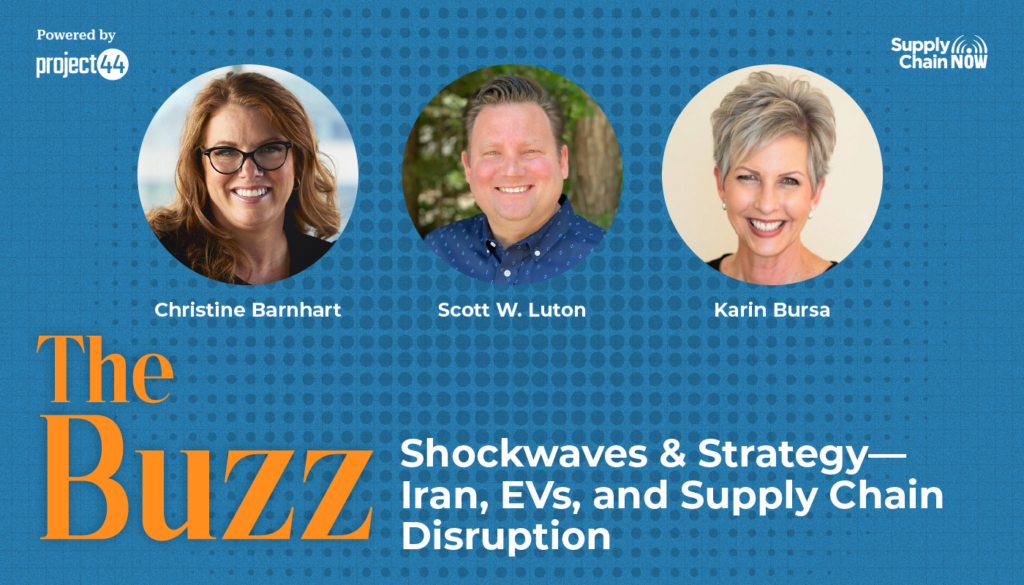
Hey, good morning, good afternoon, good evening, wherever you may be. Scott Luton and Karin Bursa, the one only here with you on Supply Chain now. Welcome to today’s livestream. Every Monday is the buzz where 12 noon Eastern time. We discuss a variety of news and developments across global supply chain and business. News that matters is what we like to call it. And the buzz, Corinne, the buzz this month is sponsored by our friends at Project44, the decision intelligence platform for the modern supply chain. You can learn how to bring more visibility, certainty, and success into your supply chain organization by visiting project44.com. We all need more certainty. Corinne, is that right?
Karin Bursa (00:54):
We all need more certainty. More confidence, more certainty. Yes. Better visibility.
Scott Luton (00:58):
All of it. All of it. Folks, we got a big show teed up here today. We’re going to be taking a look at an AI org chart for better or for worse. Of course, we’re going to be talking about the ongoing Iran war and global supply chain implications. We’re going to touch on the Rivian story. The saga continues. We’ll be celebrating the women of the revolution and we’re going to share a great coaching up moment where the focus is on handle, hard, better, all that much, much more, and it gets better. In about 15 minutes or so, we’re bringing in a special guest, Christine Barnhart with Meboch. Now, Christine is also known as Corinne, the supply chain whisperer. I love that. She’s one of our faves, always brings it on the shows. Big show here today. Corinne, you ready to go?
Karin Bursa (01:41):
I’m ready. I’m ready. I’m looking forward to it. I’m looking forward to hearing what Christine’s got to share with us today too.
Scott Luton (01:47):
Me and you both. So folks, vocal up for a big edition of The Buzz Powered by Project 44 right here today on March 16th. Let’s see. Alan Jacques is back with us. The Rodney Dangerfield of global supply chain. Great to see you, Alan. Tahib, great to see you, my friend. Let us know where you’re tuned in from and look forward to you and Alan and everybody’s perspective on the stories we hit here today. Okay. So Corinne, we’ve got four items on the front end and we’re going to start with an outstanding addition of with that said. Look at Corinne. You know that person that always talks about how great of a time.
Karin Bursa (02:20):
It is a great time to be in supply chain. I agree with her.
Scott Luton (02:23):
We had to get it in.
Karin Bursa (02:24):
Supply chain.
Scott Luton (02:25):
So folks, on the most recent edition, and we’re creeping up to 30,000 subscribers. Hey, week by week. Hey, we led with terrific perspective shared by two supply chain dynamos, Corinne Bursa right here, who by the way is the 2020 supply chain pro to know of the year and Tanger Rebellamy, a longtime UPS senior leader and an engineering hall of famer, at least in my book. Now, we spoke about their leadership journeys, the barriers that still exist for women in business and what industry can do better, must do better to continue to create more opportunities for all. Now, Corinne, I loved … Folks are going to have to go read the whole thing, but I took a quote from y’all both that I really liked. Tandria said, “I was fortunate to have a leader who pushed me to be a leader.” He would say, “If there are six people in the room and we all agree, I don’t need five of you.
(03:12):
” There’s a lot of power and gains made when you’ve got different perspectives represented in any room. So love that from Tandria and Corinne, I enjoyed learning something new about you. A couple things You gave us lots to think about, including your comment here where you said, “My leadership journey wasn’t shaped by one defining moment as much as by years of solving hard problems often as the only woman in the room.” Now, I think we would all be better off if not only we empathized with your perspective there, but even more importantly, we acted on it. So Corinne, I’d love to get you to respond to the article, what that said, those topics, you name it.
Karin Bursa (03:50):
Yeah. Well, first of all, with that said, if you are not subscribing to the newsletter, do it now because this issue, actually the last several issues, Scott, you have had so much good information in there. So it is a terrific recap of what’s happened and what’s coming in supply chain. So I encourage everybody to get on that list. Secondly, Scott, I want to thank you for raising women in supply chain in the last two issues. So this article where you invited Tandria, Bellamy and I to give you some of our personal point of view is part two really of a series that you’ve done. And I think our listeners are going to want to read both pieces. So I encourage you to do that. So I guess my final thought is opportunity matters, but I don’t want you sitting on the sideline waiting for somebody to come to you and say, “Oh, here’s your opportunity.” I want you striving for that, working for it, getting in the room, getting into the conversations, asking for the opportunities.
(04:48):
Raise your hand, get out there, make mistakes, take on some new projects and just look at it as a learning opportunity at every step of your career.
Scott Luton (04:57):
Well, said Corinne, and you’ve done it. We’ve seen you in action. I’ve known you for almost 20 years, if not over now. And you got folks that preach it, lip service leaders, I’ll call them, and you got folks that do it. So much like Corinne. So folks, take her good advice, practical advice to heart, and just do it like the famous shoe company. All right. So Corinne, we’re going to touch on all of that on the rest of the buzz here today. I want to welcome in a couple folks, Jonathan, tuned in via LinkedIn from the upstate of South Carolina, Greenville. Great to see you, Jonathan. Trisha’s dropped that link to with that said. So folks, we’re going to make it really easy. Go check out Corinne and Tandrea’s story. Ram Honey, I hope I said that right. Let us know what you think on the story is here today.
(05:38):
Andrew from Boulder, Colorado. Beautiful Boulder,
Karin Bursa (05:41):
Colorado.
Scott Luton (05:43):
I bet. I wonder what the weather is like out there. But hey, Andrew, I agree with you. We’ve got great guests here today. Great perspectives here today. And finally, Tohibi responded, joining in from Nigeria. You are well done, Scott and Corrine. Love that. Tohiv, Kindred Spirits there, my friend. Okay. So Corrine, we got a lot more to get to. That’s just the first one. And we got a great guest coming up in just a few minutes. Let’s talk about, I want to make sure this stays in front of y’all folks. National Supply Chain Day, April 29th. Join us 12 noon for a virtual event that’s going to feature a wide range of supply chain leaders and some recognition that we’re excited about. We got a new keynote, Billy Ray Taylor, author of the bestselling book, The Winning Link. Join us. Tricia dropping a link to that right there in the chat.
(06:22):
And then also, I want to talk really quick, Corinne, about the domestic freight market. How about that truck right there? How would you like to have one of those trucks in your driveway?
Karin Bursa (06:29):
That’s pretty cool looking. I got to tell you.
Scott Luton (06:31):
Like Night Rider or something. Yeah. Hey, our friends at US Bank continue to keep their fingers on the pulse of the freight transportation marketplace. Me and Corrine joined them for a great show a month or so ago. In a recent supply chain exchange article, Jeff Pape, I think is how I say that, head of transportation and public sector relationship management at US Bank. Well, you highlighted how trucking companies are responding to today’s challenging freight market. Now, as shipment volumes decline and capacity tightens shippers, well, they’re paying more. And forward-looking carriers have got to adopt new technologies to remain competitive. Jeff goes on to explain how modern platforms, APIs and AI, streamline freight invoice audit and payment processes, reduce errors and improve visibility, reinforcing how innovation helps companies manage current pressures while positioning their operations for resilience in an uncertain market. There’s a ton of great information here.
(07:23):
Go check it out. We’re dropping a link right there in the chat. And for more strategic insights from US Bank, they’re releasing their Q2 Freight Payment Index rates edition on Wednesday, April 1st. No April Fool’s joke. Go check it out. We’re dropping the link right there. Tell you, Trisha’s right on it here today. Drop the link right there. You can go check it out. Corinne, that was a great show. We covered a wide range of economic and supply chain and of course, transportation topics. It’s a good show,
Karin Bursa (07:50):
Huh? Yeah, I really enjoyed the conversation. It was so great to have a practitioner along with Bobby from US Bank going through some of the nuts and bolts of the trends that we’re seeing. I just found it a really engaging conversation.
Scott Luton (08:06):
I’m with you. And of course, joining Bobby, as you referenced, we had the supply chain leader from Ferguson, which has a great organization that he has to manage, the supply chains and more. So go check that out folks and make sure you download that market and data driven research. Okay. One more thing before we bring on the supply chain whisperer. Corinne, you dropped just a couple days ago. This great cartoon from one of our favorites, Tom Fishburne, the marketoonist. Folks, you can go check all this stuff out at marketoonist.com, but it was about this AI org chart and you’re encouraging folks to take certain steps. Tell us more, Corinne.
Karin Bursa (08:44):
Yeah. Yeah. First of all, if I ever get to come back for another life, I hope I come back funny because I really enjoy humor, especially in the work environment and having something that can just kind of relieve the stress in the room. And I saw this cartoon, this AI hierarchy or org chart after having a pretty heated conversation with some supply chain executives as they’re struggling right now to look for those positive use cases in their organization and asking, do they have to establish a brand new organization to do this work or do they bring it into their existing supply chain operations? And I kept coming back to, do we know what the use cases are that you’re trying to solve for? Because if we don’t know the use case, we can’t define what good looks like. And let’s not recreate the organization yet until we truly understand the problem to be solved, the opportunity, and then the skillsets we need and figuring out, do we upskill?
(09:44):
Do we have to bring in new resources? It was just the timing of Tom Fishburne. He is so in touch with the conversations I’m having. I’m wondering if he’s tracking me on the internet. I’m not sure. But I love his comics. I encourage everybody to go out there and subscribe because you’ll get some chuckles out of it. And I find when you laugh like that, it’s because it’s hitting home just a little close on a certain day.
Scott Luton (10:12):
Corinne, you nailed it. It’s funny, number one, but it’s smart. And really, he’s capturing a lot of those business conversations as Corinne’s mentioned. Maybe he’s tracking Corinne down from conversation to conversation. Maybe
Karin Bursa (10:24):
He’s listening to the buzz.
Scott Luton (10:26):
Maybe so. Maybe so. We’re going to connect with Tom, but we also included Corinne’s post. Share your comments, share your take. You agree, disagree, you name it. What does that cartoon speak to you? Go check it out. Okay. So we knocked out four things. We knocked out our pre-work. Now, Corinne, we’ve got a great guest, one of our faves, one of our friends in Dynamo’s joining us here on The Buzz powered by Project 44. Christine Barnhart, again, AKA the supply chain whisperer, blends over 25 years of real world experience with a sharp, unfiltered perspective on what truly moves the needle in manufacturing supply chain. From the plant at Whirlpool to driving transformation at Berry Global and Mead Johnson to executive roles like her current one, shaping product innovation, go- to-market strategy and industry ecosystems. Christine’s career has been about connecting dots that others miss in delivering results.
(11:16):
Others say, “It’s not possible, Christine. It’s not possible.” She shows them wrong. And she’s been recognized with lots of awards and accolades over the years to list too long to name, much like Corinne. Now at Miebach, she serves as head of industry engagement and alliances. You can also find her supporting her Cincinnati Bangals whenever she has a free weekend. Please join me in welcoming Christine Barnhart with Miebach. Hey, hey, Christine, how you doing?
Christine Barnhart (11:41):
Hello. Good morning. I’m great. How are you?
Scott Luton (11:44):
Well, we’re doing fine. Now, Corrine, we established pre-show and we’re not going to violate HIPAA oaths or anything, but Christine’s a smidge under the weather. Is that right, Corinne?
Karin Bursa (11:54):
That is right. She normally has a little fuller voice than what we’re hearing right now.
Scott Luton (11:59):
I’m trying. I’m trying. But Christine, your cough dropped up. I hope you got a nice hot tea or coffee in that beverage. And we appreciate you being a trooper here today because we love your perspective.
Christine Barnhart (12:11):
I appreciate it. Yeah. Yeah. This is my Stevie Nicks impression today. Stevie Nicks with supply
Scott Luton (12:17):
Chain. Stevie Nicks are Demi Moore is what we call. Didn’t
Karin Bursa (12:20):
Want is what I want to go for. Yeah, I want that.
Scott Luton (12:27):
Well, really quick. Trisha is also a fellow Bengals fan who day, as Trisha says and Bengal’s nation says. So want to make that connection. But also the fun warmup question here today. It’s going to be a celebratory one that’s a little bit more serious than normal because folks, we have got, y’all have added another big accolade to both of your long list of those. You named two an incredible list of leaders called The Women of the Revolution, which was published by Sherry Hanish, AKA the supply chain queen. Now, Christine, you were named a luminary and Corinne, you were named a catalyst and I can see both of that with you both. And I saw lots of our favorite leaders in the mix from Jenny Froom to Sophia Rivas Herrera to Claudia Fried, who I just connected with on Friday again, to Hannah Cain and so many others.
(13:13):
So Christine, we are actually, we’re dropping the list to Sherry’s post right there in the comments. You can see all, I think 68 leaders were named. So y’all go check that out. I want to get your thoughts, Christine, on the honor.
Christine Barnhart (13:25):
And I posted this on LinkedIn. I was actually a little bit speechless. I didn’t know it was coming. Sherry and I are good friends. We talk on a regular basis. She kept it completely under wraps. After I looked at the list, I was kind of taken back because I … And I don’t know if that’s just me being modest or imposter syndrome, but I was like, “Yeah, I don’t really feel like I belong in such a illustrious list of women.” Corinne was shown Laura Ciciri, another one of my mentors, Renee Ur, just this huge list of women that I respect that I am so thankful for, trailblazers that, yeah, I thought it was incredibly well done on Sherry’s part, which doesn’t surprise me. She’s an incredible individual herself. Well,
Scott Luton (14:15):
It was well done. And all of those folks, I went through every single one. I’ve got some new people I got to meet, by the way. But Corinne, I want to ask you as a catalyst, which I think is so … I think both of y’all could have been in a lot of different labels, having known and collaborated with you both, but it’s all very deserving recognition. Your thoughts, Corinne.
Karin Bursa (14:32):
Yeah, it was a surprise to me as well, but I want to congratulate all of the women who are mentioned here. It is so exciting to see a list of 68 women in supply chain roles that are being recognized because recognition matters. And thank you, Sherry. Thank you to the supply chain queen for building the list, the platform, but for shining the light on others. I just think that is so generous and such a way to kind of keep it going forward. But I also want to say congratulations to our guest today, to Christine Barnhart. Christine knows I’m a big fan of hers. I first met Christine as a customer. And so I have seen her in several different roles in the supply chain over the time that we have been friends. And I have admired her from day one. She just kind of cuts through the BS and I like that.
(15:24):
I like a good direct communicator. So Christine was in the luminary category, and I actually had to write this down because I didn’t want to get it wrong. The definition was she illuminates what others have yet to see. Her work redefines the conversation and she is a door opener. That is indeed Christine Barnhart.
Christine Barnhart (15:48):
Wow. My husband would translate that into like I called BSBS.
Karin Bursa (15:53):
It’s okay.
Scott Luton (15:55):
That’s okay. We need that.
Christine Barnhart (15:56):
You know what, Karen, I appreciate you so much. I mean, I think you’re a big part of why I am where I am, and I appreciate that. You’re very kind. Which is also what I love about Sherry’s awards, is that it introduces us to new people that maybe we didn’t know. And if that helps somebody see a possibility or see a path that maybe they wouldn’t have gone down, then I think the world is
Scott Luton (16:20):
Better for it. Well said. And the revolution gains momentum. Folks go check out the entire list right there. Trisha’s dropped the link, so we appreciate that. And again, well deserved. Congratulations to you both. Okay. So Andrew, yes, I’m telling you, Christine and Corinne, both are troopers. Andrew also issues his gratitude for joining us and still making it happen. And Jeremy, we’re getting into the buzz. Great to have you back. We’re about to tell you the buzz for March 16th. Tough to believe we’re there already.
Christine Barnhart (16:49):
Oh, today’s my son’s birthday, so we should give him a shout out. He’s 26 today. 20? He’s officially off my insurance. It’s a small fit.
Scott Luton (16:59):
Momentous. I’ll tell you, let’s go have happy hour. I bet it’s a big day. Well, and your son’s name is again-
Christine Barnhart (17:06):
Carson.
Scott Luton (17:06):
Carson
Christine Barnhart (17:07):
Christopher. They call him Johnny though. So I have a nickname. He has a nickname. He reminds people of Johnny Carson.
Scott Luton (17:13):
Carson, happy, happy birthday. Even Jeremy is adding happy birthday. We’re going to sing, maybe not today, maybe later today. Yeah,
Christine Barnhart (17:22):
My singing voice is where it needs to be.
Scott Luton (17:24):
We would love folks joining us. I don’t want to sing and drive away, but all right. So on a much more serious note, as we get into the news stories here on the buzz powered by our friends at Project 44, I wish we could keep it light and friendly, but we got to talk about some big topics such as the Iran war, which continues to ripple across the region and really the world. So a variety of outlets are reporting on its evolving impact. A supply chain dive, shared comments by Bespucci, maritime CEO, Lars Jensen, which he made at TPM already a week or two ago where he shared quote, “The basic perception was normalization of Red Sea shipping, release of substantial amounts of capacity over summer, weakening global supply and demand. That’s now not going to happen.” And of course, that was a couple weeks ago.
(18:08):
Of course, he’s referencing the geography lesson that the world is gaining right now, some of the world. Some of us have been studying this for years. As the critical choke point known as the Strait of Hermes has been essentially closed with at least a hundred vessels waiting for the conflict December down along with the threats to strike shipping vessels. Others have been diverted, creating congestion and extra costs. CNBC has reported that US crude has slipped back down below $100 a barrel, below $95 a barrel. But that’s been a rollercoaster. All it takes is one incident and it drives back up, right? The conflict and old supply concerns is creating ripple effects as reported here by CNN. Gas prices, including diesel fuel, which is approaching five bucks a gallon, more on that in just a minute. Jet fuel. The Wall Street Journal reports that European jet fuel has risen 80% according to Clarkson’s research.
(18:57):
And of course, grocery prices. Yeah, we’re going to see that right there in checkout aisle soon. And this is the worst part though, Christine and Corinne, because we’ve all been tracking. I’m not an economist, but I know a perfect storm as it continues to gather steam. Economists at Goldman Sachs increased the recession and probability forecast for 2026 from 20% to now 25%. And we’ll all keep an eye on that as we move forward hour by hour. So Christine, I want to get your general thoughts first on how global supply chain’s being impacted.
Christine Barnhart (19:28):
Yeah. I mean, I think it’s interesting. I think if you look at it on a personal scale, especially here in North America, it seems really far away. We’re not really experiencing things necessarily in our day-to-day life because Europe tends and Asia tends to be more impacted directly, at least in the beginning, and they’re seeing the fuel price maybe escalate a little more than what we’ve seen here. But the last I read, they were expecting some pretty significant impacts initially in Korea and Japan, and then that would spread throughout the region. So I think it’s incredibly disheartening. And I think it reinforces that disruption, it’s no longer something to talk about ad hoc. It really is kind of the new operating environment. And we’ve had just a string of various disruptions over the last five years, and this is the latest. So yeah, I mean, I think there’s a lot that we could unpack here.
Scott Luton (20:29):
No doubt, Christine. And before I get your thoughts, Corinne, we don’t like to think about the state of war. It’s not really fun to do. However, military analysts are really looking at this because it really illustrates modern warfare, like Russia and Ukraine, Russia’s aggression against Ukraine, that war has for the last several years. Drones by air, drones by sea now. But Karina, get your thoughts and the impact on global supply chain.
Karin Bursa (20:56):
Yeah, certainly through the Strait of Hermus, that’s like 20% of the world’s oil. So it’s a big bottleneck. It’s a big shipping location that with the disruption we’re seeing will impact globally operations and not just moving the oil, but products that use the oil and chemicals, et cetera, and all of the ships, equipments, containers that are all backlogged now. So I think we’re looking at several months, best case scenario, probably six to nine months of disruption. That doesn’t mean complete stoppage, but disruption out of that area, out of the Gulf, out of the Persian Gulf.
Scott Luton (21:37):
Yeah. Very true. And we could be here for hours talking about all the direct and indirect repercussions, but helium supply, right? Mortgage rates, of course, freight rent- Just everything. Yeah, everything.
Karin Bursa (21:49):
But think about trying to replan your network without technology. At this point in time, you’ve got to be … What Christine said, disruption is the world we live in, right? The never normal world we live in now. And I think it just puts more and more focus on technology that can help you evaluate a multitude of scenarios to figure out how you satisfy your customer needs in an efficient and cost-effective manner.
Scott Luton (22:17):
That’s right.
Christine Barnhart (22:18):
I think it reinforces that maybe beyond no other, that this is the time when your business process and your technology and your people, they have to be in sync. They can’t be siloed. There can’t be friction between the various parts of your business because it all needs to function cohesively and move your business in whatever direction that your strategy dictates. And I think tools and systems and business processes of the past, they just don’t work. And this really highlights it. And I think a lot of businesses have been struggling. Unfortunately, this will be a nail in the coffin for some, right? Because they haven’t made those investments and they haven’t kept up. I mean, I think the risk of recession is increasing. Inflation is contrary to some people’s ideas has really not subsided. And if anything, this is only going to make that worse.
Scott Luton (23:12):
Yeah, undoubtedly. We’re going to track it though. We’re going to track it and help us all work through it. Trisha’s dropping a link to one of the articles there I referenced. I appreciate that, Tricia. And Jeremy, hey, I love your question and we’re going to save it for a different show. Are we pretending we haven’t long had beyond petroleum energy engineering? Hey, that’s a great question and a whole different topic. We’ll see when we can get to a tipping point though. We’re so far away from the tipping point, it seems, for wholesale changes, including infrastructure. So we’ll see.
Christine Barnhart (23:39):
It kind of foreshadows some of the other topics that you want to talk about today, right?
Scott Luton (23:43):
Yeah. Christine, that was what we call a professional segue, and I really appreciate you for that. So yes, we’re talking … I want to dive a little deeper into diesel fuel, right? So as a Wall Street Journal here shares via their logistics report. And folks, if you’re not checking out the logistics report, you’re missing out. It’s really good information analysis. The average own highway price for diesel jumped 25% last week. It rose almost a dollar a gallon for the week ending March 9th. So I guess that’s weekend some change ago. In fact, MSN shared this nugget related to the increase. Check this out. Avery Vice, who is a trucking analyst at FTR Transportation Intelligence said that the rise was the largest ever weekly increase in both price and percentage terms since the government started tracking diesel prices in 1994. And folks, fuel surcharges are already coming.
(24:36):
In fact, they’re already here. CNM business is reporting that FedEx has already begun to add fuel surcharges. So Christine, after that A+ segue, I can’t wait for your A+ analysis. Your thoughts?
Christine Barnhart (24:48):
Yeah. I mean, fuel is, I think, one of the fastest ripple effects in supply chain. It has almost an immediate impact on everything from trucking to ocean freight to last mile delivery. And I think what I’m seeing, at least in our business is companies now that maybe we’ve talked to in the past coming back and saying, “We really need to look at our network and how do we optimize the network? How do we make investments in better transportation visibility? How do we plan better? Because these disruptions in general, but in particular in terms of diesel prices, they’re just not going away and Excel spreadsheets aren’t cutting it anymore,
Scott Luton (25:23):
Frankly. That’s right. Karen, we talk about that very regularly, the limitations of spreadsheets, but your thoughts correct.
Christine Barnhart (25:29):
I love a good spreadsheet. Don’t get me wrong.
Karin Bursa (25:31):
No, I’m anti-spreadsheet. So I think we’re introducing risk into our businesses with our spreadsheets. So that’s risk we can control. So I think there are better ways. You’re
Christine Barnhart (25:42):
Really good at planning parties. Oh,
Karin Bursa (25:45):
Wow. Okay.
Scott Luton (25:48):
So very true. So very true. And Corinne, I mean, gosh, we’re just talking a minute ago about the butterfly effect that touches everything. Well, diesel fuel isn’t exactly that, but it’s close. Your thoughts, Corinne.
Karin Bursa (25:59):
Well, I think the average American, probably the average person around the world right now is feeling it at the pump themselves without diesel fuel. So I’ve heard several reports that for every $10 a barrel of oil goes up, we will see anywhere from 25 cents to 30% increase per gallon at the pump. And then of course, in the US, different states have taxes on top of that, so it kind of snowballs pretty quickly. So it’s certainly something I think that every individual will experience as well as every business. But back to Christine’s point about if you’ve been postponing looking at your networks, looking at your transportation lanes, working with your trusted partners, this may be the catalyst that you need to sit down and make that a priority.
Scott Luton (26:47):
That’s right. That’s right. And Trisha’s dropped the link right there. So folks check that out. I would just add one more thing, going back to the military side of things. This really is fascinating, just the business part. My heart hurts for so many losses and just the war itself. But the democratization has been alive and well in all of global business. But what we’re seeing is really cheap technology, in many ways, almost completely baffle large, expensive systems. And this blockage, if it was 15 years ago, maybe even 10 years ago, maybe even five years ago, the capabilities to cause this much havoc wouldn’t be where they are today. So I’m hoping, I think one big thing, I think we’re all hoping for. Hopefully this is not weeks and weeks of additional violence. Hopefully it’s really contained and we’ll see where we go from here. But Corinne and Christine, appreciate your perspective there.
(27:39):
Okay. We’re going to take a hard left turn, right? We’re going to go to a little bit lighter- It’s not
Christine Barnhart (27:43):
A hard lift turn. It really is related. You talked about people feeling it at the pump, but guess what? I’m not feeling it at the pump because I have an EV.
Scott Luton (27:54):
Well, that is interesting. I’ll tell you, Christine, you’re going to have to be another host here, Christine. Your segues-
Christine Barnhart (28:01):
I would love to. If we could figure out, you have such a great panel of hosts. Well, I don’t know what my compliment would be, but if anybody listening has a great idea, give it to
Scott Luton (28:12):
Me. We’ve solved more complex challenges. Both of y’all have at least. So we’re going to figure this one out as well. But on that related note, when it comes to EV, let’s talk about Rivian for a moment. Folks, we’ve been tracking this story for quite some time. If you’ve been listening or watching or engaging on social with us, this Rivian store, mainly due to the local impact in Georgia, right? McCorin and I both live in the metro Atlanta area. But now, I also find it be really intriguing given all the other reshore announcements that we’ve been seeing for a couple years now, all easier said than done for sure. So here’s a quick catch up. If you have been completely ignoring the Rivian story, no problem. So Rivian broke ground on a $5 billion manufacturing plant near social circle, Georgia in September 2025 with construction set to begin this year and production plan for 2028.
(29:00):
All those timeframes have been pushed back a time or two. 7,500 jobs is what the company has been forecasting here in Georgia. Now by 2030 though, it was going to be a couple years prior, but now by 2030. The potential facility will produce the mid-size five seater R2 SUV and the R3 crossover aiming for a 400,000 vehicle annual capacity to support R2, R3 output and international expansion. But as CNBC reports, an article I just shared, Rivian has announced the launch of the R2 EV this spring. So in a few weeks, presumably, presumably. I’m not saying that right. Presumably, I think I said that better.
Karin Bursa (29:37):
There you go.
Scott Luton (29:38):
You got it. So most industry analysts though see the R2 as a make or break moment for the young company who’s lost billions of dollars in efforts to actually make a profit per vehicle. They made progress, but still at the same time, that EV demand has also evolved, certainly in part due to the tax credits that have been eliminated. But call me skeptical. It’s And Corinne, I’m going to start with you. Call me skeptical, but I’m just not sure we’re going to see that plant roll out a car here in Georgia. Corrine, your thoughts?
Karin Bursa (30:08):
I think we will see that plant deliver automobiles in Georgia through Georgia, but Rivian has already shared guidance for 2026 that they expect to lose between 1.8 and 2.1 billion with a B, billion for 2026. So they are definitely investing for the future, building that foundation, hiring folks to be able to bring these new models to market. And I think they’ve done some nice things from a design perspective. So the vehicle is distinctive. Their lights are distinctive. I think that works for building their brand. I think a lot of the things that used to make Tesla distinctive have been adopted by other automotive platforms at this point in time. So Rivian really has an advantage in a unique look in the marketplace, but that tax credit, I think we all know that federal tax credit was something like $7,500 a vehicle. So that’s significant. And without that in place, we were seeing demand for EVs go down.
(31:14):
But now with oil prices seeing such volatility, if you actually look at some information that’s been released just this past week, people are searching more and more for EVs and the best models and kind of turning back, if you will, to considering the EV marketplace.
Scott Luton (31:33):
Yes. All right. That’s great perspective, Corinne. Christine, your thoughts as an EV driver?
Christine Barnhart (31:39):
Yeah, I’m going to give you my perspective both in terms of supply chain and as a recent EV purchaser. So I bought the Mustang Machi back in September. And I would tell you, I still really love it. I loved the body style of it. I love the performance. And quite frankly, if Rivian would’ve had something comparable at the time, we would’ve looked at it. They didn’t. They were definitely a little more upmarket than where I was willing to spend money. It’s like, I don’t know about you, but I am the supply chain whisperer, right? Practical, pragmatic, spending as much on a car as I would on a house just did it like. So yeah, so I went with the Mustang Maki. Here’s what I would tell you is that yes, when we talk about bringing these EV factories to the US, it’s important to think about where we built them and access to suppliers and logistics providers and infrastructure.
(32:33):
But in terms of adoption in the US, the infrastructure is still really lacking in the middle of the country. And that is, it’s problematic on multiple fronts. It’s problematic on one front because when you live in the middle of the country, the very definition of which is you drive, you drive a lot and you drive longer distances than what you do when you live in these high concentration
(32:57):
Metropolis areas. So for me, I literally live, if you drew a line from Indianapolis to Nashville, St. Louis to Cincinnati, I live right in the middle. It’s amazing. But my EV, even with an extended life battery, I have to stop. I have to stop. I have to charge. I’m an early adopter. I’m okay with that. I think 90% of my peers where I live are not okay with that. So if they want a vehicle that’s going to allow them to do these little two, three hour road trips, that’s an obstacle that has to be overcome. So I think we’re on the cusp. I’ve read a lot of things, heard a lot of things about the new lineup of batteries that we’ll be able to get to a 600-mile battery. Here’s my feedback to everybody. If it’s marketed as a 600-mile battery, it gets 600 miles in perfect conditions in a lab.
(33:52):
It does not get 600 miles when you’re actually driving on the road. And so that’s been a key learning for me that I love the promise of the EV. I don’t think that it’s going to go away. I do think that adoption is incredibly difficult and it just is taking longer to get there than what anybody really thought about.
Scott Luton (34:14):
Well said, Christine. Now I would just add, the riches and the successes are in the mass production of these vehicles, but that’s the rub though, because we’re talking about a mega plant at 7,500 jobs, manufacturing jobs, another 2,000 construction jobs. That is massive. That is massive. If the markets, and this is a rhetorical question, can they still make money if the plant is maybe half that size? It’s still successful and adds to the ecosystem and adds to the success of the company. If it’s not quite as big, we shall see, but we’re going to track it and track all these other promises that we’ve seen big plant-wise because our tax dollars are definitely going to help them. So Christine and Corinne, good stuff here. And I would just add, Corinne was talking about the value of a sense of humor. And I want to bring in Jeremy’s comment here.
(35:05):
I can point out, Jeremy says, “A myriad of YouTube content creators who would pay for flying houses and cars that enable content production via global travel.” Jeremy, we got to explore that market, my friend. We got to explore that market. Okay. We got so much more to get to, Christine and Corinne. I want to first though, take a quick pause. I got to put a great resource and event on your radar from our forensic Project44. As we all know, gosh, our conversation shows that the supply chain is evolving fast, but that begs the question, are you leading it or are you stuck in spreadsheets or just reacting to all the evolution of change? Well, join me and a lot of top global innovators at Project44’s free Decision 44 event, April 8th through the 9th in Chicago. You’ll see how AI powered decision intelligence is transforming visibility into real world results.
(35:55):
Several hundred business leaders going to be in attendance just a few weeks away, but you got to make sure you register which we’re dropping a link right there in the chat to do so. All right, Corinne and Christine, y’all challenged me on whether we were going to get to all this good stuff here today. I’m going to try my best, but this is really, really good stuff. Christine, for important context, I want to ask you to tell us what Mebot does kind of in a nutshell. And by the way, I like this. Let’s unleash your supply chain potential. Tell us more.
Christine Barnhart (36:21):
Yeah, we help customers really from design to execution transform their supply chains. So our pedigree, our legacy, if you will, really came out of engineering, warehouse automation, network design. We’ve moved into planning and then full scale strategy and transformation. And we really think of ourselves as this very rich, very deep, if you will, deep understanding of supply chain. So we only do supply chain consulting and we are very execution focused because strategy only, it really is helpful if it works in the real world. So we try not to live in the clouds, so to speak.
Scott Luton (37:06):
Love that. Corinne, it’s important that none of us live in the clouds unless it’s for vacation. We’ll just say, Corinne, your response.
Karin Bursa (37:13):
No, I think it’s really important and that Memoch does a good job of connecting that execution of the strategy, right? So they can help you with the strategy, but they’re going to give you some guidance and support to get that put into practice so that you’ll see the ROI on the investment, the time, the energy, and it can’t be this long, long timeline. The world is moving too fast right now. So somebody who’s there with you kind of shoulder to shoulder, walking through that process with you and helping you make changes, calling an audible, if you will, in the process. I think there’s tremendous value in that experience and augmenting your team with a partner like that. Well
Scott Luton (37:53):
Said. Well said. So I’m going to ask you this, Christine. I love y’all’s focus only on supply chain. There’s lots of folks that focus across all sectors and industries. It kind of dilutes, I think, oftentimes what you get, but you are driving tons of transformation. You referenced this a minute ago. What do you think when you think of successful change management, successful supply chain transformation, what’s something, one or two things that often gets overlooked in terms of leaders, what they have to apply to make that happen?
Christine Barnhart (38:19):
It’s interesting because I think we’ve already talked about it. So this might surprise you because I think whether it’s in business and it’s in supply chain or whether it’s in life, the technology is not the hardest part. The adoption is, right? It’s getting people to give it a try. It’s having an open mind. It’s getting the education that you need to really understand what’s happening and what the value is overall. So whether it’s buying an EV for your personal life or whether it’s installing maybe some new piece of equipment in your house or whether it’s doing a supply chain transformation and applying AI and whatnot, it’s not the technology. It’s the people side of the business and it’s the change management and the adoption. I
Scott Luton (39:03):
Really completely agree to that. A lot of people say that by a completely agree answer. Corinne, your thoughts?
Karin Bursa (39:07):
I would just add to that, it’s the sustainability of the change. So adoption is a big part of that. Let’s not sit back on our laurels where you make these transformations and stages. And oftentimes I will see companies that have gone through a transformation effort and they’re exhausted by the end. They’re worn out. There are people who have been doing two jobs throughout the process and they get to that end, they do their transformation, go live, et cetera. And it’s just like this massive exhale, and can we just sit back now and catch our breath? And I’m all for regrouping, but you’ve got to continue to push for that next step and the next step because typically with those transformations, you’re going to do a critical path and then you can do an incremental and an incremental and drive incremental performance improvement. So I want you to celebrate, but I want you to keep the momentum going as well.
Scott Luton (40:04):
Yeah. And I
Christine Barnhart (40:05):
Think that’s an area, Corinne, where you can utilize tools and new methods. Process mining comes to mind. So process mining helps companies actually see what’s happening inside the operation. It becomes that digital diagnostic, if you will, for the supply chain. So that I do think that first push is really important, but I agree with you. It has to be sustained. And I’m a Six Sigma. I’m an OpEx girl. It’s all about continually moving forward.
Scott Luton (40:34):
Yeah. The best organizations I’ve been a part of, they bake into their plan that after the first week of change or first month of change, they’re going to have that dip. And we got to find a way to invest in the people because to your point, Corinne, they are going to feel that, “I need a break. Time out. I need to break for a minute.” And the sustainability of the change has got to account for that. Good stuff there, Christine and Corinne. Let’s see here. I want to talk about this podcast episode that you released, I think this was last month, February. And you talked about how real supply chain experience truly changes how you think. And folks, you can go check out speaking of supply chain, this was episode 73. So Christine, expound on that just a bit, would you?
Christine Barnhart (41:17):
Yeah, I think once you’ve gotten your hands dirty, and that’s really what I’m talking about, right? It’s one thing to sit in your ivory tower and design a supply chain, right? It’s another thing to live and breathe on the plant floor. And when I started out at Whirlpool, climbing around on equipment and coming home with grease and nasty stuff all over me, it changes your perspective and it really teaches you to stop thinking in theory and start thinking in trade-offs. Not that the theory’s not important. It’s a great foundation. Let’s understand the theoretical of how things work, but I think more people need to get their hands dirty and they need to live it, they need to breathe it, they need to understand the frustration of, I planned it and then two days later I found out something that somebody else in the org knew, but they didn’t tell me.
(42:06):
And so now I have to replan it again. And so I think for me, that’s what I would call real operations and teaching trade-offs.
Scott Luton (42:14):
Yep. I like it, Christine. Corinne, your thoughts?
Karin Bursa (42:16):
Supply chain is tangible. I mean, it’s tangible. You can reach out, you can touch it, you can walk a manufacturing operation, you can walk a distribution center. I have worked with a number of planners over my career who have never seen the products that they plan. And so I think it’s really important to make that trip to the distribution center or to the manufacturing operations to connect that tangible activity with what you do if you are a planner or you use technology to support the supply chain operations. It just changes the conversation. I mean, I know the years that I spent in plants and plant operations was an eye-opener for me. And even when we make bad decisions in those operations, I think often they’re made for the right reason. They’re trying to stockpile inventory so they can serve any customer any day, but they haven’t optimized what that looks like.
(43:11):
So it’s that combination. The heart is in the right place, but technology can help us do it better, but we need to connect that physical understanding of what our network looks like and our production distribution capabilities because sometimes we’ll see something and it’s like, there’s low hanging fruit right there. It’s been sitting there for years and we’ve missed it and it’s something that can really drive tangible value for the business.
Christine Barnhart (43:36):
And I think that Corinne, that’s one of those areas where it pays to ask questions and listen. Whether you’re taking a trip to the distribution center, you’re going out on the manufacturing floor, you’re going to your supplier who’s been quite frankly not giving you what you need, you need to ask questions and you need to be willing to listen. You may not agree with the answers that they give you, but I think you can be empathetic and that can inform your decisions moving forward.
Scott Luton (44:03):
Yep. So all you Rivian planners, those talented Rivian planners out there. Hey, ask for a free vehicle so you can really get to know that from top to bottom, know that product from top- The Toyota
Christine Barnhart (44:14):
Model, but okay.
Scott Luton (44:18):
But folks, go check out the podcast. That was episode 73, Speaking of Supply Chain and let us know your take on the discussion. Okay. So Christine and Corinne, Corinne mentioned this on the front end. We did publish a great article last week. And with that said, we’re going to drop the link to last week’s edition. And it featured Amanda, Amanda Lewton, Mary Kate Love, and Catherine Hintz, their perspective and advice. So I’m going to feature this quote from Catherine, Corinne and Christine, get y’all to react to that. So Catherine said, quote, “Women are often conditioned to carry limiting beliefs about what we can or cannot do. In reality, there’s very little we can’t learn, change, or grow into.” And she also mentioned, quote, “I started raising my hand for bigger opportunities even when I didn’t feel a hundred percent ready. That’s when my career really began to accelerate.” Christine, react to that, would you?
Christine Barnhart (45:10):
I cannot agree with her more, quite frankly. I feel a hundred percent the same. I think a lot of times we teach women how to make themselves small because that then makes other people more comfortable. And I think if we’re not a little bit uncomfortable, we’re probably not pushing hard enough. And it goes back to the conversation we had at the beginning where I said, “Oh, I looked at this list that Sherry published and I felt like, oh, am I worthy?” You know what? That means I’m pushing myself because I feel like there’s more I can do. So I loved the article. It really spoke to me. I think it was a really great reflection of this year’s International Women’s Day theme, which was Give to Gain. So they talked about sponsorship and they talked about visibility and they talked about you need people sometimes to see you in ways that you didn’t see yourself.
(46:01):
And I have lived that so many times. I am where I am today because people like Corinne pushed me, saw things in me that I did not see in myself. And I hope that I continue to surround myself with women like that,
Scott Luton (46:16):
Quite frankly. That’s how I praise Corinne, but I also appreciate her other perspective there. So here’s
Christine Barnhart (46:21):
A tidbit. My first speaking engagement ever in this kind of context was at a, I think it was the best of the best. And Corinne was like, “Christine, I want you and Mike to come and do this. ” And then Mike got sick, so I had to do it by myself. And the great team buying Corinne was like, “You can do this. You can do this. ” And I fell in love.
Scott Luton (46:42):
So
Christine Barnhart (46:43):
When I give her praise, I really mean it.
Scott Luton (46:45):
Man, okay. Corinne, react to that, would you?
Karin Bursa (46:48):
Well, Christine is right. I mean, I still remember. I still remember the first time we had that opportunity to work on a project together and literally she got called instead of being a co-presenter to be the presenter. And she did a fantastic job. I think she got rave reviews from everybody in the audience. She gave great practical insights. She used her engineering background to give some really good examples, and it was a transformation initiative. And honestly, Scott, she was a natural. So I wish I could take for her performance at that time, but it was all Christine. She stepped right in, she took a deep breath and she went with it. And that’s what I would encourage others to do. So like Catherine’s quote that you shared, raise your hand. Even if you don’t think you’re 100% ready, that’s when I want you to take that opportunity.
(47:44):
I want you to start taking those opportunities when you’re 60% ready because there’s nothing like experience to build skills.
Scott Luton (47:52):
Yeah.
Christine Barnhart (47:53):
Absolutely.
Scott Luton (47:53):
Well said. So folks-
Christine Barnhart (47:55):
Well
Scott Luton (47:55):
Said.,
Christine Barnhart (47:56):
You should take a bow. Look at the team that you’ve built. You have some incredible women around you and I don’t know that that’s typical, especially in media and supply chain media.
Scott Luton (48:08):
Christine, that is an interesting observation. And it takes me back to Corinne’s quote I shared on the front end because in a lot of our leadership team meetings, I’m the only male in the room. That’s a very interesting reverse based on Corinne’s observations. So we’re going to have to have a whole discussion around that. But it really, most importantly, it’s a blessing. It’s a blessing to be able to work with and collaborate with really talented folks. So Christine and Corrine, really appreciate your perspective there. I overestimated my efficiency because we’re not going to be able to get to this last article in the manner I wanted to, but I want to make sure I share it. And we’re also going to make sure we’ve got a couple of resources and we’re going to make sure folks want to connect with both Christine and Corinne. But folks, it is March Madness.
(48:52):
Hopefully you got your brackets out. Folks, the game start I think tomorrow. So if you hadn’t, don’t delay. We got a little inner bracket contest here at supply chain now. But folks, I bring that up because Mike Griswold from Gartner, who I’ve been collaborating with on a monthly basis for, gosh, six and a half years. It’s crazy. But he turned me on to Coach Kara Lawson here from Duke University. And folks, I want you to do this. Write this down if you’re listening or if you’re watching, go be sure to Google Coach Kara Lawson. And in particular, there’s a three-minute video where she’s coaching up her team and it’s just incredible. Three minutes. And her focus is handle hard better, right? Handle hard better. Don’t just get through the tough times, but learn to get better during the tough times. It’s not just a basketball lesson.
(49:37):
It’s a life lesson. It’s certainly a supply chain lesson. I’m making my kids watch it, whole book report, but go do that and you’ll be thankful that you did. And by the way, Trisha’s dropping a link to it to make it easy. So let’s see here. Let’s do this in reverse order. So Christine, I know you travel quite a bit. We’re talking about the dog. You’ve got quite a lap dog that had some separation, anxiety because of all of your travels. I think he may be with you right now, but how could- How could folks track you down if they want to follow up on anything you’ve shared here today?
Christine Barnhart (50:10):
I would say LinkedIn primarily be patient. I do eventually get to everything that people send me. I think in terms of face-to-face, I have a ton of stuff coming up. Next week, I will actually be with friend of the show, Jake Barr, the John Wayne of Supply Chains, so to speak, at the University of Kentucky Supply Chain Forum in Lexington. And then I will be in Atlanta at Modex. So hopefully I will get to see my Atlanta peeps at Modex, obviously Gartner Supply Chain in Orlando. Then I think Coupa Inspire in Vegas. And then I round out show season, so to speak, with supply chain leaders in action in Tampa in June. So it’s going to be a busy, busy spring.
Scott Luton (50:53):
Wow. Folks, she says be patient with her on LinkedIn, but we’re dropping her LinkedIn. You are right there. Thank you, Tricia, for that. And look forward to seeing you at a bunch of those. We’ll be at Modex and we’ll be at Gartner Supply Chain Symposium again for sure. So Korea- No
Christine Barnhart (51:08):
Bourbon in Lexington is what you’re saying.
Scott Luton (51:10):
Yeah. John Wayne, I got to catch up to him on some things. And by the way, I think it helps the iambic pentameter when we say John Wayne of global supply chain. I think there’s some poetry.
Christine Barnhart (51:24):
I’ll use that next week.
Scott Luton (51:24):
Yeah. I’ll use
Christine Barnhart (51:26):
That.
Scott Luton (51:26):
That’s the only time since high school, I think I’ve used the phrase iambic pentameter. I’m not even sure what it is. Corinne, how can folks track you down?
Karin Bursa (51:37):
LinkedIn is a great way to connect. And I invite you. I would love for you to comment on any of the articles that we mentioned as well. I would love your perspective. And of course, I get the opportunity to be here on supply chain now.
Scott Luton (51:49):
It is. And we’re all better off for it, but we’re also dropping Corinne’s LinkedIn. You’re all right there. Make sure you go check that marketoonist cartoon.
Karin Bursa (51:57):
Tom Fishburne. Yeah.
Scott Luton (51:58):
Jerry, your comments. That’s right. All right. So really quick, before we thank everybody. And Jeremy was basically a fourth guest here today. Jeremy, we’re going to have to have you on a show. He’s on LinkedIn too. That’s Kringle. So go connect with Jeremy. He’s got a lot of cool things to say. And Jeremy, I’m so glad you join us on the buzz whenever you get a chance. And by the way, Professor Mohib, great to see you.
Karin Bursa (52:20):
Hey. Yeah.
Scott Luton (52:21):
It’s been a while. He says, I really resonate with what she they said on process mapping, change management as project implementation and small bite continuous improvement. Such a solid breakdown of how to actually get things moving. Well said. Thank you. I love it. Yes. And now he’s at, by the way, he is at Wichita State University doing great things. So we’ll have to get y’all connected with Professor Moheb soon. All right. Really quick folks, we are going over a minute or so, which I hate. I always like to be on time. But folks, we’ve got upcoming live programming. If you liked what me and Corinne and Christine had here today, go check out our upcoming live programming where we love y’all’s comments as much as we’d like our own conversation. So come check that out. Also, as you’re over there visiting the new, still new, supplychainnow.com, check out our resource hub.
(53:09):
This is one of my favorite things, Corinne and Christine. I don’t know why, but I love what we’re doing with the Resource Hub. We’re launching a lot of written content, right? Such as a great sit down with Marina Mayer from Manifest, who had some really cool comments to say, including how her words, “Manifest has become the Super Bowl of supply chain.” How about that? Love it. Go check it out folks. Resource Hub. All right. So as we wrap the March 16th edition of The Buzz, I want to thank our outstanding co-host and our outstanding guest, rock and roll star here. Folks who already dropped their LinkedIn, keep the conversation going. Go check, go connect with them, go follow them, respond, engage in their social posts. And Christine Barnhart, head of industry engagement and alliances with Meboch. Great to have you with us once again here today.
Christine Barnhart (54:00):
Thank you, Scott. It was a real pleasure. I appreciate you and Corinne and everything you guys do.
Scott Luton (54:04):
You bet. And feel better. Feel better. I know you got some big things to probably do the rest of the day. Take your time so you can heal and get your immune system rebuilt, but hope you feel better regardless how you do it.
Christine Barnhart (54:16):
Vitamin C. A lot of vitamin
Scott Luton (54:17):
C
Christine Barnhart (54:17):
Today.
Scott Luton (54:18):
That’s right. Corinne Bursa, always a good time and a smart time when you stop by and join us for a show. Thanks so much for being here.
Karin Bursa (54:26):
Hey, thanks. I really enjoyed it. And Christine, always good to see you.
Christine Barnhart (54:29):
Good to see you too.
Scott Luton (54:30):
And the mantra, which y’all both illustrate here today, Corinne, is.
Karin Bursa (54:35):
It’s a great time to be in supply chain.
Scott Luton (54:37):
It sure is. It sure is. Folks, big thanks to our friends at Project 44. Be sure to join me in Chicago at Decision44 in April, just three weeks or so away. You can learn more at project44.com. Of course, big thanks to Amanda and Tricia behind the scenes, but most importantly, from Professor Mohib to Jeremy to many, many others, thanks so much to our Supply Chain Now global fan for being here. I know we couldn’t hit everybody’s comments and questions, but y’all keep it coming. Your feedback is certainly a blessing. But you know, at the same time, you got homework. Man, Christine and Corinne dropped their knowledge and been there, done that perspective. Take one thing, write one thing. Share it with your team, put it into practice. You know it’s all about deeds, not words. And with that said, on behalf of the whole supply chain now team, Scott Lutin challenge you do good, give forward, be the change that’s needed.
(55:23):
We’ll see you next time right back here on supply chain now. Thanks for buying.
Intro/Outro (55:27):
Join the Supply Chain Now community for more supply chain perspectives, news and innovation. Check out supplychainnow.com. Subscribe to Supply Chain now on YouTube and follow and listen to Supply Chain Now wherever you get your podcasts.