[00:00:00] Akhilesh Agarwal: It’s a question of when, not if eventually this technology will get developed. So when this happens, the stakes are like, is the company going to be bankrupt because they didn’t have protection? Right? So it’s not a roadmap that you start creating when the technology arrives. It’s a roadmap that you start creating today in preparation for that day when the technology is available.
[00:00:27] Voiceover: Welcome to Supply Chain Now, the number one voice of supply chain. Join us as we share critical news, key insights, and real supply chain leadership from across the globe. One conversation at a time.
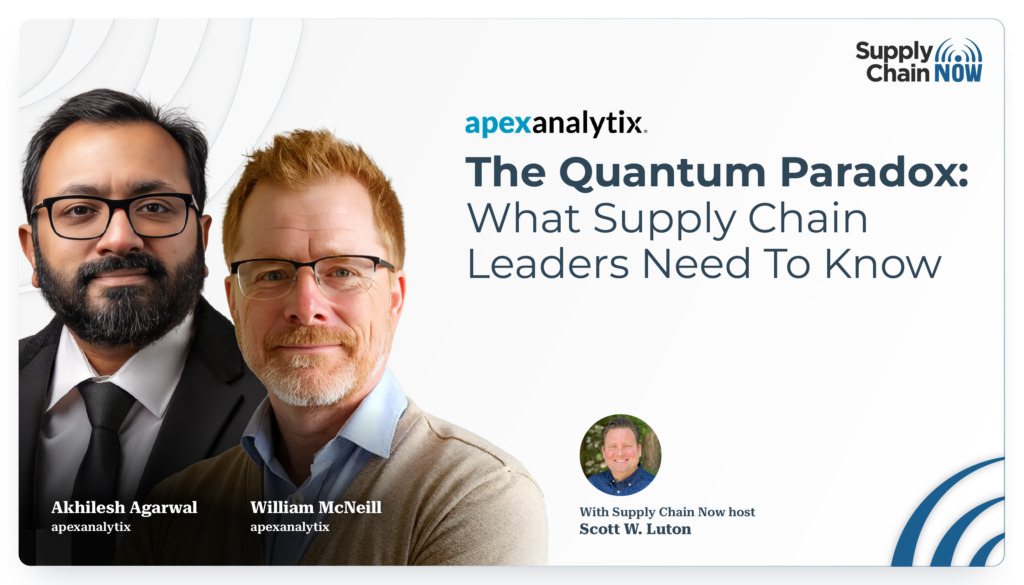
[00:00:39] Scott W. Luton: Hey, good morning, good afternoon, good evening, wherever you may be. Scott Luton with you here on Supply Chain Now welcome to today’s show, folks. We got a great conversation, teed up a fantastic one as we sit down with a couple of business leaders who are exploring one of the most intriguing and underst topics shaping. I would say the the now of supply chain, but certainly the future of supply chain and that’s quantum computing.
[00:01:07] Scott W. Luton: You’re gonna really appreciate their perspective as we unpack why quantum computing may be both overhyped and underestimated and what that really means for supply chain leaders here today. Plus, we’re gonna be exploring how quantum could unlock new levels of visibility and innovation across complex multi-tier supply chain ecosystems.
[00:01:27] Scott W. Luton: We’re gonna be discussing some of the real near term risks as well as emerging capabilities, and perhaps most importantly, we’re gonna be suggesting the practical steps that leaders should take over the next 12 to 24 months to prepare for this new quantum era that is fast approaching all of that and much, much more.
[00:01:47] Scott W. Luton: So folks stick around for a great conversation that is certainly gonna offer up tons of actual insights by the truckload. So. Let’s welcome in our two wonderful guests joining us today, starting with Akhilesh Agarwal, President, P2P Solutions & Technology with apexanalytix. Now Akhilesh leads the apexanalytix Solutions practice responsible for apex Portal industry’s only a hundred percent touchless solution for global supplier information management and working capital, uh, capital rather optimization.
[00:02:21] Scott W. Luton: He leads the development of new client-focused software innovations guided by the regular trend analysis he conducts to ensure that apex Portal delivers real-world efficiency and productivity benefits. He also oversees pre-sales, product management, project planning and reviews, risk mitigation, and the delivery of seamless solutions to large global clients across country borders across the world.
[00:02:48] Scott W. Luton: Uh, he’s got an extensive background in product design, execution and accounts payable, accounts receivable, and related areas, all that much, much more, including past leadership roles for iCORP and at, uh, at DIDIA International Colas. How you doing today?
[00:03:04] Akhilesh Agarwal: Very good, Scott. Thank you for the introduction.
[00:03:07] Scott W. Luton: You bet it could have gone on 10 more minutes.
[00:03:09] Scott W. Luton: You’ve done a lot of things in your, your, uh, career, but excited to talk with you here today and you’re joined by a wonderful colleague, William McNeill, Vice President, Market Intelligence, also with apexanalytix. Now William is, as I mentioned, Vice President Market Intelligence at apexanalytix, where he leads analyst relations and public relations and develops thought leadership on supplier risk management.
[00:03:32] Scott W. Luton: Artificial intelligence and emerging technologies just like quantum computing. Prior to joining apexanalytix will spent more than 17 years as a research analyst at Gartner, covering supplier risk management, global trade compliance, and sourcing and procurement. He brings deep industry expertise and forward forward-looking perspective to helping organizations navigate an increasingly complex and technology-driven supply chain landscape.
[00:04:00] Scott W. Luton: William, how you doing today?
[00:04:02] William McNeill: Great. Thanks for having me. This is gonna be fun.
[00:04:04] Scott W. Luton: It is, man, between you and Akhilesh, y’all are quite the one two punch. So as I shared in the Green Room pre-show, I’m gonna try to keep up with y’all. Y’all doing some big things in industry. I can’t wait to learn from you both here today on Supply Chain Now.
[00:04:18] Scott W. Luton: So let’s do this. We kind of know who we’re we’re talking with here today. We got a great topic. We’re gonna dive deep into quantum computing. An intriguing topic for sure. But first, a fun warmup question and ales realized in the pre-show that you and I have quite a bit in common. You love sci-fi, I love sci-fi.
[00:04:37] Scott W. Luton: Uh, you’re smart enough to understand it. I’m almost slow enough to be messing, to get confounded by it maybe, but you,
[00:04:45] Akhilesh Agarwal: you’re smart enough to experience it.
[00:04:48] Scott W. Luton: Ah, I like that. Uh, thank you. I So Star Wars and Star Trek two, your favorites. Let ask you two part question. Which one, if you had to sit down and binge on one or the other, which one would it be and what is one of your favorite characters that might not be as a.
[00:05:04] Scott W. Luton: As appreciated in the, the larger sense, what comes to mind?
[00:05:09] Akhilesh Agarwal: Yeah, so I’ll watch the, the first generation any day because that’s where I started with the entire storyline is of hope. And it’s less of tech back in the day. I mean, it came out in the late sixties, et cetera, but it’s more about the storyline and and and what’s possible in the future.
[00:05:28] Akhilesh Agarwal: And, and whoever was riding it back in the day, I mean, kudos to them because I mean, just thinking about the possibilities, uh, is enormous. So, so I love that. The one, um, person I’m more interested in, I mean Spark and, uh, you know, the captain, everyone knows, but Right. What about Scotty? You know, and, and the engineering team.
[00:05:50] Akhilesh Agarwal: And ultimately every single one of those episodes cannot survive without the engineering team. So, uh, spoken less of, but big fan of, of.
[00:06:01] Scott W. Luton: Akhilesh. I love that. I love, I love anything these days that centers on hope, practical hope. ’cause I think humanity needs lots of that. Given all that we’ve gone through going, I mean going even to, you know, a couple years ago with the pandemic for sure.
[00:06:14] Scott W. Luton: And if you’re navigating through the universe and exploring unforeseen places with unforeseen races, you name it technologies, you better have a great engineer that gives it all He got, all he got as in that famous Scotty ism. Lots of good stuff. I promise. Not nerd out too much on Star Wars and Star Trek here today, but William.
[00:06:35] Scott W. Luton: You’ve got a different high tech hobby that you actively put your hands on. You love to build your own computers. Tell me more.
[00:06:43] William McNeill: Yeah, it started probably about about 20 years ago when I wanted to have a little bit more control about the specs that were included in a personal computer for video games. So I obviously researched things like video graphics cards and RAM and solid state drives and put together like what I thought was the perfect combination to get my games to run optimally.
[00:07:04] Scott W. Luton: So, okay. I gotta ask you the perfect follow up. I’m a big John Madden guy. I’m a whole, my whole life, right? We had a whole league set up in Its in in its earliest days. What is one of your favorite video games of all time, William?
[00:07:16] William McNeill: The Civilization series. I’m big into the grand strategy game, so I have bought all seven iterations plus the spinoffs like beyond Earth.
[00:07:27] Scott W. Luton: William, that is a great game. I have got a copy on the emulator on my laptop. I play, uh, I think it’s Civilization two still, and that came out in the late nineties. Yeah, that was a good one. Still was a good game.
[00:07:38] William McNeill: Yeah.
[00:07:39] Scott W. Luton: All right, so all we’re gonna, we gotta get it talking supply chain and quantum computing, but I love what y’all bringing to the table and I look, look forward to learning again from you both here today.
[00:07:49] Scott W. Luton: So let’s do this. I shared your backgrounds a bit, a couple bullet points. Uh, y’all have done a lot in your careers, but I wanna prompt each of y’all to share a little bit more, especially maybe with what our audience, especially for today’s conversation, should appreciate maybe about your professional journey.
[00:08:03] Scott W. Luton: Cca, let’s just start with you. Tell us a little more about your background.
[00:08:06] Akhilesh Agarwal: Yeah, so I started working right out of high school after passing that didn’t go to college, but my first 10 years of the career was developing court case management software, paperless imaging software for the state of Texas.
[00:08:19] Akhilesh Agarwal: Did that run for 10 years and then I pivoted my career into accounts receivable. So I joined a company, uh, receivable Management Services based outta Bethlem, Pennsylvania. Worked there for almost three years, and then iCORP another company, which was having expertise in accounts receivable, but on the B2C side, they acquired RMS.
[00:08:41] Akhilesh Agarwal: So I became part of the iCORP corporate form, and then I’ve ended up working there till end of 2011. And in 2012, that’s, that’s when I joined the apexanalytix. Right. So it’s been quite a journey from India to, to New York and to Greensboro.
[00:09:00] Scott W. Luton: And I’m, I’m trying to come up with a, a Star Wars or Star Trek analogy there, but it, it’s been amazing how y’all been moving at lights, speed ever since you joined.
[00:09:09] Scott W. Luton: apexanalytix really has been on the move. William, same question. I shared some of your bio earlier, but what else would you really have folks know?
[00:09:18] William McNeill: Well, as a Gartner analyst of 17 years, I had more than 5,000 interactions with both the users and buyers of technology and providers. And so a little of that has to rub off at some point.
[00:09:30] William McNeill: You can’t help it, but one of the things I did notice was everything needs to be put into context. So whenever, even when we talk about Quantum today, it’s not gonna be a one size fits all approach. I’m not just gonna say a hundred percent of companies should do this. It’s gonna have a lot to do with what your current situation looks like and what your risk appetite looks like.
[00:09:49] William McNeill: And that’s something that I learned as an analyst.
[00:09:52] Scott W. Luton: William, I love that we don’t get enough context, especially in this ever faster moving world. So we’re kindred spirits there for sure. And you know what, I bet a lot of folks can appreciate context around, especially topics like quantum computing, that the masses are still trying to understand where it stands today and the impact for what’s in the not so distant future.
[00:10:12] Scott W. Luton: So folks, if all that appeals to you, you’re in the right place here today. We’ll do one more thing. Uh, I know lots of folks know apexanalytix and the, and the, the successful journey y’all have been on. But for the handful of folks out there that the organization may be new to, in a nutshell, what does the company do in
[00:10:29] Akhilesh Agarwal: a nutshell?
[00:10:29] Akhilesh Agarwal: Let’s start with a why. Our why statement is improve the lives of our employees, customers, and business partners. Now, how we improve lives is what we do. apex delivers an enterprise risk resolution system, which is world class. Um, how we define it is, uh, think about touchless onboarding of supplier. Auto remediating remediation of risk once it’s detected through, through our AI and other quantum systems.
[00:10:57] Akhilesh Agarwal: And then profit recovery and, and the outcomes, right? Protecting the spend. When I talk about protecting the spend, we protect more than $10 trillion of spend on an annual basis. And where we get this $10 trillion of spend to audit is, is the world’s largest company. So think about the Fortune 400 companies are out of the fortune thousand.
[00:11:19] Akhilesh Agarwal: So they are apex clients, right? And, and we service them and as we service them, I talked about the trillion dollars in spend, but also think about 250 million golden records, supplier records that apex has. And we have been in business since over th 35 years. So in that time span, we have gathered a lot of data and this data is validated and enriched and cleansed on, on 24 7 basis.
[00:11:45] Akhilesh Agarwal: So, so that’s what we do and, and how we do it.
[00:11:50] Scott W. Luton: Uh, Les, let, let me see if I capture the numbers right. And William, I’ll get your comment here as well, but 35 years in business, four over 400 companies, 250 million records, and then $10 trillion in spend is what you’re protecting, managing, optimize, you name it.
[00:12:07] Scott W. Luton: William, what else would you add to that?
[00:12:09] William McNeill: Akhilesh hinted at it a little bit with the data, right? And so this data foundation that we have, both in terms of the entity Golden records and the transactions are the foundation of our systems, and it will even apply to some of the things that we talk about with Quantum today.
[00:12:26] Scott W. Luton: Outstanding. Okay. I’m gonna try to keep up with y’all. Okay. I’m gonna try to keep up with y’all. I wanna shift gears to this intriguing white paper that y’all, y’all recently co-authored and have pushed out in the industry. And I was reading through this earlier today. I might need y’all to hold my hand here.
[00:12:41] Scott W. Luton: The quantum paradox, separating height from reality for supply chain leaders. But I’m kidding aside, folks out there watching or listening, it’s really written from a perspective that more operational folks like me can really follow along and, and understand that’s a, a very valuable component here. You point out that at its core, the paradox you’re referencing that the industry is presented with ales and William is this quote, quantum computing may post significant future disruption at the same mo moment.
[00:13:12] Scott W. Luton: Many organizations believe it requires no immediate attention. So let’s do this. Let’s start with our why first, when it comes to the white paper itself and, and why y’all invested and, and shared your perspective and research with the market. What prompted you both and the company, of course, apexanalytix to highlight that looming impact of quantum computing in supply chains right at this moment?
[00:13:38] Scott W. Luton: Akhilesh?
[00:13:38] Akhilesh Agarwal: Yeah, so that’s a great question, Scott. And the way it starts is, is with us, so when you think about the supply chain, I talk about the 400 companies, which are one, uh, 400 largest companies in the world, right from the fortune thousand. So when we are servicing customers like that and, and those customers are, are spread globally, their operations, their, their supply chain is spread grow globally.
[00:14:05] Akhilesh Agarwal: apexanalytix is one of those suppliers in the mix, right? But what are we servicing? We are servicing. Audit of $10 trillion in spend and, and we are assigned the task to protect it through our solutions and services. So when we are tasked with an amount, like $10 trillion and 250 million golden records, and, and, and those golden records have sensitive data like tax IDs and bank account numbers and, and so on so forth, just imagine what kind of data trove that we have and the responsibilities upon us to protect it on behalf of our clients, because we are a service provider, right?
[00:14:46] Akhilesh Agarwal: We provide both audit as well as software solutions as a service. So, so it starts with that. It it, it’s just being responsible as a company to protect that information. Right? Now, when we exchange this information with our clients, it goes through the internet as an example, and today. We believe and, and, and through our testing and so on and so forth, we know that we are secure today, right?
[00:15:14] Akhilesh Agarwal: So as we exchange data, it’s, it’s encrypted with the world class encryption technologies and we are protecting that data flow from one place to another. But this encryption technology, which is commonly used today, will not be sufficient in the near future. Right? And, and when I call the near future, it’s not like 20 years away, right?
[00:15:36] Akhilesh Agarwal: It’s like five years away. The reason to start this discussion and the white paper and so on and invest in this is because we have an obligation to protect and a moral responsibility to protect now because we saw this coming. We thought it, it, it is a great idea to share this knowledge with the wire so that as an industry we do better.
[00:15:57] Akhilesh Agarwal: And as an industry, we not only improve lives of our employees, but customers and business partners in general, we do go to humanity, right? Mm-hmm. So that, that was the, the why behind it. I mean, uh, we can discuss the details, but that’s the intention,
[00:16:12] Scott W. Luton: Les. I love that. William, I’ll see if I can capture some of the main themes there.
[00:16:15] Scott W. Luton: I love where you finished the good of industry, right? Whether you’re an apexanalytix customer or not, that strengthens industry. Of course, the sense of urgency related to the ever fastly evolving risk, right? And of course, uh, the responsibility that leaders of across industry, service providers and otherwise own.
[00:16:36] Scott W. Luton: To take action, especially when risk in our blind spots are so full, unfortunately. William, what else would you add to the why here?
[00:16:44] William McNeill: I think our clients wanna know that we are thinking about these things and protecting them into the future, right? We don’t want to just sit here and and wait reactively for them to ask us these questions.
[00:16:54] William McNeill: We wanna proactively push that viewpoint into the market and say, we’re thinking about these things. We’re protecting your data. We’ve already thought about this because I think what’s going to happen is too many companies are gonna wait until these mandates sort of hit in like 2030 and and beyond, right?
[00:17:11] William McNeill: And then look at it, and then it’s too late. Because what we found is anytime a company goes through this type of exercise where they’re really reviewing the type of cryptographic algorithms that they use, they’re looking at their security posture, it takes them up to five years to make these major changes.
[00:17:27] William McNeill: So if you start in 2030, it’s already too late. That’s why we’re starting now.
[00:17:34] Scott W. Luton: William, I I, quick follow up question maybe to you both really quick, and this may not be a perfect comparison, but kinda what you were just sharing prompted it for me. We know folks right now, unfortunately, some folks that are listening are watching us right now.
[00:17:46] Scott W. Luton: Their organizations are kind of, they haven’t embraced even the golden age of, of artificial intelligence yet. Right. But what I’m gathering here from the white paper and from some of your earlier perspective, is the risk of not acting sooner related as it relates to quantum computing, may e be even bigger than being a laggard when it comes to ai.
[00:18:08] Scott W. Luton: Is that a agree, disagree? William, we can start with you. Is that your thoughts there?
[00:18:13] William McNeill: I will say that if quantum computing comes to fruition, absolutely agree because it’s going to just replace every, every type of computing and model that we have today. So yes, if it were to happen, absolutely. But what I’d like to focus a little more on is.
[00:18:29] William McNeill: By preparing for quantum now there’s some real world improvements you can get, even if we never reach that nirvana of quantum computing. And we’re gonna talk a little bit about that today in terms of just IT hygiene, data hygiene. So going through this exercise today is going to yield results no matter what happens.
[00:18:49] Scott W. Luton: I love that. And we’re, we are gonna talk about that stuff, but ess really quick, is there bigger pain associated with waiting on and not engaging with quantum quantum computing bigger than companies not engaging and and acting on the AI imperative? Your quick thoughts?
[00:19:06] Akhilesh Agarwal: Yeah, absolutely. And how I wanna describe that scenario is with an example, right?
[00:19:11] Akhilesh Agarwal: So a few years ago nobody knew chat GPD as an example, right? And one fine day everyone wakes up and it’s a news flash saying there’s something called an LLM and there is chat, GPD and it can do so, so many stuff with ai, right? No harm done. I wake up, I have great news, and now the, the scenario is no harm done, but let’s see how it can benefit us and let’s have a roadmap and let’s start working towards that right now.
[00:19:41] Akhilesh Agarwal: Few years later, let’s say five years from now, let’s paint another picture. Wake up in the morning and we see the news and we, we see it in the news that there’s something called a quantum computer, right? Which exists even today, right? There’s a lot of research going on. But sometime in the future, that quantum computer is able to decrypt every single data packet that we encrypt today, right?
[00:20:08] Akhilesh Agarwal: And the news is that every single diplomatic cable ever sent by any country on the planet has been decrypted Who said what to whom? Right?
[00:20:18] William McNeill: Wow.
[00:20:18] Akhilesh Agarwal: Every single banking transaction or payment. Remittance going out has been decrypted and my credentials are stolen, and people have access to my bank account, and maybe they took the money out and my bank account is dollar zero,
[00:20:35] Scott W. Luton: no bueno.
[00:20:35] Akhilesh Agarwal: Right? So the stakes are too high when this happens, right? It’s a question of when not if eventually this technology will get developed. So when this happens, the stakes are like, is the company going to be bankrupt because they didn’t have protection? Right? So it’s not a roadmap that you start creating when the technology arrives.
[00:20:58] Akhilesh Agarwal: It’s a roadmap that you start creating today in preparation for that day when the technology is available.
[00:21:06] Scott W. Luton: That’s a powerful anecdote in that morning. Sorry, on that latter part of that analogy, when you wake up five years from now is exciting and terrifying all at once. So, which, which is why we need to be having these conversations.
[00:21:19] Scott W. Luton: It, it’s also a great segue, right? Because. In the white paper, in our, in our conversations here, you both describe quantum as both overhyped and underestimated, right? That kind of goes to heart of the paradox. Als given that paradox, I hope I’m using that word right. Yeah. Because, um, but what does that mean for supply chain leaders?
[00:21:38] Scott W. Luton: Als?
[00:21:38] Akhilesh Agarwal: Yeah, sure. So the paradoxes, like, like will was sending if and when it happens, right? So in the short term, if I’m an ordinary procurement person or an IT leader, I’m seeing the industry out there, I’m seeing the technology out there, and there is no quantum computing, which is realistic in day-to-day work.
[00:21:58] Akhilesh Agarwal: So from that perspective, it’s, the danger is not sensed, the danger is not acknowledged by people today. So that’s one part of it, but people also think that they are prepared for it in the future already. So when the time comes, the IT experts today think that all the encryption channels or methods and cryptography they’re using that will still protect them in the future.
[00:22:26] Akhilesh Agarwal: So it’s basically discording the danger and acknowledging that there is no danger at the same time. Right? And we are already prepared. Right? And neither of them is true because what will happen is, like I said, it, the roadmap needs to start today. And large corporations, especially large corporations, for a startup it’s actually easier.
[00:22:48] Akhilesh Agarwal: But for very large corporations, the roadmap starts today and then you go into a deep dive first in a discovery mode saying, what equipment, what software am I using today? Which exchanges information that needs to be protected? Right. And then once we have an inventory of those items, then we start creating a plan to remediate those things and protect against post quantum cryptography.
[00:23:14] Akhilesh Agarwal: Right? This is not gonna happen in a month of remediation cycle. This is going to take years of planning. And I’ve been to CSO conferences in the past one in Paris recently, and it was discussed at the highest levels, at private equity investor conferences and other large companies where there’s an consensus developing in the industry that every single contract, which is gonna be signed in the near future, will pass on a liability and a responsibility of owning the post quantum cryptography scenario.
[00:23:50] Akhilesh Agarwal: Mm-hmm. And the supplier is going to own it. So if there is a incident which leads to a decryption or loss of data or data leaks, then the supplier will own that responsibility. So now think about the supply chain. If every single supply contract has this provision down the supply chain, then the entire industry is impacted and every one of those suppliers in the entire chain needs to be protected against this, this liability in future.
[00:24:18] Akhilesh Agarwal: So that’s why we gotta prepare now.
[00:24:20] Scott W. Luton: Alright, really quick before I get you weigh in, William, folks write down that PQC ’cause we’re gonna hear a lot more about that post quantum cryptography. ’cause that goes a big part to the heart of, wow, this matters. Who owns what and the risk and liability there and a lot more.
[00:24:38] Scott W. Luton: William Overhyped underestimated. What does it mean? What else would you add for supply chain leaders out there?
[00:24:43] William McNeill: Yeah, when I was thinking about the paradox, I was thinking about there is a non-zero chance. Quantum computing may never happen. Yet, it’s already here today. So how can both things be true? And that’s what we’re talking about with Quantum today, where things are in multiple states at the same time.
[00:24:58] William McNeill: So if I say to one person, okay, quantum computers may not, they might not actually manifest themselves. They might be too expensive, they might just be too error prone or what have you. And yet I’m recommending you take steps today to address it. That’s the paradox. And one of the reasons I think that happens is people conflate two different topics.
[00:25:19] William McNeill: One is the use of quantum computing and the other are cryptographic standards that are currently in place today. And that’s really a bit more what I’m talking about when I say you need to take steps today to ACLU’s point. So for example, you have bodies like NIST and ISO and they’re saying, you need to use these new algorithms in place like by 2030.
[00:25:41] William McNeill: We’re not gonna allow some of these to be in place today. And that’s regardless of whether these quantum computers manifest themselves. So to me, that’s kind of what I was thinking with the paradox.
[00:25:51] Scott W. Luton: That’s a great point to call out because regardless of where, if I’m hearing you correctly, and correct me if I’m wrong, William, regardless of where, how quickly quantum computing gets here and how prevalent and how widely adopted the cryptography risk remains, and maybe an additional thought there may be is if it’s not quantum, it might be something else that the current protocols aren’t, aren’t good enough for
[00:26:14] William McNeill: You.
[00:26:14] William McNeill: Got it. Exactly.
[00:26:16] Scott W. Luton: Okay.
[00:26:16] William McNeill: Yep.
[00:26:17] Scott W. Luton: All right. We’re trying here. Good stuff, William and oh, really? I, I, I appreciate y’all’s perspective and, and the altitude that you’re attacking this conversation from. So let’s talk about something that we, all three of us have been talking about. I bet for years and years. That’s visibility, right?
[00:26:34] Scott W. Luton: Visibility. It’s been a mantra for, seems like decades in global supply chain, but for good reason. Right. And while I would say we have still, we have made some, some great progress, right? Some good heavy lifting, no doubt about it, but. And some would argue that visibility has, is quickly becoming table stakes.
[00:26:53] Scott W. Luton: However, the challenge that still persists, especially in deep ecosystems, is this all the sub-tier suppliers, right? That’s where the visibility really, our, our spotlight runs outta batteries, runs outta juice. But you both see, I think the potential for quantum computing to really put that spotlight on, uh, with some nuclear power, right?
[00:27:15] Scott W. Luton: And shine a bright so we can really see down deep and really understand, better understand and better see our risks then where things stand today, right? ’cause all those gains, we still have a lot more heavy lifting to do. Akhilesh, would you touch on, on that as it relates to the potential that quantum computing brings to the table?
[00:27:35] Akhilesh Agarwal: Yeah. So think about it like this, right? The evolution of computers. So it started with writing code so that it’s, it’s just fast compute. So instead of doing it by. We are making computers do the, the Lindy work, right? Then came something called Predictive Analytics and machine learning where we could create algorithms to try and predict the future and we could create algorithms to, to learn, right?
[00:28:03] Akhilesh Agarwal: And, and that was the first evolution of ai. The, the machine learning. So the through machine learning, the computer learns of scenarios and then helps execute the resolution to them in future, right? So we, at apex, we have been using AI long before AI was cool, right? So AI became cool with, with, with the LLMs, which was recently introduced.
[00:28:23] Akhilesh Agarwal: And what L LMS did was its large language models. It was, uh, earlier created to process large amounts of text information. And then we now have video model models and images and so on so forth. But essentially it was, uh, large amounts of unstructured text and. So the machine was able to learn from all that vast amounts of knowledge.
[00:28:48] Akhilesh Agarwal: And now if I ask a question or ask it to make a decision or give me a recommendation, it’s able to process that information, learn from it, and give me a recommendation, right? So that’s where we are now. We can use all all of these technologies and, and it’s available in our risk solutions at apex, where we make use of all available technologies today to evaluate what is the interior supply chain risk.
[00:29:12] Akhilesh Agarwal: So first of all, with that 250 million golden records that we have, we, we know what the data looks like and we have cleansed it and validated it. That’s step one. So start it all starts with good data. And then we say that, okay, because we have good data, let’s take advantage of that and see what is my supply chain risk for my tier one supplier.
[00:29:32] Akhilesh Agarwal: And then down the chain based on the products and services provided by each tier. Right. So we can do a lot of predictions, a lot of, uh, use AI to, to find out where potential risks are today, right? But risk is something that changes every single day,
[00:29:50] William McNeill: right?
[00:29:50] Akhilesh Agarwal: And risk is changing as we speak right now, right?
[00:29:54] Akhilesh Agarwal: There’s also a concept where the same supplier with the same data is a risk to somebody and is not a risk to somebody, right? And both can be true, which is the principles of, of quantum computing, right? You, uh, you, you can be in a state of a zero, in a state of one and or, and both at the same time, right?
[00:30:17] Akhilesh Agarwal: So it fits perfectly in evaluating supply chain risk because the same supplier is a risk and not a risk at the same time. So, so what quantum computers are going to help us with is massive amounts of computing and prediction over and above what AI is able to do today. The sheer amount of computing and it’s able to use those qubits to predict those risks, which are applicable to me.
[00:30:43] Akhilesh Agarwal: So it’s more accurate risk reporting, it’s more real time risk reporting. There’s a concept called Monte Carlo, right? So think about running that Monte Carlo prediction scenarios. What if scenarios in real time every day, right? And, and the applicability matters because what’s risk to somebody else is not risk to me and vice versa.
[00:31:04] Akhilesh Agarwal: So that’s where quantum computers are gonna help us with and it’s actually going to enhance AI as we know it, right? So that’s another factor. People consider AI and Quantum has two different technologies, but they’re gonna converge very soon in future.
[00:31:19] Scott W. Luton: Okay. Alright. So William, what else would you add? So AEs really talked about several things there, especially the sheer.
[00:31:28] Scott W. Luton: Injection of power to take visibility and modeling and and scenario planning, all that stuff to the, you know, next 10 degrees maybe.
[00:31:38] William McNeill: Mm-hmm.
[00:31:38] Scott W. Luton: What else would you add to that, William, especially as it relates to getting rid of the murkiness that can be found in these really big supply chain ecosystems?
[00:31:46] William McNeill: Yeah, sure. So when Les was talking about a supplier being a risk at the same time as not being a risk, I’m a big fan of the Big Bang Theory and they talk about Schrodinger’s cat quite a bit. So I called that Schrodinger’s supplier and we included that and we wrote a whole blog on that. So how can a supplier be both a risk and not a risk at the same time?
[00:32:05] William McNeill: And I think Les really nailed it when we talk about quantum computing in terms of end tier visibility. Can it help you discover new suppliers? Well, yeah, sure. Absolutely. But most of the power is actually gonna be on the modeling more than the discovery, in my opinion. Right? Mm-hmm. So if for example, you say, okay, I want to run a particular risk model against this subset of my suppliers with quantum computing, you might be able to say, I’ll just run all models, all scenarios at the same time.
[00:32:32] William McNeill: It’s only gonna take 12 minutes, right? So that’s incredibly powerful because being notified of a risk event isn’t really that insightful. It’s what’s the impact to your supply chain? Does it affect revenue? Does it affect a customer, uh, SLA, that you have in place? So to be able to run all those models at the same time and get that view into the impact, that’s the power.
[00:32:54] William McNeill: Because with the discovery part, what I, and this is where my interactions at Gartner really came into play, you could ask a tier one supplier, for example, say, help me get visibility into the tier two suppliers. The tier one supplier can just say, no. They can just say, no, I’m not helping you do that. And so you’re kind of stuck.
[00:33:13] William McNeill: And that’s why we, we talk a lot about the data. So we have the 250 million golden entity records. Great start. We have the 10, 10 trillion in transactions. Great start, like quantum computing is still gonna need a lot of that type of information to run these, this analysis. But it’s, I agree with Akhilesh completely, it’s really about the modeling and the analysis and the impact to give that customer the real value.
[00:33:35] William McNeill: Like what is this risk event really mean to me?
[00:33:39] Scott W. Luton: Okay. I got a quick question and I, I don’t mean to be overly simplistic, but I think one big thing I’m picking up from you both is when, you know we’ve got great technology today, right? Whether it’s apexanalytix or other other platforms out there that really help companies make better decisions and mitigate risk.
[00:33:57] Scott W. Luton: But something that Akhilesh said was. Risk is Everest living and breathing, right? Uh, I think he mentioned by day, but, but in some cases by the minute, right? And current technology is limited to a certain extent, but when we bring on quantum computing and the sheer, one thing I heard from both of y’all, the sheer computing power and you inject that sheer computing power into even current or technology as it continues to develop, our ability to run faster and smarter is gonna be leaps ahead where we are today.
[00:34:34] Scott W. Luton: And all that sounds good and positive, but the flip side of that is bad actors have the same access to the same innovation. Which kind of goes back to William, your clarification earlier about regardless of of quantum computing or not. We’ve gotta take steps. We’re gonna talk to touch on this earlier, to protect said data.
[00:34:55] Scott W. Luton: Said in, uh, cryptography, all the, all protect our organizations because whether it’s computing, quantum computing or not, we’re gonna get the power from somewhere, the fuel, uh, innovation at a speed that, um, we’re just getting used to where we are today, man, next year, next six months is all that right? Am I tracking with y’all on what you’re sharing?
[00:35:17] Scott W. Luton: Uh, s does all that sound right?
[00:35:19] Akhilesh Agarwal: It is Scott. And another example I want to share is, so how does top quantum computers work? Right? So one of the requirements is near absolute zero temperatures, right? So when you hear that statement, the default reaction assumption is, well, good luck because I’m not using a quantum computer as my laptop.
[00:35:42] Akhilesh Agarwal: It’s not portable. And then because of those restrictions and limitations, it is not going to be a reality. Right. Like, it’s not going to be in every corporate data center as an example. It’s gonna be limited to the world’s largest governments in a way because they have the, the funding and the resources to, to manage it.
[00:36:02] Akhilesh Agarwal: But guess what? Whether it’s Google or Microsoft or Amazon, A sector, all these companies, IBM included, they’re investing in quantum computing, right? So private companies are at, are in the race. The other aspect about uh, quantum computers, especially when we talk about cloud computing today, is that you can rent a quantum computer.
[00:36:24] Akhilesh Agarwal: So I don’t have to go and invest and buy a quantum computer and, and create a near, absolute zero temperatures to operate it and have all the engineering resources to manage it. All of that can be ma managed by, uh, the, these cloud providers. All I have to do is pay them and I can pay them based on the usage I have.
[00:36:45] Akhilesh Agarwal: Not even a fixed fee. Yes. So what that means is not only companies like us can take advantage of it to do good, but the hackers and the doc web and all the people who are holding the community, they can also rent these cloud computers, quantum computers, and take advantage of it to do the bad deeds,
[00:37:08] Scott W. Luton: bad things.
[00:37:09] Akhilesh Agarwal: Um, now think about which governments could potentially encourage or discourage, right? So if you take the United States, the likelihood of it being used for good is gonna be extremely high. If you take a country like North Korea, the likelihood that it’s gonna hurt, the, the world is gonna be higher, right?
[00:37:30] Akhilesh Agarwal: Mm. It’s all about likelihood. So which country is going to facilitate? The bad actors in which countries are going to prevent them from doing harm is the key. So we talk about nuclear weapons today, well, quantum is gonna be the weapon of the future.
[00:37:46] Scott W. Luton: Alright, so I’m gonna, I’m gonna ask y’all both about near term risk and this new acronym this’s new to me, HNDL in just a second.
[00:37:52] Scott W. Luton: But William, really quick, he mentioned QU QCAS, quantum computing as a service. I think, uh, William, is that a thing yet?
[00:38:02] William McNeill: Yeah, absolutely. I mean, you can take advantage of it today and sign up for pilot programs to run. You know, again, it’s very experimental because one of the limitations other than the temperature of quantum computing is, uh, still very, very high error rates in calculations.
[00:38:16] William McNeill: And so they need to bring down those error rates before it becomes useful. We’re already seeing this with ai, for example, so we were talking about quantum computing and ai, right? So you can use AI, for example, to generate a fake invoice, and then you can take that fake invoice and email it to somebody.
[00:38:33] William McNeill: That’s why platforms like ours, if I may just talk a little bit about our company, are so important because we’re going to run all kinds of validations on that transaction, right? So we’re going to obviously do things like deep fake recognition technology, run it on the invoice itself just to see if it’s fake.
[00:38:50] William McNeill: But we’re also gonna be running it against bank validations, tax ID validations, right? Country of origin, validations. It’s all kinds of validations. So as long as you submit that through the portal, you’re fine. It’s when you go around these controls and these systems, you start to get into trouble. We’ve seen crazy examples, right?
[00:39:08] William McNeill: I don’t know if you saw the one where a finance manager was on a a Zoom call and his CFO authorize a $20 million payment to a supplier. Wow. All fake, all deep fakes. It was a fake zoom call. Fake avatars, fake everything. You, you can’t go outside your IT controls and do things like that. That’s where the real danger is.
[00:39:30] Scott W. Luton: Wow. Okay. I did not read about that. I’m gonna be doing some Googling in a second. Alright. So I could ask, and William, uh, I wanna ask about, and, and we, we’ve touched on a little bit this, but when it comes to the near term risk, right? Stick, uh, it’s not an either or, but I want what, what’d you call that?
[00:39:46] Scott W. Luton: Schroer. Schering Schroer
[00:39:47] William McNeill: Schroer supplier.
[00:39:50] Scott W. Luton: Okay. Optimization, disruption or supplier data security. What’s the bigger near term risk? And let’s make sure we touch on harvest now, decrypt later, but arles your thoughts.
[00:40:02] Akhilesh Agarwal: Yeah. The near term risk is like, how are we planning to, to tackle this in future? Right?
[00:40:08] Akhilesh Agarwal: Do we have a roadmap? If you don’t have a roadmap, it’s near term risk. I talked about private equity investments, right? So think about if you are a startup, not even a large company. You want PE investments in the near future. And when this strategy gets adopted widely in the industry saying, are you quantum ready?
[00:40:26] Akhilesh Agarwal: Are you quantum protected, et cetera, and these items become a checklist, then everybody’s impacted. Well, whether the quantum risk is here today or not, if you want investments today, you you’ll need to comply with it. So it becomes a compliance requirement, right? So there are all these near term risks, whether it’s financial risk, uh, or data risk and, and so on, so forth.
[00:40:49] Akhilesh Agarwal: William touched upon, Hey, nothing we do today is gonna be wasteful because everything we plan towards being able to deal with the post quantum cryptography scenario is going to just help us today. Whether it’s cleansing of data or validating the data, et cetera. But now let’s talk about harvest now and decrypt data, right?
[00:41:11] Akhilesh Agarwal: Because that’s again, a near term and a and a future rest, so,
[00:41:15] Scott W. Luton: right.
[00:41:15] Akhilesh Agarwal: So the biggest. Problem plaguing the industry today, and I’m speaking from real life experience because of what we do at apex, is business email compromise. And how does the business email gets compromised? One, well email itself is gets sent across the internet in decrypted fashion.
[00:41:34] Akhilesh Agarwal: So that channel is insecure to begin with. But what is even worse is my passwords and access to my emails getting compromised. Now think about quantum computers coming in and breaking into everyone’s mailbox in no time. So, so now what happens is all of the controls, all the security controls I put today may not be relevant in future, right?
[00:41:59] Akhilesh Agarwal: Another example is I am accessing a secure website or HTT PS today, and I believe it is secure. I’m accessing my bank and I believe it is secure. And I’m using, let’s say, all those social media, uh, chat messaging platforms like whether it’s Telegram or WhatsApp or iMessage, et cetera. And everyone claims they got end-to-end encryption, so it’s secure, right?
[00:42:23] Akhilesh Agarwal: But the definition of secure changes in future, because what I can do if I’m a bad actor today is I can put in a device in the network and I can just store all of the encrypted data, which is transmitting from through my network, right? Everything is encrypted. I cannot access the information, but let’s just store it.
[00:42:43] Akhilesh Agarwal: Let’s archive it, right? So now let’s say I archive five years of data. In 2030, let’s say a quantum computer comes out, which can easily decrypt it. I rent one and then I go to my treasure trove of encrypted data, and then I decrypt it all in one go. Right. So that’s the harvest now, which I’m storing today and decrypt later, is when the technology is ready in future le less decrypted.
[00:43:11] Akhilesh Agarwal: Uh, uh, a common example we will have seen in the movies and life in general is people talk about freezing, right? Cryogenic freezers where people who are sick could be frozen. We don’t have the tech today, right? But as a thought, so freeze people who are sick, uh, with incurable diseases and maybe sometime maybe 200 years in future, we have the tech to cure that disease.
[00:43:36] Akhilesh Agarwal: So take the person out of the freezer and and cure the person. Same concept, same idea, right? I don’t have the tech today, so let’s just defer it to the future and handle it at that time.
[00:43:48] Scott W. Luton: All right. So folks, again, harvest now, decrypt later. Write that down and that that adds to the y that you should follow.
[00:43:56] Scott W. Luton: Some practical steps that William and Les are gonna offer in just a minute. William, what would you add to HNDL or some of the other near term or further term risks that, uh, Les touched on?
[00:44:08] William McNeill: Yeah, I think Akhilesh nailed it. I agree with him on the, uh, encryption part of it is, is the immediate threat because there are other implications.
[00:44:17] William McNeill: So ALS gave us the investment, like if your private equity firm says you need to have these things in place, or we’re not gonna give you funding, you might see similar requirements for business partners, right? Like, I’m not gonna sign a contract with you unless you can sort of prove you adhere to this.
[00:44:31] William McNeill: You have the cybersecurity rating platforms and standards bodies who will say, you need to have this in place. And when we transact things on our supply chain network, if you don’t have that in place, you know, you might start to lose business. The other one I just thought of, insurance. You want to get cyber insurance, if you don’t have these things in place, forget about it.
[00:44:51] William McNeill: Your policy’s gonna be 10 times what the other person’s is going to be. So these are all immediate real world reasons for addressing this, this crypto cryptographic algorithm part. And the other thing I was thinking about with the data is you need to take sort of a risk-based approach to your data as well.
[00:45:10] William McNeill: Now here at apex. Because it’s our client’s data. We treat it all with a high level of sensitivity, right? But for your own self, you might think certain things are very sensitive when they’re not. So I’ll give you an example. Your credit card number, if somebody steals that today and then goes down to the street and buys a pizza with it, yes, that’s an immediate threat.
[00:45:30] William McNeill: But in five years from now, you’re gonna have a new expiration code on it. And so that number that’s stolen with that expiration code today might not be valid in five years. So maybe that might not be the best example for all of our business listeners today, but think about what I’m really saying is take that approach to, not all data is the same, and you may wanna start with a subset of your data.
[00:45:51] William McNeill: But again, here at apex, because it’s our client’s data, we all treat, we treat it all as highly sensitive. Mm-hmm.
[00:45:55] Akhilesh Agarwal: And just to add to what William said, uh uh, one example that comes to my mind is, let’s say I’m a large retailer. I have some preferred confidential pricing with my suppliers, right? And that pricing in that contract might last seven years, maybe 10 years.
[00:46:13] Akhilesh Agarwal: It’s a long-term contract, right? So, so, so now today it’s encrypted, no one can see it, right? Let’s take the secret of Coca-Cola, right? It’s probably lying somewhere in, in a, in a secret cyber world. But what if quantum computers decrypt that, right? So the, the contracts with supplies, the long-term pricing agreements and arrangements and the part numbers or, or, or everything in the supply chain, right?
[00:46:43] Akhilesh Agarwal: So when there is confidentiality involved, especially, that’s what matters. And if the confidentiality is long term. Right. And, and that creates a risk today because
[00:46:54] Scott W. Luton: yes,
[00:46:54] Akhilesh Agarwal: I want to protect that risk long term,
[00:46:56] William McNeill: great
[00:46:57] Scott W. Luton: example. Those great.
[00:46:58] William McNeill: Yeah,
[00:46:58] Scott W. Luton: those are some great examples. And, uh, you’re making me hungry for pizza and a Coke.
[00:47:02] Scott W. Luton: Both of y all William, uh, bless you. Hey, and, and really, y’all both were speaking to a question I was gonna pose to y’all about where quantum intersects with ecosystems and contracts and long-lived data. And I don’t wanna be too redundant, and for the sake of time, I, I want to shift gears over to misconceptions, right?
[00:47:19] Scott W. Luton: Because all of us, I’m sure have lots of really big misconceptions when it comes to quantum readiness, right? It goes to the territory. So our, I’m gonna circle back to you here. So what are the biggest couple of misconceptions that you regularly, regularly see supply chain leaders have about quantum readiness?
[00:47:41] Scott W. Luton: What comes to mind?
[00:47:42] Akhilesh Agarwal: Yeah. The first one is, it’s a future problem. I don’t have to deal with it today. So let, let’s just not handle it. Kick the can down the road. Right? The risk is basically present tense, not, not future. Right? So that’s, uh, that’s one thing. Harvesting, we, we talked about it. Harvesting is happening now, right?
[00:48:00] Akhilesh Agarwal: So it’s not going to happen in future. It’s happening right now. Yeah. So gotta deal with it. The regulatory direction is being set and there gonna be more and more compliance coming out to, uh, to deal with. So you gotta be ready with it. There’s gonna be an extreme amount of talent shortage. Think about it.
[00:48:18] Akhilesh Agarwal: So as people gain awareness. It’s not like we have thousands of quantum ready resources available in the market today. So, so as people gear up to deal with this problem, there’s going to be an acute shortage of resources to find who can understand the technology, who can understand the implications and help the procurement leaders help the IT leaders deal with it.
[00:48:42] Akhilesh Agarwal: Right? So when we think about suppliers, when we think about hiring people, we gotta be ready with talent shortages and we gotta ready with, with supplier shortages. The same principle applies. Not all suppliers are gonna be ready. So you only have limited suppliers who can comply with your mandate and therefore you wanna buy from them.
[00:49:05] Akhilesh Agarwal: And the supply can only supply so much, right? So there’s gonna be a, a, a, a supply chain risk. So those are some of the, the things that come to my mind.
[00:49:14] Scott W. Luton: Les, that’s a great short list. Uh, William, what would you add to the, those misconceptions?
[00:49:19] William McNeill: If I had to add something, I mean basically I agree with Ash, but I’m just thinking about it from a slightly different twist.
[00:49:25] William McNeill: And that would be by making assumptions, assuming that your current cryptographic uh, library is even up to date right now. So when you kind of go through and do that assessment, you might find you are already using standards that have been disallowed for 10, 15 years. That’s very, very common. And that’s why I was saying even if you go through this exercise to look for your PPQC algorithms, you’re going to find that you could be al using already disallowed.
[00:49:52] William McNeill: Algorithm. So it’s about, about those assumptions. Another example that I had about assumptions was, and this is going back much further now, a company was doing sort of their IT inventory and they had, you know, whatever, 50 business applications and then they would look at the associated hardware and cryptography and everything and they had this one application and they couldn’t find where it was being housed or stored and they tried their darnedest and it turned out it was on, it was being run off of a PC under somebody’s desk in their South African office.
[00:50:26] William McNeill: So like,
[00:50:27] Scott W. Luton: wow.
[00:50:28] William McNeill: These types of exercises are just gonna reveal a lot about your current IT exposure, regardless of whether it’s quantum related or not.
[00:50:35] Scott W. Luton: William, that’s a great example. It reminds me of, um, a couple years back, I think we all had a revelation in terms of municipal. Energy, power management, water management.
[00:50:47] Scott W. Luton: Now there’s some really old green screens, very non-powerful, uh, systems that are still running those, those critical infrastructure systems for, for cities across the country. And that’s a major, major risk that we’ve gotta come to grips with. Kinda a little different, different vein than what, uh, the story anecdote you shared.
[00:51:07] Scott W. Luton: Good
[00:51:07] William McNeill: example though. Yeah. Good example.
[00:51:09] Scott W. Luton: Yeah, it is, it is. Really quick, William. We’re gonna get y’all both to weigh in on steps we gotta take. But I gotta ask you right behind you, you’ve got a chalkboard with quantum Paradox written on it. Is it, is that a paradox on top of a paradox, like a chalkboards, kind of a throwback quantum computing of course is, is so future, is that a, are you illustrating the paradox of paradoxes?
[00:51:35] William McNeill: It wasn’t intentional, but maybe it was subconscious. So, which might also be, which might also be quantum related because there’s research coming out to say that our consciousness is actually based on quantum mechanics, so.
[00:51:47] Scott W. Luton: Oh, what man? Okay. We’re gonna have to save that. I gotta study up before when y’all come back and we talk about that next time.
[00:51:53] Scott W. Luton: Good stuff. Alright, so all of this, it’s been a very helpful discussion. I really appreciate how you both really brilliant technologists kind of bring, again, bring this at an altitude that really everyone can embrace and really start to understand the why we’ve got to act today. So we are in experimentation phase today, right?
[00:52:11] Scott W. Luton: Uh, the, as y’all talk about in the white paper and you’re seeing real enterprise impact emerging, say three to six years, right? Three to six years. What practical steps should leaders take today, uh, in the next 12, 24 months, right? May, maybe today. Over the next two years, perhaps Arles, what comes on?
[00:52:33] Akhilesh Agarwal: Yeah.
[00:52:33] Akhilesh Agarwal: So the number one thing is create an inventory of what you have, uh, whether it’s IT systems, whether it’s software solutions that you’re using it within the company. Uh, list of your critical suppliers which impact your business, right? And then see how your data looks like today, right? To service all of those systems and solutions, right?
[00:52:55] Akhilesh Agarwal: So, so one is, unless you observe it, you cannot fix it, right? Right. So first, observe it, what you have, know what are the gaps, right? Create a list of gaps and tie to what is needed to be quantum ready in future, right? And then once you have those gaps and create a roadmap. To, to, let’s say fix your data.
[00:53:17] Akhilesh Agarwal: Hire talent, right? Work with suppliers, both on IT side and otherwise, uh, to, to make sure your equipment that you’re using is secure and can cope up with future requirements. And then on your supply chain, are your suppliers ready for it? Because as a company, think about it like this. If I need to roll it out in my company, I work for, it’s one company.
[00:53:39] Akhilesh Agarwal: But if I need to deal with this with 500,000 suppliers that I do business with, that’s a monumental task, right? So I can cont still control and, and influence the company I work in, but influencing 500,000 supplier, that’s a total order.
[00:53:59] Scott W. Luton: Yes, it’s gonna take a lot more time, a lot more effort. And so you’re saying, of course, the inventory you’re gonna take, uh, looking at data, looking at gaps, making sure what we’re trying to manage is visible.
[00:54:11] Scott W. Luton: And I don’t think with your last comment, by extension, have these conversations with your supplier ecosystems, what do they see? You know, we’re only as good as we all know as that Achilles heel, right? We’re any supply chain ecosystem is only as strong as the weakest supplier. William, same question. What steps should supply chain leaders take today over the next two years or so?
[00:54:34] William McNeill: Well, when we think about the talent issue that Alush brought up, think about updating your job descriptions, your job requirements. What type of candidates do you wanna look at so it and HR can get together to make sure that those profiles are updated. I mean, what could it hurt? Even if it’s a nice to have you say, nice to have p qc experience, I don’t really see the downside of adding that.
[00:54:55] William McNeill: For example, I would say look at your contracts. Look at your contracts across a few different areas. So this is where procurement people and sourcing people might come into play. Do you want to add any type of language to your contractual obligations that, uh, for your suppliers, right. Whether they’re IT vendors, you know?
[00:55:13] William McNeill: Right. ’cause we’re gonna use that term supplier a little broadly. Could be your IT provider there. I would think it’s essential. I don’t know why you wouldn’t have it. But also with suppliers of like, uh, direct, you know, direct goods and, and goods enough for resale and all, and indirect materials and things like that even with them.
[00:55:29] William McNeill: And then this is where the context comes in a little bit. So we talked about the context of is your company risk adverse or risk tolerant? So if you are very risk tolerant or you even look at risk strategically, I would say. Model out some of the big hairy problems that you’re trying to solve today and investigate some of these pilot programs that ALS was referring to, and maybe even just take advantage of one.
[00:55:55] William McNeill: I know that’s very immature, but like this, again, it’s gonna marry to your risk profile. Like if you have that type of budget, where you have this type of experimentation. So, right, so a lot of companies dedicate a small percentage of their budget to just these types of experimental projects. If you have that, go for it.
[00:56:11] William McNeill: I don’t see the the downside of it, but I’m not gonna recommend that for everybody. Like if you’re on tighter margins or you don’t have that type of budget, I’m not gonna say you should absolutely go out and do that tomorrow. So that’s why the context is so important.
[00:56:23] Scott W. Luton: William. Love that. And very practical, gosh, reviewing job descriptions.
[00:56:27] Scott W. Luton: What additional, uh, knowledge and expertise can we get that we’re already, we’re already recruiting for some of these roles. Let’s add PQC. That doesn’t roll off my tongue for some reason. I don’t have to practice that. Let’s add that to some of the right appropriate jobs. And then the second one you mentioned, gosh, revisiting those contracts because.
[00:56:46] Scott W. Luton: In many ways, we’re probably already revisiting them for other reasons. This is another lens to, um, uh, another way to scrutinize ’em. That’s a, that’s a great tip. Both y’all offered a great tip, and I would add one more because I’ve benefited as I, I figured I would by spending an hour and some change with you both folks.
[00:57:03] Scott W. Luton: You gotta reach out and connect with Les and William because you’re gonna be smarter and you’re gonna look at the world a little bit different. And, and it’s not all doom and gloom, right? We’re, we’re being very clear-eyed about the challenges, but it’s also really exciting to see what quantum computing may well pose for global supply chains and leaders and, and the wonderful human factor out there.
[00:57:24] Scott W. Luton: So let’s help make that really easy. Esh and William Esh, how can folks track you down and have a similar conversation and maybe even, who knows, start working with apexanalytix.
[00:57:36] Akhilesh Agarwal: Absolutely the best way to reach us is through our website, apexanalytix. It’s A-P-E-X-A-N-A-L-Y-T-I x.com. Uh, you can both find me and William on, on our website.
[00:57:49] Akhilesh Agarwal: You can contact us through through that. That’s the best way and looking forward to connecting with some of you
[00:57:55] Scott W. Luton: outstanding. And William, if we wanna track down that interesting blog and I’m gonna do go do that Schrodinger’s supplier if I said that right? Yep. If they want to check out some of the stuff you, y’all write or connect with you, what’s the best way
[00:58:09] William McNeill: We have a section on our website for these types of thought leading pieces and blogs and white papers they can start with.
[00:58:14] William McNeill: There I am on LinkedIn. The only thing that I ask is if you could please include a note that maybe you watched or listened to this podcast so I can separate it out from the job recruit recruiting offers that I’m getting and my paid consultancy survey, taking LinkedIn messages. I would, I would appreciate that.
[00:58:33] William McNeill: Yeah,
[00:58:33] Scott W. Luton: that’s a good call out.
[00:58:34] William McNeill: Vi William already has P QC in his
[00:58:36] Akhilesh Agarwal: resume, so yeah.
[00:58:37] Scott W. Luton: Oh well folks, also, I really encourage you to check out the white paper, the Quantum Paradox, separating hype from reality for supply chain leaders. I’m telling you, you need to check it out. It’s really exciting times and Toms, we’ve gotta take action to prepare for what’s next.
[00:58:55] Scott W. Luton: And that’s doesn’t mean five years around the corner or five years, uh uh, down the road today. But yeah, today, that’s right William. That is right. What a great conversation. I knew I was gonna be smarter leaving it as I was coming in and y’all did not disappoint. Wanna thank you both. ESS Agarwal, president, P two P Solutions and Technology with apexanalytix.
[00:59:17] Scott W. Luton: ESS is a pleasure to connect with you.
[00:59:18] Akhilesh Agarwal: Same here, Scott. Thank you so much.
[00:59:21] Scott W. Luton: You bet. And William McNeil, vice President of Market Intelligence with apexanalytix, really enjoyed your perspective as well, William.
[00:59:29] William McNeill: I appreciate it. This was a lot of fun. Thank you.
[00:59:32] Scott W. Luton: It was, and y’all are really a very complimentary one-two punch.
[00:59:36] Scott W. Luton: You gotta take it on the road. Maybe we’ll get, uh, the Rolling Stones open for y’all as we inform and make the world aware of quantum computing and much, much more. So we’ll make that happen. How’s that sound?
[00:59:48] William McNeill: That sounds great.
[00:59:49] Scott W. Luton: Who’s got, who’s got the Mick Jagger on speed dial? I don’t have it unfortunately, but we’ll look into it.
[00:59:54] William McNeill: I did start teaching myself guitar during COVI because I was so bored, so.
[01:00:00] Scott W. Luton: I wanna add that to my text message, the value prop to Mr. Jagger. We’ll see if that helps. But William and, and Akhilesh, great. Really enjoyed y’all’s perspective here today, folks, to the Supply Chain Now global fam. Hopefully you enjoyed this unique episode in conversation as much as I did.
[01:00:16] Scott W. Luton: I I certainly did. I’ve got 18 pages of notes. I was trying to fast and furiously keep up with them here today, but you got homework, right? And there’s lots of actual perspective. So pick one thing, colas or William shared, right? And put it to use, right? Share it with your team. I would suggest we, we take their practical steps that we should act on right now.
[01:00:40] Scott W. Luton: Let’s take that to heart and do something with it, right? Deeds, not words. That’s what’s gonna move us all ahead, right? And leave no one behind. With all that said, Scott Luton challenging each of our listeners. Do good, give forward, be the change that’s needed, and we’ll see next time right back here. On Supply Chain Now.
[01:00:57] Scott W. Luton: Thanks everybody.
[01:00:59] Voiceover: Join the Supply Chain Now community. For more supply chain perspectives, news and innovation, check out supplychainnow.com. Subscribe to Supply Chain Now on YouTube and follow and listen to Supply Chain Now wherever you get your podcasts.