Intro/Outro (00:00:02):
Welcome to Logistics With Purpose, presented by Vector Global Logistics in partnership with Supply Chain Now. We spotlight and celebrate organizations who are dedicated to creating a positive impact. Join us for this behind the scenes glimpse of the origin stories, change making progress and future plans of organizations who are actively making a difference. Our goal isn’t just to entertain you, but to inspire you to go out and change the world. And now here’s today’s episode of Logistics with Purpose.
Enrique Alvarez (00:00:35):
Welcome, welcome, welcome to another exciting episode of Logistics with Purpose. I’m your host, Enrique Alvarez, co-founder and managing director of Vectric Global Logistics. Logistics with Purpose, the only podcast focused on supply chain’s positive impact. And I’m here with an amazing guest and my fearless co-host, Christie Porter. How are you doing today, Christie?
Kristi Porter (00:00:56):
I’m doing good, Enrique. I’m excited to talk about Hannah. I am really excited because we love discovering people through the B Corp network. And so Hannah came to us and she has such an incredible story. I saw her immediately her post and I said, “This is incredible. We have to talk to this woman.” And you were like, “How soon can we get her on? ” And so she just has really amazing story. I can’t wait for everybody to hear what she’s been up to, what she’s doing, and the amazing things that she’s trying to accomplish. So it’s going to be another good interview.
Enrique Alvarez (00:01:28):
Absolutely. I’m excited as well. Very inspiring story. And go ahead, Christie. Without further ado, why don’t you introduce us our guest today?
Kristi Porter (00:01:36):
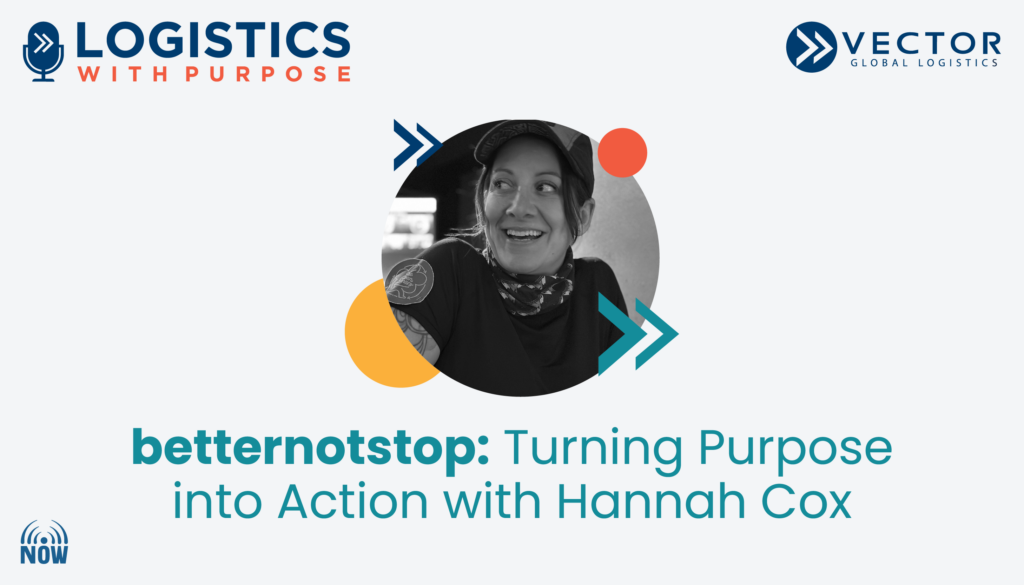
Yes. Please allow me everyone to introduce you to Hannah Cox. She is the founder of Better Not Stop and the Better Business Network, helping businesses and leaders take action to create a better world. Who can agree with that? And if she wasn’t bold enough already, the reason that we discovered her is I can’t wait to hear how one wakes up one day with this impulse, but she ran 100 marathons in 100 days. So let me repeat that. 100 marathons in 100 days to raise $1 million through Project SALT Runs, endurance and business and life, and certainly built for purpose. I can’t wait to hear how this idea came about and how she accomplished it. And I think this was actually her first marathons. She just multiplied it by a hundred, which again, not how I wake up in the morning, so I can’t wait to hear Hannah’s story.
(00:02:25):
So Hannah, welcome. We’re excited you’re here with us.
Hannah Cox (00:02:28):
No, I’m excited to be here. Thanks so much for having me.
Kristi Porter (00:02:31):
Absolutely. Well, before we get into the marathons, Better Not Stop, Better Business Network, all the things that you’re doing, let’s warm up with some quick questions. Just answer the first thing that comes to mind. So first, a quote that inspires you.
Hannah Cox (00:02:45):
Whether you think you can or you can’t, you’re probably right.
Kristi Porter (00:02:49):
Yeah. Excellent one for your marathons. What’s your favorite book?
Hannah Cox (00:02:53):
Got to be the Great Hedge of India, which will make sense to people once you’ve listened to the rest of this podcast.
Kristi Porter (00:02:58):
And your go- to running song?
Hannah Cox (00:03:01):
This is a bit of a left field one. I’m a huge fan of the Jurassic Park Ruby soundtrack, and I really like the opening credits to Jurassic Park. And if you don’t remember them or if you haven’t listened to it since you’re a kid, I recommend getting on Spotify and having a listen. It’s an epic piece of music and makes me feel like I am the main character in the story.
Kristi Porter (00:03:24):
That is amazing. And your favorite place to be?
Hannah Cox (00:03:27):
With my friends and my family. Either of those two pots of people. So not a particular place, but a place with people is really super important to me.
Kristi Porter (00:03:36):
Good answer.
Enrique Alvarez (00:03:37):
Well, thank you so much for sharing that. And thank you so much for being with us in this episode, Hannah. Again, inspiring story. Better Not Stop feels both a very personal, like a promise and a call to action. What’s the original of the name itself and how was the mindset of not selling shape your mission to building movement, systems and businesses focused on creating a better world? What was the thinking behind the amazing company and organization that you have created?
Hannah Cox (00:04:03):
Well, you’ll know this as a business owner. It’s so hard to come up with a good name for your business. And I’d say this as someone that used to run a club night on a Monday and it was called Monday Club. I’m not very good at names for businesses, but this name actually came up from my dad. So my dad and this story of Project SortOne also starts with him. So my dad actually passed away in 2011 and it was a very quick illness, really shaped what I actually did with my whole career after he passed away in my 20s. His, for context, at the time in my mid- 20s, I was working in the music industry. I would work projects, save a couple of thousand pounds, go traveling. I love to travel, but I was always doing different things, no particular career path, just whatever kind of floating my boat and I was interested in.
(00:04:55):
And my dad had spent basically his entire career working for a large pharmaceutical company in the UK. However, when he was just coming up to his retirement age, when he was planning to retire at 60, they restructured his department six months before and he had to reinterview for his job role against someone in his team that was 20 years his junior. And so he basically got completely screwed over by other company before he left. And then unfortunately he got screwed over by the universe because all the things that he wanted to do once he had retired, he got diagnosed with cancer in the May and then passed away in the July. So it was a really stressful time and really sad time. But the good I got from that was I did have the opportunity to sit down with him before he passed away and talked to him really some of those questions you’ve always wanted to ask your parents, one of which was, “Are you proud of me?
(00:05:44):
” Because I thought he wasn’t, and what advice would you give me? And the piece of advice he gave, firstly, he said, “Yes, I am proud of you. And what I love about you is you follow your purpose, you follow your passion. You didn’t fit into the conforms like I did because it doesn’t work out for you anyway, as we’ve worked out. ” And he’s like, “So you better not stop doing what you’re doing.” So the idea of better not stop came from follow your dreams, follow your purpose, follow your passion because that’s what’s important. And it started as a bit of a travel blog and a wellbeing blog. And then after a few years, it turned into my Sustainable Impact Agency. But it did take about eight years for it to turn into the company name, but that’s where the name comes from.
Enrique Alvarez (00:06:26):
That’s a great story. And thank you so much for sharing it. What was your dad’s name?
Hannah Cox (00:06:30):
His name was Derek Cox. Derek Cox, yes. And yeah, it’s
Enrique Alvarez (00:06:35):
Just- Derek, I’m sure he was like a great dad, yes.
Hannah Cox (00:06:37):
Yeah, he was.
Enrique Alvarez (00:06:39):
Well, and I’m sure he was, and thanks again for sharing that’s very inspiring story. So tell us a little bit more about your background. Where did you grow up? What was your childhood like?
Hannah Cox (00:06:48):
So I grew up in South London, which grew up there till I was kind of primary school year four in the UK. And then my family relocated to a place called Woyston in Hartfordshire, which is about 10 miles away from Cambridge. And around that time, my parents actually split up, but I had a good childhood. Both my parents, my dad came to visit twice a week. I have three sisters. I was quite a nerdy kid. So my weekends, a good weekend to me would be stuck in my room reading library books or playing chess. I did have a lot of mates. As a result of that, I did get quite badly bullied at secondary school because I was a bit of a nerd. We weren’t very rich because my mom was a single parent. My dad was living down back in London at the time.
(00:07:33):
So I think I grew up with enough. I had my family, I had the love of my family, but we didn’t have a lot. And I grew up being quite independent, thought-led, I guess I would say. I was aware that I was probably quite a bit different from people in my class at school. I liked spending a lot of time on my own. I was absolutely fine with that. So I mean, I look back at my childhood. I think it’s probably not the normal traditional childhood that a lot of people had, but I was definitely surrounded with a lot of love and I was definitely encouraged to be myself throughout my childhood, which I think is really important.
Enrique Alvarez (00:08:07):
Wow. So no track and trade runner back there, but they still made
Hannah Cox (00:08:11):
This
Enrique Alvarez (00:08:11):
Amazing.
Hannah Cox (00:08:12):
I even noticed I did not mention any sports doing that. I was not- No,
Enrique Alvarez (00:08:16):
No
Hannah Cox (00:08:16):
Sports at all. I mean, if you ask my PE teacher, they’d be like, “How was Hannah on her period every week for six years?” I would just do anything. I would do anything to get out of PE. I was like, “I’m hyperventilating. I’m dizzy.” I just could not think of anything worse than sports and PE. I was very, very bookish. I mean, I would go to the library on a Saturday, get eight books and I’d read all those eight books in the week. So yeah, I’m not a sporty person at all. So honestly, the sports did not start till I literally turned 40 Eriki. So yeah, probably not your traditional experience
Enrique Alvarez (00:08:56):
Expectation. No, but we’ll talk a little bit more about that, of course, because that’s also … I mean, that makes it even more valuable because you had a cost and the cost seems to be fueling you. It’s not that you already liked running and then you just made it part of the cost. So we’ll talk about that a little bit later, but thank you so much for sharing that. And I’m sure your PE teacher is very proud of you today.
Hannah Cox (00:09:19):
Yeah, she follows me on Instagram. Of course she is. She was like, “I bumped into your mom and she’s told me what you’re doing and I can’t actually believe it.
Enrique Alvarez (00:09:29):
” That is awesome. That is a great story. I’m sure you became one of the best athletes she ever coached. Do you have any particular story from your early years? I mean, you told us a couple now, but do you remember one in particular that kind of made you who you are? You mentioned you were nerdy, you mentioned you were in the dibrary a lot, but something that kind of shaped the way you are now. Yeah. So
Hannah Cox (00:09:49):
To give context, I was the under 13s chess champion of East Angia. I was not a cool wave.
Enrique Alvarez (00:09:55):
Wow.
Hannah Cox (00:09:55):
Yeah, my dad’s actually really-
Enrique Alvarez (00:09:57):
So that is pretty cool now.
Hannah Cox (00:09:59):
Yeah, thank God. Thank God it became cool. These things swings
Enrique Alvarez (00:10:04):
Around and about. It’s cool now.
Hannah Cox (00:10:05):
My dad was massively into chess and he had four daughters. He tried to find a way to connect with all of us and how he did that before my parents split up. And also before they split up, we’d get 20 minutes each with him in the evenings. So he got spent a bit of time with us before we went to bed. And our time would be spent either playing or learning about chess moves and how the games, he was very good at teaching me chess puzzles. And he also, his favorite book was The Hobbit and The Lord of the Wings books. So
Enrique Alvarez (00:10:36):
Actually- Amazing book.
Hannah Cox (00:10:38):
Yeah, amazing books and actually weirdly lends itself into the Project South One Story, which I’m sure we’ll get into. So I think from my early years, what those two things I think really helped. And there’s definitely lots of lessons we can learn from the game of chess, which is you always need to be thinking a few moves ahead. You need to take your time. You need to be thinking about what other people are doing. And then from the story really of The Hobbit, which is one of my favorite books, is a story of an unexpected hero having this adventure thrown upon them and they didn’t really want to do it and finding out so much about themselves along the way and trying to do something that other people think is impossible and was completely unable to do it without the support of their friends, which is basically the project sort of one story.
Enrique Alvarez (00:11:23):
Yeah, that’s basically Bilbao Baggings right there.
Hannah Cox (00:11:26):
Yeah, I am Build Bay Baggins.
Enrique Alvarez (00:11:28):
Which is way cooler than Frodo. So yes.
Kristi Porter (00:11:32):
Yes. And it also answers one of my questions because I was going to ask you if you were spending so many weekends in reading what you were reading. So yes, it sounds like The Hobbit and the Lord of the Rings Tales, which is perfect. So yes, I have used the Bilbo’s GIF. I’m ready for another adventure many, many times myself. So incredible. I love to hear that. And your dad sounded really cool. I’m so glad you not only had that time with him growing up, but those final moments with him as well to have those questions and to have that time with him to have that intimate conversation. That’s really beautiful. Thank you for sharing all of that with us again. Yeah, I also want to talk about, we have so much to cover with you as we do with every guest, they’re just so interesting.
(00:12:17):
So we’ve already talked a lot about your growing up and your childhood, but you also kind of mentioned for a second being in the music industry and you started by building and managing live events through Big Pond productions. So artists, logistics, bookings, budgets, real world constraints. So we know that well and you do too. And so now you have the more the music report, which is part of Better Not Stop. So even the Better Not Stop as a company name is all written together, which I love just the typography of that. And so you’re influencing many things. We talked about different businesses, but just how festivals and they’re built for moving one place to another. There’s a lot of sustainability issues with that. It’s always in the headlines. I feel like you hear about profitability and who’s making what and how much are artists making versus companies that are ticketing, things like that.
(00:13:10):
So you’re also at the, I feel like at the intersection of a lot of prominent businesses. So what changed in you from being in the system to challenging the system? Is this another part of going on another adventure or where was that shift for you?
Hannah Cox (00:13:25):
Yeah, thank you, Christie, because that’s such a good question and no one ever asks me about that. They’re just like, and now you’re here. So I went to university, started working in the music industry, but I loved to travel an adventure. And I actually, I didn’t never have articulated it as well as you just have, but I could never put those two things together. So I loved traveling an adventure. I cared a lot about social impact and environmental impact as an individual. I was recycling, I was donating to charity. I was basically plant-based as the whole of my. I did lots of volunteering, but then I was in this industry which was very wasteful and high pressure. And not only was wasteful from a sort of resource point of view, but also didn’t look after the people within the industry. And as a result, it made me incredibly unhappy.
(00:14:13):
And I read something called the World Happiness Report, which has a big report and datasets about what makes people happy. It’s the environment they’re in. It’s the food they eat. It’s all these so many different factors. And I learned about the fact that Copenhagen is the happiest place to live or was at the time when I read this report. And at the time, we’d better not stop. I was running these kind of free adventure planning, volunteer led meetup sessions in Manchester. And we were doing an adventure planning and actually I was at the time planning to visit the Inland Customs line, which is what Project South One is about. We’ll get onto that later. And someone said to me, “Oh, did you know that? ” I was telling them about reading about World Happiness Report and they said, “Have you heard of Bhutan? It’s a country that measures everything by their gross national happiness, not their gross domestic products.” And I thought, wow, that’s such an interesting concept that a country is making decisions on behalf of its people on whether it’s going to make its people happy, not about how much money it’s making.
(00:15:13):
So that was the first thing that led me into this idea that institutions, governments, or businesses would actually consider what’s good rather than what makes the most money. And I thought, well, Bhutan’s near India. So my thought process was I’m going to travel from Copenhagen to Bhutan through India and discover what makes people happy and I’m going to document it as a kind of expedition. And I just needed something to get my teeth into. And I thought after this expedition, I’m going to go to India and I’m going to visit the Inland Customs line. Now, for context, for everybody that’s listening and knows nothing about Projects Auton, my dad was born in India. He moved to the UK when he was three years old. And when he passed away, I really delved into my family history and how my family had been in India, which had been since 1799.
(00:16:03):
And I read about the great hedge of India, which is inland customs line that ran through the country in the 19th century. And I wanted to discover that route and explore India in that way. Sorry, this is a very long drawn out answer. So basically I went and decided to take a sabbatical from work. I was very stressed, saved up to do the road to, I called it the road to happiness trip to finish up in India. I was actually putting on a music festival at the time. I actually flew back from Thailand to put it on and then flew back to continue the trip when I was traveling. And it’s just when I finished that trip, I just thought I cannot work in an industry that doesn’t care about people and the planet anymore. I was like, I’ve got to change. And so I started working in more purpose-driven sustainable business after that journey, which was in around 2018, 2019.
(00:16:52):
And then the music industry kind of came back to me and I was approached by a few people who said, “I love the new work you’re doing. Surely you can marry up these two kind of industries.” And that’s where my work for the Moreland Music Report and with Kendall Calling Festival and being on a few trade body association kind of steering committees came from.
Enrique Alvarez (00:17:10):
Very cool. Wow. That’s an incredible journey. And I’m sure you learned a lot. You set up to discover what makes people happy. So I’m forced to ask you, so did you find out what makes us happy? Can you tell us a little bit about that?
Hannah Cox (00:17:26):
Yes. I mean, the data points there anyway, but I just wanted to speak to people in different countries because the slow travel, I mean, you’re logistics people, right? There’s a very different feeling from literally getting on a plane and popping up in a different country and just getting that immediate culture shock in your system. And it’s almost like a little bit like being a fog in you’re in the water while it’s boiling, it’s slow travel. Everything’s slowly changing, but it’s like, oh, the food’s suddenly different. People are suddenly speaking a different language. It’s a much different sort of way to travel. And it was really simple. And in every single country, it wasn’t about money. It wasn’t about status. It was about, do I have close relationships? And it didn’t have to be family members. It could be really good friends or a really good partner, but people around you that cared about you, that you cared about.
(00:18:17):
So a really good community was really core for everybody that I met. And then also having a job or something you did outside of work that really gave you joy and purpose. And for some people that meant a hobby that wasn’t saving the world, but just something that I could see the passion coming from their eyes about what they cared about and what that meant to them outside of work, or it was a job that they really felt was making a difference in the world. And those were two things that I really wanted to concentrate when I came back to the UK was, how do I build a community of people around me that makes me feel as good as some of these people that I’ve met, and how do I have a job or a purpose in my life that I feel is bigger than myself that’s making the world a better place?
(00:19:03):
So it gave way more to me than I thought that trip, but it is quite simple. And yes, we do need money to live, but also our souls need to be nurtured, and that’s the most important thing.
Enrique Alvarez (00:19:15):
Absolutely.
Kristi Porter (00:19:17):
Very much like Victor Frankl’s Man Search for Meaning as well, very much the same principle. Another incredible book too, but you get to live it out as well.
Intro/Outro (00:19:26):
Yeah,
Kristi Porter (00:19:26):
I was
Enrique Alvarez (00:19:26):
Really
Kristi Porter (00:19:27):
Lucky.
Enrique Alvarez (00:19:27):
Yes, with a lot more adventure as well. But no, this is great, Hannah, and thank you once again for sharing. Let’s switch gears a little bit. Let’s talk a little bit more about Better Not Stop. You transitioned into the sustainability impact agency and you moved towards the B Corp certification. Can you tell us a little more about this phase? Why was it important for you to be a B Corp certified company? I mean, you mentioned some of the things that you learned during your trip, but how did that kind of phase reshape the way you looked at not only your business and life, but then also a business, because at the end of the day, you won’t need to make money. I mean, profit is important component to all B Corps out there and not only purpose, and I don’t think they’re conflicting, but what is your take on that kind of B Corp journey?
Hannah Cox (00:20:15):
So when I came back from my trip, I thought the answer was travel and adventure and connecting people to that and connecting business owners to that because I felt like if I could show businesses how we’re all connected, how different cultures and people were all kind of the same, that then they would approach their business in a better way. And I wanted that company to be a B Corp because I had discovered B Corps on this kind of journey, people talking about them and the different way in which they worked. It was just before COVID. So I’d spent a year working on this idea. And just before COVID, I was in Korea on a work program with WeWork, which was supporting me in growing my startup. And we launched and COVID happened and it was like a travel startup is not going to work at this point in time.
(00:21:00):
And I knew it wanted to be a B Corp. So I was like, right, I’m going to start looking at my B Corp certification. There wasn’t a lot of information on how to do that, especially as a small business owner. I couldn’t afford a consultancy to help me through the process. I saw that you could become a B leader. So I went through that training and I actually realized this is something valuable that I can offer people support in becoming B Corp certified and understanding exactly like you said, Eriki, about how profit and purpose can be aligned and making decisions based on what’s important for all our stakeholders rather than just our shareholders is a way for you to create a business that’s really truly going to be sustainable. So I became a B Corp consultant through that. Then my work into sustainability in other ways happened and I was able luckily to pivot the business and turn it into a sustainable impact agency, which now is a business name that for many people make sense.
(00:21:55):
And I’ve seen the other sustainable impact agencies out there, but at the time it didn’t exist. There were sustainability consultancies, which I felt wasn’t really what I was because I was definitely approaching it in a very different way and I wasn’t charging people huge amounts of money and confusing them with a load of data. My real aim was exactly like you said about leadership and decision making, which is like, how do you help leaders feel confident in making decisions based around their positive impact on the planet without being worried about not being able to make money as a result?
Kristi Porter (00:22:27):
Fantastic. Yes, I think that’s the essence of it. I think it also illustrates why so many small and medium sized businesses are. B Corp sounds very similar to your journey, but it sounds like it also, I think for everybody we talked to at a B Corp, it not only transforms your inner business company mindset, all of that, but it does tend to ripple out past that as well and into your conversations and your communities. And it sounds like you also found that as a way to help others as well. And you sort of continued on that journey. And I want to follow that thread a little bit because you also started the Better Business Network in 2021, later the Better Business Summit in 2023 after we were a little more comfortable with COVID and kind of understood what to expect. You went from this advisory work to building really an ecosystem of purpose-driven leaders like we were just discussing.
(00:23:21):
So when did you realize, or was there a turning point or something for you that said, “It’s not enough to go this, to just have these conversations and build this on my own, but I need to really … ” It sounds kind of like your music journey going back to a systemic change that requires collective infrastructure.
Hannah Cox (00:23:41):
Well, yeah, I mean, that’s it. I mean, the best thing about the B Corp community, as you’ll know, is that people are there to share knowledge, collaborate, support each other. It’s a really values-driven community. And as a result, you are there to support businesses, even if they’re not in your industry or sector. If you meet someone that you like and then the B Corp, there’s always when they’ve got that B Corp badge, you know that they’re your people. And I started the Better Business Network really, because there wasn’t anybody that wasn’t … If you’re not a B Corp, who can you speak to? And for a lot of small business owners, or there’s some industries and sectors that just struggle to get the B Corp certification, but doesn’t mean they’re not doing great work. They had no community to find. But even then with the B Corp community, I found that there wasn’t enough in- person events for people to attend and to network and to meet each other because it’s an accreditation as opposed to a membership organization on a sort of community level.
(00:24:41):
There are B local events, but they’re volunteer led, ad hoc, very different in different cities. And I just felt there needed to be a bit of structure for members and also kind of ongoing support. So I started the Better Business Network for those people that might be wanting to become a B Corp or couldn’t become a B Corp but still cared. But actually what it’s evolved into is also serving B Corps as well in providing that kind of community structure and also the ongoing support, training and development for their businesses. It really was to serve a need for myself. I think I put something on LinkedIn being like, surely I’m not the only person that only wants to do business with people they like. And I always compare it to going to a family barbecue, meeting your sister’s new partner who’s an electrician, him being incredibly rude to your mom about the dinner, getting drunk, but absolutely ruining the whole event for everybody.
(00:25:34):
And then the next day, going out for lunch with your best friend to debrief and your best friend saying, “I’ve just bought a house. A whole thing needs rewiring. Do you know any electricians?” I’m not going to be recommending this random guy. I won’t give him a name, so I’m going to slag off anyone’s name, but you wouldn’t recommend them. But even though I know nothing about being an electrician, but if he’d come and been amazing and my whole family had loved him and he made me laugh and stuff, I would’ve definitely put forward his name. His credentials would have to be checked, but I’d be avid supporter and advocate of him and his business. And I feel like that’s what the Better Business Network brings. It brings values-led people together, provides them with that infrastructure and support and community so that they can get to know each other and get to know each other’s businesses.
(00:26:19):
There’s other core principles to it too, but I definitely think there’s … We can’t call it don’t be an idiot network. So we had to call it the Better Business Network, but it’s definitely a membership organization that’s really, really based on that. It’s all about wanting to be surrounded with that positive energy to help you grow your business, just have that support. It’s hard running businesses. There’s always too much to do. It’s having a community that cares around you and it can also work with to do bigger things together, I think is really important.
Enrique Alvarez (00:26:51):
No, I totally agree with you. And I think that just working with value aligned companies and people makes not only the work easier and more efficient, but I think it actually brings more value to your customers because you’re guaranteeing the same consistent service throughout whatever that product is or that services that you’re offering. You did mention something that’s very critical here, which is, well, do check your credentials. I mean, it’s not only important that he’s a good guy and fun and happy and … Well, he still has to be a good electrician. And is that why? Because you then created the better business standard. Is that a little bit of what you saw and why you thought that you needed this accreditation designed to simplify the reporting and recognize the existing commitments and all that? And tell us a little bit more about this better business standard, which of course a lot of people out there might know already and it has become very important for most businesses and the entire … In the UK in particular, and I’m guessing it’ll probably be in other countries as well.
Hannah Cox (00:27:54):
Yeah. So I mean, basically the Better Business Network exists to solve the challenges of most businesses in the UK. So we have three core pillars, which is community, continuous education, and collective action. So the community we’ve already discussed, it’s how do we connect businesses and individuals with others? So it’s online networking, regional monthly networking, coworking days. We’ve got our conference, we’ve got an app. So people literally on the daily can go into the forum and ask questions and be connected with each other. The continuous education part has grown from monthly workshops on ad hoc subjects, not just sustainability, but all sorts of subjects that businesses need to get more knowledge on, but also on carbon literacy training so that businesses actually understand what climate change is and how it affects them and what they can do individually and as an organization to be part of the solution.
(00:28:46):
And as you’ve said, a lot of it’s about being able to have the data behind you to show what you’re doing. So we do offer a B Corp bootcamp to businesses so that they can go through the B Corp process. But again, it was going back to some businesses were struggling, B Corp wasn’t correct for them. They were being signposted to other accreditations and frameworks. We offer GRI standards frameworking as well. But also an issue that was happening for B Corps and for non B Corps was like, how do we communicate our impact to people on what we’re doing? And I was like, well, we need a framework. We need to show what the evidence is. We need all the data and all these amazing reports and industry frameworks all kind of pulled together into one thing. And almost it kind of acts a bit like a course.
(00:29:30):
You go through the course, there’s different levels of the better business standard. Level one, like the bronze level is just an understanding of the situation so that you’ve got the tools to know how to put a framework in your business to become a better organization. And then it grows depending on what you are doing within your business, whether you can evidence certain things, which we believe are the core things that businesses should be doing to show that they’re doing good. And then at the end of the going through the standard, you’ve got a very base data-driven report that you can then build your storytelling and your case studies and what you’re doing around as a business so that you can then share that when it comes to procurement or whether when you’re talking to your clients or to your customers. So we wanted to solve a few issues with the standard, which was how do people get the knowledge at an affordable price so that they can implement that in their business?
(00:30:21):
How can they then compile the knowledge so they’ve got something useful that they can use and then how do they communicate that? And so that’s the impact reporting as well. And we definitely didn’t want to create a brand new thing. So what we’ve done is we pull together a lot of existing accreditations and frameworks. So if you’re doing something within another one, it will kind of feed into the standards as well. So it’s all a support system basically to give a business what they need to be able to create a better world.
Enrique Alvarez (00:30:48):
Amazing.
Kristi Porter (00:30:48):
As a systems and structure person, I love hearing all of this. I think it’s brilliant work that you’ve done. Thank you so much for supporting others in this way. And shout out to you and the UK B Corps because it is growing like crazy there and it’s exciting to watch and see and see how you’re playing a big role in that. But yeah, I think what you’ve done is just brilliant. So thank you. And so as we talked about, of course, at the beginning, this is very much a part of your career path and a part of your professional life, but certainly spills over into your personal life as well. So I want to, of course, hear more about Project Salt Run. First of all, tell us about the name. And then, so it’s again, a lot about climate action, which is a big theme in your life as well, collective responsibility.
(00:31:36):
You’ve said before that we don’t need to be perfect or fearless. We just need to start, which is a great, I think all of us start the day with too much to do and too little time. So that’s a great way to kind of focus your day. So tell us more about where this got started and the name and how this sort of all came to a culmination for you.
Hannah Cox (00:31:55):
Yeah. So I guess the project story started when my dad passed away in 2011. I started researching Indian history. I read a book in 2015 called The Great Hedge of India, which is a book by an author called Roy Moxim, a historian. And he had gone to a secondhand bookshop in London, picked up a book by a British Army officer from the 19th century in India who was talking about this inland customs line that he was in charge of maintaining in the 19th century. And Roy was like, “I’ve never heard of this. What is it? I’m going to do some research on it. ” So he kind of did all the legwork for me, to be honest. And essentially for around about 30, 40 years, so a very short period of history, the East India Company created an inland customs line running through what is now Pakistan and India, over 4,000 kilometers of a manned line, most of which was a huge hedge.
(00:32:47):
So if you imagine like 18 foot high, 12 foot deep, hedges are a manmade thing. They don’t exist unless we maintain them. So there was around 12 to 1000 British Army officers that maintained this huge hedge that ran through this country to enforce assault tax. So you couldn’t pass through the hedge unless you paid taxes to the East India company, essentially. If you look at the British library, if you go to the British Library now and look at the history, you’ll appreciate this is a logistics company that there is the data they’re saying in one, they did these almanacs every year, the East India company, where they kind of said where they were at with stuff, what the political climate was at the time, what the climate was in India, who was working for the company. And there was a very clear year where they say, “We made 12 million pounds profit out of India this year, so we’ve done really, really well.
(00:33:42):
That’s great. Really happy about that. ” And then on the next page, they’re like, “Yeah, there’s this huge famine going through the country. I’m not quite sure what’s going on there, but we, because we’re so benevolent as a company, we’re going to lend India 10 million pounds on a very good interest rate so that they can rebuild themselves.” So they were just absolutely stripping the resources out of India with no care. They were the first company that company law changed for the East India company to exist. They were the first shareholder driven company, so just existing to make sure they were making as much money as possible for the people that owned it. And as a result, countries like India and many others were just absolutely stripped of their resources as everything was taken out of the country. It’s a horrible story that inland custom design was disbanded and the salt tax was collected in a different way right up until the 90s.
(00:34:33):
And I just thought it was like such a horrible but important story about history, about how business is done, that I wanted to go to India and kind of discover if any remnants of this hedge still existed. Sorry, such a long story. As I previously mentioned, I then did the Rota Happiness trip, got to India, and unfortunately due to personal circumstances, I had to come back to the UK. COVID happened, I started my business, it all kind of fell away as an adventure I was ever going to do. And then when I turned 40 and I was feeling really despondent about how quickly change was happening after working in this industry for like four or five years, someone just said to me, “Are you still obsessed with that hedge in India?” And I thought, “Yeah, I am.” And it suddenly all connected the dots, climate justice, the B Corp movement, the Better Business Act, changing the law to make sure businesses work in the interest of stakeholders rather than shareholders.
(00:35:32):
I almost had been working against the East India Company all that time and hadn’t even realized that what I was doing. And I saw it as an opportunity to raise money for charity, highlight colonialism, why business should make the world a better place, how individuals can make a difference. So it became something almost magically it all kind of came together at the same time. And I said to a friend, because it was such a crazy idea, I said, “Unless I come up with a good name for it, I’m not doing it. ” So we spent a very long time coming up with some very embarrassing names, but then when I came up with Project Salt Run because Salt was the tax, obviously it was a run, we were like, right, let’s make it happen. And the Inland Customs line finished in Erisa. My dad’s from Colcutter, so I thought, well, we’ll run a little bit further and go to Colcutter.
(00:36:23):
Coal cutter’s only about between 60 and 80 kilometers from the Bengal border. So I thought, do you know what? I’m actually going to extend this run. And I ran from the Pakistan border to the Bengal border, which was a hundred miles and distance in a hundred days.
Kristi Porter (00:36:36):
Okay. But you said obviously this is a run. Obviously it was not a run. You created a run. Now you don’t run up until this. So where did the idea for a hundred marathons and a hundred days come from?
Hannah Cox (00:36:49):
So the friend that had, this is probably the most crazy part of the story. So the friend that had-
Enrique Alvarez (00:36:56):
And does he like you, this friend of yours? Is he a good friend? Was he trying to get rid of you or? I know. Was that his plan? Well,
Hannah Cox (00:37:04):
The actual crazy part of how it came about was I reconnected with a very old friend and it’s actually a bit of a B-Corp story. I hadn’t seen him in about two years. I downloaded Instagram for the first time in four years because I was trying to find a Bristol coworking venue to put a better business network event on. And I thought Instagram would be the best place for me to look at what the spaces look like. And I was downloading it, downloaded it. And in the first reel that came up was by a Chinese influencer walking through London and people were reacting to his traditional outfit. In the background, reacting was my friend Dan. So I reached out to him on WhatsApp and I said, “Mate,” I knew he lived in London and knew he kind of worked in sustainability. We hadn’t spoken for a few years.
(00:37:52):
He didn’t know about the Better Business Network. We reached out, chatted for a bit, and he was like, “What are you doing?” I said, “I’m just trying to find a Bristol coworking space. It’s very boring.” It was a Saturday. And he said, “No way.” He’s like, “I’ve moved to Bristol and I work at a B Corp Bristol coworking space.” And I thought, that’s mental. So I went to Bristol to see him on Earth Day, which was in the April, 22nd of April, and I’d been invited to a dinner club and by a brand called Invial to have a sucker club with other kind of sustainability purpose-driven professionals. I invited Dan along. He asked me if I was still obsessed with the hedge. Since I’d last spoken to him, he’d started ultra running. He made a joke about me running it. We went into the dinner, I got sat with the co-founder of the Green Runners, who turned out to be Dan’s friend who he didn’t know was at the dinner, who had coincidentally just qualified to become a running coach.
(00:38:46):
And then that weekend was Bristol Running Show, which they asked me to help on the Green Runner store. I know. I turned up to Bristol Running Show. Nina picked me up in the car. She said, “Are you really going to run across India?” Because that’s what Dan had told her. And I said, “Well, no, because I’m just about to turn 40 and I’ve never run before.” I said, “But maybe if I get some science in the universe, I’ll do it. ” And Dan was tearing his hair up. He’s like, “How many more signs in the universe do you need?”
(00:39:14):
And basically I was standing at the Green Runner store. I had a guy called Will come over, a friend of Dan, and he was talking about a challenge he’d done. And Dan said, “This is my friend Hannah. She’s running across India.” And Will said, “No way, I’m just about to run across India.” And I thought, oh God. But then I thought that’s fine, because Will’s in his mid 20s, I’m nearly 40. Of course he’s running across India, I’m not running across India. And then within about 30 seconds, a woman called Nikki Love came over who had a map of Australia on a hoodie with a woman running across it in her, and she’s in her 50s. And I thought, “Please do not tell me you’ve run across the country.” And she went, “Yeah, I’ve run across Australia.” And I thought, oh God, I think I’m going to have to do it now.
(00:39:55):
So I literally went from this dinner on a Thursday night to walking into the office on Monday and saying, “Guys, I think I’m going to run across India in 18 months.”
Enrique Alvarez (00:40:03):
Wow. That
Hannah Cox (00:40:06):
Is wild.
Enrique Alvarez (00:40:06):
Amazing. And it’s wild and it’s crazy. And I think a lot of people that are listening to this might have a similar example of what you’re describing, but no one actually does it because one thing is to have this idea and one thing is to go to dinners and one thing is to say, “Yeah, I’ll run across the US.” Very, very, very few people actually end up doing it. And just for the record, again, a hundred marathons in a hundred days, few hundred kilometers across India. So people train for months, sometimes years to run one marathon. How did you prepare for this? I know mentally you’re incredibly strong and you never give up, and I can see that. How do you physically make this happen without crashing in the middle of it?
Hannah Cox (00:40:51):
Well, I’d had experience of logistics. I’ve been working in events for 20 years. I’d obviously done the UK to Bhutan trip, so I was kind of confident in the event logistics side of putting together that sort of trip. And because the Road to Happiness trip had taken me 18 months from decision to do it to save up enough money to do it to go, I just thought, well, I guess this will take me 18 months. And because it was the only kind of data point I had. And I thought, well, I’ve just got to work back from 18 months. So I thought, well, I’m going to first try and run a marathon or an ultra marathon. And if I can show that dedication to myself in training for something consistently and completing it, then I am confident that then I can figure out the rest.
(00:41:42):
Wow.
Enrique Alvarez (00:41:43):
Because
Hannah Cox (00:41:43):
All I could do would be to train and go. So I did my first ultra marathon in five months, and then I publicly announced that I was doing Project SortOne about a year before we left. And we started to be accountable. So we started a podcast called Project SortOne, and we literally were counting down week by week what we were doing to try and make the project happen, sharing financial issues, operational issues, training issues with people and bringing in endurance athletes to come and talk. So I actually could hear from people who’d done long challenges before. And I talked about it as if it was happening rather than I was trying to make it happen. So it was always, “I am running a hundred marathons in a hundred days.” Not, I’m trying to, or we’re fundraising, or when we do this, this will do it.
(00:42:33):
It was always, “This is happening. So we’re on the train and we just need to go with it. ” And I was just dedicated from the first training run on the 28th of May till we turned up to India in October for every single day. I was either working on my business, so it still existed when I came back. I was training, I was fundraising so the project could happen. It just completely took over my entire life. Was I prepared when I got out there? No. Was I terrified? Yes. Did we have enough money to finish it when we got to the start line? Absolutely not. I think I had about two, three weeks worth of money left in the bank account for the project. I had paid for the flights on a credit card. I had no idea how the business was going to survive while I was away because I thought the plan had been to get it to a certain point and it wasn’t there, but I was still getting on that flight and we still did it.
(00:43:29):
We just still did it and somehow
Enrique Alvarez (00:43:31):
Miraculously
Hannah Cox (00:43:32):
Did
Enrique Alvarez (00:43:33):
It. It’s so powerful. Well, it’s so powerful because you visualized it the whole way and you didn’t give yourself an exit from the project. You kept telling yourself, “This is happening. I’m running.” It’s not like … You made it so real from the very beginning that it’s, I think, a lesson in itself. And I’m hoping that a lot of people, and I’m certainly going to share this episode with my kids, which I always do, but they certainly don’t listen to all of them. But this one in particular, I think such a huge life lesson. I mean, you aim to do something only you believed was possible and you never doubted yourself and you got it done. I’m sure your dad must be incredibly, incredibly proud of you wherever he is now. And I’m sure Bilbo bagging says too.
Hannah Cox (00:44:16):
Yes. Well, yeah, I mean, Bill by helped me out with that kind of unexpected hero bit, but it was … Jamie, who’s the commercial director at work, he’s just like, “You’re not ambitious. You’re just delusional, Hannah.” And I’m like, “Yes, also fine. I can be that. ” And I would say to people before I left, “I’m doing this. ” And they would say, “Are you insane?” And I’d say, “Obviously, next question.”
(00:44:42):
But nothing … The minute I came back, I came back a couple of weeks ago, and the minute I came back, my mom is a primary school teacher, and she used to teach at my primary school, and it’s right next to my mom’s house in a small town Royster that I’m from. And my mom was like, “I’ve told school that you’ll go in and talk to them this week about Project Soul.” And I thought, how old do I … I’m like this day back in the UK, thinking now I’ve got to talk to a bunch of school kids about this crazy thing I’ve just done. But something I was saying, even before we went out, I was doing talks about Project Salt Run, obviously trying to drum up and I pulled up some old slides and I was like, how can I change these slides from the corporate conferences I was using them at to talk to a bunch of school kids about Project Salt Run?
(00:45:27):
One of the slides really stuck out, which was dreams aren’t real, but everything starts with an idea. And that is the Project South One story. It was an idea, like everything is, every business is, everything starts as an idea and we build it into existence. And Project Salt One was an idea and it could have just stayed an idea, but what happened was it was just the perfect timing of everything. It was the synchronicity that existed for the idea to actually really be watered, the right timing of me working in that industry for a few years and becoming increasingly frustrated with systems change and what could be done. I actually think the reason that I came back from India the first time was if I hadn’t had done that, I wouldn’t have met Dan, who I met in Europe about a month after I came back and he wouldn’t have then been those triggers.
(00:46:19):
So everything is an idea, but you also need to create the right environment for that idea to turn into something. And the way I made the right environment for Project Salt One is I almost made it a non-negotiable personality trait of mine. And I had to 100% believe in it and that it was happening because if I could not do that, there was absolutely no way I was going to convince anybody else to come out with me to sponsor us, to amplify the message for us because I was like, if I can’t convince myself. So I was delusional for the whole time. And I’ll be honest with you, I’ve been back less than a month and it feels like a fever dream that it just happened, but it did.
Enrique Alvarez (00:46:58):
Wow. Well, congratulations again. That’s very inspiring, of course. Yeah. While you are running, and you’re probably on Marathon 50 or 51, I mean, what was the challenge? I’m guessing you had a lot of epiphanies along the way and a lot of times where you said, “This is it. I’m done.” I mean, what was the hardest part of that 100 marathon journey and how did you overcame some of that? Because it must’ve been crazy.
Hannah Cox (00:47:28):
Yeah, it was crazy hard. I mean, I was so lucky that Joel, Natalie, and Alex came out with me and were just an absolutely incredible support crew. Again, I think if any one of those crew members had not been incredible, the challenge wouldn’t have happened. They were so good. Obviously there were difficult times, tough times, difficult for me, difficult for them, but we all had that shared vision. We were going to make the project happen. And once we were in India, they were committed to it getting to the end. So there were days where I was sick, I was ill, I was puking, we were running out of money. There were so many factors that we were struggling with on a daily basis. I was still trying to run my business in the UK, so I would finish running and then I’d get all my emails and be trying to sort things out for the better business network, making sure things were running well for our members.
(00:48:20):
It was really difficult to manage the whole thing. Again, when the times were tough, I had just an incredible crew around me and we just supported each other in that. But of course, there were definitely days where I was crying on the sides of the road and I didn’t want to continue. I’d been sick all night. I remember one night in particular, I was projectile vomiting for probably about eight hours off the side of a petrol station food court before because Alex was being sick in the bathroom on the van because we were all sleeping on a van together. And I was just thinking, “Oh, I’ve got to get up and run a marathon in the morning.” And I just had set my alarm for half six and I just laid down and then it was half six and I was just like, “Autopilot, get out there and get it done.” So yeah, it was a lot of mental resilience, but also just having an incredible team behind me, that was a huge, huge part of Project South1 being successful.
Enrique Alvarez (00:49:12):
For the runners out there that are listening to the episode, I mean, what was the pace of it? The first day you ran it in five hours and then six and eight, and you kept it at 10? I mean, what was a little bit of the pace of each day?
Hannah Cox (00:49:27):
Yeah, so from a runner’s perspective, training-wise, I had done that ultra in the September, then I was consistently training and then in the May before we left, I did three ultramarathons in three days along the Pembrokshuk coastline. Then in the June, I did 302 kilometers in a week along the width of England. And then in the July, I did EK Monday to Friday, a day for three weeks to just build, build, build, build, build. The Pembroksire Coast trip, I was absolutely broken afterwards. The crew trip that we did on the coast to coast, I lost four toenails and the July 2020 challenge, I ended up in hospital with exhaustion. I did not go out thinking, “I’ve smashed my training and this is all going to be really easy.”
Enrique Alvarez (00:50:14):
Yeah, I’m ready. Well, that’s
Hannah Cox (00:50:16):
Cool. I did not feel like that at all, but I was like, but I did feel like I have got through all these really hard things and I’m going to be able to do this. We adjusted how we did it along the way, but what kind of worked for us as a team, bearing in mind, we’re all sleeping in the same band together. We’re going through a lot of, we’re going along a route that we’ve made from a map that we found in the British Library from 1874. So it’s like just the whole thing is mental. So we’ve kind of mapped out this route on Google Maps. We’re running along this route and some of it’s tiger territory, some of it’s national highways, some of it’s along canals. Wow. It’s just this kind of crazy adventure running through a country. How we managed it was it would be get up in the morning, eat.
(00:51:01):
I would go out running. Natalie and Alex were runners. Joel does a little bit of running, but not a lot. So sometimes I’d have someone out with me. A lot of the time I’d be on my own, but I would get up, eat, stretch, run. Then the van would meet me again at 15K and I would sit down and have a meal. And then I would run another 15K and the van would meet me at 30K and I’d have another meal. Alex would change my shoes and my socks and maybe I might have to do an Instagram meal or catch up on some work or something. And then I would do the final 12K, the majority of the time of which Natalie would join me for that last 5K to get social content. So there were breaks, so it wasn’t like consistently running for 42 kilometers the whole time.
(00:51:45):
There was walking involved because some days it was really hot, 32, 35
Enrique Alvarez (00:51:48):
Degrees.
Hannah Cox (00:51:50):
But I always had in my mind, if I did stop and walk, I would have to see a point in the distance where I started running again. Now sometimes I’d be very squinting like, “Yeah, that just thing right over the head, that’s when I’m going to start running again.” And I would be walking for quite a long time, but there would be other points where maybe I might just choose what would be the equivalent of maybe a couple of lamp posts. And I’d say, right, Hannah, you can walk, but you’re going to eat something, you’ll have some water, you’re going to change your music or put a different podcast on or put a different book on, and then you’ve got to start moving again. So I rarely stopped apart from when I was at a checkpoint. There were some very low days, but it was always about just keep moving forward, keep moving forward, keep moving forward.
(00:52:30):
And I was competing against myself. So I was the first person doing it. So the benefit of that is I’ve got the best time.
Enrique Alvarez (00:52:36):
Hey, you’re the record holder for sure.
Hannah Cox (00:52:38):
Yeah, exactly.
Kristi Porter (00:52:39):
Thank you for also shouting out your team. What a remarkable group of people to travel with you and they would have to be to fit in a van with you for that long as well. Very close quarters. And we’ve talked about some of the reasons why and of course the logistics behind it, but I also want you to spotlight the charities that you were raising money for at the time as well. There are many amazing sustainability charities out there. Who did you choose and how did you end up with those?
Hannah Cox (00:53:07):
Yeah, great question. There’s always so much to talk about with Projects and I forget really important things like who we fundraised for or why we did it. We set out to raise a million pounds of people on the planet. That’s still my mission as an individual is to raise that money and I’ve got more fundraising initiatives coming up. But again, that was just as crazy as saying I was going to run 100 mountains in a hundred days. So I wanted to put a really high North Star goal up there. We chose 1% for the planet, which is a global nonprofit started by Patagonia, which believes that every business should give 1% of their revenue back to the planet. So that is through a directory of incredible social and environmental nonprofits that they have, that they vet and check. And then as a business, all you need to do is you need to register as a 1% for the planet business.
(00:53:57):
You then show your company accounts and you show how you gave 1% of that revenue to one of these vetted charities. And that can be done through financial support, but also can be done through support of whatever service or product your business does in a percentage-wise. So I won’t delve into that, but it’s an incredible initiative. It’s the idea that we’re really just pushing the financial resources back into the place that we take it from. And it’s something very easy for a business to do. And you can choose of so many causes, ones that are local to you or particularly speak to you if it’s a social or environmental cause. So I wanted to help grow the 1% for the planet movement. And then within that, I wanted to highlight some of the incredible charities within the 1% for the planet movement that people could support.
(00:54:40):
I wanted to have a bit of a varied group of charities. So we went for four in total. So one of them was 1% for the planet that got the majority of the money that we fundraise. The second one was Frank Water, which is a water charity all around water education that does a lot of work in India. They actually came out and ran a marathon with us one day. Some women in India walk up to 30 kilometers a day to get clean water. And that was a real sort of reminder moment for me at that second checkpoint that some people are actually having to walk this every day to get water. The third one was big change, which is all about re-imagining education. I truly believe the younger we know what we can do to make a difference and more like who are, we’re going to do it.
(00:55:22):
And they’re an incredible charity. They were actually there doing their own fundraising challenge in India. We met at the Taj Mahal. Five of their challenges came and did a marathon with me as well. We met Richard Branson. It was a really weird day. And then the final charity was Client Earth, which is an environmental law firm, which is all about how do we use law and legislation to make real systems change. And they will take governments and businesses to court and when they took the UK government to court on their net zero strategy, their whole thing is about how do we change laws and legislations to make sure we make a difference. So I just wanted to approach it from lots of different ways just to show what a complicated ecosystem and challenges that we have. And I was really proud of being able to fundraise for those four charities.
Enrique Alvarez (00:56:08):
We’ll make sure to put notes on the episode when we post it so that everyone can go and check those organizations a little bit deeper. So Hannah, thank you so much. As we wrap things up, for those listening today, what would you say to someone who wants to get involved, but doesn’t know where to start, doesn’t know what to do? What would be the best way of doing it? How can individuals in business lead a life and a business of purpose?
Hannah Cox (00:56:32):
Well, I mean, it’s a big question. For me, we had some postcards made when we were trying to promote Project SaltRun. And the phrase we came up with that we cut on the postcards was the future is built by those that show up. So you’ve got to show up, you’ve got to be doing something. You can’t just let the future happen to you. You need to take action. And it’s going to be dependent on your circumstance and your privilege on what action you could take. For me, I was physically able to do Project South Run. I do not have a partner. I did not have children depending on me. I was able to make those decisions of giving up my entire life. The selfishness came from me. It was my business. Do you see what I mean? So I had the privilege of being able to do something as extreme as Projects Auto Run.
(00:57:18):
It’s all about taking individual action, being involved in collective action, but also not underestimating what you can do as an individual. I think sometimes we’re like, “Oh, I can only do this. ” But I always say, find what part of the puzzle piece you are because there’s so many problems and challenges, you can’t be the solution for everything, but you’ll find the thing that you care about and you’re passionate about. Look there and push yourself out of your comfort zone as into how much you can actually do. Because if anyone is an example of an ordinary person pushing themselves out of their comfort zone, coming up with an idea and just really believing that they were able to do it, it’s me. But understanding the privilege and everything involved.
Kristi Porter (00:58:00):
Thank you. Well, final question, of course, there’s still a lot to come from you. If somebody doesn’t give you a TED Talk out of this, we’ve all done our jobs run because this is amazing.
Enrique Alvarez (00:58:10):
And a Netflix documentary, Pearl. A
Kristi Porter (00:58:13):
Documentary, movie. Yes. Yes. I look forward to a book and a TED Talk and all the things, but thank you. How can people connect with you, learn about Better Nonstop, Better Business Network? And of course, you’re still, as you mentioned, fundraising for Project Salt Run. So where do people go and find this stuff?
Hannah Cox (00:58:30):
Yeah. So I’ve just started an Instagram, so I would really appreciate a follow, which is just, I am Hannah Cox. I’m mostly active on LinkedIn because I’m like a 40-year-old business person, so I can be found on LinkedIn under Hannah Cox. And then that’ll obviously link to all the businesses and the projects that I’m working on and how to get it from all of that. And then currently I’ve got the Brighton and the London Marathon coming up where we’re amplifying the green runner story and speaking at both those expos. And then fingers crossed, we’re going to be able to sort the dates for the Pakistan part of the Inland Pub Customs Line trip, which will be about two weeks worth of running, just so we can really continue on the story of telling that.
Kristi Porter (00:59:09):
Wow, thank you.
Enrique Alvarez (00:59:11):
Hannah, do you like running? Or I guess you like running now, but do you-
Hannah Cox (00:59:19):
I always open my talks before Project South One was, I’m not a runner, but I just happened to be doing this thing. I would definitely say I am a runner now. I always caveat it with people. If people ask me, I’m like, “I’m probably just going to chew your ear off about this now.” So if you are not a runner, then let’s just change the subject. So if you’re a runner, you want to talk to me about running, I’m all over it. I’m also a runner too, but then I’m very aware that if you’re not a runner, it’s probably quite a … Yeah, it would be a boring chat for you.
Enrique Alvarez (00:59:49):
Thank you.
Kristi Porter (00:59:49):
I am not a runner and it was fascinating. Yeah.
Hannah Cox (00:59:51):
Thank you so much.
Enrique Alvarez (00:59:52):
Unbelievable.
Kristi Porter (00:59:53):
Thank you so much. Yeah, we appreciate you so much. All that you’re trying to do in your corner of the world and spilling into everyone else else’s corners as well. Thank you for your story and being so inspiring and the fundraising. And we look forward to, we will go follow you now on Instagram and look forward to all the things that are coming. And again, of course, thank you to our audience. We appreciate you tuning in every two weeks new episode of Logistics With Purpose. That’s right, the only podcast dedicated to supply chain’s positive impact. And we are excited because in two weeks we’ll have another fantastic interview. More people like Hannah, if you love these stories, then join us. This is, as Enrique calls it, our therapy. So we love for you to come along the journey with us. And Hannah, thank you again so much and everyone have a great day.
(01:00:38):
We appreciate it. Bye-bye.