[00:00:00] Catarina Carvalho: supply chain, accounts for almost 94% of your actually emissions in your business, on average across industries. So as people are focusing on scope one and Scope two, and it’s the low hanging fruit and is a great opportunity to actually, make progress. but,
[00:00:13] Catarina Carvalho: In reality, you’re not gonna decarbonize until you get to supply chain.
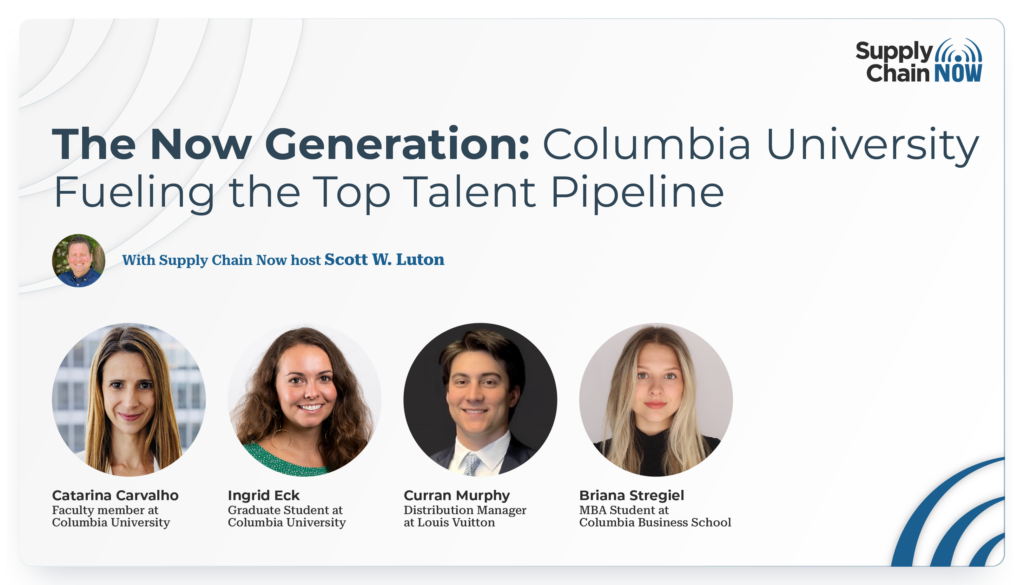
[00:00:30] Scott W. Luton: Hey, good morning, good afternoon, good evening, wherever you might be. Scott Luton with you here on Supply Chain. Now welcome to today’s show, folks. We are continuing one of my favorite series here today. One that we like to call the Now Generation, where we sit down with students and professional educators from some of the leading colleges and universities around the world.
[00:00:49] Scott W. Luton: Some are already doing big things right now today in industry. That’s where the name comes from and this show’s definitely gonna live up to that. We got big news this year on the now generation series here in 2026. We’re delighted to partner with Dr. Stephanie Thomas and the wise organization at the University of Arkansas to power this series.
[00:01:07] Scott W. Luton: Forward. Wise exists to show students that supply chain is indeed exciting, impactful, and full of opportunity. This initiative creates community. It connects students with industry leaders and helps them build the skills and confidence to launch meaningful careers. Stephanie and Wise team are doing some really cool things, great work, uh, programming, annual events, you name it.
[00:01:28] Scott W. Luton: And it’s open to all schools out there. Basically, we’re gonna drop a link in the program notes and, uh, you can click on that for more information, but today on the now generation here at Supply Chain, now we’re featuring an outstanding school, Columbia University, which happens to be one of the world’s most important centers of research and a whole bunch more.
[00:01:47] Scott W. Luton: And as you’re can see here today, the university is home to some of the most talented supply chain pros in industry. So get ready folks as we continue one of my favorite series here. I was tickled. I jumped outta bed this morning ’cause we knew we had this episode and this conversation teed up. So with all that said.
[00:02:05] Scott W. Luton: I want to introduce our esteem panel here today, and I’m gonna start with Professor Catarina Carvalho. She is part of the faculty at Columbia University in New York, where she teaches supply chain management to masters students beyond her teaching duties. Catarina also leads the supply chain practice at Arup and has been recognized by lots of industry players for her work, uh, across industry, including in 2023, where Catarina was.
[00:02:32] Scott W. Luton: Recognized as a national Top 20 under 40 honoree by engineering news record. Hey, Catarina, how you doing?
[00:02:40] Catarina Carvalho: Hi, Scott. It’s great to be here with You today.
[00:02:43] Scott W. Luton: as well. You as well. I appreciate your award-winning, uh, journey and I look forward to learning from your perspective as well as some of your, very talented students. So it’s great to see you. Uh, so I’m gonna continue the intros. Catarina, I know you know these next three individuals pretty well, but I’m gonna start with Briana Stregiel, uh, a second year MBA candidate at Columbia Business School and a consultant at Deloitte focused on retail and consumer goods supply chains.
[00:03:11] Scott W. Luton: Now get this, she recently spent the summer at McDonald’s through environmental defense funds, climate Core. Where she worked on water stewardship and supplier engagement across, of course, one of the world’s largest food supply chains. Briana is passionate about the critical intersection of supply chain strategy and sustainability.
[00:03:30] Scott W. Luton: Briana, how you doing?
[00:03:32] Briana Stregiel: I am doing?
[00:03:32] Briana Stregiel: well. I’m happy to be here.
[00:03:34] Scott W. Luton: Great to see you here today, and you’re joined by Curran, Jeremiah Murphy, a distribution planning manager at Louis Vuitton Americas, where he leads inventory, strategy, and product flow for high value watches and jewelry amongst several degrees. Curran earned a master’s degree in sustainability management and a bachelor’s degree in industrial engineering from Columbia University and in parallel.
[00:03:59] Scott W. Luton: Get this, it blows my mind. He’s an active natural gas futures trader, developing systematic risk manage strategies that integrate technical, macroeconomic and data-driven analysis to generate consistent performance. n, how you doing?
[00:04:15] Curran Murphy: I am great Scott.
[00:04:17] Scott W. Luton: Well, great to have you. Do I interrupt any calculations that you might be running?
[00:04:22] Scott W. Luton: Okay. All right. Making sure I got, I, I could barely say, uh, a lot of that math and I know I couldn’t do it, so I look forward to learning more from you here today. Ingrid Eck, a sustainability professional specializing in food systems and agriculture. Ingrid is currently pursuing a Master’s of Science and Sustainability Management at Columbia University.
[00:04:42] Scott W. Luton: Prior to graduate school, she served as senior manager of community engagement and programming at the Good Food institute. This is a, a really neat nonprofit think tank focused on advancing alternative protein innovation. That’s a noble mission. Ingrid has also consulted for food and beverage companies on sustainability, analytics, and supply chain decarbonization amongst other things.
[00:05:06] Scott W. Luton: Ingrid, how you doing?
[00:05:07] Ingrid Eck: I am doing?
[00:05:07] Ingrid Eck: great. I’m looking forward to the conversation.
[00:05:10] Scott W. Luton: I am too, and I really admired, you know, I bet a bunch of y’all have, dedicated some of your time to pro bono efforts, but, uh, Ingrid, that sounds like a really cool nonprofit that you dedicated some of your leadership bandwidth to. Huh?
[00:05:22] Ingrid Eck: Yeah, it was, it was really meaningful work.
[00:05:24] Scott W. Luton: Hmm. Outstanding. Okay, well great to see everybody. Catarina, I gotta circle back around to you. I really appreciate you taking the time to gather, uh, these three leaders so that our audience can really benefit from how they view the world and some of their perspective.
[00:05:40] Catarina Carvalho: No, I, I mean, I.
[00:05:41] Catarina Carvalho: think your introduction tells, uh, how diverse all the different backgrounds and how people are actually putting, uh, all of their leadership capacity and all of their brains into solving, uh, different, uh, problems within the supply chain in different industries. So I’m, I’m very lucky to attract this talent, in the course.
[00:05:59] Catarina Carvalho: And definitely Columbia is, uh, the Beijing University and, um, we are very lucky to have, uh. Great students.
[00:06:05] Scott W. Luton: Well, we’re gonna touch on all of that. that was a great preview of coming attractions, Catarina. Uh, so let’s do this. So Briana, I’m gonna circle back to you. First, I wanna start with kind of a couple of fun warmup questions. in the intros of, of all three of y’all, we kind of touched on academic and professional pursuits.
[00:06:22] Scott W. Luton: I wanna ask you a question, two part question if you would. Number one, tell us a little bit more about what you studied or are studying at Columbia, and what’s one extracurricular passion or hobby of yours, Briana?
[00:06:37] Briana Stregiel: All right, so like you mentioned, second year, MBA at Columbia. And the best part about Columbia is you can choose your own adventure and mix and match. So most of my curriculum is business finance focused, strategy focused, and then I get to dip into the other colleges and do some sustainability and supply chain.
[00:07:01] Briana Stregiel: so that’s mostly what I’m studying. Sustainable operations and supply chain through business. And my hobbies. I really like grandma. Hobbies. So I make sourdough, I garden, and I really love that.
[00:07:17] Scott W. Luton: Hey, that is outstanding and, Amanda, who’s, helping us, making It Happen every day here at Supply Chain. Now we are a bread factory right now, Briana, so you are gonna have to share some recipes. Seriously, she’s been nailing this sourdough recipe. So, those are some of the greatest great hobbies in my book at least.
[00:07:35] Scott W. Luton: So great. It’s great to see you here today, Catarina really quick. Briana mentioned, making bread, uh, gardening. knitting? Do you, do you do any of those things? Catarina?
[00:07:46] Catarina Carvalho: I cook quite a lot. I know Scott, most of your guests are into sports, but you have a very different crowd here today. Um, so I do a lot of cooking and I actually do, um, quite some painting myself. so very much into the arts and, um, I organize a lot of like collages, painting, drawing, events with, with my friends.
[00:08:06] Scott W. Luton: Okay. Curran and Briana Ingrid, did y’all know that about Catarina, what she just shared, especially painting.
[00:08:13] Curran Murphy: I did not know the painting aspect. That’s a new little fun fact I just picked up.
[00:08:17] Scott W. Luton: good, good, good. That’s what we’re here for. okay. We got some really cool hobbies supply chain can be tough. It’s good to have hobbies where we can decompress a little bit.
[00:08:25] Scott W. Luton: Um, Curran, same question, and now you’ve already graduated, uh, with your master’s from Columbia. So if you would elaborate, just, tell us something about that experience and same question. Where do you spend some of your free time on weekends?
[00:08:40] Curran Murphy: Yeah. So, uh, from my undergrad I was a industrial engineer, which gave me a very, uh, analytical background. Uh, and then moving into the Summa Sustainable Management Program. it was a, you know, a very eye-opening experience, being able to kind of use that analytical background, but to then give it some context.
[00:08:56] Curran Murphy: Uh, a lot of times in engineering we kind of work in the abstract, so this was a, a phenomenal opportunity to kind of marry both worlds and, uh, kind of see how it plays out in the real world. personally I love to ski. I’m a huge skier. and that kind of is what sparked I think my passion for sustainability.
[00:09:14] Curran Murphy: I do a.
[00:09:14] Curran Murphy: lot of back country skiing where I’m hiking out in the mountains, kind of just me and the wilderness, or me and one buddy. And, you know, just seeing how the environment has changed over the years has definitely given me reason to kind of have this passion to protect it for future generations.
[00:09:30] Scott W. Luton: Curran, I love that. and from what I’ve done, I’ve done some homework on all, all four of y’all, really. And I think there’s a lot of kindred spirits and the passion for sustainability and protecting, uh, what we all enjoy today so our kids and their kids can, enjoy those same, wonderful, beautiful landscapes.
[00:09:44] Scott W. Luton: So good stuff. and for our audience out there, especially my fellow. Atlanta Falcon’s audience. Curran has agreed not to bring up 28 to three ’cause he’s a big Patriots fan. So I just wanna put that out there. Um, alright, so Ingrid, same two part question. Tell us a little more about, um, your academic pursuits at Columbia and, a really neat hobby of yours.
[00:10:05] Ingrid Eck: Sure. Uh, so I’m in my second semester of the Master of Science and Sustainability Management Program. Most of my coursework focuses on corporate sustainability strategy and metrics. In addition to supply chain, I’m studying carbon accounting lifecycle assessment, ESG reporting, and in terms of passions outside of sustainability.
[00:10:28] Ingrid Eck: I really enjoy candle making, uh, playing tennis when the weather is good. And I love to read. One of my favorite genres is solar punk or climate fiction. So thinking imaginatively about the the future
[00:10:45] Scott W. Luton: I like it. I like it. That can be very thought provoking. Ingrid, you haven’t seen any, uh, nothing that scares you about the future? Is it all positive, uplifting, and, and optimistic?
[00:10:54] Ingrid Eck: Well, I’m an optimist, so I like to think optimistically. Um, but of course what’s motivating me to do this work is that there’s some, concerning things on the horizon, um, that I wanna work to, to tackle with others.
[00:11:08] Scott W. Luton: Well, I tell you, we all can feel a lot better, uh, seeing all three members here, four members, gen now generation, already making, uh, an impact, and. Making for a brighter future. So, Catarina, I wanna circle back to you on, on two things. first on a serious note, one thing I’ve noticed just in the last few minutes with Briana and Curran and, and Ingrid is how well-rounded either the curriculum or the programming or the experience is.
[00:11:34] Scott W. Luton: It’s almost, it sounds like very intentional both by the individuals, but also I’m, I’m assuming by the university too. That’s a great. Advantage as you get out in the industry, especially industry like global supply chain. Your, your thoughts, Catarina.
[00:11:48] Catarina Carvalho: you cut that really quick, Scott. Thanks for, for bringing it up. The School of Professional Studies at Columbia is very focused on actually heating exactly that gap, which is between academia and the work environment, bringing professionals and actually preparing the next generation of sustainability managers and leaders.
[00:12:09] Catarina Carvalho: To basically embed sustainability within their area of expertise. And I think if there is a common thread, uh, between everything you heard today is how everyone independently of their areas of expertise and their link to supply chain, which is of course everywhere. everyone has. these lenses of trying to bring sustainability to their area of activity.
[00:12:31] Catarina Carvalho: And that is a, a very, uh, big, program at the School of Professional Studies in the Summa program. And, uh, it’s really a pleasure to see how, um, all the new generation is thinking on how they’re gonna apply it on their careers.
[00:12:47] Scott W. Luton: I’m with you. Thinking and acting. Thinking and acting for sure. Look good stuff. And on a lighter note, Catarina, we just heard there from Keran and Ingrid, uh, snow skiing, getting outside tennis, and of course candle making. Do you share any of those hobbies, Catarina?
[00:13:04] Catarina Carvalho: Well, um, something that Ingrid and Briana had probably heard that, uh, at class this semester. I, I love skiing as well. I had actually an injury in January. I have an ACL torn, so I think I’m a little bit less into skiing now. Um, but current, I wish you all the. All the luck. Um, but yes, I’ve been there.
[00:13:25] Catarina Carvalho: And also with Ingrid I have as well as, uh, with my arts lenses. I Love uh, crafts. So I have done some, some candles. Um, so Ingrid maybe something for us to connect on. Briana already knows this. I, I cook quite a bit.
[00:13:40] Scott W. Luton: I love that. Uh, and I’ll tell you one more thing about crafting, uh, woodworking seems to be back between woodworking and pickleball. It’s taken over the world. Uh, I’m still on the outside looking in, so we’ll see if we pick that up this year. But, uh, good stuff. And Catarina, hope you get back. You heal up and you’re get back on the slopes, soon.
[00:13:56] Scott W. Luton: Uh, all right, so let’s stick with you, uh, Catarina. And then we’re gonna, uh, learn a lot more about our. Three panelists here. if you would elaborate a little bit more about your role at Columbia University as well as some of the great work you have done in industry.
[00:14:11] Catarina Carvalho: Sure. Um, so I’m faculty at Columbia. I teach, uh, sustainable Operations and Supply Chain Management course that is part of the School of Professional Studies, uh, sustainability management, masters of Science program. I’m sorry, it’s a lot of words. to go through. And one of the amazing things about the course, which I think Briana, um, brought up as a, as a great advantage of Columbia University overall, is the flexibility for students to basically be drawing from different programs, different schools, and actually make their, degrees fit to what they want to do.
[00:14:47] Catarina Carvalho: Moving next. And that’s how actually Briana found our course and so many others. Um, as of now, I would say about half of the current students, um, in the supply chain course are from other schools. within Columbia, uh, we are a very popular course. Uh, to my knowledge. Uh, no other bachelor or master’s program at Columbia actually offer, uh, supply chain management.
[00:15:10] Catarina Carvalho: Studies. So we are very lucky to attract, a very diverse set of students. And it’s, uh, it’s a great pleasure to see that people that might or might and might not end up in a supply chain in the direct. Supply chain job are interested in learning more about what the role is about and what the industry is about, and trying to make the best decisions when they go to their jobs.
[00:15:36] Catarina Carvalho: Understanding that everything you’re going to do is going to have an impact in materials and suppliers and flows and embedding it.
[00:15:45] Scott W. Luton: Everything’s got a supply chain. And I think the public is slowly but surely realizing that, which is a great thing. Of course. Um, and then, you know, Catarina, one of the things I love about, what you bring into those classes is your real world experience, uh, that continues to this day. Uh, do you wanna share a little bit about that?
[00:16:02] Catarina Carvalho: Sure. Arup is a global, large engineering firm, top 10. We have about 19,000 engineers. We design the most and advise on the most complex infrastructure. Projects, um, worldwide, we have about 140 offices and, uh, I’m very proud to say probably attract one of the most brilliant minds in the engineering space.
[00:16:27] Catarina Carvalho: and in my role I serve all North America and South America solving the most complex engineering projects within supply chain. So the types of, um, assets that I generally operate. Tend to be, um, hospitals, very high security research facilities. a lot of critical infrastructure like airports, um, rail stations.
[00:16:51] Catarina Carvalho: So Scott, I think is very different from some of the guests you have here, which are much more on the retail side or on the AI side. But this is more about the building environment and the things that everyone uses every day. When you go to a hospital, when you take a train and you don’t even think about the level of, uh, security planning, materials, hazard’s, materials waste, that goes into all of that?
[00:17:15] Catarina Carvalho: So that’s, um, what I do when I’m not with this amazing minds on Monday nights for, for class.
[00:17:21] Scott W. Luton: 19,000 engineers. You know what you can’t do with 19,000 engineers? Not much. You can basically do everything that is, uh, that’s amazing. I have to look up, uh, your organization and I can appreciate as you mentioned a couple times, the highly complex challenges. You know, I don’t know about what y’all’s take on this, but some days, whether as an entrepreneur, as a supply chain practitioner, or just as a human being, I really appreciate.
[00:17:46] Scott W. Luton: The simple problems we have in life, right? Changing a light bulb, that’s a luxury, right? Take it out, put one in. I love that we’re faced as all four of y’all have, um, implied or, or said with some really big systemic, very complex challenges in, in supply chain and elsewhere. I’m so glad we’ve got some smart folks, uh, figuring that out.
[00:18:06] Scott W. Luton: So now that we’ve kind of set the table a good bit. I wanna dive in a little bit deeper, uh, ’cause we’re talking about, um, things you’re already doing. Again, now generation. It’s not, it’s not coming, coming attractions. It’s what you’re doing now. So, Ingrid, I wanna start with you. we referenced some of your, your nonprofit work, uh, you did, and of course your academic pursuits now as well as some of your passions.
[00:18:30] Scott W. Luton: What’s one thing that you have fallen in love with, uh, in terms of what you’ve done in global supply chain already?
[00:18:38] Ingrid Eck: I would have to say that I really love working within food systems sustainability. My, uh, previous job, as you mentioned earlier, I was senior manager of community engagement at the Good Food Institute. Basically, I had the opportunity to convene, uh, scientists. Industry leaders, policymakers, who are all united by this goal to make plant-based foods, cheaper and tastier.
[00:19:05] Ingrid Eck: but sort of the, the favorite, um, part of that job for me was facilitating the relationship building between farmers at one end of the supply chain and then alternative protein stakeholders at the other end of the supply chain. It, was, uh, really rewarding work. to be able to, to work at both ends and facilitate connections, uh, between the two.
[00:19:29] Scott W. Luton: You see the passion that jumps off the screen. And I’ll just tell you, there’s so much, so many cool things going on in that, in that alternative protein space. Uh, I’m gonna tell myself maybe a little bit here, ’cause this is a boring version, maybe, I don’t know. During the pandemic, I fell in love with tofu.
[00:19:43] Scott W. Luton: Fried tofu, tofu and soups, a number of different ways. And, and I never had that growing up, right? It’s not, that wasn’t part of, our meat and three, and it has really been, uh, one of myfavorite recent culinary adventures. So, uh, so Ingrid, we’re gonna have to, uh, compare notes a little bit. I know again, there’s a lot more cool things happening in the alternative protein space, but, uh, what an awesome mission.
[00:20:05] Scott W. Luton: Catarina really quick. Uh, Ingrid talked about the food industry and I was reading somewhere that about a third of all food produced globally goes to waste up to a third. We’re talking over a trillion dollars annually, not even to include, putting the value aside. that could be repurposed to, you know, go to or, you know, families in need and whatnot.
[00:20:28] Scott W. Luton: Kind of, Randy, your thoughts on that or the passion that Ingrid shared earlier on her, her leadership role in industry.
[00:20:35] Catarina Carvalho: it’s a really good number to keep in mind. This, especially as for, for all these new generation that is trying to improve on sustainability. I can share a little bit with you Scotts, uh, ’cause we have come across this problem now in my head, at Arup, uh, with some of our clients that are struggling exactly with metrics like this.
[00:20:52] Catarina Carvalho: Um, there are a couple things you can actually do to, to change that. At the first, definitely improve your demand planning and think a little bit more about what you’re bringing into your supply chain. That’s the first opportunity to reduce waste. but also if at some point downstream that’s actually the ratio that you end up with.
[00:21:10] Catarina Carvalho: Um, there are a lot of incredible technologies out there to manage organic waste that can basically transform that into, for example, a fertilizer, like an aerobic digester. Um, equipment and then allows you to create the circularity within your supply chain and actually use that waste to fertilize, in agriculture, uh, the production of new food.
[00:21:32] Catarina Carvalho: Um, so that’s one of the things we have actually worked quite a bit with some of our, our clients and of course, donation is always a great option. Uh, but I love the first one ’cause it just seems it’s the right thing to do when you try to incorporate circularity in your systems.
[00:21:45] Scott W. Luton: I’m with ya. Uh, I’m with ya. Uh, all right, so one quick, uh, Ingrid, what’s your favorite alternative protein? Really quick before I move on,
[00:21:52] Ingrid Eck: You know, honestly, tofu is also my favorite alternative protein. It’s very versatile. It’s also the original alternative protein. It’s been around for a long time. Uh, one of my other interests is actually food history and culture. it’s a cool food and a tasty one.
[00:22:09] Scott W. Luton: you know what, uh, a lot of folks call me a nerd when I, when I share my love for tofu, and I’m glad to have some kindred spirits here. So we’ll have to get some interview, uh, some, uh, recipe suggestions from you as well. Curran, let’s go to you. and the question is, uh, one thing, love about what you do in global supply chain, your thoughts.
[00:22:28] Curran Murphy: I think one of my favorite parts, uh, about being in global supply chain is kind of the collaboration, uh, amongst different groups of people and hearing how everyone approaches different problems differently. and it really opened up my eyes once I started working in the supply chain industry about How many different possible solutions there are.
[00:22:47] Curran Murphy: To one single problem. definitely going through college, we’re kind of, you know, we’re taught like, okay, this is a problem. This is how you approach it. But once you get into the real world, the possibilities are endless. And some of ’em are just the most creative solutions that drive real business.
[00:23:03] Curran Murphy: impact, uh, creating more sales while at the same time, uh, also reducing our carbon footprint. Uh, you know, we always think about new ways of. Forecasting where the demand’s gonna be, how do we move product there in advance to make sure that we’re not doing all these extra shipments, moving things around, creating, you know, wasted time, wasted dollars, and also wasted CO2 emissions.
[00:23:23] Curran Murphy: so it was just a really great eye-opening experience to just be able to talk to people from all over the world and just see how they all think just so uniquely.
[00:23:32] Scott W. Luton: I love that. Two quick thoughts and then Catarina, I wanna get your thoughts on what we heard there from Curran too. Number one, Curran, confirm this for me. I, I’ve heard inventory is cool again, is that right?
[00:23:42] Curran Murphy: Inventory is back baby. It is. It is the hot topic.
[00:23:47] Curran Murphy: Uh,
[00:23:47] Scott W. Luton: then, and then secondly, you didn’t miss a beat there. And then secondly, uh, uh, on a more serious note, the front end of your response and the last thing, your response referenced this, but when you get a bunch of folks from a different bunch of different walks of life. All the different ways we define that.
[00:24:03] Scott W. Luton: It is amazing when we start sharing and, uh, those different perspectives and, and how we look at problems, opportunities, you name it very differently. There’s so much good stuff that comes outta that, and that’s kind of one of the things you spoke to there. Catarina, uh, your thoughts from what we heard there from.
[00:24:20] Catarina Carvalho: I love what he mentioned about collaboration, I think is one of the things we go in the course, um, quite in depth in terms of the, the flows of information and the importance of actually breaking silos across the different functions of the supply chain and beyond your own organization to collaborate with others.
[00:24:37] Catarina Carvalho: And it makes me very proud to see that, uh, he’s applying some of these things and experiencing himself and improving it. for all the others in the space.
[00:24:44] Scott W. Luton: I am with you. I’m with you. Okay. So Briana, uh, same question. One thing that you just love what you’re doing in industry.
[00:24:53] Briana Stregiel: Yeah. Uh, what I love about supply chain is that it’s really the infrastructure behind everyday life. Uh, it’s kinda like the operating system of the consumer world and. You don’t always see what’s happening behind the scenes, but it’s what makes everything work. And there’s something really exciting about being behind the scenes and knowing that every product relies on millions of coordinated decisions.
[00:25:20] Briana Stregiel: And because of that, supply chains have this huge and often underappreciated opportunity to really drive change, especially when it comes to sustainability And. How products ultimately reach their end destination, being with the customer.
[00:25:37] Scott W. Luton: Hmm. The operating system of the consumer world. I love that. And, uh, towards the end of your response there, uh, I’ve long held that one of the coolest things about the global supply chain industry is we are so much in a unique position to drive so much good change. On the flip side, we’re the reasons.
[00:25:56] Scott W. Luton: Some not so good things exist and we gotta tackle that too. But really. We’re in such a great position, uh, to create, to make such a great positive and, and powerful impact. Catarina, what’d you hear there from Briana?
[00:26:09] Catarina Carvalho: think it’s, um, right, uh, on the head. This is exactly where, um, where supply chain fits into everyone’s everyday life and everyone’s careers as well. And why do we need, um, all these brilliant, talented minds to, to help this improve the system? Slowly, slowly. As you said, Scott, um, bit by bit will gets to a better world.
[00:26:30] Scott W. Luton: right, that’s right. Hour by hour, sometimes it feels right. Um, and you gotta trademark that operating system of the consumer world. Briana. You better trademark it quick. I like that. okay. Leadership. You know, that’s been a major common thread already in the, in the first part of, of today’s podcast discussion.
[00:26:49] Scott W. Luton: Uh, and then, you know, of course the four leaders that I’m talking to, um, and some of the passions and some of the, some of the impact and some of the missions that you’re own. It’s fascinating stuff. But I gotta ask y’all, and I’m gonna go, I’m just gonna go back in reverse order and I’ll stay with you Briana.
[00:27:04] Scott W. Luton: When it comes to leadership, you know, what’s one thing that you believe will define the most effective supply chain leaders over the next five years? It’s very challenging. Your thoughts, Briana?
[00:27:17] Briana Stregiel: I think it’s the ability to drive transparency across their entire value chain. And right now what I’ve seen is one of the biggest challenges is that companies don’t even fully know how to measure their. Scope three emissions because there’s such a disconnect between how suppliers operate and what companies are actually tracking and reporting.
[00:27:40] Briana Stregiel: And I’ve seen this firsthand working with clients. For a food example, it’s pretty straightforward to measure what’s happening in a restaurant in, let’s say, New York City, but it’s much harder to trace the environmental footprint of a small farmer in Texas where you’re getting the meat, but they’re all part of the same supply chain.
[00:28:00] Briana Stregiel: So. The leaders who stand out will be the ones who can close that gap and have stronger communication with suppliers and improve visibility together.
[00:28:12] Scott W. Luton: Hmm. Briana, it’s interesting that you shared that, you know, emissions are a newer challenge that we’re still coming to grips and trying to make, uh, progress on. But it reminds me of a very old adage, Catarina, if we can’t measure it, it’s, it’s impossible to manage it. And we’re still trying to That’s right.
[00:28:30] Scott W. Luton: That’s right. We’re still getting there. Uh, kind of run your quick thoughts on what we heard there from Briana.
[00:28:35] Catarina Carvalho: Oh, I think it is, uh, it is really an important issue, especially in supply chain more than anywhere else, the transparency. and it’s really hard to address, uh, to be able to manage with all the different systems and the, all the different connectivity between where data exists. If data exist and incorporate as well, like, uh, small local organizations and suppliers into a quite complex system.
[00:28:58] Catarina Carvalho: so it’s gonna take a couple decades, um, to get there, but, um, slowly we are, we are improving there.
[00:29:04] Scott W. Luton: we certainly will. And, and I think of one specific thing, when it comes to emissions. You know, I’ve read, and there’s varying, data studies on this, but somewhere between 10 and 15% of first attempt deliveries fail. Right. Think of all the added miles and emissions and just waste in general, right?
[00:29:22] Scott W. Luton: And think about how big the gains would be if we just ratchet that number down 1%, maybe half a percent. Let’s get half percent this year. Maybe two next year. I don’t know,
[00:29:31] Catarina Carvalho: Or Scott, another great number is to think that supply chain, um, accounts for almost 94% of your actually emissions in your business, um, on average across industries. So as people are focusing on scope one and Scope two, and it’s the low hanging fruit and is a great opportunity to actually, make progress. but,
[00:29:49] Catarina Carvalho: in reality, you’re not gonna decarbonize until you get to supply chain.
[00:29:53] Scott W. Luton: hmm.
[00:29:53] Scott W. Luton: Well said, well said. Uh, and I know. Urban logistics is certainly one of your, uh, big areas of expertise. We’re gonna have to have you back and we’re gonna take a deep dive in that it’s a fascinating space. okay, Curran, we’re going to reverse order here. we’re talking leadership. We’re talking one thing that, that will define the most successful, effective supply chain leaders over the next five years.
[00:30:13] Scott W. Luton: What’s that one thing, Curran?
[00:30:15] Curran Murphy: You know, I, think there’s a lot of discussion around AI and all these great tools that are out there, but I think what will really drive the change, and, you know, what makes an effective leader, is their ability to communicate, those findings. You know, I think there’s great teams of people doing amazing things with technology, with new KPIs, new approaches on how to, you know, look at some of these issues that we’re dealing with internally.
[00:30:37] Curran Murphy: But unless those are effectively communicated to all the proper teams. No one really knows how to take the right steps and action on those results. I do really believe that the leaders in the next five years, and it’s not a groundbreaking kind of, uh, thought to think that someone who can communicate will be a great leader, but I think it holds true.
[00:30:55] Curran Murphy: It’s, you know, they’re the people that bring, you know, the different groups together. You know, supply chain reaches in almost every. aspect and every step along the way to getting the product to the final customer. And that’s a lot of different teams. And being able to coordinate everyone, making sure everyone’s on the same page, aligned with the same mission is a real challenge.
[00:31:14] Curran Murphy: And, and.
[00:31:14] Curran Murphy: if you can accomplish that, I think there’s a lot of, uh, success in those people’s future.
[00:31:19] Scott W. Luton: well said, sometimes what is old is new again. And, and that’s really important. when I hear communication, uh, Catarina on one hand. It is, you know, communication, communication, communication, and, and you could argue it always has been. However, the twist, the big twist is how we communicate continues to evolve.
[00:31:39] Scott W. Luton: You know, when I was in college, we’d fill out blue books during exams. I don’t know if y’all do that anymore. That was not fun. I, my right hand would be killing me as I left exams and got a c plus on, email. Fax is no longer texting, uh, social. I mean, you think of all the different ways that how we have to communicate and persuade, influence, inform, whatever, how that changes technologically.
[00:32:04] Scott W. Luton: So even those that communicate so well in one mode have to learn new modes to reach new people coming into the workforce that are used to different channels. Catarina, your thoughts on what Kein just shared.
[00:32:16] Catarina Carvalho: Uh, Scott, it’s, uh, it’s right there, right? The digital world is here to stay. There’s so many channels, uh, to communicate within organizations, and I think we all experience it every day. How, the decision making that needs to go. Into what is the right channel to communicate to the right people?
[00:32:33] Catarina Carvalho: How many people needs to read a certain communication, how to be inclusive at the same time, kind of not, dragging too many people into a discussion that you don’t need them to be on. Um, it’s a really, it’s a really an art and a balance to continue to, to develop, especially as new tools are going to be launched, uh, with AI here and with other, uh, technologies as well.
[00:32:53] Scott W. Luton: That’s right. And to one of your points, do all 37 people need to be in that meeting that you’re about to send an email out on? No. Sometimes seven works. Sometimes no meeting is do it on email or Slack. Right. Uh, but well said Catarina. And um, hey, really quick before I ask you the same question, Ingrid, lemme just do a pulse check ’cause I read a few months back that due to,
[00:33:14] Scott W. Luton: AI challenges and others that Blue Books were making a comeback and that there were more manual, answers to exams. do y’all still use Blue Books at Columbia University?
[00:33:25] Catarina Carvalho: They’re gonna be surprised, Scott. We don’t do blue books, but actually all the students in this course do exams in pen and paper in my course, which, uh, I think very proud of. And sometimes, uh, some of the master’s students come in, it’s like, this is my. First time actually doing a pen and paper exam. Uh, but uh, I’m old school, so I like old ways.
[00:33:44] Catarina Carvalho: I’m the current. Yeah, like this needs to be right. You sit with your knowledge, there is no tech. And now, um, yeah, let’s see how, how it.
[00:33:52] Catarina Carvalho: goes for you.
[00:33:52] Scott W. Luton: You know, I just taught my son what show your work means. Right? And, and you know, when you, there’s nowhere to hide, You know it or you don’t. So, uh, but I am glad I’m not in your class right now ’cause I think on fail, a lot of these high level.
[00:34:04] Scott W. Luton: Principles. Um, Ingrid, same question. We’re talking supply chain leadership. What’s one thing you think will define really successful supply chain leaders over the next five years?
[00:34:13] Ingrid Eck: Absolutely. Yeah. I think, um, before I answer, I, I wanna say, you know, you really can’t accomplish much without solid communication. So I just completely se support what Curran said. But I do wanna add, I think, getting familiar with some of these tools. Are coming out is, is gonna be really beneficial. specifically I think effective supply chain leaders, would benefit from being familiar with the latest climate risk and scenario analysis tools.
[00:34:40] Ingrid Eck: Uh, downscaling technology is beginning to unlock. Localized high resolution projections at the asset level, um, for climate change, whether that’s rising temperature, increased flooding, uh, more extreme and more frequent extreme weather events. I really think that all supply chain risk. Managers would benefit, from understanding how this technology works, the, the methods behind it.
[00:35:07] Ingrid Eck: and I’m actually taking a class in this subject right now and it’s, it’s just mind blowing stuff.
[00:35:13] Scott W. Luton: Man. Okay. Uh, I’m a bit of a weather nerd. We’ll have to compare notes. I spent two years in Kansas, and I know this is not exactly what you’re talking about, but that’s a fascinating part of the weather world. Catarina, really quick, let’s talk about, a lot of what Ingrid just shared and one of my favorite parts of, of.
[00:35:29] Scott W. Luton: her response was getting the data, getting it down to the decision level in the hands of the people that are making the decisions day in and day out. Sometimes we kind of create technological silos, as weird as that may sound, where, the information that the, for example, the frontline needs, it’s hoarded at the board level, right.
[00:35:48] Scott W. Luton: And we gotta bridge that better. But your thoughts on what Ingrid said there, Catarina?
[00:35:52] Catarina Carvalho: Yeah, Scott, I think you mentioned earlier that you can’t improve what you can’t measure, and if there was a second line around this, it would be, you at the same time, like there is no possibility for you, to do better in your supply chain in terms of transparency. Have a lower impact. From a sustainability perspective, if you don’t bring together all the knowledge and all the people and have all the communication and all the metrics aligned with that mission, there is a lot.
[00:36:19] Catarina Carvalho: I’m pretty sure you have seen as well all of us, a lot of reports out there with. Facts with no actual insight. Something that is not actionable for you to be tracking progress or to be tracking, anything more sophisticated, uh, change in your supply chain and cross-cutting across departments. And that’s what we need to do more.
[00:36:38] Catarina Carvalho: We need to be able to have an holistic view of our supply chains and as well, especially for the carbonization, it’s a group work. It’s not someone alone.
[00:36:47] Scott W. Luton: Yeah, well said Catarina. And, you know, it’s not solely, uh, a climate issue, but, uh, I look at chocolate and cocoa production. I look at the cattle, uh, cattle herds in the states. Uh, I think they’re at, 70 year lows, some of that due to, uh, climate factors. Uh, so I’m glad Ingrid, that we got smart people, taking data-driven approach, form and hopefully educate some of the decision making that goes on.
[00:37:11] Scott W. Luton: alright, so Briana, I’ll circle back to you as we hit this next topic. I always, when we have. These now generation conversations. I love pulsing the panel on what it’s like, Matriculating through, going through the schools and in this case Columbia University.
[00:37:27] Scott W. Luton: And, and in particular, kinda a two-part question, Briana, what it’s like to be in Professor Carvalho’s, uh, supply chain classes and the overall student experience at Columbia University. Your thoughts, Briana?
[00:37:40] Briana Stregiel: Yeah. For the first part, I think our supply chain class is really refreshing because there can be complex topics that our professor makes very easy to understand, and she comes up with these vocabulary dictionaries that we can study and it’s, Simple to understand, even though they’re complex and she also makes sure that we’re learning because of her work experience.
[00:38:07] Briana Stregiel: We are not just learning academics, we’re learning how it works in the real world. And this was the first time I’ve actually had like formal education on supply chain. I’ve worked in practice. So it’s very, very cool to see that bridge between the academic world and. Working in supply chain and industry and our professor makes that very simple to understand.
[00:38:33] Briana Stregiel: And as far as what makes Columbia amazing, it’s definitely the people. The people, the professors, they elevate everything. Even in our class on Monday, we had a case study that we were turning to whoever was sitting next to us, and you just strike up these conversations that uncover your eyes to different things.
[00:38:55] Briana Stregiel: For example, the person I was sitting next to worked at a nonprofit that was. Basically the intersection of all of my different passions. And he was telling me about like what he’s doing, at his nonprofit and it just uncovered my eyes to, wow, there’s a really cool nonprofit that I could go explore and I have a connection built in ’cause he was sitting next to me in class.
[00:39:17] Briana Stregiel: And that kind of overlap between academics, your network, and real world impact is pretty seamless at Columbia.
[00:39:25] Scott W. Luton: hmm. And incredibly valuable. uh, really quick Catarina, she talked about the bridge right between the academic and the real world, and of course the immense value of people at Columbia that makes it very special. Your quick thoughts there?
[00:39:39] Catarina Carvalho: I think School of Professional Studies is all about it, and particularly our program in sustainability management is offering every professional with different backgrounds that opportunity to bridge the real world with academia. By having a, a group of faculty and, um, and lecturers at the program that are practitioners.
[00:39:59] Catarina Carvalho: so I am practitioner, most of my colleagues are as well. so that brings a very different, uh, I think, taste to what being in school and having an experience with, talking to your colleagues, resolving case studies in class with whoever you’re sitting with. And I’m, I’m really glad that, this is resonating with the students.
[00:40:16] Scott W. Luton: Sounds like it. Uh, I’m gonna go to you next, Ingrid. Uh, same two questions, Catarina’s classes, right? What do you love about those and the overall Columbia experience?
[00:40:27] Ingrid Eck: the class has been really, really special. It’s, it’s helped me unpack, important differences between some sustainability buzz words like efficiency and resilience. I think often sustainability professionals are trained to believe that you can easily have both of these things, but in fact, uh, supply chain management really underscores that there are some inherent trade off.
[00:40:54] Ingrid Eck: Between waste reduction and risk preparedness. Uh, and it makes sustainability work quite difficult when you know that. But it’s, it’s also exciting and it’s interesting and it’s, um, I love that the work is challenging. I really appreciated, um, that deeper understanding of the, the nuances behind these bud buzzwords that we’re using every day.
[00:41:16] Ingrid Eck: and in terms of my Columbia experience, uh, more broadly, I. Love it. Uh, there are so many sustainability, uh, opportunities specifically at Columbia. Uh, really no matter your interest area. I’ve, um, even been able to serve as a teaching assistant for some climate justice classes, which is another one of my interests.
[00:41:38] Ingrid Eck: Um, there’s really a, a class and a community and a faculty member and students, that you can connect with that, that share your passions, across the campus. So I. I love the program. It’s been great. Yeah.
[00:41:49] Scott W. Luton: Fascinating. Those are two strong testimonials. I wanna go back to one thing she mentioned though, uh, Catarina, uh, Ingrid mentioned the importance of getting below surface level understanding of problems. Big and small. And I think, you know, for right or for wrong, I think humanity’s getting trained unfortunately by, some of the media, you know, the click bait, the headlines, and then that’s where our understanding, we make, we make snap judgements because we’re humans.
[00:42:15] Scott W. Luton: And I think developing the discipline that Ingrid’s talking about to, to truly get well beyond the headlines, well beyond the long held assumptions or new held assumptions and get to the, the heart of the matter. those are muscles that have to be. developed and worked and practiced so you can, it becomes almost, um, what you do every day.
[00:42:33] Scott W. Luton: Your thoughts, Catarina.
[00:42:35] Catarina Carvalho: I think it’s really important to go beyond the Ingrid, put it, uh, the buzzword and actually understand what it does take to do the job, and put it in a way that is simple enough for everyone to understand the basics on how to approach it. Then live it. And I think it resonates a little bit to what Curran and Briana was saying.
[00:42:55] Catarina Carvalho: Were saying before live it for, everyone to be able in their area of expertise as they jump into work to see what other possibilities are out there, what other resources do you have to solve that problem. Um, there is not a one solution fits all, but is the system’s thinking of assessing the problem and understanding that it’s not just, uh, that surface level, see the systems behind it and actually take action.
[00:43:20] Scott W. Luton: Hmm. Yeah, Catarina, I think the only, one solution fits all is maybe the light bulb. I think that’s the only problem. And even then.
[00:43:27] Catarina Carvalho: Maybe not.
[00:43:28] Scott W. Luton: Even then you go to Home Depot and you got 3000 different light bulbs. But anyway. alright, Curran, same question. I’ll tell you clearly Briana and Ingrid seem to be raving fans of their experiences at Columbia University and their ongoing, uh, experiences.
[00:43:43] Scott W. Luton: How about you as a recent, graduate, uh, times two, uh, your thoughts about both supply chain classes with Catarina, uh, and the overall student experience?
[00:43:52] Curran Murphy: Well, I first of all loved my experience at Columbia. It was, uh, lot of fun and a lot of work at the same time. I think the one word I’d use to describe it is opportunity. by going to a great school like Columbia and meeting all these amazing people, you unlock all these amazing opportunities for either social reasons or career reasons.
[00:44:12] Curran Murphy: specifically with the supply chain class, I came into this program. Stead set on going back into finance, that’s all I was thinking about. Like, all right, how do I look at decarbonization, uh, strategies and hedges? And professor, uh, Avario was like, you know, you should really take a look at supply chain.
[00:44:30] Curran Murphy: You might actually find that you’ll like it a lot because a lot of your past studies play right into it. What you’re doing right now is actually a lot of supply chain, whether you realize it or not, because that directly feeds into the value of a company and how they operate. I would not have be in the position I am now without taking that class.
[00:44:49] Curran Murphy: And, you know, have my eyes open to the immense opportunities there are in supply chain. And I’ve had a lot of fun, uh, working at this job and getting to know all the different components of supply chain. And that’s all thanks to, uh, to Catarina’s class.
[00:45:03] Scott W. Luton: So Catarina, if it were me, that’d be like the best thing I heard all day long, but react to that. I’ve got a related follow up question.
[00:45:12] Catarina Carvalho: No, I wanna say it’s, uh, I apologize for all my finance colleagues listening to this podcast today, but I’m very proud that I steal Curran from finance to supply chain. It took me a couple lectures, but I remember right before the class starts, Curran would be on. Room on the side solving on a, you know, black charcoal, uh, board.
[00:45:35] Catarina Carvalho: Some of his problems with his traits. And that’s why like slowly, slowly I start embedding these ideas. Like, Ron, we need talent like you in the industry. You know, like, just think about it. It could be fun. and I’m really proud to see that, uh, we are right now attracting. Not just in the course, great people with diverse backgrounds, um, but also, um, changing people’s ideas on what they wanna do after Columbia and getting them to join the industry, which, as you know, Scott, we very much need talent and we need people, uh, interested in supply chain to make a difference.
[00:46:11] Scott W. Luton: Catarina, you’re dead on. You’re, you’re absolutely right. And so Briana and Ingrid and Corin, that’s where y’all already know where we’re going next because now y’all have a shared responsibility to do the same thing and get folks from all walks of life, all skill levels, all talents, you name it. Coming into this industry so that we can continue to, uh, innovate and solve problems and hopefully leave no one behind.
[00:46:35] Scott W. Luton: so Catarina, on a related note, now that you’ve heard Briana and Ingrid and Keran and you’ve had the experiences with them, um, you know, over the last few years and, and of course you still have lots of bright students, fellow bright students in your classes, what is one or two of your favorite aspects of engaging with the Briana’s Ingrid’s and the ENSs of the world?
[00:46:57] Catarina Carvalho: Right. I, I think they all touched some of this, and especially Briana, is that idea that at Columbia you just come across people that are, in so many different parts of the economy, um, with so many different backgrounds and talented and willing to do. Things differently. So every every week when I’m lecturing, I’m posed with questions I have never thought about.
[00:47:24] Catarina Carvalho: and every class is different and every, uh, group of students, uh, come with a different perspective based on what I had experienced in the world. To me that is so refreshing to have this group of professionals that come from such a diverse background, so talented that come together at the School of Professional Studies to learn something and take it back and make it better. I, think it is an incredible privilege to have access to, These young professionals and I hope that, and I’m happy to hear that they’re taking from their experience in their program, just enough learnings to be able to come back and use as well their own minds. ’cause the world will change. There is nothing that school can teach you that is going to be forever true in the world of supply chain, the world changes and having the capability to analyze.
[00:48:20] Catarina Carvalho: Adapt and improve is really, really important. I’m really privileged to be able to see it happening in real life every
[00:48:27] Catarina Carvalho: Monday.
[00:48:27] Scott W. Luton: I tell you, I, I’m, I am jealous. I have glimpses, you know, these conversations, but you mentioned one thing that really, I can feel in my bones the questions you get in your classes from folks like this here. I’m not envious of your role. I’m, I’m not cut out to be a teacher and tackle those complex questions, so we’re gonna have to have y’all back again soon and do a catch up episode.
[00:48:50] Scott W. Luton: But in the meantime, I wanna give every, give our audience out there that are listening or, or watching this episode. Uh, I’m sure y’all have struck a nerve with many of those out there, and I wanna make sure that folks know how to connect with each of y’all in case they wanna invite you in to speak at their event or, you know, compare notes.
[00:49:07] Scott W. Luton: You name it. And I wanna start with you. Professor Catarina Carvalho, uh, how can folks, uh, track you down and, uh, connect with you?
[00:49:16] Catarina Carvalho: LinkedIn is a great resource and I always keep an eye on it, so, um, feel free to connect anytime. I love to exchange notes and I love to connect with everyone in the industry. So you?
[00:49:26] Catarina Carvalho: can find me with Catarina Carvalho, Columbia Arab, and you’ll definitely come across my profile and I’m very happy to connect with everyone.
[00:49:33] Scott W. Luton: Outstanding. And by the way, congratulations. Uh, I believe I saw you were named one of the, esteem leaders, uh, women of the Revolution, uh, supply chain, queen Sheri ish, uh, put together. That was outstanding. What an incredible list of Dynamos Catarina.
[00:49:49] Catarina Carvalho: Thank you so much, Scott. Um, it’s definitely a very rewarding recognition from, um, from Sherry.
[00:49:56] Scott W. Luton: Um, all right. So, uh, Briana Stregiel, I said that right last name, right? Didn’t I? Oh, ma. Making sure. Making sure. Okay. So, how can folks connect with you, Briana?
[00:50:07] Briana Stregiel: LinkedIn as well. I’m a big proponent of a cold LinkedIn message, so feel free to message me and I’m happy to coffee Chat
[00:50:16] Scott W. Luton: All right. I like it. I like that. Uh, and I tell you, as I, I say a lot, I wish I had come up with LinkedIn about 20 years ago, man. I tell you, it has been the go-to platform for so many, but I reach out to Breonna there and of course, Catarina. Ingrid, same question. How can folks connect with you?
[00:50:35] Ingrid Eck: Same thing. Um, please reach out on LinkedIn. You can find me at Ingrid deck. Just search for my name.
[00:50:43] Scott W. Luton: It is just that easy. Ingrid e thank you so much for being here as well. And finally, Curran Murphy, uh, Curran j Murphy. Uh, how can folks track you down, my friend?
[00:50:54] Curran Murphy: a unique situation here. You can find me on LinkedIn Murphy, uh, and uh, cold messages. I.
[00:51:02] Scott W. Luton: Outstanding. All right, LinkedIn, you’re gonna be a sponsor at some point. Uh, my friends if you’re listening or viewing out there. But anyway, Curran Murphy. Thanks for being here. Ingrid Eck, Briana Stregiel, and of course Professor Catarina. Carvalho, thanks so much for facilitating this conversation and.
[00:51:20] Scott W. Luton: Much more importantly, doing what you’re doing to bring people into this beautiful global industry that’s so consequential, and encouraging them to go out and tackle big, big feats in industry. So, thanks for being here and thanks for what you do. Um, alright, so folks. Big thanks, uh, to our panel, of course, uh, Columbia University.
[00:51:39] Scott W. Luton: If you’ve ever been curious about what it’s like to, uh, not only, be a student there or a business leader there, uh, to talk supply chain up in, uh, New York City at Columbia. and by the way, Catarina, where can folks learn more, whether they’re future students, whether they’re the future undergrads or future master’s students?
[00:51:57] Scott W. Luton: Should they just maybe reach out to you or do you point wanna point them somewhere?
[00:52:01] Catarina Carvalho: absolutely. If you are interested in knowing more about our program at Columbia and um, the different masters we offer our course in particular, please reach out. You can also, email me directly into AA 4 0 9 7. I know it’s strange email, but it is, um, AA 4 0 9 7. @columbia.edu. and I’m very happy to tell you more about, um, our program and how to get in touch with us.
[00:52:27] Scott W. Luton: Outstanding. That is a unique email. Uh, good stuff there. But hey folks, we try to share information, trusted information, and so if you’re interested, please reach out to Catarina. big thanks Dr. Stephanie Thomas and Wise. Folks go check out and get involved with their, uh, incredible work supporting supply chain students everywhere.
[00:52:44] Scott W. Luton: I wanna say that they’ve got, uh, three dozen schools, uh, part of the wise organization or thereabouts. of course, big thanks to our wonderful audience. You are what we do. Keep all the fee fa feedback’s a blessing, uh, and our audience gives us a lot of great feedback. Keep it coming. That’s how we all get better.
[00:53:00] Scott W. Luton: But you know, you got homework today. Uh, this incredible panel, these four leaders here brought a lot of very actionable perspective and passion. A glimpse of where we are today and a glimpse of where we’re going. Take one thing you heard from Ingrid and Briana and Curran and, and Catarina, and share it or do something with it, right?
[00:53:18] Scott W. Luton: Deed’s, not words. That’s what it’s all about. And with that said, on behalf of the whole team here at Supply Chain now, Scott Luton, challenging all of our wonderful audience members out there. Do good, give forward, be the change that’s needed, and we’ll see you next time, right back here on Supply Chain now.
[00:53:30] Scott W. Luton: Thanks everybody.