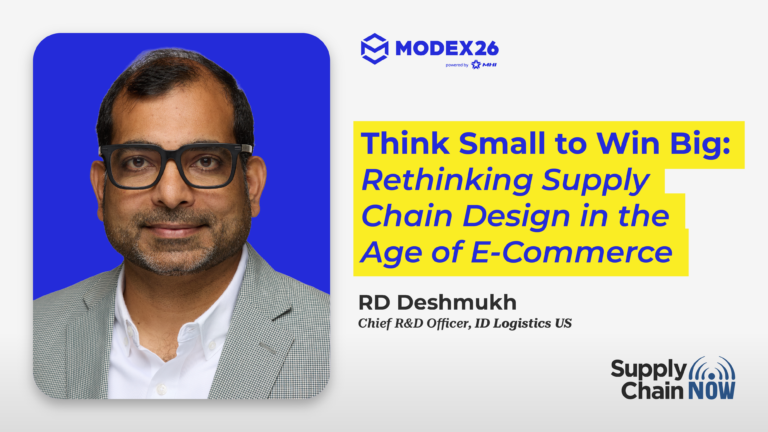
Think Small to Win Big: Rethinking Supply Chain Design in the Age of E-Commerce
At MODEX 2026 in Atlanta, Scott Luton sat down with RD Deshmukh, Chief R&D Officer at ID Logistics US, to explore how supply chains must evolve to keep pace with a rapidly shifting retail and e-commerce landscape.
From AI deployment to warehouse design and customer expectations, RD offers a clear message: the old playbook no longer applies; and those who fail to adapt risk falling behind quickly.
A “Day-One” Mindset for Continuous Change
Drawing from his experience at Amazon, RD emphasizes the importance of maintaining a “DayOne” mindset, which is one rooted in curiosity, adaptability, and constant reinvention.
“Be curious, be innovative… the day you’re not curious, it will kill you,” he explains.
In today’s environment, where disruption is constant, this mindset isn’t optional. It’s essential. Leaders must prepare their teams not just to respond to change, but to expect it. As RD puts it, the only certainty is that “tomorrow is going to change.”
This philosophy underpins how ID Logistics approaches innovation, engineering, and customer solutions; always with an eye toward flexibility and resilience.
AI: Start with the Problem, Not the Technology
While artificial intelligence continues to dominate industry conversations, RD cautions against rushing into implementation without a clear purpose.
“Do not force it… first, you must understand what problem you are trying to solve,” he advises.
Too many organizations, he notes, are adopting AI simply to “check the box,” without fully understanding its application. Instead, leaders should work backward from the customer need, define success upfront, and test solutions in tightly scoped environments before scaling.
He also highlights an emerging frontier: physical AI. While much attention has focused on digital applications, the real complexity – – and opportunity! – – lies in embedding intelligence into physical operations, from autonomous mobile robots to fully self-managing systems.
E-Commerce Demands a New Design Philosophy
Perhaps the most striking insight from the conversation is how dramatically e-commerce has reshaped supply chain design.
“The biggest trend is change… every three months,” RD says.
Consumer expectations are evolving at a relentless pace, driven by social media, market dynamics, and shifting global conditions. As a result, supply chains must be designed with flexibility at their core.
RD introduces the concept of “two-way doors”: decisions and investments that can be adjusted or reversed as conditions change. This approach allows organizations to pivot quickly without being locked into outdated strategies.
Out with the Old, In with the Agile
One of RD’s most direct pieces of advice is aimed at organizations trying to compete in modern e-commerce using outdated approaches.
“You cannot win today’s race with old horses,” he says.
This applies not just to technology, but also to mindset, processes, and organizational structures. Traditional, static warehouse designs – – while once effective, they are no longer sufficient in a world defined by speed, variability, and customization.
Instead, companies must adopt agile, modular solutions and rethink how teams collaborate. This includes embracing cross-functional “volatile teamwork” and continuously challenging assumptions about how operations should run.
The Shift to Smaller, Faster, More Frequent
Looking ahead, RD offers a bold prediction that encapsulates the future of supply chain operations:
“The quantity [of items per order]… is becoming smaller and the size of the product being shipped is becoming even smaller.”
In other words, the era of large, bulk shipments is giving way to a world of micro-fulfillment. Consumers are ordering individual items, such as from socks or hair clips or shoes, and expecting rapid delivery.
This trend has profound implications for warehouse design, automation, and inventory management. Storage systems are shrinking, order profiles are becoming more complex, and operations must handle higher volumes of smaller transactions.
To succeed, organizations must “adapt your engineering, adapt your mindset, adapt your warehouse” to this new reality.
Final Takeaway: Flexibility Is the New Competitive Advantage
Across every topic, from AI to e-commerce to execution, one theme stands out: flexibility.
Supply chains must be designed to evolve, not just operate. Leaders must listen more, question assumptions, and remain open to new approaches. And organizations must build systems that can scale, pivot, and adapt as conditions change.
At MODEX 2026, RD Deshmukh’s insights serve as a powerful reminder: in a world where change is constant, the ability to stay agile isn’t just an advantage. It’s a requirement.
Where to Learn More
Connect with RD Deshmukh on LinkedIn. You can also learn more about ID Logistics by visiting their website: https://www.id-logistics.com/us/. Lastly, you may glean a few new insights about RD Deshmukh’s journey via this blog profile here on LinkedIn.
More Blogs
AI and the Future of Supply Chains: How Leaders Move from Hype to Real Impact