Scott Luton (00:02):
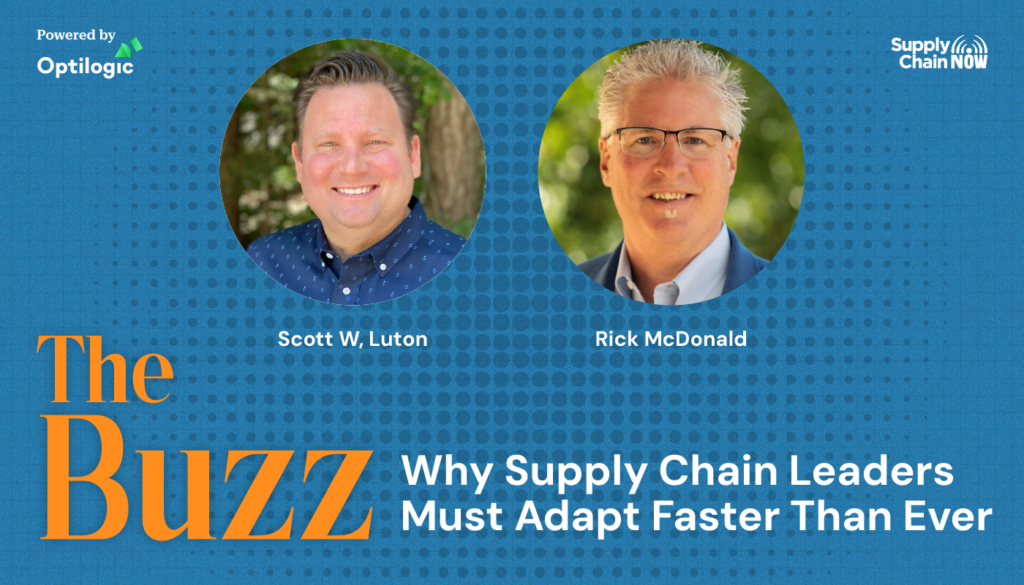
Welcome to Supply Chain Now, the number one voice of supply chain. Join us as we share critical news, key insights, and real supply chain leadership from across the globe. One conversation at a time. Hey, good morning, good afternoon, good evening, wherever you may be. Scott Lewton and special guest host, Rick McDonald with you here on Supply Chain Now. Welcome to today’s live stream. Hey, Rick, how are you doing today?
Rick McDonald (00:25):
Scott, I’m doing great. Thanks much for the invite to join you and the Supply Chain Now crew again and all of our audience worldwide.
Scott Luton (00:32):
Well, Rick, always a pleasure. I learned tons and tons of good stuff every time you joined us. Ric, you’re rocketing up the appearance, the all- time appearance list. You got to be top five by this point in time, Rick. Wow.
Rick McDonald (00:46):
What does that come with? Is that like frequent flyer points or some sort of anticipation award? That’d be great.
Scott Luton (00:53):
A bowl of soup. A bowl of soup at Panera. But Rick, we’re going to have to track that down, but regardless, always a pleasure to have you join us. And folks, today you all know it’s the buzz where every Monday at 12 noon Eastern time we discuss a variety of news developments across global supply chain and business. News that matters is what we like to call it. Now the buzz is powered by our friends at Optelogic, an AI first supply chain design company that revolutionizes decision making by transforming modeling from a multi-month project into one day breakthroughs, maybe even one hour breakthroughs. You can learn more at opteologic.com. All right, so big show teed up here today. We got a lot of topics to dive into. Warehouse automation, workforce and industry leadership. I was just mentioning supply chain redesign. We got to rethink our approach to supply chain design.
(01:43):
We’ll touch on that. Some news notes and a whole bunch more. Even a little bit of baseball. Little Bobby Cox and baseball we’re baking into this edition of the buzz. Ric, big show today. Are you ready to go, my friend?
Rick McDonald (01:54):
Yes, sir. I am. We got a lot of ground to cover here, Scott.
Scott Luton (01:57):
We got a lot of ground, but you know what? I know you’re always ready. I know you always eat your bowl of weedies in the morning and take your Friendslow vitamin. So we’re going to knock it out in an hour and probably have a minute or two to spare. What’d you think?
Rick McDonald (02:10):
That sounds great. Let’s get going.
Scott Luton (02:11):
Well, let’s do it. I want to dive into the first thing here before we get into some Modex key takeaways on this edition of The Buzz powered by our friends, OptiLogic. Let’s talk about, with that said, which is our almost weekly newsletter that we published over the weekend, this edition here. Now we let off with three or four stories that illustrated a common theme. A new playbook for supply chain leadership is continuing to be built out. Now, you can’t take a thing for granted in this chaotic environment. You really can’t, but check out these nuggets we reported on. UPS and FedEx. Well, Rick, they’re getting a little bit nervous. They get a litle bit of nervous and get a little more pressure as Amazon supply chain services launches. We touched on that and with that said, the US is offering Canada and Mexico companies tariff relief in exchange for producing more steel and aluminum here in the US.
(03:05):
That’s going to be interesting to see what happens next. Honda, one of my favorite companies out there. I think I’ve had seven Honda Cords, Rick, if I’m not mistaken. So Honda has reportedly posted its first annual loss since becoming a publicly traded company way back in 1959, largely due to its big bets on the EV market. Speaking of the EV market, one story we’ve been tracking for a couple years now. USA Today has reported that Rivian has delayed the cheaper version of the R2 SUV. So we’ll see when that production decides to ramp up. But the company has also announced that the new Georgia mega plant that has been in the works for quite some time, well, when it finally starts running, it’s supposed to produce 300,000 vehicles a year. I just don’t know. Finally, and Rick, I’m going to get you to comment here.
(03:52):
I know I’m covering a lot of ground here right out of the gate, but one last thing, Allstate CEO, Tom Wilson says a lot of CEOs are approaching AI wrong. It’s not all about the cost reductions and layoffs, but it should be more about creating new business models, new services, new opportunities and new jobs. So folks, check out with that said for all of that and a whole bunch more, including our upcoming lot of events. And Rick, I know you had a busy weekend, did some grilling, probably did a litle bit of work, maybe a lot of work, I don’t know, watched some baseball, but did you get a chance to read this latest edition of With that set?
Rick McDonald (04:28):
I did. And there were just a lot of very interesting topics covered in with that said, this version of it. And let me comment maybe on just a couple three of those. First of all, the name of the game and the supply chain continues to be about operating at the speed of the consumer and Amazon is doubling down with their supply chain services model. And you’re right, I think anybody who’s operating this space, UPS, FedEx, probably some 3PLs are a little bit nervous about the capability here. They’re trying to take their operational excellence capabilities and push that into a much broader platform. And that is going to be an interesting thing to watch as we go forward here. I do think there is a tangential lesson for lots of companies here who are thinking about their service offering to brand owners and manufacturers. Companies are looking for, brand owners are looking for more one-stop shop than they are necessarily single point solutions.
(05:24):
They want it for the simplicity, for the ease of operation, for the ease of implementation, for the change management acquired, all those things. And you have to ask yourself if you’re sitting in that chair, how well do all of your data, your demand forecast, your operations capabilities, your metrics, how does that all come together to support the mission of the company and make you more resilient so you’re ready for what’s coming? And I think this question around Amazon supply chain services might answer some of those.
Scott Luton (05:53):
Rick, well said as always Rail said. And I’ll tell you, it’s a fascinating time. 2026 has, gosh, it’s hard to believe we’re in mid-May already, 2026, but it’s already delivered so much innovation, so many good things, so many great stories. But on the flip side, it illustrates geopolitical challenges to the next degree. It’s illustrated how the market is changing rapidly on so many levels. And then Rick, one thing you just mentioned there, business leaders out there are looking for different things and new solutions to problems old and new. So we’re going to keep our finger on the pulse. I’m going to try to keep my finger on the pulse as much as Rick McDonald has his finger on the pulse of global supply chain. A couple things here I want to make sure folks see. We try to make things really easy for you folks.
(06:39):
We got a link to Optelogical. I shared on the front end right there. I got a link to that with that said right there, our almost weekly newsletter. And folks, make sure you subscribe. It comes out just about every weekend, usually on the weekends and we offer a variety of perspectives as always and opportunities to learn.
Rick McDonald (06:59):
Hey, Scott, before we go on, can I hit two more things real quick?
Scott Luton (07:03):
Please, yeah.
Rick McDonald (07:04):
All right. So the other headline from Amazon that didn’t get as much play was this idea of them in dozens of markets going to 30 minute or less delivery. This is kind of like back to the Domino’s pizza days when you get a pizza for 30 minutes or less. And so again, speeding up the supply chain enforcing more rigor on the demand forecast, the inventory optimization, micro fulfillment centers, all those things are in play as speed, accuracy and margin are in the mix. So that’s number one. Number two is I saw Tom’s comments on the use of AI. My point of view is there are two very different things and some companies are going to combine both of them. One is exactly as he says, kind of use AI for the better demand, better company performance, more innovation.
Scott Luton (07:52):
And I
Rick McDonald (07:52):
Also think there’s a real place in some companies where AI just simply has to be leveraged for headcount and cost savings purposes for the survival and the competitiveness of the company. I don’t think those two things are necessarily unrelated, but certainly a company strategy is going to depend on where they are in their lifecycle, what’s important to them, who their competitors are, and whether they can afford to leverage AI for something other than administrative savings, cost savings, and headcount reduction. I think they’re going to be way more jobs in the end created by AI than there are eliminated by it. But at this point in time, both of those things are in play. It really depends on where the company is in their lifecycle.
Scott Luton (08:33):
Fantastic perspective. And I largely agree with you. I think it’s about a healthy balance that you’re kind of describing. And then secondly, I think also, and folks, what Rick’s talking about there is that last little nugget we shared, Tom Wilson, who was CEO of Allstate. And Ric, I think one other thing, and that whole story comes from Semaphore, does some good job reporting. But the insurance industry, especially with a titan in the insurance industry space, that’s a good bit different. That model is a lot more unique than the global supply chain industry. But hey, it’s all about having the dialogue, having the discussion and finding that healthy balance to, as you said it, Rick, stay competitive in a very challenging environment. Okay. So item number two, I’m going to shift over to one of my favorite … I’ll tell you a figure that is really inseparable from upbringing.
(09:25):
I’m talking about the late great Bobby Cox, right? And stick with me. If you’re not a Braves fan, stick with me. It’ll be relevant to your journey, I promise. So we lost long time Atlanta Brave Skip or Bobby Cox a couple weeks ago and Ted Turner for that matter, just within days of each other. They both changed their respective games in their own ways, but Cox in particular, I want to focus him here. He managed the Braves from some 25 years and also contributed significantly to the front office. All this added up to 14 straight division titles, lots of trips to the World Series and a world championship in 1995, which I’ll never, ever, ever forget. Should have had to won 96, but tagged on Jim Lewitz, the catcher for the Yankees. Anyway, but all of that, it also paved away for the Brave Success ever since.
(10:15):
It led to the 2021 World Series for sure. But here’s why it’s relevant to global supply chain, global business, and why it’s good news, at least in my perspective. Bobby Cox, his management style was highly uncommon. He was passionate about supporting his players on the good and the bad days. He was in fact the ultimate player’s manager. You never doubted the fact that he had your back and it always was about the game and about the players, anything but himself, unless he was going to get thrown out having his players back, right? When I think he still ranks the top, all of Major League Baseball history in terms of getting thin out of the game by the umpires. But all of that, his style when players or team members or colleagues know that you’ve got their back, no matter what it brews exceptional confidence in rookies, All Stars, veterans, folks just now starting to play the game, all that.
(11:12):
And I believe we could use more of that proven style in the business world today. Rick McDonald, your thoughts on this analogy I’m drawing between how Bobby Cox managed those 25 years and what we see in global business today.
Rick McDonald (11:27):
Yeah. And Scott, I’m right with you. I think Bobby Cox, I mean, he may be the most legendary leader in any sport
(11:34):
And it did start with that player rapport, but right after that, I’m going to give him props for his ability to adapt because if you think about how long he was in that chair and how many different styles of players he saw coming through, he had to be highly adaptable to speak the language to relate. And you can’t be a player’s manager if you don’t understand the players. And so his ability to do that was incredible. He also led by example and that forged kind of a bond to command discipline and respect within the team and players will talk openly about he had their back, but in private, if they weren’t doing what they needed to be done, there was also going to be a conversation about what they were going to do about that. And I think the last thing is his ability to just kind of think strategically in the game was amazing.
(12:20):
I go back to 1992 when we were trying to beat the Pirates and he picked Francisco Cabrera who had just joined the team August 30th on a call up. He had 10 hits the entire year, picked him to pinch hit with two outs in the ninth inning and us down a run. And that was the legendary Sid Bream slide. I think it took Sid about 12 minutes to come around from second base, but just how he selected him. If you ask him about that later, he goes, “Well, Stan Belinda threw a certain way. Francisco hit that type of pitcher. I knew that. He’d shown me what he could do in the last year’s World Series playing in three games and he was the right guy for the … He could have picked anybody on that bench, but he picked the guy that won the game for him.
(12:59):
So I think all those things can combine to make him just an incredible leader. And all those things we talked about are things that can be adapted and applied in the supply chain.
Scott Luton (13:09):
Ric. Oh my gosh. We could be here for a couple hours exchanging stories, but I’m going to add one more. I’ll fast forward to 2026 in the Atlanta Braves. They’ve only lost one series all year long. And back when Bobby Cox was managing for those 25 years, one of his mantras was just focus on winning each and every series, not every game, just every series. And there’s something to be said there about two steps forward, one step back, two steps forward, one step back incremental but steady and consistent progress. That is perfectly applicable anywhere, right, Rick?
Rick McDonald (13:46):
That’s right. That’s exactly right. All those lessons apply. And by the way, if you play 667 ball, which is what winning the series would be in most cases, you’re going to go a long way. And of course, his teams did that and made the playoffs for I think 14 straight years. I’ve been a lifelong Braves fan. I saw him in three stadiums, Atlanta, Fulton County Park, Turnerfield, and now at Truist. And it’s just been sort of my adult love affair with professional sports.
Scott Luton (14:13):
Yes, I’m with you. I am with you. Same. I miss Fulton County. That’s where I saw my first Braves back when Terry Pendleton was having one of the biggest free agent signings in Modern Braves history. It’s amazing what he did. But anyway, we could talk about this for days, but rest in peace to Bobby Cox, best wishes to his family, from all of us here at Braves Country. And hey, we got to really pick up on lessons learned from all parts of not just global business, but the sports world too. And speaking of which, Rick, a couple comments there I grabbed from folks commenting on our story. Jeff says, Hey, great write up, Scott. Bobby Cox was such a steady force in the Braves organization always locked in and calm as a cucumber unless he was defending one of his players. He and Leo Mazzoni would always be rocking back and forth sitting right next to Bobby.
(15:00):
They were a fixture. That was a fun time to be a Braves fan. I’m with you, Jeff. Well said. Okay. So Rick, we got a couple other comments here in the chat session. Let’s see here. T squared who holds out for us on YouTube says, bring on the nourishment and the 70 30s, half and half with more lemonade than tea because it’s hot and moving fast in supply chain news. It is. It is. Jeremy says resilience is practice. I think getting there takes a lot of practice. I guess you never probably perfect resilience, but it takes tons and tons of practice for sure. And Edgar tuned in from Mexico as usual. Edgar, great to see you. Let us know your thoughts on the stories we’re talking about here today. All right. So Rick, let’s see. I started thinking of braves and I’m all the way down the rabbit hole.
(15:48):
I got to bring myself back. Oh, this is where I’m going next. Supply Chain USA, Rick McDonald. Don’t have our friends out there across the globe. Let’s see. Supply Chain USA 2026 put on by our friends at Reuters Events coming up real soon, June 23rd and 24th in the city of Chicago. Mary Kate Love, president of Supply Chain Now will be moderating one of the many valuable lessons. Mary Kate’s going to be joined by leaders from Motorola Solutions, Kenview, Ulta Beauty and KPMJ. You can check out the link that we’re dropping in the chat. And if you’re there in Chicago at Supply Chain USA, please say hello to Mary Kate. And Rick, I know you do a ton of speaking and keynotes and presentations, you name it. I don’t know how you … Well, I’m convinced you got a couple of clones out there maybe.
(16:36):
One of the few you hadn’t spoke to, I think, is Supply Chain USA. Is that right?
Rick McDonald (16:40):
That’s right. I’ve not been to that event. I’m going to check it out though. It looks like a very interesting event and a good cohort of not only speakers, but also participants. And that has a makings for a successful time in any city.
Scott Luton (16:53):
I am with you. I am with you. Let us know what you find. And folks, again, come check out Supply Chain USA in Chicago and let us know what you think. All right. So speaking of big events, Rick, speaking of big events, you and I both were at Modex this year. Modex folks is the sister event to ProMat, which I think has been around longer. ProMats is up in Chicago every other year. And then the other year, Modex is in Atlanta in the off years there. Modex brought 50,000 people here this year to Atlanta’s biggest event in Modex history and one of the largest supply chain events of the year. It took place in, let’s see, April. So Rick, what I thought we’d do is get into some key takeaways here on the buzz powered by our friends at OptiLogic. And I thought we’d start with three of the interviews we conducted as we worked really hard over the course of, I think, four days.
(17:44):
And then Ric, we’re going to get your own key takeaways kind of on the other side of this. How’s that sound?
Rick McDonald (17:49):
That sounds great.
Scott Luton (17:50):
Outstanding. And folks, we welcome your own if you were at Modex or if you saw some of the coverage, we welcome your own key takeaways as well. But up first, let’s tackle this great conversation that we conducted with Mike Harris, Vice President of Ocado Mobile Robot System, OMRS as part of Ocado Intelligent Automation. And I tell you, in my sit down with Mike, let’s see if this sounds familiar to you, Rick. Mike stressed a key point. It’s really cool and all to see the physical side of automation and how robots and the like continues to evolve, but it’s the software and innovative intelligence that separates the good from the bad or the excellent from the average. Now, Mike mentioned that one big shift he’s seen in recent years is how companies are approaching automation investments with longer term commitments and partnerships in mind. There’s a greater emphasis on dynamic solutions that can scale up and scale down based on the needs of the business.
(18:45):
He’s also seeing separation in the market where you have solutions that can optimize operations continuously throughout a single shift, right? Not making adjustments at end of the month or end of the week or even end of the day. And that’s of course a big focus for OMRS and OcadoQ. And of course, if you heard this phrase, Rick, I’m not sure about you, but I’ve heard this phrase more in the last year or so than I’ve ever heard it, sweating the assets, sweating assets, looking to get every single dollar on ROI. And folks, you can check out the link. We’ll drop a link to my conversation here with Mike, Harris and Rick. I’d love for you to respond. What’d you hear there and how do you compare and contrast it out in the market?
Rick McDonald (19:26):
Well, if you’re in the supply chain, you know that your customer wants three things. They want a few more, but the three things are certainly speed, accuracy and cost. They want it on time, they want what they ordered and they want it quickly. That sounds familiar to all of us. And at the same time, we’re all challenged with fewer available people. Those people that are there cost more and they don’t necessarily have all the requisite skills and capabilities that make them an immediate fit for organization. So of course, everybody’s turning to technology to fill some of those voids and rightfully so. At the same point in time, you got to find partners who are able to solve the problems that you have at your company. And that continues to be elusive for some organizations where they don’t have a good feel for the inventory of the problems that they need to solve.
(20:11):
And so maybe they wind up with gear that doesn’t do necessarily what it’s supposed to do. That’s not the case with Ocado’s gear. They’ve got some great performing gear and not only do they sell it to others, they use it themselves, but those partners are really important and at the same point in time, your people matter greatly. It’s talent and technology. I think sometimes we run afoul when we get too far down the road of emphasizing the technology without thinking about the human beings involved, the upskilling, re-skilling, the digital fluency that’s required of leaders and most of all the change management that has to come into play. Partnership or know if you don’t have a good change management process, you can have a 10-year deal and suffer with gear that doesn’t deliver the ROI or the business case you thought it would deliver because you didn’t do a good job of change management.
(21:00):
So I think that’s a really important footnote to ad to any conversation around technology.
Scott Luton (21:05):
And Ric, when you fail at the change management aspect of it all, despite the investment, despite the goodwill, despite the grand plans, my hunch is you can actually do more damage than good despite all of that, huh?
Rick McDonald (21:19):
It’s a gift that keeps on giving, Scott, in the wrong way. You destroy trust with your senior leaders who you’re going to go ask for more money and more resources for your next project. Your crew, whether it’s the entire supply chain or just part of the supply chain, is less believing the next time you come in front of them and said, “Hey, I’ve got something great to share with you and here’s what it is. ” So yes, it is damaging in lots of ways that will impact an organization for quarters and years.
Scott Luton (21:47):
Well, Sid, Rick, that change management piece, I know that it’s not new. We’ve been trying to perfect change management since humans were fighting with dinosaurs way back in the day, but you got different twists on it. And in this modern age of this golden age of supply chain tech and just business tech, there’s some new twists to modern change management that we got to account in our strategies. All right. A lot of good stuff here. I’ll share a couple quick comments back to Jeremy. Practice isn’t and shouldn’t be forever static. That’s right That’s right. And Jeremy, don’t worry. He says, “My bad for powering the chat again. Hey, keep it coming. We appreciate your comments. I really do. We’re dropping the link to my discussion with Mike Harris that we were just kind of commenting on to check that out. And Jeremy is also mentioning Scrooge versus Feziwig.
(22:42):
This confounded us a month or two ago, Rick. Does Scrooge and Feziwig … Does Feziwig ring a bell with you, Rick?
Rick McDonald (22:50):
I don’t know that acronym. Do you know what it is?
Scott Luton (22:53):
I do. And I didn’t know when he first shared it with us a month or two ago. Fezzy Wig was Scrooge’s boss that was a good leader and he was a pleasure to be around and he was everything Scrooge wasn’t. And so we were talking about that analogy when it comes to leadership and Rick. So it’s amazing the characters I forget. I remember Scrooge, but I was like, Fezzywig, who the heck was Fezzy Wig? But Rick, we got to be more fezzy wig than Scrooge out there in the industry, huh?
Rick McDonald (23:20):
100%. 100%. Especially as the world of agentic AI proceeds forward at record pace, it’s going to require some different leadership behaviors.
Scott Luton (23:30):
That’s right.That is right. We can’t be static in our own leadership development, no matter if you’re in the C-suite or if you’re just getting started. All right, let’s do this. Let’s hit this next article. I’m looking forward to your take here as well, Ric. We’re talking at Modex with one of my favorite people in the whole world and is Dr. Stephanie Thomas, who is professor at the Top Rank Supply Chain Management Program at the University of Arkansas. She also founded and leads WISE, which helps supply chain students and programs connect network and advance. Now we focus kind of around building the next generation of supply chain leaders. And a couple of things that Stephanie shared, I want to get your take on Ric. She mentioned there’s more interest amongst students in the supply chain management field, which is great. And one of the big reasons for this is a sense of purpose and the meaningful work that supply chain careers offer.
(24:21):
Stephanie urge organizations though to be much more intentional about talent and hiring. And one of the biggest problems she sees, especially in the competitive internship recruiting space and I would argue just in the competitive talent and hiring space in general, delayed decision making. Folks, we belabor, we beat up these candidates and go radio silent on them for months and then we’re surprised that they’ve taken a different direction. So she sees that in all of her work too. And when it comes to technology, Stephanie sees many students adopting AI tools faster than educators and employers alike. She sees that as a powerful force that will especially transform how universities teach. One big point she made, don’t sleep on the next generations that are matriculating through programs now. They, as she says, they are ready. All right, Rick, that was a tip of the iceberg, my conversation with Stephanie.
(25:17):
She’s always a dynamo. Your thoughts, my friend?
Rick McDonald (25:20):
Well, I liked everything that she said there, Scott. I want to focus on maybe one or two things. I think one of the issues that leaders have as they go to recruit and look for talent is they’re not necessarily thinking about what capabilities they need to have not only today but tomorrow. Again, as the AI transformation continues forward at record speed, I think a lot of leaders are still getting the order wrong of this. They’re talking about tools and they’re not talking about the leadership digital fluency, their own and their teams. They’re also not talking about the talent that they need to have in their organization to energize these capabilities. We talked a little bit about change management a minute ago, so I won’t hit that again, but this idea of not having the inventory of the problems you need to solve in your organization is really challenging.
(26:05):
And it leads to hiring decisions that probably suboptimize who they should be hiring versus who they did hire. They’re hiring somebody that looks like a person they need today instead of the person they need for the future. And I think if companies can become … I don’t remember who said this and when I figure it out, I’ll give them full credit. But somebody said, “You got to be problem obsessed. You got to be obsessed with the problems you got to solve, and that’ll start you down the right path.” So that’s the first thing. The second thing is I think some organizations have turned into hobbyists when it comes to digital transformations, again, impacting who they’re recruiting, the questions they’re asking, the skills they’re seeking and the talent that they’re trying to bring into their organization. And if they don’t have strategies that have AI or problem solving capabilities like that embedded in them, they are probably not thinking about the talent component correctly as they try and blend talent and technology going forward here.
(27:01):
And that is a huge challenge. So problem cest and making sure that you’re not a hobbyist in this space will lead you down a path where you’re going to start looking for asking the right questions and acquiring the talent that will help you be successful in the future.
Scott Luton (27:16):
And I want to bring one other point and get your take on it, because this is what I’ve experienced in other organizations when I was active in the manufacturing space in particular when it comes to hiring. What I have found is the hiring manager may be good to go. They might love Candidate A and be ready to hire them, but who they report to calls a timeout and wants to see more and more candidates. It can stymied organization, it can stymie growth, it can stymie great talent you bring in to the organization and stick them on initiatives or projects or problem solving all perhaps because, or one of the big reasons there is because leadership does not want to trust or does not want to empower or do not want to delegate the ultimate decision to perhaps those that may know best. And look, that’s a very big generalization, but what I’ve seen take place through multiple organizations and I think it’s one of the things that adds to what Stephanie and you and I are all seeing is this big old slowdown in decision making.
(28:21):
Rick, do you see this take place too?
Rick McDonald (28:23):
Yeah, I’ve seen that exact example and it really disables the hiring manager because their point of view is if somebody’s going to come in at the last minute and divert, change, delay, then what am I doing here with all my hard work to try and find the right candidate? Where I see it work well is when there is alignment from the top around, this is the talent that we need to compete today and tomorrow, that translates to a spec that either that hiring manager or the recruiter can go out and find multiple examples of. And then you’ve got that connection from the senior leaders to whoever’s making the hiring decision, and it should be that person’s manager. You can go a lot faster if you’ve got that alignment and you’ve had that conversation upfront. It’s a litle bit of go slow to go fast, but you’ve got to do that on the front end or you can end up with the scenario that you started with, Scott, where the hiring manager’s manager comes in at the last minute and says, “Nope, not good enough.
(29:18):
Let’s keep looking.”
Scott Luton (29:19):
Man, it can be infuriating and so frustrating. But yeah, to Rick, to your point, and I think this is a Navy SEALs thing, slow is smooth and smooth is fast, right? And it doesn’t feel like it at the time, but man, if we can grab that organizational alignment that you’re suggesting, oh my gosh, the places will go. All right, folks, check out a little bit more of our conversation with Stephanie. We’re dropping that link right there in the chat and let us know your take on those topics. And then lastly, Rick, I’m so glad I ran into RD Deshmuk at Modex. Now RD, he saw us knocking down an interview and I stepped Outside and he’s like, “Man, I tune into y’all regularly.” And I’m like, “Man, you’re making my day. I’m going to call my mom.” And let me know, ran into one of our listeners or our audience members at Modax.
(30:10):
And that led to a great sit down conversation. I learned a ton about R&D. Here in this conversation, and by the way, RD serves as a chief R&D officer with ID Logistics US. Now, he did big things at Amazon before joining the ID Logistics team. And he brings that culture and that mindset to the team he’s been with now for a couple years. And he stressed to me, Rick, how those organizations that fail to adapt to the ever-changing modern supply chain landscape, well, they risk falling further behind and fast. He shared the importance of a day one mindset, which is rooted in curiosity and adaptability and constant reinvention. RD urge business leaders to start with the problem, not with the technology. We’ve been shouting that from the mountaintops for years now. Make sure it’s a nail before you choose to use a hammer. Nevertheless, we must embrace technology and innovative technology just on a targeted basis because if we don’t, RD says you can’t win today’s race with a horse and buggy.
(31:08):
You can’t unless you’re having maybe a horse and buggy race. RD also pointed out a big trend that’s at play. The era of large bulk shipments is giving way to a world of micro fulfillment. Individual items such as, I don’t know, socks, hair clips or shoes even are being ordered. And that micro fulfillment approach has profound implications for warehouse design, automation, inventory management amongst many, many other things. Rick, this is a wide ranging conversation with my new friend, RD- Mook, who I found inspirational and very practical. Your thoughts, Rick?
Rick McDonald (31:45):
Well, earlier, Scott, we talked about Amazon looking to deliver in 30 minutes. Walmart will fast follow that just as they have with micro fulfillment centers. Walmart is using unused store space and other locations to build their own micro fulfillment centers. And I think the concept is really interesting. I also believe complimentary to that, it’s going to require brand owners to really think through their real estate strategy, how they leverage those facilities, how they do so without driving up working capital to unsustainable levels. And a lot of that is going to point them, I think, to this idea that they’ve got to have a much better capability in forecasting their demand. It’s a forecast. So we all know it’s wrong five minutes after you write it down, but if you can layer in some demand sensing tools, some of the very new capabilities, not the Gartner top right box group, that doesn’t generally exist in spades there, but some of the newer capabilities that are coming online where they have the ability to bring in the unstructured data with the structured data and predict with much better accuracy what your forecast is going to look like over thousands of SKUs, that could be a winning combination with this micro fulfillment idea.
(32:56):
So you manage your inventory, you manage your working capital and you’re meeting the customer’s requirement, whether that’s a B2B or a B2C, you’re meeting that customer’s requirement for the speed component.
Scott Luton (33:06):
It’s fascinating. And we’re all consumers and also we’re all contributing to these massive forces shaping global supply chain like ever before, but it really is just a fascinating time. And folks, I’d encourage you, go check out. Tricia’s already dropped a link to my conversation with RD. I love when, Ric, and this may not be a perfect comparison to what RD’s doing. So I’ll use more of a generalization, but I love when leaders come from organizations that are truly changing the game with immense innovation that is really a very powerful and bottom line changing and they move into other organizations that maybe I’ll call might be more traditional and they’re changing the culture and changing the business approach and it’s kind of like that spillover effect. I love it, Rick, huh?
Rick McDonald (33:55):
I do too. I mean, it’s absolutely essential to the continued maturation of supply chains. We’ll never get to the finish line. There’s always going to be a next destination. I’ll also point out you used the word change three times in that last sentence. And so if there was ever a doubt in anybody’s mind about how important that capability is and how good you’ve got to get at it to enable these changes to occur successfully in your organization, this is that moment. And it’s a capability that we just have to be a lot better at as supply chain leaders.
Scott Luton (34:27):
Ric, well said. And it is a leadership challenge. At the end of the day, all this stuff that we’re talking about, and this might sound too simple too naive, but it really boils down oftentimes to a leadership challenge and all that change we’re talking about, think of it on all the different levels, right? Consumers, of course, are demanding change. Talent and our team members out there are demanding change. And then of course the market in so many ways is demanding change. So are we up for the task? I think so, but it may just be a little pain comes with change as always, but we’ll be better for it on the other side. All right. So really quick we’re about to check in. Those are some of our takeaways from some of our conversations at Modex. We’re about to get Ric McDonald’s key takeaways. But before we do that, I want to check in with our friends at OptiLogic who dropped a really interesting message in one of their latest guest blogs.
(35:21):
Nate Rosier, the chief customer officer at Envista, spoke about how double digit cost reductions are buried in almost every supply chain network. And better yet, Nate wrote about how to find them. And this article, Nate touches on why poor data is the number one driver of supply chain sub optimization. He talks about how modern AI assisted modeling surfaces network insights in hours, not weeks. And Nate also shares the triggers that should prompt any network redesign review. You can read a full informative blog article right here and you can also visit our friends at optologic atoptlogic.com. So go check out that article and let us know what you think. Okay. So Rick, we’re going to keep driving here while Jeremy still is urging practice, practice, practice, kind of like that Ivan. Alan Iverson, remember that great … That was a press conference he had back in the day, Rick, right?
(36:20):
Are we
Rick McDonald (36:20):
Talking about practice?
Scott Luton (36:22):
Right. It was so good.
Rick McDonald (36:24):
That was fabulous.
Scott Luton (36:26):
Oh gosh. All right. Rick, let’s do this. We saw each other briefly. I think I grabbed you as you were headed to lunch with one of our dear friends. I know you stayed very busy throughout Modex. What were some of your key takeaways, my friend?
Rick McDonald (36:38):
I got three or four here, Scott. First off, the robots are here. You could not turn a corner without running into something cool with respect to AMRs, ASRS. I will say the coolest thing that I saw in this space was a new mobile case picking robot. With robot as a service commercial model, so you pay by the hour, and this was offered by Tutor Intelligence. That was absolutely slick. And I think it’s available in June or something like that. So robots, there were a lot more examples of robotic capabilities and really interesting presentations on the floor. Second, and complementing this whole idea of the technology required to run our supply chains. Lots of people talking about the lack of talent. You mentioned it earlier and those that exist that are available cost more, they don’t have the same skills. And so this move to technology is a replacement for talent that doesn’t exist or isn’t skilled for what you need them to be skilled for.
(37:37):
It’s absolutely going to continue to march. It’s a big, big theme. And then what we just talked about, change management. I’m not spending more time on this except to say that if you think you’re good at change management in your organization, then name the three cohorts, the three types of people you have in your organization. There are three distinct types. If you can name them, then you’re probably on your way to having a chance of doing good change. If you can’t name them, you need to start and figure that out and then you might be able to go down that path.
(38:06):
The number three. Number four is I’m calling data Schmatt. It’s all the rage. Everybody wants accurate data. It needs to be accurate. It’s got to be revered like never before. And that involves not only cleansing what you have, but also stop the pollution of the top of the funnel of that data input, whatever it takes in terms of controls and governance and access. All that’s got to happen so your data stays clean. But then at the same point in time, and we’ve all seen this, there’s a new report. There’s a new database. There’s new operational … Well, what are you going to do with that data? Why is it important? How impactful is it to solving a problem that you have in your organization? Just because it exists doesn’t mean you should have it or you should try and use it. It’s got to solve the most pressing problems that you have in your organization, whether those problems result in a financial issue, a customer issue, or regulatory issue, or reputational issue, the data has to serve a purpose.
(39:03):
And I would say if it doesn’t drive one of your KPIs or solve one of your problems, it’s just noise.
Scott Luton (39:09):
Ric, that was outstanding. That’s like a four-point checkup on your key takeaways at Modex. And going back to your first one there, Amanda and Tricia, thanks for all that y’all do. He mentioned a great organization that spoke with at Manifest. We interviewed Josh, the CEO at Tutor Intelligence. And if we all can find that interview and drop that in the comments because they’re doing some really cool things, Rick, at Tudor. And as you say, the robots are here indeed.
Rick McDonald (39:36):
Yeah, they really are. And this capability of end of line robotics is important, but the mobile picking robot is the thing that’s really got me jazzed. And I’m sure they won’t be the only ones in this space, but this is really kind of a cool implementation that they are authoring.
Scott Luton (39:51):
So folks, we’re going to drop a link to a quick chat I had with Josh at Tudor at Manifest, which God feels like five years ago now, but that was just in February. Okay. A lot of good stuff there. The robots are here, lack of talent, change management, change management, change management, because folks, we got to live it and breathe it. And then data schmada. I love that. All right. Rick, let’s do this. Let’s see where we’re going next. Now we’ve talked about this already numerous times on this edition of The Buzz powered by our Fred’s Optiologic, but I want to circle back to the well one more time. And we’re talking about what arguably is one of the biggest news supply chain news stories of the year and that’s been Amazon’s recent launch of Amazon supply chain services. Now I spent time at Gartner Supply Chain Symposium in Orlando just a couple weeks ago with Peter Larson, who was a great interview.
(40:41):
I think he’s been at Amazon for over 20 years and he’s a critical leader at the company at the Big A driving this massive initiative. So stay tuned for that interview soon. But Rick, you’ve been around the block a good bit. Chief supply chain officer, you’ve seen all kinds of things, all kinds of announcements good and bad and some points in between get rolled out across this wonderful industry that we all love. What’s your take at the end of the year or maybe at the end of 2027, are we going to be pointing to this announcement and talking about it in a way as big as I think we will be? Or what’s your take here?
Rick McDonald (41:15):
I think there’s a lot of potential here, Scott. And like everything else, it’s a bit of a double edged sword and it’s going to depend on what a specific organization needs right at the moment. Amazon started with Fulfillment by Amazon, FBA, well know how that works and now they’re broadening their capabilities into a much larger platform. And so on the plus side, you’ve got one-stop shopping per se. There’s a lot to be said for simplicity, fewer workflows, better visibility, more coordination, all those things that come with a sole provider. And then the flip side is you also get some things that come with a sole provider in terms of the concentration of all of your fulfillment or maybe a good part of it with on supplier, should they have issues, should they raise fees, should their business model change? That concentration can also be problematic.
(42:09):
And so I think companies are going to have to step into this with some care and interest in terms of whether they feel like the positives of the commercial arrangement and how they’ll be doing business with Amazon will improve. And likewise, they’ve got to stare, they can’t just be enamored with the plus side of the equation. They’ve got to stare at that minus side and make sure that they understand that risk profile, that they’re willing to live with that risk profile and/or they have some resilient options should something occur in the relationship or in the performance. So I think there’s a lot to be considered here relative to the business consequences of making this change.
Scott Luton (42:47):
It’s interesting like UPS, for example, they have continued, they’ve been reconfiguring their business now for at least a couple of years it seems like. I’m really curious to see what this launch of ASCS, how that will speed that further along. What you think, Rick?
Rick McDonald (43:03):
I think organizations like UPS, FedEx, anybody who has multiple capabilities in this supply chain fulfillment space is going to be staring in the mirror. And they probably already started this as part of the business strategy, thinking about how much of this do they try to adopt?This is not what Amazon is proposing here in their supply chain services. This is not a simple thing to orchestrate. All of us who run supply chains know how very difficult it can be just to make one part of it work well. Nevermind, all those parts work well. Now what they have going for them, also UPS and FedEx, but I think Amazon might have a bit of a lead here is they started as a technology company as a bookseller and they really figured out their sweet spot with respect to technology. And I believe if anybody can pull off the orchestration necessary and the connectedness and the visibility required and the sequencing of all the complex handoffs that occur in the order to cash part of the supply chain, they have the ability to do it.
(44:02):
So I’m going to be very interested to see not only what they do, but also how their competition responds in this space.
Scott Luton (44:08):
I’m grabbing a Diet Coke and some popcorn to watch how peak season this year is going to roll out. I’m curious about how much volume that they’re going to garner here in their first launch year. And then as I asked Peter, hey, given the scale of Amazon as it is today, how can they protect all of that and all those commitments they make to customers, but then add a massive new chunk to it. And so folks, stick around as we drop that episode soon, you can hear how Peter responds. But as you might expect, Rick, there’s humble confidence. I’ll put it, humble confidence and their path forward.
Rick McDonald (44:49):
I can imagine, and let me just say one more thing about this. This is about whether Amazon is good or bad. It’s really around flexibility, concentration of your business. And what we all know is once we’re embedded with a supplier group, switching costs are high and they’re often a deterrent to doing something different. So I would say the value proposition that Amazon supply chain services is offering will obviously have to contemplate the switching cost of moving from someone else and something else or maybe multiple entities in this space to a single provider.
Scott Luton (45:23):
One more thing and then I’m going to ask Ric about CSCO priorities. One of my favorite parts of all of our programming going back a couple years now has been watching Walmart change its game, right? They have really risen to the challenge in their ongoing competition. Not that they’re only Amazon’s only customer, but they’re a big one. And it’s been fascinating to watch Walmart truly innovate and change. Like I talk about a lot, the in- store experience I believe is much different than it was five, six years ago. Their supply chain, how they’re dealing with final model. Rick, in our part of Metro Atlanta, we’re on the fringe, but still, which is even more remarkable, we’ve got a drone airport at our local Walmart. We out here in Walton County. It is fascinating. So Walmart, we’re going to see how they respond throughout this year and beyond.
(46:10):
Okay. So Rick, stemming from your time as chief supply chain officer for one of the biggest, most beloved brands out in industry. And of course what you do now advise a lot of companies, keynote and some of the biggest events out there. You got your finger on the pulse of what I’ll call the CSEO mindset like few do. So based on what that pulse is like right now, what are some of the top things that chief supply chain officers are prioritizing here in late May 2026?
Rick McDonald (46:39):
Yeah. Aside from what new disruptions they should add to their supply chain bingo card, I mean, volatility is the new baseline, planning for volatility. And so that’s on everybody’s mind, of course. Certainly AI and technology seeking out, and I hear more and more people wanting to hear about the use cases for technology that can solve the problems they have in their supply chain. Those use cases are incredibly valuable. So chief supply chain officer looking at that, because you got to have an ROI and you can’t have an ROI without a business case. And so all that fits hand in hand. We talked about talent, so I’m not going to go into that, but the numbers, the skills and capabilities and the costs are all factors. Something we haven’t talked about here, Scott, is the advent of global business services. Not a brand new concept, but more and more looking to that space to unlock value and scale through automation with a third party to take over some part of their organization.
(47:37):
Clorox has done that in a couple places and I’m aware of many other companies who have moved in that area as well. I hear more and more conversation about the increased need for orchestration and eliminating black holes in your supply chain where you either can’t move with pace, you don’t have the right access to data, you don’t have the right visibility, maybe they’re human beings handholding two systems together, that all has to go away. And so more orchestration, we used to call that kind of the end to end supply chain, but more orchestration of things with real time data visibility and tools. And then last but not least is just this idea that that’s all got to come together in service of the consumer or the customer. Whoever your consumer is, the demands are getting greater, the expectations are higher and those that perform will have a competitive advantage.
(48:26):
And sadly, we know what’s going to happen with those who can’t rise to meet that challenge.
Scott Luton (48:31):
Yes. If you’re hanging on by your fingernails at the current pace of business or the current cost to serve or the current means of delivering on time in full every day and you want to stay right there, I got bad news for you folks. In the weeks and months to come, the challenge is long you get greater just to protect the current business. And of course, what’s a Monday without a third or fourth generalization, but it is so true. The environment and landscape is changing dramatically. All right, Ric, always enjoy all of your perspective as you join us regularly, as you’re moving up into the top five list of all- time appearances here. We’ve been at this for quite some time. Let’s do this. We had this outstanding webinar last Friday as we start to wrap here on the buzz powered by Optologic, Regime Valley and Billy Ray Taylor brought it, Rick.This was just Friday, right?
(49:22):
This was a webinar that was part of our series called The Bridge that was entitled, There’s No Finish Line and Leadership: Tips to Optimize Your Strategy and Execution. Now, Rick, I know it’s not fair in the waning moments of the buzz here to ask you about these big old topics of optimizing, building a better strategy, but also optimizing execution. But with that said, a couple initial thoughts that come to your mind in terms of what you would advise companies around those priorities.
Rick McDonald (49:51):
Yeah. Well, I mean, everybody is obviously working to improve their performance. I mean, that kind of goes without saying. I’m going to break it down into three things and that means I’m not going to cover a number of different elements of this, but these are the three things that came to mind. The first one is your supply chain strategy is not a standalone entity. It must be tightly connected and integrated to the overall business strategy. And the KPIs that you have can’t be your supply chain KPIs that make you feel good. They got to be the ones that actually reflect how you’re performing for your customers and for your commercial business team. So strategy alignment, number one, absolutely critical. Number two, shocker, talent, talent, talent. Does your cohort of individuals possess the skills and capabilities necessary to ensure your long-term viability, your survival? And if it’s upskilling, rescaling, importing talent, developing whatever you’ve got to do, your talent is going to matter greatly here even as you implement more and more technology.
(50:49):
And I talk about digital fluency. If you’re not sure about the digital fluency of your leadership team, go to your leaders on by one and ask them one question,
(50:58):
“What is your vision for the digital future of your part of the supply chain?” See what they say. You might be surprised about the breadth or lack of breadth that they have in this space and that’ll tell you where you need to focus your efforts. And the third thing is related to digital, get crystal clear on your digital agenda and your roadmap. What are those problems you need to solve? Be problem obsessed, run those problems through four filters, financial, customer, reputational, regulatory, and force rank them so that you know which is the best business case to go after first, second, third, and fourth to drive your digital agenda and service of solving problems in your organization. And every day you delay, I mean, you got to get going. Every day you delay is a day you’re going to be less competitive.
Scott Luton (51:42):
Every day you delay will be a day that you continue to be less competitive and those multiply. So the longer the days go, the more they multiply each other. Compounding,
Rick McDonald (51:53):
Scott. Compound.
Scott Luton (51:53):
Yes, compounding. It’s even better. Rick. A lot of good stuff. I love your list approach. It’s so easy to follow along with what you’re sharing and your perspective. So I already look forward to the next episode. And hey, like Jeremy says, thank you, Rick. Yes, we all are appreciative of what Rick McDonald’s doing out in the industry, what he continues to do out in the industry. And as evidence of what he has shared just over the last hour here on the buzz. And thank you, Jeremy. Jeremy says, love y’all’s kind of content and context. Hey, we try to keep it real and that hasn’t changed in the, gosh, eight years we’ve been doing this. Rick, that’s crazy to even think about. And Jeremy, you’re part of the North Star while we do it. So appreciate your thoughts. Okay. So folks, really quick as we start to wrap here, I want to go back to check out this webinar, which is now on demand.
(52:44):
We are dropping a link to that. I promise you, there’s something for everybody in this session. I rarely say that about a lot of our programming, but there truly is because leadership is like water. It’s that universal solvent. So go check out that episode, that webinar. We have got that link right here. Thank you, Tricia. Thank you, Tricia. Let’s see here. Also, we found it, Rick. My sit down with Josh Gruenstein
(53:08):
With Tudor. Folks, we entitled this article, Anything Is Possible. Josh Gruenstein on AI Workers, Throughput Pressure, and the next revenue lever in supply chain. Folks, go check this out. Josh is a pretty bright individual, Rick, huh?
Rick McDonald (53:25):
Man, that whole crew up there is just wicked smart. It’s fun to interact with them.
Scott Luton (53:30):
It is. It really is. And talk about no nonsense. What a great down to earth interview in a space that’s easy to lose people quick. When you’re really intelligent in the automation and the technology space, there’s an approachability there that I think the best leaders really nail. Okay. One last question for you, Rick. I want to make sure folks know how to connect with you. Again, we talked about you advise a whole bunch of companies. You’re also regularly invited to give great keynotes and presentations to some of the biggest events public and private for that matter out across the industry. If folks want to do all of that or learn more about anything you’ve shared here today, Rick, how can they track you down?
Rick McDonald (54:10):
Yeah, so they can certainly find me on LinkedIn. They can also find me at my email address, rickmdonald@att.net. And then I get to do something fun with the Imagination and Action Group again at the end of May, May 27th, I’ll be at WHOOP headquarters in Boston and we’re going to talk about another version of the integration of talent and technology. And of course, Boston is such a hotbed for digital revolution and digital talent and super smart folks at Harvard and MIT and Boston College and BC. I’m looking forward to that event.
Scott Luton (54:45):
Sounds like a great event. Sounds like a great event, one that would inspire tag team. Maybe to be there in person and to deliver the musical theme, right? It’s a throwback, folks. If you don’t know what tune I’m talking about, I’m not going to help you.
Rick McDonald (55:00):
We probably
Scott Luton (55:01):
Shouldn’t
Rick McDonald (55:01):
Sing that here, Scott.
Scott Luton (55:02):
Not going to do it. Not going to do it, Rick. But anyway, folks, Trisha’s dropped link to, gosh, gosh, me on LinkedIn.That’s not the one I was grabbing. I was grabbing Rick’s right here on LinkedIn. Folks, make sure you follow Connect with Ric right there. And we’re going to have him back on as we probably get some of his key takeaways from this great event at Whoop in Boston here in just a couple of weeks. A couple of things really quick before we wrap here on the buzz powered by our friends at OptiLogic. Folks, go check out our upcoming live programming. I’m telling you, we’ve got a great slate coming up over the next few months. Some folks slow down for summer and go to the beach. We do not. We replicate the industry. We keep on working, keep on driving. So go check out our upcoming live programming.
(55:45):
Trisha’s going to drop that link right there. And our resource hub continues to explode with practical tools, resources, and perspective that you’re not going to want to miss. We featured a couple of them here. Just a couple of examples. Going back to our Modex key takeaways and then our sit down with Josh at Tutor. So go check out our Resource Hub folks. All right, Rick, I think that is just about all here today. What a jam packed episode of the Buzz. Rick, where are you headed to next this week? Hopefully you get a chance to watch some Braves baseball, huh?
Rick McDonald (56:15):
Yeah, I got to watch some Braves baseball at my Georgia Tech Yellow Jackets. Got a double buy in the ACC tournament. So we play. We’re the number one seed we play on Thursday and super excited for what Coach James Ramsey and Coach Matt Turner and the rest of the guys have done with the team this year. It’s just they’ve been so much fun to watch. I’ll
Scott Luton (56:32):
Tell you what, they’re kicking butt, taking names. We’ll see what happens as we get into the conference tournaments and of course then fighting for many teams like the Supreme teams like Georgia Tech going to, was it Rosenblatt out there at-
Rick McDonald (56:46):
Omaha,
Scott Luton (56:46):
Nebraska.
Rick McDonald (56:47):
Yeah,
Scott Luton (56:47):
Omaha,
Rick McDonald (56:48):
Nebraska.
Scott Luton (56:48):
Nebraska. Big thanks today folks to Rick McDonald. Really appreciate your perspective as always. Rick, thanks for being here, my friend.
Rick McDonald (56:56):
Scott, I really enjoyed it. Thank you for the invite and great to be with you and the Supply Chain Now audience worldwide.
Scott Luton (57:02):
That’s right. Big thanks to our friends at OptiLogic. Learn more about the innovative things they’re doing at optlogic.com. Of course, big thanks to Amanda Tricia behind the scenes and most importantly, big thanks to our global audience for being here with us. You’re the North Star. Y’all keep the feedback coming. But whatever you do, take one thing. You know your homework, right? Take one thing you heard here from Rick. Rick shared I got 12 pages of notes here today from the one and only Rick McDonald. Take one thing, share it with your team. Do something with it. Do something with it. Deed’s not worried. That’s how we’ll continue to transform global supply chain. And with that said, on behalf of the entire Supply Chain Now team, Scott Luton challenging you to do good, give forward, be the change that’s needed and we’ll see you next time right back here on Supply Chain Now.
(57:43):
Thanks everybody. Join the Supply Chain Now community for more supply chain perspectives, news and innovation. Check out supplychainnow.com. Subscribe to Supply Chain now on YouTube and follow and listen to Supply Chain Now wherever you get your podcasts.