

Share:

Scott DeGroot

At Kimberly-Clark, Scott served as the Vice President of Global Planning and Logistics. The team’s success in transforming the supply chain’s Planning and Logistics network is a testament to a strategic approach that balances cost improvement and service excellence. Together they drove a record improvement in OTIF service, substantial inventory reductions, new approaches to customer collaboration all while delivering top-tier cost savings.

Now, as the Executive Director of the Global Supply Chain Institute at the Haslam College of Business at the University of Tennessee, Scott imparts the insights and strategies honed over years of executive leadership. His focus on cultivating talent and driving operational excellence continues to inform his teaching and research, ensuring that the next generation of leaders is equipped to innovate in the dynamic field of supply chain management.

More
digital transformation logistics
February 19, 2026

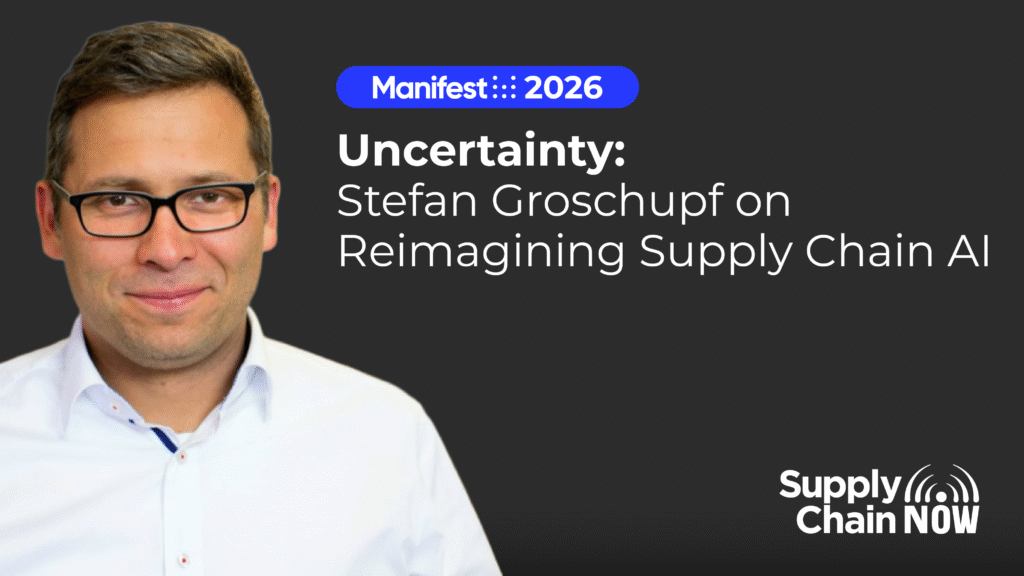
Building for Uncertainty: Stefan Groschupf on Reimagining Supply Chain AI at Manifest 2026
A Legacy Behind the Mission At Manifest 2026 in Las Vegas, Scott Luton sat down with Stefan Groschupf, CEO & Founder of Centrum AI, to discuss how a new generation of technology is being purpose-built for today’s supply chain realities, rather than yesterday’s assumptions. What began with a lighthearted joke about multivitamins quickly turned personal. When Scott quipped that “Centrum” reminded him of a vitamin from the eighties and nineties, Stefan shared the real inspiration behind the name. “My dad… the biggest building he constructed was called Centrum,” he explained. “That was the inspiration. His legacy, a head nod to him.” For Stefan, the company name represents more than branding; it reflects a mission rooted in impact and responsibility.   Designing for Today’s Reality “We’re building a new tech platform for the supply chain industry that is really built on the foundation of the reality today,” Stefan said. That reality includes uncertainty, dirty data, data silos, and geopolitical shifts that are reshaping global trade. He offered a simple example: in many ERP systems, a lead time is entered as a fixed number — say 15 days. “That’s of course nonsense,” Stefan noted. “It’s anywhere between nine days and 18 days……
decision intelligence
October 1, 2026

Leading Through Disruption: How Supply Chain Leaders Are Adapting to the “Never Normal”

A shipment delayed at sea can become a financial problem before it ever reaches the warehouse. A routing decision can change exposure to cargo theft. A technology investment can improve visibility while raising expectations for how quickly teams should respond. For supply chain leaders, geopolitical, technological, and economic disruption rarely arrive as separate challenges. They overlap, creating decisions that affect transportation, compliance, customer service, and profitability all at once. In the recent Supply Chain Now webinar, hosts Scott Luton and Jake Barr were joined by Henrik Holm, Vice President of Ocean Freight for the Americas at Apex Logistics International, and Linda Moran, Customs Compliance Senior Manager at Apex Logistics International, to explore how companies can adapt. Their discussion offered a practical perspective on what Barr calls the “never normal”: leaders need strategies that help them operate confidently even when the conditions around them keep changing.   Building Stability Through Preparedness Stability can feel like an ambitious goal when trade policies shift, shipping routes change, and transportation capacity becomes unpredictable. Yet the panel’s discussion suggests that companies can create greater stability through the decisions they make before disruption occurs. Holm emphasized understanding when and where goods are needed, planning earlier, and…