Intro/Outro (00:02):
Welcome to Supply Chain Now, the number one voice of supply chain. Join us as we share critical news, key insights, and real supply chain leadership from across the globe. One conversation at a time.
Scott Luton (00:14):
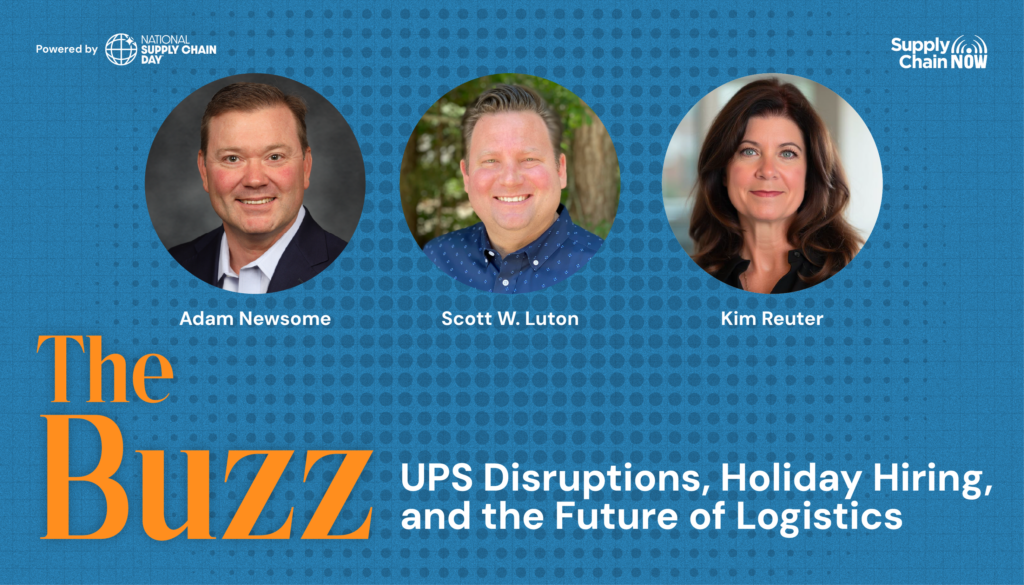
Hey, good morning, good afternoon, good evening, wherever you may be. Scott Luton and Kim Reuter with you here on Supply Chain Now. Welcome to today’s live stream. Kim, how you doing today?
Kim Reuter (00:24):
I’m doing great. How are you?
Scott Luton (00:25):
Wonderful, wonderful. Great to see you again. I tell you, we’ve been cranking out the A+ shows lately, haven’t we, Kim?
Kim Reuter (00:31):
We have. We’ve been kicking them out. It’s been great.
Scott Luton (00:33):
It has been great. And we got another one, another great show here today, folks. You know what it is. It’s Monday at 12 noon. You know what it means? It’s the buzz where every Monday at this time, for years now, we discuss a variety of news developments across global supply chain and business news that matters is what we like to call it. And folks, all month long in November, we are brought to you by our friends at National Supply Chain Day. Mark your calendars. April 29th, we want you to join us to celebrate this global industry that we all know and love, and you can learn more at SupplyChainNow/NSCD and come join us. And folks, Trisha’s going to make that really easy on everything, all the important stuff we tell you here today. Not only is she wishing Happy Buzz Day to everyone out there, she is dropping links.
(01:22):
So anything we talk about here today, we will have links in the chat. All right, so Kim, we got a big show here today. Let’s see here. We’re going to be talking about key takeaways from several big events that you and I both have attended lately. We’ve got some potential workforce challenges again at UPS, these things move in cycles, a mix of economic news, the good, the bad, and the ugly, and innovation in logistics operations and in our yards. Tons of opportunity there. Folks, stay tuned. We cover all of that and more. And we’ve got a wonderful guest back with us on the show, Adam Newsome, CEO of Laser Logistics, officially the biggest Tennessee Volunteers fan in the lower 48. Yes, we checked in with Guinness on that. You’re going to enjoy his point of view here today. Kim, big show. Are you ready to go, my friend?
Kim Reuter (02:07):
Let’s do it.
Scott Luton (02:08):
Let’s dive right in. And we got Blake Berryhill with us as well, tuned in from Marietta, Georgia. I wonder if Blake is related to the former Braves catcher, Damon Berryhill. Blake, let us know and of course, give us your take on the topics we talk about here today. Big edition of the buzz powered by National Supply Chain Day right here on Supply Chain Now. All right, so four things. In A-block, Kim, before Adam joins us, we got four things we want to knock out. We’re going to start with, with that said, it dropped over the weekend. It was a 196th edition of With That Said. Now we led with a variety of key takeaways from Gartner Supply Chain Planning Summit in Denver from just a couple weeks ago. We called them the Magnificent Seven. Have you seen that movie, Kim?
Kim Reuter (02:53):
Yes.
Scott Luton (02:54):
Have you seen the modern version of the movie?
Kim Reuter (02:56):
Oh, I don’t know about that.
Scott Luton (02:58):
I think it was Quentin Tarantino, I think is the one that did a retake on it. Anyway, if you’re like Westerns folks, you got to check it out. So these seven key takeaways ranged from stop chasing the perfect plan to more productivity doesn’t automatically mean more value to decision velocities becoming a big competitive differentiator. And then that last one touches on my favorite big theme from Denver, decision velocity, decision quality. We got to have both. It’s not a case of either or, because if we got all velocity and no quality, we’re just making a bunch of mediocre decisions. That’s not good for everybody. And if we got high quality decisions, but we’re taking all day and all week to do it, we can’t be moving slow in this environment. So folks, beyond all these takeaways from about 15 business leaders, we also included a snapshot of our upcoming live programming that you don’t want to miss.
(03:47):
So Kim, did you get a chance to check out with that said over the weekend, any reaction to that?
Kim Reuter (03:52):
I sure did. All great points. A little bit, we keep coming back to AI. The ROI on AI is really not panning out for companies. And we talk about it a lot on supply chain now, how to utilize AI to your benefit, what it really takes to have a successful AI program. So glad that they’re talking about that. There’s a lot to learn in with that said about how to use AI. And then the other thing is decision making. We don’t talk about it, but that’s really what supply chain is, is just a series of decisions and you’re hoping you made the right one. And if you didn’t, you got to make another decision because supply chain is all about pivoting because nothing ever goes to plan. So you got to have the plan B, C, D, E, F, and G ready to go at any moment.
(04:41):
So I’m glad that we’re bringing decision making up to the forefront because it’s really what it’s about.
Scott Luton (04:46):
I’m with you, Kim. I am with you. And some of these days we’re making, it feels like a million decisions. And even if there are a million small ones, it’s that decision fatigue sets in, which is why none of us want to say what we want to have for dinner at night because we’ve been making decisions all day. Anyway, folks, go check out with that said, appreciate Kim’s comments. You’re going to love Brittany and our friends at DP World. I love her quote here. “AI doesn’t diminish the importance of people. It changes where people create value.” I love that Brittany Caskey with DP World. All right, and Tricia dropped the link. Y’all go check it out. Number two. So Kim, you’ve joined me for a show or two in this series. I want to touch on our longstanding relationship here at Supply Chain now with our friends, our 2026 Strategic Alliance partner, a leader in that partnership with US Bank.
(05:34):
Tell you, we’ve been working on that series, that quarterly series for gosh, probably going back six, seven years now. But you know what? We’re already planning for 2027, which is going to have us exploring new communication strategies for critical information. We’re really excited about that. But before we move on to 2027, Kim, we’re going to be recording a look back at 2026. We did this last year with Gustav Compada. Now Gustav is head of freight payment sales for US Bank. I think we’ve done it last couple years. We do a bit of a reflection and a little prediction and Gustav does a great job. So that’s going to be published on January 4th and he always brings keen insights and lessons learned. And also in February, we’re going to be conducting our live stream with Bobby Holland, head of freight business analytics at US Bank.
(06:21):
Deep dive into the Q4, soon to be released Q4 2026 US Bank Freight Payment Index. But Kim, before we do that, if folks have missed our live Q3 live stream where we dove into the Q3 2026 National Freight Market Overview of the Freight Payment Index, it’s available now. You can check out the live stream, you can check out the data itself, venture over to the US Bank Strategic Alliance leader page at supplychainnow.com/usbank. Or if you want to check out all the publications I’ve mentioned, you can do so for free. It’s important, for free in this economy, for free at freight.usbank.com. And we’re dropping the links to all of that in the chat. Allright, so Kim, that’s a lot of information. It’s the domestic freight market. It’s a major, very complicated equation. A lot of different moving pieces going on there, huh?
Kim Reuter (07:18):
Yeah, a lot of moving pieces. And it’s really hard to get visibility into what’s going on in the freight market just because there’s so many different companies and so many different customers involved. And so this gives a really great peek into what is historically kind of an opaque market.
Scott Luton (07:34):
So a lot of opacity. Is that the right word for that, Kim? Opacity. So folks, check out these links I just mentioned, including getting your free copy of the US Bank Freight Payment Index, the one that’s just been published a week or two ago for Q3. Okay, so Kim, that brings us item number three here in the A block for bringing on our guest here today is I loved your coverage at Amazon Business Reshape 2026. It was up in Nashville in October. Now we shared some of your key takeaways, AKA Kimmy’s Keepers a few weeks ago in a terrific edition of With That Said. And so we’re going to drop a link to that. And we’ve got a little visual where we captured some of the key things from your Kimmy’s keepers.
Kim Reuter (08:17):
Look at that. That’s awesome.
Scott Luton (08:20):
It is kind of cool, isn’t it? So Kim, share a few things that really stood out to you at Reshape this year.
Kim Reuter (08:25):
So the biggest thing that kind of blew me away was just how well thought out the offering really is. Shelly Solomon opened us up and she mentioned that they’ve been at this for 11 years and you can really tell. They’ve been very thoughtful on the solution. It creates a lot of value. It’s very easy to use. They didn’t make it sort of this proprietary thing that you have to buy into. It can work with your existing procurement systems and it doesn’t matter how big you are. You can go from mom and pop all the way up to they’re working with Fortune 500s with hotel chains, global hotel chains. They have a lot of breadth and depth. So I had the privilege of talking to a couple of the leaders on the Amazon business team. First was Daniel Silverfield, and he and I talked a lot about the rules and things that you can put into the system.
(09:17):
Any other procurement system, you can write rules and have guidelines on what people can and can’t buy. And what really struck me is the focus on compliance because when we talk about procurement, we don’t always think about compliance, but if you think about PPEs, personal protection equipment, medical equipment, even software, cybersecurity equipment, there are very specific compliance protocols that are required and Amazon is allowing companies to build that into this Amazon business procurement system. So that’s super important and there was a lot of focus on that. And then the second I got to speak with Rochelle Segas and she talked a lot about usability and how when Amazon was designing the system, they wanted it to feel exactly like going on amazon.com and you’re ordering toys for your kids. They did not want it to feel like a dumbed down version or a stricken version or this sort of very worky version.
(10:14):
It feels exactly like amazon.com and they’re using all of that power from amazon.com to make procurement easier, making recommendations with AI, et cetera. Finding best prices is another thing that they’re doing. So it’s a really well thought out offering and I was really impressed.
Scott Luton (10:32):
I really enjoy your live videos that you took from Reshape and I like this quote here because folks, if you know Kim Morter, you know that she likes to keep it real, right? And Amazon is focused on speaking that natural language, not that tech speak that is so tough to get stuff done. People want to communicate in a more comfortable and human manner. And it seems like that was one of the big focuses of Amazon Business’s approach this year moving forward, Kim, is that right?
Kim Reuter (11:00):
Yeah, that helps with a lot of things. One, it helps with adoption because I don’t have to go learn something new. I don’t want to date myself. I mean, we’re not in the DOS prompt phase, but when you lose a new software, you have to, well, we use this term, they use that term. There’s a ramp. And now you can ask things like how much toilet paper did I buy in 2025 in the East Coast region? And get an answer without running a report, deciphering the report, going through it, filtering it out.
Scott Luton (11:34):
Download files and stuff.
Kim Reuter (11:36):
Yeah. So this is kind of the thing that they’re focusing on is being able to access data in a natural way and it’s almost instantaneous versus I don’t know how it… First of all, when I was at Amazon, I was not allowed to run reports. Only finance could do that. There’s a really good reason. And so it took a couple hours, if not a couple days for me to get an answer back. And so now you can get it instantaneously. So very impressive.
Scott Luton (12:00):
Love it. Folks, Kim has given you a couple nuggets from Kimmy’s Keepers and Trisha has shared the link where we wrote a whole blog article about her key takeaways. So go check that out. And tip of the hat, I went to Reshape last year, you went this year. Of course, you’ve got that X Amazon perspective as well, but I though they did a really nice job investing in that event. Would you agree with Kim?
Kim Reuter (12:25):
They really did. It was very thoughtful. They had a lot of vendors who were participating and adding value in their own ways. I was really impressed and it was a ton of information. I would say the one piece of information we gave back to feedback to Amazon was they tried to condense the show a little bit this year. So for breakout sessions, you had to choose between maybe five or six different options, which is great, but you may have missed out on something you really wanted to catch. So hopefully make it a little longer next year and you only have to choose from two or three and you’ll get to see more stuff, but jam packed full of information.
Scott Luton (13:05):
And we might know somebody that can help share some of the key takeaways in real time for all the folks that can’t get to wherever they’re hosting the event. So Amazon. All right. So Kim, let’s see here. We got one more thing to hit before we bring on a big guest here today. We got a lot to dive in the B block and the C block, but who’s also on a roll, I’ll tell you, is the Manifest Vegas team. Manifest Vegas folks, as you’re going to find, if you venture out, is one of the largest global gatherings of the brightest minds in supply chain and logistics next year, 2027 in February. 8,500 plus, plus leaders from 60 plus, plus countries will spend three days making connections and deals. With access, it really is tough to find anywhere else. And as a friend of Supply Chain Now, you can register now and save 200 bucks off the current rate, which is 900 bucks off the onsite price, but you can’t wait.
(14:01):
You can’t terry, as they say back in the old days, I think. Don’t wait. Prices go up Friday, November 20th. That’s just a couple days from now, folks. So go check that out. We’re dropping a link right there in the chat. Now, Kim, you and I both are going to be at Manifest and you are either keynoting or on a panel session. One of those two, I think, right?
Kim Reuter (14:21):
One of the two. I think we’re still working it out, but yeah, super excited to be there. So many attendees. Great show. If you haven’t attended Manifest, definitely something to think about. And I would say Manifest is kind of like a newer up and coming. Well, it’s not even up and coming, but it’s the hot show. Let’s just put it that way. It is the hot show. All these older shows have been around for decades. Manifest I think has really kind of put them on edge.
Scott Luton (14:43):
They’re on the move. They’re on the move. I mean, they grow a show from zero to 8,500 folks in four years, I think.
Kim Reuter (14:50):
Five years, four or five years.
Scott Luton (14:51):
Yeah. Whatever it is, that’s doing something. And they’ve launched a European sister event for the first time will be next year I think as well. So they’re on the move. And Kim, we believe, I think it’s confirmed. Let me know, Amanda and Trisha, let me know. I think we’re going to have Courtney Mueller, the president and CEO of Manifest and a special guest next Monday on the bus, I think. Might be two weeks. Anyway, they’ve got a big announcement coming, so folks stick around. We’re going to share it right here on the bus. All right, so Kim, let’s see. Check, check, check, check. We knocked out all of our work in the A block. So now we get to bring in a wonderful guest here today. And folks, a friendly reminder again, Trisha has been hard at work. She’s dropped links to all of that in the A block right there conveniently in the chat.
(15:38):
All right, so backed by Popper Demand, Adam Newsome serves as CEO of Laser Logistics. Now get this. After 30 years of relentless improvement, Laser Logistics has grown into the largest provider of outsourced yard logistics. They now can be found in over 700 locations in the US and Canada where they work with a wide array of organizations, including 54 companies in the Fortune 500. How about that? Let’s learn more and welcome in Adam Newsome with Laser Logistics. Hey, hey Adam, how you doing my friend?
Adam Newsome (16:11):
Doing great. Doing great.
Scott Luton (16:12):
It is terrific to see you. We’ve been looking forward to this. You and I had a ton of fun on a podcast a month or so ago, and hey, we got Kim Warder and Adam Newsome. I’ve been living right, Kim and Adam. I tell you.
Kim Reuter (16:25):
Your prayers have been answered.
Scott Luton (16:26):
That’s right. Hey, really quick, Amanda’s letting me know something. I messed something up, folks. So let me back up before we dive in with Adam. November 30th is when we’re featuring Courtney and Mark with a big announcement for Manifest. So plan on joining us November 30th here on the Buzz. Okay, now I fixed it. All right. Little duct tape, little WD-40, bubble gum. We’re good to go. So Adam and Kim, before we get into a wide variety of news and some of your perspective on what we’re seeing out in the industry, I want to start with a fun warmup question because today folks is many things, but it is also National Fast Food Day. So we got to celebrate in earnest today. So to do that, Adam and Kim, when we’re talking pre-show, we had a little exchange folks pre-show where I said, “Hey, Adam and Kim, I know we’re not splurging as often on fast food as we used to.” Adam said –
Adam Newsome (17:18):
Speak for your damn self.
Scott Luton (17:20):
Just like that. So folks, kidding aside, some of the most impressive supply chain performances can be found in this incredible industry, quick service industry. I think they’ve kind of been renaming it, built on speed, standardization and flavor most of the time. So I’m curious, Adam, when you do splurge on fast food, what’s your go-to?
Adam Newsome (17:39):
Well, my go-to is going to be Taco Bell. It’s just they have a huge variety of a menu. I mean, I didn’t know you could name a taco so many different things. It’s still a taco, but it’s got like 42 names according to them. And so I go there, I panic when I see the menu. I don’t know what to order. I order too much, but that is my go-to.
Scott Luton (17:56):
All right. And then do you get the extra hot sauce? Diablo sauce, I think as they call it.
Adam Newsome (18:00):
Oh, is there anything else? I mean, with this mild crap, I mean, you got to go Diablo.
Scott Luton (18:05):
Okay. All right. Kim, I’m telling you, Adam keeps it real like you do. So Kim, when you splurge on fast food, what’s your go-to?
Kim Reuter (18:12):
Well, first of all, I’m going to have a t-shirt man that says you got to go Diablo.
Scott Luton (18:17):
I love it.
Kim Reuter (18:19):
But I don’t eat a lot of fast food, so I had to stretch, but I’m going to go with Wendy’s because I have always been a French fried fan and I do love Wendy’s French fries.
Scott Luton (18:28):
Oh, Kim, we’re going to have to duke that one out, man. I like a Wendy’s burger, although it’s been interesting times lately, but McDonald’s French fries, you can’t beat them. You can’t beat them. That’s just my take. That’s my take. We’ll save that fight for later. And Amanda says, “I love Taco Bell, Adam.” Well, we’ll do some taste testing at some point. All supply chain research, of course. But all right, so Adam and Kim, now that we’re starving for Wendy’s Square hamburgers and all kinds of tacos at Taco Bell, let’s get into the news. We got a lot to tackle here today. We’re going to start, folks, y’all know, one of my go-to phrases, what’s old is new again. We’ve got a potential challenge at UPS that’s at least a ways out, right? And again, this is not a certainty of what I’m about to walk everybody through.
(19:11):
So remember a few years ago when we were talking about labor negotiations at UPS, I think it was 2023 when a walkout was averted, thankfully, with a new labor deal. Well, get ready, folks, as a current labor deal between UPS and some 300,000 Teamsters represented employees, that deal’s set to expire July 28th, so 2028. So we got some time, about a year and a half. And of course, all this is reported here by Max Garland at Supply Chain Dive. But you know what, Kim and Adam, it’s a great time to use this potential disruption to check in on a few things in your own supply chain ecosystem and tip of the hat to Kenneth Moyer with LJM who shared a few heads-up tips with Max. So three questions here. Ask yourselves, ask your teams. Number one, have you been investing in alternative carrier relationships? There’s a lot more options these days than there were five years ago.
(20:01):
Number two, do you know the contract exit penalties for any of your carriers, including UPS? And number three, is your shipping technology ready to support a multi-carrier approach? I sure hope so, but now’s the time to get all the kinks out while time is still on your side. So Adam, again, no guarantee disruption, which is nice, but you never know how these things play out. Your thoughts?
Adam Newsome (20:25):
Well, I think first of all, the three things that you pointed out, it’s not just true of UPS. You need to be doing that throughout your supply chain as well. So those are three kind of… If you’re not asking those questions every day, then you’re probably going to get called at some point with a situation. It could be a carrier bankruptcy, who knows what it is, failure, service, whatever the case may be. You need to have a resilient supply chain there as well. So I think those three questions are really, really important. Now, certainly with UPS being the size and girth that they are, you really do have to think ahead with that one as well. But I want to make sure, for me, it’s like, hey, that’s just a reminder. I should be doing this with anything within my supply chain because if we know one thing, change is inevitable.
(21:05):
And if it can go wrong, Kim mentioned it, I believe in the A-block, it’s a series of decisions that you’re making, and if you don’t make the right one, you better have B, C, D, E right behind it and be willing to make those decisions.
Scott Luton (21:17):
Well said, Adam. All right, so Kim, your reaction here.
Kim Reuter (21:20):
It’s going to be really interesting. UPS is not the same company it was five years ago or almost five years ago when they put this contract in place. So it’s going to be really interesting to see how things play out. Just a little historical context. UPS was founded in Seattle, Washington, believe it or not. There’s actually a little park, the UPS Park where the old warehouse used to be. I think it burned down, but there was a little park for that. But way back in the day, UPS was the 600-pound gorilla. They called the shots, they moved the freight. They were the biggest mover in the United States, and that has changed. So it’s going to be really interesting to see what happens. In addition to what we see with Amazon, Amazon’s taking on its own logistics. Amazon was UPS’s biggest customer. That has changed, but we’re also seeing DHL come back into the market.
(22:12):
We’re seeing other carriers. In addition to that, more regional carriers. So I don’t know what’s going to happen. It’s going to be a different playing field.
Scott Luton (22:19):
Well, you know what? Your crystal ball usually works, but we’ll see. We got to see on this one here. The good thing is, folks, that is July 31st, 2028. Despite the drama of my visual, we got some time. We got some time, and my hunch is we’re going to figure this stuff out. All right, so Kim and Adam, good stuff with you both, and Trisha’s dropped a link to the whole story. Max Garland’s one of the best in the business over there at Supply Chain Dive, so go check that out. All right, so number two, let me pull up this visual here. This is interesting. As reported by Liz Young, the one and only over at the Wall Street Journal, warehouses, fulfillment centers and the like are reported to be hiring workers later than usual, really putting just in time on steroids, I think. Why?
(23:01):
Because folks, I probably don’t have to tell anybody this, but there’s a good bit of uncertainty as to what this holiday season is going to deliver, especially from a retail and economic standpoint. As you might expect, logistics operators are turning to automation, gig workers, and highly flexible scheduling to kick the can down the road until they’ve got to bite the bullet and hire more help. Now, a slight twist on the same game that’s played this time of year every year, Ship Matrix is projecting that carriers will deliver 2.4 billion parcels between Thanksgiving and January 2027. That’s up from 2.3 billion last year. So with all the retail projections, you might see dollar amounts vary and you’re kind of wondering how much is inflation play into that well, and it comes down to the number of parcels being moved is bigger this year. So that’s good news, I guess.
(23:49):
Then the article also mentions how many companies have turned to more automation in their hiring efforts, which they expect will allow them to move faster when they’re ready to. Now, Kim and Adam, call me a bit of a skeptic when it comes to hiring automation. There’s some good things going on out there, but I got to say, have y’all seen these AI interview videos that’s proliferating out across YouTube? Only about you, I do not want to be interviewed by an AI bot. But in the bigger picture, Adam, with folks waiting until they have as much certainty as they can before they bring that hiring trigger, what are you seeing out there, Adam?
Adam Newsome (24:24):
Well, right now, you nailed it. There’s a lot of uncertainty. I mean, I miss today’s and it seems like a lifetime ago, kind of call it pre – COVID, pre – 2020 when you had a predictable chaotic season and retail season as well. Those days have not come back. I mean, if we’ve seen anything, we’ve seen spikes coming off of COVID, we’ve seen it come back down. We’ve seen the unpredictability that’s really the consumer. The other part about it is that the expectations of society have changed so much that I know for me, everybody’s a procrastinator. I mean, you wait until the last possible moment, you think it’s December 23rd, let me go ahead and get my gift. I mean, used to everything had to be in the store before Thanksgiving. I mean, it was a very predictable model, but with e-commerce and how dominant it is now as well, the expectation of the consumer has changed.
(25:15):
So naturally, that’s going to change what the supply chain has to adjust to. Now, I totally get why customers are waiting here saying, “Hey, I don’t want to staff up back in September, October for a need that’s really going to happen between Thanksgiving and Christmas the way supply chain is now.” I get it, but that comes with a lot of risk as well. Now, here’s the other thing I’d say about this year in particular, you can only do that when the labor market is in a certain condition as well. Now what we’re seeing is that, now I know there’s a stress on the CDL drivers, but if you look at the labor reports, what we’re seeing is it’s not that great. It’s not bad. I’m not here to say that, but it’s not that great. So you can take advantage of it to a certain extent, but I do think it puts you at a lot of risk as well, but I certainly understand that you got to manage P&L, you try to use your data, makes sense for them as well, but there’s a lot to unpack with what’s going on there as well.
Scott Luton (26:08):
I’m with you, Adam. A lot to unpack. No truer words have been spoken. Kim, react to this story from the Wall Street Journal of folks waiting and waiting until they absolutely have to bite the bullet and hire a bunch of folks.
Kim Reuter (26:22):
So we talked about, we recorded last week a collective podcast about holiday sales and how all that started and the history and evolution of the holiday sales. So a couple of points here. One, sales are starting earlier and earlier. I mean, Amazon has already started Black Friday sales a week in advance, and so we’re basically Christmas shopping in July at this point. That’s right. So the sales are moving earlier and earlier. So what that does is that really kind of spreads out the spend. So it’s a little bit harder to understand what’s going on. The second part of this is that people are nervous, right? So people are very nervous. We don’t know what spending’s going to be like. We’re expecting it best a flat for year over year for holiday spending. So hopefully we have that. So obviously companies are a little bit nervous about bringing in that headcount, but another thing that’s happening out there as we talk about automation.
(27:11):
So while automation may not be replacing people yet, it does allow for a faster ramp. So the more we have automation, the more we have human-friendly technologies, the quicker it is. We don’t need two months to bring somebody up to speed anymore like we used to. At this point, we can hand you a finger scanner and a device and a couple hours of training and you’re off to the races. So that ramp does not take long, and that’s some of the benefits we’re seeing on automation.
Scott Luton (27:40):
Kim, that’s a great distinction on automation piece. My brain, despite what you’re sharing, we’ve talked about a lot here, that had made some facility tours where we see it in action. My brain went to some of the hiring automation that’s out there. And one of my observations there, and again, I’m careful about painting with a big broad brush. However, we all know that the candidate experience has been beat up quite a bit in recent years, right? And my only pause, and again, recruiter and professionals out there, you know what you’re doing, you’re the expert, but as we apply automation technologies on the hiring side of things, that let’s lead with the candidate experience. And I think one of the big gaps there that I’ve seen for years is all the waiting. You’ll knock out an interview or you’ll knock out four interviews and then they sit and they don’t hear anything back.
(28:31):
And if we’re going to be automating and creating a lot more interviews and conversations and hiring processes, we got to find a good way, maybe automated way of closing the loop on these things.
Adam Newsome (28:42):
Scott, I think you nailed it right there. It’s not necessarily the bot interviewing you as well, and I have mixed feelings on
Scott Luton (28:49):
That. I was having a little fun with that.
Adam Newsome (28:50):
Yeah. Well, yeah, but I mean, I tend to agree with you. Now, I’m not saying that that doesn’t work. I’m not trying to call the ball. I’m just talking about my personal feelings about the human connection as well, but it’s the response time. I mean, from the time somebody puts in an application, how quick do I get back to them and how do I close the whole loop even after I get back to them? To your point about the interviews, they filled out the paperwork and stuff. I mean, because guess what? In a different market, and I’m not saying it’s not true today, they’ll have other options. Now, I know certainly with the CDL market, you absolutely have options as well. So if you have an opportunity, you need to respond quickly as well. So totally agree with you. And that’s where I think the AI can help you as well, the prompts, moving the data as quickly as possible.
(29:31):
I mean, you’re no longer carrying a paper application and putting it on somebody’s desk. So those are the things that I look at there as well. Again, I’m not calling the ball on the bots and interviewing. Maybe that works great. We’ll certainly look at it as appropriate as well. But what I do know is that the quicker we can respond, close that experience, improve that experience for the applicant, hey, that’s going to be a better thing for everybody.
Scott Luton (29:53):
Well said, Adam. And Kim, I’m going to circle back. You were talking automation in terms of as they get the job, Kind of cutting down on the learning curve with all the cool technology to use in facilities. But on the hiring side, your quick comment on where automation has a role?
Kim Reuter (30:08):
I’m torn on this. Someone who’s been a hiring manager and working at Amazon, at the time when I was working at Amazon, it was less than 5% of the people who applied for a job actually got a job. Now this is at the corporate level, not at the warehouse. And those are like NFL stats, and only half of them made it through the first year. So those are pretty steep statistics. But when you look at how many people you have to talk to to get one person who can make it a year of employment, and this was back in the early 2000s, so different company back then. It’s a huge labor force to talk to all of them. So I have mixed emotions. Recruiting is expensive. Talking to somebody every day is expensive. If you can use technology to maybe just scrub out 20% that just don’t even have the qualifications or don’t even have the interest.
(31:07):
And on the reverse side of this, a lot of people are using AI bots to submit for jobs. They don’t even know they applied for a position. They’re just like, “Oh, I got an interview? What?”
Scott Luton (31:17):
Press a button. Right.
Kim Reuter (31:19):
Yeah. So that’s a balancing act. It is. I’m going to ride the fence on this one.
Scott Luton (31:23):
Fair enough. Fair enough. We’re going to have to have a whole show dedicated to the workforce experience. That’s a good comment there, Kim. All right, we got to keep driving. So Adam and Kim, I’m going to ask for your indulgence because this third story here as we wrap up the B block is going to take me a minute to unpack. So y’all bear with me for just a second here because we’re going to get into all things economy related. So I’m going to start with this piece, some reporting from CNBC. So there wasn’t a whole bunch of love about inflation data in October. The producer price index or PPI essentially measures wholesale price points. Y’all know this, but for anyone out there that might be economically challenged like me, I had to learn that. So for October, the overall PPI rose 0.3% from September prices, right month over month.
(32:13):
That’s a 10th of a point below what the experts though we’d see. So hey, I’ll take that. That’s good. Monthly increases were driven by prices on goods, transportation, warehousing costs, and freight costs amongst others. But if you look at things from a year over year perspective, the October 2026 jump over October 2025, that was 6.5%. Highest annual rate increase since November 2022. That’s no good. Also released last week was the Consumer Price Index from the Bureau of Labor Statistics, and that showed the consumer prices up a smidge more than what was expected. Now the Fed meets next on the 8th and 9th of December where who knows what they’ll decide to do. Probably if anything, my hunch, Adam and Kim, is that they’re looking at a rate increase or keeping it same rather than rate decreases, but we’ll see what they come in with. All right, one more thing.
(33:04):
I love reading this thing right here. Texas Manufacturing Outlook Survey. Now this is published by the Dallas Fed, the Federal Reserve Bank of Dallas. Now it’s important for folks to know Texas is a really good measure for manufacturing. It leads a country in manufacturing output. I mean, it’s pretty big, but it’s second to California in manufacturing employment. How about that? For October, one of the main themes from the report that factory activity is still expanding, but at a slower rate. And one of the reasons input price pressure continues to rise. But other than the data itself, I love reading the comments. So Kim and Adam, if y’all have checked this out before, Kim, I think you and I have talked about it, you always get a bevy of comments from the manufacturers that participate. These are folks out in the field running manufacturing operations and there’s usually a couple dozen comments.
(33:53):
I’ve cherry picked a few here and I’m not going to read them word for word. And again, these are anecdotal. This isn’t meant to be some massive general concern, but I think there’s some weight to these. Number one, one shows concerns on profitability based on rising costs. I think that’s a pretty prevalent. Two is second individuals worried about the state of the USNCA negotiations. And again, that’s got some lead time, but there’s a lot of takes on what may take place, especially with some of the election results. And thirdly, one individual, you see on the right-hand side, data centers spending money on flimsy steel and HVAC systems does not make the economy robust. Rates should come down for those of us that have to support the system in the long term. All right, so a lot of takes, a lot of data, a lot of indices that make up this massive equation that is the national and certainly the global economy.
(34:45):
Adam, what are you seeing out there, my friend?
Adam Newsome (34:46):
Well, I think you nailed it with the tension of opposites. You got rising costs, but yet as the Texas study says, the demand’s not really there. I mean, if anything, it could be contracting as well like that. And that puts a lot of pressure on our customers as well. For us at Laser, we think about the market kind of in major verticals and certainly food and beverage is one of them. CPG, consumer product goods is one of them. And then retail is another one. And it’s not great. Now in retail, you’ve got a mixed bag. The discounters are doing really, really well in this market and they’re amazing companies and they’re doing well. But when you look at food and beverage and you look at CPG, and really if you look at Ford verticals in the S&P and you start talking about consumer staples, consumer discretionary, you start talking about industrials and things like that.
(35:32):
If you look at their volume, not necessarily their revenue because there could be pricing involved in there, the volumes are just not there going up right now, but yet you have rising costs. Why is that? And I’m sure your show’s covered it quite a bit as well. I mean with the regulatory crackdown, the CDL drivers, obviously there’s less of them now and that’s probably a good thing. I’m not saying it’s not, but certainly that’s caused prices to rise. So it’s a strange recovery that we’ve seen. And again, ultimately I feel like the customers are having to debate how much can I pass along to the consumer which impacts all of us? So that is, I think you got a question for me later about going into 27. That is the seminal question for us right now. What type of market are we in right now?
Scott Luton (36:15):
Gosh, Kim, we could talk for days, I think with Adam’s last response there, but Kim, react to not only Adam’s response, but react to the initial data that we shared both from CNBC and from that Texas Manufacturing Outlook Survey.
Kim Reuter (36:29):
I was just reading an article, maybe even a week ago, and it was like, why is my cocktail so expensive? And so we look at beverages, we import a lot of our booze is imported, Canadian whiskey, anybody. And guess what? It got more expensive because of tariffs and bans and all of these other things that we have going on politically. And so alcohol has become more expensive. We’ve also unfortunately could put out some of the smaller distillers have gone out of business because they can’t export or they’ve lost our export contacts. But also we have a culture, right? The culture of alcohol is dying, it seems. People are shifting away from that. So alcohol is not what it used to be. And so I think that’s what we’re seeing in that. And then what we see in metals, Canada is one of the biggest producers of aluminum in the world.
(37:18):
Most of the aluminum we consume in the United States comes from Canada. Well, not right now, but that’s another reason. Most of the raw metals that are consumed for manufacturing in the United States are imported. I don’t know when the last time we processed ore in the United States, I’m sure we still do at some point, but Bath Steel, all these old steel companies that have been around forever, they’re shuttered now. So we actually rely on that raw material a lot.
Scott Luton (37:47):
Kim, we could really, I tell you, between trade policy and the global aspect of supply chain that’s never going away, to some of your comments you’re sharing, we’ll see. I’m going to be practically optimistic because I don’t want to be practically pessimistic. There’s some cool things going on that might help reduce our country’s reliance on some of these things, but it’s a global game. It’s played on a global stage. Some things are really next to impossible to change, so we shall see. All right, so Adam and Kim, appreciate both of y’all’s comments on some of what you are seeing in the economy. And folks, Trisha’s dropped a link there to a couple things, including the Texas report from the Dallas Fed. Folks, that’s a really interesting study and I know it focuses on just one part of the world, but it really is some interesting things in there.
(38:34):
So check that out. And Trisha’s also dropped a link to the CNBC economic data on both the PPI and the CPI. All right, so going back for a second before we get into C block, Marwin, we were talking about hiring and workforce stuff. Marwin says, “I believe it’s still requiring human supervision along the right tool of AI in terms of hiring. It saves everyone time and adds more efficiency to the equation.” Marwin, I think we agree with you. I think AI and modern technology can play both on the candidate side and can play on the hiring manager side. I think just in the right applications where we really focus on the candidate’s experience while protecting the hiring manager’s time for sure. All right, so Adam and Kim, before moving to C-block, I’m going to pick Adam’s brain on a few things. I’ve got a really cool note that I want to read something new here at Supply Chain Now.
(39:26):
We mentioned National Supply Chain Day earlier. So folks, again, mark your calendar April 29th. But beyond that, we’re excited to introduce a new related program this year because Supply Chain Now is partnering with Food Logistics and Supply and Demand Chain Executive to launch the, drum roll please, National Supply Chain Day Innovation and Excellence Awards. Folks, it’s a merit-based process, a merit-based process. We’re going to be judging and selecting some of the best companies that are doing big work in transportation, warehousing, procurement, manufacturing, and a special category, the Give Forward Award. So nominations are now open, but they close January 22nd. So you got two months and about a week. Get them things in now. You can learn more at the link that we’ll be dropping in the chat. All right, so Adam, I hear Laser Logistics has already been nominated based on all the cool things y’all are doing at Laser, so we’ll see.
(40:18):
But kidding aside, I want to talk a little bit about a couple different topics and I want to start with your leadership journey. So as we shared, as we were introducing you, 30 years, oh my gosh, building Laser Logistics brick by brick. If you would tell us what you do in a nutshell for the three people out there that may not know, and what’s been one of the most important leadership lessons you’ve learned along the way?
Adam Newsome (40:41):
I think the easiest way to think about it is that we’re the largest yard management company. What does that mean? That is really the transition zone between where over-the-road trucking comes into a warehouse or a manufacturing facility and where it leaves. Basically, again, most of the industry now comes in, they want to drop their trailer off, they want to pick up their loaded trailer and go. Well, somebody has to move those trailers on the yard and everybody’s been down to interstates, the highways, wherever, seen these massive distribution centers or fulfillment centers like Amazon as in the A block that Kim was talking about there as well. Somebody’s got to move those trailers. And again, it’s a very, very precise coordinated effort to drive efficiency in the supply chain as well. To give you an idea of the scale that we operate at, we move over 32 million trailers a year.
(41:26):
You were mentioning the seven to 800 locations that we’re at, but these are massive, very busy places that we operate at. And I think that leads into probably the biggest lesson that I’ve had to learn as well, or one of the so many lessons in leadership, and you learn them through experiences there. Had a lot of people talk to me over the years about scaling your business, and that’s just a nice dinner conversation or things like that as well. But what I’ve really learned is that it’s really freaking hard to scale a business as well without losing your DNA. That’s really the key, I think, for there. There’s a lot of great businesses that, hey, they’re at maybe 10 million of revenue, 20 million in revenue, but as you start to try to take what made you great and scale it, there is a lot that goes into that.
(42:08):
So I think that has absolutely been there. And I’ve made tons of mistakes in there. I’ve made some really good decisions, but most of the time it was predated by some failure there as well. But you got to focus on what kept you or what value you’re adding to the supply chain and how do you provide that across a scaled version? So that’s probably the biggest lesson.
Scott Luton (42:26):
Adam, I love that answer. And protecting our culture and our values relentlessly and every single day. Kim, you’re nodding your head. I can only imagine the stories you could say of your time at Amazon as they were completing or continuing a big old scale up. But react to what we heard there from Adam, Kim.
Kim Reuter (42:44):
Scale is hard and people don’t realize that. And I’ve had many arguments with people over time. Anybody can have an idea, but it takes a special person to be able to execute on it and make it work. And I think that’s where companies break is you can do it a hundred times, but can you do it a million times? Can you do it 10 million times? And those are the questions that you have to ask yourself. When we were at Amazon way back in the days, we used to do this peak scaling testing where we tested all of our systems, our processes, everything was tested to 10,000 times. What happens when we go from one customer to one million customer and will all of this work flawlessly every single time? And it’s really hard to do, and if you don’t nail it, you’re not going to get there.
Scott Luton (43:31):
Good stuff, Kim and Adam.
Adam Newsome (43:34):
And Amazon is the ultimate scaling story. I mean, the ultimate scaling story there as well. And it is amazing and she’s exactly right. Well, I mean, for us going up to $800 million of revenue from where we were, I mean, it seems like a massive jump for me. And within the supply chain relative to others, it is a massive jump. But when I think about what Amazon did, there’s your primo story right there.
Scott Luton (43:58):
Right. We’re going to be studying the Amazon story for quite some time. Can’t you see us in wherever business schools are going to be in 2200, year 2200? Who knows? Maybe they’re all hologram projections or something. We’re going to be studying the big A and what the company did. That’s the most, I’m sure about 2,200 things will be a little bit different, but holograms like Star Wars, the best thing that come to my mind. All right. So Adam, I love, there’s so many organizations that kind of sleep on yard operations and logistics innovation and you are doing some really cool things. But I’m curious from your vantage point as y’all work with big companies, small companies, all points in between, what do you see some of the biggest challenges, but also opportunities that are facing logistics leaders as we head into 2027?
Adam Newsome (44:46):
Well, I think I mentioned a little bit earlier, it’s trying to first of all get an idea what is the market doing, whether that be on the call side with wages, whether that be the truck prices, whatever the case may be, have a good understanding of what you think the market will do and then accept the fact that you were probably wrong. It’s just a matter of degrees of how wrong you are there as well. And build a plan around that as well. Be aggressive where you can be aggressive, where you see pockets of strength in taking market share, take it, go get it as well. But then when you’re really sitting there thinking back, it is tough right now for leaders, I believe, to really put together a full year plan. Because again, we just talked about several of the things that have happened here as well.
(45:27):
Who knows what the political ramifications are from the most recent election cycle? We certainly saw ramifications from the previous one a few years ago, the presidential cycle as well. And think about how that threw a monkey wrench at a lot of people’s plans as well. So I think it really comes down to having a plan, using as much information as you can, talking to a lot of great people, listening in to a wonderful show like here, you and Kim that know way more than me about it and trying to develop a plan from there that balances opportunity with risk.
Scott Luton (45:57):
All right, Kim, whether you comment on what Adam sees and some of his recommendations there or what you’re seeing, especially from what keeps logistics operators up at night as we move into the new year, your thoughts?
Kim Reuter (46:08):
Trucking. I think 2027 is going to continue to be a trucking crisis. We continue to have backups at our ports because we can’t get freight moved out of there. Adam’s already touched on the CDL crisis that we have going on and we don’t talk about it. We talk about the ships, we talk about the containers, we talk about all this other stuff, but we don’t ever talk about the trucks. And you guys know this is near and dear to my heart. My partner’s a truck driver and he deals with this every day. Retired long-haul trucker, up to five million miles he’s traveled. We know a lot about this space and we never talk about trucking. And so I’m really excited to talk to Adam about yard management because that’s a passion of mine, but I think trucking is going to continue to be a problem in 2027.
Scott Luton (46:48):
I agree. We got to get your partner’s name. Billy? Billy. We got to get Bill on the show.
Kim Reuter (46:53):
This is the last thing he wants to do.
Scott Luton (46:54):
Well, you know what? We will make it worth his while.
Adam Newsome (46:59):
But let me tell you something, his perspective is what we need to hear. I mean, absolutely is Kim’s 100% correctly.
Scott Luton (47:05):
So Billy, if you’re out there, you’re tuned in, you’re listening to Kim’s co-hosting on supply chain all the time, we got to get a mic in front of you and a camera on you because we’d love to hear about those five million miles and all the stories.
Adam Newsome (47:17):
Sorry to interrupt, Scott, but for me, talking about what we do, I’m more interested in what Billy’s experience is when he comes into the yard. How does he get treated there as well? How quick can he get in and out? How inconvenient? When you think about it, they’ve just drove four or 500 miles maybe sometimes into a yard. The last thing they want to do is how about greet with a smile or have facilities to use, restrooms, things like that. That’s really, to me, what we need to hear in this industry more than anything as well, because again, we’re talking about the CDL crisis. Well, one part about it is we have made this job so unsexy for everybody. It’s terrible. Sorry, you kind of put a nick on my jukebox there as well.
Scott Luton (47:58):
That’s a good nick and those are great concerns. I hear dignity in your responses there and all of our workforce that makes global supply chain happen every day need to be treated with dignity and professional courtesy. But we’ll have some other conversations around that. Really quick, Adam, we’re going to have a fast and furious finish with the time we got left. Technology, as we’ve talked a lot about today on so many different levels, it is moving so rapidly and it’s evolving so fast. I’m curious if there’s one thing in terms of big opportunities that will improve and you’re seeing improved logistics operations out there that really brings a value. What’s that one thing that needs to be on more people’s radar?
Adam Newsome (48:40):
Well, I think first of all, you hear from everybody, visibility and data. You hear that all the time as well. But what I like to point out is what are you doing with that data? What are you doing with that visibility? What are your underlying processes and how do you have the management leadership? How do you report back on where I see an opportunity? Am I accountable to fix it or not? Stuff like that. So it’s kind of like what the person from DP World was saying earlier on about their quote about people and the impact of AI. To me, it’s about how you use that data and that visibility. Again, people have been talking about that for years and stuff like that, but to me it’s are you driving change that is meaningful? And let me be honest to the P&L, because when you talk about those numbers to 6% up and cost and things like that, the only way down from that’s efficiency.
(49:24):
The only way down on that is efficiency. Fundamentally come at a lower cost to serve or more efficient. That’s it.
Scott Luton (49:30):
Kim, I liked… Man, we’re getting some passion from Adam Newsom here today. I love it.
Adam Newsome (49:34):
I’m sorry. I’m excited about the Tennessee game this weekend. I apologize.
Scott Luton (49:38):
No, no. Keep it coming. Keep it coming. Kim, the question isn’t oftentimes whether we have visibility and data. We could argue whether we have enough of both of those, but that’s a different discussion, but all organizations and professionals have some access and a greater access than we had say five years ago with both of these. But what are we doing with it? Your thoughts here, Kim?
Kim Reuter (50:01):
We started this whole conversation with decisions, right? The supply chain is really about decisions. We need the data. We need the data quick so that we can make decisions. Everybody who knows in supply chain knows that you have to have plan B, C, D, E, F, and G because we may run through all of those in an hour and then be going, “Okay, what’s H?” So it’s really about decisions, and that is what will separate the good from the bad or the wheat from the chafe, is that if you can make educated, fast, executable decisions, that’s the other thing too, is that people make decisions and it’s like you want a what? We are not air freighting lead bricks from China ever. So I know that that looks like a solution and that was plan E, but we’re going to go on the plan F because we’re not doing that.
(50:49):
And so it has to be an executable decision. So again, people talk about AI and scenario, running scenarios, scenario management. Excellent way to run through all those scenarios. That’s a good use for AI, but you still have to be able to execute on the decision.
Scott Luton (51:04):
Well said, Kim. All right. So Adam, before we start to wrap up here, one thing, and you’ve spoken to this already, so maybe you’re picking something that you’ve already spoken to, but as we get into the next few years and velocity and disruption continues to play out and multiply, you name it, what’s one thing that’s going to separate the organizations that thrive from those that struggle?
Adam Newsome (51:24):
Yeah, I think you got to keep a calls focus. Kim opened up, certainly talking about the ROI on AI and stuff, and you can have all the cool things that make for a great TikTok video, but what does it mean to my P&L? Am I fundamentally delivering my services at a lower cost or at a more efficient cost relative to others as well? And am I accountable for that as well? So I think that’s what’s going to separate people as well. And I think that’s true, whether it was the AI world or not, is that you have to have that relentless focus on, am I doing all the right things and can I do it at a lower cost to my customer than anybody else?
Scott Luton (51:57):
Well said. All right, I’m going to bring this comment in here. This is a good one. And Amanda and Trisha, let me know who this is if you would. They say, “Scott, I think the problem with the term supply chain and data is that we’ve become so accustomed to using it that we sometimes forget what it actually represents.” That is a wonderful comment. So Amanda and Trisha, let me know who that was and I would love to share. It’s great, great. Good stuff. All right, so we got to wrap, unfortunately. I’d love to keep talking with Adam and Kim for another hour. Oh, that was Andrew Alston. I should have known. I should have known. Andrew was sharing how we got to get beyond terms and align in powerful ways about what they mean. Good stuff there, Andrew. All right, so let’s do this. Adam, I saw this on your website.
(52:43):
I want to get certified and drive one of those things at some point soon. Okay, Adam, we’ll make that happen, but I want to point people to, if you want to learn more about anything Adam has shared, laserlogistics.com. Is that right, Adam?
Adam Newsome (52:56):
That is correct, with a Z.
Scott Luton (52:57):
With a Z, folks, laserlogistics.com. You can find them everywhere and check out some of the cool things they’re doing out in industry. All right, also, let’s see here. I want y’all, this isn’t quite as sexy, but our resource hub, there’s no trucks on this one, Adam, maybe next generation, but check out our resource hub where we continue to publish our interviews with movers and shakers at the AME Milwaukee 2026 International Conference. There’s some great conversations. This one here is Bart Reimer, who has been doing some big things at Charter Steel. I bet those facilities that we’re talking about getting into some heavy duty manufacturing up there. All right, so Adam, beyond laserlogistics.com, Trisha’s dropping a link. How else can folks track you down, my friend?
Adam Newsome (53:45):
Well, certainly LinkedIn is obviously a great place to look for there. My marketing team did a great job really pushing me to get more content out there as well. So LinkedIn’s a great place as well. But again, if you got a carrier pigeon and you want to send me a note, we’ll find a way to connect.
Scott Luton (54:01):
All right. And we’re dropping the link to Adam on LinkedIn as well. And if you’re up in Knoxville, you got to check out Balter Brew Works. I’m learning definitions of vocabulary here today. And Adam, you shared with us beforehand, Balter is like just dancing in excited ways. Is that right?
Adam Newsome (54:20):
That is. It’s Celtic. I didn’t come up with it. My business partner did, but it sounds good.
Scott Luton (54:24):
I like it. Balter Brew Works up in Knoxville, Tennessee. Y’all go check that out.
Adam Newsome (54:29):
Yeah, especially around seven o’clock on this Saturday because that’ll be about the time the Tennessee LSU game and you can either help us celebrate in a Balter way or we’ll just have an old Irish cry. Depends on how you want to do it. So please come join us.
Scott Luton (54:42):
All right. So it’s Tennessee versus LSU coming up this Saturday, basically with an entry to the playoffs at stake. All right, Kim Morter, I’ve enjoyed you and Adam’s perspective here today. How can folks track you down, Kim?
Kim Reuter (54:54):
The best way to get ahold of me is on LinkedIn. Of course, you can always see me on supply chain now, but yeah, LinkedIn’s the best way to get ahold of me.
Scott Luton (55:00):
And folks, as Kim has done a ton of keynoting and MC work, and you can tell she brings a great blend of sense of humor, but been there, done that supply chain perspective. So reach out to her on LinkedIn if you would like to engage on that. All right. So Adam and Kim, what a great show here today. Wonderful show. I want to thank first off, Adam Newsome, CEO with Laser Logistics. Adam, thanks so much for being here, my friend.
Adam Newsome (55:27):
Thank you.
Scott Luton (55:28):
Folks, follow and connect with Adam on LinkedIn, and you can also venture over to laserlogistics.com. Kim Royner, the deaconess of data. Always a pleasure to have these conversations with you.
Kim Reuter (55:39):
Thank you. This is a great one. I mean, I would love to do another one and talk about yard management and trucker respect and all of that stuff.
Scott Luton (55:48):
We got to make that happen. Folks, don’t forget about April 29th, National Supply Chain Day. Of course, big thanks to Amanda and Trisha behind the scenes. And most importantly, big thanks to our global audience being with us here today. Thank you so much, Andrew. And who commented earlier on, was it Marjuana? I’m getting my names confused here. Was it Marjuana that commented earlier? I’ll tell you what, it’s Monday, folks. It’s Monday. I’m losing people’s comments everywhere. Thank you all for being here. Thank you for your perspective. Keep the feedback coming. It’s certainly our north star and whatever you do, your homework, you got to take one thing from Adam, one thing from Kim, do something with it, deeds not words. That’s how we’re going to keep transforming global supply chain. And with that said, Scott Lewton here challenging y’all, do good, give forward, be the change that’s needed.
(56:34):
We’ll see you next time right back here on Supply Chain Now. Thanks everybody.
Intro/Outro (56:39):
Join the Supply Chain Now community for more supply chain perspectives, news, and innovation. Check out supplychainnow.com, subscribe to Supply Chain Now on YouTube, and follow and listen to Supply Chain Now wherever you get your podcasts.