Intro/Outro (00:00:02):
Welcome to Supply Chain Now, the number one voice of supply chain. Join us as we share critical news, key insights, and real supply chain leadership from across the globe. One conversation at a time.
Scott Luton (00:00:14):
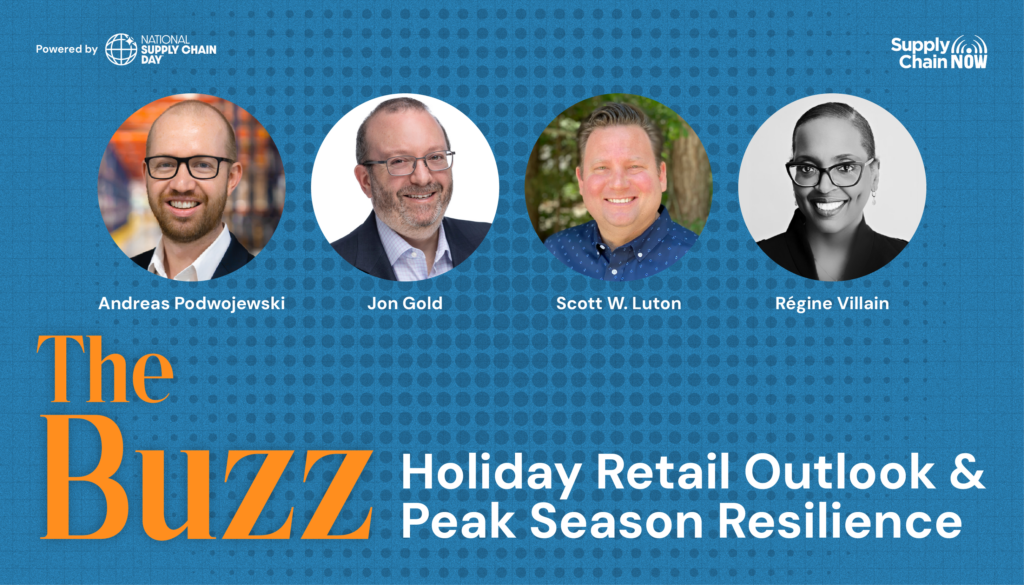
Hey, good morning, good afternoon, good evening, wherever you may be. Scott Luton and Regine Valet here with you on Supply Chain Now. Welcome to today’s live stream. Regine, how you doing today?
Régine Villain (00:00:24):
I’m doing great, my friend. How about you?
Scott Luton (00:00:27):
I am wonderful. We have got a great show here today. I can’t wait to learn from you and our two guests. Folks, it’s the buzz where every Monday at 12 noon Eastern time we discuss a variety of news and developments across global supply chain and business. News that matters is what we like to call it. And all month long in November, we are delighted to be powered by the National Supply Chain Day. Folks, mark your calendars April 29th and join us to celebrate this global industry that we all know and love. You can learn more at supplychainnow.com/nscd. We love our acronyms. All right, so Regine, we got a lot to get into here today. Let’s see here. We’re going to be getting into the holiday retail outlook. We’re going to be finding a little more about what’s going on in our ports, including a crisis we just averted, thankfully.
(00:01:15):
How to bake in flexibility and resilience into your supply chain organization during this hectic peak season, all that, and much, much more. And Regine, as if you aren’t a big enough appearance by yourself. We could do the buzz just with you and it would be electric, but we’ve got two great guests. John Gold with the National Retail Federation is back with us once again. And Andreas Podvaevsky with Arvado is stopping by here today too. Folks, you’re going to enjoy their perspective here today. All right, so Regine, big show. Are you ready for the buzz today?
Régine Villain (00:01:51):
I’m ready. I mean, I love that segment about the spending, the consumer spending. Obviously with the holidays coming up, I think it’s important to see what’s going on and very interested about that. And certainly the port strike, as you mentioned, that was averted, that was a close one because that is something from a supply chain point of view that affects basically everybody. You don’t think about it, but it affects everyone.
Scott Luton (00:02:19):
So true. So true. Just like healthcare, just like healthcare affects everybody, right?
Régine Villain (00:02:23):
Absolutely.
Scott Luton (00:02:24):
And of course, for those of you in our supply chain now, our SEN Global Fam that recognizes Regine, you know that she’s a hall of famer in the healthcare industry, doing big work across global business these days, but we’re going to have great perspective shared here today. So welcome to a big edition of The Buzz powered by National Supply Chain Day. Okay, really quick, Trisha, thanks for all that you do. She says happy buzz day. Let us know where you’re tuned in from. Folks, we love connecting the dots. So as you share perspective today, let us know where you are. And Trisha’s also dropped the link to the National Supply Chain Day, April 29th. Okay? Alan Jacques already back with us from beautiful Canada. Great to see you, Alan. Where are you at today? Are you traveling the world like you normally do? Let us know.
(00:03:10):
All right, so Regine, we got three things we’re going to tackle before we bring on our first guest here today. And we’re going to start with, let me get my abacus. Okay, it’s 197th edition of With That Said. Regine, that doesn’t mean anything to anybody except those of us that work on that newsletter. Oh man. Well, we led off with four interesting stories that folks have been talking about really over the weekend. And really Regine talked about one of them, right? We avoided this big labor strike, one of the most critical cogs in the economic engine. So folks, if you’ve missed it, the Pacific Maritime Association and ILW Local 26, a union, has agreed to a new labor contract, at least tentatively, that kept some 250 security professionals watching over the ports of LA and Long Beach. Now that keeps ports running, especially as last minute holiday merchandise and plenty more is moving through all those facilities.
(00:04:03):
It’s such a critical part of the infrastructure. And we also included resources from a variety of folks and organizations and Regine. We get your reaction to the overall newsletter in a second, but we check, we include this nugget. So according to a recent survey of 301 supply chain leaders by our friends at Clio, some 63% say their supply chain operates as intended. 73% say they report revenue loss and about a third face weekly software issues, but it’s working just as intended. And folks, if you’re wondering where we get the color, I kind of baked all this under a family feud, if you remember the old survey says, so that’s where all that comes from. Anyway.
Régine Villain (00:04:40):
Hear it too.
Scott Luton (00:04:42):
Yes, those violin, same, Regine. So folks, check out with that said.You’re also not going to want to miss, we always include a snapshot of our upcoming live programming, so check that out. We’ll drop a link in the chat. Regine, did you get a chance to check out What That Said every weekend?
Régine Villain (00:04:56):
I did. And you know what? I got to give you credit. It’s a very healthy publication. It took me a minute to get through it, but I have to tell you, I mean, you kind of gave it away when you talked about the strike because that was one of the things that struck me when I read the publication. When you talk about these guys, I think it was what, 250 watchmen and the security guards that were at the port of Los Angeles, basically a group that’s small, you think about it, could have slowed the busiest, busiest container complex in the country right in the middle of the holiday wash. You think about what that looks like, that’s actually interesting at the same time and also a little bit scary. And of course I couldn’t help but think about what that looks like in healthcare. So folks, for those of you who don’t know me, my primary background is in healthcare.
(00:05:58):
And so I’m going to apologize at first, but I’m probably going to bring a little bit of that healthcare flare into the conversation. So to me, when I think about it, every organization has a team like that, a small group that nobody really thinks about. In a hospital, for example, it’s the sterile processing folk. The people that are responsible for sterilizing the instruments that are going to be used on you when you have surgery. Trust me, you want clean and sterile instrument when you’re having surgery. Those are the people that are somewhere in a basement in sometimes not the best environment, but if that team stops, the operating room stops, period, end of story, no matter who the surgeon is, no matter what’s on the schedule. And so it’s the same thing for supply chain as well. When we talk about the loading dock, being on the loading dock, well, if that loading dock closes, there’s very little that happens.
(00:06:56):
So to me, when I think about the power between what is going on, the magnitude of such an operation and the relatively small amount of people, it was like, wow, it’s something for us to really remember and remember that sometimes major disruptions can happen from anywhere.
Scott Luton (00:07:21):
Anywhere. Great points. Excellent points. I love the healthcare analogy too. Keep them coming. And our first guest here today, which I’ll be introducing in a few minutes, has got his finger on the pulse of things like this, like few do. In fact, I kept seeing John’s LinkedIn updates as we were getting closer, not so close. So we’ll see what he has to say about it in a minute. All right, really quick. Folks, again, we encourage you to go check out. What’d you say? It was healthy regime, is that right? It was a healthy dose.
Régine Villain (00:07:47):
Yeah, it was healthy.
Scott Luton (00:07:48):
That’s high praise.
Régine Villain (00:07:49):
I mean, I just kept going and scrolling and reading, and of course you have links through it, so then you go through links. So it’s almost like going down a rabbit hole. But I have to say, it was very interesting. And I might say very Scott, I was just smiling the entire time.
Scott Luton (00:08:06):
Awesome. That’s high praise, folks, coming from a Hall of Famer, that’s high praise. So folks, and we know global supply chain, man, it’s very little succinctitude in this big old industry, right? But it’s great news. And we’ll see if that deal we’re talking about gets confirmed so we can move on to many, many other things on our radar. All right, so really quick, Trisha’s dropped a link to what that said. Thank you, Trisha. Appreciate that. And Alan, ask and folks will deliver. Alan says, Lagi Pharma Frankfurt, he was there last week in Germany. You and probably 30,000 people. Alan, let us know. Alan, two things here. Let us know the count that was there at that big event and give us your key takeaway. All right? Homework, Alan, if you’re still around.
Régine Villain (00:08:45):
Can I bring up something else that I remembered? You talked about saving money upstream creates bigger problems downstream. And again, when I read that, I had to think about what exactly that was, and then it just came to me that healthcare lives that every day as well. When you have a less expensive glove that tears in the middle of a procedure, a gown that does not hold, and the savings disappear at the bedside along with the clinician’s trust right away. It’s almost like something that is inexpensive can be costly.
Scott Luton (00:09:24):
Regine, I’ll tell you what, you have not missed a beat this Monday morning. Takes some of us about two days to get warmed up in these weeks. You’re off to the races. And this is great. This is a perfect segue because I love the leadership perspective you regularly offer here on the show, and then of course on keynotes, across social, you name it, as you continue to grow your reveal advisory firm. And lately, one of your messages, I grabbed a couple visuals here, about how organizations and leaders can sometimes sugarcoat things to the detriment of success. You kind of baked some thoughts around this notion of a missing 13th floor. Regine, tell us more.
Régine Villain (00:10:03):
Well, I mean, interestingly enough on that my radar section, when you mentioned that 63% of supply chain leaders say their supply chain operates as intended and 73% report revenue loss, to me, I though that both of those can be true and it just brought me to the building, which brings me to the 13th floor. A lot of time people step into an elevator and don’t realize, but some elevator, I don’t know how many, now that I’ve written about this, I want to make sure to see how prevalent that is. But you will find that when you step into some elevators, if you look at the panel, you’ll see that in many buildings, the buttons go from 12 to 14 as if the 13th floor itself does not exist. And so the way that I distill this is basically regardless of what you call that floor, and in some buildings they make it into a mechanical space, and in some other buildings because of superstition, they just go from 12 to 14.
(00:11:20):
But the funny thing is, and I’ve always reflected about that, the building has exactly the same number of floors regardless of what you call it. So someone decided at some point to not call it 13, and then everybody went along with it. And you go into elevator and it’s almost like you don’t think about it. And I call it the emperor has no clothes syndrome, as if 13 doesn’t exist and everybody goes about their merry way. And to me, this is similar to some organizations that we see, like a shortage, that’s a legitimate shortage. All of a sudden we’re packaging it and we’re calling it a headwind. A delay becomes a revised timeline. A workaround is like, it’s a standard process now. It’s something that we repackage and we make it sound nicer without realizing that no matter what we call it, the issue is still the same.
(00:12:22):
And then at the end of the day, we change the language so much that a year later, nobody remembers what exactly this was about.
Scott Luton (00:12:30):
Right, that’s right.
Régine Villain (00:12:31):
And so what I said is sometimes the gentler word is good judgment because it helps people face something hard without becoming defensive, but the trouble starts when that new name replaces the reality that it was meant to describe. So no matter what you call the 13th floor, it’s still 13th floor. It’s still floor number 13.
Scott Luton (00:12:53):
It still is.
Régine Villain (00:12:55):
That’s my leadership lesson in that.
Scott Luton (00:12:59):
Love it. Folks, we’re doing a couple things here. Trisha’s dropped a link to Regine’s full perspective on that 13th floor analogy and it’s a good one. She covered some of it here. Go check it out. And you also will want to follow and connect Regine and Reveal. And one more thing while we’re on this topic, I love this quote you shared recently, “We prepare for what we can predict. We become ready for what we cannot.” So folks, tune more into Regine’s perspective on social. You’ll be glad you did, I promise you. All right, so Regine, I got one more thing we’re going to knock out before we bring on our first guest here today. But first, hey Danesh, I hope I’m saying your name right. Welcome from Islamabad, beautiful Islamadad, Pakistan. And let us know your take. One more thing before we bring on the John Gold.
(00:13:47):
Folks, mark your calendars again for April 29th, National Supply Chain Day, which by the way was started by my colleague and Supply Chain Now president, Mary Kate Love. Little factoid there. But beyond that, we’re excited to introduce a new related program this year. Supply Chain Now has partnered with the food logistics and supply and demand chain executive to launch the National Supply Chain Day Innovation and Excellence Awards. Now, Regine, this is not a popularity contest. This is a merit-based process. We’re going to be judging and selecting some of the… Do not let me do it, Regine. I don’t bring the merit to the conversation. We’re going to be judging and selecting some of the best companies that are doing terrific work in transportation, warehousing, procurement, manufacturing, and a special category called the Give Forward Award. Nominations are open right this second. They closed January 22nd, so get them in now and we’re dropping a link there in the chat.
(00:14:42):
You can learn more, nominate, you name it. And if you’re listening, maybe listening to the replay, you can also visit supplychainow.com/nscd and you get all the details. Okay? All right. Regine, it’s good to celebrate this incredible industry that we all know and love. So Karai, 13 is an important number. You’re right, Karai. We don’t always love talking about it, but it is an important number indeed and great to see you, my friend. It’s been too long. Alan, small event, the Logi Farmer event he was at. Small event focused on supply chain planning, maybe 500. I though it was a lot bigger than that. My key takeaway was that there is a lot of AI FOMO and few concrete use cases. One large farmer presented a comprehensive AI program, but at the end I was scratching my head wondering exactly what they were doing. All right, Alan, we’re going to have to have you back and we’ll dive into that indeed.
(00:15:33):
But first, Regine, our guest today, first guest today, and two big ones. He is backed by popular demand. You’ve seen him dozens of times here, folks. He’s one of the most important voices, especially in the retail industry. Plus he is regularly called upon by industry leadership and even Congress to share his expertise on things such as supply chain, international trade, customs related issues, and a lot more. We’ve been fortunate to have numerous opportunities to learn from his perspective. I want to welcome in John Gold, Vice President of Supply Chain and Customs Policy with the National Retail Federation. Hey John, how you doing, my friend?
Jon Gold (00:16:07):
Good, Scott. How are you? Regine,
Scott Luton (00:16:08):
Nice to see you.
Régine Villain (00:16:09):
Wonderful. Nice to see you too.
Scott Luton (00:16:10):
Regine, we’ve had a great A block. As we get into the B block, it’s about to get even better. John, really quick, got Thanksgiving around the corner. I bet all three of us are preparing. A lot of folks out there preparing here in the States. What is one dish? Little fun question. One dish you can’t wait to get your hands on on Thursday?
Jon Gold (00:16:27):
Got to go pumpkin pie.
Scott Luton (00:16:28):
Pumpkin pie. Okay. Whipped cream, no whipped cream.
Jon Gold (00:16:30):
Whipped cream.
Scott Luton (00:16:31):
Okay. All right. And Regine, that’s a good pick. What about for you?
Régine Villain (00:16:35):
Yeah. I mean, I’d have to agree, especially a good homemade pumpkin pie. There’s something about it that just kind of warms your soul, right? Now, I think when we were kind of talking about that earlier, talking about things that perhaps I wish could go away. It’s not a dish per se, but it’s a thing that appears around this time of year.
Intro/Outro (00:16:56):
Okay.
Régine Villain (00:16:56):
To me, it is the most… Well, I’m sure there are lots of people that like it, so I’m not going to say what I’m thinking, but to me, what’s the point of these corn candies that time of year?
Scott Luton (00:17:11):
Same, same.
Régine Villain (00:17:13):
What is that?
Scott Luton (00:17:14):
Man, it’s like licorice. It’s like Crocs. Some folks love them, hate them, I like to say. But we’ll save that candy corn debate, Regine, John, because we can really offend some people with that. All right, let’s do this though. We got so much to get into with y’all both here today, and of course we’ve got Andreas joining us here in about 20 minutes. But John, let’s start with a holiday retail outlook of sorts. As we all know, Thursday or Thanksgiving rather, coming up this Thursday, and Black Friday shopping is almost here. Now, John and his colleagues, I’ve got this visual here, at NRF are forecasting holiday sales to grow some 4.2% over last year and are projecting the final count this year to come in at $1.013 trillion. NRF also expects retailers to hire somewhere between 325 and 375,000 seasonal workers this year for holiday season.
(00:18:08):
So John, I’m curious, as you talk with retailers across the country and our fellow Americans across the country for that matter, what is your read on the health of the American consumer heading into this critical holiday shopping season?
Jon Gold (00:18:22):
Yeah, I mean, let me just point out too, this is probably going to be the busiest shopping weekend that we’re going to see. We’re expecting about 183 million shoppers to hit stores and online. So this is the time to folks look for the deals and go out and shop. But I think all in all, the consumer remains healthy and we’ve seen retail sales increase month over month, which I think has been a surprise to a lot of people just with the overall health of the economy and the ongoing challenges that we continue to face with inflation continuing to be on the rise, seeing increased gas prices that we’ve seen for months now. I was happy to see gas down today when I went and got gas, but still consumers continue to face a lot of different challenges, but yet they’re still out there, they’re shopping.
(00:19:07):
I guess the holidays are probably the most important because they want to celebrate with their loved ones. So you’re going to continue to see them shop. They might change some of their shopping habits, but they’re expected to be out there in record numbers buying products and buying goods and gifts.
Scott Luton (00:19:21):
Lots of resilience there, John. Good stuff. Rajin, react to what you hear there.
Régine Villain (00:19:25):
I mean, this is interesting to me because it’s a very interesting observation because you would think with especially all the conversations that are going on about what the American people feel at home was reflected in some of the results of the elections. And so it’s interesting to see that when it comes to that confidence in buying that it is peaking as much as it is. And that to me is very surprising. And when you think about also at the same time the flip side of it, they make it so easy to shop these days. You don’t need to go to the mall to shop these days. I don’t know about you guys, but I started receiving texts and emails two weeks ago about Black Friday. So now Black Friday is basically, it’s a whole month. Black Friday is no longer a day or a few hours of a day.
(00:20:21):
Black Friday is literally, I guess, Black November.
Scott Luton (00:20:28):
All the spearing.
Régine Villain (00:20:29):
And so to me, I think what really strikes me as well in that peak, and I’ve talked earlier about bringing the similarities with what goes on in the hospital. This is the season in hospital where, for example, respiratory issues peak as well. And so there’s lots of demand on the road and on the trucks to bring those supplies. And so I’m thinking we’re sharing the same trucks, we’re sharing the same roads, we’re sharing the same containers. So that should be, to me, very interesting, kind of like a collision here. And so I just think this was a little bit surprising to me.
Jon Gold (00:21:09):
I think a couple things to point out. And first and foremost, we’re still dealing with the K-shaped economy where you’ve got a lot of folks at the higher end that are trading down and buying less expensive products to meet some of that demand. But you do have those on the lower end who really continue to suffer right now and continue to look for those deals. So it’s an ongoing challenge that we continue to face. But when it comes to the holidays, people really want to make sure that they are providing for their loved ones. So they’ll save up and spend or unfortunately use the credit and everything else. But this is the time of the year where folks really want to make sure they’re paying attention, taking care of their loved ones, friends and family. The other issue too on the supply chain regime you mentioned, everybody keeps asking when are we going back to normal on supply chain and peak?
(00:21:53):
And for many retailers, the peak now has extended starting as early as May, where prior to 2019, prior to COVID, the peak would always run July, August, September. Everybody would just rush everything in those three months. But now because of COVID and because of consumer demand, that supply chain has been lengthened out where retailers are trying to make sure they’ve got the right product mix here at the right time. So they’re bringing product in earlier so they don’t get stuck in some of the congestion issues that we faced. Although we’re continuing to face some of those congestion issues today, and we’ll certainly talk about that in minutes.
Scott Luton (00:22:27):
We sure will. We got a lot more. You got a couple more hours, John. Me and you and Regine are going to dive in. Hey, Tony Sharrota is here. He says, Hello, Scott, Regine, John from the Atlanta Returns Voice, one of the biggest returns voices out there in industry. And hey Tony, it’s a great call out. We’ll talk with John, maybe not today about their return forecast, but we’ll definitely get that in.
Jon Gold (00:22:48):
It’s coming. We’re working on the report now.
Scott Luton (00:22:50):
Kara also adds, he just published his latest article, 13 days is a luxury how AI moves the escalation trap inside your operating model. Kara, share that link right there. I love your articles.
Régine Villain (00:23:02):
That would be great. Yeah.
Scott Luton (00:23:03):
All right. So John, we got to talk about some things that we don’t like to talk about, but you’re one of the leading voices out there to help us understand these things. We’re talking about tariffs, Regine and John. So get this, according to the New York Fed, about 26% of the 2025 tariff increases were passed on to consumers and some projected tariffs to create a burden of up to $1,100 per household here this year in 2026. That sounds light to me, but hey, the experts might know. So John, I’m curious, as we approach 2027, what’s your biggest concern about the direction of US trade policy and its impact on US retailers?
Jon Gold (00:23:39):
Yeah, I think the biggest challenge is going to be the continued uncertainty of where we’re going with trade policy and tariffs. I mean, despite the election we just had and the overwhelming change in leadership both in the house and the Senate, we still have President Trump as president. And when you look at Congress, even though we have the highest majorities we’ve seen in both the House and the Senate with Democrats in charge, we don’t have the numbers for a veto-proof majority. So while Congress is certainly going to take a look at tariff related issues, the question’s going to be is will we have enough Republican votes to prevent a veto? The president is proudly displaying a veto hat on his desk right now. So on a wide variety of issues, he’s looking forward to the veto. But the ongoing uncertainty, I mean, look, this administration still believes strongly in tariffs.
(00:24:25):
When the president ran, he ran on a 10 to 20% global tariff that he was going to put in place. He’s been using every tool at his disposal to try and make that happen. We’ve gone through the AIPA tariffs, which have been ruled unconstitutional. We then got into the Section 122 tariffs, which are now tied up in litigation. Those are done, but the court’s already ruled that they were illegal and going through the process. We’ve got the Section 301 forced labor tariffs, which are now in litigation as well. We’ve got the pending 301 excess capacity tariffs, which could come at any day now, what we’ve heard from USTR. We’ve got the ongoing trade war with Canada and the Section 338 tariffs there. And we hear there are other trade investigations that are forthcoming, whether they’re Section 301 investigations or Section 232 investigation. Those 232 investigations are more kind of product specific, but they all have an impact.
(00:25:15):
If you look at how some of the 232 investigations have evolved in where they hit the derivative products, the downstream products that may contain steel or aluminum or copper, those have been significantly impacting industry. So the uncertainty is still there as to what’s going to happen next. And the other piece of this too, it’s not just the tariff policy, but it’s customs enforcement, which is really, really kind of shaping up. The president issued his executive order on customs enforcement last June, and now customs is moving forward with different rules and regulations to really put the pressure on for enforcement. We’ve got new requirements for foreign importers of record. They’re going to take effect on January 5th. I mean, they’re significant. We’ve got a major advanced notice of rulemaking and AMPRM asking 64 questions about getting advanced data, getting export related data, the cost to that.
(00:26:08):
Those comments are due in December. I mean, these are all massive changes to the import system that could come pretty quickly that’s going to really be a burden on industry. And we really want to continue to partner with customs on doing this because look, none of us want bad product coming in, illegal product coming in. We’ve got to make sure we do this in partnership so we don’t completely bog down our ports in going through examinations and everything else. So let’s make sure we’re partnering to do this the right way to keep legitimate commerce flowing as quickly as it needs to.
Scott Luton (00:26:36):
John, all right, so Regine, we got to move along fast, but two things I heard there. I want to call out burdensome and bogging down. Now that’s been a big theme. I mean, amidst a sea of uncertainty, we got a lot of friction, creating a lot more friction. Rajin, quick reaction to what John just shared there.
Régine Villain (00:26:53):
I just think that regardless of what happens in the policies and everything that we’re just talking about here, we have people who are waiting for their products in many instances. We’re talking about life-saving products, we’re talking about important things that people are waiting on. And so we’re definitely going to have to come up with a solution to help unboggle, as you said, the ports and the entry points because that to me is certainly… It’s going to get to a point where it’s not going to be manageable, I think.
Scott Luton (00:27:28):
I’m with you. I’m with you, Regine. All right, so John, moving right along here, and all these deserve a big conversation on their own, but I appreciate you giving us a variety of updates. So the latest global port tracker, which I think I’ve got this visual here from NRF and your partners at the Hackett Associates shows that another really strong year for imports, I think Rajin mentioned that earlier, along with some congestion challenges. It seems like current projections would have US import volume here this year to be up about 2% over totals last year. We’ll see how that evolves maybe as we move towards closer to the year. But John, what are you watching most closely across our nation’s ports and freight networks right now? And hey, we got some good news over the weekend, didn’t we?
Jon Gold (00:28:10):
Yeah. I mean, great news that we don’t have a strike starting over the weekend and glad to see that ports are open and cargo is flowing. Look, with the near record volumes that we have coming in, we still have congestion issues that we need to get through. I mean, LA and Long Beach were already facing challenges, especially with rail cargo, intermodal rail. I’ve heard from some members who said they had boxes sitting for 30 days waiting on rail cars to get to the ports and get them out. So imagine a strike shutting down eight of the terminals at LA Long Beach at this point would’ve been crazy. So glad to see that was done, and now hopefully we can really put the effort towards getting that cargo out. Because again, it’s the end of season merchandise that’s coming in, it’s last minute holiday merchandise that’s coming in.
(00:28:54):
It’s also starting to bring in for the new year and Valentine’s and things like that. So the cargo continues to come in and retailers are turning things over, it seems like every few weeks there’s new season they’ve got to plan and prepare for. So we’ve got to make sure that cargo moves as quickly as possible, but it’s not just the full containers. We got to get those empty containers out as well that are taking up room at the ports. So we got to get those exports moving too.
Scott Luton (00:29:19):
All right. Rajin, just because we’re getting into holiday week with Thanksgiving doesn’t mean the supply chain engine and the ecosystem across the world pauses. So your reaction to what John just shared there about the ports?
Régine Villain (00:29:31):
Well, I mean, again, it goes back to what I said earlier. It’s a good reminder that a port is basically a whole system of people and it’s a symbiotic thing that needs to happen. But it’s interesting, I picked up on something that he mentioned when John was giving the example and he went as far as Valentine’s. And it’s a reminder that really when you are out there, we go from one season to the next. We roll into them, and so there’s never really a pause. And I think you said something like that earlier, John. It’s just that the period for the retailer is just stretching even more. Because now when you’re walking around, I mean, he’s right, we’re already thinking about Valentine’s and then we’re thinking about St. Patty’s Day. We’re going on already. We’re already thinking about Easter and all of that. And so everything that we’re talking about here, the domino effect of the potential impact is absolutely massive.
Scott Luton (00:30:40):
It is. And take your point even to the next level, John, and this is on both y’all’s radar, I bet. The UPS and Teamsters that expires in 2028, sides are already positioning. And John, we got to be thinking that far ahead kind of to Regine’s point,
Jon Gold (00:30:55):
Huh? I’ll throw one more in there for you. The ILW contract is up in 2028 as well. The whole West Coast labor contract is up. You’ve got that’s coming right before the Olympics in LA.
Scott Luton (00:31:04):
Wow. Okay.
Jon Gold (00:31:05):
UPS and then ILW and then the Olympics. And oh, by the way, 2028 is a presidential election year.
Scott Luton (00:31:10):
Okay.
Régine Villain (00:31:10):
Oh, that’s right. That’s right.
Scott Luton (00:31:12):
Oh man. All right.
Jon Gold (00:31:14):
So yeah, start thinking about it now. Plan ahead.
Scott Luton (00:31:17):
One day at a time, I’ll tell you. All right, so John and Regine, let’s do this. For the sake of time, John, I know you’ve got a pressing schedule this week. It’s a busy time. I want to invite folks, folks can learn so much at the big show that’s coming up in January in New York City. Members of our team can’t wait to be there. We’re going to be creating some content, put our finger on the pulse. We’re going to try to do our best John Gold impersonation and put our finger on the pulse of the retail world. But John, why should supply chain leaders in particular have The Big Show on their radar and join us?
Jon Gold (00:31:47):
Yeah, look, come and join 40,000 of your favorite retail friends at The Big Show. We’re going to be talking about all things operational, AI, everything you talk about makes the retail go. We’ve got a special supply chain Sunday that we’re running this year, talking about a couple of key specific issues, but it’s an opportunity to meet and greet and learn from your peers from around the world. We’ve got 20 plus countries or more represented at the Big Show. I know Scott, you’ll be there for the first time and looking forward to being on the show floor and seeing all the great operational opportunities to help make retail go. AI continues to be a centerpiece, but there are lots of other issues you’re going to be talking about, how best to get to the consumer, all these things that are critically important for retail.
Scott Luton (00:32:28):
They’re finally letting me in, Regine. Took me about 27 years of –
Jon Gold (00:32:32):
Well, you’re getting special recognition as well, aren’t you?
Scott Luton (00:32:35):
Of course. I’m only kidding. Yes. I am honored to be one of the voices in the Voices of Retail program. It’s been a great experience already rubbing elbows and learning from others and sharing some of the things we track here at Supply Chain now. So folks, I encourage you, if you love retail as much as we do, and if you love supply chain and retail, if you love returns, all of it, come join us at The Big Show and you can learn more at nrfbigshow.com. And Trisha’s also dropping a link right here so you can go check that out as well. All right, so John, first off, Regine, you going to join me in New York City too?
Régine Villain (00:33:09):
Absolutely. You just give me the date again and I’ll be in. By the way, 27 years is not a wait. It’s a proper entrance, right?
Scott Luton (00:33:17):
That’s right.
Régine Villain (00:33:19):
You have 2,000 of retail friends, they have no idea what’s going to walk on the floor.
Scott Luton (00:33:23):
Watch out. Regine, well said. John Gold, always a pleasure. I love when you come in and you give us a portion of what you’re tracking on your radar and all your actionable perspective here. How can folks connect with you, John Gold?
Jon Gold (00:33:36):
Sure. Easiest way. Obviously check out the website, nrf.com. My email, goldj@nrf.com on LinkedIn and X. So I’m out there and always appreciate the followback, Scott, and the likes on the comments that are there.
Scott Luton (00:33:50):
Outstanding. Folks, go check out what the National Retail Federation is doing, nrf.com and Trisha. Thanks Trisha and Amanda behind the scenes. If we could also drop a link to my chat with John’s colleague Jason on digital pricing. That was a great interview. John Gold, always a pleasure with the National Retail Federation. We will see you soon, my friend.
Jon Gold (00:34:08):
Great. Thank you guys. Appreciate it.
Scott Luton (00:34:09):
Talk soon. Rajin, good stuff. I tell you, I wish we had three hours with John Gold on this Monday, huh?
Régine Villain (00:34:16):
Fascinating actually. It is. It’s always interesting to hear some of those stats and what people are doing out there and the things that most people don’t really think about.
Scott Luton (00:34:27):
You’re absolutely right. All of us, even us that have been in the industry, there’s some things that we make assumptions or is in our blind spot a bit and it’s so good to have conversations like this, but we’ve got more. We have got more. Regine, are you ready for our next guest here today on the buzz? I am delighted. Our next guest is also doing some interesting things in the industry. Andreas Podvoyevski serves as managing director for Arvado North America in Brazil, leading the organization and overseeing strategic and operational performance across the company’s America’s footprint based in Pleasant Prairie, Wisconsin. That sounds like a beautiful place. He’s responsible for driving growth, accelerating operational excellence, and ensuring cross-regional alignment with Arvado’s global strategy. Let’s welcome in Andreas. Hey Andreas, how you doing my friend?
Andreas Podwojewski (00:35:14):
Hey Scott. Thanks for having me on.
Scott Luton (00:35:16):
You bet. Regine, you and I have been looking forward to this segment too, haven’t we?
Régine Villain (00:35:19):
Absolutely we have. Nice to see you, Andreas.
Andreas Podwojewski (00:35:22):
Hey Regine. Pleasure.
Scott Luton (00:35:24):
So Andreas, we’re going to ask you the same billion dollar question on the front end as we posed to John and Regina earlier. What is one thing you’re looking forward to here come Thanksgiving dinner in a few days? Andreas?
Andreas Podwojewski (00:35:36):
Well, I’m going to stay with the dessert theme here. So I’m going to go for apple pie with a nice big scoop of ice cream. That would be my poison for the Thanksgiving holiday.
Scott Luton (00:35:45):
Oh, that is a good one. There is those two, that combination regime, ice cream and apple pie. I could eat it every day.
Régine Villain (00:35:53):
But it has to be like a hot, warm apple pie.
Andreas Podwojewski (00:35:56):
Oh, 100%. Yeah,
Scott Luton (00:35:58):
Same.
Régine Villain (00:35:59):
And then the ice cream melting on it.
Scott Luton (00:36:01):
Oh, thanks. Thank you so much. Now I’m not sure if I’m going to get to this next segment. Andreas, that’s a good one. And Regine, I also like pecan pie. Do you like pecan pie as well, Regine?
Régine Villain (00:36:12):
I don’t mind it. It’s okay.
Scott Luton (00:36:14):
Okay.
Régine Villain (00:36:16):
I find that some people make it and it’s really dense, and so that’s why sometimes I don’t like it. But every now and then there’s a really good pecan pie out there.
Scott Luton (00:36:26):
Okay. All right. We will debate that after the show here today. Andreas and Regine, we got a lot of good things to get into. First off, Trisha and Amanda, thank you very much. Folks, if you’ve heard all the hubbub around digital pricing, check out this discussion I had with Jason from NRF and we really get down to, we demystify the subject. So check that out folks. I think you’ll enjoy it. Let us know. All right, so let’s do this. There’s a pressure test going on right this minute, Andreas and Regine. Peak season, it puts tremendous pressure on supply chains everywhere from transportation to inventory to workforce management, sheer operations, right? Oh, and then we put ice cream on top of the apple pie, we pour disruption all on top. So maintaining peak level capacity year round probably isn’t practical, but Andreas, I’m curious, how would you suggest organizations build the flexibility and resilience needed to handle these sturges and many cases, unexpected disruptions without driving cost through the roof?
(00:37:27):
Your thoughts, Andreas?
Andreas Podwojewski (00:37:28):
Well, Scott, I always like to say that peak season doesn’t create any weaknesses in the supply chain, but it ultimately exposes them. Volumes go up, reaction times at the same time go down, product mixes shifts because how discounts and promotions are offered up, transportation network get real tight around the holiday, but customers still expect the same service levels. So peak is really the stress test, the ultimate stress test for your whole operating system, the planning, the technology, your systems, your partners in your network and your people. So basically every component of the supply chain. I liked Regine’s earlier comments around the 13th floor. Also in peak, you really got to get real here in that sense. But at the same time, you don’t want to carry peak capacity all year round. That’s also not the answer, right? It’s expensive, it’s inefficient, and if demand doesn’t land as you plan it, it’s maybe not enough anyway.
(00:38:25):
So the trick is really to separate what you lock in early from what you keep flexible. I always try to say with the team that we like to keep the core design, the systems and the baseline foundation of automation stable, but because you don’t want to improvise on those in your peak, but everything around your foundation you have to build flexible. So scalable labor models, shifts, modular automation elements, and we can surely talk about that, overflow space because inventory can really fluctuate depending on how the promotions land. So that’s how you can scale up without paying for it the extra 10 month of the year. And yeah, very practically, you have to really, I always think you don’t want to say forecast is something concrete or absolute. It’s more about building scenarios. You always have to have a plan A, B, C, and D ready.
(00:39:21):
And just one anecdote here, one of our clients last year, they launched on TikTok for the first time. Of course, their marketing department didn’t share all the details with them in time and the product went absolutely viral, which is fantastic. But at that point, the entire planning was out of the window. So you have to really pivot on the moment’s notice and your team should know what they will do in that very moment. You don’t want to leave it up to chance. You have to really know where your trigger points are to pull in the extra labor and the extra shifts. That’s really what it comes down to, that you’re predictable in the moment.
Scott Luton (00:40:01):
All right. So Regine, Andreas shared a lot of stuff there with us, a lot of good actionable perspective. One of the themes I heard is as supply chain pros, we can’t be walking around in concrete cinder blocks as if things are never going to change, we lock it in and it’s done with. We have to have all sorts of levels of dynasism, is that the right word, in our organization. I think Regine, what’d you hear there?
Régine Villain (00:40:24):
A word if you say it, that’s all that matters.
Scott Luton (00:40:27):
All right. Coining new words around here. Regine, what’d you hear there? I mean, of course, I bet he’s preaching to the choir a bit because especially in the healthcare world, we got lives on the line. We’ve got to be your thoughts.
Régine Villain (00:40:39):
There’s so much I can unpack there. I really appreciate what you said. First of all, I love that, and I wrote it down that the peak does not create the weakness because it’s so true. It just manifests itself during that time. It exposes it. That’s the word that you used. And that’s exactly, it’s almost like the same as that 13th floor analogy. The weeks of the year when nobody is under pressure are when you find out which floors you have stopped calling by their name. We just decided to call it something else, but it’s still the 13th floor. And I have an observation actually that I wrote not long ago about preparedness and readiness. And to me that also addresses that because people tend to confuse preparedness and readiness to me. And that’s the quote that shared earlier, Scott, because preparedness is what we all do.
(00:41:36):
We prepare, we do the cross-functional team preparation and all of that. But readiness is what happened when you have that peak, when you have that question and you don’t have something that’s necessarily written down, but you took the time in what I call those ordinary Tuesdays to build a plan of process that you can now go to. So I love what you just said here.
Scott Luton (00:42:00):
I like that preparedness versus readiness. We could have a whole show around that notion there. Really quick, I got a follow-up question for you, Andreas, around peak. But first, our friend T-Squared, who hails from Baltimore, he holds down a Fort Forest on YouTube, says, “Never can go wrong with Paz Isla mode.” I’m with you T-squared. Apple, like Andreas was talking about. Pumpkin, like John was talking about in the first segment. I like Pekan, but T-Squared, great to have you here. All right, sticking with peak, all things peak for a second. Peak demand, you called this out earlier, Andreas. Peak demand can look very different across industries from fashion and consumer goods to technology and high value electronics, all points in between. Andreas, what should supply chain leaders be doing differently to prepare for these varying demand patterns, especially when customer expectations and product mixes can change so quickly?
Andreas Podwojewski (00:42:49):
So I would say looking at the different industries, I would describe it as a sprint versus a marathon, although most industries have a little bit of both in there, but maybe taking consumer electronics here first, that’s mainly a sprint when I look at what I observe across the industry. Demand is often very highly concentrated around product launches or the Black Friday deals or Cyber Monday deals or other big retail campaigns, and that can easily be five or 10X of the regular volume. So a huge share of that volume can land in a very, very short window of time, often on a fairly narrow range of product. That puts enormous pressure on inventories, availability, the launch day execution, picking speed, transportation capacity, and because in consumer electronics, we’re talking about high value, also transportation security is a big thing. And timing there’s everything. Let’s say you buy a $500 speaker on launch day, your expectation is likely very different than if you buy a markdown discounted t-shirt on the summer sales for 15.99.
(00:43:56):
So being just a few days late here can have really a perceived reduction in value of that launch for the end consumer. On the fashion side, I would describe it more as a marathon. Peaks are typically longer and much more fragmented. Volumes can range 30 to 50% in their peak, often over a four to six week period. Think of a summer sale, for instance, running all June, and then it really fluctuates by collection, by sizes, by colors, type of promotion, even the weather plays in there a lot in fashion. And then there’s a part that people very often forget with fashion and that’s the returns. Returns mentioned earlier before. And fashion peak is not over when the outbound volume drops. Returns comes in as the second wave and that can be often very, very stressful for the operations. You want to get the products back into cycle, maybe into outlets or other sales channels.
(00:45:00):
So those are really sort of high level, the thoughts here, but maybe just one sort of practical example when you think about it, the order mix can really change because it’s not only volume. A warehouse can have plenty of capacity on paper but still struggle when the volume mix changes. 5,000 orders on a high running skews versus 5,000 multi-line orders picked from thousands of locations is a very different day for the operation. So those are the things that really need to be taken into consideration. I like what Regina also said about that regular Tuesday where you have to think about what’s coming next, test your process and your automation against different order patterns before peak, not just the average to really spot the bottlenecks. These are some of the most important things to really keep in mind. So the underlying principle is the same across the industries.
(00:45:59):
Preparedness and flexibility is huge, but the fulfillment model has to be designed around the industry specifics, the products, the growth plans, and also the service that you ultimately promise to the customer.
Scott Luton (00:46:12):
All right. Regine, before I get you to weigh in and recap what you heard there and give us your take, he mentioned returns. Returns are one of my favorite topics in the world because they need to be so much more visible. That’s how we’re going to get more traction. And folks, if you love talking returns, I got to point out, Tony Shroda is the leading voice in this space. He did it at Phillips 20 something years ago, maybe longer than that, not the date you Tony, but he is driving some of the most powerful conversations around returns and reverse logistics. So connect, follow Tony. Okay. Rajin, Andreas is really given us a bit of a masterclass from operations, distribution, fulfillment, peak season, you name it. What’d you hear there in his last response?
Régine Villain (00:46:53):
Gosh, so much again. And this is like nuggets. It’s the kind of stuff, I don’t know about you, but I feel like a geek, right? We get excited with this kind of conversation. Something’s wrong with us, right? But let me tell you this, this is the stuff that moves the world. And I think, Andreas, when I think about what you said, the line that sticks out to me is that a warehouse can have plenty of capacity on paper and still have a very hard day because averages do not ship orders. And I think that’s something that I learned very early on in my supply chain carrier as well, because you see the numbers and you’re looking at average and people are saying, yeah, on average we have this, but averages do not ship orders. In returns, to your point, Scott, that’s the perfect example of that second peak.
(00:47:46):
It’s the part that nobody really talks about. You don’t put it on a calendar, which is exactly why it deserves the same planning you mentioned. And I’ll just add, of course, my plugin for healthcare. In healthcare, our peak does not come from a promotion calendar though. It comes from census and season and then whatever happens out there. God forbid there’s an event out there, that’s how we get that peak. Nobody can move that. You cannot ask a flu season, for example, to wait until after Black Friday.
Scott Luton (00:48:19):
I got to go back. You got a great T-shirtism there. Averages do not ship orders. Regine, you’re dropping that on us. We got to make a t-shirt out of that. It’s good, Regine. Really quick, T-squared says peak seasons are the year-end magnifying glass for supply chain operations. I like that too. Amazon peak hiring season and tortation in action truly underscores that point. T-squared always bringing it. All right, so I want to shift over and talk with you, Andreas, about navigating US, Canada, cross-border complexity. And maybe underscore that complexity point, I’ve got the busiest visual in the history of humankind. But check this out, folks. Check this out right here at the bottom. I like perspective and context. Canadian government data shows that in 2025, goods and services worth 3.5 billion Canadian dollars moved across the border each and every day. That adds up last year to 1.3 trillion Canadian dollars for the full year.
(00:49:17):
Now those figures unfortunately probably changed a bit in 2026 and let’s get them back. North America is such a wonderful and very unique trading ecosystem. But nevertheless, Andreas, I want to ask you a question here. Arvato has been expanding its North American footprint, including, I think y’all recently acquired Think Logistics in Canada, so congrats on that. But with trade policies evolving, as John Regine was talking about earlier, cross-border shipments facing additional complexity and scrutiny and you name it, what practical steps can shippers take to keep goods moving reliably and as easily as possible between the US and Canada, Andreas?
Andreas Podwojewski (00:49:53):
I mean, John gave us already a great view from a policy side, so from a more operational side here. When we acquired Think Logistics earlier this year and launched Avatar Canada, we welcomed a very, very dedicated and committed team of people who worked exactly on this every day. So what we see working is on a practical and technical level, cross-border planning starts really long before the trucks gets to the border. Product classification, country of origin, importer responsibilities, paperwork, all needs to be correct and available early. These are the single biggest lever. Too many companies still treat customs as an admin task, and that really sits outside of their main processes and systems, which makes it both reactive and manual and sometimes surprisingly inconsistent when it comes to the needed data. If you connect your customs data with your warehouse and transportation system, you catch missing or inconsistent information before it turns into a delay.
(00:50:53):
So from a planning and scheduling perspective as well, we always want to take into consideration here on a very tactical level right now with the holidays, like holiday schedules on both sides, inspections that are happening more and more, handover between different parties that are involved in the supply chain, all those can really affect your lead time when you go across the border. And obviously in the consumer space, the stop of the three to one exception was a big change last year, so that really impacted quite a bit of different operating models that we had going. So now the question is much more prevalent to think about where your inventory sits. So depending on the product and size of the market, it’s often smarter actually to hold stock in both markets than to send daily orders across the border. So we see actually in our world, many inquiries now for local warehousing in Canada since last year, which was one of the key reasons why we invested into the Canadian network.
(00:52:00):
And we see it in different segments in consumer electronics, but also fashion and others that had traditionally more a central distribution strategy, very often servicing Canada out of the US. But with those tariff complexities that we are faced now, the equation has changed from a total cost of fulfillment so that it’s worthwhile to really build a regional or local distribution in Canada to still deliver the service that the clients expect there. But maybe one last though, I think, and we heard it from John, there’s so many different changes. One thing that I always like to say is you don’t want to redesign your whole network after every headline change because there’s a lot of noise in the news because these are really structural decisions that should be based on your individual business, on the services, on the total landed cost and really how long you expect these changes to last.
(00:52:55):
So those are, I think, very key considerations here.
Scott Luton (00:52:59):
Regine, I’m going to pull one thing out and I was trying to keep up with my note-taking and my bad chicken scratches. Andres was dropping on us there. But one thing I’ll pull out earlier, it’s not good enough here in 2026 to be swapping spreadsheets. I got this, I got that. I know you got that. I mean, we’re in a better place. He was talking about the immense value of integrated data, finding that proverbial single source of truth. We’re not trying to do that and we’re running our supply chains on spreadsheets these days. We’re really missing the mark, I think. But Regine, that was just a nugget of what he shared there. Your thoughts?
Régine Villain (00:53:30):
Again, he’s dropping a lot of nuggets. So my mind got stuck on what he said about customs. Basically customs is not an astrative task sitting off to the side, basically. It’s part of the operation. So when the data is right before the truck ever reaches the border, the border stops being the place where you find out what went wrong. So when you think about that, the data that you talked about, the integrated data, if everything works out correctly, all the steps that need to happen, then the border becomes less of that friction than what it represents today.
Scott Luton (00:54:14):
Well said, Regine. Well said. All right, Andreas, I want to touch on one other thing that actually you mentioned a couple times some of the earlier responses, automation and technology. It’s amazing. We’re here in a golden age of supply chain tech on so many different ways, and we’re seeing tremendous mind-boggling, in some cases, investment in warehouse automation, robotics, AI-enabled logistics. As organizations though, Andreas, are preparing for peak volumes and in some cases unpredictable demand, going back to that TikTok campaign you mentioned earlier, where do you see automation delivering the greatest value while preserving the operational flexibility that businesses got to have, Andreas?
Andreas Podwojewski (00:54:55):
Well, I think automation creates the most value in work that is repetitive, physically demanding, and hard to scale with people only. At peak, that can range from anywhere from goods to person and item picking, replenishment, moving goods around the building, sortation and packing. So those are just a few areas to name. And it’s not only about pushing maximum throughput through with the automation. Automation gives you more predictable performance and better accuracy in many cases. It takes physical strain of people, and it also frees up experienced employees to focus on exceptions and decision-making, which is extremely important in peak when all the systems are at their maximum stress. Maybe just to give one example here to highlight that point, at two of our warehouses in Louisville, we have the Boston Dynamic Stretch Robots unloading sea freight containers, and anyone who has unloaded a container by hand knows what a relief that is for the team.
(00:55:57):
Winter, it’s very cold in the containers. In summer, it’s extremely hot. Lifting 50 pounds boxes onto a conveyor for eight hours is incredibly strenuous and from an ergonomic and safety perspective, really a nightmare. So these stretch robots put the boxes onto the conveyor, moves the goods to the next automation cell at the end of the line, and then robots from our technology partner, Unchained Robotics, take care of the palletization before the pallets go into the warehouse. So our people can really focus on the valuable work rather than carrying the boxes and moving them around. So these are just maybe some practical points. There’s obviously one last thought here. When you think about it, the software and the orchestration are almost as important, if not in many cases, even more important than the hardware. When you look at how these systems from these different integrators work, you really need a smart integration layer that connects all these different robots and AMR systems so that they can really work hand in hand because then really the value of those will ultimately come out.
Scott Luton (00:57:10):
All right, Andreas, something tells me anybody that has any questions around any of these best practices that you and your team have vetted over the years, I bet you welcome a cup of coffee and a conversation, Andreas. Is that right?
Andreas Podwojewski (00:57:23):
Absolutely. I would be delighted for sure.
Scott Luton (00:57:27):
And Rajim, back to one of the many things he shared in that last response is when it comes to automation and going to the experts, number one, there’s that critical decision that is made on so many different ways. Do we build it or do we buy it? There’s so many different iterations of that. But if I’ve learned one big theme this year in particular as automation, AI-driven automation in so many ways has fueled and become so prevalent, we got to partner with the experts. And then number two, one thing he touched on is having a solution that can scale up as the needs of the business. We’re not operating in a static mode, going back to what we talked earlier. We need solutions that can scale and handle whether it’s a TikTok campaign or whether it’s new acquisitions or a product just goes bonkers, you name all the reasons that drives growth out there.
(00:58:18):
But Rajin, what did you hear in Andrea’s last response?
Régine Villain (00:58:22):
It’s something that I actually talked about just last week when I told you I was in Savannah. I was invited for a keynote about AI, the use of AI. And so I heard a lot of points that I made. So what I appreciate that you said, Andreas, is that AI scales capability basically, but does not scale accountability because you put the people on exceptions and decisions. You mentioned very specifically that the focus on exceptions and decision making is something then that the folks can do. And so I appreciate that you’ve said that because I think far too often these days with the hype of AI, people look to AI or automation for basically as the answer to everything. However, we cannot afford to also abdicate the fact that we still need to have the human to make sure that AI works the way that it’s supposed to.
(00:59:18):
AI is a beautiful thing in the way that it automates a lot of things that happen and really accelerates the speed of decision making. However, I think for me, the caveat is to make sure that we’re also not automating a workaround so that we’re exposing that 13th floor all over again.
Scott Luton (00:59:39):
Well said. Man, I hate to start to wind things down when it feels like we could go for a few more hours and nerd out Andreas and Regine for sure. So Alan Jacques is asking about some of your relatives, perhaps, Andreas O’Peter, and I tried to look him up. Andreas, I’m assuming there’s no connection there.
Andreas Podwojewski (00:59:59):
Well, there’s no Relation there, but Andreas Oputa is one of our business development folks in the healthcare industry based over in Europe and know him very well. Great quality.
Régine Villain (01:00:08):
Oh, wow.
Scott Luton (01:00:09):
Small world. Small world. All right. And we’re going to have Alan’s full report on Logi Farmer, maybe next edition of the buzz. Alan, you got a new homework assignment, my friend. All right, let’s do this. We’re going to make sure folks know how to connect with Andreas and Regine in just a second on this super edition, super size edition of the buzz. But first, I want to encourage folks to check out one element of our ecosystem that we’ve been investing a lot in. That’s the resource hub. This is the written aspect of our ecosystem. And here lately, we have been publishing some written interviews I’ve been conducting with leaders from AME. Now, AME used to stand for the Association for Manufacturing Excellence, but over the last several years, they’ve really broadened the tent and made it much more about operational excellence no matter what sector you’re in.
(01:00:56):
Regine, there’s lots of healthcare folks that are joining AME. This last episode here, this last interview here, I should say, I interviewed Meg Brown who serves as I believe the COO of Cambridge Air Solutions. She’s also on the board of AME, so folks go check that out. I love her title here, The Courage to Improve: Meg Brown on Leadership, People, and Operational Excellence. And as she says here, Regine, Andreas, one of the big things she mentioned, it’s not about you. Leaders, it’s not about you. Check your ego at the door, make it about your people. So we’re dropping a link right there. Thank you, Trisha. You’re Johnny on the spot today. Real appreciate you and Amanda all behind the scenes. Andreas, how can folks connect with all the cool things you and the Arvado team are doing, my friend?
Andreas Podwojewski (01:01:44):
Easiest to find me and connect is via LinkedIn, Andreas Popojevski. Happy to connect there or just visit avato.com. You can also find all kinds of great stuff about what we do there.
Scott Luton (01:01:58):
Outstanding. And you are indeed managing… Actually, I would say based on what I heard here today, Regine, Andrea’s team is not just managing complexity. They’ve got a complexity disappearing gun, a ray gun. You’re zapping complexity from supply chains everywhere. I need one of those too. Trisha has dropped a link to Andreas on LinkedIn, as well as you can learn more about Arvado at arvado.com.
Régine Villain (01:02:23):
Trisha’s on
Scott Luton (01:02:24):
It.
Régine Villain (01:02:24):
I love it.
Scott Luton (01:02:25):
She also starts a week at 60 miles an hour, not at 15 like I do. Regine Valley, I tell you, I really enjoyed your perspective here as I always do when you join us for shows. How can folks learn more about you and follow you and also your advisory firm, Reveal?
Régine Villain (01:02:41):
Well, just like what Andrea said, the easiest way to find me is to really find me on LinkedIn. It’s Regine Onorevile. I’m sure that Trisha’s going to drop it. There it is. And Reveal also has its own page that I’ve been building for the last three weeks on LinkedIn as well. So you can find some information on Reveal, but lastly, you can go to the website. So Reveal in this case is there you go. Oh, I just love it. I’m telling you. Trisha makes you look really good.
Scott Luton (01:03:14):
Man, always, always. Folks, go to Reveal. And that’s for the purpose of the URL folks that are listening to us. That’s R-E-H-V-E-A-L.com. Go check it out. All right. What a supersized addition. You know what? We’re going to have three plates on Thursday. We might as well have three plates here on the buzz on the preceding Monday. Really enjoyed the perspective. We’re all going to have to be on our, what, GLP-1s? Is that what it is? We’re all going to have to be on those things in the next few weeks maybe. But want to thank John Gold with NRF. Really enjoyed John’s perspective here today. Also want to thank Andreas Podvojevsky with Arvado. Andreas, thanks so much for being here, my friend.
Andreas Podwojewski (01:03:56):
Thank you for having me.
Scott Luton (01:03:57):
I’ll tell you what, Regine, what a wonderful show here today. I want to thank Regine Vale also with Reveal. Make sure you follow and connect with her. Regine, thanks so much for being here, my friend.
Régine Villain (01:04:09):
No, thank you for having me. I love this. I mean, I’m geeking out here. You can see me smiling and I can’t stop smiling. So Andreas, I really, really appreciated what you had to share, but the time was definitely too short. We could probably talk about some of those things for another hour easily. And John was absolutely phenomenal as well.
Scott Luton (01:04:28):
I’m with you and we’ll have y’all back. We’ll keep the conversation going. Folks, don’t forget about April 29th, National Supply Chain Day. You got several months to get ready. You also have the awards program that we launched this year. Get those nominations in now. Andreas, I’m counting on Arvado to be one of our fearless nominees this year. Can I count on you? All right. Fantastic. All right. Big thanks again to the man and Tricia.
Régine Villain (01:04:54):
Website again for that.
Scott Luton (01:04:55):
Yes. So folks, yeah, thanks for that. Folks, you can go to supplychainnow.com/nscd, which stands for National Supply Chain Day. And you got the link to nominations, you got link to past NSCD celebrations, you name it. So go check that out. Our global audience, our SCN global fan, thank you so much for being here with us today. Really, I know we couldn’t hit everybody’s comment in question, but really appreciate all the perspective we gained here today. This was a super sized edition of the buzz. Big thanks to Andreas and Regine. Big thanks to Amanda and Tricia. Folks, your homework is simple. Take one thing you heard here from John or from Andreas or from Regine and do something with it, right? D’s not words. That’s how we’re going to keep transforming global supply chain and leave no one behind. And with that said, Scott Lewton, on behalf of the whole Supply Chain Now team, challenge you, do good, give forward, be the changes needed.
(01:05:50):
And we’ll see you next time right back here on Supply Chain Now. Thanks everybody.
Intro/Outro (01:05:55):
Join the Supply Chain Now community for more supply chain perspectives, news, and innovation. Check out supplychainnow.com. Subscribe to Supply Chain Now on YouTube and follow and listen to Supply Chain Now wherever you get your podcasts.