Share:

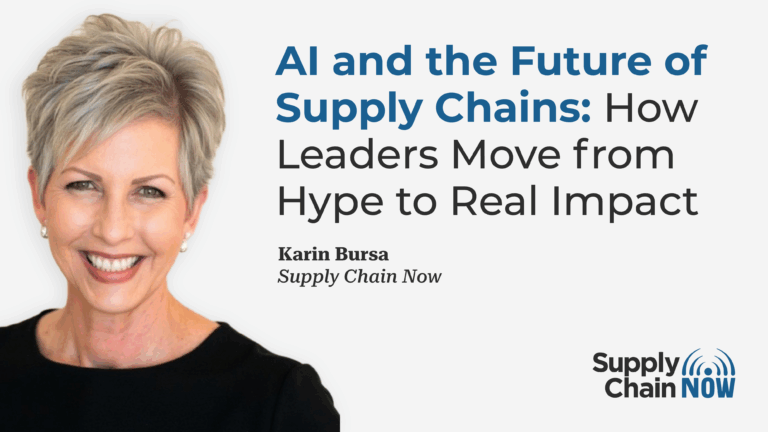
AI and the Future of Supply Chains: How Leaders Move from Hype to Real Impact

Special Guest Blog Post written by Karin Bursa, Founder and CEO of NIRAKIO and Supply Chain Now Host 


Artificial intelligence is no longer a “what if” in supply chain — it is here. In fact, Gartner predicts that 50% of cross-functional supply chain management solutions will use intelligent agents to autonomously execute decisions in the ecosystem by 2030. But how do leaders move from hype to real impact? During our recent Supply Chain Now Power Panel, I asked five senior executives to share where they see AI making the biggest impact. Their answers revealed not just excitement, but a roadmap for how supply chains can evolve.

Here is how they responded, in their own words.

Q: Where do you see AI making the greatest impact in your supply chain?

Eliza Simeonova – VP Global Supply, Mars Pet Nutrition

“AI forces operational discipline. Clean data is no longer optional. The system itself demands it. I also see AI shaping supply chain synchronization — aligning suppliers, factories, warehouses, and customers in new ways.”

Whitney Shlesinger – VP Global Planning & Logistics, McCormick

“For me, it’s about people. Employees want to move beyond non-value-added work. AI allows us to free them up for strategic thinking, collaboration, and creative problem-solving.”

Sylvia Wilks – CSCO, Lamb Weston

“AI is an enabler for better forecasting, inventory optimization, and cash flow management. It’s about using analytics not just to see the future, but to improve working capital today.”

Stephanie Beal – CSCO, Hasbro

“We’ve rolled out tools like ChatGPT and Microsoft Copilot to every employee, and adoption has been phenomenal. We’re also applying AI to demand planning and strategy reviews. It is already a game-changer for decision-making.”

Tamera Fenske – CSCO, Kimberly-Clark

“The next stage is Agentic AI — not just seeing insights but offering recommendations. One use case we love is knowledge management: decades of tissue manufacturing expertise now searchable in seconds.”

Closing Thoughts

What I found remarkable is how each leader sees AI not as a replacement, but as an accelerator: of discipline, of creativity, of financial impact, and of decision-making.

Their perspectives highlight a bigger truth: AI won’t transform supply chains on its own. Leaders will. And as these executives showed, the future is not about replacing people — it is about empowering them.

Check out the full conversation in this on-demand link and let us know how you think AI will impact your supply chain. And join us for the next “Never Normal” Power Panel on January 7th- register here!

More Blogs
AI
Blogs
January 9, 2026

John Galt’s Justin Siefert on Planning, Uncertainty, and Making AI Practical for Everyone

At the 2025 Gartner Supply Chain Planning Summit in Denver, Scott Luton caught up with Justin Siefert, a familiar face in the supply chain community and a leader at John Galt Solutions, a global provider of end-to-end supply chain planning software. From demand and supply planning to inventory and S&OP, John Galt supports organizations across industries with the holistic capabilities needed to thrive in an increasingly unpredictable landscape.   A Company Investing in the Next Generation Before diving into industry trends, Siefert shared an update on one of the programs that sets John Galt apart: its supply chain scholarship program, which awards $10,000 to students pursuing supply chain degrees. This year’s cycle brought in a record number of nominations, with new winners set to be announced in January. It’s an initiative Siefert is proud of—and one that reflects John Galt’s belief in cultivating tomorrow’s leaders.   Old Problems, New Pressures: Planning in a World of Uncertainty When asked about the biggest challenges facing planners today, Siefert didn’t hesitate: uncertainty. While the forms of disruption change—pandemics, geopolitical shifts, demand shocks, evolving portfolios—the underlying challenge remains the same. Planners must anticipate what’s next and respond quickly, often in real time. “No day…
supply chain planning
Blogs
January 16, 2026

Breaking Down Silos and Gaining Speed: Manhattan Associates on Unifying Planning and Execution

At the Gartner Supply Chain Planning Summit in Denver, Scott Luton sat down with two leaders from Manhattan Associates—Brett Lindner, Director of Product for Supply Chain Planning, and Ryan Gifford—Senior Director of Strategic Business Development. Together, the conversations painted a clear picture of one of the most persistent challenges in supply chain—and one of the biggest opportunities ahead: unifying planning and execution to drive agility, visibility, and better outcomes.   A Unified View of the Supply Chain Manhattan Associates is widely known for its strength in supply chain execution, spanning warehouse management, transportation management, labor management, and order management. As both Lindner and Gifford emphasized, what differentiates Manhattan today is its unified platform that brings execution and planning together—not as loosely connected systems, but as a single, cohesive foundation. Lindner explained that Manhattan helps companies model and design their future supply chains, enabling better planning decisions that directly inform execution. Gifford echoed that point, describing Manhattan’s approach as “two formerly siloed applications now dancing in unison”—all driven by a shared inventory and decision framework.   The Old Problem That Won’t Go Away: Silos When asked about old and new challenges in supply chain planning, both leaders pointed to the same…