Intro/Outro (00:02):
Welcome to Logistics With Purpose, presented by Vector Global Logistics in partnership with Supply Chain Now. We spotlight and celebrate organizations who are dedicated to creating a positive impact. Join us for this behind the scenes glimpse of the origin stories, change making progress and future plans of organizations who are actively making a difference. Our goal isn’t just to entertain you, but to inspire you to go out and change the world. And now here’s today’s episode of Logistics with Purpose.
Kristi Porter (00:35):
I am Christie Porter, the Chief Impact Officer at Vector Global Logistics, and I am thrilled to be here as always with my co-host, co-founder, and managing director at Vector Global Logistics, Enrique Alvarez. Enrique, we have your good friend on today, and he’s now becoming a friend of mine, and I’m really excited about this interview. So I know you are delighted and have told me so much about this guest.
Enrique Alvarez (00:57):
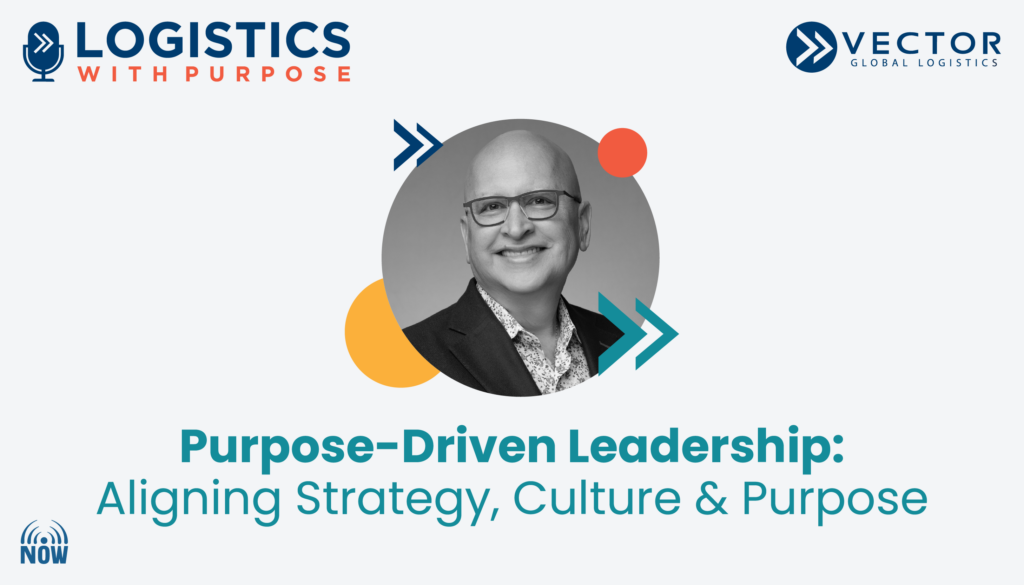
I am happy. Thrilled to be here with you, and thrilled to be here with our guest. I know it’s going to be an incredible session, and I think it’s going to be inspiring and life-changing even for everyone that listens to our guests today. I had the pleasure of meeting him a few years ago during the Conscious Capitalism CEO Summit. And so without further ado, let me introduce you guys to Fred Lifrank, global supply chain leader with deep experience across operations, strategy, sustainability. He has built a career at the intersection of business performance and long-term value creation. He has worked with complex international supply chain environments and is a CEO and founder at the Results2 Strategy, Inc. Fred, how are you doing today? Great to have you.
Fred LeFranc (01:41):
Hey, Sega, love this. This is wonderful.
Enrique Alvarez (01:43):
Well deserved as well, Fred.
Kristi Porter (01:45):
As I should be. Yes. Yeah. I was delighted to meet you a couple of months ago after hearing so much about you. Really excited to hear. I come from the hospitality industry that is a passion of yours. So I’m delighted to hear more about you and your background and your business. But before we get into that, we’ve got a couple of icebreaker questions for you. So respond with the first thing that comes to mind. What is your favorite hobby?
Fred LeFranc (02:09):
Cooking. I came out of the restaurant business.
Kristi Porter (02:11):
Yes. Well, so did I, but I can’t cook. And that’s why I worked in the restaurant business so other people could do the cooking. What activity helps you recharge?
Fred LeFranc (02:18):
Actually spending time with my wife, because I travel so much. It’s nice to come home and just spend time with her. We have three cats and they add to the mix of, I call it a cakafane when I come home and it’s kind of fun. It’s very enjoyable.
Kristi Porter (02:31):
That’s awesome. We will send that clip to her so she is aware that she’s your favorite person as well. What is your favorite book?
Fred LeFranc (02:38):
Wow, that’s a tough one because I’ve got a home with like 2000 books. So what would be a favorite book? Let’s just say Conversations with God. How’s that?
Kristi Porter (02:46):
That’s a good one. And what helps you mentally or physically reset? Meditation. Trying to get into that myself.
Enrique Alvarez (02:53):
Fred, thank you once again for being here. You don’t really give motivational speeches. You really fix reality. So when did you realize that most companies aren’t broken? When was that aha moment that you had that you saw that just companies lack direction and alignment and how … Yeah, tell us a little bit more about how you came up with that realization.
Fred LeFranc (03:13):
I was the CEO of half a dozen companies before I started my consultancy results through strategy. And even in results to strategy, I’ve been interim CEO of a few companies as well. And in working with clients, and a lot of it is primarily in the restaurant space, even though I’ve done tech companies as well, it was always interesting me to see that what people talked about in the boardroom was not happening cableside in the restaurants. It was a big misalignment, and that was you asked about alignment, and that’s what the big is. Misalignment is one of the biggest things what it is. And it’s not that there’s necessarily always bad leaders. Once in a while you get a bad leader, but it’s just that the leader may not realize how critical it is to make sure that what they’re saying at the top happens at the lowest level of the organization.
(03:53):
And I always challenge them to say, show me your newest employee that was most recently hired and trained. Let me ask them if they understand your company’s purpose and values without a cheat sheet. And if they can’t do that, then you haven’t done a very good job onboarding them because it has to be something like that. It can’t be something that they have to sort of … I mean, you got to memorize it. I understand that, but you have to embody it. And people always have these big pontifications, people are our greatest asset and all that stuff. But the reality is that that’s not always true. And that’s part of the misalignment. And people get upset about it. They hear, “Oh, we’re your greatest asset, then why do you treat us like this? ” And it’s a high bar to say that, but it can be done.
(04:29):
So that’s where the realization came to me working with clients across dozens and dozens of companies. And we also do part of our work that when we do assessments, besides looking at all their operational APIs and processes, we look at culture a great deal. To me, culture is the secret weapon of any organization. And Erigas, I think you and I share that resonance and conscious capitalism, right? Because the four tenets that just have them speak to that.
Enrique Alvarez (04:55):
That’s kind of, I think what brought us together, Fred. And I think that’s something that’s binding us. And then a lot of the conscious capitalist community, right? Just realizing that culture is very, very powerful, more powerful even than strategy. But Christie, go ahead.
Kristi Porter (05:09):
That is awesome. I love that test that you’re talking about conducting and want to talk a little bit more about that and some of your business expertise in a minute. But first let’s back up. Let’s hear about Fred growing up, your background, your childhood. Tell us about those early years.
Fred LeFranc (05:24):
Last century. Well, first off, I was born in Mexico, City, Mexico. I came to the United States when I was three, not by myself. My mother brought me and I was raised Chicago primarily. And that was different only because I was an immigrant, Mexican immigrant, and a Polish neighborhood. So it was not exactly received with welcome open arms. But the one thing I learned in life very early on is that you could become a victim of circumstances and wallow in self-pity, or you become a victor of your own life and use that challenge to overcome whatever obstacles are put in your place, be it racism or just trying to find your way in a, at that time, a foreign country. I mean, English is my second language, though at the age of three, it quickly supplanted as my primary language. And that was good to learn, to use those obstacles to develop character.
(06:10):
Kind of a Japanese norm in my office talks about, it’s not about the destination, it’s about who you become in the journey. And that’s one of the things I learned. And not only to go from being a victim to being a victor, but ultimately when you get to the right old age that I’m at, to become a vessel of information, knowledge, and hopefully wisdom that you can share with other people.
Enrique Alvarez (06:26):
Well, Fred, and I know for a fact that you speak very good Spanish as well. So you have kept your Spanish despite the fact that you moved when you were very, very little. Looking back, can you share with us one or two stories about those early years that kind of shaped who you are and kind of made you the person that you are now?
Fred LeFranc (06:43):
Well, I’ve been working since I was 11, and so I’ve always been a hard worker. In fact, I ended up paying my own tuition, paid for my mother and my apartment, their rent. Just be out of the endeavor is what I did. I ended up working at a pharmacy in the early years. And it taught me a lot about retail, taught me about merchandising, taught me about interacting with different people. They would send me into the cologne aisle at Christmas to sell i karate cologne kits to women to buy something for their husband. And you had to learn how to sell. You had to learn how to do that. At the same time, I found out that I have a knack to find shortcuts to do things. And at that time, we’d have to go through the aisles with a notepad and take inventory what you had there and to see what you ordered.
(07:22):
I bought some cheap walkie-talkies. I had a partner of mine hang out by the phone with a supply house. I walked the aisles. We just talked it through. Hadn’t didn’t write anything down off you went. So things like that, I just learned to promote, to engage with people. And that’s when I found out that I had a bit of an entrepreneurial spirit, which I still maintain to this day. I’d say the greatest gift my mother gave me was to foster my curiosity because I’m intellectually curious. So for example, right now, I’m involved heavily with learning AI. I’m taking courses, I’m reading blogs, I’m practicing it, and I know that’s going to make a difference, but that’s the nature of what I bring to the table because of my early upbringing.
Enrique Alvarez (08:01):
Fred, what was your mom’s name? She sounds like an amazing woman.
Fred LeFranc (08:04):
My mother’s name was Ophelia. She passed away about five years ago. She was the secretary. She didn’t make a lot of money, but she worked hard. She taught me the value of that. Christmas was a gift. Christmas was a brand new white shirt, and she taught me how to wash it and iron every single day. And to make sure that I looked in the mirror before I walked out of the house, that was always appropriate. She taught me manners so I could sit and have dinner with anyone in the world and know how to behave. Very strict, very, very strict in my upbringing.
Enrique Alvarez (08:30):
Well, she sounds like she did the right thing because you turned out to be a great person. So congratulations to her and her methods of upbringing. You mentioned that she fostered your creativity. Do you have one or two examples of how she did that at the same time? Because for me, strict and creativity sometimes don’t go hand in hand. How did she achieve both?
Fred LeFranc (08:50):
It was the creativity and curiosity. So if I wouldn’t walk around and say, “Mommy, why is the sky blue?” She’d go to the library and get me a book to help me understand why the sky was blue. And that’s how I would learn. In fact, he’s not one of my highlights in my career, but in eighth grade, I played hooky over 60 days. I forged notes, I was up to a Catholic priest, grammar school. So I give it to the nuns and all that kind of stuff. Eventually, I think someone called me home and say, “Is he dying? Because he’s not a lot.” Well, just to give you a sense of what kind of a nerd I was. When I played hooky, I would go to the library to read. That’s what I would do because I was bored in school. You get the books, I’d read them right away within probably two weeks, and then just sit there and go, “Well, I already know this.
(09:33):
Why am I have to listen to someone repeat everything I just read? That’s where you give us the books.” So I just did that to go to the library. And my wife gets the biggest kick out of that. She goes, “Good Lord, didn’t go get in trouble.” I said, “. The library too. And that intellectual curiosity stays with me. That’s when you ask me my favorite book. I’m like, okay, whatever. It’s tough because I have so many interests.
Intro/Outro (09:52):
Yeah.
Enrique Alvarez (09:53):
Well, and you like AI as well. And I think once you lose that curiosity, I think that then you start to grow up and then just life probably becomes very boring. I mean, is there anything else than just constantly learning and growing and changing and-
Fred LeFranc (10:07):
It’s being young-minded. I know 30-somethings that are already stale in their thinking. They refuse to learn anything more. And then I know people who are in their 80s who are still vibrant and youthful and excited about all the new things. I mean, we live in a fascinating time. We can judge it one way or the other, but it’s an incredible time to be living it. I mean, we’re getting a geopolitical lesson every single day. You deal with that in supply chain, global supply chain. And fortunately, you’re not one of those oil tankers that the US Army is chasing or the Navy is chasing around the world. So those things are all real that’s going on right now. And so there’s great lessons that we learned from history. I remember at high school, I wrote a paper on geopolitics, which I don’t know what made me do that, but I learned a lot.
(10:49):
And ever since then, I’ve had that lens and you see it happening now. There is a reason we want Greenland geopolitically. We know that. And the intersection of geography and politics is very significant.
Kristi Porter (11:00):
Fascinating. Thank you. I also love the hooky story. That is incredible.
(11:06):
Also, it just speaks to your playful nature that I noticed immediately when I first met you as well. So that’s incredible. I want to talk a little bit more about your career from a couple of different angles. So as you already told us a little bit, you’ve served as a CEO, a board member. We have a wide variety of expertise in hospitality, which now just hearing more of your background, I think that must come from your mother as well, teaching you manners and respect and how to engage with people. And those are kind of all at the heart of hospitality too. So you started out very differently working at 11. You’ve had a lot of expertise. You’ve consulted with a lot of companies, you’ve been a lot of different environments. So what has kept you committed to, and as you said, you’re intellectually stimulated by a lot of different subjects.
(11:53):
So where has strategy kept your attention and commitment to that areas? And what does that look like in a day-to-day capacity as you’re talking to these leaders?
Fred LeFranc (12:04):
Well, one of the things that’s very difficult is to get a strategic mindset, and it’s difficult because it requires one to think differently about something they feel very comfortable in. I’ll give you an example. When I was coming up in my career, and I actually had a scholarship to become a doctor, and I gave that up because I did enjoy it. I didn’t like the … These people knew a lot about a little. I wanted to know a little about a lot. So I gave that up and I just started working at restaurants and I worked my way up to being the CEO of a restaurant company, half a dozen after that. And in doing so, when you’re running a restaurant or running a region or what I was a vice president of marketing, you get involved with all the minutia in the day-to-day distractions.
(12:40):
And you got to lift your head up every now and then and say, “Well, where am I going? What am I trying to do? ” And strategy becomes important. And an example I give to anyone in the C-suite, you got to be two years out, and that’s why I put my hand out here. You got to say, two years out is what your view’s going to be. Because if I make a decision based against an objective of where I want to be with my vision in two years, the choice I make now may be different than if I’m looking at a six-month point of view. A six-month window gives you a very different answer to what should I do next versus a two-year window. And I’ve seen companies that somebody made a decision in the past that they were paying the price for it now.
(13:16):
And that’s hard because in some cases, you can change a manager, you can change a leader in a restaurant, you can change a menu. Can’t change the location. That’s sitting there, okay? You got a long-term lease, you can’t move it. And if someone made a really bad decision five, 10 years ago, you’re going to pay for it right now. And those are the kind of things that I started realizing that it’s important to have a long perspective. So when I work with leaders, not just the CEOs, I work with people lowering the organization. Let’s say, Christie, in your role, okay, I would ask you to answer two questions. First one, if I were the CEO of this company, what would I expect from my role? And notice I didn’t use names, not about names, about roles. So if you answer that question, you’ll find out immediately that you’ll find things you’re not doing that you should be doing because you’re acting as CEO.
(14:01):
You’re looking at this role going, “Oh, well, they should give me this. They should give you that. ” And that’s question number one. Number two, question. If I were the CEO of this company, what would I do given the circumstances that it’s in? That forces you to do two things. One, you’re thinking two years out. Two, you’re thinking holistically across the whole organization. You’re no longer defending yourself and your role. You’re now thinking about it as if you were the CEO. And when any individual contributor, especially in charge of an organization at the level you are, your peers starts thinking like the CEO, their behavior changes and the results are much better. Those are the ways you start thinking about things strategic.
Kristi Porter (14:36):
And why two years? I feel like we hear one year, five year, 10 year. What does two years represent for you?
Fred LeFranc (14:41):
Well, first off, five years is, no one knows that health’s going to happen next week, much less five years.
Kristi Porter (14:46):
Why has been true?
Fred LeFranc (14:47):
The reason it’s two years is because some decisions take a long time to implement will be on a year. I’ll give you an example of one of the things that happens in American business. Did you just finish budgeting this past December?
Intro/Outro (14:58):
Yes.
Fred LeFranc (14:58):
As a company? Yes. Okay. Everyone, November, December, budget for 2026. A friend of mine taught me something a long time ago. If you think about this, you think about this point in time, I’m going to take from January to December of 2026, and I really don’t think about 2026 until I get to November. There’s a flaw on that. If you instead take your budget and your forecast and move it along a 12-month forward continuum, you’re always thinking 12 months out there and invariably you’re captioned that second year because certain commitments, usually CapEx commitments come into play when you have a two-year window. A one-year window is too small. And also because the way we’re locked into our branded, it goes only from January to December. And what I’m suggesting, for example, is when January’s over, your team gathers together quickly and say, “What did we learn January 2026 that was different than January 2025?
(15:45):
And what thinking should we take it to January 2027? And let’s make some notes and do a consolidated forecast based on what we know today and you do that in February and March and you’re always 12 months out. ” It changes the way the organization thinks and makes decisions.
Kristi Porter (15:59):
Love that. Thank you.
Enrique Alvarez (16:00):
This is very timely advice I’m sure for a lot of companies and listeners out there. I mean, at the end of the day, Fred, I’ll have a slightly different question, but just complimenting to the question that Christie was saying, how often do you have to think about this? Because one thing is just to think about this two year in advance, but I think that sometimes you have to be thinking two year in advance every day for this to work. I mean, is it something that you just go do in January and then just store in a box because it feel like in supply chain and with everything that we’re seeing geopolitically speaking, it changes every day, every week. And I think that change is going to be expected going forward.
Fred LeFranc (16:35):
Yeah. I think it’s really a perspective, Enrique, and I think what you have to do is sign up is look at scope and focus, scope and focus. You do this quickly, and that’s really what self-awareness is about. There’s also social awareness. You start becoming aware of the interplay of what goes on and we can’t predict the future. We have to react to it. But it’s interesting that if you have enough perspective and to consider a variety of scenarios, I’ll give you an example. I’ll meet executives in a challenging situation where it’s just not good. The numbers aren’t good, they’re getting pressure from investors or the board or whatever the case may be, and they get freaked out because you’re human. So one of the things that I’ll do is I’ll say, “Okay, let’s sit down. I want you to conceive the worst that could happen.
(17:17):
I want to hear it as bad as it can be. You get fired, you lose your house, your wife leads you, your kids, whatever it may be, just make the worst that could happen. And I want you to really visualize it. I want to hear the details of it. ” So we do that and I don’t let them get away, “Well, it won’t be something.” No, no, I want the worst. Okay, so got it. Now we got the worst. Let’s go. And I repeat it to them, “This is what I heard you say is the worst I could have. ” My next question is, can you survive? Can you survive? Now, I’ve never had anyone say no. You always say yes. I’d rather not go through it, but I can survive it. I said, great. Now you can take all the fear and trepidation you have about that and put it aside because you’ve already decided you can survive it.
(17:54):
So what are you afraid of? You can do it. Congratulations. You’re not powerless. Now let’s take the next step. What’s the best that could happen? And let’s spell it out too. And the best thing that could happen sometimes a little bit pie in the sky, kind of like, well, if that happens, it’s a miracle, but that’s okay. Let’s get the best that could happen. We got it figured out. And you survive that. And they go, “Well, that’s kind of an interesting question.” I said, “Well, some people self-sabotage. They’re the brink of success and they do something stupid to self-sabotage.” We see this in the papers all the time. Said, all right, now you got the worst, you can survive it, you got the best you can survive it. Now let’s talk about what’s in the middle. What’s better? What’s better than the worst that could happen?
(18:26):
And what you see is that worst is small, best is small, better is wide because it has a spectrum from being close to worse and being close to … And you start saying, let’s talk about that. And what is better? Better is something you can live with. You don’t get everything you want, but you can live with it. You already know you can survive it because you already survived the worst in your head. And now you’re focusing your stuff on the better side of better, the best side of better, excuse me, the best side of better and focus your energy toward that. Once that happens, all of a sudden, all this anxiety, all this thing goes away. They have a sense of being powerful again, back in control, they’re not a victim, they’re now a victor, and they can move forward. That kind of work is very, very powerful when you try to move an organization.
Enrique Alvarez (19:06):
Wow. Yeah, that is very powerful indeed. And thank you very much for sharing it with people. Changing gears a little bit here, Fred. And looking at your career as a whole and maybe just putting some reference into some of your multiple roles that you have played throughout your career, at what point or when did you actually start to see or realize that, well, strategy is incredibly important. You have performance, that’s incredibly important. You’re measuring all this. You have the vision aligned. When, more than where, when did you realize, well, purpose. Purpose is important. Did you always have purpose as something that kind of fueled the results or is it something more recent? And if you could give us an example throughout your career where you were like, “Well, yeah, there’s something missing on this purpose.”
Fred LeFranc (19:48):
That’s a very interesting, insightful question. I took over a company years ago, five days after I took over as a CEO, they had to declare bankruptcy because the government froze their accounts. They had failed to pay payroll tax. The government is pretty pissed off if you try and take a loan from them. They don’t lend money to companies. And so we were bankrupt and I just started. I hadn’t even met the general manager at this restaurant company. We’re bankrupt and I was shocked. That was my introduction. And then it was interesting to go through the whole process of the bankruptcy. I had to go meet vendors for the first time, all this stuff. And at that point, when I went to go meet with vendors and say, I’m the new CEO and we’re bankrupt, they already knew that because of the filing. And some people we owed billions of dollars to.
(20:31):
I walked out of every meeting with 30-day terms, no COD, 30-day terms, because what I said to them is, “I’m going to be very transparent with you. No secrets. I’m going to share our financial statements with you. I’m going to share our plans with you. Did you understand what we’re trying to do? ” And in those conversations, I slowly started talking about the purpose of what we did as a company within the communities that we serve, how we wanted to take care of our employees. And at the holidays, I invited all those vendors to our holiday party because I wanted our people to celebrate. Didn’t have a lot of money, but I wanted our people to celebrate. And I gave out awards to every single vendor. So each vendor, because they only had one vendor of each category, “You’re the best produce company, you’re the best distributor, you’re the best meat company.” They all want, but they all also got a chance to see how we interacted as a culture and how we took care of one another.
(21:17):
And that’s where I began to see the sense that there’s more to it than that. And it’s funny because the managers that I inherited look like supermarket managers. They had short white sleeve shirts with a tie. It’s kind of like we see in a grocery store. And they’re all kind of cut off the same milk. And I learned something from a friend of mine a long time ago that said, most people don’t hire anyone smarter or better looking than they are, so you end up with a lot of dumb ugly people. And I couldn’t help but laugh when I heard that. And I looked at this step for the wife management team. I said, “We don’t reflect the communities research.” This was in Los Angeles. Los Angeles is a very diverse city. There’s 110 languages spoken in the school system in Los Angeles. And so I started hiring based on the demographic of our areas.
(21:57):
And pretty soon, all of a sudden, the type of person that I had running the restaurants really changed. And we had some managers that were very homophobic at the time, and I hired gay people, African Americans, Hispanics, Middle Easterns. And I’ll never forget when one of the most rigid kind of homophobic guys became best friends, one of the gay guys. And one of the things I always said at our manager meetings is that we may all look different on the outside, but what we haven’t hold on the inside, our commonality, our humanity, our purpose for what we’re trying to do is what binds us together to look past the exterior, look on the inside. And that’s when purpose became alive for me. Then when I went to my first conscious capitalism event, I found my drive. That’s what really helped.
Enrique Alvarez (22:37):
How long ago, without dating you, of course, but how long ago was your first one? Because you actually been there for a while, right, with the conscious capitalist community?
Fred LeFranc (22:45):
It was the San Diego General 80, I think 2011, 12, right around there. It’s been a while, a long time.
Enrique Alvarez (22:51):
Well, no. And once you realized that it’s one of those things, or at least in my experience, it’s what happened to me, you can’t ignore anymore. I mean, once you realize that purpose and culture is so important, then you see it everywhere. It’s that I used to work for a flow class manufacturing company, and of course no one pays attention of glass for Windows. But once you know that there’s the logo in the left corner, then you can’t stop looking at it. It feels similar to me. But tell us for a little bit more, once you realize this, how has that influenced you in the way you choose your roles or the way you choose what organizations to lead? I mean, how much of your life has this passion for purpose taken over?
Fred LeFranc (23:34):
Well, it’s really guided my work because when I go into a company and I meet with the leadership, I listen for the telltale signs of are they in a victim state or are they just doing the best they can, but maybe ignorant of opportunities to do things differently? I don’t judge it. I just try and observe it to understand it. But I always go back to the company’s purpose. I always ask them, “You know what your purpose is? ” Because it’s that ineffable quality that makes you get up in the morning, feel really good to be doing what you’re going to do. I have meaning in my life. If you look at a product with no purpose, it’s a commodity. You have a product with a purpose, you have something that’s uniquely differentiated, you have a brand. And I spend a lot of time on branding and marketing and so forth and so on, but it does start with that point of purpose.
(24:15):
And once I get the founders or the CEO connected to that for themselves and they can begin to see how they can lead it. I mean, I remember the first time I talked about love in the meeting. It was very awkward for me.
(24:27):
This was weird. And when I took cooks, I always say, “Cook the food with love. It takes better.” And just think about mom’s home cooking. I don’t care if it was a can of soup, but if she made it, takes it better than if somebody else made it because there’s love in there. There’s an intangible there. And purpose is an intangible that shows up in so many places. So then when you help a company to find their purpose, that I like to call it the brand DNA, what shows up in everything that you try and do. And because a lot of people have mission statements, but there’s no meaning behind it. It’s flat. It doesn’t inspire anyone. Purpose is aspirational. It brings out the best of everyone. In an organization, it’s a team. So the team has to bring out the best in each other.
(25:03):
There’s so many companies that are toxic that point out the flaws that somebody else has. And that’s fine as you point out the flaws, but did you realize that if their flaws, your strength, your opportunities to go help them in their stuff at their weekend so that they could be great at what they’re awesome in, that the idea of strengths finders is you don’t ever make your weaknesses of strength, you just neutralize them, have them stop pulling you down so that your great strengths can fly forward. That’s part of what it’s trying to do. So it’s very inspirational in that aspect.
Kristi Porter (25:30):
Yeah. Well, speaking of inspiration, I feel like glad we have this recording because I need to go back and take notes. So thank you for everything you’ve said so far. And I want to continue talking about Results through Strategy, which is a very appropriate name for your company. You’ll turn 20 in 2027, so a heads up on that congratulation. You’ve talked about coming into some really difficult circumstances and challenges and all different kinds of businesses. So I’m curious, and you’ve given us a couple of stories so far, but beyond improving in performance, what do you find no matter which environment you walk into, are there some common threads around what you find fulfilling in those environments, even when they’re incredibly challenging?
Fred LeFranc (26:11):
Well, it’s always helping unleash the potential of the people that work there, help them realize that they’re better than what they think they are, fading great and to recognize those unique qualities. Every one of us has a unique hidden talent, everyone. I don’t care if you’re a janitor, you have the potential to express your unique individual talent. And I think that’s part of what brings fulfillment. I ended up running a commercial bakery in Atlanta where I spent time with Enrique during COVID. I didnt anything about baking. It was just a situation that I was on board and we had just bought the company two weeks for COVID and I was asked to run it. And the energy director is a good friend of mine, he said, “Can you do it for me because you know how to run a business and I need someone to run this business because we got bakers.” And that was a humbling experience to run a manufacturing company in Atlanta during COVID.
(26:58):
By the way, a bakery in Atlanta in the summertime is about 105 degrees. It’s hot and you got to wear masks at that time, right? Which didn’t a
Kristi Porter (27:05):
Matter of humidity.
Fred LeFranc (27:06):
Yeah. We had five waves of major COVID, 10, 15, 20 people out at one time. But to treat people with dignity and respect is the starting point. And I gathered all the managers together with all the employees at the meeting and everyone was afraid. There’s a lot of fear. And when you’re managing fear, you have to do something quickly to replace it because fear and love cannot coexist. So you want to take fear and replace it with love. And what does that mean? Love of self, love of the business and so forth and so on. And I told the employees, the way these managers maintain your restrooms, your break areas, your work areas is the record reflection of what they think about you. And when I said that, their eyes got really big. Why? Because the bathrooms were a disaster. There was no break area worth to speak of because COVID wouldn’t allow more than two people in this one area.
(27:48):
So I actually built an area outside with a tent so they can go outside and get some fresh air. And very rapidly, I invested about $35,000 in improving bathrooms, the break areas, even the front office, to just make it a place that you want to come to work. It was horrible. It was really dark and bingy. I changed all the lights out and I would always go into the break areas and just check with the team, how you doing. These are humble people. There’s baking bread. I’ll never forget this one woman, she just stopped me cold. She looked at me and she goes, “God sent you to us to take care of us and I want you to know that we are going to take care of you. ” And I was blown away. I got all choked up. I did not expect that to come from, but it’s one of the most moving moments I’ve had, but it gives you an example of what happens if you treat people with dignity and respect, what they in turn can do for you.
(28:32):
And those are some important lessons that if one is only thinking from their neck up, they’re cynical, they’re in their head, you got to include your heart and your guts. All your humanity needs to be present as a leader. If you’re going to really lead an organization, you can’t just leave your heart at the door. And I’m not suggesting to become soft and squishy because one of the things I make sure with leaders say, “Are you a nice leader or are you a kind leader?” And they kind of look at me, “Wasn’t that the same thing?” I go, no. A nice leader wants to be liked, wants validation from their employees. They want to do things that makes them popular. That’s a shitty leader. A kind leader, hold accountable to results. I will treat you with respect and dignity. I care for you, but this is a business.
(29:08):
I’m paying you. You got to give me results. That means you have to have some tough conversations. And I had to learn that in myself as I was maturing as a leader. Those are part of the things that you want to do to help really make it a healthy culture based on getting results. It’s a business. It’s like conscious capitalism. There is capitalism in there. It’s conscious because it’s intentional, but it’s capitalism in terms of you need to get a return for your investors, your community, your employees, your vendors, your customer, all those stakeholder mentality that conscious tabolism talks about.
Enrique Alvarez (29:35):
Brad, your title, very interesting title, chaos strategist. Of course, it is an accidental, and you already gave us a couple of examples of how you actually use your word to bring order to this order, but it reflects the reality you step into every day. Could you explain a little bit deeper chaos strategist? What does that mean to you?
Fred LeFranc (29:53):
A woman that I met at the first conscious capitalist I ever went to, I was just standing next to her in San Diego and Ron Ashish Sodia was talking on stage. And as you know, he’s the co-author of Conscious Capitalism Book with John Mackey. And she made a comment. She said, “Oh, I’ve worked with Raj.” I go, “Really?” Because I was very impressed by Raj. How could you not be? And I said, “What did you do for? ” She goes, “Well, I helped him figure out a few things in terms of what he was trying to accomplish with himself.” And I was like, “Well, that’s interesting.” The happy hour went up to Raj. I’d never met him before. I had this myself and said, “Oh, by the way, I met this woman, or Garnett. She says she’s worked here.” She goes, “Oh yeah, she helped me really resolve.” And she gave me a perspective that I hadn’t considered before.
(30:30):
So I hired her to help me. And she ended up interviewing me. And you ever meet someone says, “Well, tell me your life story.” And you’re like, “Yeah, right. Okay. I’ll give you a 30-second pitch and I’ll go out. ” She wanted to know my life story. I mean, year by year, by year, by year by year. And at one point she said to me, “You know, Fred, you have gone from surviving to thriving so many times in your life.” And she named the incidents. No one had ever said that to me. I never had seen that perspective. I never looked back on my life to say, I got thrown in the deep end on the pool and I figured out how to swim. And that happened a lot. Immigrant from Mexico, going racism in school, challenges economically and so forth and so on. And as we were talking, she said, “You have an ability to look at a situation that may be bad, but figure it out and get out of it better than when you went into it.
(31:16):
” And that’s the pattern recognition that I learned that I had. And that’s when the chaos strategist came about because I get calm. My wife always jokes about it. I get very calm. The worst days get, I just get calmer and calmer because I’m busy looking, observing, processing. And I know that’s a knack that I have. It’s that all of us have innate talent. That’s one of mine is pattern recognition. That’s why all the moving parts of the business and the very fluidity and the dynamic part of what goes on, I enjoy that and I absorb that and I go forward from there. And next to chaos strategist, I’ll never forget Enrique today. I finally changed my title and put it out there because she said to me one very interesting, she was Fred, there’s a lot of CEOs out there. There is only one chaos strategy.
(31:55):
And that title has listed some very interesting conversation.
Intro/Outro (31:58):
No,
Enrique Alvarez (31:59):
That makes sense. And I can say because I know you, that it’s not only incredibly accurate, but yeah, I think it makes sense. It makes perfect sense. Hopefully a lot more people get a chance to meet you in person and they’ll find out that actually it suits you perfectly. And I think it explains all the things that you do and how you help others. And of course, it’s always nice to know and meet someone like you because it’s always handy to have a chaos strategist next to you or available or have their phone number handy.
Fred LeFranc (32:28):
That’s
Intro/Outro (32:28):
Right.
Kristi Porter (32:28):
Absolutely. I’d love to back up. You mentioned something in the beginning that I want to back up to. So we know you’ve worked with some big hospitality brands, Starbucks, Netello, Chobani. You’ve also advised tech companies and investment firms. You were just talking about pattern recognition, but another thing you said you were really good at earlier was finding shortcuts. So I’d love to hear some more examples of shortcuts that you found to guide people through as a chaos strategist.
Fred LeFranc (32:54):
Well, when I say shortcuts is do things that allow you to accomplish something without the same difficulty in following process. Sometimes process can be very state and gets in the way of things. If you have a clear sense of purpose and a good vision of what you want to try and do, you can jumpstart that and move forward very quickly. Don’t go into a whole lot of meetings and this and that. Just get it going. Get in front of the lies and do it. As you mentioned, it popped in my mind. Years ago, I was opening up a restaurant in West Des Moines, Iowa, which is not exactly it’s really in place to be in August. It was very hot. And you remember solidarity from Poland? Do you remember that political party? You guys are too young. I know no idea.
(33:30):
In the 80s, Le Wilenza was the leader of solidarity. He helped overthrow the communist government there. And in the United States, we were bringing a lot of Polish immigrants over. And so I’m at this restaurant opening and all the people who applied for busboys were a Polish descent. They did not speak a word of English. They’re all these young kids, great kids, and they didn’t know what to do. And so my training director was like, “Oh my God, I got to teach them how to speak English.” I said, “No, you don’t. We’re going to teach them. The English you’re going to learn is as follows. Good afternoon. My name is Stanislaus. I have fresh chips and salsa for you. ” And we repeated that over and over and over and over again. I mean, add naughty.
Enrique Alvarez (34:06):
That’s awesome.
Fred LeFranc (34:06):
And before you knew it, they knew all the words they needed to understand how to be of service in this Mexican restaurant environment. You got a bunch of Polish people serving Mexican food. It’s very funny.
Enrique Alvarez (34:17):
In Iowa.
Kristi Porter (34:17):
Yeah.
Fred LeFranc (34:18):
In Iowa. You love
Enrique Alvarez (34:19):
Your love the US.
Fred LeFranc (34:20):
Years later, I went back to that restaurant maybe three years later. And one of those bus boys was the chef. And the first thing he said to me was that line, just as a joke, because by then he spoke English and he’ll never forget because he showed him how to do it. So that’s what I mean by a shortcut. Another one which I won’t worry with the story. I had a Chicano in the Bay Area who was a bad student. He was just a terrible student. And I’m one who believes in passing out books to read. Nowadays, I big audio books because a lot of people don’t read any. And he struggled. He told me I have a hard time. I get a headache every time I read. And I go, “Well, why?” I didn’t know if he was dyslexic. He just couldn’t focus and concentrate.
(34:58):
So I took him to a bookstore. I bought him a dictionary and I bought him a book, a business book, but a fairly simple business book. And I said, “All right, I want you to read this book. And every time you see a word you don’t understand, go to the dictionary, look it up, highlight it, and read the definition and go back and read over the book.” Three months later, he showed me the book. The entire book was highlighted because his vocabulary was terrible, but he read the book and he comprehended the book. But the best thing was that after I saw him again for three months at Christmas, he gave me a gift of a book he had read that he wanted me to read. And that’s the transfer of knowledge and that epiphany, that unleashing his potential to me was just one of the best gifts I ever had.
(35:33):
And that was just something that comes up. That to me is a shortcut. How do you shortcut a hack, so to speak, to get to live? And there’s lots of them that happen in business.
Kristi Porter (35:41):
And what are a couple of books that you frequently give out?
Fred LeFranc (35:43):
My current favorite book to give out is Four Disciplines of Execution for Business. And Four Disciplines of Execution in a business context is a great book. Traction is another one. It covers the EOS system, but the Four Disciplines of Execution I think is tops. I mean, Conscious Catalom’s a great book as well. Good to Great is still a fantastic book. Jack Stacks, Great Game of Business is another great book that talks about metrics. I mean, he took a engine remanufacturing company and taught these basic rednecks, as he levelly put it, how to read a P&L on a balance sheet because he believed them and just took slow steps process by prospect, process, get them to realize their potential. Here’s the question for everyone I ask, what’s the ROI and literacy? Think about that. What’s the ROI literacy? And so the beautiful thing about ideas is that I can share it with you and I don’t lose … If we are eating a piece of food, if I give it to you, I can’t eat your piece of food.
(36:36):
You ate it, but not when it comes to ideas and knowledge and wisdom.
Enrique Alvarez (36:39):
That is not only very powerful, but I actually think that the world would literally be a better place if we spend a lot more in education and knowledge and being aware. So yeah, thanks for sharing that, Fred. Ju, at the beginning of the interview, you talk a little bit about how you become an avid AI student or learner. And you recently co-wrote an article exploring how different layers of AI actually work together and why not all AI solves the same problems. What brought you or what questions were you trying to answer or what questions were leaders trying to struggle with that actually made you co-write that article and explore that particular aspect?
Fred LeFranc (37:19):
Yeah. Well, my co-author is the founder of a company called SignalFlare AI. They do a lot of price elasticity studies for restaurants. And they could do it for any business, really, depending on what it is you’re trying to accomplish. And he and I were talking about how his algorithms actually work. We referred it to as four bands, an LLM being band one, which is great at sort of going out to the internet research information, bringing information back and consolidating for it. But if you’re doing a price elasticity study, essentially you have to do a massive mathematical formulation to do that. If you ask ChatGPT what one plus one, they don’t add, they don’t have math. They have to go out into the world and find other people’s answers for one plus one equals two. But sometimes someone says, “Oh, it could be Italian math. It’s one plus one equals three,” which is sometimes you get a multiplier effect.
(38:02):
And so that’s what it would do. But if you want math, you have to do it at different level of the algorithm and different types of AI tools. And so what we are referring to is to make sure that if you’re going to hire an AI company to do something that’s really, in this case, statistically important, you need to do regression analysis, make sure you’re doing one that is capable of doing that in isolation of everything else that’s out there in the internet. That’s what we wanted to try and do to help CEOs learn how to hire an AI company because someone says to you, “Oh, I can help you with pricing.” And what they’re going to do is take a spreadsheet, stick it in AI, and it’ll come up with a calculation that may be totally wrong. And we’re trying to look at what are the maximum price you can charge a customer.
(38:41):
And the safety will probably apply to you, Enrique, in logistics. What’s the maxial pricing can charge your customer without losing them, but maximize the value that they bring to me. And also then think about the value add you can give them so they feel that the relationship is based on more than just a transaction. There’s relationship here that’s enduring.
Enrique Alvarez (38:56):
I kind of feel like that applies to almost every business out there, right? I mean, that’s how do you maximize your pricing strategy so that you can still be competitive and keeping the clients. And we’ll put the link to the article that you wrote so that people can actually read it because it’s very interesting. And of course, we’ll ask you how people can connect to you at the end of the interview. But no, thank you. Thank you. That sounds incredibly interesting. And I think to your point, AI solves a lot of problems, but it can all be AI or there’s different AI algorithms out there that people should be aware of.
Fred LeFranc (39:29):
Different models. But I will say, I think AI is going to have a bigger disruptive effect in civilization than the internet by far.
Intro/Outro (39:36):
Yeah.
Fred LeFranc (39:37):
Yeah. In three years, what it’s done is incredible. You got to be careful with it because it could be directed in some bad ways. We know that already. But if you are not learning AI right now, you are going to be left out. It’d be same that you know how to use the laptop. If you don’t, you’re not employable in certain business as specific, maybe a blue collar work, which nothing wrong with that, but it robs you of the opportunities you create. And AI is like that. And it’s one thing I learned about AI, it does not replace human ingenuity, creativity, insights, weeps of faith. That’s our humanity. We’ll always have that. Well, I think why? Because it’s not just here, it’s here. It’s in our heart as well, right? It’s in our gut. AI doesn’t handle that feel. AI doesn’t have a heart. It has no more compass.
(40:17):
We do. And so all that AI does is eliminates all that time to compress that. I was just on a panel the other day on AI. I gave the example that before AI, if you wanted to get a set of reports and you’re going to analyze them, you would spend about 5% of your time thinking about what you were going to analyze, what you were looking for, and then 95% of your time doing the work, making those comedies, so forth and so on. With AI, it’s reversed. You spend 95% of your time creating a prompt that’s very, very clear about what you want it to act like, what the role is, what the output’s meant to be, what the specific piece of information you want, what format you wanted. And you spend a lot of time on that, and you spend 5% of it letting it crunch the numbers.
(40:54):
What’s the difference? The first example takes an hour. The second one takes 15 minutes. That’s the difference. And you are then able to take, if you want to use the full hour, keep on crafting, keep on crafting, keep on crafting to get very, very powerful things, but it’s your insight that you bring into it that makes a difference.
Enrique Alvarez (41:08):
Fred, from a more practical standpoint, what are your top three AI tools that you use the most on a day-to-day basis? I know you’re also very active on LinkedIn and I know there’s a lot of tools that can help with that. And what things that you use the most and that are more practical to you, at least that you can remember.
Fred LeFranc (41:26):
Well, the AI tools that I use the most are Claude, ChatGPT, and Perplexity. Those are the ones that I use the most. Some of the things that I’ve learned is if let’s say you end up creating this deep research. If you stick it into Notebook LLM, it does an automatic podcast of that content, so you can listen to it. And depending on how you listen, some people learn by reading, some people learn by listening, some people learn by reading love. And so there’s a combination of tools you can use. If you’re using LinkedIn, there’s a great website called Clio. It does an amazing job of creating posts for LinkedIn. It really, really does. Gamma for PowerPoints is also a very, very powerful tool that can generate some great … And then Manus is also very, very powerful because Mannis is more of agentic model. And Agentic model, as opposed to just plain AI is you start piecing workflows together to do things, to go out and do different aspects of it, which by the way, is the next wave.
(42:20):
We’re going to see it change a lot. It’ll be the classic … It’s like if you have Alexa at home or you have Siri on your phone and you want it to make a dinner reservation for you, you could do that now. But now what it’s going to do is say, oh, I seen your last conversation talk about having dinner with Enrique next week in Atlanta. Let me find three restaurants for you near his office that you go to dinner with. And they give you a list. Do you want me to make a reservation book? Yes. And then it goes off and does it. Those are the kind of things that are going to be coming on more and more and more.
Enrique Alvarez (42:47):
We could have a whole podcast on AI Fred and we’ll probably have to do that at some point because it’s fascinating everything you’ve said. But go ahead, Christie. I know that you have another interesting question, slightly different subject.
Kristi Porter (42:58):
Yeah. I love hearing about all the things you’re learning and how you’re applying them. And as we discussed and start to kind of close out the conversation here, I do want to circle back to the tenants of conscious capitalism. Vector is a B Corp. In Georgia, there’s also Go Beyond Profit. There’s a lot of these different networks around the world that are purpose-driven. I know that’s super important to you and you kind of use that lens when you’re talking to business leaders. You’ve seen, obviously, you’ve been in a lot of environments over the last couple of decades and even wealth since you were 11. So thinking of how to bring these conversations to people, how are these conversations changing over the decades? Are people this leaders more receptive to these kinds of conversations, willing to bring it into their environments and really looking to think about purpose and culture, or are some of those conversations still difficult?
Fred LeFranc (43:49):
It’s all of it. Everyone’s different. I had a client a couple of years ago that had by far the most toxic culture I’ve ever seen by far. And I pointed it out to him. I showed him the metrics. We did an assessment. He talked about the impact he’s having on his business, why his sales were struggling with profit, was struggling, why his people were engaged. He had a payment inordinate amount of money. He paid him a lot of money. That’s where they stayed. It’s like combat pay. And at the end of the day, he didn’t want to change. He was happy in his dysfunction and you can’t change that. And I said, “I respect that. That was great.” And I realized that in some ways he just was part of a tortured soul and that was his mindset. And so I quickly resigned the account because I knew I was going to make a difference.
(44:27):
Why should he waste money doing something he’s never going to do? Or other people will embrace it because they never were exposed to it before. Like me, I had ideas at Inklings and then Conscious Capitals and gave me a framework that I could use and also other people that talk about it so that people can put their own thumbprint on it, but balanced around the idea of conscious culture, conscious leadership, they hold a mentality and higher purpose.
Kristi Porter (44:47):
Hopefully we’ll see it catching on more and more.
Enrique Alvarez (44:49):
Two changes you want leaders to make right now, Brad, given your experience, all the companies that you have been able to help out and what you’re seeing in the world today, the changes that you think leaders need to embrace and they need to do it quickly or they’ll become …
Fred LeFranc (45:06):
Well, I think improving one’s emotional intelligence would be number one, because that has such an incredible impact. And the four levels of emotional intelligence, self-awareness, which is hard. You ever meet anyone says, “I’m self-aware,” guess what they’re not. Anyone who’s been to be self-aware, we immediately find out how difficult that is. But the attempt to do that, and the self-awareness just means that you recognize that free will, you hear about free will, what does that mean? That means you have a choice, okay? Things happen, you can react, or you can make a choice. The free will enables that choice. And that’s that millisecond between the cause and effect to go, “Is that what I want to do? ” You get the urge. And we all met people that you meet them, you go, “Oh, I don’t like that. ” You don’t necessarily want to act on that, right?
(45:46):
It’s not appropriate, but it’s about having that choice. So that’s number one. And then of course, going on from there, the rest of the emotional intelligence, because unlike IQ, which we cannot increase our IQ, it is what it is. We can maximize it. EQ can be improved over time through self-awareness, understanding that if I want a behavior out of my company that gives me this kind of performance, that behavior starts the way I treat them. So it starts with me, and then how do I treat myself? And let’s face it, as human beings, we all have boo-hoo stories. Someone did something to us when we were growing up, usually our parents or a sibling or a family member that really messed us up and we need to overcome that. That’s that victim or victor thing. And the reality is that trauma stays in our bodies if we don’t release it and creates illness.
(46:26):
And so part of that is to become whole to become self-aware. So that would be the most important thing to me is help them with emotional intelligence. And the second one I think is to develop a practice that embodies mindfulness or reflection, meditation, prayer, whichever way doesn’t really matter. I have no specific way, but unless you just sort of quiet the noise as you start your day, so when you walk into the day, you are aware of the things that are going on. You’re just not going through the motions automatically. All of us, I mean, have you ever moved and driven home and found yourself in front of your old place instead of a new place? And we all do that. Why? Because it’s a pattern. We go down from the, I’m paying attention to its autonomic system. We do that in so many parts of our life.
(47:05):
And a moment of calm reflection, 30 minutes every morning to just be with yourself, be prepared to enter your life in a more intentional way will change the quality of your life complete.
Enrique Alvarez (47:17):
You’re right. Very powerful. Emotional intelligence one for everyone that’s listening and paying close attention. To Christie’s earlier point, we’re definitely going to have to watch and watch this a couple of times with pen and paper to take notes. Emotional intelligence, one, work on it and then just quiet your mind, which is a lot harder said than done for sure, especially these days with AI and media and everything that’s going on, but it’s definitely important. And to that, Fred, follow up question for you. What are some of your future plans for results through Strategy Inc?
Fred LeFranc (47:48):
Well, we’re going to continue the work that we do, helping companies reach their potential. But one of the things COVID taught us, we could do a lot more things online. I used to travel 15 weeks out of the year. I don’t do that anymore. I go very understanding wife, but I’d rather be with her rather than being on the road. So being able to do things that we’re doing here. You’re in Mexico City, Christie here in Aus … Oh no, you’re not in Oscalinda, what’s the other person? Where are you at?
Kristi Porter (48:10):
I’m in Nashville. Yeah. Luis is in our. Yeah.
Fred LeFranc (48:13):
We are thousands of miles apart, but we’re together at the same time. So being able to do that, some of the work that we try and do is part of what it is. And then as I said, I’m leaning heavily into AI. So I think it’s going to make transform consulting a great deal, but conscious capitalism are values of humans, not of a machine.
Kristi Porter (48:31):
Absolutely. Thank you. This has been a fascinating conversation. We’ve learned a lot from you as we fully expected to, but you never failed to surprise us either. So as we wrap up, I’d love to ask you one of the questions we love to ask our guests here. What does the phrase logistics with purpose mean to you?
Fred LeFranc (48:48):
It means Enrique hit enlightenment and decided that everything he did had intention, that logistics is not just moving things around, it’s making sure that people behind it have purpose.
Enrique Alvarez (48:57):
Brett, thank you so much for being here, for participating. I know that we have been actually trying to get you on board for a while now, so I truly appreciate you taking the time. I’m sure our listeners are delighted to listen to this episode too. How can they connect to you? And of course, how can they learn more about your amazing company results through Strategy Inc?
Fred LeFranc (49:17):
Have a website results through strategy and STHR, you in the middle. I also started a podcast this past year called The Executive in the Mystic, and I’m working with a woman that I spent the last few years working with on a personal basis. And we decided at one point, let’s sort of join the two where executives make the mystical and the mystical gets the benefit of business. And so that’s been out. I think we’ve got like 10 episodes out there where we talk a lot about the things that an individual needs to go through in order to tap into their humanity and be effective in businesses. You got to be able to again themselves in business.
Kristi Porter (49:47):
Fantastic. That sounds like a good listen. I will add that to my playlist today. Again, thank you so much for your time. This was an incredible conversation. I know people at every level of the company will get something out of this conversation. So thank you for bringing your experience and your expertise. We really appreciate it and always love chatting with you. To our listeners, thank you again for joining us and tuning in to another terrific conversation. And guess what? If you liked this one, we’ll have another episode in two weeks. This is Logistics With Purpose, the only podcast focused on supply chain’s positive impact. Thanks so much, and we’ll hear you next time. Thank you.