[00:00:00] Chris Rogers: There’s a lot of discussion about agility and agility in decision making, and so what we wanted to do, both in our research and in our toolkits, is to give our customers the ability to have that agility to say, actually, yeah. We called our most recent outlook. The only certainty is uncertainty. That’s kind of where we are now.
[00:00:20] Voiceover: Welcome to Supply Chain Now, the number one voice of supply chain. Join us as we share critical news, key insights, and real supply chain leadership from across the globe. One conversation at a time.
[00:00:32] Scott W. Luton: Hey, good morning, good afternoon, good evening, wherever you may be. Scott Luton with you here on Supply Chain Now. Welcome to today’s show. Hey, I’m really looking forward to the show. We’ve got teed up here today. It’s all ready to go. I’ll be interviewing one of the global supply chain industries leading researchers. We’re gonna be taking a look at key developments here in 2025, and. We’re talking about the breakthroughs, the disruptions, the lessons learned a whole bunch more, but we’re also gonna be taking a look at the road ahead, including what technologies will have the most transformative impact on global supply chains in the next few years.
[00:01:05] Scott W. Luton: It may surprise you, it may not, we’ll see, but all that much, much more. We got a lot to get into. So folks stick around for a great conversation that undoubtedly is gonna offer up. Tons and tons of insights by the truckload. So with that said, I wanna welcome in our wonderful guest joining me here today.
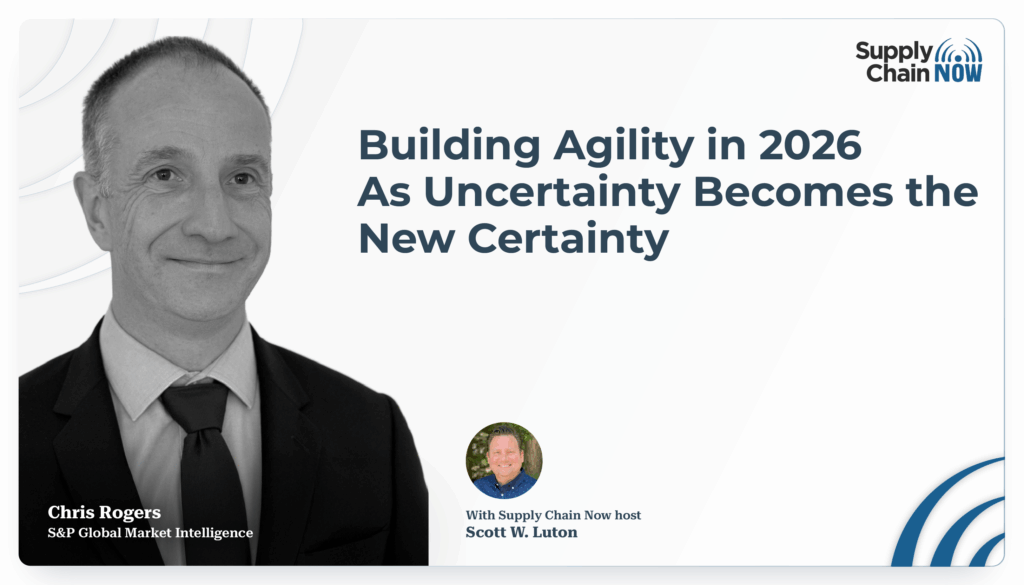
[00:01:21] Scott W. Luton: Chris Rogers is head of Supply Chain research at S&P Global Market Intelligence. Now, Chris brings more than 25 years of research experience to the table. He. Including more than a decade covering global supply chains. I bet it feels like three decades. He has worked at firms including Panjiva, which was acquired by S&P Global in 2018, Bloomberg, JP Morgan, and most recently freight forwarder Flexport, which has been on the move.
[00:01:47] Scott W. Luton: His coverage includes corporate decision making, international trade policy and logistics network operations. Folks, I promise you, you’re gonna enjoy learning from Chris and his insights and perspective here today. So. With all that said, let’s welcome in. Chris Rogers, head of Supply Chain research at S&P Global Market Intelligence.
[00:02:05] Scott W. Luton: Chris, how you doing this morning? I’m very well, Scott. Thanks very much for having me on the show. You bet. I’ve been tracking you for quite some time and we’re delighted to have you here finally on Supply Chain Now. So welcome in and I should just add. You’re the pride of Bedford, the town of Bedford, uh, in United Kingdom, which is about an hour.
[00:02:25] Scott W. Luton: Where is it in relation to London? It’s
[00:02:27] Chris Rogers: about an hour and a half. June North. It’s just far enough away to be in the countryside, just close enough to get into town and, and see. All my great colleagues at S&P Global.
[00:02:35] Scott W. Luton: I love that, uh, it sounds, it sounds like the, the perfect distance, right? Just far enough.
[00:02:42] Scott W. Luton: Just close enough. I got a fun warmup question for you as we get know you a little better before we dive into a ton of topics. So, you are a self-described device nerd. You’re very passionate about technology and I, I’ve, I have learned in our pre-show conversation that you have recently been experimenting with meta glasses.
[00:03:02] Scott W. Luton: So, Chris, tell us more.
[00:03:04] Chris Rogers: Yeah, so I, I like to try out different technologies. Partly just keeps you young, keeps you in touch. Um, also there’s a little bit of a supply chain overlay there. You sit there and you think, okay, how was this made? Where did it come from? I don’t take stuff to bits ’cause like, I’m not that clever, but with these meta glasses I was just drawn to them.
[00:03:20] Chris Rogers: We’ve played around a bit with vr, you can imagine doing supply chain network analysis. It’s all maths. So like being able to visualize is good. And that led me to these meta glasses. And I’m always surprised where like the use cases come from, right? With these glasses, it was very much about connecting to AI and we’ll talk about that later on in the show, I guess.
[00:03:40] Chris Rogers: Uh, but for me it was all about actually just taking photos. So there’s always this sting, right? The best camera is the one that you’ve got in front of you. And so having to sing on your face and just going click, seen that great picture, you know, that, that’s just been great. I’ve just been away on vacation.
[00:03:55] Chris Rogers: I got some great photos from that. I’ve got a couple of small dogs, so you can imagine my role is just full of pictures of dogs. Um, so it’s always interesting to come across these things.
[00:04:05] Scott W. Luton: I love it. You know, all the, the data centers out there in that exploding industry. I bet they love things like meta glasses, right?
[00:04:12] Scott W. Luton: It’s more and more customers, more and more space. Hey, and you mentioned your two dogs we’re big dog people here. Big shout out to Ruby and Sonny, which are our two rescues. Your dogs names Roger and Rocket, is that right?
[00:04:24] Chris Rogers: Yeah, that’s right. It is a, a funny story behind that. So obviously my surname is Rogers, our first dog was always.
[00:04:30] Chris Rogers: Gonna be called Roger just ’cause we like the symmetry, uh, of that. But it turns out that our, our first dog is a girl. So we’ve got a girl called Roger and she’s our pride and joy. So is rocket. They just didn’t mix our lives.
[00:04:41] Scott W. Luton: They do. I tell you what they sure do. Alright, so Chris, we got a lot to get into here today.
[00:04:47] Scott W. Luton: I really appreciate the opportunity. Alright, so you bring, as I shared in the intro, you, you bring more than 25 years of research experience to the table, including. Last 10 years, I believe, in global supply chain. I wanna ask you share a few aspects that’s, I know there’s a lot we could be here, we could have a six hour podcast, right?
[00:05:05] Scott W. Luton: Because I, I bet you’ve got lots of moments, but share a few aspects, critical aspects of your professional journey with us.
[00:05:12] Chris Rogers: Yeah, sure. So I’d always wanted to be in the questioning and answer space, right? I’m not very coordinated, so I’m never gonna be making stuff. So it’s very much in a kind of. Finding out how the world works.
[00:05:27] Chris Rogers: Funnily enough, when I was leaving university, I got a choice of two jobs. One was gonna go. And do operational research with Pergo, that would’ve led me straight down the supply chain route. And then, uh, a job to go work for an investment bank. As you can imagine, as an impoverished student, the job that offered the most money was the one that, that got my attention.
[00:05:45] Chris Rogers: So right. Went into investment banking for a while, focused very much on the energy sector, as you can imagine, that leads you to look at shipping and obviously energy is used in all industries, whether it is an AI data center. The guys making the chips and the steel frames to go with them. And so that leads you very much to, to try and understand all industries.
[00:06:06] Chris Rogers: I was fortunate enough that one of my employers asked me to start looking at all of the data assets they had, and that led me to speak to the folks at Panjiva. And that’s really where I got heavily into supply chain, Panjivas, a supply network and that analysis tool. And so that led me from kind of the narrow world of energy to the much broader world.
[00:06:26] Chris Rogers: Of supply chains and as a researcher, having more material to ask questions about, to find interesting answers about is really what I find to be very satisfying professionally. Yep.
[00:06:37] Scott W. Luton: Chris, I love that. And there’s so much there. I, I wanna, uh, follow back up on something because I love how you started your response with, you had that, uh, passionate, natural curiosity to understand how the world works.
[00:06:50] Scott W. Luton: And I tell you, we need a lot more Chris Rogers to help us all understand how the world works, including. The supply chain world. You might agree, you might disagree. One of the great silver linings of the really tough, difficult pandemic time was so many more consumers really understood how universal and how important and critical and how the global supply chain industry touches.
[00:07:13] Scott W. Luton: Everybody. Everybody. And I’m so glad we got smart people like you that are helping the rest of the world understand how it all works. Your quick response before I move on.
[00:07:23] Chris Rogers: Yeah, I think, I think you’re right. The, that emergence of supply chain from the back room to being at the forefront has been really important.
[00:07:31] Chris Rogers: I think it’s raised the profile of the profession and uh, I think as a consequence, we’re seeing a lot of really smart people join with different skills. Historically, it’s been very procurement focused. Now it’s a lot more people coming in who are data savvy, who are tech savvy, and that just raises the quality of the decision making.
[00:07:47] Chris Rogers: And that means we all get the stuff that we want at a better price than than ever before.
[00:07:53] Scott W. Luton: Well said, Chris. Well said. You know, we need everybody as, as I’ve been saying for years, there’s something for everybody in global supply chain. You, as Chris mentioned, could be the procurement or the engineering, the data science, that side of folks or.
[00:08:06] Scott W. Luton: Now I always get confused if it’s a right brain or left brain. That’s creative thinking. But we need all the creative folks too, right? One very small, big example, but there’s countless packaging. The whole packaging science. We need the most creative minds of helping to design packaging, which makes a big impact.
[00:08:24] Scott W. Luton: Every single day.
[00:08:26] Chris Rogers: And I would add to that, I think one of the aspects, and I wanna keep this upbeat so I’ll do the disappointing bit, but one of the things I’ve been disappointed about with this new focus on supply chain over the past five years is that the environmental aspects aren’t getting the focus that they should.
[00:08:40] Chris Rogers: You mentioned packaging. In an ideal world, packaging minimizes waste. And so you’re right. You know, we need the creative people in to come with those ideas. The engineers in. To actuate them. And you know, I said a few moments ago, it’s about getting stuff as cheap as you want. I think it needs to be green as well.
[00:08:56] Chris Rogers: There’s been a bit of a focus away from that recently for all kinds of reasons, which I’m, I’m sure we don’t need to get into today. But I, I think we do need to see a return to that focus on the environmental aspects of supply chains too.
[00:09:07] Scott W. Luton: Yeah, Chris. I agree. And I would also, I think the good news there is many of the leading world class organizations haven’t wavered in their commitment to making more sustainable progress.
[00:09:18] Scott W. Luton: And we can learn, all of us can learn something from those organizations. Okay. I wanna ask you this question because I am, I’ve been fortunate, rub elbows with some of the smart researchers like yourself. I am not one by any means. For our wonderful global Supply Chain Now, fam that’s out there listening or view or watching us, what is one thing most of all of us may not appreciate about professional researchers?
[00:09:42] Scott W. Luton: Chris?
[00:09:44] Chris Rogers: I think it, it’s just the amount of different sources that you need to draw on together. Cohesive view of the world, right? You know, you, you can’t get away with just like reading a newspaper. Of course you should be watching and listening to, to great podcasts like this one. There’s a lot more data out there than there ever, ever used to be.
[00:10:02] Chris Rogers: So separating the, the signal from the noise within all of that is becoming more difficult than it ever was in the past. And so you’re continually forced as a researcher to review the toolkit. You have to increase your skill set in using all of those tools to bring all of that together. We often talk about within supply chain decision making, moving from.
[00:10:24] Chris Rogers: Kind of the data layer to the insight layer, to the decision making layer. And I think for researchers, we can really add a lot more value at that insight layer, particularly by, by being forward looking as well. So I think, yeah, just the fire hose information, I guess is, is the key thing that researchers are trying to deal with now.
[00:10:42] Chris Rogers: And maybe some of our customers face similar issues facing a lot of information coming at them within their own organization. So it’s really incumbent on us as researchers to make all of that. Digestible.
[00:10:55] Scott W. Luton: Chris, excellent perspective there. And one thing I heard, and one of my observations when I, uh, meet smart folks like you is, is your, your superpowers of assimilating all of this data and developments and the layers that you mentioned, bringing all that in and then picking those signals.
[00:11:14] Scott W. Luton: That folks, it, you know, there’s so much noise in this world we live in, but we gotta pay attention to the signals amongst the tidal wave of noise. And I tell you folks like you and smart, savvy, professional researchers are really good at pointing to and, and pulling out the signals that we all gotta stop and pay attention to.
[00:11:31] Scott W. Luton: I gotta ask you this question. You touched on this earlier because Panjiva, I think was your entry into global supply chain. Did your perspective when you shifted from. Other aspects of, of industry and started focusing on global supply chain. Did your perspective shift what, anything else you wanna share about that pivot point in your career?
[00:11:51] Chris Rogers: Yeah, absolutely. I think it, it’s funny we all use the word supply chain and we should really say supply network. I think coming from the energy world, you think in a, a very linear manner, right? You get it outta the ground, whether it’s oil or natural gas, or you gather it from renewable energy generating sources.
[00:12:07] Chris Rogers: You deliver it through a network that might be a pipeline or a cable. It arrives maybe at a power plant and then off from a cable, and then after that you don’t really care too much. You wanna understand the downstream so you can understand the demand, but it, it’s completely linear. Um, I think what really drew me to Panjiva and has kept me at S&P Global is understanding better supply networks.
[00:12:30] Chris Rogers: So how different companies, their products, the countries they work in, and most importantly, the people who are. Involved in it are all joined together. You know, this is a, a multi-dimensional model. As I mentioned earlier, I, I kind of nerd out on VR a little bit, just trying to find a better way to, to visualize this.
[00:12:49] Chris Rogers: But really, it, it’s that broad interconnectedness. I think if we were recording this in the 1970s, I’d be coming off as a bit of a hippie, but I do genuinely believe. The understanding how these networks are connected and, and recognizing they’re multidimensional and not just a chain, I think is increasingly, uh, important.
[00:13:08] Chris Rogers: I dunno if you wanna rebrand the supply network now, but you know, maybe, maybe that time will come
[00:13:13] Scott W. Luton: only if I can minimize my license cost to you. Uh, Chris. And the greater point. I think you, you nailed it. Everyone doesn’t love it, but I love the word ecosystem. We’ve had a lot of shows where we refer to it as supply webs, but your comments there about linear thinking and how that won’t always get, get us all to where we would need to go is a really important one.
[00:13:34] Scott W. Luton: And who knows. We’ll see how our common references to what is currently the global supply chain industry, how that will evolve. I wanna look back for a second as I shift gears into this next segment of my conversation here with Chris Rogers. So we’re recording this in mid-November 2025. And when I think back to my own mindset and perspective, and I cringe at my prognostications in January, 2025, hey, I’ve learned a ton, lots of lessons learned, and I think I’m still learning day by day.
[00:14:08] Scott W. Luton: You are part of the team that publish a, what I think is a great read called Three Tools for Trump, tariffs 2.0. And again, y’all published this in January, 2025. At the beginning of the year, did you foresee this degree of tariff induced trade turmoil?
[00:14:25] Chris Rogers: Of course we have a hundred percent perfect vision into the fu.
[00:14:28] Chris Rogers: No, of course not. No. It’s funny, right? ’cause earlier in the year we were putting together some numbers and on the basis of, of what had been suggested, um, by elect now President Donald J. Trump, um, we’re like, well, you know, these tariffs, they could get up to like 6% or 7%. And people are like, yeah, you’re crazy.
[00:14:46] Chris Rogers: And of course we were all wrong by a magnitude. Yeah. The, this concept of the kind of acceptable window of policy decisions era, that’s really changed. That’s what the president really brought to the party, was just shifting that whole debate around not is it 1% or 2%, but is it 25%, 50%, a hundred percent. And I think that shocked most supply chain decision makers, it led everybody throughout the supply network decision making process to have to foundationally review.
[00:15:14] Chris Rogers: How they were making their decisions, whether that was how much to import and when, how much to manufacture, how much to keep in stock, more laterally, what to do with pricing. And so what we were trying to do with that paper early in the year was just to say, look, we don’t really know what’s gonna come.
[00:15:30] Chris Rogers: We have kind of a model from the, kind of the late 20 teens from the previous Trump administration as to what might happen in terms of volatility. But it’s just bringing those toolkits together. There’s a lot of discussion about agility and agility in decision making. And so what we wanted to do with that paper and in subsequent papers that we’ve done and in the services that we provide, both in our research and in our toolkits, is to give our customers the ability to have that agility to say, actually, yeah.
[00:15:59] Chris Rogers: We called our most recent outlook. The only certainty is uncertainty. It’s like that, that’s kind of where we are now. So yeah, we didn’t miss, we didn’t expect anything to this degree of continual volatility or the level of tariffs Yes. Being
[00:16:13] Scott W. Luton: used. Yeah. Chris, same. And I, I wanna talk, ask you about those tools and strategies in just a minute, but you know, when I look back.
[00:16:20] Scott W. Luton: A couple big events, or at least maybe big here in the States. The UPS strikes, I predicted a resolution there when it came to the port strikes. I predicted, you know, it wasn’t gonna go on in months and months, and we got that resolved and then I was like in, in January, earlier this year, I was like, surely all of this hubbub.
[00:16:41] Scott W. Luton: Was being used going into negotiations. Surely none of this is gonna linger, especially to your point 25, 50, a hundred percent more surely. This is just positioning. Oh my gosh, I think I have never been this wrong about what, how I think something will play out. So we’ve all learned together. Quick comment before I shift over and then talk Tools and strategies.
[00:17:05] Scott W. Luton: We’re not gonna get the smartest people in, in all of the world in all of history. Still we’re probably wrong about half of their predictions ever made your quick comments there, Chris?
[00:17:16] Chris Rogers: Yeah, I think it’s important to be humble when you make decision making, when you make, uh, big decisions or big forecasts like that.
[00:17:22] Chris Rogers: What we’re trying to do though is to think around the scenarios. This is our core scenario. Here’s where we could be right or wrong. Here’s how it could be better or worse. And when we speak to our customers in throughout supply chain decision making, they always do that base case, worst case, and so on. I think what’s happened this year is that we very much skewed to everybody’s kind of worst case, right?
[00:17:43] Chris Rogers: You the most uncertainty, the most changes. I think it’s worth bearing in mind though, that like tariffs do work for some companies. A lot of American based manufacturers with American sourcing doing quite nicely. Thank you very much. That’s
[00:17:55] Scott W. Luton: right. Yeah, that’s a good, great call out. There’s always an opportunity for somebody and each and every, uh, disaster might be a strong word.
[00:18:02] Scott W. Luton: It kind of depends on your, your position probably. But, um, let’s talk about the talking about things at work. What tools, strategies, you name it. Have you seen those organizations out there use throughout the turmoil that’s really been effective?
[00:18:19] Chris Rogers: Yeah. It is funny it, a lot of the companies who we’ve seen have been successful it, this is saying it’s a, an overnight success 10 years in the making.
[00:18:27] Chris Rogers: Right? Right. A lot of the companies that have been successful are ones who’ve had great visibility over their supply network, and those were, you know, as we, as we often talk about the pandemic era, those were the guys who were saying, alright, we have a need for visibility. We’re gonna invest in that visibility and then we’re gonna leverage it.
[00:18:46] Chris Rogers: Your visibility platform doesn’t necessarily tell you where the next tariff is gonna come from or what the tariff rate is gonna be, but it does mean when it hits, you know, very rapidly what you need to say to your suppliers, what you need to say to your buyers, what you need to say to your staff, what you need to do in terms of your financial planning.
[00:19:04] Chris Rogers: So those kind of visibility platforms. I know that that’s not quite as strategy as such, but having that very cohesive data-driven supply network decision making, I think is. There’s really been kind of absolutely critical. There’s a lot of kind of tactics that have been followed, right? Early shipping, inventory management.
[00:19:25] Chris Rogers: We’ve seen a lot of discussions in retail about direct import as a tactic. We are moving into the phase now of pricing and cost control, but none of those really worked properly unless you got your visibility sorted in the first place. So, so I think it, it, it’s that kind of call it what you want, supply chain control, tower Beacon.
[00:19:45] Chris Rogers: Golden source of truth. You know, it’s, that is really at the heart of, of the companies who have been most successful.
[00:19:51] Scott W. Luton: Yep. And Chris, you, you touched on this earlier and you’re kinda alluding to it now, the incredible in this golden age of supply chain tech. So really remarkable time and all these challenges we’re talking about now, trade and otherwise is really fueling more innovation and more actionable visibility where you get the visibility, but better yet.
[00:20:12] Scott W. Luton: You get a path of what decisions and, and what actions need to take place. You get solutions and all the scenario modeling technologies. It’s remarkable to see what the power in our technologies to see hundreds, thousands, if not millions of scenarios as we try to. Uh, glean a path ahead during these historically uncertain times.
[00:20:37] Scott W. Luton: I think it’s, it’s nothing short of amazing. Your quick response and then I’m gonna talk specifically about one big deal that probably the rest of the world’s watching to, to some degree.
[00:20:47] Chris Rogers: Well, that sounds ominous. Um, in terms of, yeah, I think in terms of the technology, it’s, you’re absolutely right. You know, it’s incredible the, the tools that are out there and we can talk more about tech later on, but I think the key thing here.
[00:21:00] Chris Rogers: Is that it’s people who are gonna be making these decisions. And so, you know, we all need to keep up with the technology. I do it by buying ridiculous pair of glasses with cameras built in, but you know, staying up with the technology and actually using it day to day. Yeah. That, that’s critical for all of us who are involved in supply.
[00:21:16] Chris Rogers: Now, whether decision making.
[00:21:17] Scott W. Luton: That’s right. And as we’ve been saying for years now, folks, get out there experiment. You don’t have to be a technologist, you don’t have to be an engineer. Uh, I know I’m not. Experiment with the AI platforms or meta glasses or you name it. Who knows? You might have a light bulb go off of how your organization could use it or your professional journey could benefit from it.
[00:21:36] Scott W. Luton: Okay, one more trade related question, Chris. I got two. So probably the biggest. Tentative trade deal that most of us are watching, uh, at least a lot of us are, is the US and China trade deal that is still kind of being unpacked and, and scoped out and hopefully down on paper your thoughts as to the details that have been released thus far.
[00:22:00] Chris Rogers: Yeah. As you say, you know, we’re talking in, in mid-November, uh, there’s a lot of moving parts in the agreement that have been reached. I think the first thing that needs to be born in mind, and, and this goes for. All of the agreements that have been reached by the US government with other countries is they’re not your grandmother’s trade deal, right?
[00:22:18] Chris Rogers: This isn’t 40,000 pages of closely negotiated text with some of the finest minds in the legal profession, agonizing over every number. These are deals brought together by people, um, over a handshake, over a discussion, very short form in nature. As a consequence of which you are always gonna end up with these risks where.
[00:22:39] Chris Rogers: What people thought they agreed, they maybe haven’t agreed. And we see that, for example, in this discussion around securing supplies of rare earth elements, you know, used in everything, particularly in defense, which is why I think governments are most concerned about it. But what actually was agreed in terms of ongoing access, in terms of the regulations put in place for that access.
[00:23:03] Chris Rogers: There’s some doubt about whether both sides actually were. Agreed on, on what was agreed. Unfortunately, it’s always the little things that trip over some of these deals. I think the other thing we’d be watching more broadly for all of the deals that have been signed by the administration is the follow up to next year in terms of purchasing.
[00:23:22] Chris Rogers: So lots of commitments to purchasing farm goods, aerospace products, and so on. That’s real easy to track. You don’t need to be like a, a data scientist to to track that. I think as we go into next year, that’s one area that you know, no matter where you are in supply chain decision making, you need to keep an eye to that because if those commitments.
[00:23:44] Chris Rogers: Or can’t be delivered. Then we’ll get a whole nother round of this uncertainty that we’ve got at the moment.
[00:23:49] Scott W. Luton: That’s right, Chris. Well said. It can always be worse, folks, we gotta keep our eye on the things that matter. To get specific on a couple of those things, soybeans, US farmers really have had a really tough year.
[00:24:00] Scott W. Luton: So we’re looking to see if China’s commitments on purchasing lots and lots of soybeans. Not only next year, but just through the end of this year. That’s one I’m tracking rare earths. I’m really curious to see some of the domestic rare earth production initiatives that has been begun. Some of the relationships and partnerships with groups in Australia and beyond.
[00:24:21] Scott W. Luton: And then shipbuilding. I’m very curious to see, just here lately there’s been some big, big news come out of, uh, joint US and South Korea effort to really reinvest and reinvigorate shipbuilding here in the States. ’cause it’s all but. It’s amazing to see what it was and where we are today and talk about a strategic choke point.
[00:24:41] Scott W. Luton: So it’ll be interesting to see how that, uh, plays out. Okay. Speaking of shipping, Chris, shipping and logistics operations, when you think of that large area, really important area of global business, I’ll output it. What do you think is gonna be the top two to three developments or stories this year that will still be meaningful in say, 2030 and beyond?
[00:25:05] Chris Rogers: I think the focus on the physical aspects of supply chains is, is really important. We have this saying, I think it sounds a bit like Jurassic Park Logistics finds a way large finds a away. Logistics always finds a way, no matter what’s been thrown at it through canals or the tragedies of the pandemic.
[00:25:23] Chris Rogers: Just stuff keeps getting there sometimes for a lot more money than necessarily the cargo owners wanna pay. But that’s, that’s kind of a, an important point here, right? Because I think one of the key. Elements for global shipping networks at the moment is capacity. So it’s a very cyclical industry, and this is gonna play out through 2031.
[00:25:42] Chris Rogers: Things we do at S&P is we look after the database for the International Maritime Organization, so the IMO numbers, so we have a good sense of what vessels are on the water, where they’re going, and which ones are being built. And it’s important to note that over the next four years, there’s gonna be an additional 30% added to the global container fleet.
[00:26:01] Chris Rogers: 30%. Now demand is typically growing by a couple percent per year. So it’s really gonna be a challenge, I think, for the container lines to maintain the discipline that they’ve shown to make sure that we don’t see a collapse in rates. Clearly collapsing rates is good or bad depending on which side of the negotiation that you are on.
[00:26:22] Chris Rogers: So I, I think that that balance of, of capacity is, is gonna play out through 2030. Second part is what is the right network design? So we’ve seen in emerging in 2025, the Gemini partnership between Maersk and Hapag Lloyd following a very different way of running the shipping network hub and spoke rather than string.
[00:26:44] Chris Rogers: They have said they’re having some good successes there and, and that’s a great, the question is whether we see that redesign for all suppliers. ’cause if we do, if we’d see all the container lines move over to. That new approach and that has an implication for different port operators. Remember the port operators have gotta take decisions that that last for decades in terms of building new capacity, installing new cranes, all of that kind of area.
[00:27:09] Chris Rogers: So I would say those couple of areas are, are the ones that we’d really be paying attention to over the next four or five years.
[00:27:15] Scott W. Luton: Hmm, Chris, outstanding. I wish I had a couple more hours with you. Those are intriguing aspects and we’ll definitely have to have you back as we keep tracking both of those and so many other developments.
[00:27:26] Scott W. Luton: I, I wanna ask you about this. We, you and I both have referenced the word uncertainty probably seven times so far. I was trying to keep out in our conversation. I was reading a great World Economic Forum article a week or two ago, and they were talking about the main. Thrust of this article was attempting to quantify all the uncertainty that that we’ve been talking about and feeling and trying to make decisions in, especially as global business and global supply chain leaders.
[00:27:53] Scott W. Luton: This year. Many economists and analysts say that we’re facing historic levels of uncertainty as they’ve attempted to quantify. Is this more than 1985 or 1996, whatever. A lot of ’em, folk, a lot of folks, point to data, a data-driven approach that does show indeed. It is historic and it certainly can be overwhelming on some days.
[00:28:15] Scott W. Luton: Your general thoughts in terms of 2025 uncertainty versus any other year’s uncertainty?
[00:28:21] Chris Rogers: Yeah. I mean there’s always something, right? In this year it was tariffs. Last year it was strikes the year before it was canal issues. The year before that, it was the pandemic. Before that, it was tariffs. Before that, it was.
[00:28:34] Chris Rogers: Financial failure of shipping and various economic crises. There’s always something. Yet statistically, when you pull out different measures of volatility, of uncertainty, we’re at historic levels. Here’s your corny phrase for the day. It might be historical, but we don’t need to be hysterical. Ah, I like it.
[00:28:52] Chris Rogers: You like that? Yeah. Yeah. I can feel my kids groaning in the distance. Um, but the, the, the key point here is that. W we are dealing with uncertainty in topics that are relatively well understood. It’s uncertainty in carrots, uncertainty in labor disputes. And I would also say that not all uncertainty is bad, right?
[00:29:12] Chris Rogers: We are not certain how technology is gonna play out in terms of ai. We are not certain how new business models in the logistics sector are gonna play out. That doesn’t mean it’s a bad thing through it all. And I keep coming back to this is. Building up agility allows you to deal with these kind of historic levels of uncertainty.
[00:29:32] Chris Rogers: One thing that’s always missing from those papers, by the way, is when will it all get clearer? When will these uncertainties dissipate? Are we in a continually chaotic world? Our view is very much that there will always be something, you know, it’s tariffs. Now, next year we got the US midterms. The year after, it’ll be something else.
[00:29:54] Chris Rogers: So, you know that that level is always there. So one thing we always do within our research is to say, on the 12 month view, on the 18 month view, or longer, when will we start to see these things resolve? When will we start to see this specific piece of uncertainty, uh, start to unwind?
[00:30:12] Scott W. Luton: I appreciate your perspective there and there’s so much truth in what you shared.
[00:30:16] Scott W. Luton: And then the good news is on a little bit of a lighter note, uncertainty appeals to a lot of people. You look at Las Vegas, there’s lots of uncertainty in your average trip to Vegas. They pull in millions of people per week. And you know, in a, in a weird way. Since uncertainty goes with the craft that is global supply chain management.
[00:30:36] Scott W. Luton: That might be a great talent magnet. We’ll see how it plays out, but I’ll tell you just from my benefit, I’d love just a smidge of more certainty in my weeks these days. We’ll see what happens. Speaking of, we’ll see what happens. Let’s look ahead to 2026. You’ve already called out the midterms here in, in the US political cycles.
[00:30:53] Scott W. Luton: We’ll see how that goes. Frankly, I’m, I’ve had my feel of politics. I’m, I’m good, but. Your team recently published the 2026 Supply Chain Outlook report. Share a few key takeaways from that piece with us, if you would.
[00:31:09] Chris Rogers: Yeah, absolutely. So I think there’s, there’s kind of three broad buckets that we’re, we’re looking to, to pull together.
[00:31:15] Chris Rogers: First entre policy. I know you’ve had a lot enough politics, so we’ll put the politics to one side. The good news, over the next 12 to 18 months, we’re gonna see a lot more trade liberalization. Coming through, you know, EU, with India, we are hopefully gonna see the EU with the MEO region, so that, that’s Argentina, Brazil, Uruguay, and Paraguay.
[00:31:35] Chris Rogers: We are gonna see an expansion of C-P-T-P-P. This is the trade deal in Asia. That’s hubbed around Japan. That includes Mexico and Canada and Chile and Peru Could be expanded to include South Korea or China or Taiwan, Indonesia. So we’re, we are really upbeat about the prospects for that trade liberalization coming through really as a reaction, I think, to a lot of the protectionism that we’ve seen in the United States.
[00:32:03] Chris Rogers: The second thing we are looking out for is probably a quiet year in terms of trade volumes. We talked a little bit earlier on about the expansion in capacity on the shipping network. A bit of that comes in next year. A lot more comes in. The year after. So I think container shipping rates, that kind of area that that’s gonna be very finely balanced next year.
[00:32:24] Chris Rogers: And then the third element is a change in corporate decision making away from being very tactical to returning to being more strategic. So by tactical we mean reacting through front loading and inventory management, trying to push prices up a little bit later next year, we’ll start to see more investments, particularly in reassuring, so making big bets.
[00:32:45] Chris Rogers: On the long term structure of global supply chains and where the manufacturing centers are gonna be. And I can tell you one thing, the one thing that we do know is that we don’t know who the winners are precisely going to be. ’cause we’re gonna look back in five years and go, wow, we didn’t realize Country X was gonna be such a dark horse in, in terms of emerging as a successful manufacturing economy.
[00:33:08] Chris Rogers: We are real excited about India. It’s a huge domestic market. A lot coming there. But you know, amongst all of those Ian countries, they’re all jockeying for position. As to who’s gonna be the winner of the next five years. So those three areas, trade liberalization, global trade deals, slow year for global trade balance on the rates, and then a move to being more strategic in decision making.
[00:33:29] Chris Rogers: Those are the big buckets of what we’re looking for next year.
[00:33:32] Scott W. Luton: Chris, I love it. Two quick points on your last note there. It, it is, uh, remarkable what we’re seeing, especially from a manufacturing investment standpoint in the beautiful country of India. Uh, it’s amazing to see what Mexico is doing. It really is.
[00:33:46] Scott W. Luton: And so we’ll keep our eye on all that. And then going back to your first point, uh, and not to sound too Pollyannish, obviously we got a lot of geopolitical conflict, some big ones we hope. We can find, uh, a pause and hopefully a lasting piece and hopefully we don’t have to wait till next year. Hopefully we can get that here year end.
[00:34:03] Scott W. Luton: But I think one of the good things about global trade, despite the trade wars and, and some of the friction it does cause I think generally speaking. It’s more a force for good, I think, and we’ll see what great gains we get out of global trade in 2026. Okay, back to the 2026 Supply Chain Outlook report.
[00:34:24] Scott W. Luton: How can folks access that, Chris?
[00:34:27] Chris Rogers: So I guess you can either go to your browser or I guess now chat, chatbot of choice. There’s plenty available. And just go search for the S&P Global Supply Chain Outlook 2026, and you’ll find that from all good websites everywhere. Please read the underlying report.
[00:34:43] Chris Rogers: Don’t just take the chat bot summary as, uh, content producers. We hopefully can give you a lot deeper insights in the initial summary. We’ll do.
[00:34:51] Scott W. Luton: Yeah, Chris, well done. We gotta have full context. Don’t stop at headlines, folks. And I would also add another one. You, you and I were talking pre-show, another great report, the Age of Agility, seeking Advantage and Uncertainty, economics, geopolitical Risk, trade and Supply Chain.
[00:35:06] Scott W. Luton: Other great annual report put out by Chris and the s, S&P Global team, so y’all can check that out as well. And one other quick tip. Go direct to the S&P website. That might help completely. So you can Google that in your favorite browser and go right there. And I bet there’s a library. I bet you have everything you want from Chris Rogers and the S&P team.
[00:35:28] Scott W. Luton: Have you ever dreamed of, is that, is that right Chris? Yeah, absolutely. Just
[00:35:31] Chris Rogers: head over to spglobal.com and you’ll find stuff from all of our teams, you know, not just on supply chain and global trade, but across economics, AI, sustainability, financials, the whole lot. It’s all there for you.
[00:35:47] Scott W. Luton: Outstanding. Okay. Alright, let’s, we gotta get one more prognostication in before we wrap here and before we make sure folks know how to connect with Chris, who’s on the move. Alright. So looking at the future again, and maybe even beyond 2026, which technology do you believe will have the most transformative impact on supply chains in say, the next three to five years?
[00:36:10] Scott W. Luton: And why? And one other disclaimer, maybe we look at ai but every comes to everybody’s. Uh, that’s listing or watching their mind, but maybe, what’s that? Good AI and a non-AI answer, Chris?
[00:36:24] Chris Rogers: Okay. Yeah. So if we take the AI piece first, I’ve, we are really excited about agentic ai, particularly for procurement because it is a workflow based concept.
[00:36:34] Chris Rogers: I talked earlier about kind of supply chain decision making, being data driven and all that, and that can be pretty scary for a lot of folks and. I think one of the things that Agen AI will allow is for folks who didn’t make it through that first round, who didn’t do all the data engineering and the Power BI and the Tableau and all of that to kind of jump to the next generation with what they know, which is effectively treating these systems as being a smart counterparty that knows your data, knows external data.
[00:37:05] Chris Rogers: Here at S&P, we are working with some of the finest companies in the world to build those tools. We’ve just announced. Deal with IBM to build agen workflows. We’re working with Google, all the other hyperscalers because we’ve got data and insights that can feed into that, but we recognize we’re not the whole solution.
[00:37:20] Chris Rogers: So these things have gotta be joined together. Top tip, for anyone that’s listening right now, go away. Work out what your decision making process is, write it down on a bit of paper or an iPad or whatever. And just work out within that. Which bits do I wanna automate? Put some minutes by it. Like what are the parts of your decision making that drive you crazy?
[00:37:41] Chris Rogers: ’cause you’re always trying to find the same information and it’s repetitive. Those are the areas where, um, an agent AI workflow can really help you. But you need that clarity. Don’t just dive in. I think you’re absolutely right, Scott. As you said earlier, try these things out. Do experiment. Do Be careful though, when you’re doing that in an AI environment, make sure it’s one that’s been blessed by your technology team.
[00:38:02] Chris Rogers: You don’t wanna leak any of your secrets into the outside universe, but I think those decision making workflows are, are what we’re excited about on the AI side. But as you say, there’s a lot beyond ai.
[00:38:13] Scott W. Luton: There absolutely is. It really is amazing and I, I know we’ve been talking about additive manufacturing and 3D printing forever, but breakthroughs continue to take place in that space.
[00:38:25] Scott W. Luton: I think of blockchain. I know a lot of folks that might roll their eyes when they hear or watch me say that, but I think the, the art of the possible when it comes to both of those technologies is still yet to be fully explored and fulfilled. And I got one more thing based on your ai. Perspective here today.
[00:38:43] Scott W. Luton: I think as humans it’s very difficult for us to fathom the depths of the possibilities over the next year, much less the next three to five years because our blind spot, and especially in terms of how we can apply it and not only apply what’s is known today, but what will be known this time next year.
[00:39:05] Scott W. Luton: This, these are really exciting and terrifying times all. Oh, absolutely. One your thoughts.
[00:39:11] Chris Rogers: Yeah, no, I, I absolutely agree. It, it’s very difficult. You know, for those of us, and I’ll point at myself here a little bit later in our careers, we’re not too anxious about what the, you know, the long-term implications of some of these technologies are.
[00:39:22] Chris Rogers: But for folks who are just entering the supply chain for profession, you’ve gotta grab these things with both hands. I, on the topic of hands, the non-AI development I’m most interested to watch over the next three to five years. Is high dexterity robotics, whether it’s Tesla’s optimist system or there’s a lot of other companies producing those sort of systems.
[00:39:42] Chris Rogers: Once that kind of find dexterity is sorted out, then that’s going to lead to, I think, a, a step change in how manufacturing works. Certainly a lot more producing closer to the customer. You know, you’re not necessarily looking just for the cheapest labor, then you’re looking for the cheapest kind of complete bill of materials.
[00:40:00] Chris Rogers: And so I think if we’re gonna be watching anything within the technology space, it’s that high dexterity robotics that we’re, we’re gonna be keeping an eye on out there.
[00:40:10] Scott W. Luton: Chris, that’s a great one. And you know, one of my favorite themes related to that is how it protects and enhances the, the human experience and the role.
[00:40:20] Scott W. Luton: They played a critical role that, especially our frontline, that never gets nearly enough recognition and the role they play in global supply chain and global business. You know, how can we make their days easier, more productive? Put them in a position to find more success. Much, much more easier. Uh, this is one of my favorite themes of the golden age of supply chain tech, for sure.
[00:40:43] Scott W. Luton: Okay. Chris Rogers, we’re gonna have to have you back. I really enjoyed, I’ve got my 17 pages of notes from what you’ve shared here today. Let’s make sure folks know how to connect with you. So two parts here. How can folks connect you, connect with you in general? And I know you get out there and you’re doing panels and keynotes, all, everybody wants to hear Chris Rogers take on things.
[00:41:05] Scott W. Luton: Any big events you’ll be at in the next few months?
[00:41:08] Chris Rogers: Yeah, so the easiest way to um, find me is on LinkedIn. I’m Chris, chrogers. In terms of upcoming events, we’re coming up towards the end of the year. I’ve actually just been traveling through Asia for three weeks, so. I’m looking forward to not traveling too much, but keep an eye on my LinkedIn handle.
[00:41:24] Chris Rogers: The next big, big thing we’ve got coming up is the TPM 26 conference. Uh, that’s run by our friends in Journal of Commerce, uh, another part of S&P Global. Uh, that’s March one through four in Long Beach, California. Uh, but like I say, find me on LinkedIn and you’ll be able to see where I’m appearing there.
[00:41:42] Scott W. Luton: Outstanding. And yeah, TPM always is an event to have on your calendar. Chris, I hope to see you maybe next year’s big event and folks connect with Chris over on LinkedIn. You’ll enjoy the perspective. He drops there all the time. Chris Rogers, head of supply chain research at S&P Global Market Intelligence has been a delightful experience to learn from you here today.
[00:42:04] Scott W. Luton: Thanks for joining us. Thanks very much for having me, and I look forward to coming back. Let’s do it, Chris. Folks, all of our audience members out there are dear Global supply chain, now fan. Whether you’re tuned in and watching us or you’re listening to us, you name it. Thanks for being here, number one.
[00:42:20] Scott W. Luton: But you know, I like to assign homework unlike my three kids. Chris, I’m not sure what happened to homework. My three kids never have homework from their school teachers. Folks, our audience members, do you gotta take, one thing you heard here from Chris here today. He dropped a truckload, a container load.
[00:42:35] Scott W. Luton: But take one thing, share it with your team. Share it with a colleague, your manager, you name it. But. Do something with it, put it into practice. It’s all about deeds, not words. That’s how we’re gonna keep transforming global business for sure. So with all that said, Scott Luton challenging all of our dear Fa audience members out there.
[00:42:51] Scott W. Luton: Do good, give forward, be the change that’s needed. We’ll see next time right back here on Supply Chain Now. Thanks everybody.
[00:42:59] Voiceover: Join the Supply Chain Now community. For more supply chain perspectives, news and innovation, check out SupplyChainNow.com. Subscribe to Supply Chain Now on YouTube and follow and listen to Supply Chain Now wherever you get your podcasts.