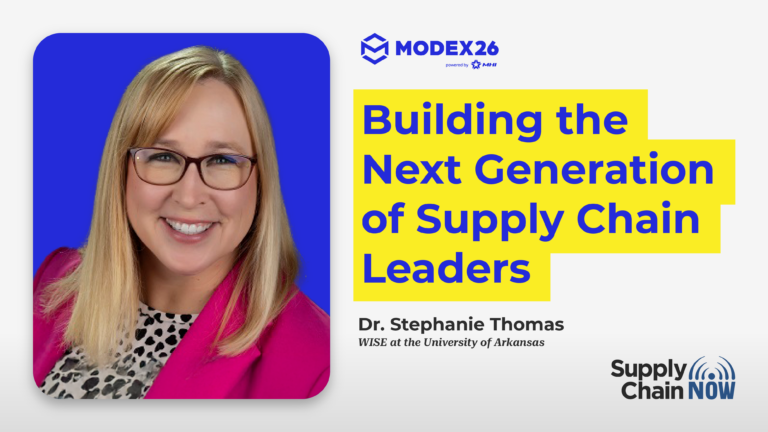
Building the Next Generation of Supply Chain Leaders
At MODEX 2026 in Atlanta, Scott Luton sat down with Dr. Stephanie Thomas, Associate Professor of Practice at the University of Arkansas and Founder & Executive Director of WISE, for a wide-ranging conversation about supply chain talent, AI, and the future of workforce development.
One thing becomes immediately clear from the discussion: while technology may dominate the headlines, the future of supply chain still depends on people. Of course, that makes the ability for organizations to more effectively engage the new generations entering the workforce all that more critical.
The Industry’s Biggest Question Mark: AI and Talent
When asked about the biggest priorities facing supply chain leaders today, Thomas doesn’t hesitate: AI is at the top of nearly every conversation.
“Everybody’s trying to unpack what is it going to do? How is it going to change things?” she explains.
Organizations are wrestling not only with how to adopt emerging technologies, but also with how to prepare their workforce for the transformation ahead. From upskilling current employees to redesigning workflows, the talent implications of AI are massive.
At the same time, the broader business environment remains highly dynamic. Geopolitical shifts, ongoing disruption, and rapid technological change are forcing organizations to rethink how they attract, develop, and retain talent.
Why Supply Chain Is Winning Over Young Talent
Despite the challenges, Thomas is optimistic about the future of the profession.
“We have a lot of really excited, enthusiastic young people who want to come into the field and make a difference,” she says.
That enthusiasm is fueled in part by growing awareness of supply chain as a career path. More universities are launching supply chain programs, and even high schools are beginning to introduce students to the field.
What makes supply chain especially attractive to younger generations is its sense of purpose. Today’s students want meaningful work – – and the global supply chain industry offers opportunities to solve real-world problems, improve lives, and drive tangible impact.
The Hiring Problem Isn’t Talent
Thomas believes many organizations need to rethink how they approach recruiting and workforce development.
“There’s an opportunity for organizations to be much more intentional about talent and hiring,” she explains.
Too often, companies take a broad, unfocused approach to university recruiting instead of developing deliberate talent sourcing strategies. According to Thomas, organizations must define what “top talent” actually means for their culture and operational needs.
For some companies, that may mean prioritizing academic achievement. For others, it may mean identifying grit, resilience, or work ethic.
She also highlights a major issue in internship recruiting: delayed decision-making. Students who have strong internship experiences often move on quickly if organizations wait too long to extend offers.
“The early bird gets the worm,” Thomas says bluntly, emphasizing the importance of decisiveness in recruiting.
WISE: Creating a National Movement
One of the most exciting developments in supply chain education is WISE, short for “We Impact Supply Chain Excellence.”
Originally launched as a student organization at the University of Arkansas, WISE has evolved into a national initiative focused on connecting, inspiring, and equipping the next generation of supply chain professionals. The mission goes beyond a single campus.
“How do we make connections across universities, not just within a university?” Thomas asks.
Through events like the WISE Future Leaders Symposium, students from dozens of universities come together with industry professionals to explore career paths, build networks, and learn from real-world experiences.
The initiative also exposes students to the incredible diversity within supply chain careers, from retail and manufacturing to nonprofits and service organizations.
Real-World Exposure Changes Everything
A key component of WISE is its “WISE On Location” tours, which bring students directly into operational environments. Thomas passionately believes there is no substitute for seeing supply chain in action.
“There is nothing like boots on the ground seeing it in action,” she explains.
Students tour fulfillment centers, manufacturing plants, and even nonprofit organizations to understand how supply chain principles apply across industries. These experiences not only build technical understanding, but they also broaden perspectives on purpose, sustainability, and career opportunities.
AI Will Change Education, Too
Interestingly, Thomas predicts that AI won’t just transform supply chains, but it will fundamentally reshape education itself. Today’s students are already deeply familiar with AI tools, and many are adopting them faster than educators and employers alike.
“This is the first technology… that students and young people coming up are actively using,” she notes.
As a result, universities must rethink how they teach analytical thinking, storytelling with data, and problem-solving. The future won’t be about manually building spreadsheets. But rather, it will be about asking better questions, exercising judgment, applying curiosity, and leveraging modern tools.
Final Takeaway: The Future Belongs to Curious Problem Solvers
Dr. Stephanie Thomas leaves supply chain leaders with an encouraging reminder: the next generation is ready.
These emerging professionals are tech-savvy, purpose-driven, and eager to make an impact. But organizations must meet them halfway, with intentional recruiting, meaningful development opportunities, and leadership that embraces fresh ideas.
At MODEX 2026, amid all the conversations about robotics and AI, Thomas reinforces a timeless truth: technology may accelerate supply chains, but people will continue to define them.
Where to Learn More
Connect with Dr. Stephanie Thomas on LinkedIn. Learn more about the University of Arkansas, home to one of the top supply chain management programs in the world here. And we also invite you to join and support WISE: https://walton.uark.edu/departments/supplychain/wise.php
More Blogs
Supply Chains That Bend, Not Break