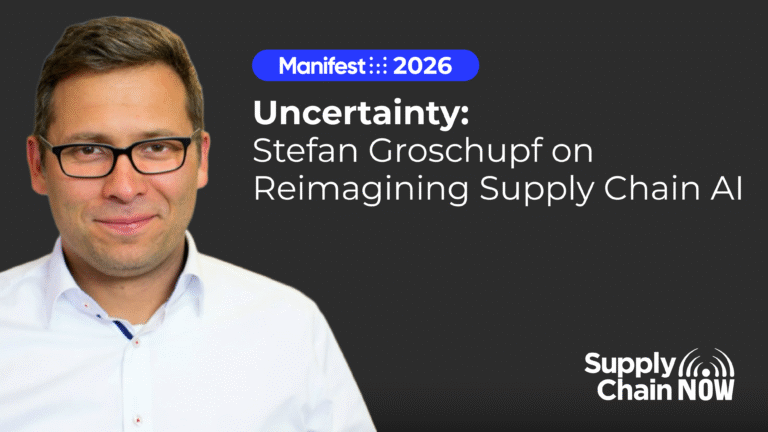
Building for Uncertainty: Stefan Groschupf on Reimagining Supply Chain AI at Manifest 2026
A Legacy Behind the Mission
At Manifest 2026 in Las Vegas, Scott Luton sat down with Stefan Groschupf, CEO & Founder of Centrum AI, to discuss how a new generation of technology is being purpose-built for today’s supply chain realities, rather than yesterday’s assumptions.
What began with a lighthearted joke about multivitamins quickly turned personal. When Scott quipped that “Centrum” reminded him of a vitamin from the eighties and nineties, Stefan shared the real inspiration behind the name. “My dad… the biggest building he constructed was called Centrum,” he explained. “That was the inspiration. His legacy, a head nod to him.”
For Stefan, the company name represents more than branding; it reflects a mission rooted in impact and responsibility.
Designing for Today’s Reality
“We’re building a new tech platform for the supply chain industry that is really built on the foundation of the reality today,” Stefan said. That reality includes uncertainty, dirty data, data silos, and geopolitical shifts that are reshaping global trade.
He offered a simple example: in many ERP systems, a lead time is entered as a fixed number — say 15 days. “That’s of course nonsense,” Stefan noted. “It’s anywhere between nine days and 18 days… and if it’s 18 days, it may change on Monday.” Yet companies continue to optimize inventory and production based on static assumptions.
Centrum AI takes a different approach. “We take uncertainty as a foundational element,” Stefan explained. Instead of relying on fixed attributes, the platform works with probabilities, reflecting how supply chains actually behave.
From Wall Street to the Warehouse
Stefan’s background spans more than two decades in machine learning and big data. His teams previously built risk models that powered “80% of all North American financial transactions” and supported algorithmic trading systems making multi-billion-dollar decisions.
“A lot of the things we did to make multi-billion dollar decisions in the stock market actually really perfectly apply to supply chain,” he said. If financial markets can compute uncertainty in real time, supply networks can as well.
2026: The Era of Compounding Uncertainty
When asked about dominant themes shaping 2026, Stefan was direct: “The big theme that everybody has to solve for is uncertainty. And the uncertainties will only increase.”
Geopolitical realignment, shifting trade blocs, labor shortages, and accelerating technological change are redrawing supply networks. But Stefan cautioned that AI is not just a technology challenge. “AI is more a human adoption problem. Change management is the top problem.”
He also pointed to the rise of physical AI, such as robotics and automation, as essential in a world where reshoring meets workforce constraints. “You don’t want to be at the same spot in five years… as you are right now with ‘all my data is dirty and I’m trying to get AI to work.’”
Seeing the Supply Chain as an Organism
Centrum AI’s broader ambition is to help leaders see beyond surface-level metrics. Stefan described a foundational model that understands the global flow of materials and how it truly represents a living, breathing “organism.”
By analyzing upstream signals, the system can anticipate downstream demand shifts. The platform can run “tens of thousands of simulations on a daily basis,” consuming “20 billion supply chain records globally.”
The outcome is precise inventory optimization. Rather than spreading “15% safety stock like a peanut butter spread on everything,” companies can reduce stock for low-risk SKUs while increasing it for high-risk ones, freeing working capital while maintaining service.
As Scott confirmed, the immense value is to help leaders “see far deeper, far further, and around corners” – – and enable them to make the best decisions possible.
A Can-Do Industry
Reflecting on Manifest 2026, Stefan expressed optimism. “People are excited to solve some of these problems,” he said. “I’ve seen a very positive ‘can-do, will-do, we need to figure this out now’ attitude.”
In an era defined by volatility, that mindset, combined with uncertainty-first, probabilistic technology, may be the defining advantage for the next generation of supply chain leaders.
Where to Learn More
Connect with Stefan Groschupf on LinkedIn here; and be sure to follow Centrum AI on LinkedIn here. For more information, check out the company website here: https://www.centrum-ai.com/
More Blogs
Critical Mass: Inside the Coalition Building America’s Circular Supply Chain