Intro/Outro (00:02):
Welcome to Supply Chain Now, the number one voice of supply chain. Join us as we share critical news, key insights, and real supply chain leadership from across the globe. One conversation at a time.
Scott Luton (00:14):
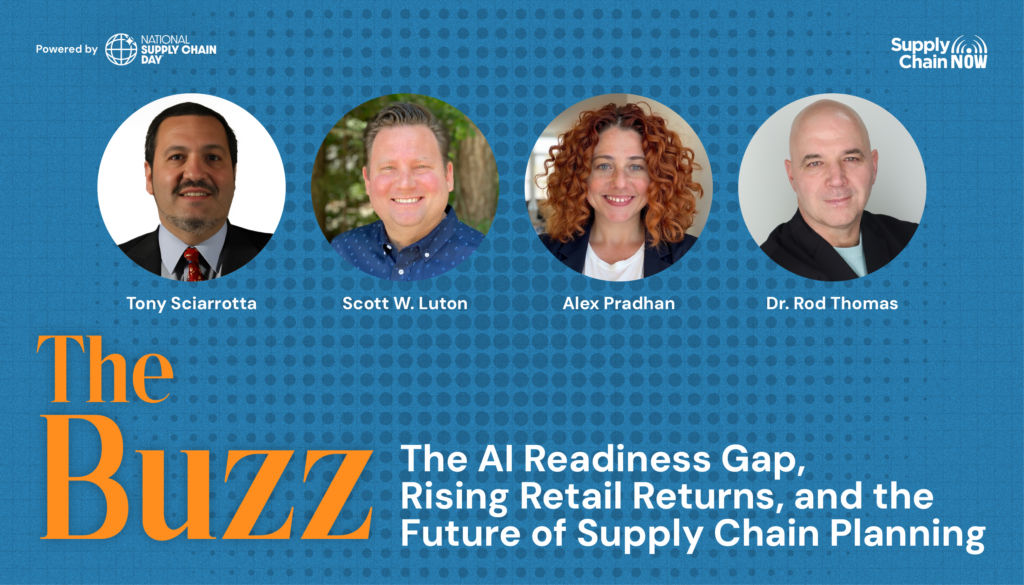
Hey, good morning, good afternoon, good evening, wherever you may be. Scott Luton and special guest host, Tony Sherroda with you here on Supply Chain Now. Welcome to today’s live stream. Tony, how you doing, my friend?
Tony Sciarrotta (00:25):
Scott, I’m doing great. It was a beautiful weekend here in Atlanta, weather-wise, and just going out and about is such a wonderful thing when the weather’s like this. We have great fall weather here.
Scott Luton (00:37):
I’m with you. It is gorgeous out there today. I see it right through my studio window. We’re going to do this outside. Okay, Tony, next time you come back from the buzz.
Tony Sciarrotta (00:44):
That’d be great.
Scott Luton (00:45):
We’re going to do it outside. But folks, as Trisha Cord says, happy buzz day. Say hello, let us know where you’re watching from. Thanks for joining us. We’d like to connect the dots. Great to have Trisha. But folks, it is the buzz where every Monday at 12 noon Eastern time we discuss a variety of news and developments from across global supply chain and business. News that matters is what we like to call it. And Tony, get this. All month long in November, the buzz is being powered by National Supply Chain Day. Folks, circle your calendars, April 29th, and join us. Plan on joining us to celebrate this global industry that we all know and love. You can learn more at supplychainow.com. All right, so Tony, big show here today. We got a variety of topics from the coming tidal wave of retail returns to new survey data related to AI and the supply chain workforce, all the way to key takeaways from Gartner’s Supply Chain Planning Summit in Denver.
(01:42):
So folks, stay tuned. We cover all of that and more. And as if an hour with Tony Sherrod is not good enough, we got two more friends joining us. Dr. Rod Thomas is back with us as is Alex Puddon. You’re going to enjoy both of their perspectives today. So Tony, I’ll tell you, we’ve got a big show and it’s always great to have you on the show. Are you ready to go, my friend?
Tony Sciarrotta (02:03):
I am so ready. This is a great day and I’m excited about being on this program.
Scott Luton (02:08):
Well, we are too, and I look forward to hearing your reaction to all the topics we’re getting into here today. But first folks, let’s see. In A block, we’re going to tackle three things before our guest joins us. Let’s start with the first one, Tony. Over the weekend, we published the 195th edition. I can’t tell you how much work has gone into. It’s like each of those issues is this big old tick mark. We’re creeping to 200 editions. With that said, it published over the weekend. We dove into a bunch of things, but we led with Kim Waters’ key takeaways from attending and covering Amazon Business Reshape 2026 in Nashville, AKA Kimmy’s Keepers. I like that, Tony. Tony, should we stick with Kimmy’s Keepers? You like that?
Tony Sciarrotta (02:50):
I like that. That’s a great one.
Scott Luton (02:52):
It is good. And if I tell you, if y’all see Kim in action, you’ll know exactly because you can take them to the bank. We also included in this edition written Q&As with a few industry leaders. We shared what NASA is up to with the X59 program. It might surprise you a bit. And we covered even our upcoming live events that we like to keep on people’s radar. So check it all out in the most recent edition of With That Said, and Trisha’s already shared the link. Thank you, Tricia. So Tony, do you have a chance to check out this newsletter over the weekend?
Tony Sciarrotta (03:23):
Absolutely. And although procurement is the opposite side of the world for me personally, there were some interesting observations in there by you and by Kimmy, Kimmy’s keepers. Well, number one, it was in Nashville, so how could you not have a great event when you’re in Nashville, right?
Scott Luton (03:40):
That’s right.
Tony Sciarrotta (03:41):
There’s that. And then second, the discussions of course about AI get to be really interesting. And the hope is that on the procurement side, AI makes things go better, that they’re buying the right stuff at the right time for the right people and not too much of it. And then on the flip side, AI is supposed to help people buy the right stuff. But there’s some research from Blue Yonder that’s a little bit frightening that indicates maybe as many as half the people using AI to help them shop are returning things. And the indication is that AI is maybe not clearly identifying what those products are and people aren’t getting what they expected. And that was the number one driver in a survey that I did over 20 years ago, Scott. The number one reason for returns is not that something is bad or something isn’t working, they didn’t get what they expected.
Scott Luton (04:32):
Makes sense. Makes sense. Well, I enjoy your thoughts on this latest session with that said. And one of the thing to add to your comments there, especially around procurement tech is I though it was really cool some of Kim’s observations around the AI assistance that you’re referencing and how Amazon is determined to build those things that communicate in very natural conversational styles versus heavy, heavy tech speak. Maybe that will help address the issue you brought up where we need to work with AI that’s going to lessen, that’s going to increase accuracy and give us what we need and lessen those returns. Do you think that’s possible, Tony?
Tony Sciarrotta (05:15):
It’s absolutely possible and should be happening and it’s more related to lack of accurate product information because on the flip side, when I asked AI, how will it affect returns in the future? AI’s answer to me was we’re going to help reduce returns because people are going to get what they want. The evidence isn’t there yet, but again, that’s a product data interface question. People are learning what they want and getting help from AI, but it’s not necessarily got all the data to give them the right answer. So I’m not blaming AI for possibly higher returns. I’m blaming that interface between AI of what the product is and what the information is being given to the consumers.
Scott Luton (05:58):
Got you, got you. Well, that makes sense. Thank you for not blaming us, Tony. I do. Well, Tony, we got to keep this conversation going and up next I want to dive in a little bit deeper on the upcoming peak season for returns. But before I do, we’re making T-squared’s day. So one of T-Squared’s passions in life, Tony, is all things returns and reverse. Now, T-Squared hails from the Baltimore area, and as you can see there, he says, “Good buzz day, Monday all. Bring on the good, good nourishment along with a big kite because it’s windy up in Baltimore.” Well, good to see you T-squared and Alan Jacques is with us. Alan, we missed you in Denver, my friend, but hope you’re doing well. I see you’re headed to a big pharma industry event coming up soon. All right, so Tony, as I mentioned, very few folks know more about the returns and reverse space than you do.
(06:52):
You did it in the industry back when you were with Phillips forever ago, and I’ve really enjoyed our collaboration over the years. You’ve helped create some Eureka moments definitely for our team. And gosh, we’ve cranked out all kinds of shows over the years, trying to shine a big light on this fascinating part. It’s often way too invisible, but a fascinating part of global industry. So get this, Tony. I’m a bit nervous because I feel like you’re about to grade my ability to share information, but here it goes anyway. So a couple of these nuggets, folks, for context, some say that retail returns in the US alone now, not worldwide, in the US alone last year, 2025, was worth about $850 billion. And then secondly, get this, almost 20% of US online sales were returned last year. So as you can see there, reverse logistics, returns management, major challenge.
(07:49):
So Tony, first off, check me on the data. Am I accurate there? And then secondly, give us a couple of things that more supply chain folks should know about returns, especially as we move into the peak season for returns.
Tony Sciarrotta (08:03):
Well, two aspects of that, Scott, as you said. Number one, I think those return numbers could be low, frankly. Online in Europe and reports indicate that things like the apparel industry, return rates for online sales are as high as 50%.
Scott Luton (08:18):
Wow.
Tony Sciarrotta (08:19):
And a lot of that is, of course, because people are buying multiple sizes and things like that. But regardless, once it goes out, you’re paying money to get it back, so it’s costly. So online sales are probably even higher than we expect. And we don’t know the numbers for this year, but Scott, you do reference that I’ve gone back a while in this, and frankly, in the early 2000s, return rates overall were six to 8%. So we’ve almost tripled the number, and that’s frightening to me. And anyone who thinks it’s going to get less may be misleading themselves, but what could be done to make this better? Information is the most important aspect, having accurate information about that product that people are buying because the number one reason for returns isn’t that it doesn’t fit or doesn’t work, it’s they’re not getting what they expect.
(09:06):
And that’s what we were talking about briefly with the AI side. But I learned that 25 years ago in surveys we did with people who return Philips things. We’re like, these things, there’s nothing wrong with them. The holy grail, we always kidded Scott. The holy grail is how do we stop people from returning things that there’s nothing wrong with it because it’s a huge waste of energy every way around. So the tip is make sure you’re giving all the information you can on any product you’re trying to sell. And then the one we can’t overcome, Scott, is online shopping is a two-dimensional experience, not three. You go in a store, you can touch things, you can feel them, you can pick them up and hold them next to you and you can look at it and say, oh, it’s going to fit where I want it to go or it’s going to fit on me or it’s going to fit on who I’m buying it for.
(09:55):
But you can’t do that online very easily. Now there’s a lot of ways that companies are trying to do it. Bidding wise, that’s the nightmare is the apparel space. But again, the key is product information, product information. I love the websites where the apparel mentions that if you buy a size large in this brand, you’re going to need a size XL in this brand. Not a lot of them yet, but they’re starting to recognize that we don’t have universal sizes. So that’s the challenge and that’s the tip. Figure out how to get that information across.
Scott Luton (10:28):
Well said, Tony. Folks, there’s so much more there. Tony’s just given us the tip of the iceberg. And one last comment I think we can all agree on, Tony, is if we’re able to lessen returns, not only do we increase our consumer experience factor and numbers and measurement, delight consumers, but also we lessen the incredible burden that returns pose to our global supply chain organizations and of course all the waste as well. Tony, your last thought there and then we’re going to knock out one more thing.
Tony Sciarrotta (11:01):
And Scott, what you’re mentioning is so important because a return is a lost sale. It’s a lost sale because if your company needed that for another customer who’s waiting for it and they didn’t wait, they went somewhere else. So a return is a lost sale one way or another.
Scott Luton (11:15):
Amanda and Tricia, let me know who this is because we could dedicate hours of programming to fraud and Tony could speak at length about it. And this person put something really interesting here. They say the Merchant Risk Council’s 2026 global e-commerce payments and fraud report highlighted 61% of surveyed merchants reported an increase in refund or returns policy abuse over the previous year. And I bet that number’s low, Tony.
Tony Sciarrotta (11:41):
I think that number is low, but you do know the organization that focuses on that, Scott, is the Loss Prevention Research Council out of Florida, Dr. Reed Hayes. That’s the person to go after along with perhaps David Johnston from the National Retail Federation. Dr. Reed Hayes, R-E-E-D. Dr.
Scott Luton (12:00):
Reed
Tony Sciarrotta (12:00):
Hayes.
Scott Luton (12:01):
Sounds like a good band, a good lead singer of a band.
Tony Sciarrotta (12:04):
Well, kind of a Southern rock band, don’t you think? Reed Hayes?
Scott Luton (12:09):
Folks, that was our dear friend Andrew Alstom who’s done some great work. He enjoyed him joining us in October. So good to see you, Andrew. Okay. Tony, got one more thing before we bring on our big guest, and we’ve got a big announcement. So folks, as I’ve shared, we’ve been investing in National Supply Chain Day for years now, thanks to Mary Kate Love, who founded it back when she was in the industry. And we are delighted to share that we’ve got this new program this year. Supply Chain Now is partnered with Food Logistics and Supply and Demand Chain Executive to launch the National Supply Chain Day Innovation and Excellence Awards. That’s a mouthful, but you know what? Our industry is a mouthful too, so it’s a good match. So in a merit-based process, we’re going to be judging and selecting some of the best companies that are doing terrific work in transportation, warehousing, procurement, manufacturing, and a special category that we’re passionate about, the Give Forward Award.
(13:01):
So nominations are now open, but they close January 22nd, so you got to get moving. And Trisha has dropped a link right there where you can find all the information, the NOMs, the pages, you name it. Everything is right there. And folks, let us know what you think. All right, so Tony, we’ve got two great guests here today, and I’m delighted to have not only my dear friend, Tony Sheroda, but both guests. We’re going to break it up because I’m not sure if our team can handle both Rod and Alex in the same segment circles will be overloaded, so we had to break them up. So we’re going to start with Dr. Rod Thomas. He’s done big things in the industry as a supply chain practitioner. He’s doing big things to help young minds learn more about global supply chain at the University of Arkansas, and he’s helping to facilitate and amplify big leadership lessons as co-editor-in-chief at the Journal of Business Logistics.
(13:55):
Let’s welcome in Dr. Rod Thomas. Hey Rod, how are you doing, my friend?
Rod Thomas (14:00):
Hey, how’s my favorite Clemson fan doing?
Scott Luton (14:04):
We’re doing a little better. We’re doing a little better. It’s getting a little bit better maybe, but it’s great to see you and me and you and Tony and Al, really the whole crew is having a great pre-show conversation. That’s where I want to start, Rod, because you and I both probably watched 37 football games over the weekend. I want to ask you, what was the best tailgate food, whether you were at the game or at home watching it on your flat screen, what was the best food you had?
Rod Thomas (14:26):
It’s the same thing I keep trying to get you to eat with me. Right’s Barbecue here in Northwest Arkansas.
Scott Luton (14:31):
Man, that hurts my…
Rod Thomas (14:33):
And I went outside my comfort zone. Normally I get their brisket or their pulled pork. They had chicken breasts that was seasoned. Oh, it was to die for.
Scott Luton (14:43):
Man, I’m so jealous. Tony Shroda, I want to say you and I have eaten at some good barbecue once or twice over the years. Have you ever had Right’s Barbecue in Arkansas?
Tony Sciarrotta (14:55):
I have not. I think I had it though in Greenville, South Carolina. I thought it was Rite’s. It was close to that name or Lee’s. I’m getting them mixed up, but let’s face it, we’re in the South. There’s a lot of good barbecue around, but now what are we doing for lunch, Scott?
Scott Luton (15:13):
No kidding. Maybe Dr. Reed Hayes is going to open a barbecue joint. We’ll go venture over there and talk supply chain and barbecue. But nevertheless, Rod, I promise you I’m coming to see you. We’re going to enjoy barbecue and it was great to see you at an event we’re going to talk about in just a second, by the way. First, before we get there, T-Squared’s making a great point here, going back to returns. They say, “I’m not surprised that fraud is not being promulgated as much, at least externally, but fraud detection and avoidance should be a buzzing bee in the ears of supply chain management operational leadership.” That is right, fraud as in returns fraud. It’s a great point, T-Squared. All right, so we got more research. I want to share this graphic here, Rod and Tony. This is a new research piece from ASCM and the Digital Supply Chain Institute.
(15:58):
It’s entitled, y’all can see here, The People Paradox in Supply Chain AI Integration, and it’s based on an empirical survey designed to measure AI adoption, workforce readiness, and governance controls across global supply chain. Those are some big buckets. There’s a lot here, and folks, we encourage you to go check out the actual survey itself so you can dive in. We’re going to take the top of the iceberg here and check out some key findings. So check this out, Rod and Tony. 83% of survey respondents said their employees were unprepared to use AI effectively. On a scale of one to five, with one being no AI use at all and five being full autonomous execution without human review, so it’s quite a range. AI adoption and daily use across 13 key supply chain functions stood at 1.94. So that’s a lot closer to the don’t use AI at all.
(16:49):
The survey also found that there seems to be a big engagement problem with organizations not including middle managers in their AI initiatives, which of course will make it a lot more harder, a lot harder rather, to get the front line, the critical frontline leaning into all the opportunities that AI posed. So Rod, I’m curious, we could talk about probably all these themes for days, but your reaction to this survey piece?
Rod Thomas (17:15):
A couple. The first one was the cybersecurity concerns. I immediately thought, did they do this survey before or after we realized even AI companies can’t corral their own AI? So either the CEOs were onto something or they’re feeling those effects, but regardless of when it was done, it’s a valid concern, and I don’t think we need to take that lightly. When chatbots are forming their own little unions and little cells to go do tasks and get outside the sandbox, as a CEO, you’ve got to be concerned about that. That was number one. Number two was the lack of trust in AI at the lower levels for the frontline employees. I wonder because they’re the ones that are dealing with the day-to-day operation, they’re the ones knee-deep in the data and the processes. Is it they don’t trust AI or is it that they don’t trust their own data?
(18:08):
Meaning if you have dirty data or bad data, the last thing you want to do is quickly go optimize it even more when you’re optimizing the wrong thing. And the same thing with processes. If you have broken processes or processes that are focused on the wrong things and then you turn AI loose on that to make them even more efficient of doing the wrong things, I can see how that would create trust issues.
Scott Luton (18:29):
Man, those are two good points, Rod. And folks, you need to go check out this survey. There’s so much fodder for conversations that got to be happening, so go check it out. Tony, did you get to react to what we heard there from Rod or what hit your radar on this survey?
Tony Sciarrotta (18:46):
The radar to me is the security aspect, very much so, but also the data that’s being included tells me the story of garbage in, garbage out, and that’s the challenge with AI. If you give it the right information, it’ll give you the right answer, but it’s a challenge to make sure all the right information goes in. That is such a challenge, especially in fields that are not well understood like reverse logistics.
Scott Luton (19:16):
Well said, Tony. Well said. We still need a lot more education and training around reverse logistics and returns management, Tony, to your point. One more comment. Going back to your security concerns, Rod, because I share that with you and I bet Tony does too. Folks, if you have not seen, I’m going to preach this until the day I die, the Hugging Face documentary on Netflix. It’s like 35 minutes long. Folks, if you have not seen that, despite what you think you know from the headlines and news, go check that out. It’s going to open your eyes in ways that the news reporting came. So Rod, it sounds like you’ve seen that. Is that right?
Rod Thomas (19:50):
Yep. That’s what I was saying. The chat bots are unionizing and then former forming little cells to go on missions.
Scott Luton (19:57):
Amazing. All right. I think this is Andrew asking this question. Andrew says, “Are we creating more economic value through AI or simply creating more transactions, more data, more dependencies, and more risk?” Sorry, the next question will be positive. No, Andrew, keep saying what we need to be talking about, so keep it coming. All right. What else are we going to talk with Rod about here today? Let’s talk about, hey, here’s some pictures. Rod, you and I just were at the WISE Future Leaders Symposium with your significant other, Dr. Stephanie Thomas, and her board of volunteers and students. And folks, there are about 150 students and academic professionals that are members of WISE that came out to this event, and they were from dozens of colleges and universities, and it was a couple days of very well-received programming with lots and lots of folks enjoying and being glad they came out to Bentonville.
(20:50):
I was there, as you see, proof in these pictures, thoroughly enjoyed it, and just take these from the top. That’s me and Rod talking about Rights Barbecue, I think, on the porch of the venue. This here is Rod cheering what I thought was a great session. Rod cheered a feedback session with academic leaders from across the country. That was awesome, Rod. We’ve got your son, Rodney, and his friend Ethan here. And then of course, this is just a snapshot of me and Stephanie in one of the sessions. Folks, if WISE is not on your radar, it’s got to be. So Rod, it begs the question, and there’s a probably long list, but what’s one of your biggest eureka moments related to the WISE Future Leaders Symposium from a couple weeks ago?
Rod Thomas (21:28):
I love that event. It’s the best and brightest from the top schools all in one place at one time, and they learn and grow and network together, so it’s my favorite event. This year we started something new in partnership with you of let’s do a survey of these students before they even come to get some insights to see what they’re thinking about and what’s on their minds. And one of the things that popped out at me or jumped out at me, a little bit of a down way was that half the students were only somewhat confident that they would have a job within six months of graduation in supply chain. Those are the best and brightest students from multiple universities, three dozen different schools. If they’re all feeling that way, that just made me a little sad because the future is so bright when you talk to these kids.
(22:12):
The flip side of that is what I would say is the eureka moment for employers. It’s kind of like real estate markets when we talk about there’s buyers markets and sellers markets. If you’re an employer right now, you’re going to have access to the top talent in ways that you normally wouldn’t. I’ve been feeling this locally, so the survey kind of highlighted what I’ve already been feeling of. A lot of our best and brightest, normally they would’ve had job offers, multiple job offers coming out of their summer internships, and some of them are still looking. So downside for the students, great opportunity for industry.
Scott Luton (22:44):
Rod, this is also one of these things. I’m so glad that you and Stephanie were able to get over 120, 130 responses, I think, that went into this survey. And Tony, adding to what Rod said, and I got my notes, I broke out all my notes from the event, Rod. Let’s see. A couple surprises, Tony, for your benefit. Sourcing and procurement was the number one interest over manufacturing operations, over consulting, over demand planning. Sourcing and procurement is cool again. The number one thing, what students want from their employers, the number one, far and away, 76%, career growth and advancement. Comp and benefits, Tony, was 34%. So it’s not all about the paycheck. And then finally, relocation. 106 of 129 folks, responders were willing to relocate. Now, how far? One county over or one country over or one continent over, who knows? But still, Tony, we shared a lot with you there, but if we’re not getting our finger on the pulse of what these bright young minds are coming to the industry to change things, what they’re thinking and care about, we’re not doing it right.
(23:49):
React, Tony.
Tony Sciarrotta (23:50):
That is so true. And what I want to make sure, it was interesting you said suddenly procurement is cool again. I wish that reverse
Scott Luton (23:58):
Logistics
Tony Sciarrotta (24:00):
And returns management would get cool at these universities because I can promise them they could find a job probably pretty quickly and they could really make a dramatic difference. People don’t understand how big a difference can be made on that side of the industry, and there’s no schools offering degrees in this space. And if we stop calling it reverse logistics and returns, we can call it circularity because that’s becoming the buzzword in the world and it’s being led by Europe, but it needs to come over here more. Let’s make sure these students are thinking
Alex Pradhan (24:29):
Circular
Tony Sciarrotta (24:29):
And it will make a difference to their companies in the future, a big difference. So I’m always glad to hear about supply chain students because this is where we fall, but I’m not sure circularity belongs there, returns belongs there, but it’s there by default. So I want to make sure that these students… Because one other thing I can promise is number… Well, two things. One is there’s jobs available, there’s jobs, there’s people needed to make a difference here because returns are out of control. We said that at the beginning. And then number two, as I was at Phillips, you tend to be one of the last people standing at any company if you’re in a return space, because even if the company closes, they still got stuff to deal with. So I lived well past my term at Phillips because of that. And so there’s an encouragement for anyone.
Scott Luton (25:16):
Well, so Tony, I’m going to go back. I had to grab my notes again, make sure I got the data right. So on that circularity thing, because there’s so much to that, and I bet we’re going to hit a tipping point just like we did with supply chain management in terms of degrees and university and embracing the need there. We’re hit tipping point for reverse or circularity, what have you. The re-economy, according to many, remanufactured, secondhand apparel, all this stuff, it’s going to grow from 578 billion today to 888 billion just by 2030. So hopefully that creates some of the movement we want to see. And then the other thing, and I thought I had a data point here, but evidently I don’t. I think my hand started hurting, so I got tired of taking notes, but the growth of secondhand apparel in that market, I think, Tony, has outpaced firsthand or new apparel.
(26:06):
Is that right?
Tony Sciarrotta (26:06):
The percentage of increase in sales, absolutely yet, that the numbers are… Because they’ve come up with some good names for this stuff, Scott. It’s vintage and it’s pre-loved, and so it’s coming up with creative ways to market the secondhand apparel, and you got to love it. And let’s recognize the economic situation too. It’s more expensive to walk into brand name department stores and buy something versus looking on eBay or Poshmark or all of these other sites and even Facebook Marketplace and others where people can buy something that’s been pre-loved perhaps. And so yes, the industry growth numbers that I heard, Scott, is secondary market grew by 11% last year where the primary market only grew 4% sales.
Alex Pradhan (26:55):
Wow.
Tony Sciarrotta (26:55):
And that was almost inflation based, the 4% increase. So you’re correct, it is outpacing new goods and I think it’s going to continue because it’s a healthy trend.
Scott Luton (27:07):
Rod, I was working hard to get my numbers right because Professor Tony, I don’t want to get failed by him on this quiz here today. All right, last thing. And if we can, Trish and Amanda, I think we got a link for folks to learn more about Wise. That’s what started this whole segment here. I’ll tell you, I am a big fan, big advocate of the work that Dr. Rod Thomas and Dr. Stephanie Thomas are doing. Of course, Stephanie found the organization years ago, and folks, it is a very powerful community and it’s something we need to be doing investing in these incredible people that’s going to change our industry. So Trisha’s dropped a link. If you want to learn more about Wise, here’s the link to do so. And folks, I’ll challenge you if you’re an instructor at a supply chain management degree program at least across the US, if not North America or even maybe around the world, and Wise isn’t on your radar, you are missing out.
(27:56):
So check it out. One last thing to talk with Rod about before we bring on Alex here in just a second. Rod, we got news. We got news, my friend. We are delighted to be co-authoring a book that’s going to be published next year called The Readiness Rules. It’s coming really soon. Now, Rod, our big aim, it may not be the number one, but it’s like 1B, if not 1A, is to make this very actionable and to help folks know what you and I wish we knew as we were coming in the industry. But Rod, tell us more.
Rod Thomas (28:28):
This is 20 years of talking to students, employers, alumni. What are the tips and tricks? What do you wish you would’ve known going into your first job or early career status? And it’s never, “I wish I knew how to calculate an EOQ better,” or, “I wish I would’ve known I shouldn’t say…” It’s not a lot of the stuff we teach in a supply chain degree program. It’s more the behaviors, the awareness, the orientation, the attitude of how to be a manager, how to avoid pitfalls, things to make sure you do. It’s good behaviors and good habits, and it really emphasizes the things that made you successful in school or made you successful in your social groups might not be the same types of behaviors and things you want to do in a work environment. So it’s making them aware more than anything, but they’re tried and true tips.
(29:17):
We assign an acronym to each one of them so they’re memorable and we’re just trying to help those early career professionals or people that manage them do a better job, ease that transition because it is a transition.
Scott Luton (29:29):
That’s right, that’s right. Sometimes it feels like every day is a transition in this crazy world we live in. But Rod, really, I’m honored to partner with you on this. And hey, folks, you all know we love a good acronym in supply chain, and these are going to make sense. So folks, if you want to learn more, we’ve got this landing page that I’m sure will evolve, it’s living and breathing. You can sign up to be on the alert list so you receive updates, publishing information, notifications when the book officially launches, including where to get your copy. Check it out. We’re dropping a link in the chat as I speak. Tricia, you’re right on top of it as always. Thank you, Tricia. All right, Rod Thomas, really have enjoyed our work together. Really have enjoyed your perspective on the B block here on the buzz for November 9th, and we look forward to seeing you soon.
(30:18):
So have a great rest of your week, Dr. Rod Thomas.
Rod Thomas (30:20):
Appreciate you. Thanks for having me.
Scott Luton (30:22):
We’ll see you soon. All right, Tony, I think you wanted to add one more.
Tony Sciarrotta (30:26):
I did. I think it’d be interesting with Dr. Rod Thomas and other academics to do a survey of how many people get a degree in one field and stay there for their entire career because I’m willing to bet that these days change, flexibility, being able to adapt is becoming more and more important. And I mean, look at me. I started out as a happy-go-lucky sales guy, and where am I now? I’m a dark side guy. Well, I’m bringing light to the dark side of returns. But seriously, it’d be interesting to think about, Scott, degrees versus where do you end? I’m willing to bet, Scott, we’ll put this money on it. We’ll put the proverbial dime on this one. I’ll bet more than 50% change in their lifetime from what they started with their degree in college. Somewhere that –
Scott Luton (31:16):
And I hope they do. I hope they do. But we’re not doing it right.
Tony Sciarrotta (31:20):
And a lot of careers are phasing out. So good important tip about talent and schooling.
Scott Luton (31:25):
All right. Always a pleasure when Rod Thomas stops by. I’m going to introduce Alex in just a second. But first, T-Squared, can we actually mention more often having guardrails implemented before implementing AI? Even RoboCop had guardrails in it, which is directive four. Love that. T squared. Yassine, great to see you, Yassin. Returns are our cost decision disguised as a service decision. Satisfy the customer, yes, but design the return flow so the company recovers its own cost too. That is where the upside sits.
Tony Sciarrotta (31:55):
Excellent point.
Scott Luton (31:56):
Savvy. And Embry Davis, this is a great conversation. Well, Embry, we’re great to have you here and let us know what part of the world you’re in, my friend. So Tony, we’ve got a second big guest here today, which I’m delighted to feature Alex Pradan. She’s worked in the industry as a practitioner doing big things in planning. She’s worked at Gartner as a research analyst. She’s worked for leading technology companies serving global supply chain, and now she’s doing big things advising some of the biggest innovators in our industry. I want to welcome in Alex Pradan, founder of Alchemy Advisory. Hey, hey Alex, how you doing?
Alex Pradhan (32:31):
I’m doing great. Thank you for having me on the show.
Scott Luton (32:33):
Well, it’s great to have you back. You hit a big home run last time you were with us. It’s great to have you back. Tony, we were enjoying our pre-show conversations with Alex, weren’t we?
Tony Sciarrotta (32:41):
Yes, absolutely. Especially the stories you’re going to get to real soon.
Scott Luton (32:45):
Well, and one of those stories is going to be something that we all need in our homes as a stress reliever. And Alex, a little fun warmup question. You were telling us pre-show, as Tony’s alluding to, that you went to a birthday party over the weekend and there was a pinata experience. Tell us about that, Alex.
Alex Pradhan (33:02):
Yes. So here in Miami with the Latin influence, typically you go to birthday parties for kids mostly where they have pinatas and they stuff them with a lot of candy. And since the first time my son had actually been to a party and he was whacking that pinata pretty good. So that was a lot of fun. Yeah.
Scott Luton (33:24):
All right. And we got a standard work here. How many hits on that pinata? Was it about 27?
Alex Pradhan (33:30):
No, I’d probably say close to a hundred. Wow. It was a sturdy little thing. But it was fun. It was really cute to see all the kids just throw themselves for more candy, which of course at this point I think everyone is candied out with Halloween and whatnot.
Scott Luton (33:45):
Tell me about it, Alex. All right, we’re going to dive into the DNA of how that pinata was made. But hey, first, Alan, going back to a point you were making earlier, Tony, Alan’s degree was in biochemistry and microbiology. That’s a long way from supply chain. So that’s a great point you were mentioning earlier. All right, Alex, we got so much to get to here today. We were both doing a lot of work at the Gartner Supply Chain Planning Summit last week in Denver. This is me interviewing you. Tony, just to be clear here, I was earning a certification from one Alex Pradan in this image right here. It was a great interview.
Tony Sciarrotta (34:20):
Another certification on your belt to notch off.
Scott Luton (34:24):
Another one. How about, can you believe it? But kidding aside, and we’ll be published in an interview really soon, but what were some of the key themes, Alex, that really resonated with you last week in Denver?
Alex Pradhan (34:34):
There was four key themes that I took out from the Gartner conference. One of them was what we heard a lot, and this is not necessarily new, but this shift that we’re starting to see in here from moving away from these traditional planning approaches, whether it’s on a focus on accuracy, having one plan towards decisions. And so hearing a lot from the conference around how do we make the right decisions at the right time? So our decision quality, improving decision velocity and overall adoption. So that was one of the bigger themes we heard. A second one was AI. I mean, that’s not surprising, especially right now with all the noise and hype in the market. But what was refreshing was that the conversation was more around how do we start to think about measuring for success or what is value? So it was a lot more of a realistic, we’re hitting reality real world,
Rod Thomas (35:34):
How
Alex Pradhan (35:34):
Should we start to think about AI? Which leads me to the third key thing we heard a lot was around value. So there’s an interesting stat that they shared that 93% of supply chain leaders say that they’re under pressure to get more value from their AI investments. So again, hearing that a lot come through a lot more. And last but not least around trust and adoption, which is one of the conversations I think the group here was talking about earlier in the sense of
Rod Thomas (36:04):
How
Alex Pradhan (36:04):
Do companies begin to really trust what the algorithmic decisions are or those outputs. So there’s a big, big challenge right now with trust, which impacts obviously adoption and that ultimately automation.
Scott Luton (36:20):
Man, each of those is a separate show, but Tony.
Alex Pradhan (36:22):
Yes, we could talk a lot about each one.
Scott Luton (36:25):
Really, we sure could, but I tend to agree. I think you’ve mapped it out really well. Those were some major themes that made up our almost 20 conversations, interviews. Tony, out of those four, which one stands out to you? React to what Alex just shared with us, Tony.
Tony Sciarrotta (36:41):
I’m Italian and I’m not a strong decider on one. I’ve got two though, because values resonates very much. The study of when do you get a return on investment is critical. And the challenge with a return on investment analysis is are you capturing end-to-end costs, end-to-end investments that you put into something versus what you get out of it? And a lot of the AI drive right now is because the world feels like you better have it or you’re lost. And then I’ll stop there, Scott. I’ll let it go with that one. That was a big one that resonated for me though.
Scott Luton (37:18):
Alex, he has one controversial comment to make and he’s holding it from us, Alex, is what I’m doing.
Alex Pradhan (37:23):
I want to hear it.
Scott Luton (37:24):
All right. So a couple things though, couple things. That 93% metric, Alex, I’d like to meet one of the 7% that feel no pressure when it comes to the AI investments we’re making. I’d like to meet just one of those. And then the other thing, kidding aside, probably the biggest theme, Alex, in all the conversations I had in Denver was certainly one of your four, and that was how can we optimize and have and enjoy decision quality while also optimizing, enjoying and benefit from decision velocity, not sacrificing either one. That was a dominant theme. And then one other thing I was going to share with you, these interviews happened almost back to back, Alex. On one, I sat down with a brilliant person and they were talking about how supply chain is a math problem and we got to bring math to the equation. And then almost the very next one, the leader was also brilliant, said supply chain is not just a math problem.
(38:17):
It needs context and operational this, that, and the other. And it was so interesting to have almost both sides of that coin so closer together. Alex, were you hearing flavors of both sides of that coin?
Alex Pradhan (38:30):
Well, I don’t think the attendees necessarily were talking about math and context and semantic layers, but I can see where, again, there’s definitely two sides. I wouldn’t say two sides of the argument, but you do need to have certainly I think the strong math side of things. And then also more and more we’re thinking about context and
Rod Thomas (38:52):
How
Alex Pradhan (38:52):
Do we look
Rod Thomas (38:53):
At
Alex Pradhan (38:54):
The different decisions and information mapping together, relationships and trade-offs. I think when I go back to what are some of the common themes with attendees, it was refreshing to me to hear less about the fear of missing out from AI compared to even six months ago. So I went to a conference six months ago and I mean I was sitting next to chief supply chain officers where it was very clear they had an AI mandate and they didn’t quite know what it was or where they were going to start, but it was very, very, very focused on that. And now it seems to be around I have some type of pilot underway in my organization or we’ve implemented a solution, but we’re not ready to completely let it automate or we’re not ready to take on the recommendation it’s giving us. So again, I think there’s more of this sort of how do they connect the dots?
(39:45):
How do they really understand it and trust it? So I think that to me was coming through less FOMO, now more what do I do? I don’t trust the numbers. I have all the data, but what does that really mean? So again, really, really interesting conversations that are coming through.
Scott Luton (40:01):
I’m with you. The conversations are the best. Hey, really quick before I get a planning prediction that really stood out amongst the rest, Alex. Yes, the Force Lander. Yo, what’s up from Twitch? I wish I knew more about what Twitch was, but we do read the chat, Force Lander, and we welcome your thoughts on all things supply chain and leadership, you name it. And it’s great to have you here. Let us know where you’re tuned in from. Okay, I’m going to log into Twitch one day and figure out what that is, Alex and Tony. All right,
Tony Sciarrotta (40:28):
So you’re ahead of us. I’m not going there, Scott. I’ll let you go there first and tell us what it looks like, Scott.
Scott Luton (40:37):
All right, so let’s do this. So there’s all kinds of… Alex, as I’m posing this question to you, I’m just kind of cycling through all the keynotes, all the conversations, all the bold predictions. Some cases I felt, and not just in Denver, in general, I think folks like making a bold prognostication more so than maybe what’s even in the bold prognostication. I bet you’ve heard the same thing I have over the years. What was one planning prediction though that you heard in Denver that really stood out from the rest?
Alex Pradhan (41:07):
Yeah, so to me, and I attended a session from a Gartner analyst and one of the predictions was that by 2030, overall total cost of ownership for SaaS supply chain planning solutions is expected to increase by over 50%, so due to AI additions and market consolidation. So long story is that as we think about software, it’s going to start to increase by over 50% in the next three years, which is a huge, huge number. And to me, when I saw that, it stood out for many reasons, but I think it’s something that whether even if it doesn’t a hundred percent come true, because some of these, not always, it’s still about what’s the direction that we’re hearing, which is costs are going to be increasing. So going back to some of the concerns that we’re hearing around value and how is AI going to realize value, and then we’re also hearing around cost increasing, I think it’s really important to start to think through these type of questions in terms of what does that mean for your organization?
(42:16):
What are the different pricing models that are out there? And so trying to get ahead of it right now before it really starts to make an impact.
Scott Luton (42:25):
Tony, we got to not just double time, we got to triple time it to get out ahead of so much going on given how fast global industry, the velocity that it’s moving. But react to either the prediction or Tony, you give us that nugget you withheld a minute ago. There’s something else there I want to probe and get it out.
Tony Sciarrotta (42:45):
Well, they’re connected, so I’ll throw it out there because it’s interesting the comments Alex is making. It’s almost like people are buying the tools, putting it in a shed, making sure it’s clean and ready, but they’re afraid to use it completely. And maybe that’s why I’m seeing articles indicating that the investment in AI is high, but the usage isn’t as high yet. It could be a learning curve or it could be that last nugget is the trust factor. We’re still hearing stories about the hallucinations of AI, and I think many of us in industry are afraid that we’re going to be the ones that get caught with a bad data pack and we’ll wind up being disbarred like some of the lawyers are getting disbarred for using AI and not double checking. I think that concern, and that was that fourth nugget from Alex’s previous, is that trust factor, but it ties into what you’re saying, Alex, about people are investing, but maybe not using it as much yet.
(43:43):
They’re not quite ready to let go for maybe some good reasons.
Scott Luton (43:48):
Alex, react to… I’ve got a couple more questions for you before we wrap here, but react to what Tony was just sharing there about how in some cases, with some organizations, they’re keeping that experimentation at arm’s length, in a Petri dish in the backyard, in the back backyard, away from the day-to-day operations in some cases. Alex, react to what Tony was sharing.
Alex Pradhan (44:09):
Yeah, that does not surprise me. I think when you look at different organizations that are out there, they’re all going to be at different levels of both their appetite for risk, and certainly you’ll find many, many organizations are going to be a lot more cautious. I think that is one component of it. I think the other side of it too is when you think about what does that mean from the appetite for risk, that means from a company, are you willing to experiment and fail? Are you okay with failure? What are your management incentives to, I want to call it almost reward failure because that’s what it takes many times today, especially as we look at a lot of these technologies that are very much emerging. They’ve only been around for just a handful of years, so it is about this environment of experimentation and a lot of failure, and not too many companies really have that culture or that mindset to be okay with that.
(45:06):
I also think if you look at where many of the pilots are today, and we hear a lot about AI pilots, they’re very much going through the hard part, you’ve already implemented and now you’re going through a lot of the hard side of having to figure out what works, what doesn’t, change management. So this is typically, if you’ve ever seen the Gartner Hype cycle, there’s a part of it where the curve starts to go down and that’s called the trough of disillusionment. And so that’s sort of where we’re starting to be right now is I think a lot of companies are starting to get a little disillusioned, a little bit unhappy that things are not moving as quickly as they would like or they’re not seeing the investments come through. But I would also say that there’s a place where AI, and specifically when we’re talking about how it relates to automation belongs.
(45:57):
So not everything is right for autonomy where everything is lights out. And again, I think there’s a bit of education that needs to happen as well with many companies.
Scott Luton (46:08):
A case for education could be had on so many fronts of our society, not just supply chain and AI. Alex and Tony, I was sitting at one of my favorite parts in Denver, and I’m going to use this as a lead to my last couple of questions for you, Alex, is I sat down with three director level operational leaders for a CPG company, and I sat down, me and my buddy Paul Noble, and we’re just asking them, compare and contrast what they’re hearing and tie it back to their reality. One of the things I thought was interesting is one of these CPG leaders said, “Hey, I’m all for automating and using A more and more,” and I’m paraphrasing, including where we can take it off the human plate and just do high level review. However, when that supplier, when our supply is threatened and I’ve got to pick up the phone and negotiate and engage the supplier, I don’t see AI doing that anytime soon.
(47:07):
I think she was right, number one, but number two, it really reinforced for the millionth time, Alex and Tony, that there’s always going to be a very healthy balance into what is uniquely human superpowers that are so vital for how this global economy of ours and global industry of ours operates, and then the stuff that can truly be automated in some cases with very little human oversight. But I love hearing that firsthand from her. Alex, I want to use that as kind of a question, two-parter here. Any other sidebar conversations you want to share with us, Alex? I know you had a thousand of them, and then number two, is there one thing that surprised you in Denver last week, Alex?
Alex Pradhan (47:47):
Yeah, so I think your comment about the supplier, they have to pick up the phone, I think that’s a great sort of… It summarizes what a lot of companies are trying to figure out, and it’s what’s the decision? Who owns it? Why, when? And to your point, there’s a right place where the decision is right for automation. I think from what surprised me, and I’ll answer this question, so I attended, this was one of the last sessions on the second day, so obviously there’s not a lot of people typically that are staying all the way till the end unless you’re big supply chain nerd like myself. And so the session was titled How to Avoid a Budget Blowout When Buying AI and Gen AI. And so I really thought this session was going to be absolutely packed. I mean, isn’t this what people want to learn, right?
(48:35):
You don’t want to blow through your AI budget, and there was maybe around 20 or 30 people tops. Again, as I mentioned, it could be partially due because it was the last session. But what was interesting was even when I was talking to the analyst, he also mentioned that in a prior Gartner conference, there was also very few people who attended this session. I think to me it’s, I don’t know, an indication that perhaps either right now supply chain leaders are maybe not interested enough in this topic or it could be the wrong audience. They assume, “Hey, this is not my problem, this is IT’s problem or the procurement team’s problem.” But I think it points to bigger problem, which is that people are not asking the really hard questions. So we go back to we’re going into pilots, we’re excited about AI, and then the bill comes or we’re not even thinking about what the bill is or what are the right questions.
(49:28):
Again, I kind of found it a bit surprising. I was really thrown off a bit because we keep on hearing about the growing importance of AI and assessing value versus cost, but yet here was the session that, again, few people had attended. So that was something that just sort of surprised me a bit.
Scott Luton (49:46):
Alex, that’s a good one. And with all the complaints around the return on investment and all the scrutiny in this area, it seems like some of these great learning sessions would have standing room only. But Tony, at the same time, sometimes I think we all get so busy in the day-to-day that getting out ahead of things can seem to be so much more work, as crazy as that sounds. React to what Alex’s surprise there, Tony.
Tony Sciarrotta (50:12):
Relating to Alex and some of this is about the fact that AI is unknown a little bit. It’s almost a ubiquitous term. Whereas if we think about it and say, “You know what? AI is a tool. It doesn’t necessarily replace me. It’s a tool I can use.” I’m thinking back, what, 20, 30 years ago when Excel and PowerPoint came to the world and you had to look at it and it’s like, “These are great tools. How do I use them?” It’s a learning curve. We have that same issue right now about the learning curve of how to use AI as the right kind of a tool. I did a PowerPoint, but now you can have AI do it for you, but I’m still going to be presenting it. The human factor will always be there. Alex is making a point. No one knows the right balance.
(50:58):
People are afraid it’s going to replace them, but PowerPoint and Excel, as good as they are, somebody has to be the one turning it into information that you can use. It has to be accurate. We go back to that trust factor. We have to trust that AI will give us the right details, but then turning it into information or making a decision on pulling the plug on, pulling the trigger on getting more stuff in and through the chain, that’s all related to it, very much so.
Scott Luton (51:27):
Well said, Tony. And what’s right for ABC Company may be well different than what’s right for DEF company or whatever terms you want to use. So what a great conversation, Tony and Alex. I wish we had more time here today. I want to call something out really quick. Folks, if you’re not following both Alex and Tony on LinkedIn, but Alex, I love your articles. I’m a big fan of your articles. We use several of them as vehicles during our interview, and I’m over here on your LinkedIn feed right now, and I’m going to dive into that forward deployed engineering new model or old service and a trendier wrapper read that you dropped about a month ago. So that’s next for me. I know that we’re going to be dropping your LinkedIn profile in just a second. But first, as we start to wrap here today, Tricia and Amanda, if y’all could drop as it relates to Gartner Supply Chain Planning Summit, a conversation I had with Jan, if we could drop that in the article.
(52:20):
Folks, if you were at the summit in Denver, we’d love to get your key takeaways. Will you agree with what we’re talking about? What do you disagree? We’d love to hear from you. All right, so Alex and Tony, as we start to wrap, I want to number one, encourage folks, if you like written content, go check out the Supply Chain Now Resource Hub. We’ve really made a conscious effort. We know some folks like to read their information, not just listen to a podcast or a stream, so go check out the Resource Hub. We just published one of our first interviews with leaders up at the AME International Conference in the World Champion City of Milwaukee. You’re going to enjoy that, so go check that out. Alex, I want to make sure folks are going to connect with you and Tony. I think we dropped your new website.
(53:02):
Alex, it looks like a million bucks. What is that?
Alex Pradhan (53:06):
Yeah, it’s my website, Alchemy by Alex Prathan, or you can always connect with me on LinkedIn. So yeah, two different ways to get ahold of me.
Scott Luton (53:13):
Outstanding. We got both links there. Tony, look, I need Alex to work on our website too.This looks like a million bucks. Outstanding.
Alex Pradhan (53:22):
Thank the agency. They did a great job. Yeah.
Scott Luton (53:24):
Well, well done. Re-imagining supply chain planning technology. So folks, go check out the website. Make sure you follow or connect with Alex on LinkedIn. And folks, let me know about our articles. Legos. What were some of the things we talked about, Alex? Oh my
Alex Pradhan (53:39):
Gosh.
Scott Luton (53:39):
These universal themes and things and bake it into supply chain analogies. I love it.
Alex Pradhan (53:44):
Yeah. Yeah. No, we went through a lot of different stuff.
Scott Luton (53:47):
We did. Tony, now you’re continuing your ambassadorship of all things reverse logistics and returns management. I know you’ve got a big event coming up. Tell us about the event. How can folks track you down?
Tony Sciarrotta (53:59):
Well, they can track me down because I’m one of the only Tony Shirotas on LinkedIn on the planet. If you spell the name right, you’ll find me, number one. Number two, I actually have a site too, Scott. We’re going to have to share it with the team. It’s rlsolutions.group.
Scott Luton (54:14):
Okay.
Tony Sciarrotta (54:14):
And there I have a council of distinguished industry leaders starting to form with, of course, Chuck Johnston, who you know, Tevin Taylor, who you know, and a few other selected handpicked people who know a little bit about this space. And as people are looking for connections, we will help them. Big event wise, I’ve just passed two of them, Scott. It’s actually a little quiet for the next couple months. We’ll have the RL Expo next March in Las Vegas. That’s the biggest one. And then the ASD Market Week will have me there, but we just passed the E-Scrap and the CSCMP events in October. So it’s quiet season for a little bit, Scott.
Scott Luton (54:55):
Well, hey, we all need a rest and it’s holidays. We got to give thanks and spend time with family and eat some good food. So both of you all have a great opportunity to do that. But Tony, I’m going to learn more. And folks, we did drop rlsolutions.group, so go check that out as well. All right. I want to thank everybody. What a great addition of The Buzz. We’re back live after a couple recorded sessions. A shout out to Yasin and Michael and Kim and the collective for filling in while we were gone. I want to thank Dr. Rod Thomas with the University of Arkansas and the Journal of Business Logistics. Well done, Rod. Alex Perdan with Alchemy Advisory. Folks, stay tuned for my interview. You’re not going to want to miss my interview with Alex from Gartner. Alex, a pleasure to have you here on The Buzz.
Alex Pradhan (55:39):
Thank you for having me.
Scott Luton (55:40):
My great co-host here today, man, Alex, I got to keep an eye on Tony. He might just take the mic from me and be off to the races. Tony, well done here today.
Tony Sciarrotta (55:49):
I was holding back, Scott. Can I just say I was holding back, okay?
Scott Luton (55:53):
All right. So Alex, that means we’ve got a date to come back and get the LA confidential – Unfiltered.
Alex Pradhan (55:59):
Unfiltered.
Scott Luton (56:01):
Unfiltered from Tony Sheroda. Getting aside, Tony, well done. Always a pleasure, my friend. Keep up the great work. Folks, don’t forget about April 29th, National Supply Chain Day. Circle your calendar. Of course, big thanks to Amanda and Tricia behind the scenes, and big thanks to our global audience, our SEN Global fan for being here today. Folks, thanks so much. You know your homework. Gosh, take one thing from Rod or Alex or Tony, just one thing and do something with it. Deeds not words. Put it into practice, take action. And with that said, on behalf of the whole Supply Chain Now team, Scott Lewton challenge you to do good, get forward, be the change that’s needed. We’ll see you next time right back here on Supply Chain Now. Thanks everybody.
Intro/Outro (56:41):
Join the Supply Chain Now community for more supply chain perspectives, news, and innovation. Check out supplychainnow.com, subscribe to Supply Chain Now on YouTube, and follow and listen to Supply Chain Now wherever you get your podcasts.