Intro/Outro (00:02):
Welcome to Supply Chain Now, the number one voice of supply chain. Join us as we share critical news, key insights, and real supply chain leadership from across the globe. One conversation at a time.
Scott Luton (00:14):
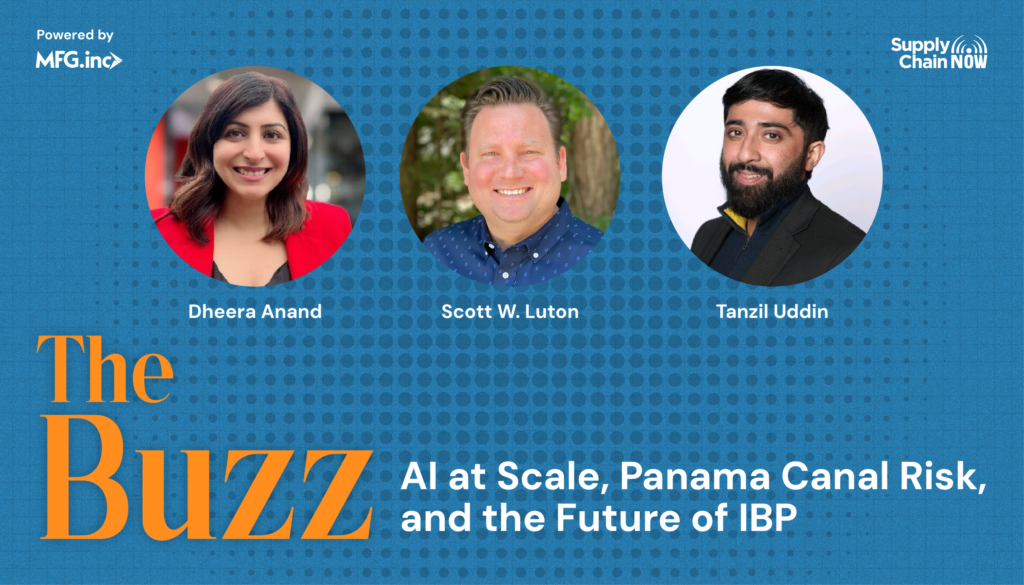
Hey, good morning, good afternoon, good evening, wherever you may be. Scott Luton and special guest co-host, Tanzil Udin, here with you on Supply Chain now. Welcome to today’s live stream. Tanzil, how you doing today?
Tanzil Uddin (00:26):
Scott, doing really well. Excited to be back on this with you. Thank you for having me.
Scott Luton (00:31):
Hey, we had such a great time last time. I felt like I earned three degrees in talking with you and others on that show. We had to have you back and we got a special surprise here today, so great to have you back. Folks, today, as you know, it’s the buzz where every Monday at 12 in the Eastern time, we discuss a variety of news and developments from across global supply chain and business. News that matters is what we like to call it. And folks, all month long in September, the buzz is powered by our friends at MFG Inc, a highly experienced firm that is helping manufacturers grow without the grind. Learn more at mfg.inc, and we’re dropping the link right there in the chat. So Tanzil, we’ve got another terrific show teed up here today. We’re going to be talking about a mix of robots, retail and reality.
(01:15):
Hey, what’s the latest with the Panama Canal and what does world-class integrated business planning look like? Let’s stay tuned. We cover all of that and much, much more, and even better Tangil. In about 15 minutes or so, we’re bringing in a special guest, Era Anand, from Bain & Company joins us, and we’re all looking forward to the perspective that Deere is going to be sharing. So Tanjal, after being off Labor Day that last week, we had a much needed rest. We’re back live today. And as I mentioned, big show here today. Are you ready to go, my friend?
Tanzil Uddin (01:46):
Yes, indeed. Really excited to get into all the key issues, what’s happening with the consumer, Panama Canal, APAC, looking forward to it.
Scott Luton (01:54):
I am too. We got a lot to get into here today. Let’s see here. Trisha is mentioning Happy Buzz Day. Say hello and let us know where you’re watching from. That’s important. We like connecting the dots across the SCN Global FAM. She also dropped a link to MFG Inc. Folks, check them out. Love what they’re doing across the manufacturing world. And Gino Pledger is back with us. Good morning. You still up in North Alabama. Let me know and let me know what you’re doing this week. I bet you’re traveling. T-Squared who holds down the fort for us on YouTube. It’s buzz day. Bring on the good, good nourishment. Well, we are. We’re going to try to work hard to not let you down. T-Squared. Tanzil, is that a commitment we can make to T-Squared? We won’t let him down on the sharpness of our perspective here today.
Tanzil Uddin (02:39):
We sure will not let him down.
Scott Luton (02:41):
Okay. That’s a commitment you can take to the bank from Tanzil, folks. All right, so before we have a great guest join us in about 15 minutes, we got three things that we want to work through Tanzil, okay? And the first one is the latest edition of our almost weekly newsletter. With that said, it dropped last Saturday, and we started with a mix of stories, as I mentioned a minute ago, robots, retail, and reality, a little alliteration to get your week going. So here’s a few highlights. Tanzil, check this out. Some data factoids. So Liz Young and the Wall Street Journal recently reported that North American companies ordered nearly 18,000 robots worth $1.2 billion just in the first half of this year. But not only is the volume increasing, but the complexity and the capability of the robots are as well. And we’re going to need the help because Deloitte forecasts that total holiday retail sales will increase as much as 4.8% this year over last year.
(03:39):
E-commerce is going to grow as much as 8.4%, fueled in part a holiday shoppers using AI tools to find what they’re looking for. And then one final thing, we’re going to talk more about this painful thing after Adira joins us, but inflation here in the US continues to increase as the consumer price index rose 3.4% in August over the same time period last year. That’s above, of course, the 2% Federal Reserve target. And in fact, get this, prices rose 0.4% in August alone from the previous month of July. Man, but Tanzil, did you get a chance to take a look at with that said over the weekend?
Tanzil Uddin (04:15):
I did. I did. It speaks to two sides. It’s the consumer and the retailer. My biggest takeaway here is the consumer is not necessarily stopping their spending, they’re just becoming more value conscious. But at the same time, what that’s doing is it’s becoming more expensive for supply chains to operate. And it just puts your retailers or supply chain teams in such a complex position where on one side you can just endlessly pass higher costs onto the consumer. And this is where, to your point, things like automation, AI, productivity, smarter inventory decisions become increasingly important.
Scott Luton (04:53):
Yes. Well said, Tanzil. And I’ll tell you, there’s one sector of the business world that’s certainly benefiting, and that’s the warehouse clubs. I think I read recently, and we’re a big Costco family here, Tanzil, not sure if y’all are where you are. But I want to say Costco membership growth is up 8% in the most recently available quarterly numbers. I think it’s second quarter this year over last year. So there’s always winners and losers, Tanzil, is that right?
Tanzil Uddin (05:18):
Oh, for sure. For sure. You’re speaking to what the consumers are telling us. We haven’t disappeared. We’re just becoming much more intentional. Ala, Costco, comparing prices, waiting for promotions, switching brands.
Scott Luton (05:29):
That’s right. And leveraging AI’s help become ever the more smarter consumers. Good stuff, Tanzil. And really quick, Courtney tuned in from Manchester in the UK. Courtney, weigh in on any of these topics we talk about here today. Great to have you here and stay around. We got some good stuff coming. And Trisha and Amanda, let me know who this fellow Atlantan is. Sometimes we have pesky security settings on social that do not let us know, but help us connect the dots. One final thing before we get to number two, Tanzil, it is National Truck Driver Appreciation Week. So any of our incredible professional drivers out there that may be listening as they’re continuing to power global supply chain forward, thank you, thank you, thank you. Tanzil, we wouldn’t be here without our professional drivers, right?
Tanzil Uddin (06:14):
Nah, we would not. What
Scott Luton (06:15):
Were you about to say? Because you don’t want to depend on my driving.
Tanzil Uddin (06:18):
No, literally keeping the world moving, right? Just like the supply chain is sold to our truck drivers, ensuring our goods are reaching where they can. And thank you just isn’t enough really.
Scott Luton (06:27):
So true. It’s so true. And by the way, folks, Vanessa is who’s tuned in from right here in Metro Atlanta. Great to see you, Vanessa, and look forward to your perspective on the shows today. All right, so Tanzil, we knocked out number one. Let’s knock out number two because we got some big news. Big news, folks. We are delighted here at Supply Chain now to continue our collaboration for I think the third year in a row with the Manifest team as we get ready for the 2027 version of the event. The show keeps getting better and better and bigger. Tanzil, I think this right here was us last year pictured there with Industry Hall of Famer Hannah Kane at last year’s Manifest. I want to ask you, Tanzil, the news keeps on coming. It’s like your Tony Gwynn, the incredible hitter, left us way too soon.
(07:16):
Hits just keep on coming. What’s the short list? What’s the new developments that need to be on folks’ radar when it comes to Manifest?
Tanzil Uddin (07:22):
Yeah, Scott, we’re super excited. This will be year six of Manifest and back at the Venetian, obviously really appreciative of your partnership. We’ve got a lot of things lined up really. I’ll highlight some of the main ones like you mentioned. So of course with AI and really making sense of AI in our industry and really in the world and the narrative really shifting from what AI can do to where AI is actually bringing returns that will be ROI and actually helping with decision making that will be a pretty central theme, of course, as expected at our show. We have an exciting AI pavilion inside of our expo hall. There is a section carved out just for really the innovative, not only the emerging tech companies that are playing in the world, but also your more established firms that can actually share case studies of how they’re approaching it, how they’re helping supply chain teams go beyond a pilot.
(08:14):
We’ll talk about this later, but moving past the pilot fatigue, if you may, for lack of better term. So we’re super excited about that. We’ve got other areas in the expo hall like Cold Chain, which was a new introduction to Manifest 2026. It now has its own pavilion and stage inside of our Expo Hall as well. And something personal to me, not necessarily fully new, but there’s just the entire, I would call it the CSCO or supply chain leadership experience that we try to continue to cultivate and manifest year over year, but that will continue to be mainstay at our show and then it’s fast approaching this February, so all things exciting.
Scott Luton (08:52):
Tanzel, that is incredible and I cannot wait to be back. And folks, at a check out Manifest 2027, here’s more reason for you to do so. I think prices go up at the end of this week, so you can register now, you save a few bucks, and I’m telling you, it’s one of the best industry events out there for folks that love supply chain. And you might run into the one and only Tanzil Udin as well. Tanzil, that’s a fringe benefit,
Tanzil Uddin (09:19):
Huh? I would leave you to say that, Scott, but maybe, maybe, maybe. I’d be excited to run into you as well. Hopefully I can get a picture with you too.
Scott Luton (09:25):
Well, hey, if you run into Tanzil, make sure to congratulate him on his Knicks win and it all, the NBA championship last year. But all kidding aside, folks go check out Manifest. Trisha is Johnny on the spot, dropping a bunch of links and make it easy for folks to check out some of the things we’re talking about. She included a link to learn more about Manifest 2027 and to register. And one more thing, Tanzil, I didn’t mention it, but the Europe version of Manifest, that takes place, is that next year as well?
Tanzil Uddin (09:55):
Yes, October of 2027. We are headed to Lisbon.
Scott Luton (09:59):
Awesome. Outstanding. So folks, no matter where you are, join the Manifest community. All right, so Tanzil, we got to say hello to Alan Jacques, the pride of Ottawa, Canada, a beautiful place. And great to see you, Alan. Give us your take on any of these topics we’re talking about here today, my friend, including basketball.
Tanzil Uddin (10:16):
Little bear, Alan.
Scott Luton (10:17):
Yes. Alan used to do windmill jams like Dominique Wilkins back in the day. So great to see you, Alan. All right, one more thing before we bring on our wonderful guest here today. I want to make sure I put another event on y’all’s radar. Folks, the Supply Chain Logistics Summit is back. It’s going to be held November 5th and 6th at the Ritz-Carlton in Dallas, Texas. I think that’s like the Las Colinas part of the metroplex. Now this is an invitation only forum for North American supply chain logistics leaders. You can expect a dynamic mix of visionary keynotes, real life case studies, and interactive sessions focused on topics such as AI automation, visibility, resilience, and risk management in a volatile geopolitical environment and supply chain sustainability across end-to-end operations. You can use the link we’re dropping in the chat there to explore your attendance or other partnership options.
(11:10):
Okay, so as promised, we knocked out, we’re three for three, Tanzil. And now as we move into the B block, we’ve got a wonderful guest joining us here today. Dhira Anand is a partner in Bain & Company’s performance improvement practice focused on operations and supply chain transformation. Over 16 years, she’s helped Fortune 500 clients across industry, really across the spectrum of industries, build supply chains that are resilient, agile, and built to compete. The results span hundreds of millions of dollars in value across cost reduction, cash optimization, revenue growth, new product launches, and service level improvements. You’re going to enjoy Dira’s perspective and point of view here today. I want to welcome indira Anand with Bain & Company. Hey Dira, how you doing today?
Dheera Anand (11:58):
Good, Scott. How are you?
Scott Luton (11:59):
Wonderful. Great to see you. And Tanza, we enjoyed a little mix of supply chain travel and sports conversation in the green room, didn’t we Tanza?
Tanzil Uddin (12:07):
We did. Hey Dira, so glad to have you.
Scott Luton (12:09):
So I’m going to ask y’all both. I like starting with a little fun warmup question and the NFL, of course, for I bet a lot of our folks tuned in, they love football. NFL kicked off its 2026 season in full fashion this past weekend. I think they had games around the clock it felt like and around the world. And I’m sure grocery retailers everywhere are celebrated because that means tailgate food is everywhere. Tanzal and Dira here in the Luten household, one of our favorite football snacks is this cheese dip where we use velveta and rotail tomatoes and peppers and it’s addictive. I’m telling you, it is addictive. And I was introduced to that by the mid-gifts when I first started dating Amanda. It was never on my radar until then, so I can thank them for my dietary dalliances maybe, but I want to ask you both.
(12:56):
Dear, starting with you, regardless of the sport that you may be watching, gathering and watching, what’s one dish that your own family enjoys eating with any big game?
Dheera Anand (13:05):
Well, we’re Indian, so we like our spice and jalapeno poppers is my go-to. Nice little bacons wrapped around it, stuffed with cheese. So jalapeno poppers is a family favorite in our household.
Scott Luton (13:17):
All right. One quick follow-up. Do you leave the seeds in the jalapenos and make them extra spicy or do you take them out?
Dheera Anand (13:23):
I do half and half because I usually have friends come over, so you can have the one with the seeds or you can have the one without.
Scott Luton (13:30):
I
Dheera Anand (13:30):
Like it. There’s something for everyone.
Scott Luton (13:32):
Optionality, not just for supply chains. Love that, Dira. All right, so Tanzil, same question. When you get together for the big game, what’s the go-to?
Tanzil Uddin (13:40):
Well, first, Dira, I am of South Asian descent. I am a sucker for spicy as well. Spicy is my seasoning, so I’m right with you. But in terms of my favorite tailgating foods, I’ve got to go with a good slider. I’m a big fan of the Hawaiian sweet rolls, and you put that in slider form for me. I’m all love.
Scott Luton (13:57):
Tanzil, I’m with you. I’m with both of y’all. I love spice and I love sliders. That Hawaiian bread company, it’s escaping me right this minute, but they’ve got a big factory right here in Georgia. Tanzil, I don’t know if you knew that or not.
Tanzil Uddin (14:10):
I did not.
Scott Luton (14:10):
Supply chain is more and more local than we all think. All right. Well, thanks for making me hungry for a spicy burger between the two of y’all, Dira and Tanzil. We got a lot to get to here today, and I want to dive into a couple different stories here on the buzz powered by our friends at MFG Inc. And we’re going to start with what’s going on at one of the most critical components of global supply chain infrastructure, the Panama Canal. So this is from a report over at the Wall Street Journal. Ilya Espino De Moroda took over as head of the Panama Canal Authority last week, becoming the first woman to ever lead the Panama Canal administration. She’s got her hands full like any leader does right now, but also in particular with the Panama Canal because persistent low water levels, they continue to restrict volume passing through the canal.
(14:56):
Not only is the amount of cargo on vessels limited with these water level challenges, but the Panama Canal is also reducing daily volume to 32 transits per day starting this week. And I think it’s down for about 40 at the beginning of the month. A little side note, water from Aria Lakes is used to help canal operations. It’s really important, especially during these dry conditions, and that competes with drinking water for the country’s citizens amongst other things. So it’s quite a delicate balance that Ilya Espino de Maroda is going to be leading for this very important passageway that carries 40% of all US containerized trade. One more thing, on the horizon, Tanzil and Dira, potentially new ports are being developed. I think they’re looking at two potential new ports as well as an energy pipeline that’s going to be able to move cargo across the region without using the lock system that’s of course central to the canal.
(15:50):
So Dira, this continues to be some modern marvel, an amazing cog in the global business machine. Your thoughts, Dira?
Dheera Anand (15:57):
Yeah, I mean Ilya’s going to have her hands full. I don’t know if I have any words of advice for them, but I think it’s interesting. As I translate the impact to companies and my clients on what this could mean, there are two things that come to mind. One is predictability, right? The issue may not be that the passage is slower or there’s fewer ships coming through. The issue could be you can’t predict that, and that is a lot harder to deal with for supply chains than actually being able to rerun your scenarios based on what you can predict. The other one I would say is visibility. So as you think about the potential impacts of this on organizations, it’s still pretty prevalent that most companies will not know how much of their goods are flowing to the Panama Canal. What is the impact to their supply chain?
(16:45):
And it kind of compounds with tier three, tier two exposure for their suppliers. So I think those are the two things that really come to mind and things to watch out for as we think about this is the predictability of it and the visibility that companies might need to react.
Scott Luton (16:59):
Very savvy, Dira. T-Squared, are you tuned in? We’re delivering on this sharpness Tangila spoke about, and T-Squared is King’s Hawaiian. That was a company I was trying to think of earlier. Thank
Tanzil Uddin (17:10):
You.
Scott Luton (17:10):
T-Squared. All right, so Tangila, back to the Panama Canal, and I love the predictability and the visibility perspective there from Dira. What do you see in this story?
Tanzil Uddin (17:18):
Yeah, and Dira kind of touched on it, but what strikes me just broad level about this, it’s really a perfect example of how risk in the supply chain has changed. It’s not simply a transportation problem. It starts with climate and water, water availability, then becomes an infrastructure problem and then ultimately becomes a sourcing inventory or customer service problem for the supply chain team or operators. So Nadira kind of touched on it, but optionality I think is becoming of great value for leaders in the space as they figure out how to navigate.
Scott Luton (17:50):
Tanza, I agree with you. Optionality is ever, I mean, it’s always been critical, right? But to your points about how these problems evolve and they morph across the enterprise, oh my gosh, one day you think it’s ABC, the next day it’s DEF. We got to find credible and reliable options that we can pivot. I hate using that word, but it’s a little less cliche than it was a couple years ago, right? Pivot seamlessly as we need to pull different levers. All right, so folks, don’t take me and Dira and Tanzil’s word for any of this. Go check out the original article from the Wall Street Journal. Trisha’s dropped it right there and you can see the Q&A they had with the new boss there at the Panama Canal. Emma Gini from Uganda, great to have you here with us today on the buzz. Let us know your thoughts on any of these topics.
(18:37):
All right, so let’s see here. We’re going to go from the Panama Canal to something a little bit closer to home, but maybe more painful, and that is some of these economic numbers from our friends at CNBC. So I mentioned earlier, before Dira joined us, how inflation continues to be a problem, right? Overall consumer prices, as I mentioned, rose 0.4% in the US in August over July, and of course that puts the consumer price index at 3.4%, an increase of 3.4% year over year, August this year versus August last year. If you look a little deeper into the numbers, again from CNBC, so energy was a big factor in the August inflation readings as gas prices were up almost 4%, oh my gosh, pain at the pump, that accounted for about a third of the consumer price indexes increase, which is remarkable. Another big factor in the rise was the increase in shelter costs, rent and the like, and then transportation costs, probably doesn’t surprise anybody, we’re up 0.5%.
(19:38):
Used cars and truck pricing up another 0.4%. And two final notes as I’m sharing the visual, as we’re tracking inflation over the last five or six years, both the consumer price index and the core CPI, where we remove food and energy, but folks go check that out. But two final points, Dira and Tangel. Number one, I hate to report this, but the AAA, which I think I’ve been a member of for 47 years, according to their invoices at least, AAA reports this morning that the national average of the price of diesel here in the US rose to a new all-time record today at 6.23 per gallon. And secondly, many expect all of this kind of rolls up and many other things into the Fed’s decision that’s coming, whether or not to increase or decrease or keep the same in terms of its benchmark interest rate.
(20:28):
I think it votes on Wednesday and we’ll see how that goes. So Dhira, no shortage of moving pieces here so much the national economy, global economy, it’s talk about the butterfly effect where there’s like a million butterflies. So what consumer trends though are you tracking in this environment that supply chain and retail leaders really need to be paying attention to?
Dheera Anand (20:49):
Yeah, I mean, we are sharing at this all day every day because it’s very fast moving. It changes by the hour. We have Pyxis, which is a Bain company that tracks consumer competitive intelligence that we use with brands and retailers, but we also just recently published our 2026 holiday shopping outlook and some really interesting and fascinating insights coming out of that. So we are expecting holiday shopping to exceed a trillion dollars for the first time, which is weird kind of thinking about everything we’re talking about, but we are seeing some positive, some strong signals. So we see positive consumer resilience. Retail sales are up year on year in July, a little over 5%. There’s a strong stock market, which again, historically has been strong over the last several months now and is kind of increasing the outlook of upper income households. The tax refunds, very, very high projected tax refunds coming are also projecting higher consumer spend, but there are a few pressures that are dampening the spending that we are also trying to track.
(21:50):
Like you said, elevated gas prices, they are squeezing household budgets. We are seeing unemployment rate kind of fluctuate a little bit. It’s stable at 4.1 right now, but we are seeing some caution around that. So it is putting a bit of a strain on shopper’s outlook for the end of the year. So I would say there are two kind of colliding forces that we are seeing here in terms of customer sentiment and spending, but also a lot of caution around gas prices, other pressures that are starting to catch up with consumers that shows more in the outlook data than in the spending data, which is quite fascinating.
Scott Luton (22:24):
It is fascinating, and I appreciate those points. And going back to one of your first ones, folks, Dira was talking about the resilience of the consumer. I’m going to tell you, right here in my household, I know the world’s most resilient consumer. I’m just kidding, Amanda, love you my dear. Thanks for you and Trisha behind the scenes for production. All right, so Tanzil, going back to the economy, whether you look at it from a business standpoint, you look at it from a consumer standpoint, your thoughts, Tanzil.
Tanzil Uddin (22:52):
Yeah, no, I appreciate Dira for painting the full picture. Consumer spending is still there. And as I mentioned earlier, there are some headwinds, if you may, that retailers and leaders need to consider. But as I mentioned earlier, that the consumer is more value-driven. They’re not necessarily stopping their spending, if you may. And when I look at it from a lot of the CSEOs or retail leaders that we work for our show at Manifest, some of the themes do come up very often and we’ll cover it at our show, but basically what we’re hearing from our side is that there’s a prioritization on just becoming better at working capital management and inventory precision through it all at the moment.
Scott Luton (23:32):
I like that, Tanzil, and I tend to agree with you. Appreciate you and Deere’s perspective, and we’ll see. It’d be really interesting to have this conversation on the other side of the holiday season to see if that gives us an injection in the arm. I want to pull one more thing here before I move on to the next one, are the Kiplinger folks, right? When it comes to inflation, their projections are for inflation to hit 3.6% at the end of the year, but if all trades above $90 per barrel, they projected to hit 4%. So hopefully that doesn’t happen, but we shall see. Tanzel and Dira, good stuff. And again, folks, we have dropped the link. Trisha did. Thank you very much to. Actually, that’s to the Bain and Company report. Dear, what is this again? The holiday shopping outlook, is that right?
Dheera Anand (24:17):
Yeah, it’s the holiday shopping outlook for 2026.
Scott Luton (24:20):
Excellent. So folks, go check that out, give us your takeaway from that information. And Trisha’s also dropped the link to the CNBC article that tracked a variety of different aspects of the inflation report. So check it out. Amagini. Hello, Uncle Scott. Hey, that is a title of endearment. Thank you so much. Sent you very many messages. Hey, if you’re sending those on Twitter, I got to tell you, I’m not oftentimes in deep into messages in Twitter, but reach out to our team and we’ll take a look. But great to have you here, Majeani. Okay, one more thing. Deira, get ready because we’re about to dive into the C block where we’re going to pick your brain on a variety of great things you’re doing across the industry. But one last story, Tanza, before we do that, and I want to look at this World Economic Forum piece where they are looking at three suggested lessons learned from Asia Pacific region of the world, especially when it comes to finding regional cooperation in this fragmented and friction field world.
(25:17):
Hopefully it’ll get better. We’ll see. I’m a practical optimist, but first the level set a couple things. First, Asia Pacific, which many folks refer to as APAC, includes a variety of countries of the world in and near the Western Pacific Ocean, China, Japan, India, Australia, Singapore, many, many others. And despite all the headwinds to global economies everywhere, we touched on a couple of those at least here in the US, APAC region’s economy is expected to grow 4.4% this year. So how are they finding success? Well, World Economic Forum gathered a bunch of leaders and trade experts, and here’s three themes that they found at play. And Tanz, I’m going to share these and get your reaction. Number one, they found a variety of regional architectures and agreements like the Regional Comprehensive Economic Partnership, AKA, that might be RCEP. What these things do is they allow for critical flexibility, accommodating for the region’s political differences while still enabling practical economic collaboration.
(26:11):
I like that. Secondly, big commitment. There’s a really big commitment by all the major regional players on interoperability. The efforts continue to be underway to unify rules across technology and digital trade. And third, the ever-growing importance of regional resilience. And like in other regional parts of the world, navigating this challenge, this challenging era is partly addressed by turning to your regional neighbors to reduce risks and limit disruption amongst other things. So Tanzum, when you think of those themes or others that you may have identified, what sticks out to you?
Tanzil Uddin (26:41):
No, I think this is a key lesson that comes out of this, but I often, I’m sure Deira and you too, there’s so much talk about de-globalization at the moment.
(26:50):
And I think what I take from this is a better characterization at the moment is maybe globalization is being redesigned. And I can take a lesson from this where cooperation doesn’t necessarily require complete alignment. You can still disagree as a country politically and still recognize that you benefit from interoperable infrastructure, trade systems and supply chains. And I think that’s also a lesson for a lot of the companies and corporations where resilience, that word Adira mentioned earlier, it doesn’t necessarily mean bringing everything home. It can mean creating this broader network of trusted partners like this one here across multiple countries so that you’re not overly dependent on one source or a geography.
Scott Luton (27:34):
Yes, I’m with you, Tanzil, and I like your first point there. Just like in our organizations, we set politics aside, we get stuff done, and they’re seeing that play out in that region. Good stuff here today. I want to say hello. Amanda, Trisha, let us know who’s tuned in from Scotland. Great to see you here. Give us your take on any of these topics we’re talking about. And Trisha, did your link, cheer link to that World Economic Forum piece right there. So folks go check that out. Speaking of APAC, before we dive into Dira’s perspective once more, I’m really proud of this new program, this new series we’ve launched here at Supply Chain Now. As we continue our collaboration with the good folks over at LodgiSim, we’re investing in content focused on the APAC region, the fascinating, innovative APAC region. You can check out the most recent installment of the buzz, APAC edition from last week.
(28:22):
We’ll drop a link right there, but you’ll see Ramon, Brett, and in this case, Wolfgang, although Stephanie joins us most of the time, but Wolfgang, Lamonker joined us for a great conversation. Folks, check that out. One final thing before we dive into the C block folks is I want to share this note. Folks, on the heels of Labor Day, where we all took a minute, although it needs to happen every day, we took a minute to appreciate the global workforce. I’m reminded that we got to continue to invest in our team members. For example, your frontline leaders, they keep your operation moving, right? MFG Inc. Offers practical online leadership training that builds stronger shop floor leaders in about three hours a week. Man, to learn more, visit mfg.inc/training and we’re going to drop that link right there in the chat. All right, so Dira, just like I have mentioned a couple of times, looking forward to picking your brain on a couple things here.
(29:14):
You’ve been spending a lot of your time, like many other supply chain leaders, looking at AI across global supply chain and enterprises, right? So I want to ask you for starters, what’s one or two of your favorite recent use cases, Dira?
Dheera Anand (29:27):
Yeah, spending a lot of my time talking about AI and supply chain and this past weekend, since this is a new show, I would be remiss to not mention all the news that came out about AI and the models and the caution around that. It’s been a whirlwind over the last, I would say 18 months or so, continues to be quite exciting. In terms of my favorite use cases, I think there’s two things that I’m seeing. There’s this whole plethora of new things that were just not possible before and you can do them. So I’ve been walking shop floors with my clients, looking at data. That’s available in the current instrumentation and their lines and seeing how we could feed that into AI to help with things like reduce waste on the lines, things that you could really not do before and the new technology is making it much more easier and possible.
(30:16):
But then there’s also this other kind of use case, which is really making technology that is not necessarily new. Machine learning is not really new. It has been around in supply chains for several years, but it has not been adopted. So a couple of examples that I’m seeing that really make the existing technology more powerful, more usable to unlock value, that’s kind of where we are focusing our energy with our clients on how can they deliver value with this new technology. Putting agentic interfaces on say optimization engines for scheduling in the plants, something that has existed, but operators have struggled to use it to adopt it because it felt like a black box. Now you put an agent interface, now suddenly the operator can say, “Hey, why did you do that? Explain that to me. Help me understand that.” And then there is a symbiotic relationship between the human and the AI that they can be used.
(31:08):
Also, they have usually been based on specific constraints that are kind of locked in. Now you can actually use the agentic interface and say, “Hey, typically I want to optimize on this, but I have an issue in my plant. I actually want to do something different. Can you help me rerun the optimization with a different set of criteria?” Again, makes it more usable. And the last thing I would say, which is very cool and a lot of folks will be able to relate to is using data that is unstructured available on the web. So whether it’s social media mining, what is going to go viral on TikTok so I can redeploy my inventory across the country in a way to cater to that demand pattern that I can see happening on social media right now and can I respond to it? Or can I scrap YouTube reviews of certain products and really help get into mixed forecasting, which is a very difficult problem to solve historically.
(32:01):
A lot of companies are good at forecasting product levels, but not mixed. So some really, really cool things happening there, both a mix of old and new technology and how you bring it together to unlock value.
Scott Luton (32:11):
Hira, I love that. And one of the themes, Tanzil, that jumps out to me from the various examples that Deir shared is moving from that as industries, we’re moving from an AI assisted supply chain to really an AI native supply chain organization. That’s going to take some time and some organizations are far ahead of where others are, but Tanzil, your thoughts? What’d you hear there from Dira?
Tanzil Uddin (32:32):
Yeah, no, I really appreciated Dira sharing how it’s actually being used in practice in operations and businesses. I think, as I shared earlier, I think that’s where we’re seeing leaders shift from where it’s pilot fatigue or we’re pretty much moving on from the demo phase of now seeing where AI is actually being used. I love the example on the demand or inventory side where AI is kind of reshaping both sides of it, where it’s reshaping the consumer shopping experience. It’s pretty much both sides of retail. The consumers are beginning to use AI to basically decide what to buy. And then on the other side, to Dira’s point, the retailer is using AI to decide what to stock and where to put it and how much to carry and how to fulfill it. So it’s really cool and great to see some examples of that shining through.
Scott Luton (33:17):
Handle, eventually it’s going to be no humans talking to each other in terms of buying and selling. The bots are going to figure it all out for us. We’ll see. Maybe they can balance our budget too. All right. And hold that though about pilot fatigue. I’m going to circle back with Deira in just a second. But Deira, before I get there, I think you’ve said that one of the factors that companies should consider when determining where to deploy AI is something you refer to as the frequency of decisions. So really quick aside before you expound on that, I think that’s one of the most challenging things about being in supply chain is you’re constantly making decisions. Some are small, but if you’re making a million small decisions, man, that is a long tire day. But expound on why frequency of decisions is an important factor, Dira.
Dheera Anand (34:01):
Yeah. It’s one of three or four factors I think through when I’m helping clients solve for a way to put AI. And I think it’s exactly what you just said, Scott. Supply chain execution is thousands, thousands of decisions stacked on top of each other. And some of them may seem very inconsequential, but when you add them up all the way through, that’s where the value leakage is happening today. The other thing I think about is humans are just not able to get to the number of decisions that need to be made. So either the decisions are not being made well because you can’t have the real-time data and you’re not making all the right decisions or we are just not getting to them just because of the sheer volume. So I always think about processes where you have to react in hours and minutes and not in days and weeks because this is not really about can the AI beat a good planner on a decision.
(34:47):
This is about is anybody even making the decision? And we actually put the machine in place to react to these things that are happening in real time. And all of these decisions are really related to movement of goods, production and movement of goods across your network. And you plan them, but then what happens? A truck reaches 20 minutes late, an operator shows up two hours late for their shift because they were sick or your line breaks down and it requires. These changes are all compounding and happening at the same time across big complex networks. And we think these high frequency decisions where the stakes at the individual level are low, you can actually make them using AI in a way to make the right choices because humans are just not getting to them.
Scott Luton (35:29):
Danzil, that’s a scary thought. It’s not a scary though, it’s reality. There’s limited times of the day and we’re still trying to offload a lot of the blocking and tackling activities off of our human plates so we can get to analysis and heightened decision making that sometimes we just run out of time. Tanzel, what’d you hear there from Dira?
Tanzil Uddin (35:50):
I really appreciate Dira’s frequency lens because it also moves the conversation away from novelty towards economics. Yeah, it’s almost completely on the same page on
Scott Luton (36:02):
That. It’s fueling the good thing, and there’s always trade-offs, good and bad, but I see one of the good things is it’s fueling more maturity when it comes to supply chain management, and that’s a great thing. Great thing. Now I won’t pose this question to Dira and Tanzil, and this may be Felix. I think Felix had joined us from Scotland. Amanda and Trisha let me know. They asked, do we foresee fake demand throwing off AI demand models with all the brands using AI to hype products? That’s a great question. I’m going to circle back. Give us your take. All y’all out there, give us your take on this question. I think that’ll be one of the risks that we incorporate into our models. One last thing, Tanzil was reading my mind when he mentioned pilot fatigue a little while ago, and we had a technology leader with us last week.
(36:47):
He mentioned that many of their clients are like, “I’ve got more pilots in Delta Airlines. I don’t need any more pilots.” Now, everyone may not feel like that, but pilot fatigue is something tracking. Here are your thoughts. If you’re seeing that, how can leaders and their teams effectively work through some of that pilot fatigue out there?
Dheera Anand (37:03):
Yeah, definitely seeing that. I think when just ChatGPT made its way and the big AI wave started, I think there was this pressure on organizations that you got to start experimenting. You have to start trying, start doing something. And I think that’s what started what I call these swarms of pilots across organizations. Well, a few months later or a couple of years later, the reality is most of these pilots have not scaled or delivered value and organizations feel a little bit stuck. So I think to actually counter the pilot fatigue, you have to go back to how are you picking the right use cases or the capabilities? And use case is also becoming an interestingly controversial term because that was part of the issue because it was very vertically deep into one problem and it actually doesn’t solve across the horizontal silos that most companies lose value in.
(37:52):
So we talked about decision frequency as one lever. There’s three or four things that I think about when I’m working with my clients on what is actually a good application of AI in their supply chain. So data quality and availability, do you actually have the data? Now, data doesn’t have to be perfect. That is the beauty of this technology. It is very smart. It can actually take into account some of the flaws of data that older solutions can’t. If you are using data to run a process today and you have it reliable, I think you can put AI on it. So that’s one. We talked about decision frequency. You’re talking about high frequency things that you actually can’t possibly get to and putting AI will automatically improve the performance of your process. We’re talking about variability and edge cases. So you’re training the model on a context.
(38:34):
If the context is changing on a daily basis, that’s not a great place to put AI in because you’ll have to keep retraining and feeding in that context. So don’t go into those edge cases or variance cases. And the last is the consequence of error. So what I call a one-way door or a two-way door. So if you’re making a big capital decision, it still is going to be very human led and human driven. Your AI is not going to decide that, but making bets on inventory redeployment as we just talked about and more execution oriented day-to-day, daily, hourly changes, that’s where the consequence of error is not massive. So really thinking about where to deploy this so you can actually scale this. One is to create an ROI 5B. If you scale it, deliver value, you can actually invest in the next thing because nobody has unlimited funds.
(39:21):
And the second is the change management and the momentum around it, the belief in your supply chain teams. You talked about the frontline operators. They’re going to be at the core of this work, and if they don’t see this working and sticking, they’re going to lose confidence and momentum. So that’s very important to pick your use cases correctly so you can scale both for value and change management.
Scott Luton (39:43):
Deira, your response, I think could power a podcast series somewhere, but I want to pick one thing out, Tanzil, one thing out of all the goodness there is that, and look, it’s not rocket science, project selection, as you build business cases out there, all of us have missed it on the selection side. But if you’re addressing the pains and the headaches that your frontline folks have with where you can pick and choose your spots and you’re able to eliminate that, that’s some fuel to keep projects rolling when folks say, oh, I’ve been doing this for seven years, you’re saying I can stop doing it or do I sign up? I mean, not exactly like that, but Tanzil, what’d you hear there from Dira?
Tanzil Uddin (40:20):
Yeah, no, I’m sorry for jumping ahead as well because this one hits at home of what we’re hearing with Manifest. It’s majority of our companies that look into this, quite frankly, they have run endless AI pilots, proof of concepts, innovation projects, and I think we are entering this post-demo era of AI. And I think pilot fatigue, I think perhaps it’s not the distinction is that it isn’t fatigue with AI, it is fatigue with pilots that never become operations.
Dheera Anand (40:47):
And
Tanzil Uddin (40:48):
That is what we’re kind of seeing the transition where I really appreciated Dira’s emphasis on the people as well. We want to know whether this will work with our data, our systems, our people and our workflows.
Scott Luton (41:00):
Well said, Tanzil, almost poetic there. And folks, you’ll lose when you lose sight of the people and what we’re trying to do with the supply chain transformation for sure. Now T-squared, so Dira and Tanzil, one of our longest tenured members of our SCN global fam, our global community is certainly T-squared. And he says there’s a lot of T-shirtisms here, he’s lost count. And just to make sure we’re the same page, T-shirtisms are those moments of brilliance that Dira and Tanzil have both delivered on. So our T-shirtism warehouse is full, Dira and Tanzil full. Let’s see, going back to this question here about fake demand throwing off AI demand models, that was Vanessa. Vanessa, that was a great question and we’ll speak to this more in some upcoming program. Good stuff here. All right, so we got extra time, man. I want to ask you about integrated business planning, Dira.
(41:51):
Now we’ve been talking about IBP for decades, I think. I’m not sure when it first formally came out, but a lot of organizations still struggle to truly integrate commercial, financial, operational decision making. Two-part questionnaire for you. What does world-class IBP look like today? And going back to AI, how is AI changing what IBP can become over the next several years?
Dheera Anand (42:13):
Yeah, it’s great. As a planning practitioner for over 16 years, this one is close to home for me. I’ll focus, when I say world-class today, focus on things that I don’t see implemented because most of my clients have some kind of an IBP and SNOP process, as you said, Scott, it’s been around for a while and there has been some focus on it where we are seeing a renewed sense or almost like I call it a poetically a planning renaissance moment happening right now. And there are two factors. There is this whole disruption that we have been in since the pandemic, and it doesn’t seem to stop. There’s something or the other. We talked about the Panama Canal earlier, so that’s kind of forcing companies to really, really focus on IBP and planning as a core competency. And the other is a second topic we just talked about, which is AI.
(42:59):
There is so much technology can do to help here that the innovation in this space is pretty massive and the focus is massive. So I’d say three things for world-class IBP today. It’s a decision process, not a reporting process. If you have gone to an IBP meeting and not taken a decision, that is not a good IBP process. It should really be thinking about how you run the business and making decisions and trade-offs and choices. Number two, it’s about it’s moving from one number, one plan. We used to talk about that a lot a few years ago. It’s coming into probabilistic forecasting. While you will still end up your IBP cycle into one plan that you’re going to align on as a team that feeds your financial forecast or your P&L, the beauty now is in having a set of scenarios, downside, upside, if this happens, what do we do?
(43:45):
So in the past, you used to leave the room saying, do we all agree on this number and the plan? Now you’re leaving. Do we all agree on this plan and what would we do if it goes wrong? Because you have to be prepared for that, and a good IBP process is activating those dialogues and those conversations. And the third thing, which has always been a core principle of IBP, but I see organizations struggle with is the value continues to be three to 18 months out. And a lot of times the tension I see in IBP meetings is there’s continued focus on current quarter, which is important, but you miss the big picture on what could be done if you actually saw the problem coming three months out, six months out, and what the levers would be because those are pretty different at that point.
(44:27):
And the AI question is kind of very symbiotic with it. So AI makes all of this possible and affordable. Why did companies not do scenario planning? Because it’s really darn hard to do. You need a lot of data, you need a lot of compute power. So it’s not like this was something that didn’t cross people’s mind. Of course it did. Building two to three scenarios by hand for the whole cycle is quite challenging. So tools and technology can make that possible now. Scenario planning could be faster. The second thing I would say that AI is enabling is a core tenant of IBP used to be if you’re making a plan, document the assumptions because the assumptions change, the plans change. Well, AI cannot just document the assumptions for you, it can monitor it. So you have this early warning signal and trigger that can be done and basically give you a signal.
(45:16):
And the last thing I would say is the monthly IBP cycle, a monthly cadence was as much about as your financial forecasting cycle and your forecasting cycle, but as much about how long it takes to do that process with the current tools and technology that existed. I can see kind of an always on IBP cycle going on in organizations as these tools get more sophisticated, as scenario planning becomes like a touch of a button. And so that’s something that really excites me and I’m thinking about and talking to a lot of other people about is does that monthly cycle become much shorter and much more faster?
Scott Luton (45:48):
Dear, it’s quite a masterclass. I want to put one thing out, Tanzil, and that’s one of the points you finished on. We’re going to hear so much more about all things being always on thanks to technology and its advancements and of course AI. But Tanzil, what stood out there to you from Deer’s response?
Tanzil Uddin (46:08):
Yeah, no, indirectly, I think the human judgment side, I love focusing on the people. One side you would think it would make human judgment less important, but you would actually, you could argue it makes it more important because people are now able to spend less time gathering data and they’re spending more time making difficult trade-offs.
Scott Luton (46:26):
Yes, that’s right. Those are big decisions. Some trade-off decisions can be small, but great point there, Tansel. All right, so Dhira, we’re coming down the home stretch and I still want to make sure we’ve got time so folks know how to connect with both y’all and to get a flavor of some of the work you’re doing at Bain & Company. But really quick perspective on this because I’ve been doing some sleuthing. I’ve been following your conversations out there, dear, that you’ve had out in the industry. And one of the comments I think you had shared not too long ago was how companies got to be more sophisticated. So I’m not sophisticated enough to say that, I don’t think, some more of a sophisticated about distinguishing from good complexity from bad complexity, because there’s a big difference there. Expound on that point really quick and so folks, we can level set on what you meant by that.
Dheera Anand (47:10):
Yeah, I think this has come to the forefront as we have talked about optionality and disruption. You possibly cannot create optionality for everything. It’s too expensive. You just can’t have that. As we think about what’s important to your business, we think about segmentation and we think about what is driving value. Everybody talks about the 80 / 20 rule, but in our work recently what we have seen, I’ve seen is a 752 is what I call it. 75% of the skews drive under 2% of the sales. That’s a huge amount of your portfolio, not actually driving the value that you would want. So that’s why this concept of good versus bad complexity, listen, we want more optionality. When we go to the supermarket, we want our pack size, we want our color, our flavor. So there’s no denying complexities here to say, and companies will need to build a muscle to manage that.
(47:57):
But the more you can have governance around complexity and actually transparency and understanding over a period of time how your portfolio is driving cost in your supply chain, that is going to be a superpower for companies going forward because I think that’s going to be critical for a variety of things.
Scott Luton (48:13):
Yes. And your earlier comment about, hey, whether we like it or not, we all have very finite resources, even the big organizations out there. Dear, really quick, we’re coming down the home stretch. Tell us in a nutshell some of the work that you’re doing at Bain & Company.
Dheera Anand (48:28):
Yeah, so I always joke that my parents really understood what I really do after the pandemic because supply chain became frontline superheroes getting products. So it’s been incredibly exciting over the last many years, but I spend a lot of my time with chief supply chain officers, COOs, helping them navigate the dynamics of supply chain today. I would say the big part of my objective of working with them is around making their supply chains competitive, whether it’s cost reduction, whether it’s unlocking a different market, new product launches, helping them deploy AI, but that’s really where I’m spending my time helping them make their supply chains competitive.
Scott Luton (49:04):
Outstanding. And Tanzil, who knows? We might see Dira at Manifest. I bet she could really illuminate the room with some of the work she’s doing.
Tanzil Uddin (49:13):
I’d love to. I’d love to. I mean, I have the pleasure of working with some of those CSEOs that come to Manifest to ensure their time is well spent during the week. So for sure, I can foresee many opportunities for us to sync.
Scott Luton (49:24):
Outstanding. Well, and it’s good to rub elbows with, first off, I’m so glad that we’re referring to chief supply chain officers, number one, more and more these days. And number two, just how central they have become to all enterprise success and the competitive advantage. Because oftentimes, if you’re not looking at your supply chains for competitive advantage, what are you looking at? Let’s do this. As we start to wrap, we want to make sure we connect all of y’all, but first I want to share a new resource. Folks, y’all know, you’ve heard me talk about our award-winning resource hub. This year we’ve really invested in more written content and it’s blowing up. We’re getting a lot of feedback from folks. The latest article we published to our resource hub is a sit down I had with Ashley Hubka, a senior leader with Walmart Business. And we focused on procurement in particular, we focused on procurement from a back to school kind of lens.
(50:15):
So go check that out. We’re dropping a link to it right there. Also, Dira, I want to make sure folks want to connect with you and all the great work you’re doing at Bain & Company. How can folks connect with you?
Dheera Anand (50:25):
Yeah, look me up on LinkedIn. I’m pretty active on the platform and add me, happy to have conversations and dialogue on the industry. And then of course we continue to publish though leadership on Bain.com and insights on the work we are doing and the movement we are making with clients.
Scott Luton (50:39):
Outstanding. Outstanding. So folks, we’re going to be dropping, I bet, Era and Tanzil’s LinkedIn here in just a second. You can also learn more. I think we dropped a link to that Bain report earlier. You can go to Bain.com as well. A plethora of resources there. Tanzel, same question, my friend. If folks can’t find you eating a delicious
Tanzil Uddin (51:00):
Baguette
Scott Luton (51:01):
Or a slider, how can folks track you down, Tanzil?
Tanzil Uddin (51:06):
Yeah, LinkedIn is best for me as well. And my personal LinkedIn, I’m pretty active. But also for any just manifest related updates, you can always check out the Manifest Vegas LinkedIn page as well as the Manifest
Scott Luton (51:19):
Europe. Outstanding. And folks, Trisha is on it as always. We got Dira’s LinkedIn right there. Thank you, Tricia. Folks, you’re one click away. We got Tanzil’s right here. And of course we shared also the Manifest link earlier in the show. We’ve got it one more time right here. That’s a hyperlink. Click on that. It’ll take you to where Tanzil’s talking about. And if you’re in Europe and you want to add an incredible show to your radar, Tanzil, again, that’s coming in October 2027. Is that right, Tanzil?
Tanzil Uddin (51:49):
Yes. Yes.
Scott Luton (51:51):
All right,
Tanzil Uddin (51:51):
Folks. Enjoy the Pastes Denata. If I’m mispronouncing that, I apologize, but I love those as well.
Scott Luton (51:56):
Love it. Love it. Well, hey, what a show today. What an incredible show here today. I want to thank our esteemed featured guest, Dear Anand, a partner at Bain & Company. Dira, a masterclass you held here today. Thanks for being here, my friend.
Dheera Anand (52:12):
Scott, thank you for having me. It’s a pleasure and it’s always a pleasure to see you. Same. It sounds really, really nice to interact with you and get to know you today.
Tanzil Uddin (52:19):
Thank you so much, Dira.
Scott Luton (52:20):
Yeah. Speaking of that, Tanzil, we’re going to have to have you back. I’m not sure the last time you stopped by the buzz and illuminated a path for all of us, but I though you hit out of the park again today and have you and Dira both here. It was wonderful. Tanzel, thanks for being here, my friend.
Tanzil Uddin (52:34):
Absolutely, Scott. Thank you so much. And
Scott Luton (52:36):
That’s Tanzil Udin with Manifest. Folks, make sure, do yourself a favor. Make sure you’re checking out Manifest Programming, doing really, really good stuff. Charles Walker, great to see you, my friend. Airborne Hula. Did I get that right, Charles? I say a different way with Air Force stuff, but great to see you, Charles. Hope you’re doing great on this start to a new week. But folks, big thanks to our friends at MFG Inc. Go check out what they’re doing, the power of the manufacturing industry. Big thanks to Man and Trisha behind the scenes. Most importantly, big thanks to all the folks across our SEN global fam for showing up here today, sharing your perspective, some of your questions, you name it. Keep the feedback coming. But one thing you got to do, a little bit of homework and Dira and Tanzil, just like T-Squared said, man, the T-shirt isn’t off the chart.
(53:20):
Dira and Tansel were hitting it out of the park. Take one thing you heard from them here today and do something with it. Put it into practice, share it with your team. Deed’s not words. That’s what we’re after here as we power global supply chain transformation. So with that said, on behalf of the whole supply chain now team, Scott Luten challenge you to do good, give forward, be the change that’s needed. We’ll see you next time right back here on Supply Chain Now. Thanks everybody.
Intro/Outro (53:44):
Join the Supply Chain Now community for more supply chain perspectives, news, and innovation. Check out supplychainnow.com. Subscribe to Supply Chain Now on YouTube and follow and listen to Supply Chain Now wherever you get your podcasts.