Intro/Outro (00:02):
Welcome to Supply Chain Now, the number one voice of supply chain. Join us as we share critical news, key insights, and real supply chain leadership from across the globe. One conversation at a time.
Scott Luton (00:14):
Hey, good morning, good afternoon, good evening, wherever you may be. Scott Luton and Alison Giddens. With you here on Supply Chain now, welcome to today’s livestream. Allison, how you doing today?
Allison Giddens (00:25):
I’m good. How are you? Happy Monday.
Scott Luton (00:26):
Happy Monday. Happy Braves winning 66% of their first three games.
Allison Giddens (00:32):
I will take it.
Scott Luton (00:33):
Especially compared to last year. It took us
Allison Giddens (00:35):
Like three
Scott Luton (00:35):
Months to get our first win, I think.
Allison Giddens (00:38):
Yeah, it was a little bit.
Scott Luton (00:39):
But
Allison Giddens (00:39):
That’s okay. Let’s not talk about it. Yeah, let’s move on.
Scott Luton (00:42):
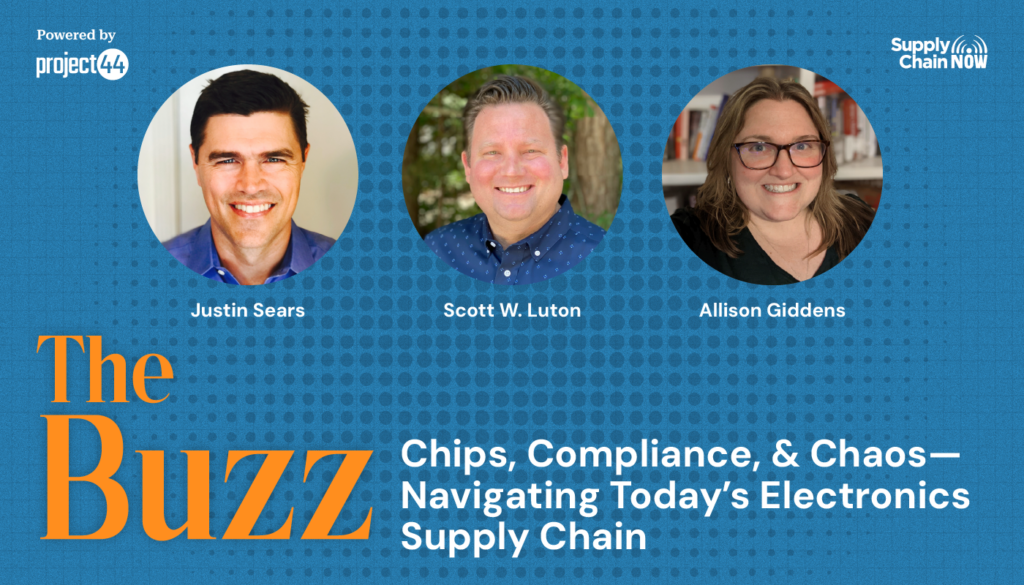
So folks, on today’s show, it’s The Buzz. We’re every Monday at 12 noon Eastern time. We discuss a variety of news and developments across global supply chain. News that matters is what we like to call it. The buzz is powered by our friends at Project44. We’re doing some really cool things to make the powerful decision intelligent platform for the modern supply chain. You can learn more about how to bring more visibility, certainty, and success into your supply chain organization by visiting project44.com. Okay, so Allison, big show here to you up today. We may feature a little bit of sports talk. We’ll see. We’ve got a few supply chain related observations when it comes to major league baseball’s opening day for sure. We’re going to take a look at some of the big forces shaping the electronics industry. Hey, Apple is making a really big reshoring investment, not just a commitment, but a real investment.
(01:33):
It’s been interesting to see. We’re going to talk about that and the bigger picture, all of that, and a whole bunch more. And in about 15 minutes or so, we’re bringing in a great special guest, a repeat guest, Justin Sears, with Altium. So you’re going to really enjoy his perspective on a variety of things here today. Allison, did you take your Flintstones vitamins this morning? Are you ready to
Allison Giddens (01:53):
Roll? I did. Well, I also have just in case of emergency allergy medication as well.
Scott Luton (01:59):
That’s critical for this time of year in Georgia because the pine trees are beautiful, right? They’re majestic, but they deliver pollen like no one else.
Allison Giddens (02:06):
Majestic. That’s the word. Yep.
Scott Luton (02:09):
So hey, really quick. Hey, Tricia and Amanda, thanks for all that y’all do behind the scenes. Trisha says happy buzz day. Say hello and let us know where you’re tuned in from. I appreciate that. And Trisha’s also dropped link to our friends at Project44. Hey, speaking of vitamins, Tsquared, who holds down the Fort Forest on YouTube is referencing that commercial back in the day. Flintstone’s
Allison Giddens (02:30):
Kids. I heard that jingle as I was reading it.
Scott Luton (02:33):
Same. 10 million strong and grown. Man, I hadn’t thought of that in forever.
Allison Giddens (02:38):
I
Scott Luton (02:38):
Know. Thank you. And as he always says, bring on the nourishment in true southern form. Great to have you here, Tsquared and everybody. So let’s see here. Before we dive into the news and have a great guest join us here on The Buzz, powered by Project44, we want to hit four items on the front end, Alison. Okay? So up first, we’re going to be talking about, with that said that we dropped over the weekend. Now that’s a great picture. That’s Elaine Binfield. I had a great interview with her and she has launched this wonderful digital media platform called Her Stories a year or two ago. And Central to the Platform is a podcast dedicated to elevating the voices of pioneers, change makers, everyday heroes, but especially the power of women. And so at its core of her stories, it was all built to address a critical gap.
(03:25):
Way too many meaningful stories were going untold, right? So that’s where you get her stories from. The folks you want to dive into with that said, you learn more about the incredible mission that Elaine is own. Plus, as always, you’re going to find tools, resources, live events, all in the latest edition of with that said. So Alison, I got to ask you, I’m sure you had a busy weekend. I think things are very busy at WinTech, but did you get a chance to spend a little bit of time reading with that set?
Allison Giddens (03:49):
I did. And I love the fact, what is she? Is she looking for a hundred stories? Is that what the kind of the goal is?
Scott Luton (03:55):
The initial goal, that’s right.That’s
Allison Giddens (03:57):
Right. The initial goal and to make it all not only podcasts, not only discussions and interviews, but I guess a book. I mean, it’s cool to see. It’s not just a, “Hey, let’s capture five or six really cool stories and tell them.” It’s like an anthem. It’s neat. It’s really cool to see. And I’m a big believer in you can’t be what you can’t see. That’s right. And so if this next generation find themselves in some of her stories, then that’s awesome.
Scott Luton (04:22):
I’m with you. I am with you. You got to see it to be it. And I’ve heard that from so many folks. And despite all the gains we’ve made, we’ve got a whole bunch more heavy lifting to do. So it really takes wonderful leaders like Elaine and yourself, if that matter, Allison. Well,
Allison Giddens (04:36):
You know what’s really cool is we’ve got an open welding position open at WinTech, put a job ad out and I’ve been sending the resumes that have been coming through. I don’t even look at them. I just send them to my fabrication manager. I popped in my office this morning and he said, “Is there something you noticed about those resumes?” I said, “I’m going to be honest with you, I’m just forwarding them to you. I don’t have time to vet.” And he said, “The majority of them have been women.”
Justin Sears (04:56):
Really?
Allison Giddens (04:56):
I was like, “Holy cow.” He goes, “I thought that was great.” He has three girls of his own. So he said, “I thought that was pretty cool.”
Scott Luton (05:03):
That is awesome. And I bet I would love, and I know you’ve been in this space for quite some time, I would love to have historical data in terms of all time applications and see how much different that is than historical norms.
Allison Giddens (05:16):
Yeah.
Scott Luton (05:16):
And we got to change those norms, Alison, right?
Allison Giddens (05:19):
Yep. Yep.
Scott Luton (05:20):
That’s great. All right, folks. Appreciate what you’re doing, Allison, to help change those norms. And of course, I appreciate what my friend Elaine is doing. Folks, you can learn more about all of that we just touched on, plus a lot of resources and perspective right there via with that said link. All right. So where are we going next? Well, I’m inviting all of you out there to come with me to Chicago, one of my favorite cities, other than it’s home to the Cubs that always give us Braves teams trouble, right, Allison? Is that right?
Allison Giddens (05:47):
Well, sometimes. I mean, I was at a game and granted it was probably 20 years ago, but I was at the game at Wrigley Field Memorial Day weekend. I want to say it was 2006
Scott Luton (05:58):
Maybe.
Allison Giddens (05:58):
And the Braves at the time had hit a record home runs against the Cubs that weekend.
Scott Luton (06:03):
Okay.
Allison Giddens (06:04):
And it was very windy. And I have to say though, Cubs fans are the nicest people. I love Cubs fans. As the Braves were winning, we had people around us try to buy us beer.
Scott Luton (06:15):
Man.
Allison Giddens (06:16):
It’s like, wait, wait, we’re on the other side.
Scott Luton (06:19):
Hey,
Allison Giddens (06:20):
They’re cool.
Scott Luton (06:21):
Give people cold, free beer and we can solve all the world’s ills. But come join me in Chicago where I’ll be attending Decision 44, a free event hosted by our friends at Project 44. You can hear perspectives from leading companies such as Abercrombie and Fritch. Alcon, Eaton, Suntree, a new one for me. Taylor brands, a whole bunch more. April 8th and 9th. That’s free to attend, but you got to register. So we encourage you to do that. Tricia is dropping a link right there. And speaking of events, folks, April 29th, as y’all know, it’s National Supply Chain Day. So plan to join us at 12 noon Eastern time for a virtual event that’s going to feature a wide range of supply chain leaders. Plus, I guess isn’t new news anymore, but hey, Billy Ray Taylor. That’s right. The Billy Ray Taylor. He’s joining us as a very special keynote.
(07:09):
He is an author of the bestselling book, A Winning Link amongst many other things. So mark your calendars to join us on April 29th. And hey, if you don’t join us, that’s fine. We’d love to have you here, but whatever you do, take that day to celebrate, especially the people that make global supply chain happen everywhere. Every nation should have a national supply chain day. All right. So as I mentioned, Alice and Tricia is dropping links to all this to make it really easy folks to check in on anything we do. Of course, you’ll continue to do that throughout the buzz so that some of these news stories we tackle, you’ll be able to go click one click away from kicking the tires on any of the perspectives that we share. So one more thing, Alice. I mentioned, maybe I didn’t. I’ve been talking so much baseball in the opening here of the buzz for March 30th.
(07:54):
You attended. This was opening day, Atlanta Braves versus the Kansas City Royals, and you captured what I like to call Sound of Freedom. This is, I think, four F-35s in four finger formation, been around for a very long time. So tell us, this blends for me, this blends baseball, it blends patriotism and supply chain all in one. But tell us more here, Allison.
Allison Giddens (08:20):
It does. Very cool. So I kind of had the inside scoop this was coming, so I was prepared with my camera. But WinTech is a supplier to a lot of F-35 parts, a couple of different, what they call big primes who report to Department of Defense, Department of War. And yeah, it was a really cool capture. And it turned out that the world is a lot smaller than you think because these planes and pilots, I believe were from Maxwell Air Force Base, Montgomery, Alabama. And when I posted this, I had a dear friend comment and say, and she said, “And a proud mom moment. My son’s name is in one of those planes.”
Scott Luton (08:56):
Wow.
Allison Giddens (08:56):
So just you never know kind of what you come across.
Scott Luton (08:59):
You never know. And the world is so interconnected and you level set on moments like that, right? Yeah. I think of sacrifice on so many different levels. So love that, Allison. And I look forward to many more serious and lighthearted moments from the Atlanta Brave seasons coming up because you’re going to be attending quite a few games.
Allison Giddens (09:18):
A couple. A couple. You
Scott Luton (09:20):
Basically have an apartment at- I
Allison Giddens (09:22):
Wish. That would be really
Justin Sears (09:23):
Cool.
Scott Luton (09:24):
So folks, speaking, by the way, again, of Alison’s post here, this is the F35, right? Single engine plane. I’m not sure when they rolled the first one off the production line, but over 2000, I went and checked out the program, I call it landing page. It’s all kinds of information. Over 2,000 suppliers come together to build each aircraft, including almost a thousand small businesses, Allison. How about that?
Allison Giddens (09:49):
That’s pretty cool.
Scott Luton (09:50):
Now I’ll say that as cool as the F-35 is, my favorite still remains the F-22 of the modern era. And of course, the F-16 signal engine is legendary and- Love you.
Allison Giddens (10:02):
I’m with you on F-22. I think that’s probably my favorite too.
Scott Luton (10:05):
Same, man. I really wish … I think they cut production. They initially planned for, I think, triple the amount of aircraft.
Allison Giddens (10:11):
It was so expensive at the time. And now I think probably, well, a lot of people I think are looking back going, “Gosh,” because WinTech does a lot of support for the maintenance on the planes.
Scott Luton (10:20):
Okay. All right.
Allison Giddens (10:21):
So we’ll repair parts and make spares and things like that. But you know F22 is one of the few planes, if not the only, that we don’t sell to other countries.
Scott Luton (10:29):
I think I remembered that. I think I remembered that. And the F-35, to your point, I think that, just on that side earlier, I think there’s a dozen countries operating it. Of course, it’s got a lot of different roles.
Allison Giddens (10:39):
Right. And different versions. I think we have a version we don’t sell. That’s right.
Scott Luton (10:44):
I’m pretty sure. Man. Okay. Allison, I’m about to nerd out. We got a great guest. I got to get in.
Allison Giddens (10:47):
Focus.
Scott Luton (10:48):
I could nerd out about this stuff. I really love what you do. And hey, look at here. Corey Comer is back with us.
Allison Giddens (10:55):
Yeah. Okay. My uncle flew F-14s.
Scott Luton (10:58):
Really?
Allison Giddens (10:59):
Yeah. Favorite thing to do is land it on an aircraft carrier at night in the middle of the
Scott Luton (11:03):
Ocean. Oh, I can imagine how challenging that must be. Corey, great to see you, my friend. It’s been way too long. You need to drop your link to your Whiskey Focus podcast, Corey. That’d be great. Even on a Monday morning, my stomach almost handle a whiskey podcast. I’m the only kid to Corey. Great to see you, my friend. Appreciate the great work you do. So we have got a wonderful guest. I’ve got to do a control alt delete to lead the aviation conversation. I could be there for a whole day, Allison, but we got great supply chain stuff to talk about with a dear friend with a passion for data-driven transformation and manufacturing. Justin Sears specializes in applying cloud-based data analytics and workflow automation platforms to truly optimize supply chains. In his leadership role at Altium, Justin leads a team positioning Altium software for streamlining hardware development and the sourcing of electronic components for printed circuit boards.
(11:55):
So please join me in welcoming Justin Sears, head of product marketing for SaaS at Altium. Hey, hey, Justin, how you doing?
Justin Sears (12:03):
Good morning. Scott, I’m great. Great to be here with you.
Scott Luton (12:05):
Great to see you as well. It’s been too long. Allison, we had a little fun on the front end because Justin joined us. I’m going to say in early March 2025, a few weeks ahead of Tariff Agedon, I think. So we were having a little fun and to pre-show that Justin’s got to give obligatory disclaimers when he appears for the first time on programs. So this is our internal program, competition challenges supply chain now, bracket busting crew. This is the men’s side. Look at this. Catherine and Vicki and Mary Kate and Amanda. And let’s see. Mary Kate and Amanda probably have the inside edge because of Michigan and Yukon are still alive and well, so we’ll see. And then secondly, the bracketbusters too is focused on the women’s bracket. And this is where Justin Allison, I am within striking distance of Laura and Mike Griswold.
(12:52):
And we’ll see if South Carolina wins tonight and of course wins it all, then victory is all but certain. Alison, let me ask you about your brackets. How are you doing this year?
Allison Giddens (13:02):
And so unfortunately I didn’t submit any. So in a way it’s good because now every time team loses or team wins, I look at my husband and I go, I probably would’ve picked them to win. And he’s like, “Yeah, I’m sure. I bet.” But I’ll tell you what I did see was that shot from the Dukon guy. Yes. Oh my gosh. His name against Duke last night. We were sitting down to eat dinner and we turned our heads and we watched him think that three pointer and went wholely cow.
Scott Luton (13:32):
That’s crazy. Duke lost, I think a 19 point advantage was their biggest lead in that game. And then that guy came along and tried a three pointer take the lead by one. Justin, we’re talking about that Duke. Duke is it Illinois, right? Illinois?
Allison Giddens (13:44):
UConn.
Scott Luton (13:45):
Yukon. Yukon. Yeah. Sorry. Justin, did you see that game yesterday?
Justin Sears (13:49):
I missed it. My team wasn’t even in the initial draw, so I haven’t been following it too much, but it was good to hear you guys recount it.
Scott Luton (13:57):
Well, Justin, it was a remarkable furious comeback. I think Yukon outscored Duke by 20 points in the second half, which is crazy because Duke only lost three games all year. But nevertheless, we’ll see. Folks, hopefully your brackets are better off than ours. It looks like Alan Jacques is. He’s in the 89th percentile for one of his. How about that? Alan, great to see you. And Andrew’s back with us from Schropshear. I got that right. I think I nailed it. Andrew, just got one supply chain client calls to listen to you as my favorite supply chain chats. Hey, Andrew, that is high praise, my friend. I appreciate what you’re doing out in the industry. I look forward to getting you, Alan, and maybe even Corey’s takes, all of your takes on the stories we’re getting to here today. So let’s get to work. Let’s see here.
(14:38):
We’re starting. We’re starting with a pretty hefty topic here, strategic data intelligence, Alison and Justin. Man. So this comes to us from industrial equipment news. They point to how strategic data intelligence is reshaping the electronics industry and its resilience. Now they point to a ton of regulatory compliance that many organizations are dealing with. I bet some of y’all can relate to some of these restriction of hazardous substances. ROHS, I think that is acronym there. ROSE, I think some people call it that. I believe, tell me if I’m wrong, registration, evaluation, authorization, and restriction of chemicals, reach also in the EU for sustainability, a trade again that we talked about earlier, you name it, tons and tons. The real challenge, as really the article points out, is not only the volume of regulation and complexity, but pace of change, right? The pace. We’re going a thousand miles an hour, and that’s on Mondays.
(15:32):
On Tuesdays, it doubles. But fragmented compliance data is really something that a lot of organizations can struggle with in light of this landscape. From a supply chain perspective, all this can greatly complicate our efforts to make quality parts, leveraging the right suppliers. And you know what? Manual processes and spreadsheets, they’re highly limiting, especially here in the modern age of digital transformation and beyond. Innovative organizations are turning technology so that teams can have access to that critical compliance intelligence at the point of decision, which helps provide a more proactive ability when it comes to managing risk and supply chain ecosystems. Now the article says, “The future of the electronic supply chain will be defined by strategic data intelligence.” Okay. So Justin, I’m going to roll the dice. I’m hoping you’re still with us.
Justin Sears (16:21):
I’m here.
Scott Luton (16:21):
All right. Wonderful. Because folks, Justin works extensively in the electronics industry. So your thoughts on what that article spoke about, Justin.
Justin Sears (16:30):
Well, folks that design electronics and distribute the parts that go into electronics, they have to keep those two things at once. We work with a lot of folks that are designing hardware with electronics inside it. So as you’re going along and you’re designing the boards and figuring out how it’s going to fit in the mechanical structure, what you’re not spending time on doing is figuring out how am I going to show if I’m in a regulated environment, I’ve gone through all the processes and the rules and regs to make sure that I’m testing, especially medical device, aerospace, air regulations you need to comply with. You mentioned Rojas and some of the others. You don’t want to take your eye off the design work to make sure you’re thinking about how you’re important afterwards, but you need all that data. And I’ll come back to data a few times that you need all that data so that when you do need to show your work, you can do that.
Scott Luton (17:15):
Justin, appreciate to show you work. It’s like me talking math with my seventh grade son. He’s like, “What are you talking about? ” I’m like, “You got to show you work how you arrived at the answers.” It’s such a timely point you made, Justin. And did I mispronounce, is it ROHS? How do folks talk about that, Justin?
Justin Sears (17:31):
I think people say it a few different ways. I’ve heard it say ROHS, but ROHS, sometimes people- Spell it out. Do you know, Allison, or have you- It’s
Allison Giddens (17:40):
ROHS in my world, but like you, I’ve heard it three or four different ways. So I don’t think there’s a raw one. We
Justin Sears (17:45):
Need an expert that knows how for now, but I’ve heard said a couple different ways.
Scott Luton (17:49):
I think the rule of thumb is as long as you don’t follow Scott Lewton’s, my pronunciation of anything, you’re going to be safe. You’re going to be safe. But all right, so Allison, follow up. Justin shared a few thoughts about this great article that we got from our friends at Industrial Equipment News. Your thoughts?
Allison Giddens (18:04):
Yeah, you could have a whole supply chain buzz just on this article, I feel like. In my world, what Justin was saying speaks volumes because it’s exactly what we see in our world. We are, as a small business manufacturer, we’re somebody, we don’t do design. So we take already existing blueprints and then we make the parts. But what we are noticing in our industry is we are having our customers say, “Hey, we need you to report reach chemicals.” I don’t remember what that stands for, but it’s essentially a certain series of chemicals and minerals that are monitored for especially the EU. And if things are imported to the EU that have those kind of chemicals, they have to be reported because it can only have so much percentage of Huron. Well, it’s frustrating as a small business manufacturer because just like Justin said, we’re busy making the part.
(18:51):
We’re not so much focused on the, “Oh, well, what kind of little tiny compliance thing are we not thinking of after the fact?” So we’ll have customers who ironically enough will be the design authority on something asking us for the reach info. So in my head, I’m like, man, when you design a product and when you say, “Hey, this type of paint has to go on this part,” why not just go ahead and then say, “That paint has this chemical in it, therefore this exists.” Because if the part is manufactured properly, the reach applies them.
Scott Luton (19:21):
I like it. Justin. And by the way, that REACH, I think the acronym you’re talking about, registration, evaluation, authorization and restriction of chemicals. As Alison mentioned, it’s big time in the EU. All right. So Justin, give you the final word. It sounds like you and Allison could have one of those cold free beers we were talking about earlier and really have some common experiences in the industry. Yeah.
Justin Sears (19:45):
And I’ll tell you, I spend a lot of my time getting closer to what folks like you, Allison, do because I’ll give you one example. We have a customer who we’ve been doing business with a lot for a while and they’re designing their consumer goods that have electronics within them on our platform. So the person that owns the contract is in the US and they have a team in the UK that wanted to test it out and a team in China that manufacturers needs to see what … You get these global issues and then there’s different regulations in different geo. So you have to sort somebody has to have the visibility to know to make sure that the whole thing is compliant end to end.
Scott Luton (20:21):
And I should just add to all of that picture that Justin shared, this is where spreadsheets really don’t cut it. They really don’t cut it. So got to find a better way. Good stuff, Alison and Justin. Man, I’m going to try to not nerd out on that topic as well, because we’ve got a lot more to get to here today. I want to talk about something we talked about last week, Justin and Allison, as we kind of pivot here. And that’s helium, right? We’re talking last week about some of the supply chain implications and challenges specifically related to the ongoing Iran war. Now, we’re going to keep this very non-political. We’re going to keep this very focused on the business side, right? Of course, we hope that things come to a nice brokered piece, but that goes without saying, but we’re going to really focus on one of the business implications here.
(21:05):
Like this growing, what is a growing helium shortage. So as reported here by Reuters, the disruption in global tech supply chains continues to mount as helium supply faces more and more pressure. Helium is used in a variety of roles in electronics industry, including chip making. As we shared last week, cutter, the country there has been the target of some of the conflict in the Middle East, and it’s a critical player in the world helium market, the number two largest provider next to the United States. Now, Russia, because someone has a great sense of humor in the broader sense of things, Russia is the third largest supplier of helium, which can pose probably some further complications from many organizations trying to come up with a contingency plan. So Justin, I got to ask you, a lot of folks may not be aware of just how extensive and how important helium is in electronics and how fast growing this disruption may end up being.
(21:58):
Justin, your thoughts?
Justin Sears (21:59):
Yeah. I mean, I can’t talk to that from a technical perspective or how that actually plays into the manufacturer of chips. But of course, a lot of what I’ll be talking about today is how the designs that we support on Altium include chips. And if you’re designing something, and Allison, I’m sure you can speak to this, you’re designing something, you don’t know on day one how changing prices of helium are going to affect the price of a component and where that component is going to be in the design that you’re making for a printed circuit board. You can’t keep up. And back to your comment about spreadsheets, Scott, you can’t keep up with all those changes. And the thing that you all know that’s so tricky about the supply chain is one thing converts into another thing. So price of helium goes up, that means the price of chips goes up.
(22:42):
That means that the design that you’ve been working on for months, suddenly you can’t bring it to market profitably. So what do you do? And it’s that uncertainty that we help our customers get ahead of as much as possible.
Scott Luton (22:53):
And we need all the help we can get when it comes to overcoming that uncertainty and really uncertainty in all of its different forms. Allison, when you think of anything that gets in the way of the electronics industry and all the various components, I got to tell you, Helium prior to the last couple of weeks was probably in my blind spot. But Alison, your take on this disruption here.
Allison Giddens (23:12):
Yeah, no, this was interesting to me because I’ve watched as a lot of other, and I’m sure Justin sees a lot of other hardware as just skyrocketed in costs and prices lately. And I wonder how much of this, how much on the design side that our electronic manufacturer, electronic design friends out there are doing to counteract this only for it to later maybe not be as impactful. And then how are the changes that they’re making later going to impact whatever supplies revolve around some sort of new constraint? It’s fascinating because this kind of stuff, it doesn’t overnight all of a sudden we don’t all see prices go up. It takes, what do they call a trailing indicator, a leading indicator. I always get too confused. That’s right. But by the time it happens, it’s going to be interesting over the next few months.
Scott Luton (23:59):
Well, y’all’s perspective and really this story about Helium, because I bet I’m not the only person that hasn’t stopped to think about Helium since ninth grade chemistry class or something. It really goes back to a big picture thought. The more we can invest within our control to strengthen the resilience and how our organizations run, how our supply chains run, we’ll be more and more prepared for the common curve balls, which we can all probably rattle off that we face maybe yearly or maybe even monthly, and we’ll be equally as more prepared for the very uncommon challenges. So we shall see. Let’s see here. This is, and help me out, Amanda and Tricia, they say makes the just in time delivery of supplies of helium a bit squeaky, a bit squeaky out. I think that’s an adjective I think in my English class here. And hey, Anabella from Argentina, I hope this finds you well.
(24:52):
Looking forward to your comments here today. Yes, we don’t want supply chains that are a bit squeaky if we can eliminate the squeaks. Okay. Justin and Allison, let’s see where we’re going next. This is what I’m going to call on a more positive note, right? More positive note. There’s this story here, as Alison knows, she’s had a front row seat at a lot of these discussions as we’ve talked about reshoring and some of the announcements, Justin, that have come about over the last year and some change. And to be fair, there’s all sorts of reshoring announcements that gone back for years for that matter. Some come to fruition, others do not, right? Others do not. But here, this is a really good story, I think. As reported by CNBC, Apple is expanding its $600 billion American manufacturing program. Now they call that the AMP, another acronym for y’all.
(25:40):
So if you hear me say it, that’s what I’m talking about. Company plans to spend some $400 million from now through just 2030, we’re talking four years or so, three and a half on new programs with companies such as Bosch, TDK, and others. Its objective, as the name may indicate, is to help manufacture essential materials and components here in the US. To support this investment and overall initiative, Apple said it plans to hire more than 20,000 US-based workers for R&D, engineering, artificial intelligence, and software development. A&P launched, the program again launched in 2025. And here in 2026, Apple is on track to purchase over a hundred million advanced chips from the new TSMC Fab in Arizona. In fact, A&P is poised to support a variety of new semiconductor production facilities as well as broader manufacturing companies across the US, which includes building the Mac Mini, the popular Apple device, building it in Houston in 2026.
(26:37):
That’s the first time the product has ever been built here in the States. So the healthy skeptic that I am, Justin, every so often what’s been announced comes to fruition. I think this is a really cool story with Apple. Your thoughts?
Justin Sears (26:49):
I agree. This is the kind of thing that you want to see. And when you’re looking at manufacturing and putting the pieces and parts together, it’s always going to be a little bit more stable and hopefully a little less expensive if you don’t have to ship all those components quite as far as you used to. So it’s going to reduce the risk and potentially reduce the cost at the end of the day. So Scott, it was about a year ago that you and I talked about new tariffs and what they were going to do. I think one of the things I said at the time is it takes a little while to build a fab or to retool a fab. So don’t expect this to come overnight. I would put this in sort of the same bucket. There’s an announcement today. We’ll see how it comes out.
(27:27):
But the thing that I noticed reading the article, Scott and Allison, is it said, you mentioned the 20,000 jobs at Apple, it also referenced supporting more than 450,000 jobs in all 50 states across the supply chain partners. And so I looked up some of the companies on the earlier program and now, and it’s very interesting to see how that breaks out by probably how much business they’re dealing with the supplier. So most of the impact is going to be on supply chain partners in terms of supporting jobs are more 450 than the 20,000 that Apple plans to hire directly.
Scott Luton (28:00):
Justin, that’s good news in my book. And of course, we’re going to touch on reshoring in just a minute a little deeper and kind of also in the bigger picture. Justin, you’re right. And Alison, what Justin is saying is his crystal ball works a lot better than mine, number one. But number two, I’m going to double down on it. It’s so cool to see the company really put its money where its mouth is. And I mean that very respectfully, but there’s lots of hype, there’s lots of lip service, but here clearly the impact’s being felt. Your thoughts, Allison?
Allison Giddens (28:28):
I think it said that Cook had absorbed $3.3 billion in tariff costs and rather than flow that down to the consumer, he ate it. And I guess that somebody sat down and went, “We can’t do this long term.” And so that investment I think it made a lot of sense. And I’m with you, I’m glad to see it and I hope it pans out even half of what they hope it to be. I’m a Google Pixel user, I’m a Android user, so I should be apathetic on the brand, I should say. Oh no, I’m just kidding. No, but this is a promising thing for manufacturers, so it’s good news.
Scott Luton (29:01):
It is, it is. And we’ll see the ripple effect from this program, if it does come to full fruition and these numbers that Justin and I both have shared and article shares, a ripple effect could be good for a variety of industries. And to Justin’s point, talking about some of the variables we take out of the equation when we kind of reset the production of footprint via reshoring and other things, it will be helpful as we tackle some of the other challenges impacting chip supply, which we’ve touched on with the buzz, memory chips in particular, which of course computers and smartphones all drawings, it’s fascinating to see the 70 chess that takes place in the electronics industry. Let’s do this. We’re about to dive in deeper with Justin in just a second and get some of Allison’s thoughts on further what’s going on, reshoring electronics and more.
(29:50):
First, I want to share a cool event that is on my radar, some more good news maybe, the Supply Chain and Logistics Summit. It returns, let’s see, May 18th and 19th, 2026 at the Red Rock Casino Resort and Spa in Las Vegas. Hey, Red 19, bet the farm on Red 19 folks. Anyway, it brings together senior procurement executives with innovative suppliers and solution providers for an invitation only premium experience, all built around real operational priorities. Now get some of these topics because they’re going to be very intuitive. Big sessions are going to focus on big topics such as AI automation and visibility, check, check, check. Operational optimization through planning excellence and cross-functional alignment and resilience and risk management in a volatile geopolitical environment. I feel that one in my bones. All that much, much more. Folks, check out the link that Trisha’s dropping. You can learn more about this event coming up in, what is it?
(30:41):
About two months, I think, right? My math is right. All right, so Justin, we’re going to dive deeper with you. And by the way, really quick, before I do this, that was my friend Andrew who’s joined us on lots of these programs that use the word squeaky in a new way. So Andrew, I’m going to steal that one from you. I’m so glad to broaden my vocabulary here on the buzz, Justin and Allison. All right, so Justin, let’s pick up on that last topic as it relates to Apple and its moves that CNBC was reporting on. I want to talk a little more about reshoring because as you just mentioned, when you joined us just over a year ago, I think we were all curious and I’m still curious about how much reshoring is going to take place, not just due to tariffs, but certainly due to that trade uncertainty and many other factors that we touched on earlier in the show and new factors, right?
(31:26):
Because the disruption and the chaos and some of the uncertainty continues to build up a bit. So I want to ask you, Justin, because you had some prognostications a year and some change ago that I think were pretty accurate. So give me some of your comments on what you’ve seen thus far in this last year and maybe some other fearless prognostications of what else we may see in the weeks and months to come.
Justin Sears (31:49):
Well, I think what I’ll do, I’ve been on the road lately, Scott, and been at a couple of trade shows. So I’ve heard it straight from the horse’s mouth, the folks stopping by our booth. One was DesignCon in February in Silicon Valley. So on the software side of our hardware, software combination here at Authium. And then actually earlier this month in March, I was at Embedded World in Germany. And I can do for both of these shows, I can do a before, after compare one year later. So it was helpful to me to kind of hear how conversations have changed for the hundreds of people coming through our booths and talking to us. And so if I were to sum that … Oh yeah, go ahead.
Scott Luton (32:28):
Justin, that sounds great. But right before you launch into this, I got to get the word, because I’m sharing a couple pictures of you and the team at the events you mentioned, right? Both, let’s see, Embedded World 2026. And then this is DesignCon. I got to get the 411 on the gentleman in the middle of this picture, because it reminds me of the McDonald’s advertising campaign back in the 1980, the Moonman, right? What is the story behind the costume?
Justin Sears (32:55):
He is the design con mascot and I think he’s representing his face has, you can see the traces for a printed circuit board. So he’s sort of like a walking circuit board. I’ve never seen him with his mask off. I know it was like personally, but he definitely, he’s a favorite at the show. People like to get pictures with him. I love it.
Scott Luton (33:15):
For sure. It looks like a guy that you’d want to grab one of those cold beers with, cold-free beers with. All right. So Justin, I’m with you. You’re going to compare and contrast all the conversations that y’all have had this year at those events and last year at those events. What are some common themes that have emerged then?
Justin Sears (33:30):
Yeah, I’ll start with DesignCon. The thing that really stood out to me for us is we serve at Altium very small designers and then very large enterprise companies. And usually you pick a show and it’s going to skew one or the other. I think what you’re seeing is a lot of smaller designers, maybe venture-backed in the Silicon Valley, they’re coming up and they’re starting things from scratch with a modern software stack. And so what that allows them to do in many cases at Leapfrog folks that have been doing things with older systems. And so you see this. I looked around our booth at DesignCon and as a marketer, it was very good for me to see the smaller shops Altium develop our solution that’s for those smaller teams all the way up to Agile Enterprise for very large companies.
(34:20):
And we had pretty much an equal level of demos going on across that. And then the product that I’m in charge of agile teams is more the mid-size, the folks that are kind of grown out their early stage spreadsheets. They can’t carry those anymore. They need something that’s a little bit more structured that still allows them to move quickly. So I was spending more time with Agile teams, but I’m looking sideways and I can see the large companies that are really small companies all able to engage and think about doing new things more efficiently than I couldn’t do before.
Scott Luton (34:48):
I like it. I like it. Allison, when you think about doing things more efficiently and you think about this landscape that we’ve painted quite a picture, right? We’ve painted quite a picture between regulatory, trade, what I’ll call just general ongoing disruption that comes with and challenges and headaches that come with managing supply chains. Teams and business leaders, we’ve got to continue to keep our eyes, our head on a pivot, looking for better ways of finding efficiencies, innovation, and real tangible terms. Your thoughts, Allison.
Allison Giddens (35:20):
Yeah, for sure.That spoke to me when Justin said that those that are starting from scratch and they’re starting with the new latest and greatest stuff are leapfrogging those who may have been around a while, but either are dragging their feet or don’t have the dollars to upgrade and so on. So I think that speaks to a lot of different industries too. In manufacturing, I’m seeing a couple of startups happen and they’re posting pictures of their beautiful five axis manufacturing CNC mills and all these things. And it’s like, okay, this is kind of interesting. There’s something to be said for those that have been in the industry for a long time and bring that value with it. I almost feel like those that are starting from scratch in the terms that Justin is talking about, I think the fresh perspective is probably really good.
Scott Luton (36:02):
Undoubtedly, especially that fresh perspective that Allison’s touched on, Justin, that leaders, despite if they’ve been around 200 years and they’ve got a big competitive advantage on a lot of their competitors in the market. However, we know that there’s some great equalizers at play right now between AI and many other, as you called it, a modern tech stack and all the different things that go into the modern tech stack or modern technology approaches. And that if we don’t look for that fresh perspective, Allison’s talking about, those big gains and big advantages can start shrinking as your competitors lean into all of that and then some. And don’t lean into how we’ve always done business, which of course is the cost of this question maybe in the history of business. Your thoughts, Justin, this is really, I look at it in many ways as an imperative, a fresh perspective imperative in the modern business landscape, huh?
Justin Sears (36:53):
Yeah. And the other show that I mentioned was Embedded World that’s in Nuremberg, Germany, and that was the beginning of this month, seems like a long time ago. But there’s a place where you have very old automotive companies that are looking at the United States and the West Coast to figure out how to kind of retool and become more agile in how they’re doing things. And so it was very interesting. One change that I saw there is I was at that show last year and we would talk about the cloud components of what we offer. We would say, “Wait a minute, we don’t do cloud.” That was last year. One person at the show this year taught me with that. Everybody else said, “Tell me more.” And so I don’t know what that means for them internally, but they’re starting to be a loosening and an acceptance of different ways of doing compute.
(37:40):
And what I get most excited about, why I love joining this show is the connection between hardware, which needs that precision, that repeatability and software, which is a constant infusion of new ways of doing thing. And making those two things work well together is a real trick. That’s what we spend a lot of time thinking about at Alteam.
Scott Luton (37:57):
I like it. I like it. Okay. So I’m blinking and we’re fast approaching the end of today’s edition of The Buzz from March 30th. So we’re going to have a fast and furious finish, Justin and Allison. We’re going to touch on a variety of other things. Really quick, Justin, I bet, I know you’re excited with a lot of things you are doing at Altium, but if you had to break it down into one thing, one initiative for 2026, one innovation that you and the team have unlocked this year, you jump out of bed thinking about each day. What is that, Justin?
Justin Sears (38:27):
Well, at the Embedded World Show in Germany, we announced Oktapart Discover. We own Oktapart, which is a search engine for electronic components. So it’s for this audience, folks that need to purchase and price components for their hardware. And we announced a way, a new solution, Oktapart Discover, which goes beyond just searching for parts and starting to search for system engineers, designers. They can start with the block diagrams, which are kind of groups of parts, so they don’t have to start from scratch. And those block diagrams are tried and true and tested hundreds, if not thousands times over. So you can go to these sort of marketplace of design blocks and start putting them together so you don’t have to start with a blank board, but you can start with ideas and groups of chips that might get you to where you want to be. Now, you can still swap out chips if one of them becomes unavailable or too expensive, but it’s really going to help the designers move a lot more quickly and really unifies for us at Altium visibility we have into the supply chain for those components.
Scott Luton (39:27):
Okay. You mentioned a couple different things I think that gets all supply chain practitioners and professionals and leaders attention, visibility, alignment, design velocity, I’ll call it, right? And more certainty of what we’re trying to do and get accomplished each and every day. Kind of going back to that first article, Allison, really quick, what did they call it? Strategic design intelligence. I think that was how they put it. Having all the information you need at that decision point, sign me up for three of those. Alison, your quick comments here.
Allison Giddens (39:57):
Yeah, no, that is dead on. We use a similar search engine for specific military components. And just to your point earlier, Justin, the data when it’s all siloed or when it’s all in one place doesn’t do us much good.
Scott Luton (40:09):
Like it. Okay. So let’s do this. I’m going to shift gears here, Justin. We can’t spend a whole bunch of time on this. We’re going to have to have you back, Justin. We’re going to have to have a bookend episode of Justin Sears on the buzz, but love what you, one of your colleagues did here by hosting a webinar, I think just a few weeks back that really focused on the growing security concerns in that electronics development environment. And I know you and Allison and some of our audience members are very familiar with. So if you had to bullet down to one or two key takeaways, Justin from, I think, is it Renata? Renata Lang? Is that right?
Justin Sears (40:42):
Renata, yep.
Scott Luton (40:43):
So based on this webinar conversation, what’s a couple of key takeaways that folks got to keep it in front of them?
Justin Sears (40:48):
I’ll say visibility and regulation. So as I mentioned before, you need to have visibility into who’s accessing your design and development environment. If you don’t know, this gets back to the point I was making earlier, going from a small kind of one team shop with 10 people in a building to multiple offices, multiple people coming in as part of the design process, gets harder to determine who has access to that design. And then on the regulatory point of view, you also have to show that you’re doing your due diligence and making sure that you’re protecting that chain of custody and bringing people in the design as well. So that’s what Renata spoke about. The way I sum it up is when people ask me about security, I ask them, “Okay, how are you sharing your designs?” And they’ll say, “Well, we don’t do cloud because we don’t know if we can trust it or not.
(41:36):
” And I say, “Well, how do you share your designs with your contract manufacturer?” And they say, “Oh, we send it as an email attachment.” I go, “Wait a minute, you’re just telling me about security.” I could send that email attachment to the wrong Allison and suddenly my IP’s out there in the world and I have no control over it. So that’s why we talk about cloud being the most secure. You can authenticate people when they come in, you can see what they do, you can track their behavior, you can monitor it much more effectively than if you’re in a dispersed email type of environment.
Scott Luton (42:04):
All right. So Alison, I’m going to get you to comment on what you just heard there from Justin. But first, folks, if that topic, really optimizing your security in the whole electronics development realm, space, environment, go check out this free webinar that one of Justin’s colleagues, Renata, put together. So Allison, sending email attachments and inviting bad actors to come in and sit on
Allison Giddens (42:28):
Our- Well, all it takes is your email to get hacked and all of a sudden, right?
Scott Luton (42:32):
And I know you’re part of a lot of conversations and what I’ll call change in industry when it comes to how, especially the defense supply chain ecosystems, how things take place there. Your thoughts in terms of what Justin shared?
Allison Giddens (42:45):
It makes a heck of a lot of sense to have your things in, like you said, a secure cloud environment. And I think additionally, maybe as a side benefit, you have more control over that configuration management as well. So when you do have a design and you’re working on things and your customer’s feedback or you need to change something, now you’re not labeling things like we did in the old days, like final, final version 3.1.
Scott Luton (43:10):
Takes me back to my mental stamping days, Alison.
Allison Giddens (43:12):
Final, final. No, really, this is final.xls. Yeah.
Scott Luton (43:16):
All right. So let’s do this. We’re about to make sure folks know how to connect with Justin and with Allison so you can continue the conversations here that we’ve had just over the last hour. But really quick, I want to share one great blog article. So Alison, you may know about this, Justin, you may know about this, I don’t know, but we rolled out a new website at supplycheanow.com last year, right? And my favorite thing is the resource hub. I’m nerding out about the resource hub. We got blogs, we got resources, white papers, you name it. And this great article from Deborah Dole about the geopolitics of junk, which is a collection of thoughts from GreenBiz 2026 is really good stuff. So folks, I invite you. I’m not going to do it justice here. I invite you to go check out the geopolitics of junk right here.
(44:04):
Trisha’s dropping an easy link. Go check it out. And while you’re there, give us ideas of what you’d like to see. What would be helpful for you in that resource hub? All right. So let’s do this, Justin. You and the team, Justin, I hear you’ve got 47 more trade shows you’re getting to by the end of the year. First off, is that true, Justin?
Justin Sears (44:21):
No, no, no. At least four, but we might’ve done that last year when we were getting back out on the road, but we’ve trimmed it down now to the most important ones.
Scott Luton (44:31):
That’s important because as I know Allison knows, we talked about this, here’s an event for every day of the year. And at some point in time, work’s got to get done. So Justin, I really appreciate what you and the team are doing for businesses of all sizes. How can folks connect with you to continue the conversation on anything you’ve said here today?
Justin Sears (44:49):
I’d be very happy to interact with folks on my LinkedIn. It’s just Justin Sears. There is another Justin Sears out there, but he’s a 6’8″ basketball player. That’s not me. So look for the guy that looks like what you’re seeing right now. And then go to allteam.com and especially check out Agile Teams, which is the solution that I mentioned for mid-market. So if you’re one of those folks that is thinking twice about emails and spreadsheets and you want to move up to something that’s a little bit more controlled, a little bit more structured because your operations are becoming more sophisticated, I encourage you to look at agile teams.
Scott Luton (45:23):
Outstanding, outstanding. And we’re dropping both links right there. Thank you, Tricia and Amanda. Both links right there in the chat. And then Allison, I got a … And Justin, by the way, thank you for being here. We’re going to wrap in just a second or two. Don’t go anywhere. Allison, I love what you’re doing on a variety of levels, right? Action oriented leadership for sure. But in particular, my favorite of all the missions you’re on is the Dave Creachy Foundation. And check this out. Justin, we’re talking about this pre-show. Look at this. Helping local kids play the sports they love, we’re talking about over 2,300 kids playing football, all the sports, all the sports that have become so pricey. So Allison, how can folks, if they want to connect with you on the cool things you’re doing in industry or they want to connect with you on your nonprofit, your powerful nonprofit work, how can folks connect with you?
Allison Giddens (46:12):
Definitely. Find me on LinkedIn, Alison Giddens. I don’t know if there are other Alison. I’m sure there are, but I’m the only one that happens to be in supply chain and the nonprofit sports world, probably. Definitely connect with me. If you do connect rather than follow, please leave me a note because I get a lot of spam and bots and I don’t always accept connection. So if you put in your connection request, hey, you saw us on supply chain now, I will most certainly accept.
Scott Luton (46:34):
So follow that advice and you can also learn more at davecrache.com. A lot of good stuff here. Well, folks, I’ll tell you, where did the hour go? Justin and Allison, it’s been delightful to spend time with you here today. It’s hard to believe we’re almost in April 2026. Goodness. Justin Sears with Altium. Thank you so much for being here. Appreciate what you’re doing out in the industry. Again, as I mentioned, to help companies of all sizes find certainty, successful certainty in this highly uncertain environment. But thanks for being here, Justin.
Justin Sears (47:04):
My pleasure. Thank you so much. I hope we can do it again soon.
Scott Luton (47:07):
We will do it again soon. Of course, also big thanks to my esteemed co-host, Alison Giddens. Again, appreciate all that you’re doing in industry and at the Dave Creichy Foundation.
Allison Giddens (47:16):
It’s fun to hang out with y’all.
Scott Luton (47:18):
It was. I’ll tell you, I learned lots of new things here today. I should also give a big high five to our friends at Project44. Be sure to join me in Chicago at Decision44. In April, you can learn more at project44.com. Big thanks to Amanda Tricia, behind the scenes. Folks, you know your homework. Big thanks to all of our folks that tuned in from around the world. You got to take one thing that you heard here from Justin or from Allison. Do something with it, deeds not words, put it into practice. You know that’s how we’re going to continue to transform global supply chain. Well, all that said, on behalf of the entire supply chain now team, Scott Luton challenged you to do good gift forward. Be the change that’s needed and we’ll see you next time. Right back here on Supply Chain Now. Thanks everybody.
Intro/Outro (47:56):
Join the Supply Chain Now community for more supply chain perspectives, news and innovation. Check out supplychainnow.com. Subscribe to Supply Chain now on YouTube and follow and listen to Supply Chain Now wherever you get your podcasts.