Share:

The Geopolitics of Junk

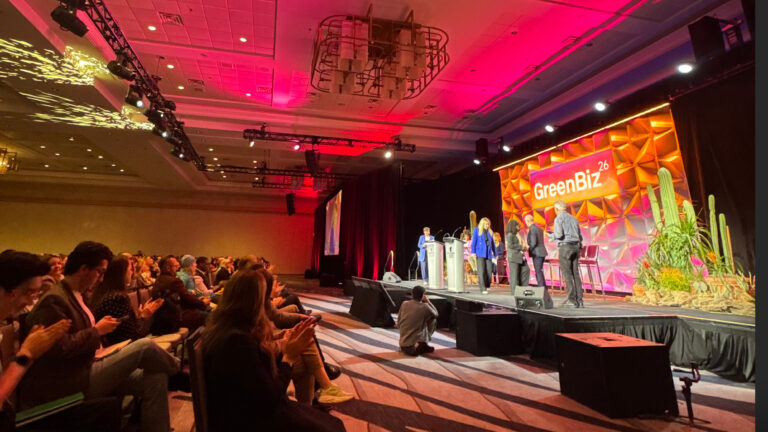
written by Deborah Dull, on site at GreenBiz 2026


I spent today in a room full of people who think about waste for a living. And the word that kept coming up had nothing to do with recycling. It was sovereignty.

Here is the situation. The United States imports 95% of its critical mineral supply. Lithium, cobalt, rare earth elements, the stuff inside every battery, every semiconductor, every electric motor. We do not make it, we do not mine much of it, and we do not control the supply chain that delivers it. That is not an energy policy problem. That is a national security problem.

Now here is the part that should make you put down your coffee. A ton of smartphones contains dramatically more gold than a ton of mined ore. We are talking about concentrations that make urban mining look like a gold rush compared to digging in the ground. And yet the recovery rate for those materials, once a phone leaves its first owner, drops to around 13%. We are losing roughly 80% of the value sitting in devices right now, in drawers, in closets, in landfills.

E-waste is also the fastest growing waste stream in the world, at 2% per year. We are not catching up. We are falling further behind every single year we delay building the systems to recover these materials.

What I kept hearing today, from people running battery recycling operations, from state economic development officers, from supply chain professionals, is a reframe that matters. Urban mining is not a recycling program. It is a domestic supply chain strategy. The materials are already refined. They are already concentrated. They already exist inside products we made and sold. The only part missing is the infrastructure to get them back and the policy environment that makes it worth doing.

There are some promising signals. The federal government put $100 million toward critical mineral recovery through Project Vault. A critical mineral ministerial just launched. States like New Mexico are directing sovereign wealth fund capital toward exactly this kind of industry. The appetite is real.

But appetite without direction goes to the people who already have the relationships. That is not cynicism, that is just how procurement works. The question for everyone working in this space right now is whether we can get specific enough, fast enough, to shape where that money actually goes.

The materials are not buried in a mountain somewhere waiting on a 20-year permitting process. They are in your junk drawer. They are in the back of your office supply closet. They are in the decommissioned equipment sitting in a warehouse three miles from here.

We just need to stop treating them like trash and start treating them like inventory.

More Blogs
Scope 3 Emissions
Blogs
April 15, 2025

Enabling Procurement Professions to Tackle Scope 3 Emissions

Special Guest Blog Post written by Memory Mathema   Tackling climate change is one of the defining challenges of our lifetime. Understanding the implications of decarbonization is imperative to eliminating the risks that come with taking a complacent approach. Our responsibility lies in understanding the impact of our operations and acknowledging the escalating urgency to transition to a carbon neutral future and reduce the environmental footprint of all business undertakings. This is not only right for individual organizations but for the good of the whole society. South Africa ranks 14th globally in carbon emissions and stands as Africa’s leading polluter. The nation’s energy intense economy highlights its crucial role in spearheading efforts to reduce the continent’s carbon footprint and achieve net zero goals. Outdated energy generation methods, particularly coal reliance for 80% of energy needs, overshadow the country’s vast potential in hydrogen, solar and wind power. Both public and private sectors are recognizing the need for sustainable alternatives and are transitioning towards greener energy sources, fostering a shift towards sustainable carbon neutral supply chains. Addressing Scope 3 emissions, which constitute a significant portion of global greenhouse gas emissions, is necessary to delivering carbon neutrality across operations. Organizations must entrench an…
orchestration
Blogs
November 4, 2025

Unifying Real-Time Data for End-to-End Supply Chain Orchestration

Special guest post written by Chris Cunnane with InterSystems Supply chain orchestration is the coordinated management of end-to-end supply chain activities, across planning, sourcing, production, logistics, and delivery, using technology, data, and processes to ensure that every moving part works together seamlessly. It enables organizations to attain an agile and resilient supply chain model through the use of decision intelligence. This is achieved through the See > Understand > Optimize > Act framework, which gives organizations the confidence to plan and respond to disruptions with assurance in their supply chain stability. See: gather raw data and information from your environment or a situation. Understand: analyze the information you’ve seen to build a comprehensive understanding of the context, your knowledge, and potential complexities. Optimize: develop the best possible solution or course of action to address the situation. Act: implement your chosen solution, putting your knowledge into practice. From a practical standpoint, this framework powers your supply chain application ecosystem with end-to-end visibility, insights, and better decisions. It helps organizations reach their supply chain goals by enabling them to align processes, stakeholders, and technology toward desired outcomes. The end result is reduced costs, improved operating margins, and optimized sustainability decisions, among others.…