Intro/Outro (00:02):
Welcome to Supply Chain. Now the number one voice of supply chain. Join us as we share critical news, key insights, and real supply chain leadership from across the globe. One conversation at a time.
Scott Luton (00:14):
Hey, good morning, good afternoon, good evening, wherever you may be. Scott Luton in the hall of Famer, Jake Barr here with you on supply chain. Now welcome to today’s live stream. Hey Jake. How you doing today?
Jake Barr (00:24):
I’m working on my tans, Scott. Nothing could be better
Scott Luton (00:28):
Now. What beach? If you want to give us a general vicinity, where are you at?
Jake Barr (00:33):
Seven beautiful miles of white pristine sand down here in Mexico. Oh, outstanding. I’m
Scott Luton (00:39):
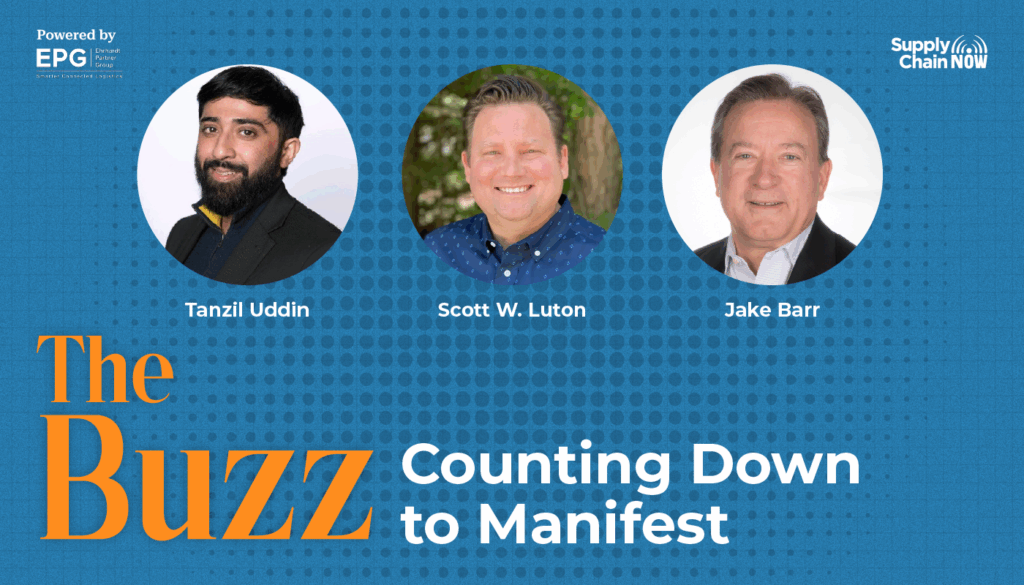
Very jealous. I’m green with envy, Jake. But hey, even better than that. Almost. Not quite well. Hey, it’s the buzz today folks, where every Monday, 12 in the Eastern time, we discuss a variety of news and developments across global supply chain and global business news that matters is what we like to call it. And the buzz folks is sponsored by our friends over at EPGA leading global provider of unified supply chain execution software. EPG has over a thousand team members across 23 locations worldwide serving over 1600 customers. Learn more about what EPG can do for your team at epg com. Okay, Jake got a big show teed up here today. We’re going to be talking about a few supply chain trends that keep on your radar here in 2026. Hey, the Supreme Court has a big decision on tariffs that may be released this week.
(01:30):
We’ll talk about it given the energy demand spike. We’re also going to be discussing one big development in the new chapter of Nuclear energy. We’re going to get a supply chain leadership pulse check with the one only Jake Barr, all that much, much more. And in about 12 minutes or so who’s counting we’re bringing in a special guest Udin with Manifest is with us here today. You can enjoy his perspective, I promise, time event on board. That’s right Jake. And we may even squeeze in a little bit of basketball. Jake, you think we’ll have time for that today? Always. Alright, so folks, stay tuned for a big edition of the Buzz Powered by EPG right here today on supply chain. Now. Okay, so before we bring on Tansel Jake here on the Buzz Powered by EPG, I’m going to tackle three things on the front end.
(02:18):
And we’re going to start Jake with one of my favorite recent editions of what that said. And I love this quote here from Indra, the former CEO of PepsiCo. While supply chains represent the biggest cost to a company, they’re also its biggest opportunity. I love that. Well folks in this edition. With that said, we let off with January being National Human Trafficking Prevention Month here in the us so stay tuned. We’ll talk more about that later. In today’s show, we offered up a few news nuggets. Jake, including UPS continues to shake up its network driven in part by its reduction of Amazon volume, big reduction. Avery Denison research shows that this isn’t so good. Global food waste is going to reach $540 billion in 2026. Jake, that’s up 14 billion from last year. And then one last thing before I get Jake’s take on what that said.
(03:10):
We featured our dear friends from the American Logistics Aid Network doing some big things. They’re tackling some big needs Now. If you don’t know, the Allen team connects nonprofit organizations responding to disasters with the logistics expertise and resources of the private sector. We invite you to learn more about open cases and projects and you can see where your support is needed and do something about it. And the most recent issue. With that said, we included a couple specific needs that they had this week. You’ll also find with that said, upcoming programs, tools, resources, or you name it. So make sure you subscribe. So Jake, did you get a chance to dive into with that said this week?
Jake Barr (03:48):
Yep, I did and I’ve got some of my pithy takeaways as always.
Scott Luton (03:54):
Okay, I’m hanging on in my socks, I’m ready to roll.
Jake Barr (03:57):
Well, I mean, if we’re going to hit the human trafficking piece later, I’m compelled Scott because I work with a team that’s Tim I want to give a shout out to in the TMS first folks down in Texas, they do in a remarkable event every year to raise funds for the victims of human trafficking. One thing is the ability to limit it and reduce it. The important piece is to extract people that have been captured and really kidnapped into it, right?
Tanzil Uddin (04:28):
That’s right.
Jake Barr (04:28):
And then how to get them the support services they need to get and rebuild their lives.
Scott Luton (04:34):
When human trafficking first set my radar a few years back, I was of the ilk like I think many are. They don’t know the size of the problem. Even modern slavery and human trafficking, which are travesty of cousins we’re talking, it impacts millions and millions of people, millions of, it’s
Jake Barr (04:51):
Just incredible. It’s the most mentally disturbing thing. If you ever have the opportunity, I encourage you to get involved and to actually go to an event. If you literally meet some of the survivors of it, it will change your life.
Scott Luton (05:06):
It sure will. And we’re going to touch on this more once Tansel joins us here in a few minutes. But folks, I’ll put two things on your radar and you’ll find these. And with that said, TAT formerly Truckers Against Trafficking. They’re a great nonprofit doing big things across the us. TT nonprofit.org is a uur L and hope for Justice doing big things globally in the fight against human trafficking and modern slavery. So you’ll find more. And with that said, and we’re going to touch on human trafficking and national human trafficking prevention month momentarily. Jake, really quick, I want to share a couple links before I switch over and get a supply chain leadership pulse check from you. I want to start with Tricia, as always. She’s making it easy, sharing a few links. Folks, you can click on the link right there and dive in yourself to the latest edition.
(05:51):
With that said, she also shared the link To learn more about Alan, the American Logistics Aid Network, you can go to allen aid.org and again, you can find specific projects where they’re looking for your help. And with that said, and Rachel, hey, to say Scott, Jake and Trisha Rachel listening in from Holland, Michigan, Rachel, outstanding, I wonder if it’s cold up there as it is here in Atlanta today. And Alan Jacque, the Rodney Dangerfield of Global Supply Chain. Alan, as always, great to see you here today. Alright, so Jake, it’s time for a patented supply chain leadership pulse check with the one or only Jake Barr, the Hall of Famer. He doesn’t just have a great jump shot, but he also moves supply chain mountains like none other. So Jake, when you think of chief supply chain officers and what their priorities are here as we’re not even in the third week of 2026, what comes to mind? They’re all
Jake Barr (06:44):
Going absolutely bonkers at the moment because the level of instability has ratcheted up once again. So we love to call it Scott, as you know, the new never normal, right? And so what did we add? Just the last 10 plus days, right? Well, we added now additional shipping and constraints around Latin America for the movement of goods and freight and services and how you run your operations because of what’s occurred not only in Venezuela, but what we also potentially have potentially unfolding in other geopolitical areas. So unfortunately, and we have this pending, as I call it, decision on the existing tariffs that the Supreme Court could potentially rule on this weekend. I’m going to put Vegas money on the fact that they won’t,
Scott Luton (07:40):
Right? They don’t want to touch it with a 20 foot pole. Is that what you’re suggesting, Jake?
Jake Barr (07:44):
If you go back and take a look at the Supreme Court rulings against sitting presidents in the first year, first full year of the term, you see they delay them like the plague in order to give some boundary width to stabilizing new policies, et cetera, et cetera. But this one unfortunately is having a knock on effect. The longer we delay this, the more instability is there and it’s a punishing effect around how you’re running business operations. I can’t tell you literally, I talk to dozens of company executives a week who are all literally bleeding money at the moment because they’re caught in a catch 22 of wait a minute, I can’t carry this anymore. I can’t eat it. I have to recover it from a cost recovery standpoint and pricing. And so we’ve got just a massive economic factors that are really swirling in the heads. And then Scott, we’ve got to make simple decisions, which is where am I going to make something? Where am I going to source something? How am I going to put it together and how am I going to get it to market? It’s a dog’s breakfast of issues right now for those that are running the C-Suites.
Scott Luton (08:53):
I feel like I have just the minds of CS CEOs everywhere, but I’ve also learned a new phrase, a dog’s breakfast. That doesn’t sound too tasty, Jake.
Jake Barr (09:02):
It isn’t at the moment, that’s for sure.
Scott Luton (09:05):
Alright folks, stick around. We’re going to dive in a little bit more into the, what might be a pending Supreme Court decision. Very consequential decision this coming Wednesday morning, so stick around. Alright, so let’s do one more thing, Jake, before we bring on our outstanding guests here today, and this is very timely, folks, we invite you to join us in Las Vegas for Manifest 2026. We had a great time last year. In fact, Jake’s going to be with us this year. We’re going to be panel discussions, networking, putting our finger on the pulse for market intel, interviewing folks from across the globe. But folks, time is running out in less than a month. Manifest is going to bring 7,200 attendees, 400 plus speakers, and 175 plus sessions to Las Vegas. You can lock in your spot alongside industry leaders before prices increase Friday, January 23rd. That’s just around the corner, less than two weeks away. And if you register before then you’re going to save 700 bucks off the retail rate. We dropped the link right there because Tricia doesn’t miss the beat ever. Click that link and you can register easily and take advantage of the discount
Jake Barr (10:13):
If you’re really wanting to get insights and intel about what your peer group across verticals are doing in the area of physical distribution. This is it.
Scott Luton (10:22):
This is it. This is it. I think that was a tour at some point, a musical tour at some point. But nevertheless, folks, we’ll see you in Vegas at Manifest, which brings me, Jake brings both of us and all of our great SEM global fan members out there to our guest segment here on the buzz. Speaking of Manifest, we’re delighted to bring on a friend and special guest here on the Buzz powered by EPG Tansel. Udin is Senior Vice President Content and Partnership at Manifest Now in this role, he spearheads content audience development for the event in particular working with, we were just talking with Jake about senior leaders. Well, Tansel works with C SCOs, COOs and CPOs and other supply chain leadership personas that take the stage and attend with their teams. And prior to the several plates he runs today at Manifest prior to joining Manifest in 2021, TANSEL led programming and shipper related efforts for numerous events in the last mile, urban logistics and cold chain spaces respectively. So let’s welcome in. Tansel Udin with Manifest. Hey. Hey Tansel. How you doing today?
Tanzil Uddin (11:32):
Hello, Scott. Hello, Jake. I’m doing well.
Scott Luton (11:34):
I’m so glad you could take a quick break. Jake, he’s, he’s moving fast right now, right? It’s game time. It’s go time.
Jake Barr (11:42):
Oh, it’s go time. In fact, he’s got a new baby. I’m wanting to figure out whether he is actually going to strap the baby to his chest and be a first time at,
Scott Luton (11:54):
I’m be taking snapshots tanza, so we shall see. And kidding aside, happy birthday to Zed. Is that right?
Tanzil Uddin (12:02):
Yes. Turns one this week.
Scott Luton (12:04):
My apologies. One years old this week. That’s awesome. Hey, really quick. We’re into the news and we, and folks, we have a lot of news coming at you today. A lot of perspective today. Start with a fun warmup question, Tansel and Jake. So did you know on this day back January 12th is today, it’s hard to believe we’re already there. Back in 1970, the original jumbo jet that Boeing 7 47 made its maiden flight. Now, in case you didn’t know, the 7 47 was the first wide body airliner. It was the first to use the twin aisle layout, and it was also the first to use high bypass turbo fan engines. Now, the final Boeing 7 47 was delivered in 2023 and over 400 are still in service with most of those, of course being freighters. So folks, we always try to equip you to win trivia contests all around the world. So with all that is a backdrop. Tansel, I got to ask you and Jake, on your longer global flights, as you’re out there shaking hands and collaborating with all the industry leaders to get there though, do you sleep? Do you work, do you read? Do you drink? What’s part of your routine there?
Tanzil Uddin (13:09):
Well, I love that question. I am a sucker for routine. Try to keep it as consistent as possible.
(13:16):
I always need a few things. One of those will be my over the headphones. I have a hard time sleeping in flights. So before any long haul flights, I will download some of my favorite shows for now, that would be the office, some episodes of the office, some episodes of Better Call Sal on Netflix. And I will just watch them while on flight until I figure out how to fall asleep. But that’s my typical routine. I need some shows that I can watch throughout the entirety of the flight. So I’ll do the math of how many episodes will that amount to on any given show?
Scott Luton (13:49):
I love that. And man, and I just finished watching Better Call Saul because we jumped off too early when we were watching it live. So Tansel have to compare notes after the fact. And of course, the office, Jake
Jake Barr (14:02):
Rule number one of long flights. You must immediately upon entering that airplane, put yourself in the time zone of where you’re going. So that automatically means if it’s middle of the night you sleep, you don’t have any disturbances, you no food. You’ve got to get your body acclimated for making it an easy jumpstart to the new arrival destination.
Scott Luton (14:26):
Okay, we are going to get into a series of news stories here today. Tansel and Jake, we’re getting everyone to weigh in. And then we’re also going to dive more into what’s to come at the big manifest 2026 in Vegas. So folks stay tuned, but we’re going to start with the news. So our friends at Supply chain shared an interesting read recently, I think it was last week, focused on five supply chain manager trends. They recommend keep front and center on the good old radar this year. Now the five day site, and lemme get both of you all to weigh in. Number one, fragmentation and diversification will be fueled by geopolitical risk. Something Jake already touched on. Number two, supply chains will be tested by many things, especially economic turbulence. Number three, a top priority for many supply chain leaders cost optimizations. Stop me if you’ve heard that one before. Number four, AI hype. What’s going to be facing a recalibration of sorts? And number five, the supply chain workforce challenges are going to persist folks, we’ve got a great, by the way, we’ve got a great manufacturing workforce dish, the bridge coming up here next week. We need to drop a link on that. Alright, so those five trends to keep front and sitter tansel, your thoughts there?
Tanzil Uddin (15:35):
Yeah, no, I think this just echoes what the two of you were talking about earlier. These uncertainties are essentially the new norm for us in today’s environment. What used to be called black swan is now pretty much, it feels like it’s a daily thing in the supply chain. And I think I’ve talked about this before in previous conversations where decisions just feel extremely heavy right now in the supply chain. But what I get from this article in particular is that it’s more so about strategic action that will outweigh reactions. Can we actually anticipate inflection points and act quickly? And I think that will help certain organizations outperform 2026 is perhaps about turning some lessons from recent volatilities or ongoing volatilities into strategic resilience. And it’s not just about adopting new tools, but how do you pair them with smart cost management and workforce upskilling will be the key.
Scott Luton (16:31):
I like you’re very poetic with that perspective. And Johnny on the spot. Jake, what would you add when it comes to these trends or others?
Jake Barr (16:38):
Yeah, there’s no question. There’s really a big push on, I’ll call it not only the squeeze of more productivity out of the existing organization, but actually re-skilling the talent that you have as part of your transformation efforts. On top of that, folks are advancing their automation efforts and it’s merely, I’ll call it a layering effect of saying, Hey, I’ve held off on potentially doing a piece of automation, et cetera here or there, but I’m actually leaning into it now because it’s helping with me provide a level of additional agility for how I’m able to deal with these routine. Unfortunately, they’re not black swans anymore. As Ansel know, you’ve got ugly ducklings running around everywhere.
Scott Luton (17:24):
Yeah. Oh man, I’m sorry. A dog’s breakfast still comes back to my mind. I’m going to steal that one from you, Jake. Ugly ducklings dogs breakfast, you name it. It’s going to be a tough year. But as we were talking last week, I think we were prepping for an event. We were comparing all the predictions that are out there, tans and Jake this time of year. And one article played it really safe with its predictions and I made the comment, Hey, but that’s okay. I’d love a vanilla boring 2026. That’d be a wonderful thing. But then it’s not
Jake Barr (17:53):
Happening, Scott,
Scott Luton (17:54):
I realize that. I realize that. But lemme finish, lemme finish. But my dear friend Mark Gillum who joined us, he said, if that’s the case though, no one has any excuses if this all this disruption’s not taking place. So we shall see, we shall see. Hey, let’s do this. Workforce was one of the big trends and Jake both spoke to it. It was one to five in the article. Folks, Trisha and Amanda will drop a link in the chat, but on January 23rd, Alison Giddens, a manufacturing leader here in the Atlanta area, is joining me and Amling and Daryl Edwards to dive into building the new manufacturing workforce. You’re not going to want to miss that 12 noon on January 23rd. Let’s see. We’re going to move fast now. We’re going to get to everybody’s favorite topic or maybe not so favorite topic at tariffs. I can’t wait till the day comes when I don’t have to talk about tariffs every day.
(18:45):
A lot of folks are watching, as we’ve mentioned, the Supreme Court who may decide on the legality of the Trump administration tariffs on Wednesday, as reported here by cnbc, the high court pushed a potential tariff decision from Friday. A lot of folks are watching last Friday to this Wednesday, January 14th. And if the court rules that the tariffs enacted last year are largely illegal, the markets will likely rejoice, right? A lot of us may have parties and rejoice too, but there’s quite a mess of cleanup as tons and tons of tariff payments will then have to be refunded, right? However, some legal analysts say that the White House may find a different path, alternative path to maintaining and enforcing the tariffs in place no matter what the high court decides. So I can’t wait to get you to weigh in on this possibly a very consequential week.
Tanzil Uddin (19:38):
I’m going to be careful about this one. I appreciated Jake just sharing his thoughts on where he put his biggest money. It just speaks to the amount of uncertainties that we are having to deal with in today’s environment. But what I’ve learned and what I’ve heard from especially a lot of the leaders that are coming to our event next month, it seems as though the smartest supply chain leader, if you may, they’re not waiting. They’re planning for both outcomes because like you said, there might be other alternatives that the administration can consider to keep these in effect. So you control the controllables is what I like to say. You plan for both outcomes wherever you can. So that could mean you run dual cost scenarios or you strengthen contract visibility or you diversify, you’re sourcing incrementally. But those are the things that you can try to control and get ahead of it. But I think what I’ve seen is the leaders are actually planning for both outcomes versus just waiting because you already have enough on your plate in terms of things that you cannot control.
Scott Luton (20:33):
Tansel, well said. And Jake, if you’re leading your supply chains with spreadsheets, oh boy, you might be in trouble. Your thoughts are, Jake,
Jake Barr (20:41):
It’s fool’s gold. If you’re expecting the ruling to come and reverse everything, it’s going to be a mixed bag of some things will be reversed, some things won’t. There’ll be layering on top of those that are reversed. As Tansel said, look, in today’s age, you’ve actually got to be running literally 10, 12, 15 different scenarios, not only on sourcing, but also on distribution planning and network fulfillment modeling. So we got into the piece earlier, Scott, about, well wait a minute, UPS’s model is changing now because they lost part of the Amazon piece. Guess what? That is also new normal. So the way you break and assemble networks, the way you break and assemble supply relationships is going to continue to be very, very dynamic.
Scott Luton (21:34):
Well said Jake and Tanza. So we shall see, we’ll see, back to your earlier point, Jake, we’ll see if the Supreme Court even issues a decision on Wednesday, but nevertheless. Alright, so let’s move from, hang on a sec before we move a couple things here. By the way, we’re dropping the links, these articles right here in the chat, so folks don’t necessarily take our word for it and our take on it. Go check it out. Thank you, Tricia. Drop the one on the tariffs right there, and Gino Pledger, the pride of North Alabama. Hope you’re doing well Gino and a rock and roll drummer, by the way, which I’m going to have to take into concert at some point soon. Alright, so from tariffs to nuclear power, the new age of nuclear power, I love this. This might be a brighter topic to talk about.
(22:22):
So we’ve spoken at length over the last year or so about the big time spikes in the energy demands fueled in part by data centers and AI, innovation and usage and a whole bunch more. One energy opportunity, I’m a bit bullish about though a new chapter of nuclear energy as reported by our friends here at Reuters. The United Kingdom government has chosen a site in North Wales for its first Rolls-Royce small modular reactors, aka SMRs, where they’re planning three units for space up to eight, and they’re targeting first power in the mid 2030s. That’s less than 10 years away. Folks, you’re going to hear SMRs talked about a lot more small module reactors. Some folks have talked about how companies are looking at placing an SMR onsite, powering some of the data centers, right? This project though here is part of the UK’s strategy to boost nuclear capacity from about 6.5 gigawatts today to as much as 24 gigawatts by 2050.
(23:21):
And to establish a fleet based SMR deployment model officials and the industry partners said the SMR program could kickstart a broad or European nuclear supply chain with international collaborational components and manufacturing across the EU and beyond. But plenty of challenges remain including securing, of course, regulatory approvals and scaling supply chains that can effectively support SMR infrastructure. So Tansel, I’m really shooting above my pay grade talking about nuclear energy, but I do find it fascinating in terms of the role combined with green energy and many others of how it can help us meet spiking energy. Demand your thoughts.
Tanzil Uddin (24:03):
Yeah, thanks Scott. What I found interesting when I read this is that Europe and UK are treating SMRs as a supply chain strategy. They are explicitly trying to standardize this. While if I speak to the US, we have incredible innovation, but there’s just more fragmentation, which makes things certain, which makes certain things harder to scale sustainably. So I think it would be a good use case to see how this continues to develop, like you said, over the next year or so. And on the side, just other initial thoughts I have is just behind closed doors. I wonder, I ask, can this lower scope to emissions, for example, without increasing cost volatility, does it support 24 7 daily operations, whether it be at a factory level, dcs, the pharma cold chain, which are things we’re really interested in at manifest. So that’s going to be interesting, again, behind closed doors as you hear from different supply chain leaders
Scott Luton (24:57):
With you, it’s a fascinating time. Jake, what would you add?
Jake Barr (25:00):
We need all and more, Scott. There’s not enough. In fact, the SMR strategy, I’m with tansel as typical Europe is leading the way around how to think about the format in a more structured and quick scalable environment. But unfortunately, when you look at when those are coming online, that’s well past the timeline for even the current, I’ll call it doomsday effect of what we have of the data centers that are already being constructed, the AI centers, et cetera. We’re outstripping the grids. It doesn’t matter which content you’re talking about more than we’re able to generate. And so we need all of it, right? We need the entire recipe, the menu walking into the restaurant. We need wind, solar, fossil fuel, nuclear, we need it all.
Scott Luton (25:50):
That’s right. Well said. And folks, you’re going to be hearing a lot more about energy in the months ahead if you haven’t heard already. In fact, one of my favorite, going back to the prediction blogs and all that come out this time of year, one of my favorite ones mentioned that, hey, we can’t take energy for granted when it comes to planning our network infrastructure and the like. And I find that to be very astute. Okay, Jake and Tansel, next up we’re going to be talking a little bit more about human trafficking prevention month, but before we do, I mentioned a great addition of the bridge coming up January 23rd. Folks, Tricia has dropped the link to that show right there in the comments. That’s the one that’s going to be diving into the notion of building a better manufacturing workforce. So come join us. Alright, so some folks are referred to January as National Human Trafficking Awareness Month.
(26:40):
Others are going to be talking about human trafficking prevention month. I think in layman’s terms, it’s no more and do more month when it comes to human trafficking here in January and really year round. And the year round part is important as referenced by this great article here. But before we get to what Inland Kenworth is doing, lemme share a couple of nuggets which you’re going to find. With that said, our newsletter earlier. So again, human trafficking is no small problem. Tens impacts tens of millions of people worldwide. An estimated 27.6 million people globally are victims of trafficking and forced slavery. That is remarkable. Broader modern slavery estimates, including forced marriage, pushed that figure closer to 50 million people worldwide. And sadly, roughly 25% of victims are children underscoring the extreme vulnerability of minors. But there is good news because you got great industry leaders such as this 76-year-old truck dealership, inland Kenworth, my apologies, as reported by Trucker News.
(27:40):
They’ve got four, three locations in California and throughout the southwest. A great vehicle for helping to drive awareness, right? Well, they have made human trafficking awareness a year-round priority since 2016. Inland Kenworth has invested in the fight against human trafficking. A number of ways from wrapping the trucks like this one right here, including the trafficking hotline number folks to use. If they see something, the old adage, you see something, you say something, but there’s a hotline, right? They train their employees on how to spot human trafficking and better yet what to do about it. And they’ve put their money where their mouth is. They’ve raised more than $500,000 for the nonprofit TAT formerly Truckers Against Trafficking. That is what I like to call action-based leadership. Now, I’d like to say we got to know more about it and know that things exist before we can get to elimination and prevention. But your thoughts.
Tanzil Uddin (28:32):
Yeah, no, I really appreciate what Inland Kenworth is doing here. And if I look at just our industry in particular, this also just shows that logistics isn’t just about moving goods. It is also a key channel or it can be a key channel for safeguarding human rights and embedding some of these ethical vigilance and efforts into daily operations. I also love that the supply chain professionals being mobilized here, especially those frontline workers, like a driver into acting as defenders against human trafficking. So I think that’s very refreshing to see. And witness
Scott Luton (29:06):
Tanza, that’s a great call out because of the really supply chain professionals are in a very unique position to do something about human trafficking in so many different ways, especially our transportation professionals. Jake, your thoughts on human trafficking prevention?
Jake Barr (29:21):
It all starts with awareness. Our job is to make people aware that it exists and to help them educate them. What are the signs they can look for? See something, say something is really vital. But from a supply chain profession standpoint, at its very essence, we’re at the core of this. It’s undeniable because look, we move everything around the world. If this is going to exist, people are going to be moved. So we’re at the heart of it.
Scott Luton (29:51):
That’s right, Jake. So folks, I invite you to check out, we need more inland kenworths, I think in industry. Love the commitment they’re making and give it a read over at Trucker’s News. And by the way, if you admire what they’re doing, let ’em know, number one. Number two, find a way that your own company can embrace the fight against human trafficking, not just in January but year round. So Jake and Tansel, we’re about to take a deeper dive into all that you’ve got under the hood for Manifest 2026. But before we do that, Jake, we like to share resources around here. And you and I were part of a terrific event that we now are offering on demand that we created in conjunction with our friends at EPG, of course, who are powering the buzz all month long in January. Folks check this out.
(30:38):
Me and John Wayne, the global supply chain, that’s Jake Barr, thoroughly enjoyed this very actionable case study on a webinar just last month. We dialed in on outdoor caps implementation of voice picking in their warehouse and it’s changed the game for their operations and for their customers. That’s my favorite part. I’m talking about an almost 60% improvement on overall quality, which was already high and a 15% productivity jump, which was almost double what they were expecting. Even better, it’s going to help fuel more successful growth and expansion in the months ahead. We invite you to check out the on-demand recording and learn more about how EPG can impact your own supply chain organization. Jake, quick question. I loved you came up with a nickname for our friend Peel Chronister, right there with Outdoor Cap. Was it King of Hats? I think Jake,
Jake Barr (31:24):
Yeah, king of
Scott Luton (31:25):
Hats. I love that folks.
Jake Barr (31:28):
Hey, but Scott. But it ties directly to what we’ve been talking about today. They are an example of, wait a minute, I got all the chaos around me. I’m not sitting and waiting for it to just drop on my head. I’m actually going to lean into change and drive additional agility into what I can do in my lineup. And it’s giving them a business itch.
Scott Luton (31:54):
That’s right. It’s so true. And it’s going to be the gift that keeps on giving kind of like the Agility Month Club from Christmas vacation. It’s going to give and give again, be a force multiplier. So folks check out, don’t take Jake’s word for it or mine. Tricia has drop the link to that on-demand recording. Check it out, let us know what you think. Alright, Tansel, man, I cannot wait till Vegas and manifest in February. We’re less than what, four weeks away, me and Jake and the rest of our team. Some members of our team will be back there in Vegas participating in panel discussions, leading a great one. We’ve got this one coming up. The marriage between supply chain and technology. What’s optimizing our decision making with our friends from Phillips Revolve and Fab Fit, fun. So come check that out. We’re going to be doing some interviewing, Tansel, we had a lot of great interviews last week. Really appreciate you Courtney, Pam, and the whole team and how You’all facilitate those relationships. But here’s where I want to as we get ready to do all that. And then some, again, really excited about it. I want to ask you, this might be asking, like asking for your favorite kid, right? It’s tough because y’all got a bunch of new stuff for 2026, but what’s a couple of updates for Manifest you’re most excited about Tinsel?
Tanzil Uddin (33:07):
Yeah, absolutely. Thank you Scott. I like to focus on a lot of the things that are new for this year’s manifest. Very excited to just be less than four weeks away. Of course, we’ve added quite a couple of new segments and this is just by demand really. Our community has asked for it. One of them being there is an entire stage, for example, dedicated to procurement. We’ve evolved over the years to become the show that encompasses really the full ecosystem across plan, source, make, and deliver. And reflecting our discussion today, procurement really is at top of mind for so many planning and procurement specifically. And so we’re excited to have a lot of your chief procurement officers, your supply chain leadership, your technology leaders all sit at the table, figuratively at our event to discuss some of the key issues that hit at home for them, especially given all the stuff that is looming around the industry today. That’s one of them for sure. Another area is cold chain. There is an entire pavilion that is dedicated to this industry, looking at life sciences, looking at food and beverage, looking at perishables, what’s happening, especially as climate change becomes so top of mind for us all. We’re excited to have an area that is dedicated to not just bringing the leaders that are operating this day-to-day, but also the technologies that you otherwise would not have known existed until you came to an event like Manifest and experienced it yourself.
Scott Luton (34:32):
Tansel outstanding. And you saw Jake, Jake, I like you. How you applauded cold chain. Cold chain is fascinating. I love that focus, your thoughts and what you hear there from Tansel and what you’re looking forward to at manifest, Jake? Well,
Jake Barr (34:45):
I’m especially thrilled by the cold chain piece. I mean, Scott, we were talking a bit earlier about the food waste situation, but look, I’ve had the opportunity to work especially recently on projects. Look, it’s a convergence of how to use AI to not only do the old school, call it temperature monitoring and track, but actually to do predictive and prescriptive actions back in the supply chain processes, to actually prevent the spoilage, to arrange for replacements to ensure customer and consumer satisfaction in terms of the movement of the goods or the materials. I mean, I had a company that literally worked with about two and a half months ago with one of these firms in question where we were putting from the time we put the ingredients together in the lab, it was a rare disease medication to the time it needed to be in the arm in a clinic of a patient for their treatment. Six days of shelf life, guys, six days. So can’t, it’s not your grandmother’s supply chain. You must have just incredible control. Not only control, but then the added AI on top of it to be able to allow you to manage that flow and predict whether it’s going to be good or not. Wow,
Scott Luton (36:02):
Not a whole bunch of wiggle room tansel love the emphasis. I can’t wait to sit in on some of the sessions and meet some of the leaders and the networking and sidebar conversations. Before we dive a little deeper into your passion for creating compelling content, I want to call out one more time, folks, you can register for January 23rd and still take advantage of some discounted rates. And Trisha’s dropped the link right there in the comments to do just that. And Tansel folks can’t delay. They got to move, huh?
Tanzil Uddin (36:29):
Nope. Yes they do. Yes, indeed. Less than four weeks. Room block is selling out. It’s all exciting.
Scott Luton (36:35):
Outstanding. That’s at the Venetian folks in Vegas. And as I heard someone, a really good person telling me one time when you do events at the Venetian, you know have made it. It’s like your Elvis when you’re doing events at the Venetian. Alright, so Tansel love that core to any successful event, of course, beyond the people, but it’s the content and the discussions and the topics and how folks can be informed and educated and entertained. And you’ve really, as I’ve been observing you lurking and sneaking and seeing what you’ve been up to, you’re a mastro when it comes to creating content and panel discussions and the like. Where does your passion for creating this stuff come from? Tansel.
Tanzil Uddin (37:13):
I love that question. I really love content that tells a story. Just like Manifest tells this story about bringing innovation at the forefront, bringing an ecosystem together under one roof to just benchmark, bring peers together to rub ERs, talk about what’s happening. Well that’s reflected on our panels as well. Are we bringing an ecosystem perspective to every single discussion that is happening, whether it’s plan or source or make or deliver and all of the branches that stem out of those key themes. Are we accounting for the different perspectives that need to be at the table to really drive some of this forward? And as a result, are there some takeaways that our attendees can go back to the office with immediate action in the next week or month, not just the next year or years. And you kind of approach every session or conversation with that lens or from that lens, chances are it bodes well for the people that are in the room. So yeah, I really love being able to tell a story. You’re covering every aspect of the journey and supply chain and you’re ensuring that you’re giving a chance to every perspective, whether it be that operator, that technology leader, even if they’re seed early stage, we want to give them that voice. And similarly for the investors that contribute to a lot of our discussions as well. So you kind of hit it from operator innovation and funding all of the above when it comes to most of the discussions that are happening at the event.
Scott Luton (38:40):
I love it. So Jake, I knew we were going to have a lot in common with Tansel here, even though he’s a heat fan, which we can deal with the Miami Heat fan later, but two of his big points he shared there amongst other things I can definitely relate to because we try to bake it into the content we produce here. One thing you’d mention is how content drives action, right? Solutions, outcomes. And number two, you mentioned diversity and you look at all the data driven studies out there, how the power of diversity can impact top lines, lines, and all points in between. What’d you hear there, Jake, that really resonates with you?
Jake Barr (39:16):
Well, I mean, Tansel and his team do a great job of bringing together diverse group of stories because honestly, if you’re a supply chain leader, the best thing you can do is look outside your four walls for ideas. It isn’t that you don’t have ideas in your four walls, but in many times if that’s the only place you’re looking, what you miss is context of what might be a bigger opportunity. So when you get the opportunity to go through and listen from these other individuals outside your vertical, outside your experience, it just rewires your brain to think differently about pursuit against a problem.
Scott Luton (39:52):
We all need to rewire our brains from time to time. Sometimes day to day is what I’ve found. I want to again, pull up the panel I’m a part of thanks to you and your great work because I love this thing. I love the participants. I’ve really enjoyed this call. We’ve had this with them, but the theme, Jake, the marriage between supply chain and technology, what’s optimizing our decision making? There’s some marriages out there to continu this analogy that aren’t as longstanding and productive and fruitful and there’s others because that leaders really invest in this marriage and invest in their team’s abilities to make faster, better, more confident decisions. And they’re going to be celebrating a hundred year anniversaries. Maybe Jake, your quick comment on maybe this theme and then Tan, I’m going to circle back around to maybe the origin story really quick in a nutshell of where this came from. Jake, your thoughts on the theme?
Jake Barr (40:44):
Yeah, the reality, Scott, is this is a piece that you could talk about every week, every month, every year for the next 10 plus years moving forward. Because we are deep in the age of using AI for the first legs of being able to solve problems. And the reality is, in a new period of never normal, our problems are constantly changing. The constraints around them, the issues, the evaluations that we need to do. So even using ai, it is going to be this sweet marriage of people and technology to actually drive us forward because the models can only learn what we help teach them to learn. You have to provide that human element to make it deliver for you.
Tanzil Uddin (41:31):
Oh yeah, absolutely. This is just one of those discussions that we were talking about earlier and I shared is just decisions feel really heavy today in today’s supply chain. And to Jake’s point, there is a new norm of uncertainty that we’re experiencing. So that marriage is key of tools and talent, which Jake already covered. And also just getting into the minds of some of these operators that are on stage with you, Scott, of this is what we’re doing across our organization, our talent, and this is how we’re leveraging ai, how we’re feeding data into it to ensure it’s long-term stable success. And we’re definitely excited to hear some of the outcomes or takeaways from a conversation like this one.
Scott Luton (42:13):
Me too, Tim, I get a certification, maybe even a two year degree out of each of these sessions that I participate in. So really appreciate the opportunity and I’m still what you and Jake both talked about this theme. You’ve already given me a few notes, but folks be a part of this panel at manifest. Come join us, Julie and Heather and Berger, I’ll tell you they’re going to bring it. You’re going to only find this at manifest 2026 and the time to register is now, it’s February 9th through the 11th. Gosh, it’s less than a month away. And if you register before the 23rd again, you’ll have some discounted registration fees. By the way, Tansel, what’s the easiest place? I know Tricia is dropping a link right here. It’s really easy. You’re one click away folks. But is there anything else that you would suggest in terms of registering or engaging with the manifest ecosystem?
Tanzil Uddin (43:03):
Yeah, this is the critical time for us. The app will also go live this week. So emails will start going out to all of those that are registered to set up their profiles and start networking. So for those that are not registered, we definitely urge you to do so so that you can get in early. Start networking. This is when people start coordinating all of their meetings really ahead of the start date of February 9th. So we’re really excited about that. Check out the website plan ahead. I mentioned registering in the app, but you can also browse the full agenda, which is already live session times, including this one Scott, that you’re leading. You can just kind of map out your agenda within an agenda if you may. Really develop your entire experience ahead of time. And then also leave some room for just serendipitous engagement while you were there. So you want to get in early, get into that app and start networking. Now
Scott Luton (43:56):
There are lots of pro tips there. Lots of pro tips. Alright, and folks, you get to meet Jake Barr, the Hall of Famer in person. Jake, there’s usually, there’s two parties here in Tansel. I’m going to say this very diplomatically cause a lot of times event apps are kind of like black licorice or they’re like the Dallas Cowboys folks love them or they hate them is what I have found. So Jake, if folks want to come out and meet the John Wayne global supply chain at Manifest, what would be your suggestion to them? Jake,
Jake Barr (44:28):
Just drop me a note in the LinkedIn. That’s the way I would’ve said my phone, but my phone was always blowing up, so that’s a bad thing.
Scott Luton (44:36):
And we’re going to make sure folks know how to connect with Tansel as well in just a minute. Alright, so again folks, Tricia’s dropping the links there. Tansel before we leave the topic of Manifest 2026. By the way, when are you getting, if you can tell me when are you arriving in Vegas A few days before. I assume
Tanzil Uddin (44:54):
Some members of the team are there a few days before I get in early Sunday the eighth.
Scott Luton (44:59):
Okay. And if folks want to get together with you to talk supply chain or to talk and debate the Miami Heat and their performance this year and may be Atlanta Hawks fans like myself,
Jake Barr (45:11):
There are none, but that’s okay.
Scott Luton (45:12):
I agree. Oh man. Hey, don’t sleep on the newly rebuilt hawks. Hey, we hate to see Trey Young go, but folks get ready. It’s new era driven by new general manager. We’ll see. But Tims, I’m going to go ahead before, since we’re talking about it, how can folks connect with you? What’s the easiest way?
Tanzil Uddin (45:31):
I’d say LinkedIn as well. Drop me a note on LinkedIn and we can definitely find each other on site if you’re planning to be there at Vegas.
Scott Luton (45:39):
Okay, outstanding. Well,
Jake Barr (45:41):
Thank you, Trisha. Dropping all you have to look for. You’ll find Tansel on the floor with a baby strapped to the front of him. He’s going to be easy to pick out.
Scott Luton (45:51):
Hey, I’m looking for you, I’m looking for you. But hey, the event is even bigger than it was last year, so it’s going to be tougher and tougher. We’re going to be more deliberate about finding people this year. Alright, so before we wrap here, what is this? The second edition of the Buzz for 2026, powered by our friends at epg Jake. We’re still celebrating the new website. There was still a relatively new website at supply chain now com and folks, it was purpose built to make it more convenient and impactful for you. We just talked about a minute ago our manifest programming. Well folks using our website, you’re going to be able to go find, I think we did 13 interviews at Manifest last year, and you can use our website to go find that. Or you can go to our YouTube channel. We got a sub channel dedicated to manifest 2025. We’ll have the same thing dedicated for this year. And who knows, I might sit down with both Tansel and Jake, man, my week will be even better. But Jake, we also have an upcoming live programming tab. Jake, you’ve mentioned the new Never Normal series. Of course, the bridge, our live streams and webinars. I think we did almost 200 live streams and webinars last year. That’s crazy. But folks can find that right here. Jake, it can’t be much more convenient than that, huh? It can’t be. It’s a
Jake Barr (47:05):
Click away,
Scott Luton (47:06):
A click away, a click away. I only wish resolving tariffs were a click away. But we’ll save that until next week. And then also, folks, you’re going to find the Resource hub. So this is a written summary of our friend Sean Elliot tools group, CEO, which we sat down at Gartner Supply Summit just month, where you’re going to these of interviews and summaries the resource again at the new supply chain now.com. Drop new. It’s a new site, supply chain now.com. I don’t want to confuse anybody out there. Okay,
Jake Barr (47:37):
So Scott, before you wrap us, okay, we took a detour past this giant food waste problem that we’ve got going on around not only the US but the world, right? And you know me to be a problem solver, right? So I’m going to plug, if you think you can’t do anything in your local community that actually makes a significant difference in keeping food out of dumps and helping your local neighbors look up a firm called last mile food.org. In my opinion, it is the gold-plated standard for how local individuals put together and use both people. And Tansel and I have been talking technology to prevent food from going to waste and to actually feed your neighbors
Scott Luton (48:32):
Big, big problem last mile food org, last mile food do org. I got that right, Jake.
Jake Barr (48:38):
That’s right.
Scott Luton (48:39):
Outstanding, outstanding. Big problem. We got to do, do much better, much better. And I’d also, Tansel and Jake is a great, I guess they’re not a startup anymore, but Gooder, G-O-O-D-R is an Atlanta based organization doing great work and not just solving the food waste issue, but also nourishing those families in need. And hey, look there, we got the link right here last mile food.org. So folks check it out. I’ll tell you, I really appreciate your perspective here. I love what you and the team are doing at Manifest providing this opportunity. And we need it in all the divisiveness and the disruption and the complexity and headaches. We need outstanding in-person opportunities, not just for content and for thought leadership and for problem solving, but to reconnect on a human basis with our friends and suppliers and customers and collaborators out across industry. Andel, I’ll tell you, you and the manifest team have gotten it. Really. You’ve cracked the codes. I really appreciate what you do, my friend.
Tanzil Uddin (49:39):
Likewise, Scott. Thank you so much for having me. Pleasure talking to both you and Jake. Looking forward to continuing it next month.
Scott Luton (49:46):
Undoubtedly. On that note, Jake, thank you for joining the Buzz once again. Of course, Tansel hit it out of the park, didn’t he? Jake? Huh?
Jake Barr (49:56):
He did. I think he’s looking for the side heat jersey is what he’s won.
Tanzil Uddin (50:02):
Kelly Hero. Yes, sir.
Scott Luton (50:04):
We shall see. Hey, I hope that Atlantic can assemble one of those super teams like y’all had down in Miami a few years back. But regardless, folks, you can find, connect with Tansel and Jake and myself at Manifest in February. We also dropped the links if you want to connect in between now. And also check out the nonprofits. We list as well, big opportunities to take action. So as we wrap here today, want to thank my dear friend, I think we’re second cousins now. Tanza uin, senior Vice President, content and Partnership at Manifest. Want to thank my esteemed Hall of fame co-host Jake Barr and our friends at EPG who are powering the buzz all month long in January in fueling many global supply chains, electric performance in 2026 and beyond. Of course, big thanks to Amanda and Tricia behind the scenes. And most importantly, big thanks to our global audience, our SCN Global fam for joining us. But you got homework folks. Tansel and Jake brought it. Take one thing they shared here today. Put it into practice, share it with your team, do something with it. Deeds, not words. And with all that said, on behalf of the entire supply chain now, team Scott Luton challenge. You do good, give forward, be the change that’s needed. We’ll see you next time, right back here on Supply Chain now. Thanks. Bye.
Intro/Outro (51:16):
Join the supply chain now community. For more supply chain perspectives, news and innovation, check out supply chain now.com. Subscribe to supply chain now on YouTube and follow and listen to supply chain now wherever you get your podcasts.