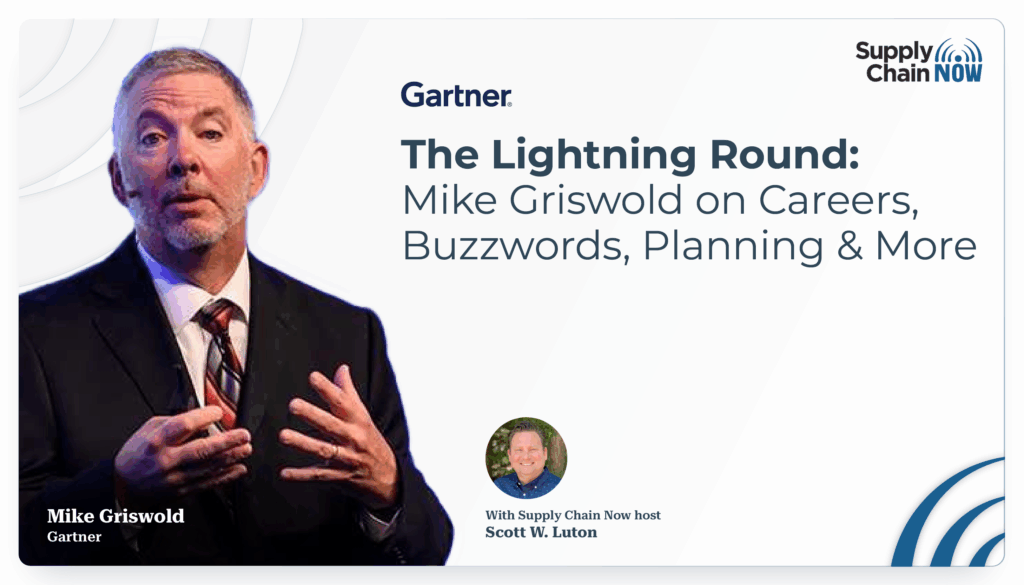
[00:00:00] Mike Griswold: The superpower is this ability to orientate your supply chain more from an end-to-end perspective, so that it’s much more than just distribution center and transportation. It’s, it’s planning, it’s new products, it’s customer service, it’s innovation, and to me, the ability to convince your organization that this is where our supply chain actually needs to start and stop to create the most value.
[00:00:29] Mike Griswold: That to me is the superpower.
[00:00:32] Voiceover: Welcome to Supply Chain Now the number one voice of supply chain. Join us as we share critical news, key insights, and real supply chain leadership from across the globe. One conversation at a time.
[00:00:45] Scott W. Luton: Hey, good morning, good afternoon, good evening, wherever you may be. Scott Luton and the always special guest, Mike Griswold here with you on Supply Chain Now. Welcome to today’s show. Hey, Mike. How you doing today?
[00:00:55] Mike Griswold: I’m doing great, Scott. Looking forward to today’s session. It’s always good to spend time with you and the folks that take time to listen to us.
[00:01:02] Scott W. Luton: Same, same, same, same. I tell you, we get a lot of feedback around this very long running show. I was, in fact, I was going back looking at some of our earlier episodes, Mike, we’re gonna have to set up a future episode that dives into.
[00:01:15] Scott W. Luton: Probably we’re approaching four dozen, maybe five dozen shows now. But today, folks, we do continue one of our longest running most popular series supply chain today and tomorrow with Mike Griswold from Gartner. Of course, Mike serves as Vice President Analyst with Gartner. And we’re rolling out a new mechanism today.
[00:01:35] Scott W. Luton: I did not put my creative thinking cap on enough ’cause we’re calling it the lightning round. So it’s not too terribly creative of a name, but it implies our approach. I’ve got nine questions teed up that we’re gonna get Mike to weigh in on. From a question or two around Mike’s professional journey to supply chain buzzwords, those we like and those we don’t like to supply chain leaders or their superpowers rather, that we admire all that much, much more.
[00:02:01] Scott W. Luton: So stay tuned as we walk through an outstanding discussion with the one and only Mike Griswold. So Mike, are you buckled in, ready to go, hanging onto your hat and all?
[00:02:11] Mike Griswold: Yes, I have fastened the seatbelt. The arms are inside the ride, and yes, let’s give this a shot.
[00:02:20] Scott W. Luton: Oh gosh. You know I heard a great analogy earlier today on a live show.
[00:02:24] Scott W. Luton: We were talking all about returns and reverse logistics, and we were interviewing the. A legend, a living legend, Chuck Johnston, who basically rolled out the returns of management approach and organization at Walmart and Home Depot. And he used a great analogy, Mike, that we just shared there just, it sprung in my mind.
[00:02:43] Scott W. Luton: It’s like a roll up mattress. Once you get it out, it’s not going right back in. So folks, you gotta be ready for a great conversation teed up the day. So I’m stealing that one from Chuck, but Mike. Question one, which is essentially our fun warmup question here today. So the Europeans largely dominated the Americans in the Ryder Cup just last weekend.
[00:03:04] Scott W. Luton: Yeah, it got a little closer on the final round, right? But we all knew what the outcome was gonna be. The Americans were up against a really, really tough challenge. You’re a big golfer, Mike. I’d love to get your reaction and you aren’t gonna yell at me or call me. Names are you, Mike?
[00:03:21] Mike Griswold: No. I mean, I, I think, and I will, I will try to keep this brief, we could do a whole show on my thoughts on the Ryder Cup.
[00:03:28] Mike Griswold: I, I think the behavior of the fans is unacceptable. It’s unacceptable at, at any sporting event. I think though, th this is not a case where anyone should have woken up surprised that this was gonna happen. Right? You, you knew this is what was gonna happen when you picked several, however many years ago that we were gonna have the Ryder Cup at Bethpage Black in New York.
[00:03:49] Mike Griswold: Right. You, you knew if, if you had any brain, you knew this was gonna happen. And unfortunately it did. And I think, you know, even if somehow the US had won the way the fans behaved would’ve still marred, I think the event regardless of, of the winner. I think it is a, a perfect example of, and I’ll link this to the supply chain.
[00:04:13] Mike Griswold: It’s a perfect example of an organization that had a plan in Europe. And had a continuity throughout the entire Ryder Cup process. You could hear it in the press conferences, you could see it if, if you’re a golf fan, you saw, you know, familiar faces. You’ve seen the same faces on Europe, behind the scenes.
[00:04:34] Mike Griswold: Obviously Luke Donald has coached the last two, but the vice captains and the other people involved with how Team Europe is constructed. Has basically been the same people in the same voices for years. Their attention to detail, their planning, and their continuity, and the fact that they played very, very well.
[00:04:54] Scott W. Luton: Yes.
[00:04:54] Mike Griswold: are the reasons that they won again, and they’re the reasons that, you know, if you woke up Monday morning having never watched the Ryder Cup at all and saw 15, 13, you’d have said it was a nail biter. You’d have thought it was a nail biter, but to your point earlier, Scott, you said it very well. It really wasn’t.
[00:05:11] Mike Griswold: Frankly, after Friday and the beat down on Friday, it, it was gonna be very difficult for the US to recover. Right. I think from a, a process perspective, there is a lot of things the US needs to go back and think about from a process perspective, from an organizational perspective, and even from what does the Ryder Cup mean as as a sporting venue, right?
[00:05:36] Mike Griswold: Clearly, the European team. Was highly motivated and highly bonded on a singular mission, which was to win the Ryder Cup. Yes. And I’m not saying the US wasn’t, but what I’m saying is there were so many examples of what Europe did to put themselves in a position to win that we did not. That th this Ryder Cup was probably won two or 3D two or three days after Europe won in Rome.
[00:06:08] Mike Griswold: With the work that they were putting in for an event that was two years later, disappointed as a highly patriotic golf fan. Highly disappointed in the outcome. Probably more disappointed in the selection of the venue and what happened off the course that really was never should have happened.
[00:06:27] Scott W. Luton: Yes, lots of good stuff there.
[00:06:29] Scott W. Luton: Resilience, yes, that European team. Found it. And I’ll tell you those first two days, it seems like they had a counter punch for every one moment that the Americans had. And I tell, uh, if I had a dime for every time one of the announcers said, well, maybe that’s gonna give the Americans a spark. Right. It never, we found a little of a spark on that final round, just enough for me to watch really the whole thing from gavel to gavel.
[00:06:54] Scott W. Luton: But even. The, uh, approach shot that teed up the win for the Europeans. I can’t remember the American golfer, but he, um, in a, that pivotal match on, on day three, his drive landed in the sand trap. He made an incredible approach out of the sand on the green, had a great putt and put pressure back on, um, the European player and then that got the European player.
[00:07:17] Scott W. Luton: Just shot a dagger. Yeah. Five feet out, made the putt, and then the mat, the whole Ryder Cup was over. And that almost in a nutshell was kind of the epitome of the whole shooting match. So
[00:07:30] Mike Griswold: yeah, Europe. Europe had an answer for everything the US did, particularly on Friday and Saturday. I mean there, there was one instance where we made a 40 foot putt for birdie.
[00:07:40] Mike Griswold: And then Europe made a 35 foot putt for birdie. Same exact hole. Right? So I think the other, the other lesson here is when you need to perform, right? Your, your supply chain needs to perform. You need your best players to perform. That’s right. Right? You need whatever your core competency is, it needs to perform.
[00:08:03] Mike Griswold: Right? I mean, there is no doubt. That outside of the Ryder Cup, Scotty Scheffler is the best player in the world, right? I I don’t think you get a whole lot of debate pre Rider Cup around that, right? And I think post Rider Cup, people would, may still wanna debate that, but at the end of the day, he’s the best golfer on the planet, yet he just did not perform on Friday or Saturday.
[00:08:25] Mike Griswold: And, you know, the fact that it even got to two points when he delivered, you know, one point and really needed to deliver three points. You have to have your best assets, have to perform when the lights are the brightest. Right? Think about holiday season right, or whatever it might be for your particular supply chain.
[00:08:46] Mike Griswold: Your best assets have to step up. Yes, and if they don’t, you’re gonna have problems.
[00:08:51] Scott W. Luton: We gotta lean on something. We gotta find some, yes, some foundational expectations and assumptions somewhere, and make educated bets on the, the super performing aspects of our organization. So good stuff there, Mike. And by the way, Shane Lowry was a gentleman.
[00:09:07] Scott W. Luton: Yes. The European golfer. That. Yes. That just came up clutch it seemed like throughout all three days. And you know what, Mike, I’m only kidding, but maybe those tariffs further motivated the European team ’cause they were on a mission. I was so impressed. Very. Um, okay, so let’s do this. Okay. This isn’t, this is gonna be maybe the pseudo lightning round.
[00:09:27] Scott W. Luton: We got a lot of stuff to get to. We’re gonna have some elongated responses perhaps, but question two. Mike, totally different topic. So when I’m up late at night catching up on work, right? Maybe after taking the kids to volleyball or cheerleading or whatever, one of my go-tos that keeps me hydrated and keeps me moving is the Kirkland Brand.
[00:09:48] Scott W. Luton: I’m a big Costco guy, VitaRain Zero from Costco. Now folks, you may have heard me talking about this before. There’s no sugar, but better yet, Mike, there’s no sodium. I find it better and a lot of that sports drinks out there, ’cause a lot of ’em are loaded up with that sodium, no sugar, no sodium. That’s my go-to.
[00:10:04] Scott W. Luton: What is your go-to snack fuel? You name it when you’re doing some late night. Super Gartner analysis and those crunch sessions.
[00:10:13] Mike Griswold: Yeah. I’m, I’m gonna, I had a bunch, but I’m actually gonna, gonna piggyback on that drink from Costco. We love it in our house and, you know, my, my favorite flavor is the orange. I think it’s mango.
[00:10:26] Mike Griswold: That’s my go-to drink. It’s interesting, a real quick story. We had two years ago, one of our basketball players on the varsity. She loved that stuff as well, but she hated the orange, but loved the lemonade. I’m not a huge fan of lemonade. Love the orange. So we would bring in bottles and swap. Right? I would bring her the lemonade.
[00:10:47] Mike Griswold: She would bring me the mango. Life was good, but no, for the same reason. Scott, you highlighted right. No sugar, no sodium. Tastes great. I will mix the lemonade with a nice tea to make my own Arnold Palmer and that tastes quite good. Nice. But yeah, it, it’s a good, uh, it’s a good non kind of standard water drink.
[00:11:08] Mike Griswold: I love it. Great, great choice.
[00:11:10] Scott W. Luton: We’re gonna have to get the Costco supply chain leaders on here and, and interview them. See, see how they’re keeping up with a growing organization. Good stuff. And folks, again, if you wanna add that to your shopping list. Yes, that’s the Kirkland brand. ’cause Costco’s got some great Kirkland, uh, store white label stuff.
[00:11:26] Scott W. Luton: VitaRain Zero. Check that out. Okay, question three. Here’s an interesting question. I don’t think I’ve ever posed to you, Mike. No. So you’ve had quite a, quite a career in global supply chain, but if you didn’t do supply chain in your career, what career would you have pursued?
[00:11:42] Mike Griswold: Yeah, it’s interesting. Years and years ago, right?
[00:11:46] Mike Griswold: I thought I wanted to be, I love aviation, I love planes. I thought at one point I wanted to be kind of a corporate pilot that seemed to be like the best job in the world. But then as I got older and realized that there’s a lot of meticulous stuff. You know, when you do a pre-flight, you have to like do everything.
[00:12:03] Mike Griswold: And if you don’t feel like doing everything and don’t do everything, bad things can happen. That kind of slid off to the side, and now I think if I had to do it all over again, it would be some form of kind of color commentary around basketball, college primarily. Probably now more women’s just because I’ve gravitated through the coaching and through the women’s tournament.
[00:12:28] Mike Griswold: But I find myself watching those games often asking myself questions. How would I explain that to someone? Is there something I would’ve, that I observed, that I would’ve suggested, you know, be done differently? So not sure I’d be a big fan of the travel and all that kinda stuff, and time away from the family, but it would intersect.
[00:12:49] Mike Griswold: Very nicely with what I love to do, which is talk
[00:12:53] Scott W. Luton: about basketball. I love that. You’d be great at it. I’d tune in just for the Mike Griswold. Thank you. So we’re gonna come see you at some point. Yeah, I’ve been talking this for years. See you in your craft coaching, those teams. Okay, good stuff there. Now, the lightning round, or maybe the pseudo loud lightning round shifts, we’re gonna be now getting your perspective on a whole bunch more of what’s going on out in supply chain.
[00:13:16] Scott W. Luton: Here’s an interesting question. So if supply chain planning were a board game. Which one would it be? Chess, monopoly or Jenga?
[00:13:27] Mike Griswold: Yeah. I, it’s interesting when I, when I saw that question, hopefully our audience knows those three board games, right? ’cause we do so much stuff online. I think to specifically answer the question, probably Jenga because of all the moving parts and having to fit things in, in a way so that things hang together and that, you know, one misstep in pulling out one piece at the wrong spot.
[00:13:50] Mike Griswold: The structure collapses. And certainly I think that that’s very analogous to the supply chain, right? One thing can go wrong that either you, you know, in Jenga you kind of control it, right? ’cause you’re pulling out the piece. And sometimes we are guilty of self-inflicted wounds within the supply chain.
[00:14:07] Mike Griswold: But I would offer, more often than not, things are done to us that cause those types of challenges and, and cause that gender structure to collapse. I will throw out one additional game my wife has been, it’s an online game. It’s a game called Township, and it’s been around for a long time. She’s been playing for probably 10 years.
[00:14:30] Mike Griswold: It’s a game where you basically start as mayor of a town. You build up the town and you have access to things like agriculture. And things like factories, and it’s a, it is a fascinating supply chain game because I will hear my wife talking to, ’cause now all the kids play, right? My daughter plays and now the grandkids are into it as well.
[00:14:53] Mike Griswold: And they’re always talking about making stuff, putting it in their barn and waiting for a train to come or waiting for a plane to come. Or they can’t make this until they’ve made that. So it is a fascinating online supply chain game. Highly interactive that I think really, you know, when I hear her talking to folks, Hey, you need to do this so I can send my train, right?
[00:15:18] Mike Griswold: It’s got supply chain written all over it.
[00:15:21] Scott W. Luton: Outstanding. Yeah. I’m gonna add that. I wrote that down township. Yes. I’m gonna check that out.
[00:15:26] Mike Griswold: Yes. But I loved
[00:15:26] Scott W. Luton: your commentary. Around the supply chain planning and Jenga. An analogy ’cause stuff there. Okay. Let’s talk buzzwords for a minute. We are an industry that loves our acronyms.
[00:15:38] Scott W. Luton: Yes, we love our buzzwords, we love our flavors of the month. All of that. And then some. When you think of supply chain buzzwords 2025, what is one of your favorite ones and what’s one that you’d love to retire forever?
[00:15:52] Mike Griswold: Yeah. And I’m gonna. And it is not because I wanna keep us on schedule. I’m going to use the same word in it’s AI because I think it’s gotten to the point where it is such a critical part of a lot of our supply chain challenges in providing solutions for the supply chain.
[00:16:12] Mike Griswold: But it’s also thrown out there so often as, Hey, AI will fix this, or AI will fix that. Or if we just had ai, life would be great. So. I am not necessarily in the camp of Let’s Retire ai. I’m in the camp of, from a buzzword perspective, we have to know what’s going on with AI and we have to be embracing it.
[00:16:37] Mike Griswold: And from a, but let’s really know what we’re talking about when we say ai, and let’s be a little bit more specific around what particular problem. Am I gonna solve? Or what particular challenge is AI gonna help me work through? Yes. That’s where I think the conversations really need to go is kind of at those two ends and have fewer conversations and fewer discussions around just, Hey, throw some AI at it and life will be good because we know that is not, maybe that’s what we should retire, is this concept that AI will fix everything for us.
[00:17:15] Mike Griswold: Because you, it won’t, right? Yes. It need, just like any other tool you have in your supply chain, you need to identify what problem is it gonna solve? How are we gonna deploy it, and are we aware of potential unintended consequences that might arise if we rush into, into using it?
[00:17:35] Scott W. Luton: Yes. And, uh, be lying. One of the points there you’re making about ai, I was reading earlier a piece over on, uh, CIO Dive, and according to S&P Global Market Intelligence, the share of companies that were, that have been abandoning most of their AI initiatives jumped to 42% this year, over last year, 42%.
[00:17:59] Scott W. Luton: And largely because I would argue, lack of sound business cases and how some executives out there are just throwing AI in any problem, even when it’s not a great fit.
[00:18:10] Mike Griswold: Yeah. What, yeah. What you can’t have is you can’t have AI running around trying to solve a problem. You need to clearly articulate the problem and then decide is AI or some element of AI the way to tackle that problem.
[00:18:27] Mike Griswold: It would be great if we could find that 42% and just kind of dig into the root cause. ’cause I, I agree with you completely, Scott. My sense is it’s misaligned to the problem and the business case probably fell apart because of that.
[00:18:44] Scott W. Luton: Yes. And the sad thing is. Is because of, of the frustrations and the burnout and the lack of good outcomes, that’s gonna jade a lot of very talented human beings to do some great stuff with AI that’s gonna really maybe create some jading there.
[00:19:01] Scott W. Luton: And that, of course, has continued negative returns. So, you know, we, it’s a leader. I think it’s a leadership problem and uh, hopefully we can learn from it and get better at it. So I gotta share two, two quick thoughts. So we’re talking about favorite. Buzzword of 2025 and would like to retire. Your answer to both was ai, which I completely get in a similar vein.
[00:19:22] Scott W. Luton: Vuca, I’ve been using vuca. It’s been, you know, it’s acronym’s been around for decades, but it is so apropos, so vuca, F, uh, VUC, a, volatility, uncertainty, complexity, and ambiguity. That’s become one of my go-tos. And then one thing I’d like to retire forever, Mike. Are folks that still need to say www as they share a, we don’t need that anymore.
[00:19:48] Scott W. Luton: Oh, yes, we do it. So
[00:19:50] Mike Griswold: yeah, fortunately, I I have not run into anyone. And that’s a, that’s a good one, Scott. I have not run into anyone, um, that still uses www. And the VUCA one is, is another interesting one. We’ve on the Gartner side, if you were to look at a lot of our research. And even our, our CEO gene hall over the last probably year, has been using VUCA a lot in terms of describing the environment that our clients are in and what do we, as Gartner, how can we help them across all four of those, right?
[00:20:22] Mike Griswold: All four. The V, the U, the C and the A. So yeah, that’s that. I mean, it it, it’s also one of those that I think that environment elements of those four things are gonna be around. For a while. That’s right. Right. I think initially we were experiencing, and even just to to a degree, today, we’re experiencing all four at once, which really becomes problematic.
[00:20:46] Mike Griswold: I think we’re gonna continue to experience all or parts of those four letters for the foreseeable future.
[00:20:53] Scott W. Luton: Yep. Completely agree. And I think that the acronym VUCA dates back. To the eighties and I think the US Army war colleges who first coined that, if I’m not mistaken. Um, okay. Moving right along in our pseudo lightning round, which supply chain tech trend is most over-hyped now and which one is still underrated, Mike?
[00:21:15] Mike Griswold: So I think, you know, we’ll go back to, you know, not to beat the AI horse, but I think. AI is certainly one that is, is hyped now. I think for good reasons. I think from one that is maybe under hyped to a degree would be just the general, we’ve had these conversations. Just the general planning technology space, I think is one where if we don’t plan well at the very beginning of our supply chain process, it’s very hard to recover from that.
[00:21:49] Mike Griswold: And I, I think people are still. Wrestling with the general concept of planning, which is why we get so many people to our our planning summit. Right. Kinda shameless plug for that. I know we’ll talk about it later, but that’s why we get so many people that wanna come to the planning summit ’cause they wanna understand and kind of separate the hype from what’s really going on in planning from a technology perspective.
[00:22:16] Mike Griswold: Certainly there’s process implications as well. But I think we’ve really made significant strides from a tech perspective. And now it’s that intersection between the, the, the kind of the tried and true planning technology and this new thing called ai. What is that gonna look like in a planning environment?
[00:22:34] Mike Griswold: In fact, I’m working with one of my colleagues, he’s doing a session at the planning summit, specifically around the impact of AI on planning. You know, is it gonna replace planners? Short answer, no, it’s not, but. It’s gonna change that, that relationship, it’s gonna play, it’s gonna change that planning dynamic now that we’ve got this new tool.
[00:22:56] Scott W. Luton: Completely agree. And, and it’ll be amazing, you know, um, I was reading the other day as I’m preparing for a little presentation in a few weeks about the Universal product code history. Right. And I can, I can’t remember the name of when the, when the two inventors that that started. Developing that technology and then patented it.
[00:23:18] Scott W. Luton: It was called something different. They probably had different intentions for it. It was done back in, in the fifties or sixties and now, and of course now that we’re all looking back, we see how it evolved and now how it’s ubiquitous today. You don’t leave a single retail store without using a scan, you know, on the UPC code barcode or what have you.
[00:23:39] Scott W. Luton: And it, it, it is kind of. Boggled my mind a bit just for a second, that I wonder what we’re using today and how we have kind of assumed that it’s only good for how we’re applying it today, that in 30 or 40 years, the technology and AI, of course, comes to mind, is gonna be so transformational that we not, it’s not even within our frame of reference in our mind today that really.
[00:24:08] Scott W. Luton: We’ll make you sit down and think about that for a second. Don’t it, Mike?
[00:24:11] Mike Griswold: It does. And I, and I’m wondering, as you were saying that, I was thinking to myself, well, what, what might that be? And I, I’m gonna land real quick on kind of the shopping experience, right? We think about the development of the UPC code.
[00:24:25] Mike Griswold: I mean, it’s been relatively unchanged since it was first in, you know, first implemented. You know, I’m wondering, you know, 15, 20 years from now. I think about my own current shopping experience, right? Even with self-checkout, picking the item up, scanning it, putting it in my bag, wrestling to get my Walmart bag to actually open all those types of things.
[00:24:48] Mike Griswold: But you, you, you do see, I see it in the Chicago airport, where you can just kind of, they’re taking pictures of product as you’re moving it through this device. There’s still an element of checkout. It’s a lot faster though, and I’m wondering if we’re just gonna get to a point at some point where we can just leave everything in our cart and we go through some big tunnel.
[00:25:09] Mike Griswold: I know Kroger for a while was experimenting with things like that, right? Where you just run your shopping cart, multiple cameras, take all kinds of pictures of what’s in your cart, you’ve already prepaid with already preloaded a credit card, and you’re just zipping out. Now, you know, you still may want bags and that kind of thing, but.
[00:25:25] Mike Griswold: To me, the shopping experience is one of those things I think we’re gonna look back on and say, I can’t believe we used to have to scan an item one at a time. Right, right. So it’s so
[00:25:37] Scott W. Luton: true. We’ll
[00:25:37] Mike Griswold: see.
[00:25:38] Scott W. Luton: We’ll see. We, we’ll see. And you know, that’s the cool thing about retail, the innovation we see in retail and how it, it touches the consumer with each and every, um, interaction.
[00:25:47] Scott W. Luton: It’s a fascinating thing to study. Okay. You have been involved, Mike, with The Gartner Supply Chain Top 25 for a very long time now. Your role in that has certainly evolved. Yes. Just like the retail environment we’re talking about a second ago, but I’ve got a, I’ve got a question I’ve never asked you and ’cause we’ve talked a lot as, as those have been published, we share your analysis all the time, all the different companies and what we can learn from that.
[00:26:12] Scott W. Luton: But I’ve never asked you what’s one of the funniest. Or maybe the strangest reactions that you’ve ever gotten from an executive about where their company ranked in the Top 25.
[00:26:22] Mike Griswold: So, yeah, I, I’ve been very fortunate, Scott, to have been part of this for a long time, both as an author, as manager of the program for five, I think five or seven years.
[00:26:34] Mike Griswold: To being able to present on stage the Top 25. If we go back in the way back machine, when we were at a MR, we did a live reveal at our event in Phoenix where we had dinner. We went through the countdown, we talked about all the companies, and then we, you know, we did a live reveal right after dinner. One of my best experiences, as I had as an analyst, had built a really good relationship with Starbucks.
[00:27:00] Mike Griswold: And you obviously, we, we don’t tell anyone kind of, we don’t reveal the list. It’s like super secret until we actually do the live reveal. But to be there the first year that Starbucks got into the Top 25 to reveal them and then hear their table at dinner just erupt in being so happy that they made the list and, and just to talk to them afterwards.
[00:27:28] Mike Griswold: And just how proud they were for being able to get into this list and be recognized as one of the 25 best supply, at least from our perspective. Right. One of the top 20, the 25 best supply chains in the world was pretty cool to see. Right. And it’s a lot of people have that reaction in terms of getting into the list.
[00:27:49] Mike Griswold: Now, you know, we’ve evolved. It’s a webinar, now we can. Showcase this with a lot more people, but having that in-person in the moment reaction was, was by Starbucks was pretty cool.
[00:28:03] Scott W. Luton: Oh, I bet. So very rewarding. I gotta ask you, and you might not can tell me, but do you ever have folks that, and I’m just picking out a couple numbers, that folks may be ranked at 22 that think they should be in the top 20 and they wanna kind of make their case after the fact.
[00:28:16] Scott W. Luton: Do you ever get any of that?
[00:28:17] Mike Griswold: Yes. So there are people like Starbucks that I think have. A, a healthy appreciation for the Top 25 and what it can mean. We have other companies that have what I would refer to as an unhealthy obsession with the Top 25 and where they land. The last year that I was really actively part of the program, I did probably.
[00:28:45] Mike Griswold: 75 to 80 company debriefs after the event. So we reveal, we have a very detailed set of collateral. We send companies that really breaks down the methodology. Here’s where all your points came from. Here’s how you landed, or whatever number you landed at. And the conversations that go well are the ones where we’re not really talking about.
[00:29:07] Mike Griswold: You landed at number 20. We talk about here’s kind of where you did well, and here’s opportunities for you to improve your supply chain. The conversations that don’t go well is when someone lands, I’ll just make up a number. Someone lands at 10 and all they want to talk about is how do I get to nine or eight?
[00:29:25] Mike Griswold: That’s not why we, we built this program. Right, right. So I know it’s, it’s a cliche, but it is about having the right perspective on, on what to do and how to participate and how to. Think about where you land in the Top 25 and having the right perspective.
[00:29:45] Scott W. Luton: Hmm. Love it. And I’ll tell you, that’s why I’m a fan.
[00:29:49] Scott W. Luton: I love, um, the analysis. I love the benchmarking. I love the comparing, contrasting, and I love the learning ability. Yes. No matter if you’re small business in a different sector, you can learn so much leadership, supply chain management, innovations, mistakes. Uh, how to recover, all that stuff. I think from the discussions that the Top 25 causes creates every year.
[00:30:13] Scott W. Luton: Okay. We’re question eight now. We’ve got two to go. So this is, now, we’ve talked about the intersection of supply chain in Hollywood a couple times before. Yes. That’s where this question comes from. Yes. If supply chain were a movie sequel, right? It’s global supply chain industry, we’re a movie sequel. What would the 2026 title be?
[00:30:32] Mike Griswold: Yeah, I’m gonna. I would not classify myself as like a rabid Star Wars fan. I’ve seen all the movies. I have perspectives on kind of which ones I liked and didn’t like, and which ones I thought were better than others. But I think for this question, I’m gonna use the kind of the return of the Jedi analogy, right?
[00:30:54] Mike Griswold: And I’m gonna use that from the standpoint of think about the supply chain pre COVID, right? It was one of those things where we have one. I’m not gonna pay any attention to it. As long as it doesn’t screw things up, I’m gonna be okay. And now let’s fast forward to COVID and coming outta COVID. And people really had an appreciation of what it’s like to have a really good supply chain.
[00:31:22] Mike Griswold: Mm-hmm. And why you need to have a really good supply chain. And the ramifications of not having a really good supply chain. And I’m thinking of the story in those first few movies of, of the Star Wars soccer, right? Where the Jedi are kind of down and almost out, and then in Return of the Jedi, they come back and you realize.
[00:31:46] Mike Griswold: The good things that happen when the Jedi are back and the f the force is back and all that kind of stuff. And it just reminded me of the appreciation that we should have had and that we now do have because of the, of the, the COVID experience around kind of the return of the supply chain. Mm-hmm. As being a force that can drive your organization forward, or it can be a boat anchor that’s gonna hold your company back.
[00:32:15] Mike Griswold: And it’s really up to you to decide what type of supply chain do we wanna have and how do we wanna extract value for our organization for the supply chain. So probably not necessarily a perfect tie in, but when I saw your question, Scott, that’s kind of what popped into my head.
[00:32:34] Scott W. Luton: You know, I bet there’s lots of supply chain practitioners out there that wish they had a lightsaber at various times.
[00:32:39] Scott W. Luton: Various days, yes. Uh, so you referring to the Jedi when you mentioned, and that’s interesting. Personally, that was the first movie I can ever recall going to. My mom took me to see it at the Mark one and two in Aiken, South Carolina, and I was over the moon, no pun intended, with Return of the Jedi, even though looking back.
[00:32:57] Scott W. Luton: Now it’s one of my least favorites. Yeah. But at least I can understand the plot. Yes. Unlike the modern movies of Star Wars, I gotta get my son to catch me up on the 37 plots that’s taking place in the same movie. It’s interesting, Scott, because now
[00:33:10] Mike Griswold: what I have to do is I need to go online and have someone explain to me, for example.
[00:33:17] Mike Griswold: Like when in the Star Wars universe, when does the Mandalorian take place? Yes. Or, or when do these other ones take place? You know, when Rogue, rogue One, which is actually one of my favorites, when did that take place? Right. As it relates to the plans for the Death Star. So yes, there is a lot of these, these things you trying to figure out when they happen I think is important to kind of appreciating the stories.
[00:33:43] Scott W. Luton: I’ll tell you, it makes supply chain planning look easy. Uh, Mike? Yes,
[00:33:46] Mike Griswold: it does. Yes. A lot. Yes, it does.
[00:33:48] Scott W. Luton: Alright, and really quick, mine will be Groundhog Day, one of the most iconic movies of my, of my, um, growing up. And because as the name implies, or if you’ve ever seen the great Bill Murray, Andy McDowell movie, we’re gonna see a lot of what we’re seeing this year.
[00:34:04] Scott W. Luton: We’re gonna see it next year. But how we solve those problems, that’s, that could be the big differentiator. Okay. Question nine. Nine of nine here today. And then we’re gonna talk about the planning summit, which is a great opportunity for folks out there. What is one superpower when we think supply chain leadership, right?
[00:34:19] Scott W. Luton: What is one superpower that you admire the most when it comes to the modern supply chain leader, Mike?
[00:34:26] Mike Griswold: I think Scott, it comes down to the evolution. Of leadership in terms of how they actually define their supply chain. I think you and I have been around long enough where we can remember supply chain used to equal distribution and logistics, and in some instances, supply chain was only logistics.
[00:34:47] Mike Griswold: It was just moving stuff. Fast forward to today, and I look at our Top 25 companies and the broad span of control that those companies have when they define their supply chain. So for me. The superpower is this ability to orientate your supply chain more from an end, end perspective, so that it’s much more than just distribution center and transportation.
[00:35:13] Mike Griswold: It’s, it’s planning, it’s new products, it’s customer service, it’s innovation, right? It’s, it’s all of these broader things that, that leading companies are saying, you know, we want our supply chain to manage this. We want our supply chain to be responsible for this. And I think that to me is one of the superpowers or it’s one of the differentiators when I look at companies like those in our supply chain, Top 25, is they have broadened their horizons around where they want their supply chain to start and stop.
[00:35:47] Mike Griswold: And to me, having that superpower, the ability to convince your organization that this is where our supply chain actually needs to start and stop to create the most value. That to me is the superpower.
[00:36:01] Scott W. Luton: Yep. Well said Mike. Been there and done that perspective. I would just add, uh, one of the things I admire the most in su in the modern supply chain leader and really.
[00:36:12] Scott W. Luton: Timelessly when it comes to supply chain leadership or business leadership, are those leaders that can bring people together and talk about the toughest topics of our time, toughest issues, toughest challenges, you name it, but do so in a fact as corver. I likes to say a facts, not feelings, respect for all.
[00:36:31] Scott W. Luton: If we have folks that disagree, let’s, let’s, let’s share all that. Let’s share the perspective and the data, but at the end of the day. We’re gonna find a way to move everybody forward, and that every leader that I’ve come across doesn’t have that. Yes, you’ve gotta wanna do it. You’ve got to spend the time and invest the preparation and the disposition in order to do that.
[00:36:53] Scott W. Luton: But man, the people that that really practice and perfect that superpower, they can really move mountains and they, everybody wants to move them with them. You know, Mike?
[00:37:02] Mike Griswold: Yeah, I, I agree completely, Scott. I, I think it’s, it’s the ability to. Even if you are the smartest person in the room to not come across as being the smartest person in the room, meaning you’re willing to take ideas and observations from others and then have a healthy discussion around the topic.
[00:37:24] Mike Griswold: Yep. And to me that we all know folks, um, that, that come into situations. Thinking they’ve got all the answers based on their experiences. Wanna take what they did from over here and just bring it over there. And those situations are, are where supply chain struggle. Yeah. It really is this fostering of ideas, this recognizing that, that individually I don’t have all the answers.
[00:37:53] Mike Griswold: Collectively, we probably do have all the answers. And fostering an environment where people feel comfortable surfacing. And or challenging ideas and assumptions.
[00:38:06] Scott W. Luton: Yes. And you know, sometimes all of that, some of those folks that are the smartest people in the room, they’ve got to allow other folks to experience things for the first time.
[00:38:15] Scott W. Luton: Yes. Even if they have a certain assumption about how it’s gonna end up. It’s kind of a modern play off of, um. The one of my favorite Mark Twain’s sayings that I’m gonna paraphrase here, but a man that carries a cat by the tail learns a lesson that he’ll never learn any other way. And then sometimes folks need to carry the cat by the tail and say, okay, I’m never doing that again.
[00:38:35] Scott W. Luton: But the learning and the experience and the good things that come out of those failures like that, man, those are what creates transformational leadership moments. So, uh, agreed. Good stuff. Okay, let’s wrap. Talking about the Gartner Planning Summits, which have really grown in popularity the last few years.
[00:38:55] Scott W. Luton: I’ll be attending the Denver Colorado version in December, right around the corner. But prior to that, the uh, planning summit’s also gonna take place in London in November. And Mike, if folks love. To really join a, a targeted, focused event around one, you know, the really big but very focused topic subject matter of supply chain planning.
[00:39:19] Scott W. Luton: This is the event for them, right?
[00:39:22] Mike Griswold: It is, uh, I think Gartner does a really good job with their events strategy from the standpoint of the reason for an event and the reason you should attend an event is very clear. And we do, I think, a really good job of tailoring content to meet that mission, right? The mission of the planning summit is to really provide insights for people, everything from people that actually do planning from a day-to-day perspective, to the people that have to run a planning organization.
[00:39:57] Mike Griswold: What are the things that you need to know around what’s happening in the world of planning so that you can get the most out of your planning organization? So. Highly focused. It’s got a mix of kind of stuff for people that lead planning teams and stuff for people that actually do day-to-day planning.
[00:40:17] Mike Griswold: So there’s a good mix of that kind of strategic and tactical stuff. It is the place to be. If you wanna learn more about planning.
[00:40:24] Scott W. Luton: Undoubtedly in the sidebar conversations I’ve heard, learned so much about I can’t wait to participate in the keynotes and the, uh, the panel sessions and the, and the workshops and of course all the great supply chain networking that takes place at these summits similar.
[00:40:40] Scott W. Luton: Yeah, different but similar to, uh, the symposium. So yeah, folks, you can learn more at gartner.com. You’ll be able to find all of Gartner’s global conferences and events there. And make sure you key in on the Gartner Supply Chain Planning Summits again, London in November, and Denver in December. Okay, Mike Griswold.
[00:40:59] Scott W. Luton: How can folks connect with you, whether it’s Ryder Cup talk or whether it’s supply chain superpowers, how can folks connect with you?
[00:41:07] Mike Griswold: Yeah, let’s, let’s throw basketball conversations in there as well, because the college basketball season is, is kicking off as we speak. Mike.griswold@gartner.com, LinkedIn.
[00:41:17] Mike Griswold: Those are the two best ways, um, to reach out. Love to hear from folks on work or non-work related stuff. I
[00:41:24] Scott W. Luton: love it. Mike Griswold, Vice President Analyst with Gartner. Mike, always a pleasure to connect and learn from you, my friend. My pleasure. Great to talk to you. Folks, hopefully you enjoyed this convers, this wide ranging conversation as much as I have.
[00:41:37] Scott W. Luton: Hey, I promised to fine tune the lightning round machine. We were enjoying the conversation too much today, but regardless, I know that, uh, gosh, by keeping count, I got my 17 pages of notes here. Great Actual takeaways from Mike. Hopefully you’ll take at least one thing you heard here from Mike. Share it with your team.
[00:41:55] Scott W. Luton: Deeds not words. That’s how we can drive, continue to drive supply chain transformation out there and leave no one behind. But whatever you do, on behalf of the whole team here at Supply Chain Now, Scott Luton challenges you do good, give forward, be the change that’s needed, and we’ll see you next time right back here on Supply Chain Now.
[00:42:10] Scott W. Luton: Thanks everybody.
[00:42:13] Voiceover: Join the Supply Chain Now community. For more supply chain perspectives, news and innovation, check out supplychainnow.com. Subscribe to Supply Chain Now on YouTube and follow and listen to Supply Chain Now wherever you get your podcasts.