Scott Luton (00:02):
Welcome to Supply Chain Now, the number one voice of supply chain. Join us as we share critical news, key insights, and real supply chain leadership from across the globe. One conversation at a time. Hey, good morning, good afternoon, good evening, wherever you are. Scott Luton and Karin Bursa with you here today on Supply Chain Now. Welcome to today’s livestream. Hey, Corrine, how you doing today?
Karin Bursa (00:25):
I’m doing great, Scott. I want to extend my welcome to all the supply chain movers and shakers who are joining us today as well.
Scott Luton (00:31):
It is a great time to be in supply chain. Corinne, I though you were going to spike both of those footballs on the front end.
Karin Bursa (00:38):
Well, I didn’t know you were going there, but it is a great time to be in supply chain.
Scott Luton (00:43):
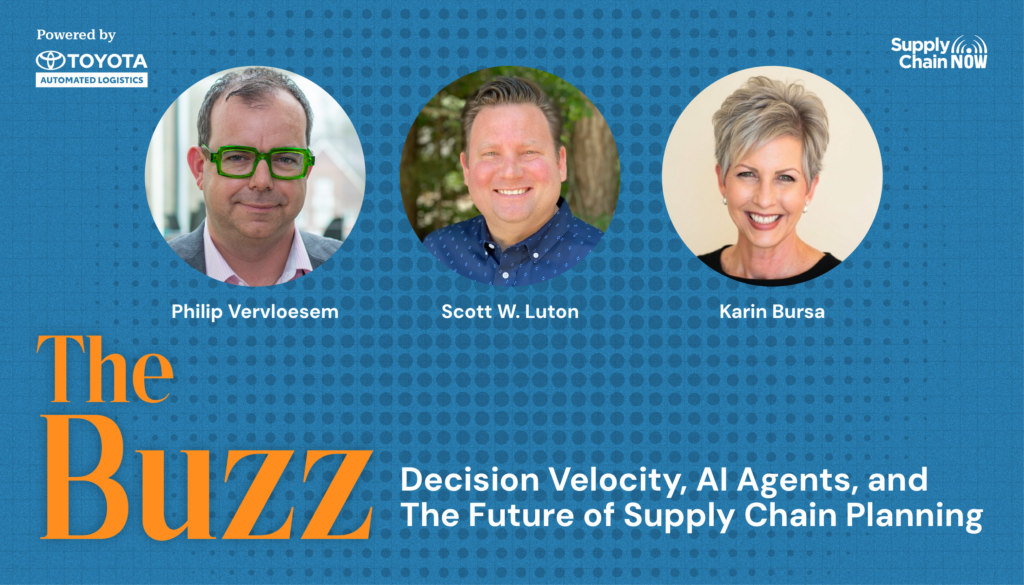
Folks, on today’s show, It’s the Buzz where every Monday at 12 noon Eastern Time, we discuss a variety of news and developments from across global supply chain and business. News that Matters is what we like to call it. And folks, all month long here in August, the buzz has been powered by our friends at Toyota Automated Logistics, your global partner for integrated warehouse automation. To learn more, visit toyota-automated-logistics.com. All right, so me and Corinne, y’all know we keep it real, right? So today’s show is not live because we’re traveling this week, but never fear we got a great show teed up and we’re going to be back live with you next week on August 31st. All right, so Corinne, we’re going to touch today on lots of things. Let’s see. We’re going to talk about unleashing the enterprise. We’re going to be talking about challenging water levels on the run.
(01:32):
We’re going to be answering the question, or at least maybe trying to answer the question, could this year’s El Nino be the most disruptive since 1950? We’re going to talk about it. And decision velocity is something that organizations are investing in more and more. We’re going to be discussing how critical it is in the modern supply chain organization. So folks, all that much, much more, but even better yet, Corinne. In about 15 minutes or so, we’re bringing in a very special guest, our friend Philip Vervlessum, chief commercial and markets officer with OMP. Folks, we’re delighted to have Philip back on, actually with us on the buzz for the first time, but back with us for just his latest segment here with us on Supply Chain Now. So Corinne, I’ll tell you what, we’ve got a lot to get to. Great show here today. Are you ready to go, my friend?
Karin Bursa (02:16):
I am ready. Let’s get the conversation started.
Scott Luton (02:19):
Let’s do it. I’m going to try my best to keep you on your toes and surprise you a little bit at least a couple times over the next hour. Does that work, Corrine?
Karin Bursa (02:26):
Hey, I’m open. Yeah, let’s go.
Scott Luton (02:28):
Folks, stay tuned for a big edition of The Buzz powered by Toyota Automated Logistics right here today on Supply Chain Now. So before Philip joins us, me and Corrine, we’re going to be hitting three things on the front end of the buzz. And I want to start, Corinne, I’ll tell you, I’ve really enjoyed a lot of the shows that we’ve done over the years, but especially here recently. We’ve had a hit after hit. It’s been like Motown. Hit after hit after hit. So a week or two ago, you and I enjoyed an episode with Wiley Jones, CEO and co-founder of DOS, and we focused on key takeaways from this really popular news series for 2026, Enterprise Unleashed, my favorite verbs. Now I want to ask you, we heard a lot from Wiley and we reflected a ton on all of the big time guests we’ve had on this series.
(03:17):
And Corinne, I think I got three pages of notes just from what you added on that show a few weeks ago. What were some of your favorite moments or takeaways?
Karin Bursa (03:26):
Yeah, it was a great discussion with Wiley Jones, and I love the theme of that series that you’re working on, the enterprise unleashed. I think that this is a real opportunity for all of us. I think that one of my key takeaways from that was that this next chapter in unleashing the enterprise is really not so much about proving that AI works, but proving where AI unlocks measurable, tangible business value. And Wiley certainly had a few very specific ideas around where those opportunities were.
Scott Luton (03:59):
Sure did. And one of my favorite things continues to be, I talked about on this show, I think I’ve been talking about it nonstop, is for all the focus on technology and AI and all things tech leadership on that series of conversations, a lot of times it goes back to what’s old is new again, the power of culture, the power of real leadership. And I’ll tell you, it really is amazing what organizations can do when the culture is right and it’s protected. Would you agree with that?
Karin Bursa (04:27):
Absolutely. And I think the future is not just more digital or more intelligent or more automated. When we talk about being adaptive, it is not just the mechanical response to changes in the market. It’s how our culture, how our team embraces those changes, finds the opportunities, and works together to really serve the customer needs and deliver on the company’s brand promise, whatever that might be in the marketplace.
Scott Luton (04:56):
Well said, Corinne. I agree with you. So folks, go back and check out that show. Go back and check out the series. I think we released five or six episodes by now. We got several more to come with some big guests. And also go check out what DOS is doing, doing some big things as they continue to grow with rocket fuel. All right, so Corinne, we got a couple more things here. I want to get your reaction really quick. I love this also new things. We’ve had a great blog series here that we launched in conjunction with our friends over at the Journal of Business Logistics. And this is the latest piece. And basically in a nutshell, folks, for those that may be new with us here, many of our old-time guests know what a manager’s cut is, but basically what they take is they take really big ginormous scientific white papers and they chop it down into a manager’s cut, which is really kind of the Reader’s Digest or the TikTok version, something that’s easy to read and digest and act on.
(05:48):
And we’ve got a lot of great feedback here. And this one here, as you can see, blame follows the messenger. This piece highlights what some might call surprising research showing that who delivers bad news can matter as much as the news itself. When retailers proactively notified customers about shipping delays in the analysis, customers tended to blame the retailer more and were less likely to buy from them again. When the carrier delivered the same message or customers discovered the delay through tracking, a retailer received less blame. The takeaway is pretty clear, companies should remain transparent, but thoughtfully decide who should communicate a service failure because the messenger can strongly influence who customers hold responsible, kind of a supply chain version of don’t kill the messenger. So Corinne, react to what’d you read here?
Karin Bursa (06:37):
Yeah, so first of all, I love this headline, blame follows the messenger. I mean, it caught my attention right away, but I do believe that the messenger matters, that the one who is sharing the information and talking about what corrective action might be needed or when your package will in fact be delivered and doing that proactively is really important. So yes, who delivers the message can shape how the customer views your brand and you are the person they place the order with. So it’s important that you manage that and own that as much as possible. And that’s really my key takeaway from the article, from the blog or the summary of the white paper is when blame gets assigned to the retailer, it’s going to affect the customer’s future purchase intent. They will assign blame to the retailer more quickly than they will to the carrier.
(07:35):
So it’s not just about what my service experience is, it’s building my revenue projections, my loyalty issues, my customer value proposition. So very interesting research.
Scott Luton (07:48):
Brain, I’m with you. And one last thought as you were sharing a couple of our observations came to my mind is first off, folks, go check out the read. Give us your take. You agree, disagree? Let us know. But we talk off all the time about we’ve got to control what we can control. And as I was reading this piece, and of course we all want to optimize the relationship we have with customers, it’s interesting how much more we always had, in my mind, in my view at least, how much more we actually have within our control when we start looking at things differently and purposefully trying to get as close as possible with the customer. Who would’ve thought it was all in how good or bad news is delivered? But hey, the proof is in the pudding, Corinne, is that right?
Karin Bursa (08:32):
It is indeed. It is indeed. And I will tell you that bad news does not get better with time. So the sooner we can convey that, the better off
Scott Luton (08:40):
We are. Well said. All right. So folks, one more thing before we bring in a wonderful guest here today. I want to share this resource from our friends at EasyPost. Folks, you all know it. Every peak season forecast talks about volume and surcharges, right? Volume and surcharges. But this EasyPost survey of some 141 verified logistics professionals has found that the bigger risk to peak season success sits somewhere. It doesn’t get as much buzz. It’s the cost that teams can’t see or the backup plans that are never run and practiced. We invite you to download the full report today to learn more. And as always, let us know what you think. All right, so Corinne, we are excited to bring on our special guests here on The Buzz today. Folks, let me introduce Philip Pervlesem. With extensive experience in market analysis and commercial strategy, Philip plays a key role in aligning market trends with corporate vision.
(09:37):
As CCMO at OMP, he focuses on enhancing customer satisfaction, driving value realization, and ensuring future-proof solutions. Phillip’s career has involved identifying market opportunities, exploring sub-segments, and aligning sales with business goals. As a community chair, he strengthens collaboration by organizing lead customer events and building industry connections. And I’ll tell you, he’s got about seven million industry connections from what I see. He’s like the mayor of global supply chain. In alliances, Philip even combines his expertise in business and technology to refine go-to-market strategies and support strategic market expansion. Folks, please join me in welcoming Philip Verblesem, chief commercial and markets officer with OMP. Hey, hey Phillip, how you doing today?
Philip Vervloesem (10:25):
Hey, Scott. Hi, Corinne. Doing very good today. Glad to be here.
Scott Luton (10:28):
Excellent. Now, Corinne, we were talking pre-ship. We had to go through your rock and roll agent, Philip, and we had to work through about 17 different schedules, and we had to coordinate with the airlines because Philip stays on the go. Is that right, Corinne?
Karin Bursa (10:43):
It is indeed. I think Philip is one of the most interesting people in supply chain. He is always on the move. And when he has free time, he’s always doing something very interesting. And usually it involves either speed or adventure or trying something new. So he’s always up to something.
Scott Luton (11:03):
I’m with you. And all that, kidding aside, Phillip, I do admire, we all are in living virtually and digitally and remote meetings. I love your passion for getting out and meeting and breaking bread with colleagues and customers and market leaders in person. That’s clearly something you’re very passionate about. I love that, Philip.
Philip Vervloesem (11:21):
It’s still all about trust building as well, right, Scott? That’s important.
Scott Luton (11:26):
All right, so a fun warmup question today for you both. So back to school season began in recent weeks, at least here in the States. And that means one thing, summer is over. Yeah, I hate to even say that. I really hate to say it, but I’ve got a question for you both. As you conduct an inventory of how you spent summer 2026, I got to ask you, what was one of the absolute highlights?
Philip Vervloesem (11:50):
I think my highlight, you said summaries over. Today I was reading downstairs here my barometer at home and the temperature looked 100 degrees and it feels like 122. 122. Summer is not over yet, but in one word, my summer was hot because wherever I went, it felt like there was a heat wave. I went twice to Europe. Both weeks were heat waves in Belgium. In China two weeks ago, there was a heat wave. So I feel like the only time I could cool down was last week being in Brazil because of this weaker there. It actually felt cold with a jacket. Yeah, that were some of the highlights.
Scott Luton (12:26):
Let’s go to Brazil next week. I want to get a break from this Georgian heat. Well, one more quick follow-up question, Phillip, because I’ve done some spying, right? I’ve crawled across your social media channels, and I found this image of you somewhere in a gorgeous setting. Looks like you’re doing some watercraft. Tell us what’s going on.
Philip Vervloesem (12:44):
Well, in the back you see the CPR lady, Annie, laying down there. She’s still alive. We did just our rescue and CPR diving last weekend, and we managed to complete all the tests and certifications. So I’m very happy going into the next level now, and maybe at some point go for master diver or course director.
Scott Luton (13:03):
That’s awesome. And just to level set with everybody and let y’all in a little inside joke, Annie, as Philip was talking about, is a CPR dummy that folks use to practice and get qualified on this lifesaving technique. So good stuff, Philip. And good luck, Annie. Good luck, Annie. Hang in there. All right, so Corinne, same question to you. I’ve been fortunate to collaborate with you a few times through this very hot summer 2026, but what are some highlights for you of how you spent your time this summer?
Karin Bursa (13:30):
It certainly has been hot. We have been doing a little hiking in the Blue Ridge Mountains, and you got to dress for sweat basically. So you’re not looking your best when it’s over. You look like you’ve jumped into the lake versus just been hiking up in the Blue Ridge Mountains.
Scott Luton (13:48):
Not only great exercise, but it’s gorgeous, especially if you can just avoid snakes. Corinne, you hadn’t seen
Karin Bursa (13:53):
Too many snakes
Scott Luton (13:54):
This summer, did
Karin Bursa (13:54):
You? Nope. Nope.
Scott Luton (13:55):
Okay.
Karin Bursa (13:55):
No snakes. Beavers, seen lots of beavers and gophers and deer and all that, but no snakes.
Scott Luton (14:02):
All right, folks, good stuff. Hope y’all summer out there. If you’re celebrating summer, if you’re celebrating winter, whatever season of life you’re in, hope you had a great last few months. So let’s get to work Philip and Corinne. I want to dive into several stories here on the front end of the buzz powered by our friends at Toyota Automated Logistics. And first up, we’re going to take a look at the latest iteration of a big challenge for many folks across Europe, looking at how low water levels on the run is impacting regional industry and really a lot more. The Reuters reports that water levels have hit record lows lately, and the related disruption continues to increase higher costs, which continue to accumulate. Logistics bottlenecks are getting worse, and really overall industrial production is being hampered. Now, from the experts that we’ve talked to, it’s not quite as bad as the historic 2018 crisis on the run, but you know what?
(14:53):
We’re going to see how the next few weeks go. And if you want to get a feel for what happens when barge traffic has to be replaced, get this Corinne and Philip. One industry leader interviewed for this Reuters story here said that up to 150 trucks are needed to replace a single barge. Now, of course, in many instances, barge traffic doesn’t necessarily stop altogether, but the barges are forced to carry much lighter loads to deal with low water levels. So you may not need 150 trucks, but you still may need 75 or 60 or whatever. It’s a lot of logistics. So Philip, Phyllis, what are you seeing with this story of low water levels on Rhine?
Philip Vervloesem (15:31):
Well, I vividly remember the 2018 because we were actually doing a project at one of the giant chemical companies along the Rhine. And that’s where what struck me as very important there was ability to model that as what we call a value chain because things are not. One is depending of the other. The fact that, for example, the barge cannot handle the full load or truck capacities needed will have other dependencies as well. So looking at that from a full value chain point of view, reasoning and reallocating dynamically and doing that as much ahead of time as scenarios was at that time extremely important. And now that you see that it’s coming back up again, I think many companies learned of doing that more in an anticipated way, but it is important for sure.
Scott Luton (16:19):
Phillip, I’m with you. And I guess the silver lining here, Corrine, is that Philip was talking about 2018 here eight years later, my math is right, gosh, there’s a whole bunch more powerful opportunities to do all that scenario modeling all proactively and hopefully have a lot more options a lot sooner to successfully navigate, no pun intended, around these challenges like this. But Corinne, react to the story about the rhine.
Karin Bursa (16:42):
Yeah, I have to agree with Philip’s point of view on this. It’s a great reminder for us, a great example that resilience isn’t something you measure after a disruption occurs. It’s the ability to actually see what’s changing and to make better decisions while you still have choices. So whether we’re lightening the load or we’re bringing in over-the-road transportation to augment what we normally put on barges, it’s showing all of those examples, the different scenarios, and figuring out what’s the best next right thing to do. So the visibility might tell you that the rhine is low, but the decision intelligence, the ability to plan and re-plan is going to tell you what to do about it.
Scott Luton (17:25):
Well said, Corinne. Well said. Well, folks, we’re going to keep our finger on the pulse of what takes place. I’m hoping we get a bunch of rain or whatever solves this issue. I guess my brain goes straight to more water. However we can get more water, I’m hoping that the rhine works itself out. All right, so weather’s going to be a bit of a theme here today because in story number two, Philip and Corinne, we’re talking about what this year’s El Nino may bring to global industry. A lot of folks are talking about it. Reuters again reports that many scientists claim there is a growing chance that this year’s El Nino is going to be much stronger than anticipated. And in case you don’t know, let me put on my meteorologist hat here. I’m not a real one, but I’m going to play one for a minute.
(18:05):
So El Nino is a recurring climate pattern in which surface waters in the Central and Eastern tropical Pacific Ocean become warmer than normal. That extra heat changes atmospheric circulation, which can shift rainfall, temperatures, and storm patterns thousands of miles away. Now for the US, El Nino often means wetter conditions across the south and warmer or drier conditions across parts of the north, especially during the winter. Now globally though, it can contribute to droughts, floods, crop disruptions, wildfires, changes in hurricane activity, making it a significant factor for agriculture, and of course, global supply chain management. I get this, Corinne and Philip. I really enjoyed this story, by the way. Reuters did a nice job of leveraging some of the data here, so check this out. Market intelligence firm AlphaSense is monitoring corporate filings and conference calls, which is in this article by Reuters. Their data was tracking 478 companies, and it shows that the mentions of El Nino in these leadership conversations is at its highest since 2019.
(19:09):
But if you look at these corporate sectors, that activity of planning conversations and you name it is highest in the food products, the chemicals, and the banking sectors, especially food products. You look at the graph here off the charts. And then if you look at things geographically, many India-based companies are discussing El Nino because that part of the world is heavily reliant on monsoon rainfall. And a stronger El Nino can cause weaker monsoons, which can lead to lower crop yields and then subsequent tighter supplies, which can lead to higher commodity and food prices, and of course even trade policy restrictions and lots of supply chain headaches. So Philip, I’d love for you to weigh in. Number one, please tell me it’s not going to be as bad as it may be. But number two, how are you seeing companies plan?
Philip Vervloesem (19:57):
I like to be comforting, but it might be bad still. And I think weather is indeed a theme today because you have the drought. It’s been already so far a rough year for Europe, for example, as Ricky testify firsthand. But I think Asia, for example, you mentioned there on the graphs that we’ll have a tough time in Q4. Of course, many of the source materials for food, for tired production, and so for like cotton, cocoa, palm oil and so forth that are located there that have huge global impacts on supply chains. And to me, these events and the consequences of the events have, of course, a lag effect. And we see that with many of our customers. The good thing is, and the key thing is to plan for that now, not later. And just as we talked about with Ryan and some of the chemical companies there, it’s to have your scenarios ready, do that now so that by the time that there’s a summum of everything that’s happening, that you have the contingency built, that you have the resiliency already in place, at least for whatever is possible.
Scott Luton (20:59):
As Philip was sharing his observations here, Corinne, it kind of struck me. Hey, El Nino is not new. Challenging water levels on the run or the Mississippi or whatever, that’s not new. But what we can do as supply chain managers and supply chain leaders, we’ve got a whole bevy of new tools in our tool belt. But Corinne, react to either what Phillip shared there or the original story. How bad is El Nino going to be?
Karin Bursa (21:23):
Yes, Scott, I’ve got to agree with your point is that these disruptions are not new. What’s different now is that our systems are more intelligent and we can take these market indicators, these weather indicators, and use it either as predictive measures for the future on crop availability or on higher demand based off of temperatures, et cetera, or lower demand based on temperatures, and be able to work that into our supply chain plans. So I think that that’s a real critical factor. You need to make sure that you’re working with technology solutions that really allow you to bring in this external data or syndicated data so that you can tune your plans with as much insight and information as possible.
Scott Luton (22:13):
I’m with you. Well said, Corinne. Well said. And isn’t that cool, Philip and Corinne, of how we’re monitoring all of these communications and these calls in entirely new ways? I would like to see the ’80s, which is one of my favorite decades. They couldn’t cover basically endless calls and press releases and corporate communications for like 500 companies all at once. I mean, it really is. It really is cool. But I’m hoping that it won’t be as bad as some are projecting, but we’ll keep our finger on the pulse, no doubt. All right, so next up, I’ll tell you that this story, as we’re putting together the research for today’s edition of the bus, this story got my attention like few could. It’s fascinating what’s going on. I love manufacturing, number one. And the automotive industry, of course, is such a cool part of the global economy and global manufacturing, of course.
(23:03):
Folks, check this out. The Chinese automotive industry, it is moving into overdrive. They didn’t do it. Hyper drive might be a better term. I’m not sure. The Wall Street Journal reports there’s been a massive surge in car exports from China. So why is that? Well, there’s quite a few reasons, but I’m going to offer up a couple in the short list. Number one, we’re absolute cutthroat competition between some 100 auto brands that are making cars in China. The car companies also have overproduced a far domestic demand there in China, and these Chinese car companies are trying to further penetrate the global market, of course. Get this. So China exported, Corinne and Phil, this in a nutshell is really what got me. China exported 600,000 vehicles in 2019. So less than a million, 600,000 vehicles. Research group, Mobility Global says that number could hit 10 million exported vehicles this year.
(23:54):
And there was a quote in there, and I meant to grab it earlier, but I’m going to paraphrase it. And this executive says China went from an afterthought to six, seven years ago in the automotive manufacturing space to a dominant player in basically no time. And despite the auto-specialized logistics industry growing by 40% or so in the last few years, there isn’t enough capacity for this explosion of shipping demand by far. And as expected, the freight rates are way up too, which have caused some automakers such as BYD, which by the way stands for Build Your Dreams. That’s kind of cool. The Chinese automotive manufacturer, BYD, they’re launching their own car carrier programs to get around the costs and the capacity constraints. So Philip, this is absolutely mind-boggling to me. You were in China a couple weeks ago. What’s your read here, Philip?
Philip Vervloesem (24:43):
I think it’s amazing and it’s astonishing because two reasons. One, I was in China two weeks ago and the amount of different brands you see there, and sometimes it’s interesting because you say, “Oh, this looks like a Range Rover.” But it’s not, it’s a Chinese version of a Range Rover. The EV diversity there is huge. But I have one story that was just from a little bit over a year ago where in Belgium actually, they produce the buses for school commutes and so. And so there’s a Belgium manufacturer, Von Hole, it’s called, and they were competing against BYD buses, and they didn’t win. So they basically in Belgium, they preferred a Chinese manufacturer to provide all the buses in Belgium for that purpose instead of their own. And that was just because of the performance, because of the radius, because of many reasons. But that’s why I feel like the China automotive industry is really setting the pace.
(25:42):
And that’s because of the combination of the electrification, the AI on it, the battery leadership and unparalleled innovations. I hear you with the capacity that’s really shortening on just the shipping part.
Scott Luton (25:55):
Philip, I got a quick question before I go to Corinne. As you left China, did you think about just for a second or two standing up an automotive export business to make a few bucks and take a few automobiles with you? Did you think about that for a second, Philip?
Philip Vervloesem (26:08):
Well, I thought about that until I realized I actually was carrying a battery pack, and there you cannot even ship or take with you and carry on a battery pack that’s more than 5,000 amps. Really? It’s very strict. So I was like, “No, maybe not. It’s too strict for me.”
Scott Luton (26:26):
It stopped the business plan in its tracks. Okay. Corinne, react to this, what I think is just an intriguing story, and especially think about where we’re headed. What’s your thoughts, Corinne?
Karin Bursa (26:35):
Yeah. Well, what got my attention is really that it’s not China’s manufacturing scale. I think we all have an appreciation for that, but it is the speed at which these companies are learning and iterating and commercializing. So think of it as taking decision velocity, which a lot of supply chains are focused on right now, which I think is very important, and having that actually transition into a competitive velocity. If I can put those decisions into action and iterate product design and performance and the commercialization aspect, I think we need to keep our eye on what’s coming out of the China market.
Scott Luton (27:14):
Well said, Corinne. Both eyes, ears, you name it. I tell you, it’s fascinating. And that speed to market and that speed to success in an industry that they, again, using that executive’s quote that they were a bit of an afterthought in years ago, it’s amazing how competitive they have come. And Philip was talking about one market. I’m reading about Mexico to the UK to many, many global markets. So it’s a fascinating time. All right, so Corinne and Philip, we appreciate y’all’s take on those three stories. It’s always tough to figure out what we’re going to talk about, what we’re not going to talk about. There’s so much intriguing stuff going on. But Philip, we have about 27 questions for you in just a second. So don’t go anywhere. But before we move into this next segment, I want to share this quick message from our friends at Toyota Automated Logistics, your global partner for integrated warehouse automation.
(28:05):
Folks, did you know this company combines the talents of Bashon Solutions, Vonda Lande’s warehousing business and ViaStore all under one brand as an integrated automation hub to deliver scalable systems, intelligent software, and lifecycle services. It brings together the latest supply chain technologies into one connected solution. Toyota Automated Logistics delivers a seamless journey from system design to delivery, empowering customers with a lasting competitive advantage. Folks learn more at toyota-automated-logistics.com. All right, so Corinne, the first out of, I don’t know, 37 questions we’ve got for Philip teed up here. Really, I’ve got about 37 questions about your world travels, but I’ll stick to supply chain here. The OMP team had its yearly US seminar within the last few weeks, and I’d love it as you gathered all that talent and all those folks that got the finger on the pulse of so many organizations and their supply chain performance, what were some of your favorite takeaways from that yearly event?
Philip Vervloesem (29:03):
All the takeaways I would say are twofold, but indeed, like you said, we hold with the entire US team now we’re about 250 team members there, a yearly US seminar in the summer to reflect on the first half of the year and be super clear and intentional about the targets for the remainder of the year. So this year, the key theme was twofold. One, of course, on the market dynamics and the positioning of OMP and what we call the embedded AI strengths in platforms which can provide companies an incomparable reality-based decision power. We’ll come back to that hopefully later as well because I’d love to talk more about that, but also how the investments leadership make for us for delivery, consulting, development, marketing, sales, and so forth with the right AI augmentation tools to elevate there and to, from a productivity point of view, and also just purely from an augmentation.
(29:54):
That was the AI topic. We also had a more human topic, I would say, with an external speaker called Tom focusing on the human aspect of true collaboration. And he’s been in Georgia a coach of a basketball team and he said, “Your best team members will never be remembered for only their technical capabilities, but for aspects like trust, like confidence, like empathy and so forth.” And to me, that’s important in the collaboration as well. It’s not just pure technology.
Scott Luton (30:22):
All right. So Corinne, we could probably make a whole series out of his response, especially on that human element, leaning into the unique human superpowers of building trust and the superpower of empathy. But Corinne, what’d you hear there? Even going back to the technology focus, what’d you hear, Corinne?
Karin Bursa (30:40):
Yeah, well, I think Philip is actually saying investments are being made in their team and building their culture. So we started by talking about the importance of culture, especially as technology is moving so quickly. As a company that is a leader in the supply chain technology space, their product is moving forward very quickly. They need to make sure that they’re helping their people make that transition with them and helping them therefore help the customers to leverage new capabilities and to think differently. So it’s not just about going faster anymore, it’s about changing the way decisions get made.
Scott Luton (31:16):
Well said. And of course, when we’re betting, embedding rather, AI just into the platforms so we don’t have to make a conscious decision to turn on this switch or hit this button, it can move faster and better all at the same time. All right, so Philip, my hunch. I think me and Karin both have had an opportunity to break bread and eat good food with you. I bet y’all had some good food at that US seminar this year is my hunch. Philip, is that right?
Philip Vervloesem (31:39):
It was pretty good indeed. I was thinking like, what did we have? But no, it’s pretty good. We have the prepared to have a campus at the Galleria close to the battery in Atlanta, and we have the Renaissance Hotel right next to it. So they cater amazingly to events that we hold indeed.
Scott Luton (31:57):
Nice. Maybe got some baseball in or first place Atlanta Braves. Man, what an event. All right, so we’ve mentioned decision velocity probably a couple times on the show already. And of course, like we have mentioned it earlier, it is a dominant theme across industry. It’s really becoming, and Philip, this is one of your regular mantras, decision velocity has become a clear-cut competitive advantage. So I got to ask you, Philip, what separates companies that can actually make faster, better supply chain decisions from those that simply, they got more data, they got lots of technology, but they’re not finding that same success? What’s the difference, Philip? Well,
Philip Vervloesem (32:38):
I think first called, as you could see, because we meet each other quite regularly at Gartner events and so forth. So you see at the occasions that we meet and the customers that share their success cases, that’s decision velocity is indeed key. And to me, just as Carina already mentioned earlier, it’s not just about making decisions faster, it’s about the right decisions faster. And to me, that’s what separates the leaders from some of the laggers. So the ones that need to still build upon the maturity level is not who has the most data or most AI because everyone is investing in both of course, but it’s the companies that are pulling ahead are those who have moved from or moved beyond the connected data into connected decisions. And there’s the ones that are able to sense change, evaluate options very dynamically, and execute them across commercial supply chain and finance functions in hours instead of days and weeks.
(33:34):
And I feel that’s where we see more and more winners emerge as well.
Scott Luton (33:38):
Corinne, are you seeing the same thing? And when it comes, especially to decision and velocity, what are the winners getting right, Corinne?
Karin Bursa (33:46):
Yeah, so it’s not just about analyzing the problem faster, it’s about figuring out what to do next. So that feasibility, is it a plan that can be executed by our business and drive the desired outcome? And I think that that’s a real differentiator. So using AI where it makes sense, all the different flavors of AI, if you will, in order to drive not just the decision velocity, but the outcome that your business is looking for, whether it’s new market expansion, accelerated time to market, better margins, whatever it might be around your full product portfolio, having that ability to be precise and to do it with confidence.
Scott Luton (34:31):
One quick sidebar before I move on to the next question, Philip. Last week on the Buzz, we looked at one industry association that had conducted an annual survey. And this year they had surveyed about 500 global professionals, mainly in supply chain manufacturing and the like. And one of the things, because we’re all talking about how many companies are investing in technology, sure, lots of them are. But out of those 500 or so respondents, 28% said they’re not leveraging AI at all. If you get down in the weeds, there could be a couple reasons for that, right? But still that figure surprised me. Does that surprise you, Philip?
Philip Vervloesem (35:06):
It doesn’t surprise me. If that survey was also crossing different industries, it doesn’t surprise me that that’s still 28%. But to me, the start is to move that 28%, at least in the motivation and the willingness to invest in it and to invest in it with the right intention. Not just to increase productivity or so, but go wider, have really the vision a bit broader.
Scott Luton (35:28):
Brynn, same question. Does that figure surprise you?
Karin Bursa (35:31):
I’m with Philip. I’m not surprised that 28% of the survey sample is a late adopter, but I think that they have to move very quickly from AI curiosity to AI of consequence, understanding where AI can have the biggest impact on their business. And that is a place where I think it’s going to be important to work with partners that have that context, that understand supply chain, that understand where the value proposition is most likely to be achieved in the shortest time possible. So I do think that we’re moving very quickly from little science projects to actually moving into production and seeing the impact in very tangible ways.
Scott Luton (36:14):
AI of consequence. I like that, Corinne. We got to put that on the back of a t-shirt. All right, so Philip and Corrine, as y’all probably are seeing and maybe even doing some of this, we’re hearing a lot about agentic AI moving from experimentation into real world outcome-producing supply chain operations. It’s been a fascinating time. Where are you seeing AI agents deliver legitimate value today? And where do you see maybe there’s a bit more lip service than real outcomes where maybe the industry’s still getting ahead of itself a bit? What do you see?
Philip Vervloesem (36:47):
Well, first to piggyback on Corinne’s point, it’s still better of companies to experiment fast than to do nothing at all. So that’s a positive trend as well. But to me, every board that I am connected to or I hear the C-suite talking about has high pressure to invest, to go beyond that experimentation and to drive the highest possible value as well. And I feel the biggest misconception is that agentic AI is just about replacing planners or about pure productivity gains. To me, that’s really not or shouldn’t be the focus. To me, the biggest value is where I see many examples really come out well, is augmenting decision-making. And those winners that invest in that and that are able to industrialize that are companies that use AI agents to identify issues, to simulate options, to coordinate also across the enterprise as well. And to be the ones that find themselves at that type of blocking point to not go beyond experimentation are often those that deploy many agents, but without a trusted data foundation or without a governance model.
(37:55):
So to me, it’s like autonomous is great, it’s interesting, but augmented decisions are more transformative or give the right value.
Scott Luton (38:04):
I like it. In an augmented model, you get the best of both worlds. These incredible human superpowers and these incredibly talented planners amongst many, many other roles that augment them with powerful innovative technology, AI and otherwise. Brynn, what about you? What do you see where AI agents are really delivering value and where maybe we’re still trying for some breakthroughs?
Karin Bursa (38:24):
Yeah, I think we’re still in the early stages of the agentic capabilities, but the foundations are being put in place, and I think that’s important. And at some point we’ll have agents, super agents that help to orchestrate other agents. But I think one of the most important things is what Philip was alluding to, and that’s your board of directors, is going to be very focused on not necessarily how many agents do you have, but what’s happening or what’s the outcome? Are we improving margins? Are we improving service? Are we getting better utilization out of our inventory investments? Can we grow with our existing capacity? I think the ability to answer these very important and strategic questions for the business is what we need to get focused on and understanding how that progresses us over time.
Scott Luton (39:17):
The power of focus, we’ve learned for the Mayeth time just how important focus is, especially when we have all of these options, all these technologies, all these distractions in the modern boardroom or modern supply chain organization. So I want to ask y’all this. So Philip, we’ve talked about this quite often as we’ve met at these events and had you on other programming and whatnot. I’m not sure if I’ve asked you this question. Are we reaching a drum roll? Are we reaching the beginning of the end for what I’ll call traditional cycle-based supply chain planning? And a little two-parter here, five years from now, what does a planning organization look like if always on planning truly becomes the norm? Your thoughts, Philip.
Philip Vervloesem (40:00):
Yeah, it’s a big theme for us, the always on, right? And I don’t think that traditional cycles or the planning cycles themselves will completely disappear, but they will become more the exception than the default operating model. And to me, there’s still many companies. Kareem mentioned some examples as well that discovery disruption, let’s say on Monday, they analyze it on Tuesday, they discuss it on Wednesday, and then they make a decision on Friday. And that’s often, very often, way too late. So I feel in the coming years, months and years actually, AI agents will detect the disruption, assess it and assess the impact across demand, supply, inventory, the financials within minutes, and then bring the recommended action before people even know that there’s an issue because it’s an anticipation of what likely could happen. And they do it, and that’s very important to me to make it work.
(40:49):
They do it in a very reality-based, executable, and repeatable way, because then there’s also the trust building again. And then the planner’s role shifts from gathering data and running spreadsheets and orchestrating decisions to really managing trade-offs and steering the business. And to me, that’s really what Always On is about. It’s fewer planning cycles, but more continuous decision-centric decision-making.
Scott Luton (41:14):
Brynn, I think Philip kind of paints a compelling picture there, especially my favorite part out of his whole response, I think, was the changing way that the nature of the planner’s role and how that’s going to greatly evolve and really for the betterment of the organization, for the betterment of the performance, and frankly, probably a lot more fulfilling work for the human planners out there. But your thoughts, Corinne, on what Philip shared and future of always on planning. We’re going to hit this tipping point soon. Your thoughts, Corrine?
Karin Bursa (41:43):
Yeah, I think so. The short answer to your last question is Philip made the point about continuous planning. If we think about traditional planning, most companies plan their business on weekly or monthly cycles. They had a monthly planning cycle, for example, or they would plan a production on a daily or weekly or monthly schedule. I think that starts to go away because we are planning continuously. We are always updating and refining it based on the closer we get to the need for the goods. So I don’t think planning disappears. I think waiting disappears. So I think those decision cycles, the wait time, our decision velocity that we were just talking about is what changes. Those cycles get quicker and quicker. And so I can make smaller incremental changes and be more in tune with market demand, product availability, production capacity, so that we are making more informed decisions in the future.
(42:46):
And then it becomes very important that our people have that business context that they can help with this new data, these new insights to make better decisions every day.
Scott Luton (42:57):
Corinne, I loved it. And your part about we greatly reduce all the waiting. The former Air Force airman in me is delighted with your prediction there because that phrase hurry up and wait, I know we’ve all heard that. I swear that was coined in the processing centers and the onboarding in our military because I can’t tell y’all how many times we get hurried here, hurried here as a young airman, and then we wait and then we wait. A big version of that happens regularly in industry as well. So I love the future both of y’all are painting and taste exciting time. Well, Corinne, I’m not going to steal your mantra. It’s
Karin Bursa (43:32):
A great time to be in supply chain.
Scott Luton (43:34):
That’s right. That’s
Karin Bursa (43:35):
Right. Join me. Let’s say it together. It’s a great time to be in supply chain.
Scott Luton (43:39):
All right. So Philip and Corinne, I was going to ask this question, but I’m going to make it more about industry because clearly both of y’all are big believers in the value and of the beautiful human role in our planning processes and supply chain. But do you think as an industry, and industry gets infatuated to technology. As an industry, are we underestimating the power of the people side of the planning transformation? And when you think about that ideal planner, say four years from now, 2030, what’s going to really separate an exceptional planner in 2030 versus a Fair to Midland planner, I’ll call. Philip, your thoughts.
Philip Vervloesem (44:19):
I think you’re right that the industry’s at risk at least to overestimate technology and underestimate the people and the impact of people. I mentioned it linked to our US seminar. So one of the strongest messages that Sean Brados is the future of planning is not just about AI, it’s about amplifying the value of people and strengthening the collaboration across teams. Because AI, for example, Unison Companion from annoying people point, if you can generate insights, recommend actions, automate routine work, but it cannot build trust, aligned stakeholders, navigate trade-offs, and inspire also across the organization. And I mentioned that in a previous webinar, Scott, it’s about IQ complemented with the right EQ. And to me, by 2030, the best planners won’t be the ones that train the best model or the best spreadsheet. It will be the ones that can actually connect the different teams, the commercial, supply chain, finance, operations team.
(45:15):
000, for example, calls them the translators where they can make recommendations, but in a business context and drive decisions that create these right outcomes.
Scott Luton (45:26):
Philip, I was on that webinar you’re referencing and I loved, I think we had t-shirts put out there, IQ+ EQ. If you’re new to those acronyms, IQ, of course, intelligent quotient, but EQ is a uniquely human. It’s the emotional quotient. And Corinne, I’d love to get your takes in general, but I would say that change and transformation takes a ton of EQ, uniquely human EQ to drive progress there. But Corinne, your thoughts on the human element and in 2030, what’s going to make an outstanding planner?
Karin Bursa (45:58):
As always, I think it’s a great time to be in supply chain. It’s a great place to build your career. Even with the advances in technology, the planning and analyst role will continue to be vitally important to every business that serves customers with tangible products. So it’s not going to go away. Now, some of the criteria may change over time, and I think Phillip’s onto something here. I think our planners need to be able to influence decisions. They need to be able to present the recommendations that come out of the systems, the planning systems that are providing the decision intelligence for us so that they can add value with their knowledge of the business that’s not hidden in the numbers. So I think that that’s going to be important. So you need to be able to explain the plan, convey the alternatives, and help the executive team to make the best decisions going forward.
(46:52):
So the planner of 2030, I think you asked, instead of driving spreadsheets and being spreadsheet jockeys, they’re going to win because they understand the business. They understand the merits of the various trade-offs, and they trust the AI because they understand the way it’s working and analyzing the opportunities that are in front of them. But they are going to have to have that influence so that they can convey it to the rest of the business.
Scott Luton (47:21):
Well said.That reminds me, Corinne, you and I are both in Denver last year at Gartner Supply Chain Planning Summit, as was Philip. I know. Corinne and I both, we took in Noha Samar’s keedote. I loved it. One of my favorite sessions. And of course, she’s been here on supply chain now talking about the immense power of decision shapers. And a lot of what you shared there, Corinne, reminded me of that session. And storytelling’s become so cliche, but it’s so real. And I think whether you’re planners or whether you’re in other areas of supply chain management, those that can look at the numbers, they can get rid of what’s not important, focus on what’s really important number-wise, and then figure out what it’s saying, and then convey that effective story in a compelling way to colleagues and management and you name it. Folks, if you can learn to do that, you can write your own ticket in many, many ways.
(48:14):
Philip, react. Do you agree with that, number one? And I want to ask you about OMP in just a second. But Philip, do you agree as well about the power of decision shaping and storytelling?
Philip Vervloesem (48:24):
Yeah. Well, actually, what Nohan mentioned as a decision shapers from the Gartner lens is very similar to the translators from 00. The thing is from a hiring and building of the team, that capability is very scarce. So we need to really build that from the junior level up to have that skill as
Scott Luton (48:43):
Well. And mentioning Zero 100, they joined us on a recent webinar, Philip, and I really enjoyed that. Prin and Philip, the signal that comes out, I think about once every two weeks from Zero 100. Folks, if that’s not on your radar, and if you’re not diving into that every other one, I think it comes out every other week, you’re missing out. Must read email, MRE, different type MRE. All right, so Philip, used to be a lunch in the Air Force, all deployment, but not so much anymore. Philip, you and OMP team have been on the move. It’s amazing to see what y’all have been up to in just in the last few months. Of course, I track all your travels. I am. I got an app. Where is Philip today? It’s on my iPhone, I’m sure. I’m very envious. But if you would, in a nutshell, for folks that may be brand new to OMP, what does the organization do?
Philip Vervloesem (49:38):
In a nutshell, so I feel OMP exists for a key reason as purpose. It’s to help world’s most complex supply chains because we love handling the complexity to make better decisions. And with that, we combine our deep industry expertise, reality-based digital twin, our embedded AI, and amazing people and expertise that way to turn complexity into confidence. And you know a little bit our DNA and the way we’re put together, but at the end of the day, we’re not just building a planning software. We’re helping organizations really moving from insights to actions with greater speed, better collaboration. And with that, of course, stronger business outcomes and values. So in one sentence, I’d say OMP. And in that, of course, Unison Planning, which is powered by Unison IQ, is where human expertise, AI, and supply chain intelligence come together.
Scott Luton (50:30):
I like it. Hey, you expertly filled that nutshell, Philip, of what OMP does. And my favorite part out of what Philip shared, I think, I think. Of course, the human superpowers. I love anytime the focus is there, which I know is such a big focus, OMP. But Corinne, moving insights and converting them into actions. I think we are, I’m not sure if this is an arguable statement or not, but we are so insight rich. We’re so data rich and still in so many different ways we are prescribed action poor. And I love the emphasis there, helping organizations take the right actions, make the right fast decisions, and move forward. But what’d you hear there, Corinne?
Karin Bursa (51:10):
One thing that stuck out to me was transforming complexity into confidence. I think that that’s very interesting because I know OMP works with some of the largest and most complex supply chains in the world, and that’s not going to go away. So do they have a way to really translate that complexity and help them optimize their capabilities to drive significant value in the marketplace to serve their customers, to build their businesses? And I think that that’s one thing that OMP certainly has done.
Scott Luton (51:42):
Tend to agree with you. And you know what? You make a great point. World is getting smaller, folks, and that’s a great thing, but it’s not getting less complex. We got lots more complexity. Philip and Corinne, what an outstanding. I say this a lot and I mean it all the time, but this is really, I feel like we could talk about supply chain planning for a couple more hours. Let’s do this. I want to make sure that y’all have found our resource hub. Me and Corinne talked earlier on the front end and the A-block about that latest article with our friends at the Journal of Business Logistics. You’re going to find that and so much more. It’s like the Chinese automotive industry. We’re blowing up at the Resource Hub. I love greater emphasis on written context. So go check that out at supplychainow.com and let us know what you think.
(52:30):
And I also want to make sure we make it really easy for folks to connect both with Philip and Corinne. Let’s just take your travel out of it. Let’s take your travel out of it. What’s the easiest way for folks to connect with you, Philip?
Philip Vervloesem (52:42):
I wanted to say, well, the easiest and fastest is on LinkedIn or subscribe to Scott’s Tracker. That’s possible as well. Of course. I love connecting to people of course that are passionate about transforming supply chains and also hearing some challenges about arguments as well. And in one sentence, in person, I’ll be at our two upcoming conferences in Changai and Singapore, as you are as well at the Gartner Planning Summits at 000. And we are organizing a number of councils to also promote some of the new regions we’re in, including Mexico City, Tokyo, and beyond. So plenty of options.
Scott Luton (53:16):
Outstanding. And folks, you can go to omp.com. And in particular, that calendar of events, resources. There’s plenty. Virtual events, in-person events. Folks, if you love all things supply chain, especially planning, go check that out at OMP.com. Good stuff, Phillip. All right, so Corinne Versa. I’ll tell you, it’s like Motown. Philip has just delivered another hit for us. I am so delighted to be able to talk shop with brilliant leaders like the two of y’all. But Corinne, I want to make sure folks can track you down as well. We’re going to be at a lot more events before the end of the year, I think. How can folks connect with you, Corinne?
Karin Bursa (53:52):
The best way is really through LinkedIn. And you can message me there. Connect. Certainly we’ll be here on Supply Chain Now and at several of these conferences that are coming up as well. And one last reminder, it is a great time to be in Supply Chain. So there’s never been more technology, more intelligence, and frankly, more opportunity to make a business impact. So you’re in the right place. Tune in here is Supply Chain Now and hear from innovators like Philip that are helping companies make that transition and embrace new technology trends.
Scott Luton (54:23):
Corinne, love it. I tell you, it is a fascinating industry. Challenges and all. It’s a fascinating time to see the evolutions and the innovations and the old and new challenges, you name it, the whole thing. And folks, we’re so happy to be able to connect with y’all on programs like The Buzz or some other programming. All right, so Philip Verblesam with OMP. You hit it out of the park as we thought you would. It’s so great to sit down and spend an hour with you today.
Philip Vervloesem (54:51):
Always fantastic. Two years ago, thanks for having
Scott Luton (54:53):
Me. You bet. Corinversa, I can’t wait to what we got next on the schedule. Really have enjoyed from Wiley to Phillip to some of our live programming, some of our recorded programming. We’ve got upcoming events. Corin Versa, always a pleasure.
Karin Bursa (55:07):
Always a pleasure. Thanks for the opportunity.
Scott Luton (55:09):
You bet. Folks, also, big thanks to our friends at Toyota Automated Logistics. Go check them out and let us know what you think. Of course, big thanks to Amanda and Trisha behind the scenes. As we mentioned, while today is recorded, we still welcome your feedback and your comments, and we’ll be back live with you next week. But most importantly, folks, big thanks to all of our SEN Global fan for being here. Really appreciate all the endless feedback. Y’all make us better for sure, so keep it coming. But here’s your homework. You got to take one thing. Philip and Corinne both shared tons of actionable perspective usually. Take one things, do something with it. Feeds, not words. That’s how we’re going to keep transforming global supply chain, leaving no one behind. And with that said, on behalf of the whole Supply Chain Now team, Scott Lewton challenges you to do good, give forward, be the change that’s needed.
(55:55):
We’ll see you next time right back here on Supply Chain Now. Thanks, everybody. Join the Supply Chain Now community for more supply chain perspectives, news, and innovation. Check out supplychainnow.com. Subscribe to Supply Chain Now on YouTube, and follow and listen to Supply Chain Now wherever you get your podcasts.