Intro/Outro (00:02):
Welcome to Supply Chain. Now the number one voice of supply chain. Join us as we share critical news, key insights, and real supply chain leadership from across the globe. One conversation at a time.
Scott Luton (00:14):
Hey, good morning, good afternoon, good evening, wherever you may be. Scott Luton and the one only Corinne Bura right here with you on supply chain. Now, welcome to today’s live stream. Hey Corinne, how you doing?
Karin Bursa (00:25):
Hey, I’m doing great today. How are you?
Scott Luton (00:27):
I am doing wonderful. The cold weather’s back here in Atlanta. What happened, Corinne?
Karin Bursa (00:31):
I don’t know, but as long as the sun sticks around, I’m happy. But it’s the wind that’s so biting. I think at this point in time.
Scott Luton (00:38):
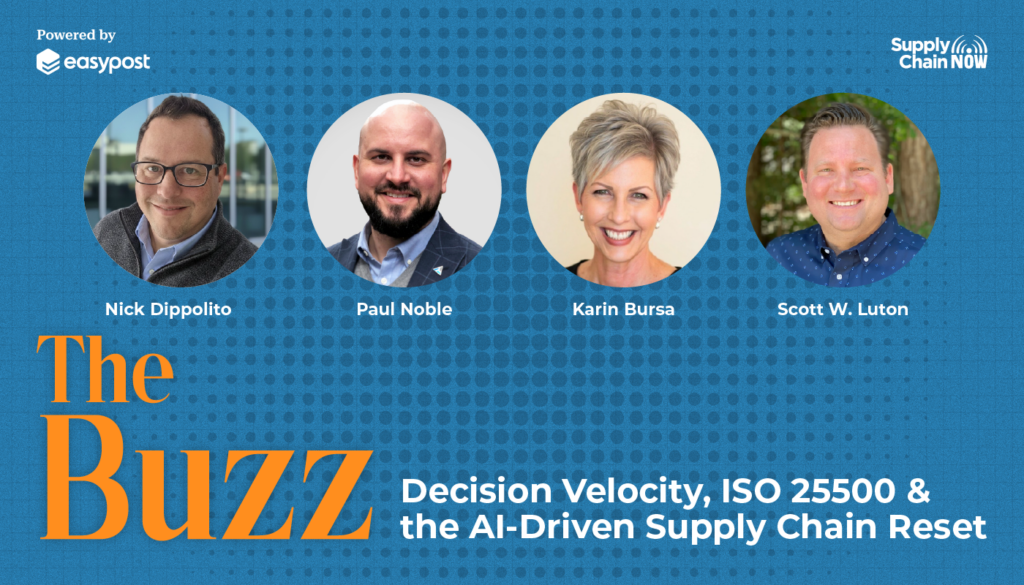
It is, man, even our weather has embraced uncertainty. We can’t get enough of it. I tell you folks today, you know, it is the buzz where every Monday at 12 noon eastern time, we discuss a variety of news and developments across global supply chain and business news that matters is what we like to call it. Now, the buzz is powered by our friends at EasyPost doing some pretty cool things, making shipping easy, flexible and scalable. You can learn how you can simplify your own shipping operations and delight your customers@easypost.com. Check that out. So Corinne, we’ve got a lot of stuff going on here today. We’ve got some key takeaways from a really big, big, big supply chain leadership event that you hosted last week. Of course, we’re going to talk tariffs, goodness, on the heels of a big decision by the Supremes. You can’t hurry. Love. What other Supremes can we make into that? And we’re going to get into four key fashion supply chain trends to keep your eyes on. We’re going to be exploring a critical need for faster, smarter supply chain decisions, all that and much, much more. And in about 12 minutes or so, we’re bringing in two special guests, supply chain now, OG Paul Noble and Nick Dippolito, who’s going to be sharing critical insights you got to know on ISO 25, 500 Corin big show here today. You ready to go?
Karin Bursa (01:53):
I am. I am. There’s a lot to talk about and one of these topics could take the whole time. So I know you want to hit several different things.
Scott Luton (02:01):
Yes, we’ve got a work cut out for us here today on the Buzz Powered by Easy Post. So yes, Corinne, that’s right. We got four things that we’re going to knock out before we bring on Paul and Nick. And we’re going to start with again folks, I hate to keep hammering bad news, but everybody is trying to figure out what’s going on with tariffs. Of course, we led with a few key takes on the Supreme Court ruling on tariffs and what might come. We shared a big event coming up for supply chain leaders in November, the Supply Chain and logistics summit out in Warm and sunny California. We touch on big news from Rodney Apple. We touch on our love of baseball and why we should think more like kids and guest perspective from David Sheron and many others from Ocado, intelligent Automation, all that. Plus as always, our upcoming live events for the week. So give it a read and let us know what you think. Now, Corinne, did you get in a little bit of weekend reading on with that said?
Karin Bursa (02:53):
I did. I did, but I’ve got to tell you, the lead story took all of my brain power, so I skimmed the other ones. But tariffs certainly as of Friday morning last week had been nothing but the top topic that we’ve heard and that all supply chain professionals are trying to figure out what’s next.
Scott Luton (03:13):
That’s right, and a lot of smart folks out there, some I know as well predicted that Supreme Court wouldn’t weigh in on tariffs and gosh, they sure did Friday. We’re going to see, we’re going to talk more about that here in a minute with Corinne, Nick and Paul. Alright, so we’re going to drop the link to, with that said, your one click away folks from subscribing and downloading and giving us your take on everything we covered. So number two, Corinne of these four appetizers, you led a terrific edition of our very popular never normal series, which started last September. I think you led a conversation with three or four C SCOs this time around. We had Douglas and Corey and Shay and Eduardo, all big time supply chain leaders doing big things at a variety of companies we all know and love. And Corin, I got to ask you, what were some of your, we did be here for the whole hour on this question alone, but what are some of your quick key takeaways from that conversation?
Karin Bursa (04:09):
Yeah, it was a great opportunity just to spend some time with four great leaders that are doing impressive things in their organizations. And it reinforced for me, Scott, that it is in fact a great time to be in supply chain and these business leaders are making an impact every single day. We explored everything from some of their career defining moments to where they see artificial impact, or excuse me, artificial intelligence having an impact on their operations, what excites them about it and even some advice that they would give their younger selves. So I always love to hear how people respond to that, but four fantastic points of view. One thing that stuck with me is that Shay Nestler, who’s the VP of logistics at Danone, he kept coming back to we are striving to be boringly consistent. So volatility, one of the things that’s his mantra is we’re working hard to be boringly consistent. And so I thought that was an interesting countermeasure to all the volatility, the opportunity, the changes that we’re seeing in supply chain.
Scott Luton (05:16):
It’s so true. Key takeaways is I was in the cheap seats with my popcorn and diet Coke and it was such a real and genuine conversation, but two things, people were in the golden age of supply chain tech. We talk about it all the time because it’s important, right? But the love for people, the appreciation for people was so alive and well in that conversation. And then that leaves me to my second key takeaway. I love the anecdote. I think it was Douglas that shared an earlier moment in his career where he saw the CEO stopping the hallway and asked the janitor named Maria about how her kids were doing. It was
Karin Bursa (05:48):
Fantastic.
Scott Luton (05:50):
Yes it was. And we should all strive to be more like that. Corinne, huh?
Karin Bursa (05:55):
Absolutely, absolutely. And back to Shay for a second. He talked about that same kind of empathy and connection with the team in very difficult times. He shared a story about needing to close a manufacturing operation and what a learning experience that was for him as well. So I think those two between Doug and Shay talking about that connection and knowing people’s names and knowing the impact on them personally and professionally in good days and bad days was really something that hit home.
Scott Luton (06:25):
So folks, the good news is all this is good news from COR here today, but the good news is you can check out this great panel and two previous installments on demand. Big thanks to demand and Tricia making things happen behind the scenes here today. We’ll drop the link right there in the chat and let us know your take. Alright, they may agree, you may agree with what we took away, you may disagree. We welcome all of it. Okay, so on a quick aside, we checked in with a couple of team members who are based in Mexico. We’ve all been monitoring some developments there over the weekend. I’m glad to say they’re safe and sound. And of course we pray for lots of simmering down of the violence and hopefully no one else gets hurt. Okay, so up next folks, mark your calendar. Just that time of the year again, I should say April 29th, national Supply Chain Day folks, mark your calendars, whether they’re digital or they’re old fashioned, like I’ve got hanging on my wall right behind me. Join us April 29th at 12 noon eastern time for a virtual event that’s going to feature a wide range of supply chain leaders and supply chain topics. But I promise you big theme will be our love and celebration for what people do across global supply chain every single day. Alright, Corren, is that circled on your calendar?
Karin Bursa (07:39):
It is indeed. I mean, I love this celebration around national supply chain day. I mean, it’s all about our community here, everybody who’s with us today and is a part of the supply chain now family around the world. This is our chance to celebrate what they do every day.
Scott Luton (07:55):
That is right. So come join us folks. April 29th. Okay. And then lastly, we’re all about sharing resources, folks with our, as Corin mentioned, our SC and global fam. If you’re still relying on GPS or beacons or expensive hardware to track assets or personnel, you just might be overpaying for a bunch of bulky hardware. Juxta delivers sub-meter, indoor and outdoor visibility anywhere without those beacons and cameras and GPS. That means no new infrastructure, no complex installs and deployment in under an hour, man using the devices you already have. You can track shipments, equipment, personnel in real time across warehouses, yards, and facilities at a fraction of the cost of traditional systems. Folks, stop guessing and start seeing everything. Book a demo with our friends at juxta here today. We’re going to drop a link to that right there in the comments. Corin, man, that’s no nonsense. I’d love to stop guessing about lots of things, including what the Braves are going to do in this season coming up. Corinne, are they going to make the playoffs? Quick question before you bring
Karin Bursa (08:57):
On. I’m just hoping for a better season than last year all the way around.
Scott Luton (09:03):
Oh man, that makes two of us folks. That aside though we’re Spring Hope Spring’s eternal, I think is how the saying goes. And Major League Baseball is getting started and we’re going to see how that unfolds for everybody. But in the meantime, here on the Buzz powered by EasyPost, we’re delighted to have a couple of terrific guests join us, including one who we have deemed, of course an OG here at Supply Chain. Now Paul Noble has made dozens of appearances on our programs over the years. He’s been driving big innovative gains in global supply chain for a long time. He’s also a popular Fords contributor co-founder at Veris and AI and many, many other things. Now joining Paul today, Corinne, he’s bringing Nick Dippolito now. Nick has spent almost 20 years driving transformation at Accenture and has now co-founded VDSI where he serves as Chief Operating Officer. Now folks, V-D-S-A-I is the operational layer that makes the industrial internet globally accessible. You can learn more@vdsai.net. Now let’s welcome in, Paul Noble and Nick Dippolito. Hey Paul, welcome back. How you doing?
Paul Noble (10:11):
I’m great. Good to be here.
Scott Luton (10:12):
Fantastic. Live from Tech Square and downtown Atlanta. GA and Nick, welcome to the Buzz.
Nick Dippolito (10:19):
Hey Scott, thanks for having me.
Scott Luton (10:20):
Great to see you tuned in from Pennsylvania, right? Eastern or Western?
Nick Dippolito (10:25):
Eastern, the Philadelphia. So still in the same baseball division.
Scott Luton (10:30):
That’s right, that’s right. You’re a Phillies fan. Oh, Nick,
Paul Noble (10:34):
Yeah, Nicks gets mad when I’m supporting my Braves hat.
Scott Luton (10:39):
Okay, Paul, we’re going to have to team up on Nick and get him converted. Me and you and Corrine. All right, so Corrine, Nick, and Paul, great to have everybody as we move into the B block and we’re going to start with some great news folks. I tell you what the fun warmup question, look at this gang. Did you watch that historic Olympic hockey match between the US and Canada? I tell you, it was incredible. Even if you’re like me, not really a fan of hockey, as y’all probably heard a thousand times over the weekend, it’s the first time that team USA has won a gold in men’s hockey since that 1980 classic. So that begs the question, and Paul, I’m going to start with you. What is one of your most memorable Olympics moments?
Paul Noble (11:17):
Yeah, I think if I’m thinking Olympics and diverting away from the ice hockey discussion, I think to me one of the biggest transitions was in the basketball arena with the dream team, big basketball enthusiasts, and that first team that went in with professional players moving on from amateur just really set a great global tone for the game and something I’ll always remember watching growing up.
Scott Luton (11:44):
Paul S next, that was 1992. And the best part about that and lesson we can learn from a supply chain standpoint is all those egos, all those hall of Famers and they all set playing, set aside, all that stuff to make an incredible memorable run. There’s certainly something to be said there for global leadership. So good stuff, Paul. Alright, so Nick, that’s going to be a tough one to beat. What about you? Favorite Olympics moment?
Nick Dippolito (12:09):
That is a tough one to be. That was almost mine, but
Paul Noble (12:13):
I back
Nick Dippolito (12:13):
Up, so that’s good. Hey, I’m glad Paul and I are on the same wave you’ve left. That’s important, right? So I would probably say most memorable being my first memory of the Olympics was probably the Mary Lou Retten 1984. I just remember my mom having it on and that was probably my first, oh wow, this is the Olympics. This seems really important. Maybe I should pay attention. So that’s probably most memorable being my first memorable moment of the Olympics.
Scott Luton (12:42):
Nick, that’s a great one because Corinne, I can still see Mary Lou Rutten’s, massive smile, megawatt smile. But Corin, how about you? One of your favorite moments?
Karin Bursa (12:52):
Well, I love both the moments that they’ve mentioned and I saw the end of the hockey game, which was just phenomenal, amazing. But I have to say overall, if you open it up to Olympics in general, the 1996 Olympics were hosted here in Atlanta, and it was so cool to live here in the Atlanta area and just be able to experience all that. We had several friends who came and stayed with us and went to different venues and different events and saw live sports that we’d never seen in person before. And it was just a lot of fun. Just the visitors, the fans, the athletes, it was amazing. And
Scott Luton (13:30):
I wasn’t here at the time, but it really changed the course of Atlanta as a city and really as a region, right?
Karin Bursa (13:36):
It did. Yep. Preparing for it and technology was a big part of it.
Scott Luton (13:41):
That’s
Paul Noble (13:42):
Right.
Karin Bursa (13:42):
So it was very exciting,
Paul Noble (13:44):
Right, man. Yeah, no, it was such a catalyst. I was not here either, but talking to people that were here, just what it did to prepare Atlanta for where it’s at now and the development of Tech Square and just everything that goes on here, it’s great for the city and a testament of where we’re at and why we’re the global supply chain capital of the
Scott Luton (14:07):
World. That’s right, Paul. That’s right. Now Nick, did you hear that? Because Philadelphia is not I’m kidding, just kidding Nick. Just kidding all. So Corrine, Nick and Paul, good stuff, good stuff on as it relates to all things Olympics and beyond, but we got to get into a lot of news related to supply chain. And I hate to start with this topic again, but we got to, it impacts a lot of stuff, right? We got to talk tariffs. The Supreme Court ruled last Friday for maybe three people out there that don’t know that the White House improperly relied on the International Emergency Economic Powers Act. S the I-E-E-P-A. You may have heard about all of that. To impose broad tariffs on countries around the world, the decision doesn’t necessarily eliminate all tariffs in the course. The White House is already looking at other measures. Over the weekend, president Trump has already announced a new 15% global tariff on all imports, citing an alternative legal basis for the measure. Now it was reported here by CNBC, the European Union is already balking at the new move, potential move and are asking for clarity from the White House. Aren’t we all? So with that in mind, Paul, with that in mind, Paul, tell us your thoughts on the latest related to tariffs.
Paul Noble (15:22):
Just when you think things are somewhat running smoothly and global supply chains, we get another thrust of uncertainty. Yeah, I think everyone’s consuming a lot of information. It’s certainly going to, I would assume be wrapped up in appeals and a bunch of different other activities trying to get everyone wrapped in their arms around it. There’s big discussion around refunds for those that paid in. And so again, I’m no expert on the tariffs, but I think we get about 150 days of this temporary, 15% that’s going. And I think everyone’s going to be closely looking at how can they take advantage of lower tariffs while they can if they were at some of the higher thresholds. But overall, it’s keeping people on their toes as it pertains to how they’re going to do long-term business and what will come of that as the ruling and the appeals progress.
Scott Luton (16:21):
Yes, and all the more reason to look to a better forward looking approach at running your supply chains, including technology of course. Nick, your thoughts on the latest with tarsal?
Nick Dippolito (16:34):
Yeah, I’ll probably tap into my former experience consulting on a lot of this more in the indirect space, but I think we always tell companies, be prepared. Know your exposure before things happen. So having good segmentation and understanding your exposure to whatever happens quickly then can help you react. I think the do nothing scenario and understanding if you do nothing, what does that costing you or what are your risks is definitely important. And then I think we’ve always said have clear executive triggers that you can say, Hey, if this happens, we’re making this decision. No regrets, right? We all agree that if this trigger happens, this is what we’re going to do. Not necessarily translating that and here’s exactly what you need to do today. But I think being prepared and saying, look, if these triggers happen, no regrets. We all agree we’re going to do this.
Scott Luton (17:28):
I’m hearing a little bit of a theme of facts, not feelings. The next response. Corinne, what are your thoughts?
Karin Bursa (17:35):
Facts, not feelings is exactly what I would say. However, I cannot imagine, and one thing that Nick mentioned is having a playbook of if A happens then we’re going to do B or B one. But I think what is mind boggling to me is that this is extremely difficult for the best run supply chains in the world. I cannot imagine how businesses that are struggling with their supply chain processes efficiency overall or they are planning their businesses on spreadsheet. I don’t know how they keep up. There’s just too much volatility and variability right now that makes a huge impact and something like tariff at tariffs that are swinging so dramatically, these are big, big changes. So I hope we can step away from the gambling table and come at it like problem solvers that we are in the supply chain and be able to really develop a playbook as Nick said, because I think that these tariff type changes from the US or from other countries in the future are going to be a part of our futures going forward.
Scott Luton (18:42):
Yes, well said. Corin and Nick and Paul and folks, what do you think and what do you think way in let us know what your organization may be doing different or maybe one thing you’re glad your organization implemented kind of to the panel’s point here early months ago to better deal with this new layer of uncertainty. We’ll see. Tara Ping Pong continues though, Paul, Nick and Corinne. Okay, so I want to shift over to what Corinne, we talk about this all the time, fashion supply chains, there’s so much going on that we can learn from some incredible constraints that the fashion supply chain industry has. Here’s a great read from our friends at Supply Chain Dive. It highlights major risks and shifts shaping fashion supply chains in 2026. So I’m going to share a couple of key points and then I’m going to get Paul, Nick and Corinne weigh in too.
(19:30):
So of course persistent. This is going to read like Groundhog Day, the movie folks, right? Persistent trade volatility and evolving tariff policies are all forcing brands to rethink sourcing strategies and cost structures. Companies are working really hard to protect the margins through things like supplier diversification, nearshoring and tighter inventory controls, agility and resilience. Heard those two words before are becoming competitive differentiators as disruptions remain constant. At the same time, AI is playing a much larger role in forecasting, sourcing optimization and logistics visibility. All of this and more helps brands improve traceability, reduce waste, respond faster and more successfully to shifting consumer demand. Now folks, I promise you it’s going to read like and sound like Groundhog Day, right? I’ll get Paul. Paul, your thoughts on what we’re seeing here in the fashion industry and maybe elsewhere.
Paul Noble (20:22):
Overall the tariff conversation, things that are changing, the risks are high. So Corin made a great point of being ahead of those things and so many organizations have a lot of great tools, but there’s still a lot of uncertainty and risk in the data and how they’re communicating with their supply base to secure and stay ahead of things. So I think this speaks much to those same elements of balancing finance and risk across your supply chain is a constant struggle and sets the tone for what we’ll be talking on the back half of areas where you can have more validated data for AI to be using and put yourself in a more trustworthy position to make decisions that’ll affect your business greatly.
Scott Luton (21:15):
Good stuff. And really quick note before I get Nick to weigh in, because it’s something Corinne and I have talked about going back ways unlike chocolate or gold or video games, those are constantly in demand, right? But fashion’s, gosh, they change all the time and you got to be on the front end to be able to make money in a profit. It adds that layer of extra complexity. Nick, what do you see when it comes to fashion supply chains and how they’re trying to navigate? What’d you hear there?
Nick Dippolito (21:42):
What I heard was need to be able to react faster and you couple that with being able to react to everything and being able to react fast, that’s coupling the complexity that you have to face and I think that complexity leads to more risk and uncertainty. Hey, I’m reacting faster, but I’m really not so sure if I’m reacting the right way to certain trends, as you said. So I think that’s all the more important that you have the right information. If you’re going to react quickly and be able to react to everything, there’s a whole lot more data and a whole lot more trust that you need to have in those decisions.
Scott Luton (22:19):
Good stuff. Nick, Corinne, Amanda said I was the least person qualified to talk about fashion anything here today, but Corinne, your thoughts on what the fashion industry is doing and maybe what we can learn from it?
Karin Bursa (22:32):
Yeah, well I think you hit on one of the key themes and that is that fashion in particular is one and done. So one season and done. They may come out with a similar collection in the future for the same spring offering, but those items are not heavily replenished. Sometimes they’ll do an in-season replenishment, but that fashion is something that is being predicted months and months and months ahead of time. Also, in the apparel sector and fashion sector, that manufacturing is outsourced predominantly or multi sourced. So again, these tariff conversations that we’re talking about are a big part of how these brands are planning for the future. So tariffs are going to continue to play a big impacts here. This particular article, I recommend everybody take a read of it because it highlights some research from McKinsey. So McKinsey does a report every year about the fashion industry and what’s coming and some of the stats that are shared in the article are from that McKinzie research. So if you’re in a highly seasonal business or a fashion oriented business, be sure to take a read of this article. It makes a recommendation about multi-sourcing and sourcing changes take time. It’s hard to implement those rapidly. So again, changing tariffs may change your strategy on where you want to move your sourcing operations as well. So no question AI is going to have an impact. No question. Supply chain network designs are going to change in the future and fashion is kind of the canary in, what is it? The canary in the
Scott Luton (24:09):
Coal mine?
Karin Bursa (24:10):
In the coal mine? Yes. Canary in coal mine. So fashion industry is going to feel it very rapidly, very quickly, and we should all kind of keep our eyes on the levers that they pull to address some of this volatility and change.
Scott Luton (24:23):
Well said Corinne, we are going to move right along. We’re going to leave the fashion supply chain world, Paul, Nick, and Corinne and I love talking about lots of good news. Did y’all see Paul? So I love talking about good news folks, right? Y’all should know that maybe by now, especially good news that AI is creating out in the market, but as it brew reports on, we got to take the good and the bad because as we all know, the bad actors are also innovating every hour with AI too. Now get this according to Cisco’s second annual state of AI security report, the bad guys are making progress in all the innovation, ensuring that AI risks become more sophisticated, complex, numerous and deadly to supply chain ecosystems everywhere. Threats include fragile AI supply chains with inadequate provenance checks, advanced prompt injection and gel breaking techniques and malicious use of AI tools originally meant of course for good positive productivity. Attackers are increasingly using autonomous AI agents to scale and speed up their operations creating new vulnerabilities. But one big key, one big key folks, governance before deployment. A sound AI strategy starts with a formal AI governance framework before tools are widely adopted. So we’ve got to kind of manage that bias for action with the bias for safe action perhaps. I don’t know, Paul, this is right up your alley. You’ve been doing some big things in technology, ai, you name it for years, your thoughts.
Paul Noble (25:53):
Yeah, I think I’ve been receiving a lot of inbound talking about for the work I do with Forbes writing about the increase of where does data live. Every organization has new AI committees before they commit to new applications. They understand the benefit, but it’s also almost paralyzing trying to manage all of the risks of where’s your data going? Is that data proprietary to certain customers if you’re an application and things of that nature. So there’s a lot of governance as you mentioned, but I think the ever presence of impersonation and fraud across supply chain I think is really key component. That’s while AI is going to drive credible outcomes and efficiencies and workflow and things of that nature, the element of impersonation and bad actors utilizing it as well for supplier impersonation and things of that nature is something that organizations are going to have to prepare for with their everyday applications today and it’s going to make planning more difficult and it’s going to throw a wrench in the balancing of that finance and risk game.
Scott Luton (27:12):
Paul, good stuff. Before you leave here today, you’re going to give us a sneak peek on what’s coming next on your good stuff that you’re writing over at Forbes. Nick, I enjoyed Paul’s take here. I’d love to learn your take on the bad actors, still going to do the bad acting this time with AI and a whole bunch more your thoughts.
Nick Dippolito (27:31):
Yeah, I think this is, everyone has the tool, right? Not just the good guys. So the bad guys have the tool too. They’re going to accelerate the things that they’re doing, impersonation, fraud, and they’re figuring out just as quickly as we’re figuring out how to do the good things. I think it’s important to create more of a governance that you’re able to prevent a lot of that. But even in my own use of a chat GBT, I’ve realized it’s really tough to hit the undo button if you realized, oh wow, I didn’t realize it took that to mean that. I think that’s what we have to understand is when you go down the road too far, right, it’s really hard in these LOM models to hit an undo button and make it forget everything that it based off of that. And that’s very scary in supply chain, right? Because now you have a whole bunch of, if you’re automating your supply chain, you’re building supply chain intelligence, it’s really tough to hit the undo button. Once you’ve made those decisions,
Scott Luton (28:29):
Nick, billion dollar advice between you and Paul Corin, what would you add here?
Karin Bursa (28:34):
Yeah, there’s no question that we need to be vigilant and we need to have good governance for security, not just professional, but for personal as well. That these advances in technology can be used for evil as well as they can be used for good. So I think the biggest challenge right now is just keeping up with how fast things are evolving and the access to data and looking at streaming data and double checking and making sure that there are still humans in the loop on many of these decisions until we can have better security in place overall.
Scott Luton (29:09):
Well said Corinne. Folks, go check out this read, give us your take and it brew again focused on the Cisco annual cyber reports. Let us know. Alright, so Corinne, I wanted to give this a fully throated discussion here today, but time’s not ever on our side. I want you, if you would share a couple key takeaways, and I bet we can bake in some of these in the next segment, but tell us, you had a great article we published over on the resource hub@supplychainnow.com focused on the critical need for better and faster smarter supply chain decision making. What was some key takeaways here, Corinne?
Karin Bursa (29:42):
Yeah, thanks for sharing that. The resource hub, by the way, for our listeners, if you haven’t taken a look at that on the supply chain now website, be sure to do that. There’s lots of good information out there. What this really focuses on is this changing metric and how we think about decisioning or making decisions and how quickly we’re able to make those. And a term that’s evolving is decision velocity. So understanding how you make decisions in your organization, the data that is a part of that, what good looks like for your business. It goes far beyond visibility. So if you’re still simply talking about visibility, that’s table stakes. My question to you is what will you do with that visibility? And that is your ability to make decisions, implement them, and measure the success rate of the outcome. So take a look. There’s some good information in that article and I’d love to hear your thoughts on it. Anybody in our audience, I welcome your feedback.
Scott Luton (30:37):
Folks, SC and global fan let us know. This has already generated a lot of comments and conversations out across social, so we’d love to hear your take on that. Okay, so Paul and Nick and Corinne, we’re about to learn a lot more. You’re bringing back bad memories and nightmares of me and ISO from my days in manufacturing, but we’re going to talk about ISO 25, 500 in just a second. But folks, I do want to share one quick heads up on programming. Got to come join us February 26th. We’re just talking about AI for good, right? Big theme and for bad, but big theme AI for good throughout today’s conversation. Check out this live program we’ve got coming up this Thursday at 12 noon chat, GPT, just the beginning for shipping. We’re going to talk about what it can do, what AI cannot do. Very frank conversation and I promise you’ll leave with some very actionable strategies for making life easier for your team and delighting your customers. Okay, so Paul and Nick, I want to dive into again this topic that I think this whole conversation here is going to put some critical thoughts on supply chain leaders radars. I promise you they’re probably in the blind spot for many folks out there. Based on everything else we’re dealing with ISO 25, 500. So Paul, let’s kind of start with kind of what it is and given talking about something earlier on, the buzz supply chains already exchanged tons, tons of data digitally, what problem does ISO 25 500 actually solve that today’s systems do not?
Paul Noble (32:05):
Yeah, I think the crux of the situation is ISO 25 500 was recently published and what it’s doing is creating a framework for the exchange of verifiable data across many different disciplines. But if you think about supplier verification, material verification, things of that nature, it’s difficult for any one organization to keep up with their master data in that regard. And so initially it’s the framework. There’s about 30 governments that have said yes, this is how we want to prepare. And it goes also to the element of what we talked about earlier with the growing use of AI and AI platforms needing cleaner data the better, but not going back to the old playbook of data cleansing and coming up with new ways to verify data and exchange that data in the appropriate manner so that every part of the chain can adopt the AI tools that help them do business better without limiting or opening themselves up for risk.
(33:16):
And so the frameworks there and there have been a lot of ISO standards, ISO 8,000 in terms of data formatting. This is more of the exchange and the creation of the industrial internet, but organizations need to adopt that. So there’s an opening for VDS AI specifically that we’ll talk about being able to allow end users applications, sis and suppliers to get their data verified and prepare themselves for what’s coming in the future so that they’re not playing from behind, adopting new AI tools that can’t utilize that data effectively. And so it’s really allowing everyone across the supply chain to begin adhering to the standards that have been around for a long time and largely organizations don’t adhere to and applications don’t all kind of siloed and in each individual box and allowing it to drive outcomes because obviously outcomes are what matter, but how you get there is certainly a key component and a foundational component of that
Scott Luton (34:24):
Like that. Paul, we need to work with the dream team to get those outcomes. Nick, what else would you add as it relates to ISO 25 500 and why it’s got to be on folks’ radar?
Nick Dippolito (34:35):
Yeah, I think it doesn’t replace data exchange, right? We’re always going to be exchanging data. It adds a layer to verify that data, so must look at it as a filter, making sure that it’s letting you know, hey, the data you’re exchanging can’t be verified by the party you’re trying to send it to or by the authoritative source that owns that data. I think another key shift is we’re exchanging today a lot of stored, replicated data almost whisper down the lane over the years. It really switches that and says there may not be a need to own or store data that you’re not the source for because you through I 7 25 500, you now have an infrastructure to be able to reference that data from the verified source.
Scott Luton (35:21):
And Corinne, between what Paul and Nick both have shared your thoughts around the importance of ISO 25 500 and where organization may be a little bit behind and what it’s aiming to address.
Karin Bursa (35:33):
Yeah, yeah, I think one of Nick’s last points was really important and that is storing data and that this can reduce the need to store or replicate data. If you can use that data instream or inflow and not replicate it, that’s a chance to be in its purest form, if you will, or to access it from that perspective. So the fact that we have standards that are available gives us greater confidence in that and greater confidence in the trading partner or trading payers that we’re looking at. So I think that’s important. We will also continue probably in this next 24 months to see AI applied to improving data quality. Paul made a point of saying we’re never going to have perfect data, but we do have an opportunity to improve the data quality that is available. So these standards will help that improve the quality work towards a standard AI will be a part of that message too for sure. I think we’ll see a lot of work on master data management or MDM in the next 24 months where AI can help improve that even within an enterprise, much less out in trading partner relationships where there’s huge opportunity as well.
Scott Luton (36:47):
Just stuff Corin, Nick, I was reading as I was trying to get up speed, especially up close to speed between you and Nick and you and Paul and Corinne, I was reading something about the supply chain data formatting clause, right? Standardizing dates and entities and locations and items. Now all that sounds a little bit simple, but why is that such a big deal in practice?
Nick Dippolito (37:10):
Yeah, great question. The standards actually have been around for a while and we haven’t really adopted them and I think one of the major reasons is that putting an infrastructure in place to actually exchange data using these standards. So it was almost like putting the cart before the horse a little bit. I think this might drive folks to maybe adopt them, but one of the most important things is creating global, unique unambiguous identifiers. The ISO 25 500 doesn’t run unless you’re able to have global unique unambiguous data running through it, otherwise your traceability back to the source. If you have an identifier that might be resolved by two different sources, you don’t know where to go to go get that information. So really it’s the foundation of ISO 25 500. It’s the building blocks to say we need to have data that is global, unique, ambiguous, that’s traceable back to an authoritative source in order to operate on ISO 25 500.
Paul Noble (38:12):
And it benefits both sides. So I mean users of information that have thousands and thousands, if not tens of thousands of suppliers, suppliers that sell to tens of thousands of organizations and then all of the applications, whether it’s a system of record, an optimization or a planning platform. An easy example of that is that if I’m a supplier, I could have a thousand different representations of myself across every different portal and application and customer that I sell into. If you bring it back to that foundational, every organization has an international business identifier that can be verified. And if I’m a user buying from thousands of different suppliers, that opens up risk in terms of impersonation and things that we’ve talked about and fraud. The goal is to get ahead of that and be able to identify not only core suppliers within category management, but also be able to eliminate and validate even suppliers that are smaller in the long tail that you’re buying from. So being able to get back to that authoritative source as Nick mentioned. And once the supplier is verified, it could be verified across various applications. The benefits are wildly important, both from a financial and a risk aspect in terms of what chief supply chain officers, chief procurement officers and CFOs are looking at of the impacts of this data and how do they utilize that data to run their businesses more effectively.
Scott Luton (39:52):
Corinne, your thoughts?
Karin Bursa (39:54):
Yeah, I think it’s an important initiative and it allows us to compete as a supply chain instead of a bunch of companies that do business together. So anything that we can do to accelerate the access and availability and interpretation of meaningful training partner data is a good thing. And so it will be interesting to see the adoption here. You mentioned date formats. We’ve been struggling with that for 20, 30 years now at this point in time, as I think back to even early working situations on collaborative planning, forecasting and replenishment that the voluntary commerce standards worked on in 2000, right? So what is a product? What’s a product id? What’s a volume, what’s a container? All these different definitions are just building blocks that can accelerate business. And what that lets us do in the long run is it allows us to replace risky inventory with valuable insights with that data so that we can accelerate faster and so that we’re not caught in the fashion crunch that we talked about with the fashion industry. If we can get that information faster, we can adjust our investments in inventory in moving those goods or inventory in motion as it comes to market as well.
Scott Luton (41:15):
Grin, you’re reading my mind because that’s adoption and what changes is what I was going to post to the panel next. So Paul, I’m going to pose this to you. So if and when maybe ISO 25, 500 becomes much more widely adopted, what does change kind of referenced a couple of these things, but what else changes and strategically for global supply chains?
Paul Noble (41:36):
Yeah, I think we’ve talked about it briefly, but being able to have the technology you can plug in and action against the standards that exist and become compliant takes that uncertainty and mistrust in some of your core baseline master data, whether it’s supplier, master, material, master giving you representative information to power the applications that you’re using to run your business. So it helps balance working capital and risk across the indirect direct logistics part of the supply chain. And then as that compliance happens, there will be more and more outcomes and pipes that data that can flow through those pipes actually that again allows you to prepare and plan more effectively for the things that we’ve been talking about in this entire episode. And you all talk about on a day-to-day and week to week basis. So it’s really getting back to that foundation and laying the foundation that allows all of the great innovation and work that’s happening in the supply chain to take greater shape and again, get back to the outcomes that matter, which is running your business regardless of what you make, what you ship, what you do.
Scott Luton (42:57):
Sign me up. Alright, so Nick, anything you’d add? That was a very comprehensive answer we got from Paul, Jay Noble, anything you’d add there? Nick?
Nick Dippolito (43:04):
I think we talked a lot about some of our challenges on impersonation risk, everything on the industrial internet, ISO 25, 500, you’re verified who’s requesting information, who’s responding with that information. I think that’s a key piece to prevent a lot of the bad actors. I’m sure they’ll try once this becomes fully adopted to infiltrate. But being preventative and only allowing verified entities, verified identities is a key piece of design for this. I think the other thing, if I go full utopia, if we’re verifying everything, we should be able to allow AI to start orchestrating our supply chain, finding efficiencies. I watch the Amazon truck come to my neighborhood every single day. If everything’s verified, we know everything that’s coming and where it is. Somebody should be able to figure out how to do that a lot more efficiently and we’ll be able to react faster, but also trust our reactions.
Scott Luton (44:07):
Corinne, that’s the key word. Trust, trust, trust, trust. Your thoughts though on what else changes Corinne that maybe Nick and Paul didn’t hit on or something you want to maybe emphasize of what they did share?
Karin Bursa (44:18):
Yeah, no, I like the idea of utopia, Nick. If we ever get the utopia supply chain, I want to see that in action, but it certainly turns fragmented data into more int operable framework for decision-making or for digital communication between businesses. And I think that that’s where it becomes a real accelerator. So if we don’t have to, if we get to the point where we’re complying with the standards or IS OS certified in that process, that means we can adopt AI as was mentioned and we can automate. So automation I think is good or the goal of getting to an automated framework or interchange is where all businesses want to be. It may be painful getting there, but it’s definitely a destination worth striving for.
Scott Luton (45:12):
We nail the approach and then we’re off to the races like Carl Lewis or Jackie Joyner EY to throw out a couple Olympians from back in the day, right?
Karin Bursa (45:20):
You’re on a roll.
Scott Luton (45:21):
Yeah, Olympics are on my mind folks and I wish I could have run fast like this folks. Anyway. Alright, so let’s do this. I wish we had another 30 minutes, hour, couple hours with y’all, but Nick and Paul really excited to hear more about VDS ai. Nick, let’s start with you. Tell us about what the organization does in a nutshell.
Nick Dippolito (45:41):
Yeah, so VDS ai, if you think of the traditional internet, we all have an internet service provider. Vds AI is the commercial provider to allow everyone to access the industrial internet. So really go to vds ai.net. We can get you verify that’s the most important. Like I said, there’s an entry of verifying, almost look at it as we have a bouncer checking your ID at the door and then we can get your prefix. So just like on the internet, we have a domain name. I’m sure all of you have tried to secure the right domain name or bought the domain name that fits your company best. That’s what we’re doing right now is we’re helping companies register that smart prefix, which is really your domain name for the industrial internet. You can get that today. And what that does is that secures your globally unique identifiers specific to your entity. So also every entity, so if you have multiple entities within your company can register prefixes for each entity.
Scott Luton (46:36):
Man. Okay, I think I’m picking up what you’re putting down Nick, and that doesn’t always take place on Mondays here on the buzz. Paul, what would you add to Nick’s as he shared what V-D-S-A-I does in a nutshell, what else would you add, Paul?
Paul Noble (46:54):
Yeah, I think well said Nick, but overall, it’s a simple way to start actioning and getting prepared for what’s coming, right? So there are simple things you can do. The industrial Internet’s coming, this is a way that you can secure your spot and begin, begin that verification process. That’ll, if you’re a supplier, it helps you with your customers if you’re an application or an si, it helps prepare the systems that are being used across. And again, you’re less data dependent of trying to rectify that authoritative data back to the source to make your application work better. And then ultimately, for the users of products, you have greater trust that can help you decision more effectively. So just think of it as a simple plugin that does that foundational work for you and can get you compliant and get you ready for what’s coming.
Scott Luton (47:54):
Outstanding. All right, so Corrine, it sounds like we’re going to hear a lot more about a ISO 25 500 and you got to get help somewhere folks. VDSA might be one such partner if you want to. What was that? The utopian supply chain? Was that an analogy all three of y’all were talking about earlier? But Corrine, what’d you hear there? I mean, leaders got so much on their plates, they don’t need one more, but they’re going to have one more. Seems like by the hour your thoughts when we heard there from Nick and Paul. Yeah,
Karin Bursa (48:22):
I guess the final thought that I would leave with folks is that data is critically important. It’s always been critically important, but it is growing exponentially right now. So the fact that we have a standard that can be adopted that allows us to access, interpret, and leverage that to accelerate business decisions is really important. So I think each and every business needs to figure out, look, is data going to be rocket fuel that propels our business forward or is it going to be kryptonite that really cripples our business in the future? And this is an opportunity to adopt a standard that’s out there and really accelerate that adoption process.
Scott Luton (49:00):
Corinne, I love that. Rocket fuel or kryptonite. The choice is yours folks. My son Ben would love that. Love those two options there. Okay, well I hate to leave it here, but folks, we’re going to make sure you know how to connect with Corinne, Nick, and Paul in just a moment. We want to share just a couple more resource if you like conversations like this. Want to share a couple more resources where you can find more starting with all of our upcoming live programming folks, you can venture over to, I must still call it the new supply chain now.com because it’s still kind of new. We rolled it out last year. It was a big passionate project, folks, the new site. But you can check out upcoming live programming for the latest live streams and webinars that we’ve got scheduled. We’d love to have you come join us and share your perspective.
(49:42):
And as we’ve touched on a couple of times, you’re going to find Corinne’s great article there going to find at our resource hub, you’re going to find all of our written interviews from events like Manifest. You’re going to find all of that at the resource hub, white papers, news, eBooks, blogs, you name it. All right there at the new supply chain now. Okay, so let’s do this As we start to wrap Paul and Nick and Corinne, I feel like I’m smarter after this February 23rd edition of the Buzz. That doesn’t always happen, but this has been a great session, so I want to make sure folks, now I connect with all three of y’all starting with Paul J. Noble, OG here at Supply Chain. Now Paul, how can folks track you down
Paul Noble (50:26):
At Paul J. Noble and I think most of the platforms out there, LinkedIn X, so on and so forth. Or you can go to forbes.com and look me up, trying to put out more and more informational meeting with different CEOs across finance optimization platforms. It’d be putting out something covering takeaways from Manifest, finalizing that, and then we’ll be writing more on the subject at hand. ISO 25, 500.
Scott Luton (50:54):
Okay, so folks, we got our sneak peek from Paul and Forbes. Make sure you follow Paul, wherever he may be. All those socials he mentioned. Nick, for your first time here on the Buzz, I really enjoyed your perspective. I don’t like your Phillies as we,
Nick Dippolito (51:12):
It always comes back to that. Yeah, right, right, right. I hope you’ll have your back during baseball season. Scott,
Scott Luton (51:18):
Nick, as the, all kidding aside, as we’ve talked about though, at manifest when the Phillies beat down the Braves in their last playoff matchup, y’all took our soul. We got to get it back. We got to get it back. But Nick, congrats. The cool big things you’re doing in industry. How can folks connect with you and vd? SAI?
Nick Dippolito (51:37):
Yeah, so you can go to my LinkedIn page. I’m working on probably being more active on social media. Maybe Paul can coach me on that. But also vds ai.net. Go to our webpage, tons of resources there explaining everything we just talked about.
Scott Luton (51:54):
Outstanding. Corinne Bura tell you what, you are always on the move. Really enjoy what you do here. I know you do a lot of keynoting and advising out in the marketplace. How can folks have a conversation with you, Corinne?
Karin Bursa (52:06):
Yeah, I think the easiest way is LinkedIn, as our other participants mentioned. It’s, it’s an easy way to cut through some of the noise, so please connect with me there. I still want to invite feedback on the article that we shared today as well, because I think we’re going to hear more and more on decision velocity and the impact on your business and just the way you think about metrics that you measure. But please reach out and of course, I look for opportunities to be with you here on supply chain now as well.
Scott Luton (52:33):
Outstanding. Corin versa. What a great, great hour spent here on the February 23rd, 2026 version of the Buzz, brought to you by our friends at EasyPost. I want to thank our Esteem panel, Paul J. Noble. Great to have you back, Paul,
Paul Noble (52:47):
Great to be back. Thanks. Always fun to spend some time on the supply chain now platform, so appreciate the opportunity and always good to be here.
Scott Luton (52:55):
You bet. I think I got a certification with you and Nick and Corinne here today. And Nick Dippolito with VDSA, folks. You can learn more@vdsa.net. Nick, great to have you here today.
Nick Dippolito (53:07):
Thanks for having me, Scott. This was fun. First time, it was great,
Scott Luton (53:10):
And I thought you were going to throw in a go Phillies there, Nick, right? I was ready
Nick Dippolito (53:14):
For it. I was ready for
Karin Bursa (53:15):
It.
Scott Luton (53:15):
I was ready. Yeah. Yeah. Well, Nick, all kidding side, great to meet you. You manifest. Good to catch up with you as well, Paul. Great to have y’all here. I want to thank my esteem cohost Corinne, always a pleasure.
Karin Bursa (53:26):
I enjoyed it. It’s great conversation today. Thanks.
Scott Luton (53:29):
No doubt. The big thanks to our friends, EasyPost again, who are powering the buzz all month long here in February, and who are helping to make shipping easy, flexible, and scalable. Folks, you can learn more@easypost.com. Big thanks to Amanda and Trisha behind the scenes and most importantly, the biggest of thanks to our global audience for being here with us. Appreciate all the feedback. Keep it coming. But folks, you got homework. You know the homework, it’s the same assignment every show you got to take one thing you heard here from what it was, a great panel, Corinne and Paul and Nick, take one thing, share it with your team. Do something with it, right? Put it into practice. It’s all about deeds, not words, right? And with that said, on behalf the entire supply chain now, team Scott Luton challenging you, do good, give forward, be the change that’s needed. We’ll see you next time, right back here on Supply Chain now. Thanks. Bye.
Intro/Outro (54:16):
Join the supply chain now community. For more supply chain perspectives, news and innovation, check out supply chain now.com. Subscribe to supply chain now on YouTube and follow and listen to supply chain. Now, wherever you get your podcasts.