Intro/Outro (00:02):
Welcome to Supply Chain Now, the number one voice of supply chain. Join us as we share critical news, key insights, and real supply chain leadership from across the globe. One conversation at a time.
Scott Luton (00:14):
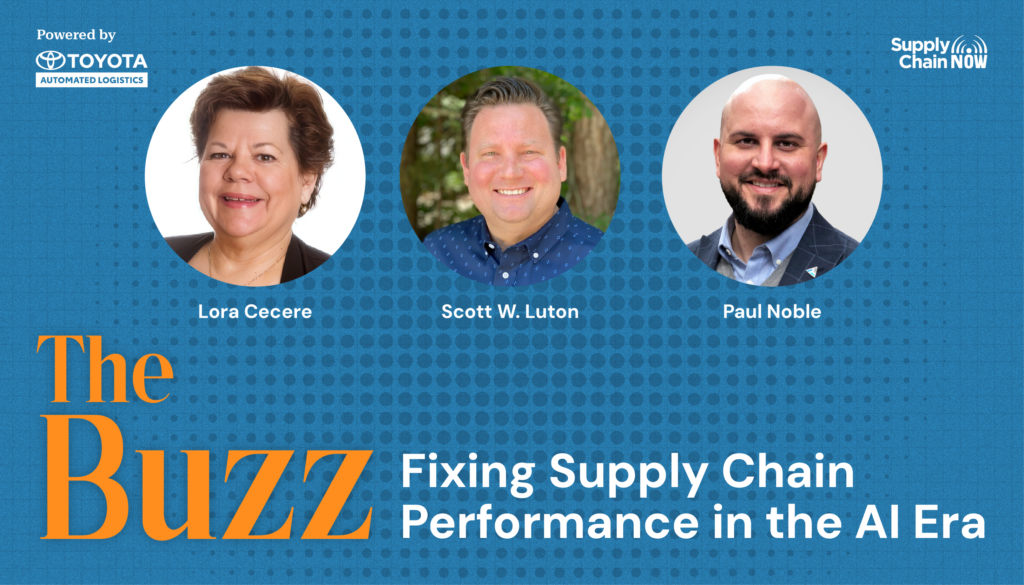
Hey, good morning, good afternoon, good evening, wherever you may be, Scott Luton and Paul J. Noble with you here on Supply Chain Now. Welcome to today’s live stream. Hey, Paul, how you doing today?
Paul Noble (00:25):
I’m well, Scott. Good to be back Supply Chain Now and Buzzing from TechSquare here in Atlanta, Georgia.
Scott Luton (00:32):
Hey, that is the center of the universe for some types of buzzes. That’s right. And it’s great to have you here. And as Tricia says, hey, happy buzz day. Folks, let us know where you’re tuned in from. Paul is right there where it’s happening in TechSquare. But folks, it is the buzz where every Monday at 12 noon Eastern time, we discuss a variety of news and developments across global supply chain and business. News that matters is what we like to call it. And all month long in August, the buzz is powered by our friends at Toyota Automated Logistics, your global partner for integrated warehouse automation. You can learn more by visiting toyota-automated-logistics.com. So check it out. So Paul, we’ve got no shortage of topics here today. Just to tease things a bit here, we’re going to be talking about agentic commerce. Hey, what are bots doing for you?
(01:20):
We’re going to be talking about some leadership lessons learned while you’ve been climbing Mount Everest. We’re going to ask the question, “Hey, why aren’t all supply chains performing better here in the golden age of supply chain tech?” Well, we’re going to find out. Stay tuned as we cover all of that much, much more. And Paul, in about 15 minutes or so, we’re bringing in a special guest. It’s been way too long since the one and only Laura Sacerra joined us here on the buzz. Well, folks, she’s back, so you better hang onto your socks. Paul, we’ve got a great show here today, huh?
Paul Noble (01:54):
We got to cover all this in one hour.
Scott Luton (01:57):
Well, I know what you and Laura are capable of. I’m not sure about myself, but I figured y’all are going to make efficient use of our time. So
Paul Noble (02:04):
Look forward to diving into some of the things that Laura’s been writing on. She always has very poignant and objective opinions and love to follow what you see in supply chain. So I’m with you.
Scott Luton (02:17):
Got a great conversation teed up. So folks, buckle up for a big edition of The Buzz Powered by Toyota Automated Logistics right here today on supply chain now. Hey, really quick, we have got our friend Alan Jacques is back with us from beautiful Canada. Great to see you, Alan. I look forward to your take here on some of these topics here today. But hey, Paul, before we bring in Laura, there’s three things that we got to knock out.
Paul Noble (02:43):
Are you ready to go? Let’s do it. All
Scott Luton (02:44):
Right. So up number one, we have our most recent edition of With That Said, it dropped on Saturday Morning. And I’ll tell you, we led off with what I though was a really neat article. Yeah, I’m biased, but it was based on a conversation that The Collective had. Now, if you’re new to this series, The Collective is a group of four e-commerce and supply chain leaders, kind of like the A-Team for supply chain maybe, led by Kim Reuter, who many of you know from our work here really for years. And Paul, all four of these leaders were with Amazon in its earlier days. And I’ll tell you, they got to be writing a book. But nevertheless, we highlighted a few key takeaways from the coming age of agentic commerce where bots will be much more involved in placing orders for humans, both in the office and at home.
(03:27):
Now right now, some data suggests that only 5% of consumers have used a fully autonomous AI agent to actually place an order on their behalf. But get this, Paul, that number’s set to change dramatically because some say by 2030, one in four e-commerce purchases could be fully completed by AI. What are the ramifications for consumers and for supply chain pros everywhere? Well, you’re going to have to tune in to the replay of that podcast episode or read with that said, and you can capture some of the key takeaways right there. Trisha’s already dropped the link in the chat. So Paul, when you think of agentic commerce or as you dove into with that said over the weekend, what stood out to you?
Paul Noble (04:09):
Yeah, I think it’s coming. Everyone is looking at how do I build, buy, or deploy individual agents for e-commerce across supply chain? But also everyone has this utopian vision of getting to, whether it’s the folks building the technology or using the technology that we should get to agent to agent orchestration.
Scott Luton (04:34):
There’s
Paul Noble (04:34):
A lot of things that have to happen. So yes, I think that number’s going to go up. It wouldn’t be a supply chain technology conversation if we didn’t say, “Hey, it starts with data.” I have some views that we need to change the approach to, it’s not just garbage in, garbage out. There needs to be trust developed between humans and agents. We need to find our way there together. And I think for supply chain, that’s going to be really imperative. And for e-commerce, yeah, I think more and more we will see more of our everyday purchase going on autopilot, so to speak. So I think it’s great, but there’s a lot of work together that needs to be done. And that’s from manufacturers and users to suppliers and partners because there’s a lot of procurement opportunities and operational efficiencies on the table for just everyday supply chain commerce.
Scott Luton (05:31):
You’re right. And there’s a lot more. We could spend the next hour just talking about this. And hold that though about trust. I’m going to circle back in just a second on that. But in the meantime, folks, go check out. With that said, give us your take on agentic commerce, especially from a, hey, what must be done in global supply chain to be better prepared to deliver on what’s coming? So let us know. All right, so number two, Paul, right? Two out of number three before Laura Cesara joins us. I want to ask you about trust. Trust is certainly the currency for global supply chain. And as AI agents take on more and more work across global, across industry really like we’re talking about, agents are negotiating, procuring, sourcing, transacting in this ever faster growing velocity that global business is operating at. Faster and faster by the minute, it feels like some weeks.
(06:21):
So in terms of trust across supply chain ecosystems, which is what you were just talking about and referencing, what do you think fundamentally changes as we move further and further into this agentic era?
Paul Noble (06:35):
Yeah, I think it starts, there needs to be a lot of trust rebuilt. Everyone over the last two years rushed to deploy agents on a technology leaders at organizations, maybe specifically talking about, let’s say manufacturing, for instance, is like, what are we doing with AI, the C-suite? What are we doing for sales, marketing, operations, supply chain, whatever it may be, that kind of fell flat. Everyone wasn’t ready, data wasn’t ready, and there was trust lost between the business and the technology partners at any given organization. And then now it’s gotten really confusing and hard for organizations to trust what they’re hearing from different partners from a strategy perspective, suppliers, technologies, because it’s kind of like AI washing. I was speaking with a large technology CEO last week. They power a ton of the supply chain, and it’s just so much AI washing. It’s confusing to people.
(07:33):
So then again, if you’re overwhelmed or you’re confused, you’re not going to trust things. So that said, with that said, we do have an opportunity to change the approach. Better data is always better, but I think there’s new ways that we can utilize AI to build trust in the data foundation that exists in and across supply chain. I think it speaks to a lot of the things that Laura was writing about and what we’ll cover later in the show.
(08:00):
But that don’t go back to the old playbook like we did for the cloud and we did for SAS of I got to spend years trying to get perfect data so my people can trust it and agents can trust it, or we’ll be in this chaos once again and have some real trouble getting out of it.
Scott Luton (08:17):
But Paul, we love, as an industry, we love those old playbooks and we cling to those old playbooks. We’re going to have to have some digital crowbars to separate some of these organizations.
Paul Noble (08:29):
Yeah. I would love to put out to the audience, when has a data cleanse ever really worked other than a real moment in time? Anyone that has ever scaled utilizing that effort and time, I would love to talk to you.
Scott Luton (08:45):
Okay. We’ll probably touch on that and a lot more as we get further into today’s edition of The Buzz. So folks, we’d love to hear your take, right? Give us your take like Junaid. Hope I’m getting that name right. Great to see you here today. Let us know where you’re tuned in from. Junaid says clean and authentic information will be a priority as well as client data security. Excellent points there at Junaid. All right, so Paul, one last thing. I think I went and crawled across your social media feed and I hunted down this image of you climbing Mount Everest. Okay, this isn’t Mount Everest, folks. I was only kidding with that, but it is Mount Rainier, if I said that right, which is one of the tallest peaks in the US, if I’m not mistaken. So Paul, you’ve been climbing, I think three different mountains.
(09:30):
It’s part of a program, like a personal journey. You’ve got another one coming up in a week where you’re tackling Mount Whitney, I think. So I want to ask you this, and congratulations by the way, but let me ask you this. When you think of as your only successful quests of yours that test you, test your abilities mentally and physically, what’s been a leadership lesson or analogy that has really hit between your ears?
Paul Noble (09:52):
Yeah, the challenge of going to do something of these endurance hikes through 29029, which anybody that’s interested in that is a great program, a great community of people, great network that we’ve built,
Scott Luton (10:04):
Putting
Paul Noble (10:04):
Ourselves through this. But what comes out of it is really, it’s a lot more mental than physical. And a lot of our challenges in business and in life are getting over the hump mentally and what are you capable of? And one of the folks at this last climb brought up everyone associates passion with something you love, but really if you look down to the root, the Latin root of it, it’s really to suffer, to undergo, to endure. What are you willing to do or that thing you’re passionate about to get over the hump and mentally push through. And so that resonates to me from a leadership perspective because a lot of what we do is tough mentally and you’re always grinding. It’s part of life. But hopefully you can find that passion and really build on it for yourselves. I
Scott Luton (10:55):
Like it, Paul. So if I’m hearing you right, I’m very passionate about having a good looking yard, but do not care nor am I passionate about all the work involved to get there. Is that kind of what you’re sharing a little bit?
Paul Noble (11:08):
Yeah, exactly. I
Scott Luton (11:10):
Look forward to getting more images of you tackling mountains across the US and the states. And Mount Whitney’s coming up in a week, so we’ll see. Folks, we’ve also dropped a link where Paul describes that and some other images and some other learnings from this journey he’s on. Thank you, Trisha, for dropping that in the chat. Okay. Well, Paul, we have got an outstanding guest joining us here on The Buzz Today. Now, perhaps she doesn’t need an introduction. As most of the supply chain world knows, Laura Cesaria, along the lines of what Paul was saying earlier, as well as her informed perspective analysis and research on what global supply chains are doing right and wrong. She’s a founder of Supply Chain Insights and of the popular supply chains to admire program. She also has co-founded a dynamic benchmarking tool known as Ask Laura, which we’re going to touch on today as well.
(11:59):
Whether you agree with her at times or not, Laura typically says what needs to be said. And I have found her always to be fueling conversations forward, especially those that must be taking place. So please join me in welcoming Laura Cesari with Supply Chain Insights. Hey Laura, how you doing?
Lora Cecere (12:19):
Couldn’t be better, Scott. Thank you. You
Scott Luton (12:21):
Bet. Great to have you here, Paul. We’ve been looking forward to this, huh?
Paul Noble (12:24):
Yeah, absolutely. Good to see you, Laura. Thank
Lora Cecere (12:26):
You. So
Scott Luton (12:26):
Let’s start with a little fun warmup question. We got a lot to get to here today. We may even touch on the screw worm and the beef industry. We’ll see what all we get to here today. But let me ask you all this. So today, August 17th is National Thrift Shop Day. I didn’t know. Everything has a day here, at least in the States. Thrift shops, consignment stores, they’re vibrant parts of what a lot of folks refer to as the re-economy, right? Remanufacturing, resell, reuse, all that stuff. Well, did you know the global reeconomy is valued by some data sets to be worth $289 billion? Wow, that’s according to the Thread Up Resale Report. So when it comes to Thrift Shop Day, got a two-part question for you. Laura, I’m going to lead with you here. Do you ever visit thrift shops through flea markets, antique stores?
(13:15):
And if you do, what’s the coolest thing you’ve ever picked up?
Lora Cecere (13:18):
When I was young, we never went, but it’s part of the changing dynamic, and I think the economic reality for folks that are changing demographics of finding cool things in thrift shops. The coolest thing I ever found was my mother’s book, which was out of Prince.
Scott Luton (13:39):
Wow. But
Lora Cecere (13:40):
Now I’m in this declutter phase where I’m 72 and I’ve almost a thrift shop in my house. And for those of you who follow my writing, I had a fire in my house two years ago. So everything I own is in storage and I’m really going through storage and decluttering my life. Laura,
Scott Luton (14:00):
I got a thousand questions. Before I get to Paul, one quick follow-up. Your mother’s book, how cool is that to come across at some random store out there? Do you remember the title?
Lora Cecere (14:11):
Yeah, my mother’s book is about West Virginia quilts. And she and my dad went across West Virginia and cataloged quilts. And those of you know me, I’m an avid quilter. And so to find it with her signature where she had given it to somebody on a book tour was really great. That book was published in the late 1980s. That
Scott Luton (14:31):
Is awesome. What an incredible story. Super cool. All right, so Paul, you’re going to be hard-pressed to top that one laws.
Paul Noble (14:38):
Not even close.
Scott Luton (14:40):
What’s the coolest thing you’ve ever picked up in a thrift shop?
Paul Noble (14:43):
I will be contributing to the reeconomy. Just went through a move and boy, do we have a lot of stuff to donate and declutter for, but there was a sports-themed thrift store where not everything was used. It was a lot of news, some used called Arnold Athletic in Middlesboro, Kentucky here where I went to school at Lincoln Memorial University. And there were tons of gems there. The one that stands out that I shared with you is this red, probably from the ’80s, pony jumpsuit, tracksuit with the jacket and the black and white diagonals all over it. Still have it to this day, cannot park with it.
Lora Cecere (15:22):
Okay. Ask me to wear that.
Paul Noble (15:27):
I should have worn it.
Scott Luton (15:28):
Come on, Paul. Come on. No, next time, I’m going to hold you to it. Both of those are great stories and great finds, and you never know what you’re going to find walking into these stores that you pass oftentimes never stop. But one of the coolest things I ever picked up lately was a Baptist hymnal from back in the late ’70s. It was the same edition that I grew up singing out of every Sunday in church. And just looking through that hymnal, I could hear my granddad singing, especially about five or six particular songs that we’d sing every stanza of on those long church services. But that was really, really cool. So folks, if you don’t get out in these thrift shops, you’re missing out, missing out. Laura, Paul, thank y’all both for sharing. A couple quick thoughts here. Eric says, “Hey, Laura is never afraid.
(16:14):
Tell it like it is. Always worth a listen.” Well said, Eric. Well,
Lora Cecere (16:18):
Thank you, Eric.
Scott Luton (16:19):
Great to have you here. Let’s see here. And Amanda learned something new because Amanda’s a quilter too, and she had no idea, Laura. So we’re going to have to compare notes after the show today. So moving the B block, we got three news stories we’re going to talk through, and then we’re going to dive deeper with Laura, including some of her latest writings here towards the last third of the show. But first, I want to get into this piece of research called the 2026 MHI Annual Industry Report. So folks, if you know MHI, they’re the group behind Promat and Modex, amongst other things. They surveyed more than 500 supply chain professionals globally. And I’m going to cherry-pick a few of the findings, okay? We’re going to drop the link so y’all can go check out all the data. But I’m going to mainly speak to this busy infographic here, and I can’t blame anyone other than myself.
(17:07):
So the top challenges they found, according to these 500 supply chain professionals globally, 58% said talent acquisition, workforce challenges. 48% said accurate forecasting, inventory management. 46% said meeting evolving customer demands. Probably nothing new there. The top barriers for companies trying to adopt technologies, 40% said cybersecurity concerns. 36% said lack of clear business case. That’s got to be a lot higher than 36% from what I’ve seen. And 30% said lack of budget. They ain’t got no dollars. And then lastly, when it comes to how AI is being used in supply chain either now or the predicted use of AI in a couple years, maybe when they finally get a few bucks, the top two uses identified were 33% said enhancing demand inventory optimization. 30% said improving predictive maintenance and equipment reliability. But you see they’re really in the bottom, and I meant to put a red circle.
(18:01):
28% of those 500 professionals surveyed said they weren’t leveraging AI technologies at all. I find that nugget kind of interesting. But Paul, I’m going to go to you first here. Your thoughts or takeaways from this industry report from MHI?
Paul Noble (18:17):
Yeah, I think a lot of it’s not that new. A lot of the things we’ve been hearing over the last several years just redefined for where we’re at and where we’re trying to prepare for the AI and agentic future. But I think the most important thing that everyone out there, and these are the underpinnings, is but what outcomes really matter? I think that anyone looking out there of what am I going to do next? How does my roadmap look? Where am I currently at? Where’s my data at? It can be very overwhelming, and we talked about it early in the show and paralyzing. But I think the big takeaway is, hey, there are a lot of new things that are different. Technology is evolving very quickly. And really go back and focus on the outcomes. What are you trying to accomplish as an organization? And look at things a bit differently Because again, full playbooks aren’t going to solve today’s problems.
Scott Luton (19:15):
No matter how tightly we squeeze them. Laura, I’d love for you to weigh in on this industry research. Well,
Lora Cecere (19:21):
First of all, I’m in a research snob. So I was looking for the demographics around early adopters versus late adopters on this 500 people. And I was looking for what is the definition of AI? Many people are doing what I call AI stupid, which is putting agents on top of existing supply chain planning taxonomies. We’ve not seen a lot of improvement there. If I go to a conference and people ask me about AI, I always say, “What do you mean by AI?” I think we’ve got a lot of progress around deep learning, machine learning, or people that are open to rethinking demand and inventory processes, and we can’t just do things the same old way. I really am very bullish about large language models in terms of education, but this survey doesn’t define AI and it doesn’t tell us enough about the demographics to really drive any insights.
(20:18):
So I struggle with the survey.
Scott Luton (20:20):
Appreciate that. As we promise folks, Laura tells it like it is. We need more frankness in global supply chain and global business in modern society, I’ll call it. Hey, really quick, couple comments here. And Trisha and Amanda, let me know who this is. This person says shocking that forecasting is not the number one supply chain challenge. That’s right. It came in number two. And let’s see here. TSquared who holds on Fort Forest in Baltimore says talent acquisition is absolutely not new. The gaps between talent location and mobile were major even before getting the supply chain management bug, before he got the supply chain management bug. That was in 2007. Okay, good stuff, T squared. And finally, Junaid says it’s a shortage of people whose skills can keep pace with rapidly changing technology. Oh, really quick, I want you to react to something Laura said there that I think is an important note because we all say AI all the time and all of us have lots of different definitions in mind as we’re communicating that.
(21:15):
I love that she level sets on what do you mean by AI? React to that, Paul.
Paul Noble (21:19):
Yeah, there’s a ton of different flavors. There’s large language models, there’s small language models, there’s generative AI. There’s a lot of different ways that you can architect your strategy. Again, know what you want to do and create an environment where this is coexisting. We’re not just going to throw this to agents. People will get re-skilled. People will be managing some agents to do work and tasks and work for them, automate more of those processes, but it’s not snap of the fingers. It’s exactly completely agree with Laura in terms of, hey, just trying to squeeze. I think this is how it should be done or this is how we always approach it. Now let’s layer AI on top of it. That’s a recipe for failure. So it’s really where do you want to go? Pick a few things. Start small to win big that your organization can really reduce risk, drive economic and operational outcomes with and get after it because it is changing quickly too.
(22:15):
So you want to be able to be nimble as the technology evolves so you’re not locked in again. And then those challenges show themselves. All
Scott Luton (22:24):
Right, Laura and Paul, man. Well folks, check out the report. Trisha dropped the link. And we might see some of y’all at ProMat 2027. And I’ll tell you, Modex, I think they’re adding a second Modex event. So if you like getting out and meeting people industry, those are two great events. Hey, Cora Cose, the one and only. We’re trying to get Cora back on the show soon. It says Laura is the GOAT. And that for some of y’all that may not know the greatest of all time, that’s how I praise Laura. I
Lora Cecere (22:54):
Don’t know. It’s also a hairy, smelly animal.
Scott Luton (23:01):
This
Lora Cecere (23:02):
Eats anything, right? So thank you, Korai, but yeah.
Scott Luton (23:07):
It’s how you define it back to how we define it. Yeah, exactly.
Lora Cecere (23:09):
Yeah. Well,
Scott Luton (23:10):
Cora, I hope this finds you well, my friend. I’m sure you’re in the air somewhere. You stay traveling. And then I also want to point back up, this was Sarah. Sarah’s tuned in as who talked about being surprised at forecasting is not number one challenge. And Sarah, let us know what part of the world you are in. All right, we got to get to story number two. We’re going to be talking about supply chain fraud. I’m going to throw this visual up here. So before we talk about the story though, Laura and Paul, it’s important to share that supply chain fraud, if you don’t know folks, it is on the rise. We talk regularly about one pillar of fraud, which is cargo theft. Just by any account is on the rise globally. But there’s so many wide varieties when it comes to types of fraud that are being perpetuated across industry almost every hour.
(23:52):
In fact, did you know the Institute of Internal Auditors 2026 Research, I hope that meets Laura’s. What’d you say? Your research snob. We’ll have to go back and make sure if we check all the boxes on the qualifications, but nevertheless –
Lora Cecere (24:06):
There’s integrity of how you do a research study that many people don’t really prescribe to, which drives me nuts. But anyway, go ahead.
Scott Luton (24:15):
I think that’s an excellent comment because research, that term is thrown around quite a bit. But nevertheless, they describe a potential phantom vendor scenario in which AI creates a synthetic vendor, produces realistic invoices, and uses conversational AI to interact with accounts payable, and then they take off with the funds. Happens regularly. So let’s get to the story here though. So Reuters is reporting that the Vatol Group, I think that’s how you say it, and Cargill have stopped trading with Radiant World, which if you don’t know, is one of the biggest iron ore traders in the world. And Glencore, a third entity, has paused all new business dealings with Radiant World. Now, Reuters says that a couple of the companies have claimed that Radiant World was providing invoices or documents that either weren’t accurate or not valid, or there’s also been claims that some documents have been falsified or that they don’t match actual recorded contracts.
(25:04):
Now, to be clear, RadiantWorld has denied all of these claims and it seems like everybody and their sister are all investigating. All right, so Paul, we’re going to lead off with you again here as well. Your take on this example, whether it comes to fruition or not, your take on supply chain fraud.
Paul Noble (25:19):
Yeah, it’s exponentially rising. There are bad actors using AI and that’s outpacing any organization’s or current system’s ability utilizing their underlying data to see it, get ahead of it. And so right now, I mean, we get supplier portal updates and all sorts of things that say like, “Hey, be careful before you click, before you share, before you do this.” Because what’s essentially happening is very good phone call, email, website spoofing, and even video deep fakes requesting monies for information that are very realistic. And it’s really tough for everyone to keep up with. I think a new FBI statistic said over 21 billion this year alone has been attributed to that. I’ve experienced it. I’m sure you all have experienced it. And so it’s something to be cognizant of. And it goes back to trust and verifying data and looking at new ways to verify the relationships with your business partners for identity verification and things of that nature.
(26:30):
I think that’ll evolve significantly and needs to because a lot of that data exchange is very stagnant or traditional. Yeah.
Scott Luton (26:39):
Barb, really quick before I get your take, there’s a term for this, and I’ll defer to the folks a lot smarter than me, but basically you’re physical neighbors with Mr. and Ms. Jones. You see them every day, you know who they are, you learn their patterns, you develop lots of trust, and maybe you’re in the same neighborhood for 40 years or so. You know them. You can take it for granted. However, in the digital world, once you give trust to a Mrs. or Mr. Jones, it’s like we cannot even assume the next day they’re the same entity. And given the rapidly rising threat and the growing complexity in these threats, it’s really dangerous to do so. But Laura, when it comes to supply chain fraud and what Paul shared and these allegations here, what comes to your mind? What
Lora Cecere (27:22):
Comes to my mind is this kind of fraud is not new, it’s just automated. When I used to run a distribution center, I actually found a million dollars worth of fraud where an employee had written a PO for pallets and done some receivers without us getting pallets, which is a million dollars of fraud. But now it can be automated. And I think about all the data that we don’t use in the system to be able to look at predictive analytics like EDI, those EDI folks that are sitting in IT have the ability to do predictive analytics over abnormal spend to be able to track abnormal behaviors of Mr. and Mrs. Jones. We are not using the data that we have in predictive analytics to its fullest to be able to do alerting around abnormal trends in the processes. And so I think that there’s no substitute for two-factor authentication and procurement.
(28:27):
There’s no substitute for predictive analytics. And one of the issues I have is we’re not using the data we have to be able to give us alerts. And we
Scott Luton (28:39):
Have a whole series dedicated supply chain fraud. And you said Beck leading that DC identified a million bucks. Laura,
Lora Cecere (28:47):
I
Scott Luton (28:47):
Bet they had a parade in your honor. No,
Lora Cecere (28:49):
They didn’t. I actually ended up with PTSD. It was horrible. I ended up with three years of criminal trials and the whole whistleblowing effect of employees is not well understood. So yeah, it was horrible. It’s a chapter of my life that I don’t want to repeat. What a
Scott Luton (29:10):
Story. Paul, quick comment, and then we’re going to move on to story three. Good for
Paul Noble (29:14):
You for doing the right thing even though you ensued that. But yeah, I think we could do a whole episode in collaboration. Obviously supply chain is like balancing capital and risk because it’s always a gain. And I think finance is pretty underserved. There’s a lot of cool things coming out, but it’s going to affect every single part of the C-suite. Every single part of the supply chain business will have this impact. So it’s something that needs to be very top of mind. That’s
Scott Luton (29:43):
Right. And for folks that do blow the whistle, we got to make them feel empowered and we got to offer some aftercare after that. We’ll have to talk more on that later. Okay, couple of quick comments. Tsquared, not just on the rise when it comes to fraud, it’s becoming amorphous and inventive and Enough in terms of variation for even well-trained auditors to miss. Junaid says deep fake scams are escalating with fraudsters impersonating voices and faces to build trust and exploit vulnerable employees. Man. All right, we got to get to the third story and we still got a lot of more questions for Laura to come. Let’s talk about one of my favorite sectors, probably a lot of folks’ favorite sectors. That’s a manufacturing industry. Now all three of us, Paul, Laura, and myself, we’ve spent some time in the manufacturer industry. And there’s no shortage of data points and subjective and objective takes on what the industry’s experiencing activity-wise, health-wise, you name it.
(30:39):
Trying to take a look at one data set that we regularly review is ISM manufacturing PMI for July 2026 was released a couple weeks ago. Again, I want to encourage y’all out there, don’t just live and die by one set of data. Take it into account. Key findings from this data set, the US manufacturing sector expanded in July for the seventh consecutive month, as did new orders. Even the employment index was in positive expansion territory according to ISM for the first time in 33 months. However, that’s just one data set. I also wonder how much of that data and expansion is tied to data center build-outs. Well, folks, the Fed does too. So much so it’s created economic tracking that’s more isolated and separated from mainstream industry data so it can better understand how the impact data center explosion bonanza used the word it’s having on economic activity.
(31:33):
And one last thing, Laura and Paul, I love reading the comments in these reports. And again, you can’t read into one comment and then tee up all your action around it, but I found this one interesting. It comes from a company in the machinery sector. And there’s a comment in the ISM report says, “Now that it seems the build out of AI infrastructure globally is nearing real activation, products going into data centers are at full procurement and manufacturing ramp up. Thus, demand for our semiconductor end products and connectivity, power networking, photonics is booming. Similarly, defense is at an all-time high with most of our product orders going to these two industries. Order volumes for medical, industrial, and consumer products are markedly lower.” So Laura, when you think of what you’re seeing, especially in the US manufacturing sector, give us some observations.
Lora Cecere (32:23):
Well, I think the last paragraph that you read sums it up pretty well for me. If we look at what’s driving manufacturing, it’s war and it’s the AI centers. The biggest impact AI has had on the supply chain is building the centers and what we’ve got in the boom economy for semiconductors. We have a real slump in automotive with the dumping of cars from China. We have the slowing of GDP and a lot of economies, which has affected consumer packaged goods and the chemical industry is really struggling. So we can’t generalize industries. So it’s all about discreet. And one of the issues that I’m working with a number of companies is we don’t have very good technologies. So a lot of our focus has been on process-based technologies versus discrete industries, and our discrete industries are seeing the boom.
Scott Luton (33:17):
Outstanding perspective. We need a whole hour for this at least. Paul, your thoughts when it comes to manufacturing.
Paul Noble (33:23):
Strong topics today, Scott. Lot to talk about. I think overall, I think here in the United States, strong, optimistic what’s happening. And there’s a lot of different variables. I think there’s a lot of preparation going on. I do agree with Laura and it depends on which vertical you’re talking about. Certainly others are doing better than certain ones, but collectively adopting strategies with the data center boom, the effect on utilities and the grid and where that power’s coming from. Had a lot of conversations with utility leaders on that specifically and what that infrastructure looks like. But it seems like everyone’s kind of working together, which is I think a good foundational start. And goes back to what you mentioned earlier, we need good skilled people that want to work in supply chain, want to work in the trades to be able to support the plan for growth and the evolving dynamics of AI and infrastructure and what’s ahead of us from a supply chain perspective.
Scott Luton (34:29):
All right, Laura and Paul, appreciate y’all both weighing in on the manufacturing industry. We’ll keep our finger on the pulse for sure. Up next, we’re going to pose some questions to Laura, but first I want to share this little note from our friends at Toyota Automated Logistics, your global partner for integrated warehouse automation. Now, did you know the company combines the talents of Fashion Solutions, Vandalande’s warehousing business, and ViaStore all under one brand as an integrated automation hub to deliver scalable systems, intelligent software, and lifecycle services. It brings together the latest supply chain technologies into one connected solution. Toyota Automated Logistics delivers a seamless journey from system design to delivery, empowering customers with a lasting competitive advantage. Folks, learn more at toyota-automated-logistics.com. All right, so Laura, I wanted to get into. Me and Paul have a thousand questions for you. We only have a few minutes left though.
(35:25):
But up first, you and I were talking last week, what I thought was one of your latest blog articles entitled Syncing to Market Actuals. And I’d love for you to kind of weigh in on a couple of the main points that you hope that readers will take away. I think there was like 30 or 40 comments, so there’s lots of conversation. And one thing I’ll pull out in particular is this chart here. Laura, maybe you start here and then you speak to the broader takeaways you hope folks take from.
Lora Cecere (35:54):
As we think about a gossamer or the thread that goes through supply chain, it should be lead time. The average company has 20 different systems that have lead time in it, but most people will put a factor in and set it and forget it. And it isn’t as much the number as it is the variability in lead time. And it’s the fact that outbound and inbound are variables. And as we can see here on Shanghai and LA, when we talk about ocean, we’ve got a 16-day differential on the inbound and the outbound, and this data is provided to me by Project44. So we’re tracking the lead time. But Scott, nobody’s using lead time data through the supply chain. In fact, if you ask people about what is their lead time, they’ll look at you like, I wish you hadn’t asked that question because this inbound lead time has grown as we went through global multinationals, but we’re not using this supply chain visibility data and we’re not using the manufacturing cycle times, which have been elongated by complexity.
(37:07):
And if we look at aggregate lead time, it has grown both in terms of the number, but more importantly, the variability and the inbounds and outbounds are different. And so everybody out there that has put in systems, all these systems, DRP, MRP, I could go on and on, they lack a unified data model and we’re not using the data we have. And instead we spend millions of dollars on supply chain risk management when really we could use the data we have for predictive analytics and to connect all of these spinning plates together with consistent lead times. And that I think is a big opportunity.
Scott Luton (37:46):
Massive opportunity. And folks, Paul, before I get your comments, Trisha has dropped a link to this latest article from Laura. And folks, when you read it, make sure you read all the comments and exchanges, some good stuff there.
Lora Cecere (37:57):
Fascinating comments, weren’t they? They were great.
Scott Luton (38:00):
Yeah, I agree. I think that’s one of my favorite things oftentimes about social. No matter how you feel about the main primary message, it’s the interactions back and forth in the comments that really make it. Paul, Laura shared quite a bit there. By the way, thanks to our friends at Project44 for helping us all gain a little bit more clarity in our supply chain conversations. But react, Paul, your thoughts.
Paul Noble (38:22):
Yeah, I think I love the topic. I think it’s something that most organizations have, depending on where you’re looking in the supply chain. I think as you go up and it’s not perfect, but finished goods, consumer gets a little bit better maintenance and lead types, lead times, direct material lead times. It’s progressively up or better as you move up the chain, but still a long way to go. All of them are too static. Even calculating lead times doesn’t suffice. This is a topic that back to passion that I’m very passionate about, and I think it affects if I can know when I can get something with a high level of accuracy or confidence, then I know whether it’s critical or non-critical, what I should have, where I should have it. And too many people are guessing, there’s not enough trust in it. It is very set and forget as Laura mentioned.
(39:18):
And I think that there is a huge opportunity to be able to look at who do I do business with? What do I get from them from a materials perspective? And how can I, in a collaborative way, but also in a perfect use case for agents to be able to ping back and forth and closer to real time, what am I really looking at for this good or service? I mean, it’s less service, more materials, but that’s the way it needs to go. It’s something I’m working on a little bit in a different way, but it’s huge and so much is predicated on it. So much risk comes from it. So much bloated inventory happens because of it. So I completely agree with you, Laura. Great insight.
Scott Luton (40:03):
Laura, it begs the question, I think, because you’ve mentioned time or seven that 80% of industry sectors are performing worse today than they were before the pandemic. That’ll stop you in your tracks, folks. So after all the investment, kind of what you and Paul are talking about, we’ve written big checks, all sorts of checks into technology. Why aren’t some supply chains not? Why are they still underperforming, Laura?
Lora Cecere (40:28):
Well, let’s start with how do we define underperforming? In the supply chain stoodmire, we look at market potential, which is the intersection of operating margin and inventory turns and growth and return on capital employ. And we do the program where we draw the orbit charts for each industry and those are all available. And then we compare each individual public company against that industry potential, and they’re failing to live up to that industry potential. And why is that? Well, I think it’s because many people are moving forward on historic practices and historic definitions of technology without really asking themselves the question of how do I improve outcomes? And in the regional definition of supply chains, now we could optimize functional outcomes like we do in supply chain planning. But as we went from regional to multinational to global, functional optimization throws the complex non-linear system called the supply chain out of balance.
(41:31):
And as a result, we actually lose margin and we actually are not able to manage inventory. So if we look at the evolution of the global multinational, safety stock went from about 45% to 15%, but most people are only managing safety stock and they’re not actually looking at real lead times into that safety stock calculation. Whereas if we look at form and function of inventory, the inventory that grew was the in-transit inventory, which again, we look at that inbound lead time on in transits. But people aren’t looking at the form and function of inventory and they’re not using the data they have. And they are implementing yesterday’s technologies in a very rote format, assuming that the business problem has not changed. And all around the edges, we put all of this new stuff like supply chain risk management, supply chain visibility, but it is not connecting an interoperability level to be able to inform decisions.
(42:31):
And everybody wants to talk about AI. And I’m like, why don’t we just use the data we have in a predictive way to drive better outcomes? That was a long answer, Scott. I’m sorry.
Paul Noble (42:41):
No, Al, that was a great answer. I’m sure. It’s true. It’s
(42:45):
True. And there’s another one on top of it around, again, set and forget lead times, set and forget or a subjective approach to how you establish criticality. There’s enough data and enough people in the room to be able to redefine those and say, “Hey, if this is a critical part on a critical asset, or this is a critical part going into my finished good, I need to know what that is, where it’s at, and what the lead time for that is because it’s very true that something could be highly critical, but highly available. And it doesn’t mean sit on a ton of inventory as an insurance policy. There’s too much of that that still goes on end to end.
Scott Luton (43:24):
Low margins, poor inventory management. Laura, I’m going to ask you a dumb question maybe, but you think those are two of the biggest culprits of why supply chains are underperforming our inability to truly measure actual margin, actual profitability, and the inability to really get out of fantasy land when it comes to our inventory management procedures?
Lora Cecere (43:46):
The biggest issue is the fact that the organization is designed around functional outcomes, functional bonus incentives, functional optimization, and people don’t have a balanced scorecard. And if I measure the function and I reward the function, I will throw the supply chain out of balance and I will cause waste, which looks at a decrease in operating margin and higher inventory, which will result in detrimental inventory turns. And so moving from functional outcomes, because we’re so programmed for functional outcomes, to being able to look at how do I make trade-offs across source, make and deliver together is a big paradigm shift. And we’re not teaching that in schools and our systems are not enabling it. And everybody talks about functional metrics, but less than 1% of companies actually have a balanced scorecard that aligns the functions to be able to deliver business results.
Scott Luton (44:42):
All right. Well, we’re going to dive more into this, I bet, on September 2nd. Folks, we’re going to make sure y’all know how to be a part of that, so stick around. Hey, really quick, Laura and Paul, we’re going to have a fast and furious finish. I got about eight, nine more minutes, and I only have about 80 more questions for you, Laura. So this came up last week on a webinar. Yasir, a.k.a. Y3K, him and Detroit Dave joined us. And one of the points he made, he’s like, “Hey, you’ve had Laura previously on your show, and she said something that really got me thinking.” So many words you said. Laura, you’ve argued that many of the things we call supply chain best practices are not best practices. They’re actually just historic practices. So tell me this, what is one longstanding supply chain historical practice that you think companies got to leave behind in the dust?
Lora Cecere (45:31):
Well, one of the ones that I have been working hard on is forecasting. People will implement a forecasting tool assuming that items are forecastable, they won’t back cast, and they don’t recognize that demand has flow. And demand basically is characterized by how forecastable the item is, the pattern of that item group, and the need for models and optimizers to basically align with demand flow. And flow is push-pull depending upon what I do with demand shaping. So if you’re implementing forecasting in a traditional way, I’m not surprised that you score low on that MHI survey. And if you’re asking young professionals to do forecasting like the old days, no wonder you’re not getting talent. The best red blog I’ve ever written was on Valentine’s Day, which was have you given your demand planner some love? Because the demand planners are the least satisfied of anybody in supply chain because they get beaten because most people don’t understand the whole world of demand.
(46:40):
And we can’t implement forecasting in a traditional way based upon the variability that we have in markets and the longer tail of the supply chain and the increased complexity.
Scott Luton (46:52):
Folks, whether it’s Valentine’s Day or any other day, any day of the year, really, pick yours out of 365. You got to love on your demand planners because I agree with Laura. Paul, react to what she shared there, especially as it relates to forecasting and archaic forecasting practices out there.
Paul Noble (47:09):
Yeah, demand planners are like air traffic controllers, trying to keep things moving smoothly. So yeah, I agree. There’s a lot. There’s got to be new approaches to looking at age old problems and challenges, but looking at opportunities of, yeah, we’ve always gone about it in this way. Has it really driven the outcome we want? But let’s look at new approaches, I think is the biggest thing. To me, the gap that I’ve seen that helps forecasting demand planning and other elements is on the whole, supply chains run on replicated and unverified data, and everyone’s trying to rush to get their data better so they can use AI and whatever. And I think it’s an approach that hasn’t really worked very well as we’ve gone through different areas of cloud and SaaS and whatnot. But I think it’s like, hey, let’s look at things differently that, again, and where do we want to be and start working backwards to fill those gaps and connect internally, but also the great external connection opportunity.
(48:10):
So that’s going to help collaboration, communication. It can get more automated over time. Trust will be built. It’s not utopian, it’s achievable over a period of time if we think that way.
Scott Luton (48:23):
Okay. I like it. And we got to level on those air traffic controllers too. We get a lot more of them, I think. We’ll see. All right. So Laura and Paul, I really wish I had an extra hour. I know both of y’all probably have a burning one o’clock. I want to ask you just a couple final questions here. Laura, really quick, we’ve got this session coming up on Wednesday, September 2nd, 12 noon. We’ve got you and Yel back with us. As we kind of give an update to folks on a variety of levels, what are some of your team’s newest learnings from both Ask Laura? If you can learn more folks, asklaura.ai and supply chains to admire for 2026. What’s one thing? Give us a sneak peek. Give us a teaser, Laura. Why should folks tune in?
Lora Cecere (49:02):
Well, it is the only large language model that I know that is providing education for supply chain. We’ve had research behind the firewall way too long, and it also allows people to model the industry potential and look at their performance and their practices to the supply chains to admire. So what has been really interesting are the questions that people have asked Laura. And Ask Laura’s actually, I’m pretty proud that the model has held up to the questions, but it’s interesting to watch the behaviors as people learn how to chat with Ask Laura and the question types and how the questions change based upon the user capabilities. And that’s actually been fascinating for me to watch.
Scott Luton (49:52):
Well, folks, it will be fascinating as we learn a lot more of what and expound on what Laura just shared there. So folks, Trisha’s dropped a link to this event. Come join us. Come join us. We’d love to have you. And we encourage you, as many folks out in the market are doing, take Ask Laura for a spend. Trisha’s dropped a link right there. Ask Laura, and that’s L-O-R-A.ai.
Lora Cecere (50:15):
And
Scott Luton (50:15):
Scott,
Lora Cecere (50:15):
If I can just interrupt. In the last blog post, I gave everybody a free login. We’re going to lock it down in two weeks, but Ask Laura actually has all public information for all public manufacturers and distributors. And so encourage people to use that code and go try it and see what they
Scott Luton (50:35):
Think. Hey, I look forward to seeing the feedback. Paul, you going to take it for a spin? We’re going to put you on the spot here. You going to take Ask Laura for a spin, Paul Noble?
Paul Noble (50:43):
Damn right, I am. Okay. Nah, I look forward to checking it out. I think it’s great that you put it out there.
Scott Luton (50:49):
Ed, that’s a confident answer. I love it, Paul. All right. Ahmad, you sure? Great. I’m going to read your comment here because it’s really big. I appreciate you being here. Ahmad says, “Forecasting in a supply chain means predicting future customer demand so businesses know exactly how much inventory to produce, order, and store ahead of time. And accurate demand forecasting prevents expensive overstocking, saving money on warehouse shortage while ensuring you never run out of stock and disappoint your customers. In short, forecasting turns inventory management into a clear plan, helping the entire supply chain run smoothly, efficiently, and predictably.” Well said, Ahmad. It’s like a William Shakespeare of supply chain.
Paul Noble (51:28):
Wouldn’t that be nice?
Scott Luton (51:29):
Yeah, wouldn’t that. Yeah, wouldn’t that be nice? All right, so let’s do this. Let’s make sure folks know how to connect. Folks, we definitely want to encourage you to go check out the resource hub over at supplychainow.com. We just published our latest collaborative piece with the Journal of Business Logistics focused on, hey, Blaine follows the messenger. You’ll have to read it to get the gist there. Laura, beyond asklaura.a. How can folks connect with you, my friend?
Lora Cecere (51:56):
I answer every question on LinkedIn, and they can also send me an email with my contact information there. I feel very blessed, Scott, to have 350,000 people follow me on LinkedIn. It’s a great gift. Thank you.
Scott Luton (52:09):
I’m with you. And I did not know that. Man, I’m sure you stay lots of busy based on all the. Really quick, Tiffany says, “Hey, agree with Paul. Tools don’t solve the problem. Alignment on the definition of good does and revamping our processes to fit current trends and external factors.” Excellent stuff. And Tiffany, I think when it comes to those details, Tiffany, I think you’re talking about either the Ask Laura details or the event on nine / two. Good news is we’ve got links to both in the chat. If you want to learn more about that Ask Laura promotional code, you can go check out the blog article we talked about earlier in the buzz. And if you want to join us on nine / two, Tricia has dropped the link right there in the chat. All right, so Paul, you and the VDS AI team are out to move some mountains again.
(52:52):
How can folks connect with you, my friend?
Paul Noble (52:54):
Yeah, LinkedIn @pauljnoble, socials, same. And Paul at VDSAI, Victor David Sam or verifieddatasystemsfora.net. Please reach out. We’re looking at a ton of different use cases where, again, we can solve for this data verification and exchange layer that does not exist in supply chain and we feel very passionately about that should to solve a lot of the problems that we talked about here today.
Scott Luton (53:21):
Outstanding, Paul. Appreciate having you here today. Look forward to having you back soon. Folks, make sure you follow, connect Laura and Paul on LinkedIn. I want to thank Laura Cesare with Ask Laura and Supply Chain Insights. Laura, until next time, thank you so much for being here, my friend.
Paul Noble (53:37):
Thank you, Laura.
Scott Luton (53:38):
Big thanks to Paul Noble. Thanks for being here, Paul. Look forward to next time as well. Big thanks to our friends at Toyota Automated Logistics. Folks, go to toyota-automated-logistics.com and learn more. Of course, big thanks to Aman and Tricia behind the scenes. And most importantly, from Tsquared to Sarah, to Tiffany and all the others, thanks so much for being here. We really appreciate all the feedback we get and all your own takes on the topics we talk about here. But most importantly, folks, you got to take one thing here you heard from Laura or from Paul. One thing, share it with your team, do something with it, put it into practice, deeds, not words. And with that said, on behalf of the entire Supply Chain Now team, Scott Lewton chaallenging, you do good, give forward, be the change that’s needed, and we’ll see you next time right back here on Supply Chain Now.
(54:24):
Thanks everybody.
Intro/Outro (54:26):
Join the Supply Chain Now community for more supply chain perspectives, news, and innovation. Check out supplychainnow.com. Subscribe to Supply Chain Now on YouTube, and follow and listen to Supply Chain Now wherever you get your podcasts.