Intro/Outro (00:02):
Welcome to Supply Chain. Now the number one voice of supply chain. Join us as we share critical news, key insights, and real supply chain leadership from across the globe. One conversation at a time.
Scott Luton (00:14):
Hey, good morning, good afternoon, good evening, wherever you may be. Scott Luton and the one only Corin Bursa here with you on supply chain. Now welcome to today’s live stream. Hey Corinne, how you doing today?
Karin Bursa (00:25):
I’m doing great. It’s a fantastic Monday morning. And Scott, it is a great day to be in supply chain. There’s never a little moment.
Scott Luton (00:32):
I knew it. You dropped it early as you should because I completely agree with you and it’s a great day to be in Atlanta. I love the brisk weather we got here today. I love it. I step outside, I’m ready to tackle the day after I soak it all in. But Corinne, we’ve got speaking of great things, we’ve got a terrific edition of the Buzz folks. Y’all know every Monday at 12 noon Eastern time, we discuss a variety of news and developments across global supply chain, really global business news that matters is what we like to call it. And Corinne the buzz is powered by our friends at omp, right? A software and consulting company delivering advanced supply chain planning solutions, specifically tailored to individual industries worldwide. You can learn more at omp dot ComCom. Okay, Corinne, so we got so much to get into here today.
(01:19):
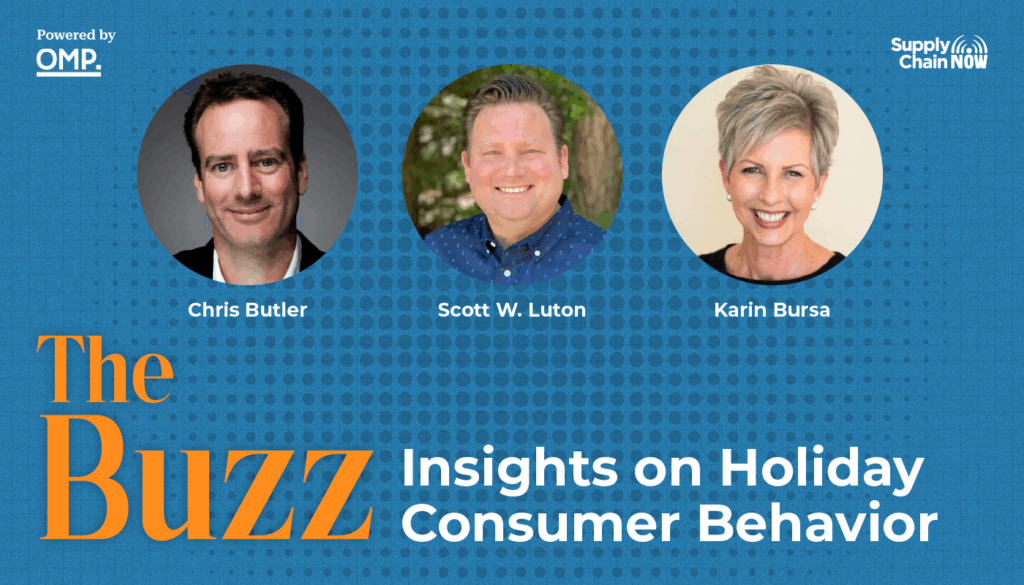
We’re going to be following up on a key automotive supply chain challenge that’s playing out out there. We’re going to be touching on the US warehouse market, which is getting hotter and hotter. We’re going to be offering a supply chain leadership pulse check delivered by the one and only Corinne Versa. We’re going to be talking about some of the biggest issues facing business leaders out there, including tariff, uncertainties and inflation, all that more. Plus in about 10 minutes or so, we’ve got a great guest, Chris Butler, CEO of National Tree Company, who’s going to be sharing some really interesting insights, including some of the holiday consumer behavior shifts. They’ve been tracking all that and a whole bunch more. Corin should be an outstanding addition of the buzz, huh?
Karin Bursa (01:54):
I know. Let’s get started. The supply chain movers and shakers are waiting.
Scott Luton (01:59):
I completely agree. And folks, as you weigh in, let’s follow Trish’s advice, say hello and let us know where you’re tuned in from. We love connecting those dots. So Corinne, there’s four things we want to get into before we bring on an outstanding guest here. Today. We’re going to start with our latest edition of With that said, which published over the weekend. Now we celebrated and we led with this and with that said, we had two big milestones. Not only did we just published a hundred 50th edition of With that said, the whole team has been an outstanding journey. But wait, there’s more because last week we published our 1500th, that’s right, 1,500 podcast episodes, Corinne, oh my gosh, amazing.
Karin Bursa (02:37):
That’s amazing. 1500. So 10 times the number of with that said,
Scott Luton (02:42):
Oh my gosh, I’ll tell you what. Well, most importantly, well Corinne has been, as you know, a big team effort, but most importantly, big thanks to our wonderful supply chain now, global fam for joining us on this extraordinary journey. So what did we talk about? And with that said, well, we use one of my favorite automotive dad jokes there. How many parts does it take to build an automobile? All of them, right? Well, we followed up, I mentioned that topic, that big topic, big challenge in automotive supply chain circles everywhere. Next, I think I said that right? It’s a Chinese owned Dutch semiconductor maker what continues to work through a variety of challenges that’s holding up shipments of their chips to automotive customers across the globe. In fact, a Honda plant in sole Mexico, I think I said that right, has shut down production at least until November 21st due to next period shortages.
(03:30):
Some say the tentative China US trade deal will help resolve the problems. Stay tuned. We also featured a great story from Max Garland with supply chain dive, who’s I tell you, he’s one of the best in the business, especially in the logistics space. Max reported on how warehouse demand here in the us it continues to rise, right? In particular, Phoenix and Indianapolis are two of the hottest markets that saw a big jump in demand in Q3 2025. So that lots of resources, tools, live events, you name it, give with that, set a read and let us know what you think. Corinne, did you happen to work in a little bit of weekend reading with that set?
Karin Bursa (04:06):
Of course I did. And let me just comment on that lead story on the chip crunch continues. First of all, let’s talk global for just a minute. We’ve got a Dutch company operating in China with a Chinese owned manufacturing facility that is supplying a Japanese owned auto manufacturer for a plant in Mexico. And then you sprinkle in a little tariff turmoil in the mix as well. And you talk about complexity because you know these are important parts, raw materials for the assembly plant. And so the best planning I’m sure has gone around this. Nobody was surprised by the order, it’s the delivery of the order and getting that all synchronized. So as manufacturers attempt to get back in the driver’s seat to orchestrate their supply chains, disruptions and shortages continue, whether it’s geopolitical or other supply side disruptions, but I had to chuckle at the global, just the big moves in that equation.
Scott Luton (05:13):
Corinne well said. And all the articles that I’ve been consuming on this topic, a lot of them have big statements from big automotive brands that are trying to not only plan for the current challenge, but plan to prevent it from happening again. And all of them to an individual talked about how it takes a lot of time to find a quality supplier to step into what they’re doing and what they’re getting from next. So we’ll see. We’re going to keep our finger on the pulse and a lot of folks are reporting a little bit of a breakthrough. We’ll see. And we hope that the tentative China US trade deal does indeed help folks give. With that said, a read and let us know what you think. Moving right along, we got a great guest, folks stick around. Chris Butler with National Tree Company is here.
(05:54):
Corinne, we got a big leader as a guest here today. Got a big leader that I’m co-hosting with today. You work with all the movers and shakers out there. We are here in mid-November 2025. It’s hard to believe supply chain organizations are really busy right now. Not only are they working through peak season, but they’re dealing with a variety of old and new challenges as well. We just touched on a couple. Given your work, you got your finger on the pulse like few do. What is one of the top priorities for world-class chief supply chain officers right now as we dive into another supply chain leadership pulse check?
Karin Bursa (06:23):
Yeah, I think Scott, really the big challenges we’ve just talked about, one is tariffs and the uncertainty around the tariffs. And what that means is that as a chief supply chain officer, they’re relying on their team to run multiple scenarios for their business. Honestly, with their current suppliers for short-term needs. They can change suppliers in the longer term horizons, but that takes time. So working through those details, the different scenarios is absolutely critical. So simultaneously, chief supply chain officers are looking for some wins with artificial intelligence. The whole C-Suite is looking for corporate wins with ai, whether it’s in the area of predictive and analytic ai, generative in the way their teams are interacting with systems, or if we’re going all the way to AgTech and they’re able to actually automate portions of their planning process. Lot of focus there and they’re looking for wins. They’re looking to stack up some wins to show progress and either better decisions, more precision, more scenarios so that their teams have greater confidence in network performance.
Scott Luton (07:38):
Yes, that’s right. While they free up time for those precious teams, they’re doing such great work. Excellent perspective there from Corinne Versa. Really quick, Andrew is back with us from schrock Shear. I think I said that right, Andrew, great to see you and I appreciate you sharing some great resources after last week’s show. Let us know what you think here today here on the bus. Okay, speaking of resources, Corin, I got two more things we share before Chris Butler joins us. The first of those, Hey, one thing that chief supply chain officers and really all business leaders out there making decisions need, well, that’s solid information, insights, and analysis. Our friends at US Bank provide that on a regular basis on time, and in full US Bank released their most recent freight payment index on Thursday, October 30th. So just about 10 days or so ago. And after some surprises we saw in Q2, Corrine, including national and across the board, regional shipment volume increases. The new data showed that the freight marketplace regressed in the third quarter. In fact, only two of the five regions saw volume increases and national shipments was down sequentially, meaning quarter over quarter
(08:43):
And year over year versus Q3 2024. And as we do each quarter, in fact, Corin versus joined us last quarter, we had a great economist with the A TA, but here last week we reviewed the Q3 index findings on a live stream last week with Bobby Holland from US Bank and Heather Silt, director of Global Logistics at Fortive who joined us in 2023. So a couple of years ago. And I’ll tell you, Heather brings a great deal of enthusiasm and expertise to our recaps. We’re going to have the podcast ready soon coming up really soon so you can download that. And in the meantime, Corin folks should go out, not walk, they should run to get their free copy of the US Bank Freight Payment Index for Q3 2025. We’re dropping the link, Trisha’s already on it. Drop a link right there in the chat to do just that. Corin, really quick, this is when you fold this in with a variety of other resources, data-driven resources and boots on the ground insights. You roll that up. It’s a pretty powerful recipe, huh?
Karin Bursa (09:40):
Yeah, it’s a great resource. I love the quarter to quarter comparisons and looking at this as a real indicator of commerce of what’s happening in the market today. Because these are products that are in motion, right? They’re moving to distribution points are out to customers. So great resource, I love that they come and share it with the supply chain now, fam, on a regular basis every quarter, right? They’re bringing it to us, giving additional insights. But download this report because it’s a great resource to look at as your business grows or as you look at optimizing your current network.
Scott Luton (10:16):
Well said, Corinne. And hey, one more little tidbit here. Two of my favorite parts. I think number one, we’ve got to better understand history, right? Because that’s how we identify trends and better plan for what’s ahead because we understand it more. And secondly, I love the blend. It’s not just freight data, it’s a blend of economic data, industry data and trends. It’s really a nice holistic resource. So check it out again, Trisha’s dropped link right there in the chat. T squared holds down the for us on YouTube as back says, bring own. The nourishment is coming, it is coming here today. You got Nadim tuned in again via LinkedIn from Saudi Arabia. Welcome, welcome in. Great to have you here. And Leah Kim is back from Seattle on LinkedIn. Leah, I’m going to be up in your neck of the woods this week at a great Amazon reshape event. So great to have you here today. Okay, one more thing, Corinne, one more thing.
Karin Bursa (11:05):
What’s
Scott Luton (11:05):
That? And that is Manifest big 2026, right? I was so excited about this event that I shared this visual earlier today on the Buzz folks, I’m looking forward to being back at Manifest in Vegas in February, 2026. As you may know, if you’ve been thought leadership is a cornerstone of the event, and this year’s a manifest 2026 is not going to be any different. The 2026 agenda is alive, Corinne. They have their act together, they plan well ahead like the rest of us supply chain folks do 150 sessions, over 150 sessions, over 400 speakers across three days of innovation strategy and real world insights that all shape the future of supply chain logistics. Prices are about to increase Friday, November 21st. You don’t want to lose those dollars. But the good news folks, our supply chain now audience members have a great opportunity to save a couple hundred bucks off the current price, which is 900 bucks off the show up on site price. But you got to get your registration in now, Corinne, we’re going to have to get you to Vegas with us in February. You ready to go? Corinne
Karin Bursa (12:07):
Vegas is definitely the place to be in February and Manifest has grown year over year. And last year you had a great show you were there. I think you were exhausted afterwards. You may have needed a couple of days of r and r. There were so many conversations happening and I know it’s going to be bigger and even better this year.
Scott Luton (12:25):
So true, so true. And yes, my feet still hurt from last year. We were on the go throughout two and a half days there. So Rene, looking forward to it. Folks, check out the link. Tricia is dropping resources, making it really easy for y’all to check it out. And if you’re there at manifest, give me a shout. Love to connect. And Ahmed, great to see you also from Saudi Arabia via LinkedIn. Looking forward to your take here today. Okay, Corinne, are you ready? We’ve got a terrific guest as promised. Are you ready?
Karin Bursa (12:50):
I’m ready.
Scott Luton (12:51):
You’re always ready, Corinne. You’re always ready. Well, as I mentioned folks, we’ve got a terrific guest joining us here on the Buzz Powered by our friends At OMP. Chris Butler is the chief executive officer of National Tree Company, where he leads the organization’s growth across e-commerce, omnichannel, retail, and global manufacturing operations. That’s quite a full plate now with a career spanning over two decades in consumer products, digital commerce and retail strategy. Chris has a proven record of driving revenue growth, optimizing operational efficiency, and building higher, higher performing teams, not just high, higher, and higher. Prior to joining National Tree Company, Chris held senior leadership roles at Advantage Solutions, Mondelez International and Nestle Waters. Please join me in welcoming Chris Butler, CEO of National Tree Company. Hey. Hey Chris, how you doing today?
Chris Butler (13:40):
I’m good, Scott. I’m good, Corrin. How are you guys? Wonder? Doing
Scott Luton (13:43):
Great, Corinne. We really enjoyed Talking Shop and talking holiday trends in the pre-show. We should have published that as a separate podcast and we’re delighted to have Chris here today, huh?
Karin Bursa (13:53):
Absolutely. It’s your season, Chris. This is it.
Chris Butler (13:56):
It’s definitely our season. Sales are ramping up exponentially. You know how it works. October starts a little bit and then November every weekend basically the sales are exponentially larger than the prior weekend. So until you hit hit Thanksgiving weekend where it’s absolute peak and all hell breaks loose saves for a while, and then December 15th is cutoff there. As you know, FedEx UPS no longer gap deliveries and then post-Christmas. post-Christmas and post New Year’s is a big, big sale season. One of our customers does about 60% of their volume post Christmas, which is amazing really. And then by January 15th it’s then slows down and it’s kind of restarting all over again, putting our orders through and everything. But yeah, it’s a business that never sleeps. But yeah, peak season is absolutely right now.
Scott Luton (14:39):
Well, Chris, you’ve already shown you’ve got your finger on the pulse tell you of the business and of industry. Stay tuned folks as we dive into some big topics. But first I want to start with a fun and warmup question. So Chris and Corinne, this first day is the stuff of my nightmares, this international accounting day. Yikes, my least favorite topic. It’s also the United States Marine Corps’s birthday, it’s World Science Day. But here’s a special one that one I want to use to pose a fun warmup question to both of y’all folks, it is Sesame Street Day because the very first episode of Sesame Street published on November 10th, 1969. So with that in mind, Chris, I’m going to lead with you here. With that in mind, what is one show, TV show, you name it that was completely inseparable from your childhood or your upbringing?
Chris Butler (15:25):
Oh man, that’s a tough one. Only the people in England would get this if you’re a very old English person like myself. So I’ll say Grange Hill, which is kind of like a kid’s soap opera about a bunch of unruly teenagers at a London school. And then as I got a little older, the 18 night rider, all of the Hasselhoff specials. So that was my formative years, which had an intelligent answer for you, but that’s what I watched as a kid.
Scott Luton (15:51):
Well, I love it and I’m so disappointed. I guess I’m old. That’s how you preface your answer. And I love the A team and I got to check out Grandchild. That was a new one to me.
Chris Butler (16:01):
Don’t waste your time. I’m sure we did at the time, but I think it’s probably past its prime
Scott Luton (16:04):
Day. Corinne, same question to you. What was a big show when you were a kid?
Karin Bursa (16:09):
I was a fan of Sesame Street when I was young, young, but I have always been kind of a techie. And so Star Trek was a show that I always watched and I’d watch it with my grandmother, who I guess was way ahead of her time. But just think of the number of things where we had recorders and communicators and now we’re all walking around with all of those things. So I’m just waiting to say, beam me up, Scotty, I’m ready.
Scott Luton (16:34):
Well, Corin, I’m so glad we established you’re a fellow Truckee, I learned something new. I’ve known you for a long time,
Karin Bursa (16:39):
Long and prosper.
Scott Luton (16:41):
That’s what supply chain organizations are everywhere trying to help us all do. Right. And Gene Roddenberry, you mentioned just how forward looking. He had an incredible vision and as you mentioned, it’s so interesting to see kind of what we enjoy today and how he basically predicted it and put it into shows a long time ago. So alright, couple quick comments. Meine great to see you via Ethiopia, via LinkedIn. Great to see you here today. Looking forward to your perspective. And Amanda says she loved Sesame Street, Mr. Rogers, the FRAs, and of course reading Rainbow. Good stuff there. Alright, so we got to get to business and we got to talk about some tough topics that aren’t nearly as fun as a big bird and Elmo and you name it. But let’s start with some context. Chris Butler, you and the team have been on the Move National Tree Company for years now. Let’s level set. Could you tell us a little more about what the organization does?
Chris Butler (17:30):
Yeah, sure, absolutely. So National Tree is the leading artificial decor company in the country specializing in Christmas decor. So trees, wreaths, garlands, outdoor, indoor. We do some other seasons as well, Easter, spring, some shrubs. So we’ve been around for 50, 60 years now. I joined the company in 2020 and yeah, super happy to be here and help continue with the legacy of the company. But yeah, it’s an amazing industry. If I can take a few seconds on that, America, 85% of Americans celebrate Christmas with a tree, see, looking at almost a hundred million households. About 80% of those households celebrate with an artificial tree. So definitely more of a leaning in the states to artificial trees. And every year we do a survey and we try and find out where people are buying and what they’re buying and what they look for in a tree.
(18:20):
And every year we say, what are some of the things that you want to see in a tree or you would prefer as a tree? And again, 85% of consumers are looking for a full green triangle basically with lights. So the trains don’t necessarily change too, too much. About 30% of those trees are bought online. That number stayed fairly stationary. I think people like to feel and touch and get a full view of it. But of course with online you have the ease of purchasing and you have a Honda Civic, it’s tough to get a seven and a half foot tree in the back of that from your local Walmart. So we definitely see a decent percentage of people buying those online, which is where we mainly sell.
Scott Luton (18:59):
I’ve tried to do that in the Honda Civic, so you’re absolutely right, doesn’t fit Corinne. I love the trends that he’s got his finger on the pulse of and I love that he’s coming to us. It’s like he’s surrounded by his products there and those are all gorgeous. What’d you hear there, Corinne?
Karin Bursa (19:13):
Oh, absolutely. I am surprised 80% are using artificial trees. I say I’m surprised. We switched to artificial probably about five or six years ago, and then Chris, we’ve added every year to the assortment. So there’s multiple trees now and in fact we put ours up this weekend. So thank you very much and we are good to go. And the outdoor decor and I would say our neighborhood, some of these inflatables are really, like Santa’s Village has popped up just down the street from me, so it’s pretty impressive. Yeah,
Scott Luton (19:47):
Love it. As we were talking pre-show, some families have a real tree and then some artificial trees in the kids’ rooms or different rooms of the house and whatever it takes to get you into the holiday spirit.
Karin Bursa (19:58):
One of the things that artificial trees don’t do is they don’t bring that wonderful pine scent into your home, but National Tree has these things called scent sickles. Am I saying that correct, Chris? That’s
Chris Butler (20:09):
Correct. Sensical, yes,
Karin Bursa (20:10):
They are fabulous. So they’re like you hang out like an ornament in your tree, and so when you get close to your tree, it smells like fresh pine everywhere. It’s really genius
Chris Butler (20:20):
Smell of Christmas in a bottle for sure. Yeah,
Scott Luton (20:23):
Love it. Chris and I also loved your perspective there. You’re really tied to customers and what they want and you’re certainly not sitting on your laurels. It sounds like you’re rolling out some new innovative products. Let’s do this. I want to talk business and get you to wait on some broader topics, but first, Nadeem says he loved Star Trek as well. Captain Spock was his favorite character, Nadeem you and millions of other people. Leonard de Mo, he was quite the actor. Okay, so just last week, Corinne and Chris, I was sharing some findings from the National Association of Manufacturer’s third quarter survey where manufacturing leaders, you can see it there in front of you, cited their top current business challenges. And this probably doesn’t surprise anybody. Trade uncertainties including tariffs are whopping 78%. It’s number one primary current business challenge, and we’re going to drop a link to this survey. There’s a lot of good stuff here, but Chris, I want to get you to weigh in on how you see tariff uncertainty and it’s not so fun because inflation influencing a variety of factors. Let’s start with your thoughts on how all of that’s been impacting pricing and availability first, Chris.
Chris Butler (21:27):
Yeah, for sure. So 90% of the Christmas to decor business was made in China. And so historically 90% of all items to do with Christmas or came out of that country. We moved a few years ago, we started to move out of China just for flexibility, diversity perspective, which I think it just makes a lot of sense to do that from a business perspective, but the industry still remained there. So when Liberation day came and tariffs started to really hit, a lot of companies had made some moves because of the warning of tariffs, but a lot of companies hadn’t. And so there became a mad scramble, especially when tariffs went to one forty five, a hundred forty 5% on China. All production stopped in the country. So all production in China basically came to a grinding halt while companies tried to figure out, well, we can’t afford to bring in product that are two and a half times more expensive than they would be normally.
(22:16):
So a lot of things stopped for about 30 days. There was no production on Christmas. A lot of companies also moved and quickly tried to find other supply chains. What’s interesting, I saw your piece about the automotive industry, it’s not easy, but it’s not as difficult to find factories to set up shop in other countries to make Christmas trees. Christmas trees don’t require the same number of parts as a car, for example. So it is a little easier, but it did gum up and slow down the entire supply chain of raw materials moving from country to country, et cetera, et cetera. So we also then when the 145% came back down, we saw companies, retailers beginning to reorder from China at the 30% rate, but at a lesser level because I think at that point companies were starting to get worried about consumer demand and the consumer profile going into the season.
(23:03):
So from a supply profile, we definitely think there’ll be less supply in the season. Right now we brought in about 20% less than we did last year. But again, not sure what that demand profile looks like because I’ll get into that now. I guess the demand profile of the season, consumer uncertainty I think is tough. The cost of the product, definitely there’s a small cost increase on a lot of products. Manufacturers have eaten some of it, we’ve eaten some of it and we have passed on some costs to the consumer. We know that a lot of companies in the industry have passed on costs, again through public information, just seeing prices this year versus prices last year. So I think suppliers tighter and costs have slightly risen, not astronomically and not breadline type supply situations, but certainly it’s impacted pac, both of those. But the biggest concern for me right now and the biggest concern going into the season is one of the other things you had on your chart, and that’s consumer sentiment and consumer demand.
(24:01):
And in this business you never know exactly the weekly domestic economy, so you never know what’s going to happen. And what we’ve seen so far, Halloween we’ve heard was soft. Our Halloween was okay, but Halloween across the board we heard was quite soft. And then what we’re seeing right now, definitely demand has been soft so far versus last year. So again, I think consumer behavior has changed and we can talk about that a little bit later, but I do think that demand is going to be a little soft right now. So you’re probably going to start to see retailers offering deeper discounts to try and get those to buy some of the inventory that they have. So all difficult year. And I think I liked what you said earlier about the chief supply chain officers. I think you have to be flexible and you have to be fast. And obviously the more complex your supply chain is, the more difficult that is. Again, I think our team has done a great job at pivoting a lot. We got ahead of it a little bit, which helped us, but we’ve had to pivot many, many times this year between country, between factories, between items, different source of distribution, selling to our customers. So it’s definitely been a challenging year. I’m proud of the team and I would a hundred percent agree with what you said. Flexible and fast are the key attributes of any good supply chain organization.
Scott Luton (25:15):
Well, so Corin, I heard a lot there from Chris. I’ll start with this because he mentioned all this, the complex or the challenges depending on the complexities of your supply chain. I am so glad as someone that has made parts for the automotive industry in my past, I’m so glad I’ve not automotive here in recent years. Secondly, he mentioned costs, input costs, other costs, someone’s got to eat it, right?
Karin Bursa (25:37):
Yep.
Scott Luton (25:37):
Some companies have been got
Karin Bursa (25:38):
To go somewhere.
Scott Luton (25:39):
Some companies have absorbed that more so than others. Some are passing along to customers for sure. And one last thing you touched on, which we’re talking about in every single conversation almost as often as AI is uncertainty. And it’s interesting, I was reading a great article from the World Economic Forum, I mentioned this earlier last week. It was focused on how we quantify uncertainty and a lot of economists, a lot of analysts that look through decades of data point to the current uncertainty as being historic in terms of how it’s impacting global business decision making. Corinne, your thoughts on what we heard there from Chris?
Karin Bursa (26:09):
Yeah, I think we’re all much more sensitive on a global basis now and our expectations are very different as consumers. We’ve been trained to be more aggressive about our expectations as well. The one thing that I would add that obviously Chris deals with every day is his portfolio is very seasonal. Certainly Chris, I think you said you do a lot of other seasons other than the holiday, the Christmas season, but this has got to be the big one for you, I would think with lots of inside and outside decor is such a central part of the celebration of the holidays. So on top of all of that volatility, his team has got to think in terms of excess inventory at the end of the selling period as well.
Scott Luton (26:54):
And we’re going to touch on similar topic in just a second. Corinne, as usual, you’re predicting the future and you’re really good at that. Maybe Chris is too based on what I’m hearing. But really quick folks, Trish is dropping a link to that survey that we’ve referenced a couple times. Check it out. What I shared there is just the tip of the iceberg. There’s tons of good insights there. Also, one other thing I want to share a quick resource with all of you good people out there, cool resource from the team over at OMP who are powering the buzz all month long. In November, new ebook entitled Making AI Work for You from explainable to Ag Agentic. Kind of what Kareem was talking about earlier, this ebook explores how decision centric planning powered by unison IQ enables organizations to move beyond explainable AI toward truly ag agentic systems.
(27:38):
Lots of practical actionable stuff in here, including some powerful insights from the team over at zero 100 and all told shows how AI can drive measurable impact across enterprise. You can check it out. Tricia is dropping the link as I speak. Good stuff. Okay, so Corinne, I’ll pick back up on what you’re sharing. Chris smearing the smearing effect. It’s been in play for years as retailers have spread out sales and deals across the year rather than just at the end. I’m going to share a couple of things here. Holidays, Chris, I think you mentioned Halloween earlier, right? Perfect example. It’s been promoted in stores in the spring in recent years, months before the ghouls and goblins show up at your door for trick or treat. And in fact, some folks have dubbed this trend as summer ween. But here’s the so what behind this, Chris Andre get this, the National Retail Federation, Corinne, we look for data facts, not feelings, right? The National Retail Federation has been polling Americans on whether or not they celebrate Halloween. They’ve been doing it for clearly decades. In 2005, about 50% of Americans said they celebrated Halloween in 2025. This year, almost 75% of Americans said they celebrated Halloween. So no wonder retailers want to capitalize on the sentiment and demand kind of throughout the year more so than just in a 30 day cycle. So Chris, your thoughts on the smearing element that’s been at play for years, really?
Chris Butler (28:57):
Yeah, no, it’s super interesting. Again, year after year as a consumer, it drives me crazy when I see Valentine’s candy on December 1st, but I get it. It’s all of these candy companies shoving their inventory into the stores because if it’s there, it sells. It’s expandable consumption, right? Guarantee. Someone who buys a huge bag of m and msms Valentine’s candy on December 1st, that is not lasting until the February 14th. That’s gone by December 2nd and then they’ll keep buying, et cetera. So it makes sense from a retail perspective. Retailers are brutal business and so you want to make sure you get your products in front of consumers as much as possible. The interesting thing about Christmas really, you’ve got Halloween on October 31st obviously, and on November 1st it’s immediate. Everybody’s mindset really changes into Christmas mode. You definitely see trees, wreaths and gars and other things put up in some retailers earlier than that. But typically November 1st is that big turnaround. It’s interesting, a few retailers this year because of the supply chain issues aren’t going up yet. They haven’t gone up and they won’t be going up until the middle of November, end of November, which obviously is a disaster for them. But yet in general, smearing is here to stay. And like I said, summer Ween makes me shake, but as a seller of Halloween goods, I’ll take it and we will take those fine customers who buy from us all around.
Scott Luton (30:19):
That’s right. I’m probably the oddball here, but to one thing Chris mentioned, Corrine, just in the last few days, my family went straight to Christmas. My kids, Amanda, you name it, straight to Christmas, I’m like, Hey, timeout, timeout. Thanksgiving is my favorite holiday of the entire year. And it’s like Rodney Dangerfield, it gets no respect. It gets no respect. But Corinne, whether it is that yearly challenge or the smearing that’s been at play, again, this is nothing new. Your thoughts were heard there from Chris and what you see out in the industry.
Karin Bursa (30:47):
Yeah, well I think it’s important and what Chris mentioned is, is a technique that’s been in place for a while and that is demand shaping. And so especially around these highly seasonal celebrations, if we can stretch that time period out, that gives us a bigger opportunity to sell. So as manufacturers or retailers look at actually shaping or incentivizing demand promotions, et cetera, if the floor space is available or the endless aisle of online ordering is available, then that opens up a longer selling period and an opportunity to move more product over a longer period of time. So I think it’s very real. I think especially for the highly seasonal celebrations.
Scott Luton (31:30):
That’s right. You got to get those dollars when you can smoke ’em if you got ’em. Chris, were you about to add one more thing for I shift over to consumer?
Chris Butler (31:37):
Just think about that. Valentine’s candy,
Scott Luton (31:41):
Anything but those terrible hearts that have been around for a hundred years, they’re a pasty thing. Oh my gosh. Got to throw those out. Okay, so I want to dial in if y’all can’t already tell man, Chris and the team, they are dialed in on consumer preferences and behaviors. I’m going to share a couple of factoids and we’re going to get Chris and friend both the way in. So Capital One released some interesting research early this year. None of this will surprise you. I bet 64% of Americans consumers shop in stores on a weekly basis. I’m one of those because I bet ’em in my local Kroger about every other day. I have no idea. You would think I can plan better. That’s just reality.
Karin Bursa (32:15):
You have three young children at home. That’s not something to do with it.
Scott Luton (32:19):
Thank you. That’s right. Only 24% of consumers prefer to purchase furnishings and appliances online. That doesn’t surprise me at all. About 20% of US consumers prefer to purchase groceries and household goods online. And I bet that number’s growing. I think we get, with the exception of our trip to Costco, we get all of our groceries online. Consumers are 148% more likely to select ship to home over in-store pickup, which is the second most popular fulfillment method. And here’s one more to get this Chris and Corinne for each day a delivery is late, right? Each day a delivery is late, consumers are 1.1% more likely to return e-commerce purchases. So that clock is ticking. So Chris, when it comes to holiday consumer behavior in general, what shifts are you tracking, Chris, especially related to timing of purchases and e-commerce versus in store?
Chris Butler (33:13):
Yeah, and it’s a great question. There’s a lot of stats there. So one of the things is consumers have, again, the peak for us is the Thanksgiving weekend. And so a lot of consumers wait until Black Friday through Cyber Monday and then Tuesday. Those five days are by far our busiest through the year. We’ve seen that concentration of buying more and more as the years have gone on. So I think more and more consumers are becoming more deal savvy. So from a buying perspective, that is the absolute peak for us. And we will do 60 plus thousand packages a day across our network during that time. It’s a lot of trees. So I basically live at a warehouse, not because I can add any value or help, but because I like walking around and you can learn a lot of, when you look at the labels, the shipping labels, you learn a lot.
(33:58):
You see, oh, all the pallets go into one particular customer or one particular retail. You just get a lot of insights and things when you’re live on the ground. But the other thing I’d say to your point in terms of late orders, the closer you get to Christmas, the more important that delivery date becomes. So if you are buying your tree on Black Friday and it says deliver to your home by December 10th, that’s not great. If you’re buying on Black Friday and it says deliver to your home in two days, then that is a major indicator of buying that product. So price, promotion, style, those are all important, but the time it takes to get that product delivered during the season is probably the most important differentiator between choosing an item or not choosing an item. So for us, that means we have to have an excellent kind of outbound system and very tied to our customers. So yeah, delivery, I didn’t know that stat. Late delivery is really interesting. And overall, our industry tracks it about the same as the furnishings industry. So about 30% of our business or the industry’s business is sold online. Most of our business is online, but 30% of the overall industry is online. I think it’s because again, people like to touch and feel too, get an understanding of what they’re buying.
Scott Luton (35:08):
Well said, well said. Really quick aside, and a big thanks to Amanda and Trisha behind the scenes handling production every single day along these lines of consumer preferences, folks could check out a show we did last week with our friends at Easy Post, Amanda, let’s try a link to that last week. Lots of data and better yet what shippers can do about it. Corinne as expected, Chris, his fingers on the pulse of what customers want both now and maybe next year, maybe next five years. What’d you hear there from Chris?
Karin Bursa (35:35):
I really appreciate the insights Chris and the National Tree business as a kind of a bellwether of what’s happening certainly in these highly seasonal periods. I’m with you though. I think that the shipping and shipping direct to home is important, especially for larger bulk items or things I’m buying in quantity, right? If you’re decorating the outside of your house and you’re putting up Christmas wreaths, you may not just put up one, you may put in the south, we put them on several windows. So we’ve got five actually on the outside right now. So when you think of that in those bulkier items, you made a joke earlier about carrying a tree home on a Honda Civic. It’s nice to get that delivered to your door. And so that becomes important. And I agree with Chris’s point about having confidence in getting delivery in a day or two versus a two week window of time makes it a little more uncomfortable, especially with all of the challenges in supply chain. So customer experience is critical because I’m going to assign my overall experience with the item I’m purchasing. The retailer may get a piece of that if I’m in the store, but it’s all about that brand protection and making sure that we’re creating raving fans for the business as well.
Scott Luton (36:51):
And folks, for all of you shippers out there, one thing we talked about last week, Chris and Corinne, is don’t assign that brand promise to a third party or if you do, do so at your own peril, because to Corinne’s point, customers that brand Promise runs from the time they first stumble onto the site and select what they want until the time they get it back, get it home, unpack it and use it. Any point in there, your brand certainly is at risk for any bad experiences. We got so much to talk to you about, Chris, we’re have to have you back. Really have enjoyed the time here today. Let’s do this. One more question I got for you is how can folks connect with you and the National Tree Company? I think I got a little snippet. Your site snows as we’re selecting Christmas trees. I love it, Chris.
Chris Butler (37:36):
So yeah, this is our site, national tree.com. So that is the best way, but we’re available on Amazon, Wayfair, Walmart, target, so all of the major retailers, you’ll be able to find our products, but one of the best places is our own website, national tree.com.
Scott Luton (37:52):
It is just that easy. Corinne, I think me and you might be on that site later today. What do
Karin Bursa (37:57):
You think? I think there’s some potential there. I’m trying to hold back. Given everything that we put up this weekend, there’s always listen to you. There’s always just a couple more things, just a little more so true.
Scott Luton (38:10):
Let’s see here. Tricia is dropping the link. Check it out right there. You want to click away from checking out the great work and products that Chris and his team are bringing to bear. Chris Butler, CEO of National Tree Company. Thanks so much for being here, Chris,
Chris Butler (38:24):
Thanks so much for having me. I really appreciate it.
Scott Luton (38:25):
All right, happy holidays. We’ll see you soon.
Chris Butler (38:27):
You got it
Scott Luton (38:27):
Corinne. I love it. We’re going to have to have Chris back. I love his perspective. He shared not just on cool things you’re doing at National Tree Company, but man, it’s understanding of supply chain and economics and
Karin Bursa (38:38):
Fantastic. I really enjoyed that. A CEO that can talk supply chain to me is always that much more interesting, I think, and just brings to the forefront how important supply chain is to a business and a business that is manufactured overseas, whether it’s in China or elsewhere. He gave us a couple of really good examples of some of the big moves that National Tree has taken in response to tariffs and changing patterns of buying periods and all that kind of good stuff too.
Scott Luton (39:09):
Yes. Well, you beat me to it. I was going to ask you some key takeaways and you just shared it. You’re reading my mind here today, but folks, if you do interact with National Tree Company, we’d love to hear from you. Give us your experiences and your thoughts. I’m really impressed with his appearance here today. Alright, so Felicia, our dear friend, Felicia Prisa is back with us here, Felicia, great. So great to see you. And we’re talking about this consumer preferences earlier. She says, I have grocery delivery, Walmart or Instacart two to three times a week. It saves me so much time. Hey, completely get it. That resonates with me for sure. And Amanda also, same she says, same Felicia, it used to take three to four hours on a weekend to put my list together, go grocery shopping and then unload it all. Now I order Saturday night. It’s all delivered Sunday morning.
Karin Bursa (39:53):
That’s
Scott Luton (39:53):
A priceless convenience. Corinne, how do y’all do groceries?
Karin Bursa (39:56):
We do it the old fashioned way, except I have made one upgrade when I got married 30 some odd years ago. And that is that my husband does most of the grocery shopping, so he likes to go in person. He’s a big produce guy, so he’s still out there touching and inspecting the local produce on a regular basis. And so I get to piggyback on that except for big celebrations. Then I’ve got to go and do some of the heavy lifting for Thanksgiving, for example.
Scott Luton (40:24):
Speaking of produce, I saw in that capital and research, there’s a ton of data there, but I was surprised to read that almost somewhere between two and half 3% of all produce is sold online. How about that? So times are changing. Alright, Corin a second ago here. We’ve got a couple more things to wrap up here on the November 10th edition of the Buzz Powered by our friends at OMP. You were just talking about the importance of supply chains, the importance of supply chain leaders. Here’s some carton research that came out just a week or two ago, and this research doubles down on what many of us already know the importance of strong CSCO leadership. The role of the chief supply chain officer, of course, is essential in driving alignment between supply chain manufacturing while adapting strategy for the wave of innovations on the horizon. Gartner says at least their survey, the research says that 49%, 49% of organizations lack confidence in their manufacturing strategy to deliver on future business outcomes over the next one to three years. However, survey respondents reporting to the CSEO are 68% more likely to feel their strategy is effective compared to respondents who report to the COO. So Corin, your thoughts on this research here,
Karin Bursa (41:37):
A couple of things. One, the headline is a headline, right? 49% of organizations lack confidence in their future manufacturing strategy. So not necessarily what’s happening today in their manufacturing environments, but their ability in the future for AI driven automation, some robotics process improvements, et cetera. Gartner is telling us that they’re going to see a stall, a stall in advancement here. But the thing that you just highlighted on manufacturing and those organizations where manufacturing reports into the chief operating officer versus manufacturing into the chief supply chain officer or the CSCO, I’m fascinated by this continually because to me, manufacturing is a pivotal part of the supply chain and it should report organizationally into those programs so that when we’re doing things like shaping demand in the future or we’re looking at quick ship options and different ways that we’re leveraging our production capabilities, we want that synchronized with the whole supply chain. And even though you can do that inside of an organization, I think we reporting in to the same C-suite individual really accelerates that process.
Scott Luton (42:50):
Yeah, I have not dove into deep into the research, but at a high level, not only do I agree with you, and I think there’s one other element here at play, and it’s an obvious one, I think to me least we’re just talking about it. Really, it’s been a theme throughout the whole show. Supply chains touch the customer so often. And when I think about effective strategies that are really rooted in reality, of course they’re connected like none other with customers and what they really want. There’s no fooling when it comes to what customers want. And so when I see that the survey respondents that are reporting up to and into the CS CEO’s office, naturally they’ve got that supply chain connection, which means they’ve got the customer connection, which means the strategy is much more rooted in that reality. So critically important. Now again, that’s a high generalization, I get it. I’m not saying COOs can’t do that or don’t do that, but that was one of my first thoughts as I read this research, Corin your response and then we’re going to share a quick event with folks.
Karin Bursa (43:46):
I think the research underscores what you’re saying, right? 68% are going to be more effective according to the Gartner research. So this research was conducted I think in May, 2025. So it’s recent in taking a look at the market dynamics. And I don’t want to infer that the chief operating officer doesn’t care about customer experience because I think they do. It’s just having it as part of the actual fabric of what’s happening in supply chain so that you don’t have this, oh, well, we gave them the production orders to run and then they a different group in the organization went and ran them. I think thinking of it holistically from a culture perspective is very, very important. And Chief supply chain officer has a seat at the table. They’re a strategic lever in the business. So let’s make sure that everybody’s focused on the same priorities and we’re removing any of those roadblocks.
Scott Luton (44:43):
Yes, you said it much more eloquently than I did, and I would just add chief supply chain officers delivering on the customer experience long before customer experience became a formal study. Good stuff there. Corin, on a related note, one of my favorites, Noha Samara, not only is Noha going to be back with us with Mike Griswold in a few weeks, but Corin, we’re going to be out at the Gartner Supply Chain Planning Summit in Denver, right? I think they just wrapped up the one in London, I think. Yep. Last week in just a couple weeks there in Denver. Is that
Karin Bursa (45:13):
Right? That’s correct. Looking forward to it. I’m looking forward to catching up with knowhow as well and just getting a real read on what Gartner is seeing now as we get ready for 2026 in the adoption of technology and new business practices and certainly Noha Samara is one of the very well-respected analysts that will be there with Gartner.
Scott Luton (45:34):
So true. And we only can hope that by the time that rolls around that the government is up and running and air travel all the, I mean, I feel so bad for all the people out there, kidding aside, but the people that are still working and not getting paid, and then all the travelers folks, I don’t have to tell you all this because we’re all feeling it together. Gosh, all the delays and the redirects and more uncertainty out there. So hopefully if I had one holiday wish, I think Steve Martin had a SL Skittle on that way back in the day. But if I had one wish, I hope all of that is back to normal so that all the hardworking folks out there can take a minute and celebrate the holidays with their families. Corinne, I’m going to give you the last thought and then we’re going to wrap today’s edition of the Buzz.
Karin Bursa (46:15):
I’m with you. I hope that all gets settled this week. There’s some news this morning that makes it promising that we’ll be able to reopen everything and make sure everybody’s paid and has the resources that they need. So if you are a government employee that’s been directly impacted by this, not just because of your travel plans, but other things, we are with you and we’re thinking about you, but it’s just another example of the uncertainty in the marketplace today, right? When we think of geopolitical events and the impact that they have on our households, as well as on our businesses. So I’m going to say, Scott, it’s a great time to be in supply chain because you guys understand this. You understand what you can do to make a difference, to increase the visibility and resilience of your businesses. And so I just want to applaud everybody that’s here, getting things done on a day-to-day basis.
Scott Luton (47:08):
Well said Corin. Me too, folks, on a much, much lighter note, thank y’all for being here today. Appreciate it. Hearing from folks really around the globe really enjoyed Chris Butler, CEO at National Tree Company. Really enjoyed his perspective. We’re going to work hard through his agents rock and roll agent. To get Chris back, we’ll have to do a review once we get a new year. We’ll do a review on the holiday season and see what lessons learned they had. We dropped a lot of links. I’ll tell you, Tricia is on it, making sure folks can connect with some of the resources and the people that we mentioned here today. Big thanks to Corinne Versa, my Esteem co-host Corinne, what a great episode of the Buzz here today, huh?
Karin Bursa (47:43):
Oh, it was really interesting and Chris Butler really brought it today. So thank you so much for all the insights you shared. And Scott wants more congratulations on the milestones for the team at Supply Chain now, both with your newsletter, hitting number 150, and then podcasts 1500. That is amazing. Congratulations,
Scott Luton (48:03):
Man. I tell you what it feels like we just started. Maybe we’re just still getting started. We’ll see. But I appreciate that Corinne, great to have you as part of this journey and big thanks to the team, right? Noha is incredible and great guest. Much like I talk about incredible the extraordinary Kora Jose, great to see you Maria, tuned in from beautiful Spain, great to see you and folks hang in there hanging there. We’re going to get through these crazy times together, but most importantly, you got to take something today. You got homework folks, we got to challenge you with some homework each and every show. Take one thing you heard from Corinne or from Chris and share it with the team. Put it into practice deeds, not words. That’s how we’re going to get into an exciting new future and continue to transform global supply chain while we do it. So with all that said, I’m going to have the whole hard hitting always on the move supply chain now, team Scott Luton challenge. You do good, give forward, be the change that’s needed. We’ll see next time right back here on Supply Chain now. Thanks everybody.
Intro/Outro (49:01):
Join the supply chain now community. For more supply chain perspectives, news and innovation, check out supply chain now.com. Subscribe to supply chain now on YouTube and follow and listen to supply chain. Now wherever you get your podcasts.