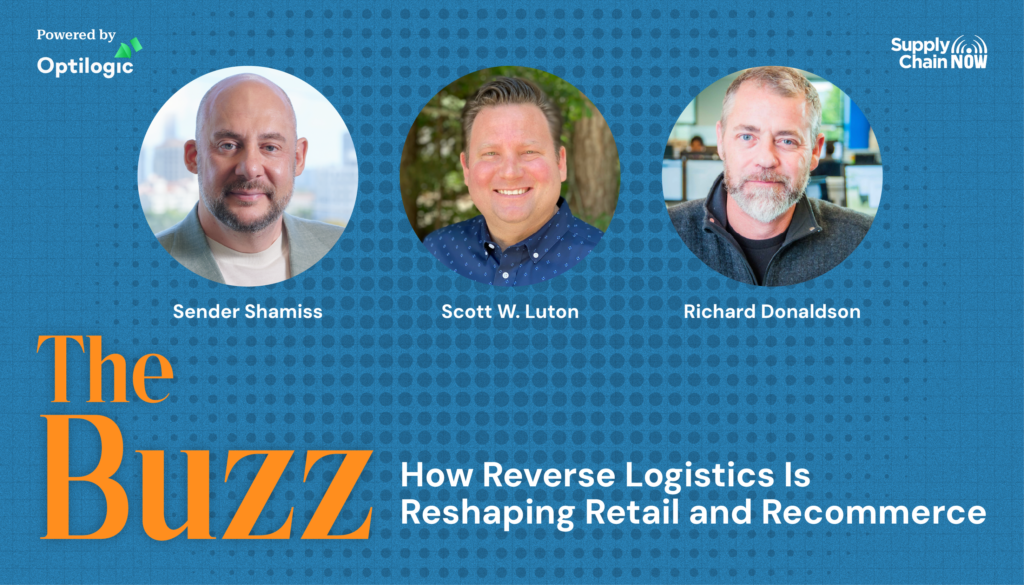
Intro/Outro (00:02):
Welcome to Supply Chain Now, the number one voice of supply chain. Join us as we share critical news, key insights, and real supply chain leadership from across the globe. One conversation at a time.
Scott Luton (00:14):
Hey, good morning, good afternoon, good evening, wherever you may be. Scott Lewton and Richard Donaldson with you here on supply chain now. Welcome to today’s live stream. Hey, Richard, how you doing?
Richard Donaldson (00:25):
Hey bud. Scott, how are you doing down there?
Scott Luton (00:26):
I am doing outstanding. It looks like it’s a gorgeous morning out there in the Phoenix area. Is that right?
Richard Donaldson (00:32):
That’s absolutely correct. We’re still not quite at triple digits yet today, so yes, it’s tempered for the moment.
Scott Luton (00:37):
Outstanding. Well, as Tricia says, everybody, happy buzz day. Say hello, let us know where you’re watching from and thanks for joining us here on The Buzz. As we start a brand new week full of opportunities, folks. The Buzz where every Monday at 12 noon Eastern time, we discuss a variety of news and developments across global supply chain and business. News that matters is what we like to call it. We are powered this month by our friends over at Optelogic, an AI first supply chain design company that revolutionizes decision making by transforming modeling from a multi-month project into one day breakthroughs. You can learn more at optologic.com. All right, so Richard, we got a lot to get into here today. We’re going to be talking about supply chain and space. Now, when I saw that, Richard, do you remember the old Muppets segment? Digs in.
Richard Donaldson (01:26):
Of course,
Scott Luton (01:27):
Of course. Okay, good. Well, we’re going to talk about supply chain space. We’re going to be talking about big and bulky, gets more visibility in retail. We’re going to be talking about a big move that the Big A has made. We’re going to be looking at critical trends and reverse logistics and returns management with an outstanding guest, all that and much, much more. And the guest you may ask in about 15 minutes or so, we’re going to be joined by the one and only Sender Shamus, CEO and co-founder of Return Pro. He’s back with us. And folks, I promise you, you’re going to enjoy Senator’s perspective and passion for changing the reverse and return side of industry. Richard, we really enjoyed the pre-show conversation, huh?
Richard Donaldson (02:02):
Absolutely. I mean, Senator’s got such a great perspective on it and spent a lot of time in the space and even talking about reverse logistics as he pointed out early and we’ll get to it when he gets on the program. There’s a big difference between reverse logistics, which has been around for a while, but not necessarily as mature as it should be. And then the movement towards circularity, which is something I’m keyed up to ask him about.
Scott Luton (02:21):
Well, we’re going to dive into that and a whole bunch more with senders. So folks buckle up for a big edition of The Buzz Powered, our friends at Optulogic right here today. And a couple comments here. First off, Tricia, thank you for letting folks know one click away from where they can learn more about OptiLogic. Alan Jackey’s back with us. He says, “Hey, Scott and Richard from beautiful Ottawa, Canada. Great to see you Alan. Tian, great to see you from Vietnam via LinkedIn. Love to know you and Alan’s thoughts on the topics we’re going to be talking about here today. Great to have you here on the bus. Okay. So Richard, we got some work to do before Senator joins us. We’ve got three things we’re going to hit on the front end and we’re going to start with some early, early, early key takeaways.
(03:05):
Well, I should say we’re going to start with that said, which is our almost weekly newsletter, which started with early, early key takeaways from Orlando and the Gartner Supply Chain Symposium that we attended last week as a media partner. Richard, I bet we worked really hard Monday and Tuesday in particular. I think we had about 20 interviews and we led this session with just a tip of the iceberg that comes to some of our takeaways. So let’s see, Nicole Taylor with Ketaku. KQ’s doing some cool things, says the autonomous business era isn’t approaching is already here. Raphael, you with Sophist Technology said that the accelerating decision making continues to be the mantra. I think it’s been the mantra for decades, if not centuries, but we’re finding some really cool ways to speed up, not only speed up decision making, but making better and more confident.
(03:53):
And he says it’s all about right now, right now, right now. So true. Wolf Vena reminds us that there’s still tons of companies taking a more measured and technical approach with AI where they’re looking for better and smaller use cases. And Bill Benton with Gaines observed that based on the work they’re doing and the conversations they had at Gartner, there’s still a ton of companies that are early on in their AI journey. There’s even a handful that hadn’t started yet. Hey, it’s out there. Laggards are still across the industry for sure. In this edition, you’re going to find more perspective from those conversations at Gartner. You’re going to find tools, resources, and live events all in the latest edition of with that said, give it a read. Let us know what you think. So Richard, did you happen to take a look when you weren’t flying and instructing over the weekend?
(04:37):
Did you take a look at what that said?
Richard Donaldson (04:39):
Yeah, absolutely. And a couple things I think that jump out in right away is the automation. So kind of the AI first supply chain design as that’s coming up. I think AI is still the hot topic. It’s not going to go away for anytime soon and how it gets applied to pretty much every facet of life, whether it’s medicine, whether it’s supply chain, whether it’s autonomous vehicles or in my world aviation. The autonomous vehicle has been around UAPs. The size of the drones these days are basically fighter jets that they’re flying around. The new fighter strike fighter forces coming out are going to be autonomous for the most part and there have been sci-fi movies on that sense. I want to bring it back to our world. I mean, even looking at an Amazon, they’ve moved towards automation and their logistics parts of their business for a long time.
(05:20):
They’ve got basically warehouses run by robots they have for quite some time and that continues to move up the scale. So I think you’re going to see with AI in particular a step function, change, acceleration, if you will, towards automation that I believe is happening right now. And I think to your point, people can avoid it kind of like they did early on with the days of the internet and say, “Oh, the internet bad.” Well, AI is not a fad. It is here and it is going to augment everything we’re doing and it’s better to start playing with these tools now, adapting your supply chains in that direction, adapting all the things you do for delivery, reverse logistics, and all the things that Center’s going to talk about, I’m sure, into what you do today, otherwise you’re going to be left behind.
Scott Luton (05:59):
So true. And folks are still wondering somewhere, do I need a website? Well, I guess technically you don’t need a website like you need oxygen. But as we all learned, it does help tremendously. So it’s interesting. I like that comparison. Let’s see here. We have got some dear friends, Richard, in the comments starting with the one only Tony Sheroda says, “I love that I can join today for cinder and for circularity.” Of course, Tony tuned in from Atlanta. Tony is a iconic figure in the reverse and return space. Great to have Tony, my dear friend with us. And Brandy tuned in once again from Dallas Fort Worth. You’ve been through Dallas lately, Richard?
Richard Donaldson (06:36):
Not lately, but flown over it a couple times.
Scott Luton (06:38):
Okay. I bet you have. Robbie tuned in from the Mississippi Gulf Coast. Hopefully it’s not too hot down there just yet. It’s coming. And hey, our dear friend Kathy, Maro Robertson tuned in from Atlanta. Folks, if you’re not checking out, actually there’s a couple she does, but one of the great newsletters straightforward. We’ll see if Kathy can drop the link into the comments so folks can check that out. So good stuff. Lots of friends here today. All right, we got to get more to work and folks stay tuned as Senator Shamus joins us here in just a few minutes. Number two, Richard. Now, I worked hard. I was trying to Google to find that pigs in space snapshot so I could really flash that back on as we get into space supply chain for a minute and I could not get a high quality picture.
(07:18):
So folks, if you’re not old enough to remember the Muppet Show, the original Muppet show, you’re really missing out. You have to venture over to YouTube and check it out. But me and Richard both are big time space nerds. Richard is an aviator, he’s an instructor, he’s a high tech guy and he is really tracking with his finger on the pulse, what’s going on when it comes to space supply chain. Richard, what’s one thing? It’s one thing that you find most intriguing right now.
Richard Donaldson (07:43):
Okay. So easy answer, and it applies to the supply chain, but it more applies to the door opening wider for us to start exploration of space. Well, it’s two of the same thing. One is the release of the UAP UFO files that just happened over the last 48 hours or I think in the last five days. That is a significant move in the direction of opening up all of our government, if you will, secrets towards what’s been going on and everyone’s been talking about for a long time. All conspiracy theorists are cheering because that’s actually happening now. And concurrent to that over the last two months, which is tied to the same thing is you’ve had this just odd disappearance of about a dozen, 13 or 14, I think we are now scientists in the field of astronomical discovery, alien discovery, whatever you want to call it, even nuclear power, things on how to power through space, have been disappearing.
(08:28):
So you start putting these two things together and I think we’re again at a step, I mean, you can’t deny this, a step function acceleration towards space, whether it’s Musk’s movement, adapting his plans to go from Mars to the moon. Now you’re releasing all this information on things that people have been talking about forever, which is contact with first contact, if you will. I mean, you talk about Star Trek earlier that we’re going to get to and we’re right at the throes of that. It’s probably already happened. I think that’s going to start changing people’s perspective, I think, and start looking towards the stars in a much more significant way. The way, and we’ve talked about this before, Christopher Columbus looked at the ocean and wanted to navigate it. I mean, we’re at a really interesting inflection point for humanity and I think our supply chains are going to adapt towards that.
(09:10):
They already are.
Scott Luton (09:11):
Richard, very well said. It is exciting and kind of scary all at once, but that’s what new chapters bring oftentimes. And secondly, folks, as this develops, as this emerging market industry space, for lack of no pun intended, continues to develop, logistics need really, you name it, supply chain needs and how the craft will learn a whole new connection to make and how we supply human endeavors in the Great Beyond. This is going to be remarkable to watch. So Richard, you’re our space correspondent and we look forward to future space supply chain correspondent. We look forward to future updates on what we all got to know. How’s that sound?
(09:52):
Good. Okay. Also want to share a few folks before we hit one more thing here. Scott tuned in. Scott Alfin. Scott, let us know where you’re tuned in from. Welcome, welcome. Our dear friend Andrew from Schropshire is back with us. I think I nailed it that time. Andrew, we’re going to have to have you on the buzz at some point soon. You’re doing cool things in technology. Kathy did drop the Freight Forward, the latest edition. Folks, check it out. Kathy’s one of the best in the business. And she also says, hey, she also compiles weekly news every Friday on the reverse space creatively called Reverse News. So she’s dropping the latest leak there. Good stuff, Kathy and always a great sense of humor. So Richard, one more thing before we bring in Sender here today. We partnered with our friends at OptiLogic to deliver what I think was a fascinating webinar a few weeks ago.
(10:39):
It focused on how an AI first approach to supply chain design not only builds resilience and optimizes performance, but even better, it can transform the teams, the people within the organization, empowering them in a wide variety of ways. Plus, I would argue that it’s a terrific any better, innovative, high tech way of doing business that’s going to be a magnet for top talent. Top talent looks for stuff like that. But nevertheless, Vic and Gavin pictured here, brought a ton of practical and actionable perspective to the table, including a few examples where OptiLogic is helping to change a game for organizations out in the industry. We even had the professor, AKA Scott DeGroot join us. You can check out the Replay Now Demand and let us know what you think. We’ve got a great conversation coming up here today. We welcome back one of our faves.
(11:26):
Sender Shamus is the co-founder and CEO of Return Pro. Industry’s leading fully integrated returns management and reverse logistics platform. He’s a seasoned entrepreneur with multiple successful exits. He’s well known and I can attest to for identifying large scale inefficiencies, building scalable technology driven ecosystems and transforming complex operational challenges into profitable, repeatable models. Now his impact on industry has earned national recognition. We’ll be here maybe all day reading off some of the honors, but one of them, pro to know Lifetime Achievement Award. This is a young guy. He’s done a lot in his life for his long time and long-term contributions to supply chain innovation, which was awarded in 2024. Many, many others beyond that, please join me in welcoming the passionate trailblazer, Senator Shamas, co-founder and CEO of Return Pro. Hey, hey, Sender, how you doing?
Sender Shamiss (12:20):
Thank you very much for having me. I’m doing great. I was listening to you guys. What are interesting, fascinating topics.
Scott Luton (12:26):
Undoubtedly. We got a lot of more good stuff to get into. And Richard, as well I said earlier, we really enjoyed our short conversation with Sender on the pre-show. I can’t wait to get into here today, huh? So where are we going to start? I want to start with a little bit of pop culture because today, folks, today’s many things. It’s Hostess Cupcake Day. Hostess, I think the same folks that made it Twinkies, if I’m not mistaken. It is National Technology Day. How about that? We need like a whole month at least. It’s Somerset Day to celebrate Somerset in the United Kingdom. Andrew, maybe you can tell us exactly where that is related to where you are. But it’s also, folks, it is Twilight Zone Day, which is meant to celebrate what I would consider to be one of the most consequential television series of all time.
(13:13):
And this is my favorite episode, by the way. It’s called Time Enough to Last, features Burgess Meredith as Henry Bemis. And I’m not going to ruin the episode, folks, but if you haven’t seen this, you got to check it out. But Senator, with all that said, whether it is Twilight Zone or whether it’s other sapha or fantasy series, what are you an absolute big fan of?
Sender Shamiss (13:32):
I’m a Trekkie. I’ve always been a Trekkie. I love Star Trek. I’ve been a Trekkie since I was a kid.
Scott Luton (13:37):
Okay. So what’s your favorite next generation or original series?
Sender Shamiss (13:41):
I love Next Generation, although I like the original as well, but I love Next Generation. And some of the movies. I love some of the movies as well. I think they’re really cool.
Scott Luton (13:48):
All right. So Richard, I think you and I both are also fellow Trekkies, but Richard, I don’t want to lock you into Star Trek. What else comes to mind, Safi?
Richard Donaldson (13:57):
I mean, I can’t deny singers hitting on it. Star Trek’s like one of the birthplaces of sci-fi, especially television. And I mean, who can argue with James Tiberius Kirk is one of the greatest characters of all time and William Shatner’s depiction of that. I mean, he’s iconic, right? Still to this day, people imitate that. But I’m going to bring it forward a little bit and I kind of go, it’s kind of my go- to show or series or author is Isaac Asimov in the foundation series. Of my original series that really broke the mold for me and what reading and imagination was all about but fused with scientific knowledge that was really prognosticating what was coming down the pipe. And Apple has done a fabulous job of trying to render what is almost an impossible book to try to put to film in the foundation series on Apple TV and they’ve done a pretty decent job.
(14:46):
It’s not perfect, but it’s damn good for what it is. And close second would be Villa News depiction of Dune lately. I thought that was a much better depiction of Dune than the early one just based on what he could do with it. But yeah, foundation series for me has always kind of etched its place in really what’s coming true to life.
Scott Luton (15:04):
And Sindra, I feel like we just had a real critic weigh in with some actionable critical review. Now, Cinda, have you seen that foundation series that Richard’s talking about?
Sender Shamiss (15:14):
I love the foundation. I think it’s amazing. I think it’s one of the coolest concepts and a lot of people don’t like it because it gets really complex, kind of goes through space and time and all that. I haven’t seen the latest season. I’ve been meaning to watch it. I don’t have that much time, but if I have an international flight, hopefully in the summer soon enough, I’ll binge watch it all the way through because it’s impossible to sleep on those flights.
Scott Luton (15:33):
Well, it is. When you do, you got to come back in and give us your critical evaluation of
Sender Shamiss (15:39):
It all. I’ve seen the first couple of seasons. It’s amazing. It’s amazing. All right. The concept of it is just brilliant.
Scott Luton (15:45):
Sounds like it’s must see TV.
Sender Shamiss (15:47):
It’s like Westworld style. It’s a very, very, very smart
Richard Donaldson (15:51):
Show. Yeah. And it’s hard. Send it to your point. It’s hard to keep up. And ever read the series. Read the series because it’ll make you revisit everything you’re seeing on TV in a whole different way.
Sender Shamiss (16:00):
I’ll do that. It sounds amazing.
Scott Luton (16:01):
All right. Well, hey folks, we got to get some work done around here. Right before we do, let’s see, Andrew’s giving me, hey, 10 for 10 in pronouncing Schropshear. I work hard for you, Andrew. Tony says he prefers the hostess day over the tech day. I’m with you, Tony. I’m with you. My diet disagrees. It’s frowning at me right now. But Tony, good stuff. And I think this is Amanda. Says she’s obsessed with the Twilight Zone since I was in middle school. The beholder is her favorite Twilight Zone episode. Kathy loves the new Dunes series as well. Richard. Oh
Richard Donaldson (16:32):
Yeah. The New Dune series.
Sender Shamiss (16:32):
Yeah, that one’s good. I love that. The Doom series is great.
Scott Luton (16:36):
And finally, Somerset, and I think this is Andrew, says it’s a county in the west of England. It originates from the Saxon period, referring to settlers dependent on the town of Summerton has had great grazing and arable land. Hey, ask and you shall receive. Good stuff there. All right, so Senator and Richard, we got a lot of stuff getting to here today. I want to start by taking a look at what one retailer is doing to address the lack of visibility that often accompanies big and bulky orders. So this is what comes to us from our friends at Retail Brew. Home Depot is doing a lot of things right from a supply chain and fulfillment standpoint, right? And that’s a good thing because here’s a did you know? In 2025, more than 55% of in- stock SKUs at Home Depot were delivered same day or next day delivery.
(17:22):
That’s triple the 2022 rate, so they got to be doing good things. But when it comes to things like concrete and lumber, company leadership has determined there’s still work to be done. That’s where a new 414,000 square foot distribution center on Long Island comes into play. Home Depot is going to use it to specialize to focus on same and next day delivery for big and bulky building materials. It’s a complex aspect of retail, which is illustrated in that third party carriers deliver about 90% of big and bulky goods. Certainly one of the many reasons for lack of visibility for customers. We’re going to see how Home Depot’s efforts land with the customers in the months ahead. All right, Sender, it’s interesting to look at these stories from a couple different views. We’re all supply chain practitioners, but also big consumers. Now, don’t let the secret out, but I tend to be in Lowe’s a bit more than Home Depot these days, but it kind of goes back and forth every year.
(18:22):
But Senator, your take on big and bulky and how we can offer up more visibility, how you think the next couple months may play out?
Sender Shamiss (18:28):
Well, first of all, I’m a Home Depot guy, but nevertheless, I think any big and bulky is an issue, whether it’s Lowe’s or Home Depot or any other Payfare or whatever you’re buying, it’s always an issue. Consumers have more visibility into small packages, but they want more visibility into large packages. When you look at the journey of a large item, you have to make plans ahead of time. Whether you’re getting a refrigerator or lumber, you need to understand what’s coming because you have to prepare for it, especially when it’s big and bulky items. When it’s a small package, you know it could sit at your doorstep, but a refrigerator is not going to sit at your doorstep. So that visibility extremely important. Unfortunately, when you look at supply chain today, basically you get a scan when the item starts its delivery journey and you get one when it ends probably after in most cases.
(19:11):
It’s already arrived and you’re like, yeah, good. Well, be happy that you let me know after the fact, but I wish I got a scan when it was on the way or very similar to the scans we’re used to, or at least the notifications that we’re used to when small items, kind of parcel items hit our door. And I think Home Depot is making an effort or a strike towards that. But one day, in my opinion, one or two days don’t require that much communication. It’s the longer journeys, five, six, seven day journeys of these big and bulky items that need to be solved. So there’s work to do there for sure.
Scott Luton (19:39):
Yep. Sender, well said. Richard, how do you react to this story here and their quest to give more visibility to big and bulky?
Richard Donaldson (19:47):
Not much to add. I mean, Senator’s point is spot on. It’s tagging, kind of knowing where they are, but I’m going to fast forward a litle bit in the asthma vein of thinking of disruption. And I think we’re still traditionally thinking about materials and raw materials or large lumber, concrete, things of that nature. I think on the horizon not too far away is what 3D printing is going to do to the entire supply chain. The elements of 3D printing capabilities have yet to really be fully advanced enough, but they will be where they could disrupt this entire supply chain and make bulky kind of deliveries obsolete because I can set up cheaper 3D printer capabilities on a much more hub and spoke model and therefore kind of reduce the lag time that these large items need. And I think that might be five to 10 years out, but it’s not that far enough away that I wouldn’t be discounting it right now.
Scott Luton (20:32):
Yep. Good stuff. And I think a prediction I’m going to take to the bank. Sender, if Richard gives you a prediction, you can take it to the bank, just giving you the heads up or whatever it’s worth. All right. So Trisha’s dropped link right there below. Y’all could check it out. Let us know what your take is and let us know if you’re one of the folks, maybe you’re a contractor out there and you’d love, it would change your business if you got more visibility. Let us know. Alan Jacques, by the way, going back to something that Richard and Senator was talking about, says the foundation books are great. Apple Plus series was almost unrecognizable. That’s interesting. We’re going to have to have a sci-fi conversation. Alan, there’s so much there. No, I
Sender Shamiss (21:10):
Have to read the books.
Richard Donaldson (21:11):
I got it. Yeah. I mean, Alan’s not off on that one. I get it, but it’s got to appreciate the attempt to make with such a big tone. It’s like watching the Hobbit series come to life. I mean, it’s such a big book that it’s really hard to do. And yes, this is the first stab at it, but it wasn’t that. That’s all I would say.
Scott Luton (21:28):
That’s fair. Not to go down too far down this rabbit hole. I’m tempted not to say this, but I’m going to anyway. I think there was a legitimacy behind that rumor that the Star Wars creator … No, no, Star Wars- George Lucas? Yes. So George Lucas intentionally started on episode four because he felt the technology of special effects and whatnot wasn’t where it needed to be for him to start with chapter one. So it’s really interesting how production and limitations innovations plays into how we tell, kind of to y’all’s point, how we tell these really big massive stories and how they unfold on screen. Let’s see here. I want to dive into some news from our friends at the Big A. That’s right. Amazon made some big news last week. In fact, I happened to be with Peter Larson from Amazon last week at Gartner Supply Chain Symposium where he shared the news right after the press release hit about Amazon supply chain services.
(22:23):
Folks get ready for the interviews coming out soon. But in the meantime, as reported by the one and only Max Garland and supply chain dive, Amazon has opened up its freight, distribution, fulfillment, parcel delivery. They’re super brains for supply chain to all companies, not just Amazon sellers. So Amazon’s knowhow along with their 200 US fulfillment centers, 80,000 trailers, 100 plus aircraft that maybe Richard’s going to fly here and there. All of that infrastructure and know- how is ready to be put to use. Now, Peter made this interesting analogy actually as quoted in this story, Sender and Richard, he said, “Amazon’s bringing the infrastructure intelligence and scale of its supply chain services proven over decades to businesses everywhere, much like Amazon web services for cloud computing.” Now, there’s going to be lots of takes on this story. It’d be really interesting to see how it unfolds and how it may change the game in some way, shape or form.
(23:18):
But Sinder, your initial reaction to Amazon’s news from last week.
Sender Shamiss (23:21):
So I think it’s not so much a supply chain story. I think it’s a re-commerce story. I think if you look at Shopify’s journey with small business and medium-sized business over the years, I think the important thing to remember is they left supply chain. They left it because they couldn’t figure it out. And you saw a lot of that kind of volume being taken over by companies like Flexport and you see this shift, this dynamic shift now towards the Amazon model and it’s because these third party marketplaces are becoming more and more popular. Amazon has a third party marketplace. Walmart is making amazing strides in its third party marketplace. Macy’s is getting into the third party marketplace business. So there’s like four or five major players in the third party, and then there’s probably 30 or 40 ancillary players just in the United States and that space is growing at 30% a year plus where e-commerce is growing at a 6% ratio and there has to be a market to serve that not just digitally but physically as well.
(24:11):
And that’s what Amazon is tapping into. They’re saying, “Look, we’ve done this very well for ourselves.
(24:18):
There’s a huge part of the re-commerce business that we don’t touch and we need to get into servicing these Shopify customers.” And that’s really what they’re doing. I think that they’re going to be successful, but I think they’re going to have some competition. I’m sure that Walmart and other companies are not far away, but really the ones that are going to suffer here are most likely the Flexports, the UPSs, the FedExes, the DHLs.
Scott Luton (24:37):
Interesting, Cinder, I tend to agree with you. And really quick, Richard, before I invite you, one of the things we’ve loved covering for years now, and Richard, you and I have talked about it a lot is Amazon and Walmart, the arms race. It’s been fascinating and in particular, it’s been fascinating to see what Walmart has done the last five or six years. But Richard, your thoughts on … Let me see if I got this acronym right. ASCS, Amazon Supply Chain Services. Your thoughts, Richard?
Richard Donaldson (25:01):
Yep. So I think Senator’s hitting on it. And again, I kind of just used the analogy we’ve seen this story play out before. Insofar as this is no different than the original maritime wars where the shipping companies that first started on Christopher Columbus kind of going the East India Dutch company, there were gazillions of different shippers trying to do logistics across the oceans hundreds of years ago. We’re just seeing the current manifestation of that in the digital era and there are going to be a number of players that are trying to but can’t replicate what Amazon has done at scale or Walmart might be able to do at scale. There’s just going to be a handful of kind of logistical supply chain entities that are doing the digital equivalent of what Maersk is doing on the oceans. It’s the same story that’s going to play out in the space race as well too.
(25:41):
So I think Amazon is smart in doing this. They’re opening up their logistics. They’ve proven themselves. They can do it faster, cheaper, better than anybody else out there, including the postal services, including UPS. So I mean, to sender’s point, anyone that does delivery to the end user is going to get squeezed and Amazon is smart enough and technically advanced enough to take advantage of what their know- how and clearly can outdevelop anybody at this point. So I wouldn’t bet against them. I just think there’s space for one or two or three of these the same way you’ve got one or two, three major shipping global shipping companies. Amazon’s just in the poll position right now.
Scott Luton (26:14):
Outstanding. As reported by supply and demand chain executive, Reverse Logistics is being identified as a powerful strategic engine in one particular sector, the mobile device market. A lot of us know this. I know Senator Richard, we’ve talked about these things before, but Kimberly Allison really gets to the heart of the matter in this article with this quote, I think. “With the smartphone return volumes continuing to surge driven by trade-in and upgrade programs as well as insurance replacements and lease returns, ability to recover process and refurbished devices efficiently are central to how affordable high quality secondary market devices reach consumers worldwide. “Now get this, customers got a record $1.59 billion in like credit or value via mobile devices that are traded programs in just the third quarter of 2025. That is a 46% increase over the same period just a year prior, but companies have to be masters of the reverse logistics domain or be able at least to be bringing expert operators to tap into all this opportunity.
(27:20):
So Sinder, your reaction, hopefully it’s not too much like water is wet, but your thoughts, my friend.
Sender Shamiss (27:26):
Water is wet, but it’s interesting people look at reverse logistics through the lens of trade- and I think that’s the lowest hanging fruit, especially on the mobile side. Reverse logistics as a whole is much more than that. And I think that the easiest path to kind of monetization for retailers is looking at programs such as cell phones and higher end items, but there’s just so much more to that. Big boxes have so many categories, up to 500 categories. And I think it’s extremely important to look at the entire ecosystem for everything to do with returns and trade- and kind of see where the money is going from a venture perspective. Historically, if we’re talking about where dollars have gone from a reverse logistics point of view, or at least an investment perspective, they’ve gone into these portals and you’ve seen this really kind of high-end demand for returns portals by venture capital, but what ends up happening is they overinvest in a specific area that has really low kind of TAM and it seems to them that it’s 0 800 billion business.
(28:26):
It’s not really. It’s 800 billion on the supply chain side. So more money should be thrown at the supply chain re-commerce side and less at this portal side and more money in places like the iTAD businesses that support this mobile phone trade-in ecosystem. But there’s also other categories. There’s computers, there’s televisions, there’s power tools, there’s home improvement. There are so many places that we can do so much better and reverse and I think the world’s just waking up to it, especially with the advent of robotics and artificial intelligence and all that. It’s letting businesses analyze what’s happening in the crevices under their pillow cushions and they realize that there’s massive opportunities regardless of the size of the business. Unfortunately, they’re not experts in doing it. So what they do is they seek out experts in getting the job done.
Scott Luton (29:11):
That’s right, Sinder. That is right. Richard, I can’t wait to hear your thoughts on this topic.
Richard Donaldson (29:17):
Well, I think senators hit on the major talking points here and reverse logistics has actually been around … Well, it’s a stepping stone towards what I would consider to be what we should be thinking about, which is true circularity. But that said, iTad’s been around since I’ve been in the technology business back in 2000. I helped develop a bunch of that stuff at eBay. I launched an entire company focused on this. And what we can see here is through the returns that you’re mentioning, Scott, cell phones, computer equipment, television, anything that’s got a fairly rapid tech refresh cycle has driven this reverse logistics need because there’s a lot of money to be made in taking these back, refurbishing them and reselling them to the secondary and tertiary markets. So I think that’s again, money drives most of this stuff, but at the end of the day, I think People are now waking up to, this should run across all aspects of things that are being delivered.
(30:05):
So it’s raw materials that sit out there. And I keep thinking about a circularity gap report where we talk about the hundreds of billions of metric tons of material that’s extracted out of the earth. I think it’s a hundred million metric tons of materials that are pulled out of the earth every year per the circularity gap report. If I look at that, and that’s just a raw material count, and I take that over the last 20 years, that means I have 20 million or whatever it is, billion metric tons of materials sitting on top of the earth that’s far more efficient to reuse, repurpose and refurbish, if you will, not just technology. So I think technology’s kind of opening the gateway for people to revisit what reverse logistics is a requirement for, but leads to how we really reuse these materials that are sitting above the ground in a more efficient way.
(30:48):
It’s not only good for the ecosystem, good for the planet, but economically it’s going to make a crap ton more sense to refurbish those things versus extract raw materials, which is really expensive and refine that stuff which is really expensive. So I think it’s moving. I wish it moved faster, but I’ve been talking iTADs for 20 years and now all of a sudden it’s a hot topic and it’s like, well, it took a while to catch up, but there’s so much more to do with this is the point.
Scott Luton (31:12):
There is tons, Richard and Sender. And I appreciate both of y’all’s perspectives and your passion in this area. By the way, folks, we’ve mentioned the acronym iTAD several times when Sender and Richard’s comments there. Let’s just make sure everybody’s with us. And I had to Google it, make sure I got it right because my God, a couple of guesses, but it’s been interesting. I’ve been in some of these facilities where they’re taking apart trade-ins and being able to get in positions so they can really utilize every single gram of the material that comes to via trade-ins. IT asset disposition is ITAD. You’re going to hear a lot more of that acronym probably in the months and years ahead.
Sender Shamiss (31:48):
But Scott, I’ll tell you, that’s where it started. IT is where it started, but what Richard’s talking about is way more than that. There’s more raw material on top of the earth, which then under it. So extract it or figure out how and that’s where the money should be going. That’s where the VC dollars should be going to figure out how to repurpose that because eventually we’re going to run out and this isn’t from a hug a tree perspective. This is just straight economics. We have to figure it out. And it’s also why guys like Elon want to go to space, right? Because they know the raw materials are there and it’s just much easier to do there than here.
Scott Luton (32:18):
Interesting, interesting stuff, Sender and Richard. Well, we’re going to have to park it there for now. We’re going to get into a second cousin maybe of this conversation here in just a minute with Senator Shamus and the cool things they’re doing over at Return Pro. But hey, Tony Sherodo, we’re trying not to let you down, my friend. Tony says supply chain now is bringing light to the dark side. Keep it going. Hey, we’re trying hard folks. And Trisha dropped a link to that last article we were just talking about. So really appreciate that, Tricia. Really quick folks, if we do anything, every edition of the buzz, it’s bring resources and informed perspective to you. That’s our mission. And folks, if you like this kind of programming, you can go check out our live programming, our really creatively titled live programming tab at supplychainnow.com. I think we’ve got nine webinars and live streams coming up all live.
(33:08):
We would love to hear your comments and perspectives on all those shows, including a leadership never goes out of style. Unfortunately, some folks don’t subscribe to it, but we’ve got two Hall of Famers in Regine Valley and Billy Ray Taylor who’s joining us this coming Friday, the 15th. I believe it’s already May 15th, 120 New Eastern Time where we discuss their best practices, their proven best practices to not only fine tuning your strategy, but also truly driving executional performance and excellence. So come join us on the 15th. Man, Senator, what happened to this year? We’re blinking and it’s May 15th already. Does that feel like it to you?
Sender Shamiss (33:45):
Every day feels like it’s moving faster and faster. Too much stuff to do.
Scott Luton (33:49):
Oh my gosh. All right. Let’s do this. I want to dive in to some of the cool things you’re doing, Senator Shamas, me and Richard do, and I want to give credit where credit’s due. Thanks to Tony and some of the good friends there in the chat, you and I met years and years ago, right? And you had already been what I’ll call a trailblazer in the reverse logistics and returns management space for now years at that time, about 20 years now, Sender. I mean, gosh, time just flies by when you’re having fun. It’s
Sender Shamiss (34:16):
Been
Scott Luton (34:17):
A long time. It has been a long time, but we’re moving at lightning speed now and I really appreciate that. So when you think of key developments and trends in the space that we’re describing that we’ve kind of covered in our last story, those that are really important for supply chain leaders to understand, appreciate, and maybe even track, what’s the short list that comes to your brain, Sender?
Sender Shamiss (34:36):
So it’s interesting. I’d start with the past instead of the future. If you look historically, supply chain’s been reverse logistics as a whole, has been moving product from one location to the next and kind of figuring out how a retailer or brand can get a credit based on the returns that occurred and then shoving it into some sort of liquidation pallet, putting it on a website, hoping that somebody who has a business somewhere bids some random amount. Recently, the whole concept of the circular economy, the UCC codes, the addition to the reverse logistics of the circular economy, circular economy getting its own code, that’s been a very interesting thing and I think it got a lot of attention. What I think’s happening though, there’s a lot of convolution and Richard, you and I talked about this before. There’s a lot of this confusion between circularity and reverse and they get jumbled in together a lot.
(35:21):
And yes, they belong together, but there’s a real differentiation between extracting commodities that have already been used from a recycling perspective out of a piece of technology and reusing that technology. Reusing that technology should be the first thing we do or that commodity, whether it’s a piece of clothing or a computer or whatever, we need to try to reuse it, whether it’s in this market or a second world country or third world country, whether it’s a mobile phone or a garment or a piece of furniture, that’s the most important thing. I think that that has gotten a lot of attention over the last three to four to five years. Additionally, like I said, VC dollars came into this market because somebody, because the NRF started basically because of Tony and that’s where Tony gets a ton of credit and I think he’s solely responsible for this.
(36:04):
He started advertising to the world through his reverse logistics association that returns represented a huge amount of that retail GDP. When he started doing that, people started paying attention to it and venture dollars started showing up and saying, “Well, wait a minute, it’s $250 billion industry a decade ago and suddenly it’s an $800 billion industry, it’s growing.” Whether it’s growing or not is kind of irrelevant. The fact is it represents a massive amount of the GDP and I think the relevance comes from e-commerce. As long as e-commerce continues to grow, reverse logistics is going to grow and circularity is going to grow. So from our perspective, we see a ton of dollars going into the VC world, but if you want me to predict the future, I really hope a ton of dollars from the VC world stops going into these portals that are doing fairly poorly because they can’t figure out how to monetize it and goes into supply chain on the reversal into re-commerce, which is what matters.
(36:52):
To me, it’s always going to be some sort of software to enable the process, some sort of physical touch, which is supply chain at the end of the day, and a lack of transportation rather than more transportation and ultimately some sort of re-commerce, which is so important. And that’s what you need to do. You need to get this product back on a shelf, first and foremost. Before you start trying to break it apart for its rock commodities, because if you can resell it and give it a second life, that’s better for the environment. It’s always reduce, reuse, recycle. We don’t plan to reduce. That’s not just society we live in. Unfortunately, we love capital and we love to spend money. So let’s try to reuse before we recycle. And that’s kind of the way I look at the world and that’s the future. I would predict everything from that 50,000 foot basin.
Scott Luton (37:32):
Okay. Richard, I like reduce, reuse, recycle, but we heard a lot of the things there from senders. He talks about some of the top forces shaping the space. Your thoughts, Richard.
Richard Donaldson (37:42):
Yeah. I mean, he’s spot on. We’re going to complete each other’s sentences when it comes to this stuff because he’s obviously thought a lot about it. And the whole kind of, again, just reverse logistics, that’s been around for a while and that’s interesting. But what’s really going to pave the way for, again, a step function change in both how we cohabitate on this planet, but then also how we economically take advantage of the things we’ve already pulled out of the ground is in the area of circularity. And I just wanted to clarify my numbers. I threw in there for Tricia to share with everybody, but there’s a great chart from the National Geographic ironically thing that kind of kicked off the circularity gap report that comes from the Circle Economy Group out of the Netherlands and it shows the hundred billion tons, metric tons of materials that we pull out of the earth every year and kind of where they go and how little they’re used.
(38:24):
And since the circularity gap report has come out over, I think it’s five, six or seven years right now, we haven’t moved the needle to Sinder’s point. It’s about 7% is kind of what we’re producing, reusing and repurposing that hasn’t moved. And it’s like, well, why not? And it’s just because there’s no economic engine behind it. It needs capital. If you look at the iTADs, again, they’ve proven that you can really make a lot of money repurposing these things that have already been out there through a refresh cycle, but you can apply the same methodology to all raw materials in a way that we also have capabilities today that we didn’t have 10 years ago, 20 years ago. The technology exists where we can break things down. We have robotics, we have automation. So there’s no reason or even just the raw materials down into something that could be 3D printed for goodness sake.
(39:07):
I mean, I’ve seen some people doing stuff like that. So again, you need to make circularity sexy. That’s something I talked about 12 years ago and it just hasn’t gone there yet. People still think in a very linear fashion, I buy it, I buy it off the shelf new. Yeah, we see people kind of trying to reuse and redo things today, but it’s always been a litle bit of that stigma around I’m buying something used. And I go back to the automobile markets, the Mercedes popularized the pre-owned Mercedes and that opened up the entire audible mill market where I would argue today, most people look at people who buy brand new cars and like, “You’re silly. Why are you buying a brand new car? Buy something used.” We got to cascade that across everything that we use, not just the kind of token materials that are out there.
(39:48):
And I think Center’s hidden on it, but it’s going to take a concerted effort. And I do think it’s capital that’s going to drive that.
Scott Luton (39:53):
And just as a extreme example perhaps and living proof, we are still running a 2004 Honda Accord and it runs like a top. Oh my gosh, Sinder and Richard. It’s crazy.
Richard Donaldson (40:06):
Plastic
Sender Shamiss (40:07):
Is cool.
Richard Donaldson (40:07):
Yeah. Yeah.
Scott Luton (40:08):
Classic is cool. That’s right. And I’ve never been called cool in my life, but I’ll take
Richard Donaldson (40:11):
It. Ty, it Scott and Senator too, and Senator’s kind of opining on this one a little bit, but if you think about deep splace exploration, you can’t send a ship up with enough materials to get to Mars. So the concept of circularity is systemic to our deep space exploration capabilities and that’s something that they’re thinking about in a huge fashion. And I’m talking things when, again, you look at the still suit from Dune, it repurposes all of the bottling moisture from a human being. That’s the concept we need to be applying because it’s applicable to even us going into space.
Sender Shamiss (40:43):
It’s natural to the human, it’s natural to our entire species. It’s natural to the earth. Circularity is how it works. Water, funneling. It’s just the way it works. Correct.
Scott Luton (40:53):
Yes. Well, I was just laughing because Richard illustrated why I have opted out of the astronaut program because I would not be the first one volunteering for 100% recycling of all human. It already
Richard Donaldson (41:06):
Happens. But to stay point, that’s already what happens. I mean, that’s the part that’s kind of.
Scott Luton (41:11):
I’m in mission
Richard Donaldson (41:11):
Control.
Scott Luton (41:12):
Happy to be in mission control in Houston or wherever else. But anyway, getting aside. By the way, Richard mentioned some additional resources there. Trisha has dropped the link, circularitygap.world/2022. Check that out. Couldn’t quite get that graphic you shared. Having a little login issue here, Richard, but we’ll try to
Richard Donaldson (41:29):
Maybe share that. We’ll pick it later. It’s just an old one. It’s from an old report from National Geographic. It kind of shows all the use of a hundred billion materials and how it flows through.
Scott Luton (41:37):
Fascinating.
Sender Shamiss (41:38):
Well, Richard,
Richard Donaldson (41:38):
You
Sender Shamiss (41:39):
Said something interesting to me and I always think about that. You talked about the fact that you’re a pilot and how big of an average pilot. I use this case all the time. I remember when I went through flight school, which I never graduated, but I went through flight school, they talked about an alternator and how it spins and how in the 20s and 30s there would be these avid pilots and they would use these alternators and then eventually they would use alternators from automobiles on airplanes and they kept on crashing. And the insurance industry stepped in and said, “Sorry, you can’t do that. ” And these thinkers would repurpose these alternators and turn them the other way to make them work for airplanes. So I mean, it’s been around for a long time. So smart people use it all the time.
Scott Luton (42:17):
We got to expand it to the point y’all both are making. And Tony’s writing it down here in comments. We need certified, pre-owned, pre-love programs to make the return goods sexier like the auto industry did to Richard’s point. That’s right. All right, let’s do this. We’re going to have about 10 minutes and we got a lot of good stuff to get to Sender and Richard. I want us to do this first, Sender. We referenced Return Pro a couple times now. I loved the tour I was a part of thanks to Tony and RLA and back last September, I think it was. We went into one of your facilities out in the Dallas area, fascinating stuff. Tell us in a nutshell what Return Pro does, Sender.
Sender Shamiss (42:53):
So basically we solve returns. I know that’s a pretty big statement, but we’ve had a lot of different circularity mission statements over the years. It’s come down to two simple words we solve returns. Ultimately, we do this through software in many different areas, whether it’s portals or vendor hubs where retailers and vendors kind of meet to figure out the financials between their returns and different return to vendor credits, which become very complex and enterprise business all the way through warehouse management software specific to returns all the way to re-comms, including physically managing the facilities for our clients, for ourselves, multi-tenant buildings. We have eight in the United States. We have a few in Mexico, some in Southeast Asia and Canada we’re about to expand to Europe. There’s a lot of physical supply chain that’s necessary to cover the footprint to solve these returns. And then ultimately the second shelf, the re-commerce piece, the extremely important re-commerce piece and the data layer that sits on top of it.
(43:48):
That’s what we do as a company. And we hope to see more companies like ours out there. Ultimately, I think you asked me what I think of the future. It’s very simple for me. I think in reverse logistics consolidation, I think that’s what matters because I think a lot of these problems that Richard was talking about are going to be solve through consolidation. People don’t like to see massive companies, but unless you throw a lot of small venture capital at things and solve the little problems one at a time and then have a big enough company, like you saw in transportation like FedEx, UPS, whatever, to be able to pick up these smaller companies and then really focus on expanding their share of the TAM, you’re not going to have these innovative breakthroughs and you’re not going to be able to make big strides into circularity.
(44:31):
So you need consolidation. I think it’s going to happen.
Scott Luton (44:33):
All right. So Richard, we heard a lot there from Sinder on what Term Pro does as well as some predictions, which we’re going to ask more of him in a minute. What’d you hear there, Richard?
Richard Donaldson (44:42):
Again, he’s been at it for 18 years. I mean, clearly has thought a lot about the space. I think we share a lot of the same concepts here. It’s hard not to. And you kind of think about where we need to go from a circulator standpoint. I guess one of the questions I’d follow up on is given where you are now, you’ve had a 20-year run with your TurnPro. So 20 years is, if I look forward 20 years, my God, 2046, for goodness sake, I mean, we will be in space. We will be Star Trek. We will be going to planets, but I’ll just even short it down to five years. You’re in a very interesting place, Ender, to help manifest some of these changes towards circularity. How are you guys doing that on any of their small basis or even a global basis?
Sender Shamiss (45:17):
So I think the most important thing is to be able to figure out these verticals. At the end of the day, we kind of look at ourselves as a similar to an Amazon in terms of verticularity or Walmart or whatever. We don’t play in a specific space. We play in three different elements. So we play in software and even within software, there’s three or four different platforms that we have to develop to make this happen. And we play in this supply chain space, then we play in this re-commerce space. And it’s difficult because you have to run a business with three verticals. If I go raise money and I ask, “Hey, give me money for a business for three businesses in one, venture’s going to look at me and laugh me out of the room.” Ultimately, I had to prove this model. So at this point we’re ready, I think the last three years has just been expansion and growth.
(45:56):
The idea is to be able to tackle this and kind of spread it across the different verticals that we’re in. We started with the easiest hanging fruit for us, which is consumer electronics. We’re not very strong in apparel. We’ve become stronger and stronger in furniture, home goods and things like that. It’s about expanding those verticals and becoming best in class in each one of them across the different verticals and understanding what you need to develop that business. And some of it is buy, some of it is build and it’s a collaboration of that and it was really finding out, finding the best startups in the market, figuring out the most innovative things that they’re doing and either partnering with them or acquiring them to get the business bigger and have solved more of the problem.
Scott Luton (46:35):
There’s a great segue there, perhaps sender, perhaps. It’s a great question, Richard, but I want to bring this up here. This is clarity. It’s new venture named Clarity. It made waves earlier this year, maybe late last year. I was fortunate to see a bunch of us were fortunate to see a demo in person in your facility sender and why is this significant sender clarity?
Sender Shamiss (46:55):
So this is one of these things that comes out of sheer necessity. There was no company that did. It didn’t exist. And we just saw from our retail partners just nonstop fraud. And even worse, there’s two types of kind of fraud in returns. There’s the kind where an individual consumer does it and maybe they’re taking out a USB cable or maybe they’re wearing a dress once. It’s extremely difficult to spot and as a retailer, you’re not going to ding them for it. You’re going to try to understand who these customers are and see how much money that adds up to and maybe restrict their customer profile. And then there’s really organized fraud, which is more sinister in nature. And there’s a lot of organized fraud, Asian
Richard Donaldson (47:34):
Fraud
Sender Shamiss (47:35):
Where they send brand new items. We would get thousands, tens of thousands of these items a month, whether it was Apple items or whatever, seemed to be more expensive items, but we’ve seen soap. The little fancy foam soap in the different pinks and the greens, we’ve seen those scentist fraud. And it was very difficult for the human eye to tell and we were fumbling along in our facilities trying to figure out how to do this. We figured out eventually that the best way to do it is X-ray. We look for people who can do it. I found a couple of partners that were capable of doing this and we launched this pilot so to speak and it was an investment as a company and that’s what Return Pro did and partnered with this company called Clarity, which was amazing and developed this prototype in less than a year.
(48:14):
And now we’re in pilot phase with two major retailers. I can’t say which, but they’re really, really big. And what we’re doing is basically just using the machine. There’s an AI element to it. There’s an X-ray element to it. It identifies if there’s missing components in the item, if there’s missing accessories in the item, which is a different, it’s completely different from fraud because it could tell if the item’s reusable, it could tell you if the item’s in the original condition, meaning how it’s laying in the box if the packaging is still on it in the right way so a human doesn’t need to touch it. So you save a lot of those supply chain dollars. And of course it looks inside it and sees if it’s fake or it’s fraud using the X-ray technology that it has. I mean, it solves a lot of problems very quickly.
(48:56):
It’s still slow right now. I think it’s like three seconds per scan and the ingestion for the first kind of template, which it creates, which AI uses as a kind of golden template, takes about 10 seconds, but over time, hopefully in the next six months, we’ll get it down to a much faster speed. We’re putting these in depots and stores and the idea is just to stop the fraud and stop the stupidity.
Scott Luton (49:18):
I love it. I love it. Sender. Richard, I want to get you to … I had a leg up because I’ve seen it in person and I heard a lot of the use cases and the impact and the so what. So to be honest, I’m already a fan. But Richard, react to what clarity and react to what sender shared about the importance of this startup.
Richard Donaldson (49:36):
Well, again, what we’re at the precipice of is trying to figure out how to analyze all the wrong materials that come back, whether in component form, assembled form or otherwise and determine where it goes after that. So this is the stepping stone towards that kind of circular pathway back towards how to repurpose these things, reuse these things. You got to identify what you get in the box first. What condition is it in? How’s it put together? Is it reused in original form? Can I repurpose this? Do I need to refurbish this or do I have to break out the piece parts to do something with it to move into something else? So this technology strikes me as kind of an early step negative one towards that circular on- ramp of taking those pre-used or first use raw materials and trying to ingest them back into a true circular supply chain for repurposing and reusing, whether it’s in, again, original form or otherwise.
(50:25):
So it’s exciting stuff. Brilliant,
Sender Shamiss (50:26):
Richard. You hit on something we talked about. We haven’t shared it. It’s so crazy that in a five-minute conversation, you figure it out. You’re a brilliant guy.
Richard Donaldson (50:34):
Well, thanks, man.
Sender Shamiss (50:36):
I could tell you this. We talked about actually looking at landfill items, specifically older consumer electronics and being able to tell the kinds of metals and materials they’re inside to be able to repurpose it because you don’t want to invest in something that doesn’t have gold, silver, boring, bleath, whatever. So you want to be able to tell it. You don’t know if it’s sitting in some landfill or in some recycling pallet, but there is. So there’s definitely a lot more uses for these types of machines, especially if they’re AI powered. We’re
Scott Luton (51:03):
Going to have to have the Clarity team join us, Sinder. We’re going to have to
Sender Shamiss (51:07):
Have little. They’re way smarter than I am. I tell you. Well,
Scott Luton (51:10):
Let’s get them on. And you know what? We’ll pair them with the brilliant Richard Donaldson and Chopped Liver over here. How about that? All right. Sinder and Richard, I’d love to get more fearless predictions, but for the sake of time, for the sake of time, I want to share a resource and then we’re going to make sure folks know how to connect with Sender and their Return of Protein because there’s so much good stuff there. And you know what? Sender is a really kind guy. He’ll bring in tour of the facility. It’ll be amazing to you. It’ll change your perspective around the massive opportunity industry has. And he’ll tell you about clarity. That’d be cool. All right. So really quick, resources, resources. Folks, beyond the live programming tab, we want you to check out our resource hub. It is a growing, vibrant part of our website.
(51:57):
We’ve got lots and lots of written articles, resources at the apply named hub, tools, guides, you name it, and got a new blog series called The Executive Exchange. This here is where I sat down with Lamb Weston, Chief Supply Chain Officer, Sylvia Wilkes. And you’ll be surprised with some of the perspective that she shares. So venture over to supplychainow.com. Check out the Resource Hub. I want to make sure folks know how to connect with both of y’all, Cinder and Richard. Send let’s start with you and the Return Pro team. How can folks track you down, my friend?
Sender Shamiss (52:30):
LinkedIn’s probably the easiest way for me personally. And if you want to know about the company, the website, returnpro.com, feel free anytime or reach out to me on LinkedIn.
Scott Luton (52:38):
Leave your returns to the pros. Let’s store a little screenshot of the website, go check it out. Lots of resources there as well at returnpro.com. And also you can track the center down on LinkedIn. Same question for you, Richard. If they can’t, you’re going to be up in the air for a big chunk of your day-to-day, but when you’re here beet on the ground, how can folks track you down?
Richard Donaldson (52:59):
Well, it’s going to be LinkedIn again. Always been there, been there for a long time, but I don’t want to lose sight of the fact that Starlink now being pervasive in general aviation and the aircraft of today, we’ve got internet connectivity. So you might be surprised I can do the next supply chain episode from the air without hesitation because we got the 500 megs up and down.
Scott Luton (53:17):
Okay. Richard, we’re going to figure that out. I’m not sure. Maybe we’ll have you on autopilot or maybe we have you in- Yeah, long cross country. Yeah. The pilot’s in the left seat and the copilots in the right seat. Do I have that right? Okay. So maybe you’re up and you’re in the right seat and you can let someone else have the controls, but regardless, we’re going to figure that out, folks. We dropped the link to Return Pro and to Sender and Richard right there on LinkedIn. Folks connect with them. You’re going to love talking shop with both of these brilliant individuals. All right. Sender Shamus, it is a pleasure. Great to have you back on supply chain. Now it’s been too long. I’m already planning your next appearance. Are you ready? Are you ready, my friend?
Sender Shamiss (53:56):
Always ready. And thank you for having me. Really appreciate it. And Richard, thank you for the conversation. Thank you as much. You’re an intriguing person. Yeah,
Richard Donaldson (54:02):
Thank you.
Sender Shamiss (54:02):
So are you Scott? Scott, you’re not ready for that. I enjoy talking to you on and off. That’s
Scott Luton (54:08):
Right. Hey, it’s all in good fun and it’s terrific to lean into conversations with folks that are changing industry in the direction that needs to go. So big thanks to Senator Shamas, again, CEO with Return Pro. Big thanks to my friend Richard Donaldson, who I learn a ton from every time he shows up. Richard, thanks for being here, my friend.
Richard Donaldson (54:27):
Appreciate it, Scott. Always a pleasure.
Scott Luton (54:28):
Folks, check out our friends, OptiLogic. You can learn more about the innovative things they’re doing over at optlogic.com. It’s just that easy. It spells just like it sound. But of course, big thanks to Amanda and Trisha behind the scenes. Most importantly, thanks to our global audience, our SEM Global FAM for being here with us. I know we couldn’t hit everybody’s comments and questions, but hey, I think we got … Let me see if I can find it really quick. I think we got Tony’s seal of approval, Sender and Richard. Great session day. It sure was. Very actionable, inspiring session of the buzz here, powered by our friends at OptiLogic. But here’s your homework, folks. You know what? You got to take one thing you heard here from Sender or from Richard. Just take one thing. There’s lots of options. Do something with it, right? Share it with the team.
(55:08):
Take action. How about deeds, not words. That’s what’s going to change the world. And with that said, on behalf of the entire supply chain now team, Scott Lewton, challenging you to do good, get forward, be the change that’s needed. And we’ll see you next time right back here on Supply Chain Now. Thanks for bye.
(55:24):
Join the Supply Chain Now community for more supply chain perspectives, news and innovation. Check out supplychainnow.com. Subscribe to Supply Chain now on YouTube and follow and listen to Supply Chain Now wherever you get your podcasts.