Intro/Outro (00:02):
Welcome to Supply Chain Now, the number one voice of supply chain. Join us as we share critical news, key insights, and real supply chain leadership from across the globe. One conversation at a time.
Scott Luton (00:14):
Hey, good morning, good afternoon, good evening wherever you may be Scott Lewton and Karin Versa with you here on Supply Chain now. Welcome to today’s live stream. Hey Karin, how you doing today?
Karin Bursa (00:23):
I’m doing great. Hey, happy new year to you and the whole supply chain now team and happy new year to all the supply chain movers and shakers who are with us today.
Scott Luton (00:32):
I echo that a thousand percent. And this is going to be a great new year. It’s going to be friction free. It’s going to be disruption free and of course not. Can you
Karin Bursa (00:42):
Send me a pair of those rose colored glasses, please? Just
Scott Luton (00:45):
A pop them all
Karin Bursa (00:46):
Once in a while.
Scott Luton (00:47):
That’s our job, right? That’s why global supply chain management professionals exist, right? But it’s going to be a very successful year. I don’t want to echo what Corinne said. Happy new year to all of you out there. And hey, Trisha is here right there in the comments. Happy Buzz Day, Happy New Year. Let us know where you’re tuned in from around the globe. It’s supply chain’s ultimate global team sport. So Corinne, today is the buzz where every Monday at 120 Eastern time we discuss a variety of news and developments across global supply chain and really global business, news that matters, but we’d like to call it. And hey, for the whole month, I mean the whole month of January, the buzz is powered by our friends at EPG, a leading global provider of unified supply chain execution software. Each PEG has over a thousand team members across 23 locations worldwide, serving over 1,600 customers.
(01:34):
You can learn more via the link we’re dropping into comments to see how EPG and what they can do for your team. Corinne, big show teed up here today. We’re going to be looking at the biggest developments in global supply chain from 2025, at least some of them. We’re going to be getting a few predictions for 2026. They may not be as rosy as mine were a minute ago, but we’re going to be discussing interesting results from a recent supply chain survey. And we’re going to be talking about how a lot of supply chain organizations, well, they still just can’t understand the big picture. All that, a whole bunch more. And even better, in about 12 minutes or so, we’re bringing in a special guest, our dear friend, Alex Praden with Alchemy Advisory. Love reconnecting with Alex at Gartner out in Denver last month, along with Corinne and Jake and many of other friends, and you’re going to enjoy her perspective today.
(02:16):
So the billion dollar question, Corinne, and I already know your answer. Are you ready to go on the first edition of The Buzz in 2026?
Karin Bursa (02:23):
I am, Scott. It is great time to be in supply chain and I’m so happy to be with you today. Can’t wait to cover some of these topics.
Scott Luton (02:29):
Me and you both. So folks, stay tuned for a big edition of The Buzz powered by EPG. You can learn more at epg.com. Okay, Corinne, let’s see here. Before we dive into the news here on the buzz and bring in Alex, we’re going to hit three things on the front end. Starting with one of our favorite resources gets published almost every week. It’s with that said, now we led off on a variety of predictions for 2026 in this edition, predictions for global supply chain, global business, technology, you name it. And one that stood out in my mind came from our friends at Semafor, S-E-M-A-F-O-R. It’s one of my favorite newer media sources. And they predicted that in 2026, data centers won’t be reserved for server equipment alone. Get this. The sections of newer buildouts will feature places for residents to quote gather like community gardens, playgrounds, restaurants, and stores.
(03:20):
The addition of community spaces will attempt to ease negative sentiment towards data centers. I find that to be intriguing. You can check out more predictions for 2026 and this edition of with that said, along with resources, live events and more, and give it a read and let us know what you think. But Corinne, back on the prediction side, any of those stick out in your mind or anything else in this edition with that said?
Karin Bursa (03:40):
Yeah, I thought that article was really interesting and it is an interesting attempt to counter some of the criticism, but the size of these data centers is just enormous. So the fact that they’re trying to incorporate some community space and green space is a good thing because I think we’re all going to need the computing power. My takeaway from with that said was really a related article, which was on power and that we can no longer take access to power or energy for granted that in production, in distribution, but also in computing power to feed those large data centers, we really need to be looking at the infrastructure to support growth into the future.
Scott Luton (04:22):
Yeah. Excellent points, Corinne. Folks, go check out with that said, Trisha dropped the link right there in the chat. And folks, energy, to Corinne’s point, energy, power generation, demands that’s being placed on our energy infrastructure around the world due to a variety of factors, but of course due to data centers, they’re being built and right. And if we want to keep fueling innovation and everything that it brings, we’re going to have some big decisions to make starting right now when it comes to power generation. Is that right, Corinne? I’ll give you the final word.
Karin Bursa (04:49):
I totally agree. I think it’s a big opportunity. I think we need to look at it not just in North America, but on a global basis because one of the high value propositions of artificial intelligence is its accessibility. And we want that accessible to all cultures around the world and all talent pools.
Scott Luton (05:07):
That’s right. Leaving no one behind. Good stuff, Corinne. All right, so it’s number two. We got two more things to cover before we bring in Alex Pernan. Start of the new year. Got one big question for you because you’ve been busy. 2025 was a banner year in the Bursa household, but what was one or two of your favorite shows here on supply chain now last year?
Karin Bursa (05:25):
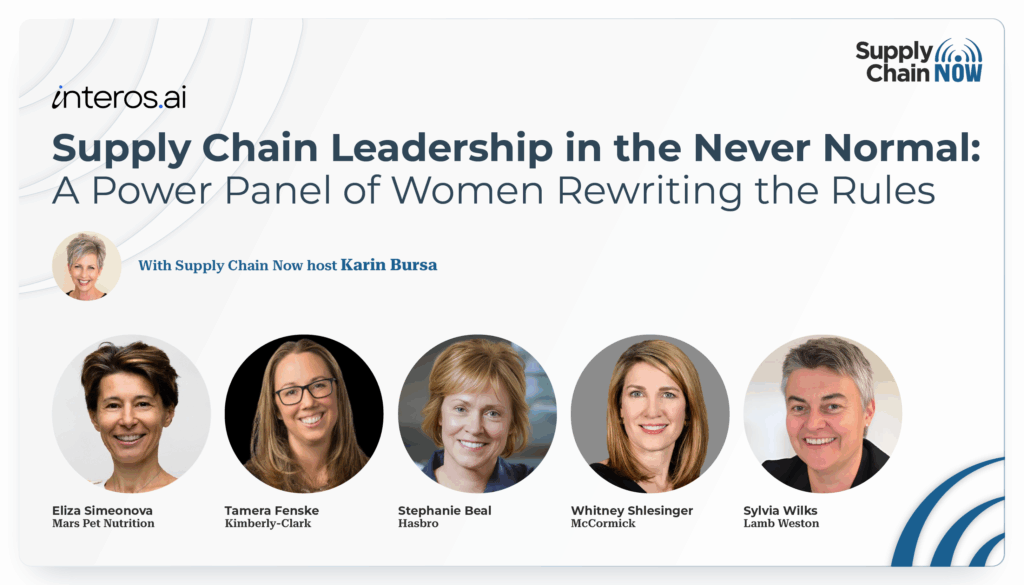
There were so many great shows. I don’t know how you and the team produced so much great content, but I had the opportunity to participate in a number of different shows and discussions on everything from power to distribution to Christmas trees. So there was just a lot of fun content all that had a connection to supply chain, but I have to admit that you gave me a really terrific opportunity when I had the opportunity to host a panel, the first never normal panel of supply chain executive leaders. And I’m going all fan girl here because they were all female. And I had never had that opportunity before. In fact, something like that may never have occurred before, but bringing together supply chain executive leaders like Stephanie Beal and Tamara Fensky and Eliza Simonova and Whitney Schlesinger, and last but not least, Sylvia Wilkes was such a highlight for me.
(06:24):
And I want to thank you for that, but I also want to encourage our audience, if you haven’t tuned in and listened to what these leaders had to share, you can still do it. So that’s available for replay, on demand, on supply chain now. And I just encourage you to just carve out some time, grab a cup of coffee and listen to what these really high impact leaders had to share with us.
Scott Luton (06:47):
Corinne, you still sum my thunder. Although that was thunder I had planned for and expected for, right? I admired the panel and your job of getting so much goodness. Getting an hour with a single chief supply chain officer is like a gold bar you got to protect. And folks, you can check out the on- demand. So Amanda and Trisha, if y’all be so kind to drop the link, make it really easy for folks to go back and check either the on- demand version of the whole show or Corinne has some great blog articles that offer some summary findings too.
Karin Bursa (07:14):
And Scott, you’ve got the next panel coming up this week. So everybody wants to tune into that as well.
Scott Luton (07:21):
This is going to be the next installment of the Never Normal series. So folks, you can find that information right here if you want to sign up, be a part of that right here. And with that said, so go check that out. We try to make things really easy. So back to favorite programming. Now, Corinne, this is kind of like choosing your favorite kid. It’s a tough question because we surpassed 1,500 podcasts last year, and of course, additional hundreds of webinars and live streams, in- person events and whatnot. I admired Corinne’s work. I also love Corinne’s work on lots of supply chain planning conversations last year, ZS, Conaxis, many others. And if you know me, I love good case studies. And we had a lot of those with OMP and SAP and AutoScheduler, EPG, and many others. I enjoyed Corinne. I don’t know if you caught any of our programming with EasyPost.
(08:05):
I love practical, informative, no nonsense shows. And I’ll tell you, those shows help shippers of all sizes. Plus, who’s not a fan of Lori Boyer? I’m her biggest fed, at least in Atlanta. Our new series, The Bridge, offered some great conversations. All that would be a top or near the top, my very long list. And Corinne, I’m looking forward to what 2026 brings in terms of content that informs, educates, inspires, and hopefully challenges us all to think differently. Corinne, your final word on what 2026 might bring.
Karin Bursa (08:37):
Yeah, I agree with all of that. And I believe wholeheartedly that it is a great time to be in supply chain. There’s no question that there’s going to be challenges in the year ahead, but I guarantee you there will be lots of opportunity. And everyone listening here has an opportunity to make an impact. That’s right.
Scott Luton (08:55):
It’s up to us whether we walk through that door or not. Robert, great to have you here today. Let us know where you’re tuned in from around the world. And also, Trisha and them just dropped that big September power panel, Hollywood panel with Corinne and the gang. You can find it right there in the chat. So one more thing, folks, we wrap every show with Do Good, Give Forward, Be The Change. And we are always trying to invest our resources into amplifying really important, consequential, and oftentimes nonprofit missions out there. And to that end, we’re going to be featuring a new segment almost every week here on the Buzz where we’re going to be supporting one of our favorite impactful nonprofits. We’re talking about the American Logistics Aid Network. It connects nonprofit. A lot of folks refer to that as Allen, by the way. Alan connects nonprofit organizations responding to disasters with the logistics expertise and resources of the private sector.
(09:43):
When supply chains folks are disrupted and communities need help fast, well, Alan helps to mobilize transportation, warehousing and supply chain support to move critical goods where they’re needed most. The Allen team’s working on a variety of projects and needs, but two of their current priorities, we’re talking pre-show Corinne. They’re helping the Indianapolis, Indiana community with pre-disaster planning and pre-positioning supplies. That’s a big part of the equation. And you may have missed it in the holiday goings on, but Allen’s helping Southern California recover from the atmospheric river flooding that took place in late December. And they could use your help. We invite you to learn more about open cases and projects from across the globe. They’ve got stuff going to Ukraine, many other places, and you can find out where your help and your support is needed. We’re dropping that link right there in the chat.
(10:27):
Thank you, Tricia. It’s right there, American Logistics Aid Network. And Corinne, I know you are no stranger to the great work that Kathy Fulton and the Allen organization are doing. Your quick word there.
Karin Bursa (10:37):
It’s important work and it’s much appreciated in a time of crisis, which so many communities face. And obviously they’re unexpected. Who would think that California after the fires last year was going to end the year with flooding? So they’ve really had it coming from boat directions, heat and tons of water. If we could only get the water to come at the same time that the fires are happening, we could keep it contained.
Scott Luton (11:00):
Man, maybe this year. But folks, one last nugget, we’re going to bring on a wonderful guest here. Alan, of course they could use your dollars, but they could use your expertise. They could use your supply chain infrastructure. If you’ve got some open warehouse space you want to donate towards a great cause, give Alan consideration. And again, Trisha dropped the link right there. You can learn more about all the things you’re working on, how you can get involved, you name it. Corinne, changing gears here. I’m really excited about our special gusts here we have on the first edition of the buzz in 2026, and I am going to introduce Alex Praden, who brings more than 20 years of deep business expertise to the table, especially at the intersection of strategy, supply chain planning and technology. That is a congested intersection. She’s advised over a thousand global companies across a broad range of supply chain strategic and operational topics.
(11:46):
Alex has held a variety of leadership roles in her career, including serving as a Gartner research analyst amongst many, many other roles. I want to welcome in Alex Perdan, founder and principal at Alchemy Advisory. Hey, hey, Alex, welcome to The Buzz here, powered by EPG. Great to have you join us.
Alex Pradhan (12:03):
Thank you. Thank you so much for having me, and it’s great to talk to you, Scott and Corinne. Well,
Scott Luton (12:07):
Corinne, we’ve been looking forward to this and enjoyed learning from both of y’all out at Gartner Supply Chain Planning Summit in Denver. And Corinne, I’ve got a big question for y’all that just kick things off, right? Y’all know we love our fun warmup questions around here, and this is a timely topic, New Year’s resolutions. Now folks, New Year’s resolutions are kind of like Black Licorice or The Crocs or Dallas Cowboys. Folks love them or they hate them, right? With that as a backdrop, I got to ask you, do you have any New Year’s resolutions you can share? And if you don’t, we got an opportunity to make some here. So Alex, anything you’d like to share resolution-wise?
Alex Pradhan (12:42):
Yeah, I laugh because I usually never complete any of my resolutions. But I would say this year, I’m trying to read more. I love books. I buy them and then either I start reading them or I get halfway through one. And so that is kind of, I think my goal is to … I’m not even going to put a number. I’m just going to try to complete or read more books that I did last year.
Scott Luton (13:03):
Alex, I love that. It’s not quite a smart goal without that number, but hey, we’ll save the 25 books in the new year, Alex. We’ll just cherry pick a number out there. But regardless, I think we could all benefit from reading a lot more. I love that goal. All right, Corinne, do you have a resolution you can share with us?
Karin Bursa (13:17):
I do. It’s funny because it happens to me around books as well. But I was so happy last year that I actually saw my resolution all the way through the year. I think that’s one of the first times I’ve kind of made it all 12 months. So starting off this year strong, I have a book club that I’ve been part of for about eight years,
(13:36):
And I always read the books, but I don’t always make the club meetings. And honestly, the club meetings, it’s the fun part if you ask me. And so my commitment this year is to get to the meetings, not let work or travel, interrupt if I can avoid it, and be there in person and meet with the group because they always pick a great variety of books. They are not supply chain oriented whatsoever. So it kind of gets me out of all of my supply chain and industry and business reading and just kind of unlock some of that creativity juice and thinking a little differently. So my commitment is making the party part of it, not just doing the work.
Scott Luton (14:16):
Hey, I love it. You make a really important point there, the value of being well-rounded, right? We could all nerd out on supply chain stuff twenty four seven. But as we all know, the global supply chain benefits from thinking outside of our industry, right? And so I love the point you made, even if it was a little bit in jest. And by the way, you mentioned book club, Corinne. Stay tuned. Amanda who read like 86 books two years ago.
Karin Bursa (14:39):
I cannot compete.
Scott Luton (14:40):
We want you to be part of a new book club that she’s launching for all of our friends across global supply chain. And I promise you, there’ll be non-supply chain books
(14:48):
In those discussions. Well said, Alex and Corinne, we’re going to hold you to those resolutions. Robert answered our question about where he tuned in from. South Africa. Great to see you, Robert. Love all of our friends across South Africa and for that matter, across African continent. Kara Jose, we included his predictions in with that said, including about geotech. He says, “Hey folks, greetings to the entire team and all the best for 2026 and glad to see Alex on the show.” I am too, Kara. Got to have you back too, really soon. We got a lot of work to do here today. And folks, we want to hear from you. We want to get your take on all these topics we talk about. Combine that with Alex and Corinne, we’re going to be able to solve some problems here today. We’re going to start with reflecting the power of reflecting and the power of reflection.
(15:28):
I really enjoyed this reflective piece from Supply Chain Dive. It took a look at 2025 transformed supply chains. I’m going to share a list from this article, but we all know, folks, this is not meant to be a holistic or comprehensive list. We’d be here for hours, but some of those that they called out, the California wildfires, which Corinne talked about earlier, rebuilding continues to take place there. Trade wars in particular, US trade policy towards Mexico and Canada, but still evolving for that matter. The subsequent inventory front loading that we saw across the US, which made for a really unique peak season, we’re all kind of waiting to see how the pending marriage between Union Pacific and Norfolk Southern, how that comes together. It’d be historic if it does, gets past those regulators. US investments in the critical mineral supply chain, that’s a story we’re going to only hear much more about, hopefully see a lot more action around.
(16:14):
I bet Caracas they could talk to that. And really, that’s just a few of the bigger stories and developments that shaped and impacted 2025 and all will continue to impact 2026 and beyond. So Alex, that begs the question, when you look back at 2025, what are some of the bigger stories that stand out in your mind?
Alex Pradhan (16:30):
Yeah. As I think about 2025, I mean, it was definitely a year that was defined by, let’s call it systematic disruption. And you definitely highlighted a combination of whether it’s trade policy shifts or labor, unrest, natural disasters, and just overall operational uncertainty. And so that’s really forcing supply chain leaders to adapt quickly and rethink their strategies and build that resiliency. But I think what’s happening as we go into 2026, tariffs are going to tighten that economic squeeze for retailers, manufacturers, and consumers. And some of the things that come to mind, especially as I was reading that article was about policy risk must be baked into planning. I think we’re going to start to see a lot more of an emphasis on how to think about that type of risk. There’s actually a report, I was reading consumer goods technology that said nine in 10 manufacturers have made strategic changes to cope with tariff uncertainty, including things like price adjustments, passing on costs and switching suppliers.
(17:29):
And that’s really not surprising. And I really can’t think of any manufacturer right now that hasn’t made some type of strategic change given everything that we’ve mentioned. So I do think as we go into 2026, we’re going to see a lot more of manufacturers reacting to ongoing uncertainty in the face of tariffs and thinking about areas of focus like collaboration, thinking also about supplier diversification and the emphasis of flexibility.
Scott Luton (18:00):
Yes. Well said, Alex, both coming and going, 2025 and beyond. We’re going to touch more on predictions in a minute. For that, Corinne, weigh in on 2025, whether it’s anything that supply chain dive kind of pointed out or top stories that really stick with you.
Karin Bursa (18:13):
Yeah, I think supply chain dive hit the highlights or the big impact items and the big, big story is tariffs. But really the part of that that I think gets forgotten is the volatility on the tariffs. So when they were first announced, they were going to be implemented inside two months timeframe, and then that time got extended and came back and forth. And it’s all of those variables, as Alex mentioned, that we need the ability to model. So it’s not just the tariff increase itself and the price impact on that. It’s the timing of when that gets implemented and what impact that has on our inventory policies. And like you said, Scott, we did a lot of front loading, right? We ordered inventory. We brought it in early when we thought we knew what the cost was going to be, but then we had additional storage costs associated with it, but we need the ability to model that as well.
(19:04):
So we had the West Coast ports, we’re seeing congestion as a result of front loading inventory. So all of those variables come together. I just think that the story for 2025 was that when we look at sales and operations planning or we look at planning our supply chains, we got to be fast and we got to bring in more variables and we have to pull in these market indicators. That’s not going to change.
Scott Luton (19:29):
Well, Sad, Alex, you’re going to add something?
Alex Pradhan (19:31):
Yeah. And I think what Carin is mentioning, what’s really interesting about the inventory story is if we look back at 2024, the focus was on those finished retail goods. And this year was just actually last year, 2025, it was on preloading sits upstream in that middle mile. So wholesalers, distributors holding both those intermediate and finished goods, which is kind of amplifying a bit what we saw at those financial constraints. And I don’t know about you guys, but I noticed, for example, that we saw earlier than usual holiday promotions and discounting as retailers work to clear a lot of that preloaded stock to avoid long-term carrying costs. I mean, I was starting to get, I think it was in September and August, emails and text message promotions about Christmas. And I was like, it’s still the summer. But all kidding aside though, I think also that ripple effect of what is going to happen with tariffs, even as we go into Q1 looking at, for example, reverse logistics cost and returns accounting for 17% of annual retail sales.
(20:34):
So I think that will be really interesting to see if we see an increase, for example, in returns as well.
Scott Luton (20:41):
There’s a lot of good stuff there, Corinne and Alex. Gosh, we could spend the next couple hours on your responses, but I’ll just say the smearing that you called out, Alex, because I got emails on Easter, I think this morning. We’re going to really see it with July 4th here in the States, because it’s the 250th birthday of the US. So we’re going to have July 4th overload. So we’ll see how retailers play that. I want to get to the prediction side. Now, so I got to tell you, I enjoy reading all the predictions that come out at the beginning of every year, maybe the end, right before the beginning of the new year. Some go bold, others go a bit more on the safer side. And I’m not picking anybody, but this blog from our friends, Oliver White, it goes a little bit more on the safer side if you ask me.
(21:18):
For the record though, I should say Corinne and Alex. I’m all for a boring vanilla year here in 2026 after last year, right? But here, check this out. They predict tariff impacts becoming the norm, manufacturing, boom, in the US finally coming to fruition. Everybody’s been tracking that. IBP, integrated business planning continues to evolve. And as we all know, AI is going to continue to dramatically increase the speed of decision making. Got to be ready to move faster and faster and writer. But all that and much more, you can check out the article, we’ll drop that in links. But I want to ask you both. And Alex, you get a tough question first. What’s a couple of your predictions in 2026?
Alex Pradhan (21:53):
Sure. I guess I’ll go first. There’s a lot of conversation about AI. And so to me, I think AI fatigue is coming. This is where we’re going to start to see that the hype is ending. Could we say AI is not cool anymore in a way? We’ve seen that blockbuster deals have soured quickly, especially with open AI and there’s increasing nervousness about the incestuous nature of business relationships in very large tech firms. We’re seeing top AI salaries starting to drop. And I think within the supply chain community, and especially in technology, we’re seeing more levelheaded conversations and webinars about AI. So in a way, it went from the spectrum of AI is going to call it magically solve everything to now we’re talking about the real challenges of AI adoption. But if I had to replace going into next year, or this year, I should say, the AI with new buzzwords, I’m going to predict that this year it’s going to be the year of the ontology and orchestration.
(22:48):
And so I think there’s definitely a growing realization that large language models don’t have those magical answers and they’re great at generating language, but they still need to be grounded. And so that grounding really comes from having a clear structure that defines what does data mean? How does it connect? How should the outputs be shaped? And so the idea of an ontology, I think we’re going to start to hear a lot more of that, which is refreshing and also orchestration as well. That’s one of my predictions.
Scott Luton (23:16):
Love it. Place some bets on some of those predictions from Alex. Corinne, your predictions for the new year, 2026.
Karin Bursa (23:22):
So I’m more bullish on AI than what Alex shared, but I think I’m bullish because of the same reasons that Alex is interested in the ontology and platform. I think hyperscalability, transforming data into insights, these hyperscalers that can unlock new insights and data are going to change what I like to refer to as decision velocity, right? Our ability to model lots of different scenarios and make decisions quickly with confidence. And I think that’s going to be a game changer. I think we started to see that in 2025. I think we’ll hit an inflection point here in 2026 and it will continue to grow from there. But it’s different technology than the way that we have planned in the past, or it’s a different way to harness the signals, whether they’re movement signals, demand signals, disruption signals. The other thing I think that we need to keep an eye on is that one of the expected outcomes of the tariffs is to stimulate US manufacturing.
(24:25):
And I think that we as supply chain professionals all understand that those structural changes take more time. So you don’t just say, okay, I’m going to move manufacturing to the US and 30 days later have the ability to do that. Some of these investments will be multi-year investments before that additional capacity comes online or these brands or manufacturers are able to move that production back into the US. So we need to keep an eye on that. I’m very excited for manufacturing to come back to North America, to the US, but I think we all know that the timelines on that are not immediate. Structural changes in suppliers, production capacity, et cetera, take time.
Scott Luton (25:08):
And energy. That mattered.
Karin Bursa (25:09):
And energy back to power.
Scott Luton (25:10):
Yes. So a couple thoughts here. Y’all both had some great predictions, very actionable for discussion purposes. Two things. I’m going to make two safe predictions. There’s going to be a whole bunch more disruption in 2026. Some of it’s going to be very new to us, right? And all of that leads to why we’ve got to act on the art of the possible that Corinne and Alex both are speaking to with respect to AI orchestration, you name it, right? Those organizations that don’t, that continue to kind of rest on their laurels, they will be at greater risk for being put out of business, unfortunately. And the Falcons aren’t making a Super Bowl. I’m making that fearless prediction. One last thing.
Karin Bursa (25:45):
Is it a prediction if it’s a fact?
Scott Luton (25:48):
AI fatigue. That’s an interesting thing to think about and talk about, Alex. And while it deserves a fuller discussion, I would just suggest to folks out there, a chunk, maybe the plurality or maybe the majority of AI fatigue that we all know is out there. I would argue it’s a leadership problem because we still have a lot of organizational leaders that are seeing what’s out there. Oh, I want some of that. They’re investing without a plan, without a targeted strategy, without where they plan on getting return. They’ll want that ambiguous blob over the fence to their teams that where it creates a ton of fatigue and burnout and frustration. There’s a better way. We all know leaders that are leading those better ways more effective and are not on the AI fatigue train, but they’re on the AI, get it done, and then some train.
(26:34):
And that’s really good news in my ears. So Alex, since it’s your term, the AI fatigue, your quick response, and we’re going to move to what’s next here on the bus.
Alex Pradhan (26:42):
I mean, I think you point out too when it comes to how to counteract that AI fatigue, it’s picking those use cases that are solving critical business problems that are going to drive value. And what we’re seeing also is increased interest in AI pilots. So I think that’s a really good way for a lot of companies to kind of dip their toes and try more emerging or nascent technology. And of course, I’m using the term AI very broadly here. But with that said though, I think one of the areas that also companies need to keep in mind is what is their appetite for risk. So for example, when I used to cover blockchain back when I was at Gartner, one of the things that I would say is, do you have the resources? Do you have the time? Are you okay with failure or do you have, for example, your management metrics are tied to experimenting and failing.
(27:31):
And so that is part of just understanding what is your appetite with risk as you’re moving forward.
Scott Luton (27:36):
Well said, Alex. Well said. Okay. I want to get one more comment here. And I’m not sure if I can share this. I might cut Alex off. I’m just going to read this from Ashwaria. And great to see you, Ashwaria. Let’s see where you’re tuned in from. They share another point here. Supply chains are advancing more to planning and digital tools we’re talking about. Real-time visibility into tariffs, taxes and trade policies combined with scenario planning and AI forecasting. All that’s no longer optional. Leaders are embedding trade compliance into supply chain and procurement processes to react swiftly to tariff shifts, minimizing cost exposure and maintain competitiveness. Well said, Ashwaria, great to see you here today. Come on back anytime and again, let us know where you’re tuned in from. Okay, Corinne, Alex, we got to keep driving. But before we get to the next article, Corinne, I mentioned a little hold on myself a little bit because I love case studies, right?
(28:22):
It’s one of my favorite things to talk about. And I got to share this great case study, which is now on demand. It’s on demand resource we created with our friends at EPG, again, who are powering the buzz all month long in January. So me and Jake Barr, a. K.a. The John, Wayne, the global supply chain, we thoroughly enjoyed this terrific actionable case study on a webinar in December featured Peel Chronister, who’s also known as the king of hats. I think Jake coined that term. He leads warehousing and logistics at Outdoor Cap. And Javier Esteve, with EPG joined us as well, we dialed in on how Outdoor Cap has been implementing voice picking in their warehouse, and it’s really changed again for their operations and their customers talking about an almost 60% improvement on overall quality, which was already high and a 15% productivity jump, which was almost double than what they were expecting.
(29:09):
Even better, it’s going to help fuel more successful growth and expansion the months ahead. We invite you to check out this on- demand recording and learn more about how EPG can play a role within your supply chain organization. Okay. And thank you, Tricia, for sharing that easy link. You’re one click away, folks. What is our next topic here on the first buzz of 2026? We’re going to be talking about speaking of companies that are looking at getting more success in 2026. Wall Street Journal had a great article. It kind of focused on the chief supply chain officer at Cody, one of the world’s largest beauty companies. Now I got to tell you, I was new to this behemoth that is Cody, right? You may be familiar with some of the brands in its portfolio such as Covered Girl Cosmetics, Hugo Boss Fragrances and many others.
(29:51):
The company has struggled a bit in recent years due to a variety of factors, definitely all struggled a little bit in recent years, but Cody has rolled up its sleeves and taken action. They brought in new leadership. They’ve moved some of its manufacturing production from Europe to the US in a timely fashion, may I add? They’ve invested in accelerating product development velocity, no more 18 months to get a new fragrance out, especially when it involves, as their CSCO pointed out, only a month of work, 18 months lead time, and really it’s about a month of work. They’ve been investing in a different way of thinking at their factories more agile and less traditional. And as a result of these and many other measures, there’s more to the story. Cody expects a return to profitable sales growth in the second half of the current fiscal year, which I think started in October, if I’m not mistaken.
(30:33):
So Alex, whether it’s something that Cody’s doing, are you seeing other companies make the moves that Cody’s making here, Alex?
Alex Pradhan (30:40):
Yeah, definitely. I think when I look at that article in general, what’s happening across the market is that consumer expectations are rising faster than supply chains can adapt. And so there’s sort of this growing gap between what do consumers expect? They want fast, flexible, low cost experience, and what supply chains can reliably deliver under all the pressures that we’ve been talking about for the last hour, tariffs, regulatory complexity, demand volatility, and the challenges with data. And I think we’re starting to see a little bit of this tension that it’s not just about cost cutting alone, but it’s serving what is it that the customer really wants. And I think what I really found interesting about that specific use case was that it’s decision making is the most important thing. It’s if you really are reading it, it’s not so much, yes, agility is important, but it really points to how do we improve our decision-making processes so it’s not just faster, but more intelligent and of higher quality.
(31:39):
And I think that is a theme that we’re going to be hearing a lot more this year, especially with new product introductions or new product developments and thinking about what is those right decisions to help with the ultimate outcomes of the business.
Scott Luton (31:53):
Yes. Just faster, is it good enough? Actually, it could be a whole bunch more trouble. And then secondly, kind of to one of your main themes there, and I’m pointing a finger at me, we are fickle as consumers and we’re getting fickle faster, it seems. Corinne, your thoughts on what Cody is doing here?
Karin Bursa (32:08):
Yeah, I think it’s about time. Cody has been struggling for a few years. So I’m excited to see some of these changes, some structural changes, but also they are incorporating artificial intelligence, not just from a supply chain perspective, but in the product design or new product introduction. And that is helping them make, as Alex said, decisions faster or back to this idea of decision velocity and looking at the business plan or rollout for that, but also market testing and looking at or sensing demand so that they can in fact be more responsive to actual market demand, which I think is going to help supply chain performance.
Scott Luton (32:46):
A doubt. Both of y’all have kind of implied or spoken to the value of the pilots and the value of really understanding risk appetite and all that for every organization. I am proud to tell y’all a lot of things that I have created and rolled out there in the past has failed miserably and we’re better off because of it. We
Karin Bursa (33:01):
Learn from that. We learn more from that. Yeah.
Scott Luton (33:04):
Everything we’re doing is working and successful. We’re not getting out there enough. And we certainly aren’t being a trailblazer and being as innovative because all innovation doesn’t work, right? If it did, man, things would be a lot easier in this life. But I admire, I think that’s a really important learning from both of y’all. We’ve got to know what our risk appetite is as we kind of figure out, as the CSCEO clearly has. Cody, hey, 18 months to get a new product. There’s only a month of actual work. We got to think differently. I love that. Alex, your final word.
Alex Pradhan (33:32):
Yeah. And I think what’s also interesting is the change of consumers that many companies are going to be serving. So you have, of course, I am baby boomers, you’ve got your Gen Z and your alpha, but I think this idea of hyper demand volatility where, I mean, they were using the example of the influencers. I’m guilty. I buy stuff through Instagram, but I like it, right? But if you think about traditional supply chains, they’ve been designed for stability and not the world of TikTok and Instagram where you see something, you click, you buy, and then by the way, I want it tomorrow. So it is very much changing the rules of the game. And I would imagine even more so in not fast fashion, but beauty and cosmetics as well.
Scott Luton (34:12):
To your point, and thank you, Alex. Corinne, we had a great show. It wasn’t last year, it was year before, I think, where we featured a supply chain planning leader from an apparel company, fashion company, maybe. One of the big takeaways from that session was if we think supply chain and other sectors is challenging, try to be in fashion and apparel where you got to predict the future. Creden, speak to that for a second before we move on to the next article.
Karin Bursa (34:34):
You are correct. The segment of fashion, which certainly is cosmetics apparel footwear, but it’s also when we think of electronics, consumer electronics, they behave very much like fashion and they get innovated or outpaced or replaced with new models as well. So I think we have to embrace that speed because as Alex said so well, our expectations as consumers is changing, right? We have very short attention spans and we want what we want and we want it right away. And the designers are working hard to provide that, but the supply chains and the ability to source, produce, distribute in a timely fashion can’t do it without technology.
Scott Luton (35:17):
That’s right, Corrine. Imagine how boring it must have been 50 years ago, maybe 80 years ago when all your demand sensing was either foot traffic or long catalog orders that might take you weeks to actually get from the time the customer filled it out.
Karin Bursa (35:31):
I think it was boring. I just think that the challenge is we worked on a problem longer in those days, right? But the challenges are all the same, predicting demand, customer demand in the marketplace, whether it’s business to business or consumer demand, and then sourcing, producing, and distributing efficiently for a profitable business in the marketplace. So we’ve got a lot more science that we can apply to that now. To your point, Scott, when you talked about failing and learning from those failures, we have something that’s a little bit different now. And that is the pace that technology is evolving is happening faster than I’ve ever seen it. So in my 30 years in the industry, I have not seen the evolution of technology unfold as quickly as it has these last couple of years and what’s coming in the next few years will be even faster.
(36:20):
So all I can say is buckle up and don’t expect perfection, but start building those skills on how you’re going to incorporate artificial intelligence, whether it’s in product design like Cody is sharing in this particular case study, whether it’s in your planning process, whatever that might be, you’ve got to start now, don’t wait and be prepared. Have a use case, as Alex said, understand what the problem is you’re trying to solve so that you understand what good looks like on the other side.
Scott Luton (36:47):
Yes. And I would still argue supply chain management careers are much more exciting now. Good, the bad, sometimes the ugly, but well said, Corinne and Alex. We’re going to have a fast and furious finish here in the last 12 minutes of the first buzz edition of 2026. And I want to go next to this great, I thought, a very intriguing piece from our friends at Supply Chain Exchange who recently reported on market research that focused on escalating consumer expectations, ever changing, rapidly moving as we’ve really talked about first half of the show, and the ability of global supply chains to keep up. So get this. I’m going to share a couple findings. There’s a lot more here. Trisha’s dropping a link. I’m going to cherry-pick a few findings from this research and get y’all both to respond to it. So the following findings come from the research report entitled Supply Chain Integrity Outlook 2026.
(37:35):
It pulled a thousand consumers and 750 supply chain leaders all based in the US. So consider this, Alex, Corinne, and all of our friends out there. 84% of supply chain leaders agreed that ever changing trade policies were impacting their planning. I want to talk to 16% that it didn’t impact. And 53% said it has led to increased prices for customers. On the other hand, 56% of consumers said they would stop buying a product if tariff related costs were passed on to them. So I would argue the truth is probably somewhere in the middle. A couple of other nuggets here. Supply chain leaders surveyed 52% said that rapid demand shifts are the biggest threat to supply chain integrity. How about that? 59% of supply chain leaders in the food industry are worried about FDA traceability requirements. Folks, there’s a big deadline related to the Food Traceability Act or rule rather, which is now set for July 20th, 2028, and a third of the supply chain leaders polled are expecting to miss the deadline.
(38:35):
How about that? So Alex, I cherry-picked a few of those findings. There’s a lot more there. Your top thoughts when you see some of the research polling and all?
Alex Pradhan (38:42):
All the numbers, I was actually writing them down as you were talking that it’s pretty … I don’t know if the right word is daunting, but I mean, almost basically half of all supply chain leaders are worried about something that has to do related to, I think, going back to the earlier conversation about how consumer expectations are quickly changing. So if I take that maybe a step further, I really think that the study, what it shows, it’s not just that the bottleneck isn’t necessarily insight, but it’s how do we think about connecting those decisions, the data, the alignment, and going into execution, because that to me is really a big challenge that we’re seeing out there in the supply chain is you’re already aware and you know, and I don’t want to say you know no, but of all these ongoing issues. And then how do supply chains react to that and fulfill the customer promise or meet whatever it is, a corporate strategy?
(39:31):
So if I go back to my earlier prediction that I talked about with this idea of either ontologies or getting better data and a shared understanding across really fragmented enterprise landscapes and whatnot, I think that’s going to become really important and these type of stories just point to that.
Scott Luton (39:47):
Alex, well said. And I love when earlier parts of the discussion are just as relevant in the later parts of the discussion. It’s like we set the table or something. Corinne, respond, react to this research that Supply Chain Exchange published.
Karin Bursa (39:59):
Yeah, I agree with much of what they shared in the article. AI is going to be very important and the demand signaling is going to be more important. It’s always been a challenge. The question is, what do I do with the insights that I get? And does that mean that I not only need my enterprise data, which is what most companies use to produce their demand forecast, but I also need to bring in market data. And that market data has to be specific to the region or community or marketplace that serve. And it’s bringing these things together to drive more precision because my demand in the Northeast of the United States might be very different than it is in the Southwest of the United States or a weather event, as we spoke about before, may drive demand for certain goods that there’s only moderate demand for in other marketplaces.
(40:49):
But Alex made a really important point, and that is how do we take that insight and respond quickly to it? How do we harness our abilities to source, produce, distribute in a fashion that gives us an advantage in the marketplace?
Scott Luton (41:04):
Alex and Corinne, we’re going to have to leave it there. I’d love to dive in deep into a lot more of these findings. But folks, good news is you can. Trisha’s dropped a link right there. You can one click away from checking out supply chain exchanges thoughts on the research and also downloading the original research as well. And hey, David Food. Great to see Dave Food here. Awesome discussion he shares. I really enjoyed the show or a couple shows with Dave last year, as a matter of fact, doing some great things in global supply chain. So Alex and Corinne, I don’t want to take out any of the stuff we’ve got left. So I’m going to use this next one from our friends at Zero 100 kind of as a lightning round, right? It won’t do it as justice, but we can continue conversations afterwards.
(41:41):
But folks, great root here from Kevin Omara and our friends at Zero 100, which centers on how organizations measure return on investment when it comes to AI. So here’s a nugget. At the beginning of this read, I want to share. I want to quote it and get Alex and Corinne both to kind of react to. They write, quote, “Maybe just as Microsoft Office is never really subjected to rigorous business case analysis, AI may soon become so essential to employee productivity that we stop trying to quantify its functional ROI and instead start measuring its impact on human capital development.” So Alex, just your gut response to that.
Alex Pradhan (42:17):
Yeah, I think my initial gut reaction to that is, and I think the article hints to this is that productivity doesn’t automatically equal value. And so we’ve been talking a lot about AI can help people do more faster, but unless that productivity is directed towards the right decisions, the outcomes, the trade-offs, it doesn’t translate into business impact. And so I think that’s sort of that same analogy or example with Microsoft Office.
Scott Luton (42:42):
Well said. Alex, Corinne.
Karin Bursa (42:44):
Yeah, I agree. Artificial intelligence or the use of artificial intelligence, and as we’ve said earlier, there are many different types or forms of that AI. It is going to change the nature of some of the work that is done. And I think we’re just scratching the surface on what that looks like. But I love to tie that back to a term that Alex used earlier, which is orchestration. I love this word orchestration because it makes me feel like we’re back in the driver’s seat versus simply being reactionary to what’s happening in the forces of nature or supply chain around the world. And I think that harnessing this technology and looking at how it changes job profiles or performance profiles or prioritizes the work to be done or the workflows in which it’s done is going to allow us to take control back. So that may sound a little backwards, that artificial intelligence is going to let us take control back.
(43:38):
But I think if we employ it correctly, it will.
Scott Luton (43:41):
I agree with you, Corinne, you and Alex. And I wish we had more time to dive in deep because a really great article here from Zero 100. But folks, go check it out. Trisha Drop link. By the way, we got to have Kevin Omara back, Corinne. Each one is for the bridge earlier this year, second, third appearance with us. And I’ll tell you, the George Clooney of global supply chain is won Kevin Omara.
Karin Bursa (44:00):
Yeah, I saw him in November and we were talking about this topic that this article is about and the work that Zero 100 is doing in how AI is impacting the nature of work or the organization itself with a keen focus to supply chain, but overall business performance.
Scott Luton (44:18):
Outstanding. All right, one more thing. We wrap with this as a cleanup hitter. Alex, I really enjoyed an article that you shared a few weeks ago. It’s entitled Orchestration in Isolation: Why Supply Chain Still Can’t Understand the Whole Picture. Now, I got to tell you, Alex, I hope I’m not the one because I’ve said some version of visibility is table stakes or some version of that. I hope that wasn’t me because this is a compelling piece. But Alex, what’s the primary message you’re conveying in this piece from a few weeks ago?
Alex Pradhan (44:47):
The main point that I think users and the audience should take away from this is that when we think about business value, real value, it comes from connecting the visibility, the decision making, and how do you coordinate all of the different decisions across the entire supply chain, but also having the right balance of automation and the human, so the machine and the human together. And so I really want to implore to people that orchestration isn’t just about reacting faster disruptions and that companies may get that false sense of we are orchestrating because now we can see things quicker and react to that faster, but it’s really about making those better system level decisions that actually move the outcomes. And so it’s a bit different than I think historically we’ve been very focused on, I can see, I get that visibility and I can react to disruptions.
(45:40):
Still very valuable, but that again, is not quite orchestration. So the blog goes into that a lot more.
Scott Luton (45:46):
Well said, Alex. Folks, you should give it a read and listen to what you think. Corinne, when you hear Alex’s thoughts there and the blog itself, your thoughts?
Karin Bursa (45:53):
Yeah, I thought it was very well written. And back to this theme of orchestration, Alex, I like recapturing that. You said something in your blog about we refer too many oars as we look at our different scenarios that get evaluated this or that versus looking at this and that. And I think that technology as it continues to evolve is going to let us take that visibility from the proverbial four walls, which is very narrow and maybe have some blinders up to start opening that up and looking at our trading partners, our customers, our suppliers. This is something that supply chain has desired to do for decades. Back the year 2000 when we talked about CPFR, collaborative planning, forecasting and replenishment, I think technology is now getting to a point where it’s easier to harness, but then we need to think about our supply chain and our business differently, which is one of the takeaways I got from your article.
Scott Luton (46:50):
And folks, give us your thought, whether you agree, disagree, what stands out to you in Alex’s article. We’re dropping this right here. Thank you, Tricia. I couldn’t find it amongst all the other links. We covered a lot of ground here today, but it is a great read that will undoubtedly generate some thoughts for y’all as well. Alex, well done. Really enjoyed that. And by the way, David says, as supply chain executives, for the sake of our companies, we need to get better at asking better questions of our planning, especially as we start using AI. That is right. AI is still figuring out how to ask questions. Humans ask a lot better questions than AI thus far, but you never know what’s right around the corner. I tell you what. All right, so let me ask you both. Really have enjoyed a great discussion here today.
(47:31):
We’re running over for a couple minutes. It’s the bonus edition of the buzz here to kick off the year. How can folks connect with you, Alex, Prodden, and the cool things you are doing at Alchemy Advisory?
Alex Pradhan (47:41):
Yeah, sure. So you can go and connect with me on LinkedIn. So I think you have my link there that you’ve shared and feel free to send me a DM, a direct message, and that’s the best way to get ahold of me.
Scott Luton (47:51):
And we’ll have to next show, we’ll have to talk more about our mutual love for Oreos, which I think we have talked about previously.
Alex Pradhan (47:57):
Yes.
Scott Luton (47:58):
That won’t be on my diet for 2026 for me. That’s okay. Corinne Bursa, you’re doing really great things here at Supply Chain now and many other organizations, including your own Narochio. How can folks connect with you, Corinne?
Karin Bursa (48:09):
Yeah, absolutely. LinkedIn is a great way to connect. Give me a little context about what you’re interested in covering, but I am always looking to connect with supply chain movers and shakers out there. Also, Scott, you and I are going to be together on Thursday of this week. So come back and listen to what we’ve got to share with you on Thursday as well.
Scott Luton (48:27):
Corinne, it’s a great call out. So folks, this is our first live show of 2026, but on Wednesday and Thursday of this week at 12 noon Eastern time, you can find live programming. We continue on Wednesday, our never normal roundtable discussions. We’ve got a trio of supply chain dynamos and supply chain leaders. And on Thursday, Crin and I are going to be sharing some of our key takeaways from Gartner Supply Chain Planning Summit, including a special guest we just confirmed this morning, Noha Samara is joining us on Thursday live. So 12 noon Eastern time. And if you want to learn more, check out. With that said, it’s got all the links you need. And if you can’t find something, reach out to us on LinkedIn or at supplychainnow.com. So I want to make sure Trisha’s got Alex’s link right there on LinkedIn. She also has already shared Corinne’s link right there on LinkedIn.
(49:12):
And if you have not found us yet, if you find us only on social or webinars or whatnot, make sure you’re tuning into our podcast. We’ve got a link right there to make that really easy as well. Okay. Big thanks to our special guest, Alex Berdon, founder and principal at Alchemy Advisory. Alex, thanks for being here.
Alex Pradhan (49:29):
Thank you. It was awesome. It was a great
Scott Luton (49:31):
Talk. It was. I felt like I’m leaving here with some kind of a degree here today from both of y’all. Also, big thanks to my scene co-host, Karin Burs. Karin’s great to see you in person in December. Look forward to Thursday already.
Karin Bursa (49:42):
Looking forward to it. And Alex, love to just kind of geek out with you on this topic anytime. Sang me
Alex Pradhan (49:47):
Up.
Scott Luton (49:48):
We’ll do that. You’re already registered as of right now, Alex. And big thanks to our friends at EPG who are powering the buzz in January and many global supply chain’s electric performance in 2026 and beyond. Of course, big thanks to Amanda and Tricia behind the scenes. And most importantly, big thanks to our global audience for being here with us. Appreciate all the comments. No, we couldn’t hit everybody’s, but we look forward to you tuning into our future live programming as soon as Wednesday. So with all that said, you got to take one thing, folks. We’re going to kick off. You got more homework in the new year. Take one thing. Alex and Corinne brought a truckload, maybe a couple of truckloads of actionable perspective and expertise. Take one thing, do something with it, share it with your team. It’s all about deeds, not words. That’s what drives action, right?
(50:28):
And with all that said on behalf of the entire supply chain now team, Scott Lewton challenging you, do good, give forward. Be the change that’s needed. We’ll see you next time right back here on Supply Chain Now. Thanks everybody.
Intro/Outro (50:39):
Join the Supply Chain Now community for more supply chain perspectives, news and innovation. Check out supplychainnow.com. Subscribe to Supply Chain now on YouTube and follow and listen to Supply Chain Now wherever you get your podcasts.