[00:00:00] Stephanie Thomas: We may have this amazing technology, but we’re still gonna have to develop those skills. And the other one that kind of went along with that a little bit for me sitting in and as an educator at the university level, is we’re constantly evaluating how are we training the next generation?
[00:00:19] Voiceover: Welcome to Supply Chain Now the number one voice of supply chain.
[00:00:23] Voiceover: Join us as we share critical news, key insights, and real supply chain leadership from across the globe. One conversation at a time.
[00:00:32] Scott W. Luton: Hey. Hey. Good morning, good afternoon, good evening, wherever you may be. Scott Luton and Mary Kate, love with you here on Supply Chain Now. Hey, Mary Kate, how you doing?
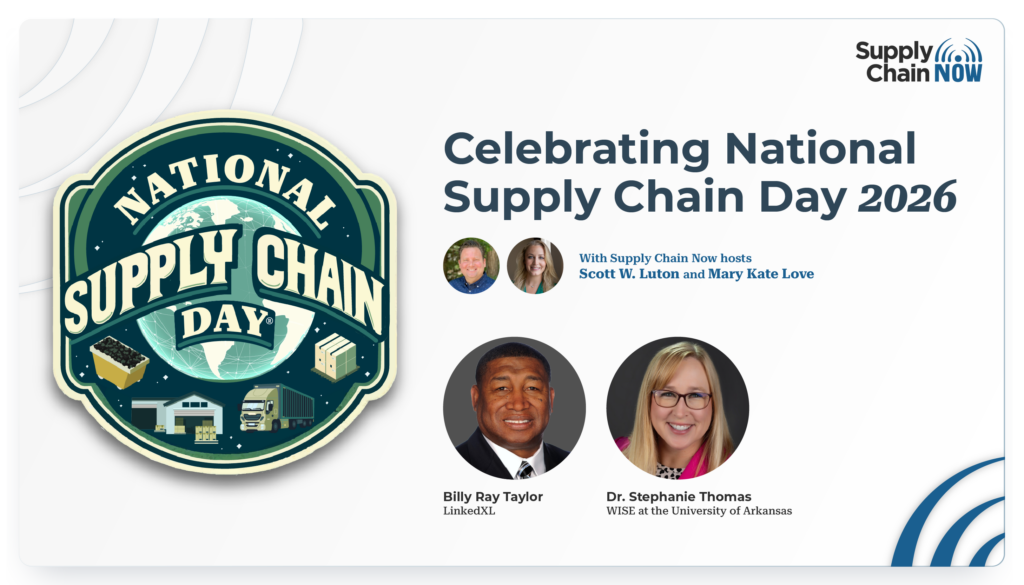
[00:00:41] Mary Kate Love: Hi there. Happy National Supply Chain Day.
[00:00:44] Scott W. Luton: You beat me to it. Happy national. You let the cat outta the bag, but hey, everyone knows. Everyone knows April 29th. Yep. Is the day set aside to celebrate this incredible global supply chain industry. We all love so much. And as I like to say, Mary Kate, don’t let the name fool you because we believe that every country out there needs to be celebrating national supply chain day.
[00:01:11] Scott W. Luton: Just like we’re every nation needs a national supply chain day. Is that right Mary Kate?
[00:01:14] Mary Kate Love: Totally agree. It’s really the industry that is the most connected. Right? It connects our entire world.
[00:01:20] Scott W. Luton: It is. It is. And today, folks, we got a big show. The one and only Billy Ray Taylor is joining us. We got a lot to get to.
[00:01:27] Scott W. Luton: We got awards. Yeah, you name it. And Mary Kate, when you think of the lineup we’ve got, and we’re also gonna kind of tip the hat to where we’ve been Yeah. And maybe where we’re going.
[00:01:37] Mary Kate Love: Yeah.
[00:01:37] Scott W. Luton: But hey, is there any better of a way to celebrate this industry we all know and love?
[00:01:42] Mary Kate Love: No, I love this. Like you said, global team sport.
[00:01:45] Mary Kate Love: And really the whole idea behind this day is to celebrate the people of supply chain. And you can do that through storytelling, right? So we’re gonna be telling. Lots of stories about the people in supply chain today.
[00:01:57] Scott W. Luton: Let’s level set on this mission.
[00:01:59] Mary Kate Love: Yeah.
[00:01:59] Scott W. Luton: Of national supply chain day. You created this day when you were back at Georgia Pacific.
[00:02:05] Mary Kate Love: Georgia Pacific. Yeah. Right. In 2020, so,
[00:02:07] Scott W. Luton: right. And you know what? I jumped in the way back machine and I found a pick from the very first,
[00:02:12] Mary Kate Love: yes.
[00:02:13] Scott W. Luton: National supply
[00:02:14] Mary Kate Love: chain tank. Oh my God. Look at that. That’s me in my apartment in Atlanta. Swelling a lamp forward because I had no lights.
[00:02:22] Scott W. Luton: You’re innovating,
[00:02:24] Mary Kate Love: and of course.
[00:02:24] Mary Kate Love: So awesome.
[00:02:26] Scott W. Luton: Our dear friend Greg White is with us there. Yeah,
[00:02:27] Mary Kate Love: this is handwritten. I love it.
[00:02:29] Scott W. Luton: Love it. And it gets better. We even captured a social graphic from Yes. Six years ago where you’re celebrating the first ever national supply chain day. And I think I made a comment there. Look at those graphics.
[00:02:41] Scott W. Luton: Uh, it only took over 240 years in this country, but we’ve got a national supply chain day. So, and as you mentioned, man, we’ve come a long way, folks. That was when most, a lot of us were locked down and, and not having much fun. Fun. We were, we. But you know what, what hasn’t changed, I don’t think. And we’re gonna check in with Mary Kate to find out the mission.
[00:02:58] Scott W. Luton: The mission exactly That major, take that first step years ago to what we do today here in 2026.
[00:03:04] Mary Kate Love: Yep.
[00:03:05] Scott W. Luton: I think it’s mainly just gained more momentum and ambassadors, but Mary Kate, tell us more.
[00:03:08] Mary Kate Love: Exactly. Yeah. The overall mission right is to propel our industry forward. So, you know, taking supply chain from almost a background.
[00:03:17] Mary Kate Love: Operational thought to more of a forward, Hey, this connects everything. This runs everything we need to spend more time and attention on supply chain. So of course, naturally supply chain has really come forward as an of interest to everyone, just given kind of the state of our world. But we need to continue to tell the stories of supply chain so we can keep pushing it forward.
[00:03:41] Scott W. Luton: Like any industry out there, and perhaps more so, it’s a very living and breathing industry that changes sometimes by the hour. It’s really important that we do it that way because consumer expectations continue to change by the By the minute too. Is that right, Mary Kate?
[00:03:56] Mary Kate Love: That’s a fact, right? I mean, I get about six text messages now every time I order something online about where it is, when it’s coming to me.
[00:04:03] Mary Kate Love: It is almost too much visibility, dare I say, in that moment.
[00:04:07] Scott W. Luton: Dare you say that. So yeah, I gimme some of that visibility. Yeah. But, um, anyway, we have got, uh, we’re gonna keep track. We’re gonna be fast moving here today, just like our industry over the next hour and up next Mary Kate, now that we’ve level settled on the mission, and again, I really appreciate your leadership, your innovative leadership.
[00:04:24] Scott W. Luton: I’ll tell you, you don’t give yourself enough credit because you’re helping. Thank you. Our industry continue to change. You’re helping what we do here to continue to change. And we all, it all is highly noticed, uh, yeah.
[00:04:34] Mary Kate Love: And
[00:04:34] Scott W. Luton: appreciated.
[00:04:35] Mary Kate Love: And we have, there’s now in-person events happening too. New gen architects is having a few in-person events.
[00:04:40] Mary Kate Love: You can see more on our webpage if you visit supply chain now.com/nscd. But that is so exciting. We love seeing that.
[00:04:48] Scott W. Luton: This next segment. I’ll tell you what, we are very fortunate to have a world-class keynote. Join us here on National Supply Chain Day. So the last few years I’ve thoroughly enjoyed learning from and collaborating with the Billy Ray Taylor.
[00:05:02] Scott W. Luton: If he doesn’t have the, in his name, he should have the, in his name. Uh, he’s the one and only. So Billy, I’ve got his book here, we’ll talk touch on in just a second. Billy’s got deep roots in the industry, especially the manufacturing industry, where he served in leadership roles that absolutely transformed factories and invigorated the workforce.
[00:05:18] Scott W. Luton: The word bestseller, Mary Kate is thrown around a lot these days.
[00:05:21] Mary Kate Love: Yeah, yeah, yeah.
[00:05:22] Scott W. Luton: But the winning link, which he wrote a few years back, has flown off shelves. I think they’re moving into its next printing.
[00:05:31] Mary Kate Love: Wow.
[00:05:31] Scott W. Luton: And one of the reasons it is, is because he tells stories. Like you were saying, and, and shares, tools.
[00:05:37] Scott W. Luton: Been there and done that perspective that works. And look at the line of folks signing his, uh, getting his autograph.
[00:05:42] Mary Kate Love: I was just gonna say, look at this. That’s awesome.
[00:05:45] Scott W. Luton: I am impressed. Um, but he’s not one to sit on, uh, sit on laurels. I think that’s how the phrase goes. He serves a CEO and president of LinkedXL, a global consulting firm focused on helping organizations design and implement high performance operating and management systems.
[00:06:02] Scott W. Luton: His mission to change the world just does not stop. So I wanna hear from our special keynote speaker, the Billy Ray Taylor, right here on National Supply Chain Day.
[00:06:13] Billy Ray Taylor: Hello and welcome to National Supply Chain Day with Supply Chain Now I am Billy Ray Taylor, founder and CEO of LinkedXL. I’m excited to be here with you today.
[00:06:29] Billy Ray Taylor: I work with companies all over the world on how to win. And often when I walk into companies, I ask leaders, are you winning? And they often say, yes, but as I go deep into their organization and talk to operators, supervisors, I ask that same question. Are you winning? In most cases, they have no idea. See, what I wanna talk to you about today is how you win, how you define a line and execute winning so that you can win every day in the supply chain.
[00:07:10] Billy Ray Taylor: Well, before we get started, I want you to write this down. You can’t manage a secret. See, in most companies, I go into the strategies a secret. The standards are secret. And even if you’re winning a secret, as you go deep down into the organization, see what’s important about winning. Is extreme ownership.
[00:07:35] Billy Ray Taylor: So those three things I talked about with you, how to have deliberate clarity on what winning is. Deliberate ownership, where people know what they own. In your strategy and deliberate practice, what’s your routine to win every single day in the supply chain? So let’s get started. Let’s talk about deliberate clarity.
[00:07:58] Billy Ray Taylor: See, starting with the standard on how you win is the most critical thing you can do often follow a, a gentleman by the name of John Linas. John was one of the greatest leaders and coaches in history. Some of the great follow him. And remember what I said, you can manage a secret. See, John was doing his last keynote and he walked on the stage and he had a baseball plate around his neck and see that baseball plate he put around his neck and he says, if you’re ever gonna win.
[00:08:32] Billy Ray Taylor: You must start and hold to the standard. He said, this baseball plate is 17 inches. See, if you played little league baseball, home plates 17 inches, high school, baseball, home plates, 17 inches. If you played college baseball and having to make it to the majors, home plate is 17 inches. See, it’s the standard.
[00:08:58] Billy Ray Taylor: Players may change. Age differences happen. That means the plate’s a lot closer. But whenever changes is the standard, it’s 17 inches. See, most companies and leaders, they wanna widen the plate. You can’t widen the plate in business, and here’s why.
[00:09:22] Scott W. Luton: See,
[00:09:23] Billy Ray Taylor: write this down. What you accept, you cannot change. See if you have a standard around safety, your operating procedures, your people quality, that’s the standard.
[00:09:39] Billy Ray Taylor: But a standard isn’t what you write down. It is what you walk by. Let me bring that into perspective. See, if you have a 16-year-old daughter or a son and you say the curfew is at 1130 and that child comes in at 1:30 AM and you say nothing, and they do that two weekends in a row, what’s the new standard?
[00:10:03] Billy Ray Taylor: It’s one 30. Who set the standard? It’s not the child. It is you. Because see, you accepted that new standard. The child tested your standard. Remember what you accept, you cannot change. So that’s what I mean. Your standards can’t be a secret. What you expect cannot be a secret. And so your strategy cannot be a secret.
[00:10:34] Billy Ray Taylor: See, most companies don’t fail because of bad strategies. They fail because they don’t know how to execute. And that’s what I’m moving to the next section. How do you execute these? Next two topics I’m gonna talk about is around deliberate ownership and deliberate practice. But let’s get into deliberate ownership.
[00:10:56] Billy Ray Taylor: See, the strategy for execution is this, strategy plus execution equals results. What if it was that simple? Why do so many companies struggle with it? It’s the plus strategy. Plus who owns what in my strategy allows me to execute. See, most companies fail. To attach ownership to their strategy. It’s not clear who owns what.
[00:11:27] Billy Ray Taylor: And I have a saying when two people own feeding the dog, the dog dies. Why? I thought you fed the dog. No, I thought you fed the dog. Well, no one feeds the dog and then the dog dies. See, you have to have that deliberate ownership because you have to drive that ownership to the lowest level of the organization.
[00:11:49] Billy Ray Taylor: I’ve been walking the companies and everybody’s calm while they’re building the strategy, and so we have a goal to make $8 million, and everybody sits at the table very calm, but at the end of the month, we make $7 million. Companies often panic and go into blame mode because it is not clear who owns what in that strategy.
[00:12:16] Billy Ray Taylor: Have you ever heard this saying, oh, we missed by 1 million. Stop traveling, no catering, pause on hiring. We even get, I’m telling you outside of the box, stop. Stop spending. Get your in pens out of a hotel room. We don’t know who owns what. So we take this scattered approach to winning. Great companies drive ownership to the source because most leaders confused working in the business with working on the business.
[00:12:54] Billy Ray Taylor: And so that’s why we move to the next portion of this keynote. It’s called Deliberate practice, your daily management and operating System. It’s the routine on how to win. And what I often see companies, they’re very good at zeroing in on what are the KPIs and you heard measure what matters. So we get so connected to the KPI that we never focus on the KPA and see.
[00:13:31] Billy Ray Taylor: The KPI are the key performance indicators. The KPAs are the key performance actions, the things that we have to do to achieve the indicator. Let me give you a practical example. See if I wanna lose weight, I stand on the scale. That’s called the KPI. It tells me my current state. But I have to focus on the KPA.
[00:13:59] Billy Ray Taylor: Did I work out? Meaning did I take 10,000 steps today? Did I eat 3000 calories today? Did I work out five days in a week? And at the end of the week, if the scale didn’t move, then I go back and analyze my KPAs. Well, how many calories did I eat? Oh, I ate 4,000. Well, how many steps did I take? Well, I took 10,000.
[00:14:27] Billy Ray Taylor: How many days did I work out? Four days out of five days. So I know specifically why the skill isn’t moving, or it tells me if I’m focusing on the right things or not. And so good companies build their systems around KPIs that drive the KPIs, and you must know the score. See, when you go to a football game, the first thing you do is look at the score.
[00:14:54] Billy Ray Taylor: We rally around winning. Imagine going bowling and you bowl the ball down the alley, but then halfway down the alley, there’s a curtain came down and you didn’t know how many pins you knocked down. So what’s your next move? What’s your strategy? It’s hard to create a strategy because your performance is a secret.
[00:15:15] Billy Ray Taylor: And remember what I said, you can’t manage a secret. So you must have that deliberate practice. And the next thing is, the last thing I want to point out is earning the right to win. Earning the right to change. See, there’s two rights. The cultural right and the technical right? The technical right. We seem to always get that right.
[00:15:43] Billy Ray Taylor: I have a title, I make enough money, I’m in charge. I’ve given you tools. But when tools lead failure follows. Now the next thing I want to talk about, what’s really critical is the cultural right. The cultural right is that respect, that trust. Why would I follow you? My mother would often ask me that question, but she would say to me, do people trust you?
[00:16:13] Billy Ray Taylor: My favorite quote is, if a bird lands on the branch, does the bird trust the branch or does it trust its wings? My mother would often say, I’ve seen many birds land on branches, but what I’ve never seen is a branch break and the bird fall and die. She would say, trust your wings. What I will tell you is people will trust you if you have their respect.
[00:16:39] Billy Ray Taylor: See behaviors you can see mindsets you can’t trust. Influences the mindset. See people have four basic needs that need to be heard, them need to under to be understood, that need to matter, and a need to be free to be who they are. See, and that’s how you win in the supply chain. Because see, it’s all around value.
[00:17:08] Billy Ray Taylor: People will migrate to value. And what drives that value is this. How do you define winning? How do you align yourself to win? And how do you have an execute so that you can win? It’s your daily practice. And in the end, how do you foster an environment of trust? I thank you for having me today on this special day with supply chain now and National Supply Chain Day.
[00:17:41] Billy Ray Taylor: Have a great day and enjoy supply chain day, the National Day. Billy Ray Taylor signing out.
[00:17:51] Scott W. Luton: I love it.
[00:17:51] Mary Kate Love: Love that. I could listen. So motivational
[00:17:55] Scott W. Luton: it, you know, it is so motivational. But I think what takes it a step further is, uh, and a lot of folks may not know, uh, some folks may not know Billy Ray’s background, but, but he established an incredible track record going into plants and turning them around, empowering the workforce, invigorating the workforce, and what he espouses he knows because he’s done it.
[00:18:18] Scott W. Luton: So folks, I want to make sure check out his book. I’ve got it. I’ve read it twice. What’s some of your favorites, Mary Kate.
[00:18:25] Mary Kate Love: Okay, first of all, lifelong softball player had no idea that the standard plate size is 17 inches and it never changes. So that’s just a little side fun note, but I had no idea. I’m sure, sure.
[00:18:37] Mary Kate Love: Other people didn’t either. But true takeaways is, uh, I love the saying you cannot manage a secret. I think that’s huge, right? I’ve always thought you cannot, you know, measure anything that you don’t know about either, right? So you can’t keep track of something that you’re not aware of. And it made me think about innovation and supply chain in general, and how whenever we were doing an innovation project or going to solve a problem, we were very focused on making sure that the people that we were helping could define their problem first.
[00:19:11] Mary Kate Love: So, I know that sounds a little bit silly, but if you’re not able to define the problem, right, and you know, there’s no element of secret there, you gotta be able to define the problem if you’re not able to say exactly what the problem is. The impact it has in who owns the problem, which is another point Billy Ray made.
[00:19:28] Mary Kate Love: It’s probably not worth solving or you’re not ready to solve it, which means you’re not ready to innovate there. So I love, love, love that. I wrote that down about you cannot manage a secret.
[00:19:39] Scott W. Luton: A couple things I wanna pull out though, uh, beyond what you shared. Uh, first off, he mentioned his mother, Ms. Vera.
[00:19:46] Mary Kate Love: Yeah.
[00:19:46] Scott W. Luton: And she’s got some of the best takes on business and life. Yeah. That really drove his performance and his success. You have to get the book to read ’em out. Yeah. Uh, to check ’em out. Um, working, of course, working in the business versus on the business. It’s so easy to work in the business. We gotta help ourselves and our people to work, own the business, own the business.
[00:20:06] Scott W. Luton: And then I could go on and on, but, uh, clarity, deliberate clarity. Folks, this world, our industry, our supply chain ecosystems does not have enough clarity. We focus a lot on visibility. Whole different thing than clarity. I know they’re close and it reminds me of that moment from a few Good men, Mary Kate, when Jack Nicholson, the the Colonel.
[00:20:27] Voiceover: Yes.
[00:20:28] Scott W. Luton: Is like, are we clear?
[00:20:30] Voiceover: Yeah.
[00:20:30] Scott W. Luton: And Tomm Cruise says Crystal.
[00:20:32] Voiceover: Yeah.
[00:20:33] Scott W. Luton: But there’s a big gulf between visibility and clarity. And if we’re not being in intentionally clear
[00:20:39] Voiceover: Yeah.
[00:20:40] Scott W. Luton: With our team members, then we’re not doing what we should be doing. So one last thing and then we’re gonna get to a couple great awards.
[00:20:48] Scott W. Luton: And folks, if you liked what you heard there, come join us May 15th as we welcome him in to Hall of Famers, not only Billy Ray Taylor, but regime Vallee. And we’re gonna be focused on how there’s really no finish line in leadership. We’re gonna have to offer up. Been there, done that. Tips on not just strategy, but something else you heard there from Billy, how to execute.
[00:21:09] Scott W. Luton: So Mary Kate, do you feel that?
[00:21:11] Mary Kate Love: I feel that.
[00:21:12] Scott W. Luton: That is the pressure that is on this industry each and every day. Sometimes
[00:21:17] Mary Kate Love: every day,
[00:21:18] Scott W. Luton: every time there. Sometimes it’s overwhelming. 2026 has delivered no shortage of challenges in global supply chain.
[00:21:24] Mary Kate Love: Yeah, it’s much more right? I mean, I was reading something about weather related challenges being five times more prevalent, um, in the last few years than it has in the past.
[00:21:35] Mary Kate Love: So just, you know, natural disasters and things like that, which obviously very much affect the supply chain.
[00:21:41] Scott W. Luton: That’s interesting ’cause that’s what I have been reading as well. If you look at, uh, research from ey, McKinsey, and, and other prestigious organizations, it shows that large scale macro disruptions have accelerated.
[00:21:53] Scott W. Luton: Dramatically.
[00:21:54] Mary Kate Love: Wow.
[00:21:55] Scott W. Luton: A hundred years ago. Such disruptions occurred every five to 10 years.
[00:21:58] Mary Kate Love: Yep.
[00:21:59] Scott W. Luton: Fast forward to today, they happen three to five times per year, so a couple words to give out. We’d be here all day acknowledging and celebrating innovators across global supply chain. But our team did want to create an award that shines a spotlight on innovative leadership that’s truly changing our industry.
[00:22:16] Scott W. Luton: And so today I’m very proud to announce. Are you ready, Mary? Kate, are you ready?
[00:22:20] Mary Kate Love: I’m ready. I’m excited.
[00:22:22] Scott W. Luton: I am proud to announce our first Innovative Leadership award on National Supply Chain Day, and that is Keith Moore, CEO, at AutoScheduler.AI. Now, Mary Kate, some of y’all out there know that I’ve spent some time with Keith and customers and team members going back the last couple years.
[00:22:42] Scott W. Luton: The AutoScheduler team, I’m gonna tell you, Mary Kate is transforming how warehouses are managed and run. In fact, they’re helping companies of all sizes confidently answer the question. Do you know what’s happening in your warehouse right this very minute? And then AutoScheduler is helping those same organizations and their teams implement what should be happening.
[00:23:02] Scott W. Luton: Mm-hmm. Especially from a smart orchestration standpoint that optimizes automation systems, real-time decision making, workforce management, overall performance, and a whole bunch more. Now we’ve, as I mentioned, we’ve spent time with a few of AutoScheduler customers who have shared the transformative effect that it has had, the team has had on their operations and outcomes.
[00:23:22] Scott W. Luton: And Mary Kate, this is my favorite part, and if anyone’s ever listened to any single podcast I’ve ever been on, I’m, I bet this is like me beating a dead horse, but I can’t help it. It’s genuine.
[00:23:32] Mary Kate Love: Yeah.
[00:23:33] Scott W. Luton: What auto schedule has done, what Keith and team have done, have made the workday get a lot easier for the incredibly talented, dedicated, and hardworking human element that wanna show up and deliver.
[00:23:45] Scott W. Luton: The onus is on US industry leadership. To help eliminate as many of their headaches and obstacles as we can. So congrats to Keith Moore, CEO and co-founder of AutoScheduler.AI, and we’re gonna hear from him in this brief message coming up.
[00:24:01] Keith Moore: I’m Keith Moore, CEO of AutoScheduler.AI. I’ve been a supply chain technologist my whole life and what excites me the most about the future of the supply chain is that we’re finally leaving the era of the point solution.
[00:24:14] Keith Moore: So technology’s kind of finally catching up with the people and processes that we’ve always needed. You think it, you know, for decades every new problem in a warehouse meant there was another system you’d put in another integration and another six month IT project teams always had to bend their operations to the software instead of the other way around.
[00:24:34] Keith Moore: If you’ve done a WMS implementation, you know what I’m talking about. So we’re moving away from that. And the future that I see is a supply chain that doesn’t run on spreadsheets, whiteboards, or tribal knowledge. It’s where planning and execution work together and actually talk to each other, where people can teach software, how to make decisions so they can focus on the most important parts of their operations.
[00:24:55] Keith Moore: We’re, we’re quickly moving into that age of AI and supply chain and I’m excited that AutoScheduler and our team is helping to shape what that looks like with our innovative partners. Thanks to Scott and the supply chain now team and Happy National Supply Chain Day.
[00:25:08] Scott W. Luton: We like to keep it real around here, folks, and we kick the tires hard before we, we give especially formal recognition and it really is, uh, incredible to see what Keith and the gang are doing.
[00:25:20] Scott W. Luton: But Mary Kate equally as incredible
[00:25:23] Mary Kate Love: Yes.
[00:25:24] Scott W. Luton: Is celebrating folks that have been doing big things in industry for years upon years, and we’ve got a very special second award. Right?
[00:25:31] Mary Kate Love: Yeah. So next up we have our lifetime achievement award. So I’m really excited to give this award to Jim Opoka, recently retired from FEMA.
[00:25:41] Mary Kate Love: So really this award is honoring an individual Jim, whose career has left an enduring mark on the supply chain industry. So, perfect timing. As Jim just retired this year, his extraordinary career has been dedicated to public service and emergency response with fema. So as you can imagine, um, Jim is perhaps the person who feels supply chain challenges and pressures, right?
[00:26:05] Mary Kate Love: Probably the most out of all of us. And I’ve been able to see him navigate those challenges. And really, you know, a job like that requires you, and you’ll hear from Jim too, I don’t wanna take away, but he’s spent four decades really being there for people on the worst day of their lives, right? And making sure the people, the government, the cities first responders, have the right resources and plan that they need.
[00:26:30] Mary Kate Love: So, really unique role. Or you need to see big picture and little picture at the same time, which I think a lot of us feel in our supply chain careers. So. You’re gonna hear from Jim and a little bit more about his role, but really excited to be giving this Lifetime Achievement Award to Jim Opoka from fema.
[00:26:47] Jim Opoka: Hi, my name is Jim Opoka and I’m recently retired after nearly 38 years with the Federal Emergency Management Agency or fema as a resource recovery branch chief and a, uh, response operations section chief. I worked many, many national floods, tornadoes, hurricanes, earthquakes, and our national COVID Pandemic Logistics and Supply Chain Management and any response in recovery operation.
[00:27:20] Jim Opoka: We, we are constantly juggling critical resources to meet the needs of individuals and governments on one of the worst days of their lives following an event. I’m very excited to see the advances in technology. And the increased communication and collaboration amongst supply chain professionals that allows us to respond better and faster to resource shortfalls in any event.
[00:27:50] Jim Opoka: And that ability makes us all stronger as a nation epi national supply chain day. Thank you.
[00:28:00] Scott W. Luton: That’s terrific. It’s great to, uh, recognize good, innovative leaders that truly, uh, have a far reaching impact. And in Jim’s case, a far reaching legacy. And Mary Kate, as you mentioned, that space, at least in my opinion
[00:28:16] Voiceover: Yeah,
[00:28:16] Scott W. Luton: a whole disaster recovery, the FEMA space, you know, helping people in their worst day, not only the individuals, the professionals in that space I think are way too under-recognized, but the supply chain I orchestration it needs to get a whole bunch more, much bigger spotlight.
[00:28:33] Scott W. Luton: Right.
[00:28:33] Mary Kate Love: Yeah. I envision a time where. Yeah, there could be innovations that support those type of rapid relief efforts. You know, there already are, but I imagine there are more opportunities ’cause it’s just, you know, a job where you have to be solving so many problems every single day and it’s ever changing too.
[00:28:53] Scott W. Luton: That is right. So, congrats for on behalf of all of us here, congrats to both of our, uh, award winners. Uh, both Keith Moore moving mountains out there across industry, and Mr. Jim Opoka, who has, uh, established an incredible track record of helping so many and doing so much for communities out there. One last thing and we’re running along, folks, if I can run along on any day of the year, please let me run along on National Supply Chain Day.
[00:29:21] Scott W. Luton: Okay. I wanna celebrate because this book is live today and this is a wonderful member of our, uh, family, a c Global fam. And this is Will Quinn, who published Modern Warehouse Management. Today on National Supply Chain Day. Go, go check that out folks. Um, alright. We got more good news. Mary Kate. I teased a special second guest here today, right?
[00:29:44] Scott W. Luton: Yeah. Earlier, right?
[00:29:45] Mary Kate Love: Yes, you did.
[00:29:45] Scott W. Luton: So we are delighted to welcome in a very good friend, a Titan industry. Uh, a very special guest who is also moving mountains, uh, out in industry. Dr. Stephanie Thomas serves as an associate professor of practice at what some may say is a top supply chain management program in the country, the University of Arkansas.
[00:30:05] Scott W. Luton: She also has a very deep practitioner background in supply chain. Having worked at companies such as Lowe’s and even IBM, but perhaps my favorite, she has founded and currently leads an incredible organization that is engaging bright student minds on all things supply chain leadership. That organization is wise and it’s got several dozen universities and colleges as members and folks, if your school is not part of wise, let’s fix that today.
[00:30:33] Scott W. Luton: So I wanna bring in our dear friend, Dr. Stephanie Thomas. Hey. Hey Stephanie. How you doing today?
[00:30:40] Stephanie Thomas: I’m glad to be back again.
[00:30:42] Scott W. Luton: Hey, really quick as we move ahead. I want to share, uh, I, I was honored to be a part of the last wise leadership symposium, which would, this was a picture from, uh, September last year is one of my favorite events of the entire year.
[00:30:55] Scott W. Luton: And, uh, Stephanie, we’re gonna talk about wise and how folks can connect, but what’s your favorite thing about getting all these incredibly intelligent, bright folks together once a year?
[00:31:05] Stephanie Thomas: Seeing the enthusiasm and, and excitement of this upcoming generation for the, for the field and, and just they are ready to, to tackle and take on the world.
[00:31:14] Stephanie Thomas: And, you know, some of us as we get older, can get a little. Cynical about things and to see that there’s, you know, this passion and enthusiasm out there is just, um, invigorating and you’re like, you know what? Everything’s gonna be okay.
[00:31:27] Scott W. Luton: And Mary Kate, the thing, the cool thing about that is one, one of the intriguing things about that is, you know, Stephanie right now and the whole wise organization and all the, uh, wonderful people engaging these bright minds, there are more Keiths and gems and Mary Kate’s and Stephanie’s out there that is gonna graduate and go change the world.
[00:31:46] Mary Kate Love: Yeah.
[00:31:46] Scott W. Luton: And it’s a critical role. It’s a critical mission. Your quick thoughts, Mary Kate?
[00:31:50] Mary Kate Love: Yeah, I totally agree. And I, you know, that’s the whole point of this day, right, is to not only celebrate people that are already doing it, but hopefully inspire the next young generation to see supply chain as an industry that they wanna spend time with and get passionate about.
[00:32:06] Mary Kate Love: So that is the perfect. Kind of connection with national supply chain days, connecting that, the new generation.
[00:32:12] Scott W. Luton: That’s a great segue for this next segment, because you know, this industry, we love focusing, uh, national supply chain day around the people. The people. Even in this golden age of supply chain tech is the people that often are taken for granted.
[00:32:26] Scott W. Luton: So what we wanna do, Stephanie and Mary Kate, is celebrate a couple roles or positions that make global supply chain happen each and every day. And Stephanie, I’m gonna give you, you’re gonna, you’re gonna be the lead off hitter here. What are a couple roles that come to mind?
[00:32:40] Stephanie Thomas: I was trying to think who are some of the behind the scenes people and, and a couple that came to mind were, uh, those that are out there ensuring that every time we need medical care, uh, whether it’s in an ER or a surgery or a test, or even pharmaceuticals, that those that work in he care, that manage the sourcing and inventory of the things that we need so that we can get the care that we need.
[00:33:04] Stephanie Thomas: That’s one that I think a lot of times we. Just don’t think about how much has to go, um, on behind the scenes for that. And then another one, which is through some work that I’ve been doing more recently is really thinking about the people that work in supply chain in nonprofits. ’cause they’re a lot of times doing a whole lot and supporting really important missions on very little.
[00:33:26] Stephanie Thomas: They’re unsung heroes.
[00:33:28] Scott W. Luton: Yep. I’m with you Stephanie. And again, they’re way too invisible, uh, for the work, the incredible work they do. Mary Kate, before you share yours, respond to Stephanie’s.
[00:33:38] Mary Kate Love: Yeah, actually my response is building on one of those too. ’cause I actually also is one of my roles to highlight and I love the behind the scenes of the, behind the scenes, right?
[00:33:46] Mary Kate Love: Because even though supply chain’s becoming more forefront, there are still these behind the scenes kind of players. I had the inventory demand planning kind of group is someone that I was thinking about because just with how volatile the world has been and increased natural disasters, I think every single.
[00:34:06] Mary Kate Love: Industry is affected by inventory and demand planning and it is the number one job that people have this major, major expectation of and can see when something goes wrong. Right? Even you could be super predictive in this role. You can use every tool and there can be something that you can’t predict that happened and you run outta toilet paper or something, you know, whatever it is.
[00:34:27] Mary Kate Love: Um, so I thought that that was a great role to highlight because it’s just a huge role that really it starts the entire supply chain. So huge role to highlight in my second role is kind of building off Jim a Pokas role in thinking about these disaster and relief roles, you know, and their role with the supply chain.
[00:34:47] Mary Kate Love: I know just being in industry when I see news coverage of a disaster relief and you already see like, wow, there’s a tent set up with resources within an hour or whatever it is, you know, it’s just amazing to see. And I can’t even begin to think about how they orchestrate all the behind the scenes and even physically get people there so quickly.
[00:35:07] Mary Kate Love: So that group, I think is such a cool group to think about today.
[00:35:12] Scott W. Luton: I’m with you on your first one. Inventory specialists, inventory managers, uh, planning, inventory, forecasting. You name it, you know, I spent some time Stephanie and Mary Kate. Uh, thanks to my dear friend Kim Humphrey with the Association for Manufacturing Excellence.
[00:35:25] Scott W. Luton: Spent time with ROI Goldratt a couple days ago, who is the son of Ellie Goldratt, who wrote the Goal, right? The famous publication and, uh, ROI had never heard his father speak in person, uh, who unfortunately passed away, you know, about 15 years ago. But ROI is as captivating probably as his father. But one of his father, one, one of Ellie Gold Rat’s sayings that you reminded me of, Mary Kate, is the forecast is wrong.
[00:35:53] Scott W. Luton: The very minute you finish it, you know, and we don’t like to set that. Yeah. There’s a little perfectionist in probably every supply chain practitioner out there for sure. It’s so true. And those, and those talented people you mentioned are the ones that know it. They embrace it. Yeah. And they, they put a plan in place to overcome the gaps that every plan has.
[00:36:14] Scott W. Luton: Stephanie react to, uh, Mary Kate’s, uh, roles. She chose,
[00:36:18] Stephanie Thomas: she and I were aligned, I think on, on several things of what we were, we’re thinking and, and more Now that we’re thinking, I’m, I’m going through. So many other roles that we have highlighted. And in my mind I’m going like, think about the people at zoos that keep the animals alive, the many different things that, where we have people doing very interesting, amazing things in supply chains, making concerts happen and things like that.
[00:36:41] Stephanie Thomas: That there’s, there’s a lot more than just getting my shampoo on, on the shelf, which is important. But it also shows that this field, there’s infinite possibilities of what you can do in it,
[00:36:53] Scott W. Luton: no doubt. Um, and it also says be very appreciative to all the folks you run into. ’cause that’s your opportunity to make them not feel invisible and not feel underappreciated.
[00:37:05] Scott W. Luton: Now, one of my highlights, probably, of at least the modern era, at least in my life, but in recent years for sure, is I was able to venture back to McCall Air Force Base in Wichita, Kansas, where Mary Kate spent some time. And I met with alumni and current maintainers that have taken care of our air refueling.
[00:37:24] Scott W. Luton: It’s, it’s the largest air refueling base in the entire Air Force. That’s the new Pegasus that’s replacing the, uh, longtime air refuelers that we’re still using 40, 50, 60 years old. This is du Pegasus. But anyway, the highlight of this trip was sitting down and meeting these incredibly, talking about problem solvers.
[00:37:43] Scott W. Luton: And it’s not just problem solvers. Think of all the preventative maintenance that goes into Right. Keeping our fleets, our factories, our offices, you name it.
[00:37:52] Right.
[00:37:52] Scott W. Luton: Running. Right. Uh, so one last note. Um, McConnell in Wichita, Kansas started a program called Knuckle Busters some 50 years ago, and it all celebrates at least once a year.
[00:38:05] Scott W. Luton: It’s a big banquet that that gives out awards to all of our maintainers. Now, Stephanie and Mary Kate, I would propose we gotta have more knuckle busters. In every sector at every plant. Yeah. At least once a year. Would y’all do I kinda get a second? Can we pass that by majority?
[00:38:21] Mary Kate Love: Amen. Yes.
[00:38:21] Scott W. Luton: Okay.
[00:38:22] Mary Kate Love: Amen. Yeah.
[00:38:23] Scott W. Luton: All right, so we’re gonna do it. Um, but folks, it’s a great practical idea. Go out and take care of your maintainers. Give ’em some, uh, recognition. It’s, it’s amazing what they do. And then secondly, uh, I wish I had some graphics. I wish I had pictures of my time in metal stamping most days. But I wanna celebrate.
[00:38:40] Scott W. Luton: I wanna celebrate designers, right? Yeah. Such as mechanical design engineers or electrical CAD designers. You know, computer aided design, AutoCAD, you may have heard that term on my journey. It was the designers and estimators that helped our team, uh, create new parts in the metal stamping world,
[00:38:56] Voiceover: right?
[00:38:56] Scott W. Luton: They created the blueprints that helped bring new programs, new products, really knew everything. Helped ’em all come to fruition. Now I miss a lot of those wonderful people. Uh, Bart, Samantha, clay, Arnold. Many, many others. I don’t miss the red mark em up meetings. Uh, that gave me a, a lot of
[00:39:18] Voiceover: yes,
[00:39:18] Scott W. Luton: bad days, but hey, it goes with it.
[00:39:21] Scott W. Luton: But, you know, tip of hat to all our designers, estimators, the folks in that part of industry across sectors. Uh, but it’s important to note, you know, AI is disrupting this area of industry. I don’t see the incredible human skill sets going away. I I, I imagine the, the human designers are gonna be becoming more and more of like AI supervisors.
[00:39:43] Scott W. Luton: Yeah. In the months and years ahead. That’s my prediction. So
[00:39:46] Mary Kate Love: yeah.
[00:39:47] Scott W. Luton: Mary Kate maintainers, designers are two. I called out your reaction.
[00:39:51] Mary Kate Love: I think it’s just giving this bigger picture too, of how many different roles. Stephanie, you said it too, right? How many different roles there are in supply chain. And I hadn’t even thought about those two roles, Scott.
[00:40:03] Mary Kate Love: And when you said ’em, I’m nodding along ’cause I’m like, geez, how did I not even think of that? Those are huge, huge roles. Keep everything moving along for us. So I love that we did this section to think about all these different types of people in supply chain.
[00:40:17] Scott W. Luton: That’s right. And Stephanie, before I get your comments next time, folks, you are going through the airport.
[00:40:22] Scott W. Luton: I know we all travel so much and we, and we take that for granted these days. And when you sit down and wait on your flight, look out the window on the tarmac and just watch all the different work that’s going on from the refueling to, you know, getting the cargo and all the freight up there, summy things.
[00:40:38] Mary Kate Love: That’s, um, the joy of having young kids, the toddlers, the boys, watch every worker out there and ask exactly what they’re doing. And it really makes you think like, wow, they’re here at this time. They move here, they’re following this. It is really cool to see.
[00:40:53] Scott W. Luton: Love it. And Stephanie, you ever peer out that you strike me Stephanie as someone that I bet is fascinated with what’s going on out there on the tarmac?
[00:41:01] Scott W. Luton: Is that right?
[00:41:02] Stephanie Thomas: Absolutely. And, and I can’t go to a, a beach and not find like a port and see some big blo and trains. I’m counting cars,
[00:41:12] Scott W. Luton: supply chain field trips. We gotta take more of them.
[00:41:15] Stephanie Thomas: Yeah.
[00:41:15] Scott W. Luton: Um, all right, so the other thing I wanted to talk about, and again, big thank you to all the folks around the world that make our industry happen every single day.
[00:41:26] Scott W. Luton: So I wanna ask Stephanie and Mary Kate, some of your favorite supply chain themes or trends or eureka moments from your conversations and programs in recent months. We’re gonna lean into recency bias. Uh, Stephanie, what comes to.
[00:41:41] Stephanie Thomas: So a couple that I was thinking about is recently at a couple conferences or, or shows or events that I’ve been at.
[00:41:48] Stephanie Thomas: I would say six to 12 months ago, everybody was talking about ai and that was the dominant theme. But I wanna kind of say I’ve noticed the shift back of, not that people aren’t still talking about ai, but there’s this whole shift towards the focus on people skills and the soft skills and, and stuff in the realization that, that those are very important and we, we may have this amazing technology, but we’re still gonna have to, um, develop those skills.
[00:42:16] Stephanie Thomas: And, and the other one that kind of went along, uh, with that a little bit for me sitting in and as an educator, uh, at the university level, is we’re constantly evaluating how are we training the next generation? And AI is definitely changing a lot of those conversations and stuff. But one of the things that hit me.
[00:42:36] Stephanie Thomas: Recently, and I, I talked about this a little bit at at modex on a panel that I was on. As educators, we have spent decades trying to get students to learn to embrace tools like Excel and, and we have made them do work and we have should given them projects and stuff. And until they go out in the workforce, they fight it.
[00:42:58] Stephanie Thomas: Tooth and nail AI is completely different because they are bought in and I think that a lot of these young professionals are going to have better AI skills, have embraced it in ways that a lot of the, the more senior people in organization aren’t. So when you talk about that, like things like reverse mentoring and stuff, I can see some upskilling of AI from these students and, and soon to be professionals.
[00:43:27] Stephanie Thomas: Because they’re in on this. And I feel like that is a very different dynamic than most other tools and technologies that we, we’ve had out there. And I’m very interested to see how this all plays out.
[00:43:38] Scott W. Luton: I unfortunately am buried in spreadsheets. It’s, it’s a, a secret weakness of mine. I, I’ve been doing better and better, but the catalyst is making me do better and better.
[00:43:47] Scott W. Luton: Is that person right there. Mary Kate is all about,
[00:43:52] Mary Kate Love: well, shoot, I was on the other side for you,
[00:43:54] Scott W. Luton: so I
[00:43:55] Mary Kate Love: was like, thank you.
[00:43:57] Scott W. Luton: So Mary Kate, uh, is kind of what you’re talking about, Stephanie, it’s so interesting. Yeah. How we train is such an intriguing question. Mary Kate, respond to what we heard there from Stephanie.
[00:44:06] Mary Kate Love: Yeah. I am like, so aligned and actually one of my themes that I noticed that I was gonna bring up, so my number one I’ll go with is that people still matter the most. And so just like Stephanie is talking about, you know, is ai, ai, ai. Now the conversation is still ai, ai, ai. It’s also a lot about, I mean, I feel like I see something every day.
[00:44:26] Mary Kate Love: I just saw something that we now say less words a day than we ever have. And that’s not a good thing, right? That’s not good for everyone, anyone. And whereas six months ago I was challenging myself every day. Use AI this way, this way, chuck it this way. And sometimes now I say, I need to challenge myself not to use AI today.
[00:44:46] Mary Kate Love: Seriously, because you know, we’re getting to a point of relying on it so much that it’s removing, you know, what makes me, me and my brain power on something. So I totally believe that AI is going to be harnessed by people. And people need to learn how to use ai, and they’re obviously very excited to use it.
[00:45:06] Mary Kate Love: But no matter what, you cannot convince me otherwise that people still matter the most, um, in supply chain and everywhere. But that is a theme I think, Scott, we’ve seen in our conversations and I keep coming around these news articles, like I said, about us speaking less and pregnant pauses and no one knows how to order a coffee anymore and things like that.
[00:45:25] Mary Kate Love: So crazy.
[00:45:27] Scott W. Luton: We live in amazing times. Yeah, that’s all I can say. Uh, and you know, I hope with my two observations I’m gonna share here, I hope you won’t break my leg for sharing these ’cause it’s kind of run, it’s gonna kind of run counter a little bit to what you just shared.
[00:45:38] Mary Kate Love: Yeah, no, it’s good to have that.
[00:45:40] Mary Kate Love: Yeah.
[00:45:40] Scott W. Luton: But you know, what do you normally say? Stephanie, Mary Kate normally says, um, two things can be right at the same time.
[00:45:46] Mary Kate Love: Yes.
[00:45:47] Scott W. Luton: And we don’t oftentimes embrace that. Stephanie, have you heard that?
[00:45:51] Stephanie Thomas: Yep. No, I, and I, I agree in decision making in business. Two things can be right, but sometimes you’ve gotta pick one.
[00:45:58] Stephanie Thomas: It doesn’t mean the other was wrong. It’s just what you need to do at that point. What you need to try. Yeah.
[00:46:03] Scott W. Luton: So true. Uh, alright, so, so this, it’s really unfair question, right? Because we have tons and tons of conversations, so it’s really unfair. And to pick two is even more unfair if I said that right? But anyway, the first one I’m gonna share, Stephanie and Mary Kate.
[00:46:18] Scott W. Luton: You know, you can’t let a good crisis go to waste. I’m not sure if Winston Churchill or Rah Emanuel or whoever should get credit for that, but it’s so perfectly relevant in global supply chain management, for example, we’re all tired of hearing the phrase straight of Horus, right? But what’s taking place there, and hopefully we get this resolved really soon.
[00:46:36] Scott W. Luton: It continues to create ripple effects. Some that we’re seeing now. Some’s gonna be visible in the weeks to come. So get ready supply and pricing, uh, perspective. But our industry’s dogged innovation from the pandemic. I’ll use it as an example. It’s precisely why we’re in a better position. It may not feel like it sometimes, but we’re as a whole, we’re in a better position to navigate this current major disruption.
[00:46:58] Scott W. Luton: Now, does it, does it mean that it’s easy? Of course not. Is innovation that we’ve been talking about for the last hour perfect. And able to account for all challenges, old and new? Heck no. Not at all. Right. However, the leaders and organizations that truly don’t let any crisis or disruption go to waste, and they see it as an opportunity to transform how they do things, they’re rewarded.
[00:47:21] Scott W. Luton: Yeah. And that is a whole bunch of good news in a very tough world, at least in my eyes. Stephanie, you agree? Disagree. Your quick thoughts.
[00:47:28] Stephanie Thomas: No, I agree. And in fact, if you’d given me three, four, or five, one of my next ones was gonna be the, the fact that supply chain leaders are having to be well-versed in geopolitical national security conversations and stuff that we didn’t used to have to.
[00:47:44] Stephanie Thomas: Worry about as much, but now that we’re more, um, part of everyday conversations than we ever were pre COVID, the expectations have changed and the spotlight has changed. So the behind the scenes is not so behind the scenes.
[00:47:57] Scott W. Luton: So true. And Mary Kate, your quick reaction?
[00:48:00] Mary Kate Love: Yeah. Actually my second theme was kind of on this, which is I think that we’ve seen that more people are focusing on resiliency in supply chain versus efficiency.
[00:48:11] Mary Kate Love: So it used to be just like cut costs, any way you can make it efficient, fast, cheap. And now that’s not so much the most important thing, right? Because of everything that we have going on.
[00:48:23] Scott W. Luton: So you’re back on your first one. This is where this next one I’m gonna share here. Mary Kate, this may run a little bit counter, but again, two things can be right.
[00:48:31] Scott W. Luton: Yeah. At the same time. So I was in an event earlier this week, right? One of, I think a dozen we’re gonna be at this year.
[00:48:37] Mary Kate Love: Yeah.
[00:48:38] Scott W. Luton: Um, and I heard Sarah. MI think that is her name. I hope I’m not butchering that last name. But anyway, she was a brilliant presenter. She’s a senior supply chain practitioner with GE Healthcare, and she’s spoken some cool things that they’re doing.
[00:48:51] Scott W. Luton: And she wrapped Stephanie and Mary Kate with this terrific nugget from history. You know, I’m a history nerd. Uh, she was talking about electricity around the turn of the century when the light bulb came out, and when electricity first began being baked into our country’s infrastructure, one of the first places that folks were trying to ramp up productivity was in our factories, right?
[00:49:14] Scott W. Luton: Because imagine working with a bunch of candles. You got a safety issue, you got productivity, you got limit, all kinds of limitations. Well, unfortunately, the masses didn’t trust electricity, right? They didn’t trust the switches, they didn’t trust the bulbs. It was brand new to them. Imagine how scary that would be for humanity at that point in time.
[00:49:32] Scott W. Luton: So they were still using all these candles, all these candles, until as Sarah made such a great point. Leadership stepped in and they helped these folks see the light pun a little bit intended. And they helped the transformation start and the adoption, and they helped communicate the why and you know, what’s in it for them.
[00:49:52] Scott W. Luton: Yeah. All of that and much, much more. But it took leadership to step in, in order to make things better, not just for the workforce, but capture the immense productivity gains. So that could be had. And of course the electricity has continued to deliver. So, Stephanie, Mary, Kate, why does this matter? Well, I believe that one anecdote that Sarah so wonderfully closed out her presentation with it really captures that so much in this world.
[00:50:18] Scott W. Luton: It really boils down to leadership and the leadership challenges, whether it’s technology related, whether it is geopolitical related, whatever impacts our day to day. So are we gonna talk about it or are we gonna roll up our sleeves as leaders and make things happen? Right. It’s a daily question. It’s a daily test.
[00:50:35] Scott W. Luton: It’s a daily challenge. And the billion dollar question is, will you accept said challenge. So Stephanie Thomas, you are certainly accepting the said challenge, your quick reaction.
[00:50:49] Stephanie Thomas: So I think this goes you with what some of the stuff Billy Ray was talking about of you can’t be a secret that you need key performance actions and as a leader, like your people can’t, can’t do what they’re supposed to do if you haven’t let them in on the, on the secrets.
[00:51:05] Stephanie Thomas: And if you haven’t told them how to get there and just said, Hey, here’s the number to, to hit that, I, I think you’re spot on that so much comes down to strong leaders and I, I think being a leader in organizations now is harder than it ever has been or has some unique challenges, especially as the world continues to change.
[00:51:25] Stephanie Thomas: But, uh, those that rise to the challenge and figure it out are gonna be the most successful.
[00:51:31] Scott W. Luton: That’s right. Mary Kate, uh, your quick comments.
[00:51:34] Mary Kate Love: Yeah, agree with everything you both said. I even think, you know, sometimes we think leaders is just the head of the company where, you know, I think about your colleagues and coworkers as leaders too, in certain ways.
[00:51:48] Mary Kate Love: So I start to, you know, if someone is adopting a new process or a way they work, I kind of take notice and I might do the same thing. And I think that it goes back to Billy Ray’s talk too, about ownership. And it is leadership’s job to give everyone their areas that they own. And they know, they know the goals, but they own it and they can do their own process however they want.
[00:52:11] Mary Kate Love: Right. And I think that that ownership piece, it’s actually something I’ve become obsessed with lately, is so important so that people really feel like they own something and they’re part of the bigger process. And then everyone’s a leader in their, in their own way.
[00:52:25] Scott W. Luton: You can’t let anyone define if you’re a leader or not.
[00:52:29] Scott W. Luton: Yeah, you define that. You send your power, it’s in within your control, and that is the choice we have every day. Okay. Well speaking of making connections, and that’s just one of the many things you’re doing, Stephanie Thomas at Wise, and I’m gonna drop this thing here. This is a landing page for folks can go learn more about wise.
[00:52:46] Scott W. Luton: Maybe we can drop this in the links. But Stephanie, I got two final questions for you.
[00:52:51] Stephanie Thomas: Sure.
[00:52:51] Scott W. Luton: Number one, how can folks come be a part of wise, uh, whether you know, colleges, universities, individuals, you name it. And then how can folks connect with you?
[00:53:03] Stephanie Thomas: Sure I can be found on LinkedIn under Stephanie Thomas.
[00:53:06] Stephanie Thomas: I’m also on the University of Arkansas, uh, supply chain faculty, uh, department webpages that has my, my email address as well. We’re looking for more universities to be involved in the Annual Wise Future Leaders Symposium. It will be in October, uh, this year. We’re also looking for individuals or organizations that would like to partner with and, and support sponsorship.
[00:53:29] Stephanie Thomas: Uh, opportunities are available and it’s a, a great time to meet a lot of young professionals, very enthusiastic young professionals from a lot of different, uh, universities and programs, and they’re looking for exciting roles to go into for internships and full-time opportunities when they graduate.
[00:53:48] Scott W. Luton: That’s right. That is right. And if you are curious about the acronym, we impact supply chain excellence altogether, we impact supply chain excellence. Go check it out. Uh, Stephanie mentioned the wise future leaders in, uh, symposium. That was the event I was at last September. It was a plus. I’m telling you A plus.
[00:54:07] Scott W. Luton: If supply chain is serious about getting top talent and you’re not engaged with wise, you’re messing up. I’m just gonna put it that bluntly. So Stephanie folks can connect with you on LinkedIn, is that right?
[00:54:17] Stephanie Thomas: Yes, sir. And thank you for the support, Scott.
[00:54:20] Scott W. Luton: You bet. Happy to be involved. I, I learned and benefited so much.
[00:54:23] Scott W. Luton: So Dr. Stephanie Thomas with the University of Arkansas and, uh, the founder, executive director with wise, thank you so much for spending a portion of your national supply chain day with us.
[00:54:33] Stephanie Thomas: Thank you for having me. Thanks Scott. Thanks Mary Kate. Thanks.
[00:54:35] Scott W. Luton: See you soon. Alright, so Mary Kate, that brings us to our final question of the day.
[00:54:41] Scott W. Luton: Yes. Kind of two final two questions of the day. First one is, what is your. Final thought as the, uh, who started all this, uh, back in the day at, at uh, Georgia Pacific. What’s your final thought for folks today, including any challenge you wanna put out there to our industry?
[00:54:59] Mary Kate Love: Yeah, I think, uh, the challenge would be find a way to tell your supply chain story.
[00:55:05] Mary Kate Love: So whether that’s through mentoring someone, sponsoring something like wise, starting an internship at your company, finding a way to share your story with the next generation and um, provide some mentorship, I think is key to the industry continuing to attract the level of talent that’s needed for the coming years.
[00:55:28] Scott W. Luton: Yep. That is a good one, Mary Kate. It’s a great challenge. If you’ll accept it. And, uh, I would just add to that, um, you know, we were talking about the leadership challenge that we’re posed to every day.
[00:55:40] Mary Kate Love: Yeah.
[00:55:40] Scott W. Luton: That’s a daily choice we have. Do we wanna put on our, our big boy, big girl britches mm-hmm. And do something about the challenges in our industry or the challenges in our teams or in our communities, or do we wanna sit back and let other folks do it?
[00:55:54] Scott W. Luton: We all have that option. And Mary Kate, the other thing is, if folks want to get involved in National Supply Chain Day programming, if they wanna bring you in or, uh, to speak Yeah. Or you name it. Uh, how can folks connect with the one only Mary Kate Love?
[00:56:08] Mary Kate Love: Yeah. So very easy. Just find me on LinkedIn, Mary Kate.
[00:56:11] Mary Kate Love: Love, um, easy to find. And yes, national Supply Chain Day is growing. As we said in the beginning of the program, there’s now onsite events that, um, you know, you can see on our websites. If you have an idea you wanna partner with us or you just want our support, just let us know and we’d be happy to promote whatever you’re doing.
[00:56:37] Scott W. Luton: It’s been a pleasure to, to follow Mary Kate’s leadership here and, and be a part of, um, this vehicle that really uplifts, uh, global supply chain. So I appreciate that Mary Kate. Love. Big thanks to all that you do.
[00:56:49] Mary Kate Love: Thank you too, Scott. This has been, uh, this is always a really fun, fun day for us, I think.
[00:56:54] Mary Kate Love: ’cause we get to celebrate people.
[00:56:56] Scott W. Luton: It is. And you know, I, I think other, the, the other distinction, uh, and you kind of alluded to this, there’s so much to celebrate out there. Yeah. And there’s so many wonderful people that are celebrating our industry out there. So we’re, we’re delighted to be part of it and to help hopefully create opportunities for folks to jump on and connect and, and share their views and help appreciate the industry.
[00:57:15] Scott W. Luton: So with all that said, I want to congratulate again, Keith Moore and the AutoScheduler.AI team really appreciate what they’re doing. I want to congratulate Jim Opoka Hall of Fame. With our lifetime achievement award. Well done, Jim High five. Big thanks. Also, Billy Ray Taylor knocked it outta the park.
[00:57:35] Mary Kate Love: Yeah, it was great.
[00:57:36] Scott W. Luton: You know, Mary Kate, one of the things we wanted to do today is to make it practical and actionable. Not just have the conversation and, and, um, you know, celebrate different parts. We wanted to give a actual message to the industry. And Billy Ray Taylor nailed it.
[00:57:51] Mary Kate Love: Yes, he did.
[00:57:52] Scott W. Luton: He nailed it. Again, you can check out his book.
[00:57:54] Scott W. Luton: Actually, I got two books here. I wanna make sure, uh, mention again if they’ll come to me. We got Billy Ray Taylor’s the winning link. You’re gonna love this. You’re gonna love Ms. Vera’s. Stories. Stories, very actionable stories. And then we’ve got Will Quinn’s new book just published today, modern Warehouse Management.
[00:58:14] Scott W. Luton: Congratulations to Will and all the. The first time publishers out there, Dr. Stephanie Thomas, with Wise knocked it outta the park. Folks, if you’re not part of Wise, you’re messing up. Reach out to Stephanie, uh, Amanda and Joshua and Tricia and Laura. All the folks behind the scenes that you may not see, uh, appreciate all they do.
[00:58:35] Scott W. Luton: I mean, we stand on their shoulders, they knock out our production. They’re a big part of the supply chain now, supply chain. And, uh, we’re very grateful for all they do. And Mary Kate Love, again, appreciate your leadership.
[00:58:47] Mary Kate Love: Thanks so much, Scott. This was a great one.
[00:58:49] Scott W. Luton: Most importantly, all the folks tuned in are SCN Global Fam.
[00:58:53] Scott W. Luton: We’re very grateful, uh, for what you do. We’re grateful for this industry that the world depends on, and especially as many of you we’re grateful for the people that this industry depends on, that this world depends on, right? Everything’s interconnected. Goodness. So folks,
[00:59:09] Mary Kate Love: it’s true.
[00:59:09] Scott W. Luton: Hopefully enjoy the conversation as much as I have, but the homework is simple.
[00:59:13] Scott W. Luton: Especially on this day of all days. Take one thing you heard from today’s conversation from Billy and Mary, Kate, Stephanie, you know, Keith and Jim. You name it, pick one. Do something with it. Share it with your team. Make something happen. It’s all about deeds, not words. And with that said, on behalf of Mary Kate and our whole supply chain now team right here on National Supply Chain Day, Scott Luton challenging.
[00:59:36] Scott W. Luton: You do good, give forward, be the change that’s needed. Be the Keiths and the gyms, and the Mary Kate’s the world, and we’ll all be better off. And we’ll see you next time. Right back here on Supply Chain now. Thanks everybody.
[00:59:49] Voiceover: Join the supply chain now community. For more supply chain perspectives, news and innovation, check out supplychainnow.com.
[00:59:55] Voiceover: Subscribe to supply chain now on YouTube and follow and listen to supply chain now wherever you get your podcasts.