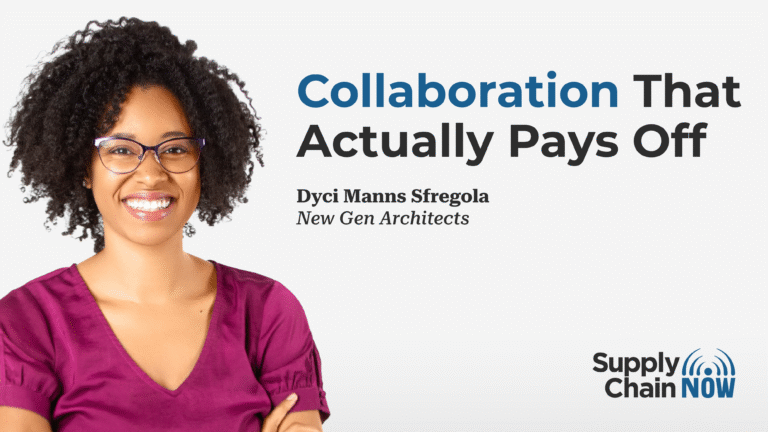
Collaboration That Actually Pays Off
Special Guest Blog Post written by Dyci Sfregola
Why planning, procurement, and leadership must move beyond coordination theater
Collaboration is one of the most overused (and misunderstood) words in both modern supply chain and construction management. Everyone claims to value it. Few organizations design their operating models to make it work.
In a recent conversation, Scott Luton sat down with Dyci Sfregola, author of Next Level Construction Management, to unpack what real collaboration looks like in practice; and why so many well-intentioned efforts fail to deliver measurable results.
What “True” Collaborative Planning Really Means
According to Sfregola, real collaboration isn’t about more meetings or more dashboards. It’s about working together to create one plan, one set of assumptions, and real tradeoff analysis – – all owned collectively across functions.
That includes finance, commercial, marketing, manufacturing, planning, and procurement all working from the same reality. Capacity, labor, cash flow, and constraints are visible. Decisions are documented. Actions actually change what happens next.
The most common failure? Confusing information sharing with alignment.
Teams often circulate data and emails and call it alignment, but no one in the room has clear decision rights – – or the authority to commit resources and change priorities. When plans don’t materially change, or they change constantly without accountability, collaboration becomes performative.
Sfregola calls this what it is: coordination theater. And when collaboration stops at discussion instead of commitment, ROI never shows up.
Connecting Network Design and Procurement for Real Impact
Many organizations still treat network design as a theoretical exercise and procurement as a transactional function. The strongest performers, however, understand that the two are inseparable.
Supplier decisions aren’t just about contracts or unit price. They are network design inputs that shape total cost-to-serve, service levels, resilience, and business continuity. Location, transportation costs, capacity, lead times, minimum order quantities, and quality all determine how the network actually performs.
Procurement becomes strategic when organizations translate network strategy into execution through:
- Category strategies aligned to enterprise goals
- Supplier segmentation that differentiates partnerships from compliance management
- Supplier performance management with scorecards, cadence, and corrective action
- Cost optimization validated through the P&L; not just negotiated price reductions
If network strategy isn’t reflected in how suppliers are selected and managed, organizations keep paying for “optimization” while still expediting, buffering inventory, and missing customer commitments.
Breaking Silos Starts With Leadership Design
Silos don’t disappear because people suddenly become collaborative. They break when executive leaders design operating models that force end-to-end decisions and cooperation amongst functional leaders.
Effective leaders reward enterprise outcomes (service, cash, and risk) over functional wins. They make decision rights explicit and protect cross-functional owners from politics and backchanneling.
Executive sponsorship is often the missing ingredient. Too many leaders say “collaborate” without providing strategy, authority, or air cover when tradeoffs get uncomfortable.
Strong sponsors do three things relentlessly:
- Set a clear north star (service vs. cash vs. growth vs. risk)
- Assign and defend decision rights
- Enforce cadence, accountability, and follow-through
The most effective operating models combine S&OE, S&OP, and IBP into a shared cadence, with consistent executive expectations, clear escalation paths, and empowered decision makers.
Digital Transformation Is a Skills Problem—Not a Tool Problem
As digital tools spread across planning, procurement, and execution, the biggest gaps aren’t technical. They’re data literacy, process design, scenario modeling, and change leadership.
Training people to “click buttons” isn’t enablement. True enablement means teaching teams how decision making will change, how workflows will evolve, what governance looks like, and how to operate when the data is messy – – because it always is.
Including people early, especially skeptics, is critical. When change feels imposed, resistance follows. The teams closest to the work often spot adoption risks long before leadership does.
One Practical Step Leaders Can Take Today
Sfregola’s advice is refreshingly practical: start with prioritization discipline.
Build a simple effort-versus-impact matrix and focus first on low-effort, medium-to-high-impact digital improvements. Quick wins build confidence, reduce skepticism, and create momentum without burning people out.
Once trust is established, scaling becomes much more possible: deliberate, repeatable, and sustainable scaling at that.
Where to Learn More
You can learn more about achieving true collaboration by designing and implementing a best practice S&OP process by taking Dyci’s LinkedIn Learning course. An active member of the supply chain community, you connect with Dyci Sfregola on LinkedIn. Schedule a discovery call here to discuss supply chain consulting & training — learn more about the full suite of service offerings at newgenarchitects.com. You can sign up for the next collaborative planning workshop here – being held on April 29th in Atlanta, GA before the Operations & Business Leadership Gala in celebration of National Supply Chain Day.
More Blogs

Top 10 Ways a Data Gateway Improves Time to Value Across End-to-End Supply Chains