Constant Supply Chain Disruption Promises to Keep Logistics Entertaining, Exciting, & Challenging
Special Guest Blog Post written by Brittany Caskey, Chief Commercial Officer – Logistics with DP World Americas
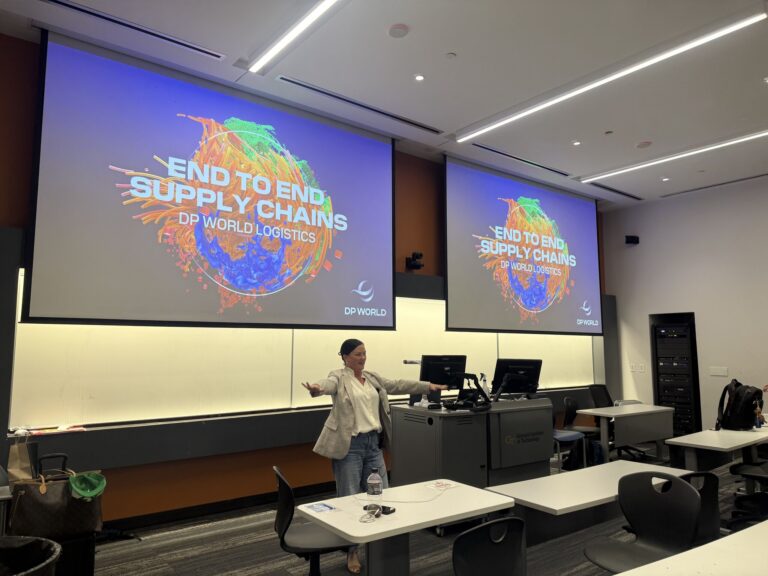
I was recently invited to speak with students in the Supply Chain and Logistics Organization at Georgia Tech, and it reminded me why I still find this industry so energizing.
I walked them through my own path — starting in logistics right out of college, building my foundation at UPS in sales and sales management, and eventually stepping into my role today as Chief Operating Officer at DP World in the Americas.
What I shared with them is something I still believe deeply: logistics keeps life interesting, because no two days are ever the same. Customer expectations change. Geopolitical realities shift. Trade lanes evolve. Weather, labor, technology — everything is in constant motion.
That constant change is what keeps logistics professionals sharp and solutions focused. It’s also why customer experience has become the true differentiator in today’s supply chains.
Because while disruption is unavoidable, how you manage it is a choice.
Customers Don’t Care Why — They Care That It Works
One message I emphasized with the students is the same one I reinforce with customers and teams every day: customers don’t really care why something went wrong. They care that it did.
Tariffs, weather events, cyber threats, and shifting trade lanes have made volatility the norm. Disruptions now cost companies hundreds of billions — even trillions — in lost revenue. But from the customer’s point of view, the explanation doesn’t matter. What matters is whether their product arrives when it’s supposed to.
A delayed shipment feels like a broken promise.
The organizations that stand out today aren’t the ones trying to eliminate disruption altogether. They’re the ones that design their networks to absorb volatility and protect customers from the chaos happening behind the scenes. One key theme in many of our meetings – risk mitigation. What if things don’t go as planned? Then what? Prepare for it. Have a “Just in case” mindset versus always reacting.
Where Supply Chains Still Break Down
Most organizations believe they have good visibility — and many do, until something goes wrong.
Tracking often works from port to warehouse, but blind spots tend to appear during handoffs: cross-docks, transload facilities, customs clearance, or the final miles to the customer. Those gaps are where small issues quietly turn into major service failures.
When disruption hits, decision speed matters. Waiting too long — even by minutes — can turn a manageable delay into a customer-facing issue.
You can’t fix what you can’t see.
Technology plays a role, but visibility alone isn’t enough. The real advantage comes from connectivity — systems that talk to each other across carriers, suppliers, and facilities to create a shared, real-time understanding of what’s happening now and what’s likely to happen next.
When Efficiency Becomes Fragile
Over the last few years, we’ve seen how fragile overly optimized supply chains can be.
Concentrating volume through a limited number of ports, routes, or suppliers may reduce costs in stable times, but it leaves organizations exposed when conditions change – and they always do.
That’s why many companies are rethinking “just in time” models and moving toward “just in case.” Not as an overreaction, but as a smarter way to build flexibility.
Done right; diversification creates options, not excess.
Alternative ports. Multiple carrier relationships. Regional fulfillment strategies. Forward inventory that can be activated when needed. Those options allow organizations to pivot quickly and maintain service levels when primary routes become constrained.
Data, Technology, and the Human Element
Managing disruption ultimately comes down to decision speed.
If data is fragmented, outdated, or buried in spreadsheets, teams are already behind. Predictive analytics, dashboards, and scenario modeling help surface risks earlier — but they don’t replace people.
Automation has transformed logistics, improving speed and consistency. But when something goes off plan, customers don’t want a system alert. They want communication, accountability, and clarity.
They want to know “Who is my person and can I count on them when it matters?”
At DP World, we are differentiating ourselves by focusing on customer centricity and service. The strongest supply chains balance technology with human judgment. Technology handles the routine. People handle the exceptions. That balance builds trust — especially during disruption.
Taking Control of the Logistics Future
I closed my conversation with the Georgia Tech students by reminding them that logistics rewards those who take ownership of their future — and the same is true for organizations. I emphasized the following behaviors as crucial:
- Build your network: Relationships matter in logistics. Across ports, carriers, customers, and partners, your network becomes your advantage when conditions change.
- Become a Subject Matter Expert: Logistics is broad. Depth matters. Whether it’s operations, customs, technology, or commercial strategy, expertise builds credibility and confidence.
- Develop an operations mindset: Even if you’re in sales or strategy, understanding how things actually move will take you far. The best leaders I’ve worked with know how decisions play out on the ground.
- Think globally: Logistics is inherently global, and having a global perspective — culturally, commercially, and operationally — creates better decisions and more resilient networks.
- Stay tech-forward: Technology will continue to reshape this industry. You don’t have to be an engineer, but you do have to be curious, adaptable, and willing to evolve.
Supply chains don’t just move goods. They move promises.
In an unpredictable world, the organizations — and the people — who design flexibility, embrace technology, and lead with judgment are the ones who keep those promises.
Brittany Caskey serves as the Chief Commercial Officer for DP World in the Americas, leading commercial activities for logistics, contract logistics, and freight forwarding. She’s spent 20 years in the logistics industry, driving transformation and growth across global commercial teams for contract logistics and transportation management.
More Blogs

5 Supply Chain Predictions on our 2026 Bingo Card