Intro/Outro (00:02):
Welcome to Logistics with Purpose presented by Vector Global Logistics in partnership with Supply chain. Now we spotlight and celebrate organizations who are dedicated to creating a positive impact. Join us for this behind the scenes glimpse of the origin stories change, making progress and future plans of organizations who are actively making a difference. Our goal isn’t just to entertain you, but to inspire you to go out and change the world. And now here’s today’s episode of Logistics with Purpose.
Enrique Alvarez (00:35):
Good morning and welcome again to another exciting episode of Logistics With Purpose. I’m your host, Enrique Alvarez, and I have of course, my co-host Christie Porter with me. Christie, how are you doing?
Kristi Porter (00:45):
I am good. We have had a fun little pre-chat show. This is, I feel like a different guest that we’ve had on before. So I’m excited to talk about new topics and very cutting edge things. So I feel like it’s early morning here in the US in the evening for him, but it’s going to be a great discussion and I’m thrilled to have him on.
Enrique Alvarez (01:03):
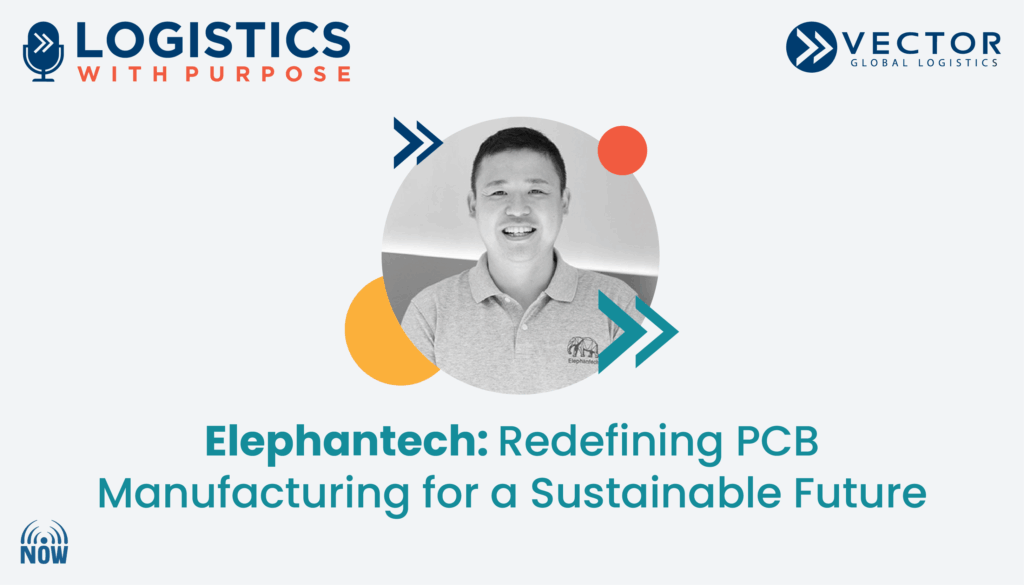
I agree with you. I mean, we have a very technologically advanced individual to actually enlighten us with some of the amazing technology that their company is producing. And I think, without further ado, let me introduce you to Satoshi Kga. Satoshi Kga is the executive officer head of Marketing and FBC sales at Elephant Tech. Hey Satoshi, how are you doing? Good morning for us. Evening for you.
Satoshi Konagai (01:28):
Yeah, great. Thank you so much for wonderful introduction. I’m so excited to be here.
Kristi Porter (01:33):
Yes, we are thrilled to have you and you are definitely going to be an education for us because this is a world, at least I can say for myself I know not a little about. So really excited to dive into it. But first I want to tell everyone a little bit about your background. It’s incredibly impressive. So a wealth of global experience and purpose-driven innovation. You have led complex cross-border projects in everything from cost accounting to business process, re-engineering at large scale systems, implementations and turnarounds. You’ve managed global operations at scale, help midterm shape, midterm strategies, and drive transformation across cultures and industries. That is all I feel like top of mind for everybody these days. So you are definitely ahead of us all. And now you’re a part of Elephant Tech, which is a Japanese deep tech company tackling climate change through cutting edge manufacturing, which is, I know something I could say. So you’re really leaning a pack here and what really stands out for us is your passion for building a better world. And that’s why we’re excited to have this conversation with you, leveraging technology, collaboration, the power of purpose. Satoshi, thank you so much for joining us today.
Satoshi Konagai (02:45):
No, thank you. Thank you. Absolutely. It’s my pleasure to meet all of you. And then I know our technology is very technology related and then it’s difficult to understand. So this time I would like to make things more simple and easy to understand and I hope everyone get absorbed about what we are doing it and then yeah,
Kristi Porter (03:06):
It is very
Enrique Alvarez (03:08):
Impressive. It was impressive. We actually watch a couple of the videos before jumping in and we’re excited about this call. Of course, everyone around the world knows that, hey, Japan almost always means amazing technology. So you are in Tokyo right now, so we appreciate you joining from Tokyo and thank you for being here in our show.
Satoshi Konagai (03:27):
No, thank you so much. Yeah, and just grateful this technology too, right beyond the time differences, we can connect each other every single time, so that’s very appreciative. Yeah,
Kristi Porter (03:38):
Yeah. Well, before we get into the incredible work you’re doing at Elephant Tech and some more of your background, I’m going to warm us up with some quick questions. So just answer
Satoshi Konagai (03:47):
The first
Kristi Porter (03:48):
Thing that comes to mind.
Satoshi Konagai (03:49):
Sure.
Kristi Porter (03:49):
So what is one thing you can’t live without?
Satoshi Konagai (03:52):
Since I’m Buddhist, so I’m doing morning and afternoon for those prayer. So that’s one of the things which meditate myself and reshape my determination to change the world in a better way. So that’s one of the things I cannot stop it.
Kristi Porter (04:08):
Yes, very grounding for your day as well. What is your favorite hobby? We talked about a few ahead of the call, so now I want to know which one you’re going to pick.
Satoshi Konagai (04:16):
I used to be a swimmer, but now I’m doing walking and running and also weight training to be a healthier body to sustain my health.
Kristi Porter (04:27):
That’s good. You got to raise those two little energetic kiddos for sure.
Satoshi Konagai (04:30):
Yeah, yeah, exactly. I’m trying to hold my kids in the left arm and the right arm always to pick not from master school and yeah,
Kristi Porter (04:43):
Fantastic. Coffee or tea?
Satoshi Konagai (04:45):
Oh, I love both. Since my hometown is very famous for the green tea, which has Mount Fuji, so yeah.
Kristi Porter (04:52):
Okay, good choice. Favorite place to be?
Satoshi Konagai (04:55):
So I like Hot Springs, so wherever I go that has hot Spring is my favorite place to travel. And for the city, I love OC Orange County in California since I spend five years over there and the weather was really great and with a beautiful beach and delicious food. And then Tex-Mex, I love Tex-Mex.
Kristi Porter (05:18):
That’s awesome. Well you and me both, we’ll have to find a way to get together sometime.
Satoshi Konagai (05:22):
Yeah, exactly.
Kristi Porter (05:23):
Your favorite book, what have you been reading?
Satoshi Konagai (05:26):
Oh, I love Romance of Three Kingdoms, which is a Chinese history book. And also I love comics books, which manga, which is very famous in Japan. And then my kids start reading Dry and Dry is like those small double food produce who bring out invention that helps me to gain more imagination of technologies and stuff. So I think comics books is good choice for cultivating the imagination.
Kristi Porter (06:01):
Absolutely. Yeah.
Enrique Alvarez (06:02):
Well thank you very much for sharing those answers, Satoshi, and as you said, right, all this very creative writers and comic books, I feel like technology’s really trying to catch up with the sci-fi and it’s good inspiration for things that are possible that are probably not yet real, but technology can make them real. So before we dive into the technology and of course the great job that Elephant Tech is doing, I would like to hear more about your background. Tell us a little bit more about where you grew up, how
Satoshi Konagai (06:32):
Was your childhood? So I grew up in the city called Shizuka, which has Monte Fuji, and then I’m the only child and then my parents has a disability due to Poeo. So both of my parents has a disability in the left reg. Without that kind my parents’ disability, I don’t have any disadvantage of while I was at the childhood. So I’m so glad to be my parents’ kids. And then I was so enthusiastic for the swimming competitive swimming up to junior high. And after junior high I moved to the Tokyo for my high school degree. So after 15 years old I separated from my family and then that time I was living in the dormitory with 150 guys and then we live in one small room with four members in one semester and then each semester we change a room, those kind of circumstances. So yeah, it was very interesting experience for me to understand about the different culture and even Japan from different region has different culture From that experience I learned about the diversity and of course after I moved to the United States for gaining my undergrad and grad school degree, I had that experience with a more variety of culture.
(07:57):
But I think understanding of a different culture and the circumstances those kind of nature is I think was cultivating by my childhood time I guess.
Enrique Alvarez (08:08):
Of course that helps a lot. And then understanding the world as a whole, if you have those very diverse relationships and experiences, it helps a lot and I’m sure that helps to you a lot during your career. But before we go into the career itself, did you ever climb Mount Fuji? I mean you mentioned that you were from where my Fuji is. Did you ever go up, have you climbed it?
Satoshi Konagai (08:28):
Yeah, I climbed it actually when I was I think 10 years old, I got climbed Mount Fuji with my friends and also my teachers. So in the elementary school we trained ourself to running background all the time. That’s great. It was great experience actually. But yeah, I was so surprised when we climbed up to the top, there was a garbage over there. So before Mount Fuji was recognized as a UNESCO like heritage. So the environment itself was so kind, contaminated. So that’s very ambitious in sense. So that time I felt like an environmental issue already.
Enrique Alvarez (09:08):
So maybe that experience helped you develop who you are now and that’s why you’re such a good proponent of sustainability and you care about the environment and
Satoshi Konagai (09:17):
Yeah, I think that’s one of the reason why you need to do a better
Enrique Alvarez (09:21):
Job, right, as humans to preserve some amazing nature
Satoshi Konagai (09:24):
Stuff. Yeah, exactly.
Kristi Porter (09:25):
It’s also very unusual compared to at least here in the US to move out of the house at 15 and go off to school. So you must have also learned a lot of independence and had a lot of experience during those years where you were living in this school. I’m curious what that is, how did that shape you as a person as well?
Satoshi Konagai (09:46):
I think it’s coming from my parents’ education because my parents is the one who pushed me to be a good person since I am the owner to gain the good education that those kinds of people has an obligation to contribute to the others to make us world in the better way, they try to push me to be more independent, to gain more culture, not stay in that local town but to gain more experience. Those kind of, I think parents and I really appreciate their mindset, especially the time my mom overcame two cancer. So first one is was a breast cancer when I was a senior of junior high. And then at the time I think it was very difficult decision making for her to let their only son to go to Tokyo, but she bravery chose that decision. And then the second time was when I was at the senior in high school and then that time I was also shivering myself whether I should go to a United States or stick in Tokyo or a university in those kinds of things. I chose, I was wondering which one I should take, but my mom pushed me to go to the United States to experience more, to have a better education. So I really appreciate her mindset and then she’s always be a best supporter for me.
Kristi Porter (11:13):
Yeah, those kind of like very special people.
Enrique Alvarez (11:15):
Thank you very much for sharing that story. And your mom sounds like a very brave woman and of course always thinking on your interest first. That’s something that most moms would do, right? Putting their children first,
Satoshi Konagai (11:28):
Especially being a puzzle with two sons. Now I understand that decision was very tough for her, but I really appreciate her and of course my father’s choice as well.
Enrique Alvarez (11:41):
Well congratulations to both your parents. They’ve done a really, really good job clearly. And we’ll talk a little bit about your career. I’m sure they’re both probably proud of what you have accomplished. And so moving to the academic side of things, you have a very successful career too. Satoshi, you earned your degree at Soka University of America. You mentioned it briefly and then you went on to Yale and you focused on international development economics and even explore MBA courses in small and social businesses. This, you mentioned this a little bit already, but how have this global academic experiences shaped how you think about innovation, sustainability, the role of business in creative positive change? Could you tell us a bit more about your experience while you were in this institution?
Satoshi Konagai (12:24):
Yeah, thank you so much. I think the split of nobody is of bridge penetrated not only in my undergrad, also grad school. So when I both academic institution, my undergrad founder is always telling a student that we need to serve common people since we have a opportunity to gain a higher education. Those kind of spirit was always told by our founder and then that I think pushed me to study harder. And also Yale is a one that always teach student to serve the people. Yeah, I think those kinds of mindset shapes me to motivate myself, not only pursue my career but also to contribute to something good for the public world. And then the reason why I chose a development economics measure is because I have experience in the half year study abroad in Mexico. And then at the time, yeah, I studied Spanish, actually I forgot almost all.
Enrique Alvarez (13:23):
I had no idea about this. We could have done this whole interview in Spanish,
Satoshi Konagai (13:28):
No. And then I stayed like host family and then help out with horse family was a single mother and she didn’t have any education a bit and she couldn’t read and also she couldn’t count the numbers. And then since my host family, a very great person and they took care of helper and they also help us daughter not only wages but also for the education opportunity and so on. So she was very lucky in some sense, but when I was confronting people who didn’t have opportunity for the education directory, I felt like this shouldn’t be happened. Of course everyone is different and every circumstance is different, but I think basic education or those basic opportunities should be equally provided to all people. That’s what I felt through the interaction with a host family and also help of host family. And then those kind of things led me to think how we can make and how can fulfill the gap of those differences.
(14:41):
And then yeah, that’s pushed me to study more for those developmental economics. And then when I went to higher education, I was wondering whether I should go to a PhD or I should go to a private sector. And at that time I felt like I should go to a private sector to have more experience to how we can make a workforce and then also how we can make a sustainable business scheme to make not only gaining profit but also for the public goods. Those are the reason why I chose to my career. And then now I’m working on environmental issue, but my core motivation is to make the world in a better way with my fault. Yeah.
Enrique Alvarez (15:32):
Wow. Thank you so much. We definitely more people like you Satoshi, thank you so much for sharing.
Kristi Porter (15:39):
And it sounds like you were also, it was an amazing experience to have such an ecosystem around you from your parents to the people you interacted with, to professors. Everybody had a very similar mindset about how education can improve lives and how, I love the fact that you stated that education gives you the obligation to be able to give back to others. That was a really, I loved the way you said that and it sounds like that was completely reinforced all around you and has certainly put you on a great path, which I want to talk about now. I’m very excited to hear about Elephant Tech. You’re doing incredible cutting edge things there, things that you will have to explain very slowly and simply to me. But you’ve been there for almost three years. And so tell us about FinTech, what do you do and what is your role?
Satoshi Konagai (16:26):
Okay. I joined FinTech October of 2021. Before that I was working as a management consultant. So I did on the project and the ERP system SAPs all stuff. And then I went China to see how Chinese manufacturing is growing up. And I was so, I don’t know, astonished about how Chinese technology was catching up and even for surpassing to the Japanese technology. And then because of that, my experience in China for two years, I believe I should go to a startup which create a new technology from Japan. And that’s the reason why I chose FinTech. And the FinTech is a company, we are like a 10 years old startup company initially starting from Tokyo University technology, but now we have own patent and what we are doing is we are doing sustainable manufacturing technology with using printing metal inkjet printing. We chose the fast field using our technology is a printed circuit board, which is called so-called PCBs. And then we are using inkjet printing technology using nanometer ink to form the circuit directory. So that compared to a conventional methodology which pair up all the raw materials, stuck the raw materials and then do a chemical itching and the chemical treatment to patterning, our technology is pretty eco-friendly since we don’t have raw material raw compared to a combustion methodology. So those are our technology.
Enrique Alvarez (18:03):
So Toshi, it’s an impressive technology, it’s a great company and it seems like your background, you’ve slowly unfolded this little pieces of information about you being in us. Then you went to Mexico, then China again. So you really understand kind of what the world’s doing in terms of technology and you wanted to use Japanese technology to improve it. So before we continue with the very interesting information and interview, let’s just go back to the printed circuit boards, the PCBs, and if you don’t mind, I will try to put a clip here from your company that shows the equipment that you’re using. But if I understood this correctly, the normal methodology to print circuits is by basically having a lot of copper and then you take out, you scrape out everything else other than the circuit and the circuit remains intact and your technology is different because adding it, you’re printing it. We would print a piece of paper and so the circuit is the only thing that you’re Exactly as opposed to just taking everything out. Yeah, it quick. Give me a second and I’ll let you a chance to explain what we are seeing here. Let me put play on this. Go ahead. Tell us a little bit more about what we’re seeing Satoshi and what is this machine?
Satoshi Konagai (19:19):
So this is in printing machine. So we put on the substrate, this is a flexible printed socket, so socket machine. So we put on the poly mite substrate on the stage and then we do inject printing using this. And then we hold to other process which is a drawing process. So we do a photo using this machine to dry up unnecessary part and then to make a rigid patterning. And then after this drying process is done, then yeah, we have a seed layer or patterning and then we put into electroless cup operating rain to make growth socket sickly enough for must produce label. So the combination of inject printing for seed layer printing and printing leads to the must produc label of quality for the PCBs. So other similar technology is only doing a printing technology, but our interesting part of our technology is a combination of both printing and printing. So that
Enrique Alvarez (20:25):
I read up to more than 50% of carbon emissions from mobile phones come from the way that they’re printing their current circuit boards. Correct. You eliminate all this by using your technology.
Satoshi Konagai (20:37):
Exactly, exactly. So video shows is only flexible printed socket, but our technology is also right now developing to the rigid printed socket, which is a green stick one a grass based substrate. So normally when we imagine about the PCBs, it’s everyone imagine about semiconductor tip, but on the top of the substrate there is some semiconductor tip. Third substrate part is actually it’s A PCB and then that that’s a rigid printed socket, so it’s more commonly used for the or of the world. So both like a rigid printed socket and FPC. And there is other type of sub P CCB as well, but that accounts for a auto carbon emission of smartphone and also notebook PCs even for the automotive too. So in the automotive also only a small percentage of usage of PCBs, but that accounts, I mean the C two emissions. So one of, I think the LCA calculation article outlet is like 40% accounts PCBs for a total emission of one car and now it’s the consumption of PCBs are growing since electric vehicle coming up and then also auto informatics is going on. So they need more PCBs.
Enrique Alvarez (22:02):
Well, and with your technology they can actually continue growing. The automotive industry will definitely continue shifting towards electric, but then at the same time their emissions don’t have to be as much as they are now using this new technology. This is very interesting, very, very technologically advanced. Christie, I don’t know, we’ve been looking at this and it trying to
Satoshi Konagai (22:23):
Explain it. And also I would like go ahead, add two more trait. So not only CO2, but also our production methodology has less water consumption. So compared to a conventional one, we roughly calculate a 95% reduction of water consumption because our process is very shorten compared to a conventional one. So not so much washing process going on. And then with less chemical. So our water consumption reduce a lot and then meanwhile, since we reduce low material wastage, so that leads to copper consumption as well.
Enrique Alvarez (23:06):
Wow. Because most manufacturers use the carving, right? So they’re carving this copper out and that requires a lot of water, I imagine, and a lot of Exactly. And then you have to the water because it’s all polluted. Exactly. As opposed to you Exactly that you just simply use the copper wherever it’s going so that the circuit is exactly
Kristi Porter (23:26):
Well, and for anybody who’s listening, I definitely encourage you to either go to their website or go back and even better go back and watch the full episode on YouTube. But it’s fascinating to see. Yeah, I think we’re so used to seeing manufacturing videos in one way, and so to see these components come out and they look like paper, they’re flexible. I mean it’s a totally new way of imagining things. So thank you Satoshi. I mean just incredible work that your team is doing. I wish we had them all
Satoshi Konagai (23:54):
Here. Thanks you so much. I’m very proud of my engineer team. Yeah, thank you.
Kristi Porter (23:58):
Yes. And so you’ve launched this new copper nano filler with Ultrafine. Look at me. So I’m saying this, I know what it means. So you’re going to have to tell me a copper nano filter with ultrafine 15 nano Miller called particles except for dispersion stability. So again, you’re talking about slashing copper use, which is of course not only bad for the environment, but also then you also get into dealing with vulnerable populations who are often children or people at risk who are having to do all this copper mining as well. There’s that benefit too. You’ve lowered carbon emissions, water consumption. Again, you’re talking about something that is completely new on the front of what we’ve been doing for decades now. So I’d love for you to also tell us about some of the trial and error. What have you learned in this process of trying to forge a whole new path here?
Satoshi Konagai (24:50):
Great, thanks so much. So now still we are trying to catch up our specification to the conventional one. Of course, we are catching up many of specification, but still there is some limitation of specification. So out of r and d is necessary to be done. And then we need to also pass all the Cort examination and stuff. And then we now proudly have experiments with mass production for the flexible brain circuit, which means we pass all the core T examination. But there was a lot, of course a trial error was going on to make the core desirable, but still we need to improve a lot to do a cost down and also specification improvement as well. So that’s still auto development is necessary to be done. But yeah, we are still on the kind of entrance of towards our ultimate goal to change our conventional PCB manufacturing method to our technology.
Enrique Alvarez (25:53):
Well Satoshi global brands like Apple for example, they’re definitely under pressure to reduce their CO2 emissions. Scope three for them is critical. The world is watching and everyone has actually set up this very aggressive goals for the future and how they are going to continue reducing their CO2 emissions as head of marketing. You must understand this not only at the technological level, but then also understand how to convince the companies. So from a marketing standpoint, how are you positioning elephant’s tech solution? How do you talk to Apple to this bigger companies? How do you convince them that this is the way to go? And I know that the data is very straightforward. I mean you’ll save copper, you don’t have enough, you don’t have waste, you’ll save water. But what are the main points from a marketing standpoint for your company? I
Satoshi Konagai (26:43):
Think our technology is very unique since we have a competitive price level with a lot of environmental impact reduction, though our electronic component is most difficult, I think element for the manufacturing to change the new methodology since they need a core device. But I think the trade of our cost competitiveness plus environmental impact reduction makes us a very unique, I think standpoint of a marketing perspective. And the plus, I’m always saying that it look like please bite a bit to make your CSR report more stronger and then please be a fast paying to be a market leader for adapting this technology. And then there is some companies like Logic for example, courageously take our technology to adapt their mass production label be, and then I really appreciate their courageous spirit and then also considered environment as a most important human beings issue. And then I cannot tell the name, but there is other device manufacturer or a brand maker also taking the same attitude as Logitech does. I’m feeling that people trying to make effort to make a world in the better way, especially with current high temperature. And everyone knows that we need to take action and then although it’s what we are doing is a small step, but the accumulation of small step leads out a huge leap for the human beings. And then yeah, I’m very appreciate our partners who are taking a lead.
Kristi Porter (28:35):
Yeah, absolutely. Well, that’s a great company to have in your corner and I’m sure, yes, there are others behind the scenes, but I feel like also more people will start taking notice not only because there’s the moral case for it and then there’s the business case for it. And I feel like you’re at a perfect intersection for both of those arguments. So thank you. You’re headquartered in Tokyo, as you mentioned, Tokyo, of course, right? Always you imagine both innovation and manufacturing when you think of Tokyo. So from your perspective, how is Japan’s role in general evolving as a leader in global green manufacturing climate tech? How do you guys fit into that piece and how do you see the country doing?
Satoshi Konagai (29:19):
I feel like Japanese government has a doing great job with recent years. When I was at joining the airplane tech, like a climate issue, it was big deal but wasn’t so enthusiastic compared to as of now. And I feel like many of brands are changing their attitude towards more to solve a tissue issue. So I could tell when I joined the FinTech being sales planning and those stuff, when I communicate with our potential client, they’re saying QCD, so quality control delivery is the most important thing. And then environment is, it’s like six or seventh ranks. So it’s not important. That kind of attitude was, but they changed their mind with recent dates and they’re saying that the environment is also of course it’s very important issue. So I am hoping that as being Japan, Japan is kind of meat position in not China and US and with current geopolitical situation. So I am hoping the Japanese government has a good lead towards global warming issue as well. And then Japan is a good place to accumulate a lot of funding technologies like raw materials, equipment, machine equipment, and then those stuff. So being a Japanese startup is very, I think has many meanings. So we would like to leverage out for the existing technology of accumulated technology in Japan and to make a global level of a scale startup. So that’s what we are aiming for.
Kristi Porter (30:58):
Yeah. Wow. I love that you’re saying that you’re 10 years old, but you’re still in startup mentality, which means you’re always learning and going and looking for new opportunities. And I think that’s a great
Satoshi Konagai (31:08):
Mindset. Yeah, we are still a challenger and trying to catch up a conventional PCB standards because PCB is a hundred years old history, and then they have out of curative technology. Of course there is some issue of environment, but I really respect conventional methodologies like company does because of their effort. We can use electric devices with very cheap and sustainable cost and they’re making a lot of effort of it. So we are hoping that, so we would like the pilot PCB manufacturer to the PCB equipment manufacturer. So for us, like a conventional PCB manufacturer is not a competitor, but it’s more like our potential customer. We would like to run more technology of PCB than their requirement, and we would like to make our technology more advanced to widespread our manufacturing methodology to the world. So that’s what we are aiming for.
Kristi Porter (32:11):
Fantastic. Wow.
Enrique Alvarez (32:13):
It’s a really good mindset. And of course you have to congratulate all your engineers and you have to congratulate you Satoshi and your company and of course the Japanese government for really investing and protecting and growing companies. And you’re right, I mean it’s a technological change that’s a shift. So you’re respectful of the past because the way that it was manufactured in the past allow you to be who you are and create and innovate towards the future. And it’s funny and very professional view that you’re also saying that they’re not the competition, you’re actually trying to see them as a customer. And at some point I’m pretty sure they’re going to be using elephant tech printed circuit boards to run their printing devices on their traditional way of printing PCBs. But hopefully it sounds to me that this is a technological shift. It sounds that in time people are going to realize that it’s just a better way of doing things, less costly, more sustainable, less water consumption. It sounds like a very straightforward proposition. With that said, that’s now, how do you imagine the future will be Satoshi? If we were to ask, so 10 years from now, what are some of the future plans for Elephant tech? Where can you take this new technology into the future? What would be your vision for the next 10, 20 years?
Satoshi Konagai (33:32):
Yeah, that’s great question. So with our mission, we are not want to be only PCB, but also to adapt our technology into a wider level. And we don’t need to stick with inkjet printing, but also maybe other manufacturing method methodology which can produce a more sustainable way to, of course pass with. So we would like to be, let’s say a sustainable manufacturing methodology like a proposing company and which is to be, I think both equipment and also raw material manufacturer to provide and to propose new way of manufacturing methodology to the world. So that’s what I think we like to be. And then of course, other competitor or other manufacturer like us will come up, which leads to the human beings like technology development more advance. So to the set, I hope we have good competitive environment in terms of reducing the environmental impact with accordant cost. And then I believe a human 10 years or 20 years of the world will be better than right now. I strongly believe it. I’m not pessimistic about the future. I’m very optimistic of the future. Yeah.
Kristi Porter (34:58):
Well, you’re certainly leading the future for sure. So leading in the right direction. So thank you for
Satoshi Konagai (35:04):
I hope. Yeah, I hope I I will be the want to it, but yeah, I try my best to make effort. Yeah.
Kristi Porter (35:12):
Well, and it sounds like as soon as you get this challenge tackled, then you were already looking to New Horizons as well. And we’ll figure out bigger and better problems to solve after this. And we’ll just, it will continue to be a wave of it. So thank you for really giving a positive reset to manufacturing practices. And again, I agree with Enrique showing gratitude for where we’ve been because that has allowed us to have all the technology that have now, but also knowing that that has put us on track for making it even better. And so it sounds like we’re certainly headed down that path. Well, thank you again for your time. This has been wonderful. It’s been fascinating to learn about. And so before we go, I would just like to ask you, what does the phrase logistics with purpose mean to you?
Satoshi Konagai (35:56):
I think logistic is very necessary activity for the human beings. Without logistic. I think all the Japanese people will be die with hunger. So because a lot of transportation, the interaction, everything includes what of logistic. So I think logistic is a very key component of a human being’s activity. So for that activity with either mindset of a concerning of the purpose is very necessary.
Kristi Porter (36:25):
Yeah. Thank you. I appreciate that.
Enrique Alvarez (36:27):
Well, thank you. Thank you very much, Satoshi. And once again, congratulations. As Christie mentioned, you are leading the future and I’m sure, and I’m hoping that a lot of our listeners are paying close attention to what Elephant Tech is doing. You guys are really reinventing the way the printing works, and that of course impacts a lot of different industries. So congratulations again. I personally would like our listeners to go and check your website, which by the way, it’s beautifully designed and it’s very easy to navigate. So please, please, if you have a little curiosity about this groundbreaking technology, just visit Elephant Tech’s website. It’s a well managed and coordinated effort. How can our listeners connect with you? And yes, LinkedIn could be a good start of anything else.
Satoshi Konagai (37:16):
And then also you can put it on the message at the contact us. And then yeah, we can of course connect with not only me, but also a sales members can connect you. And then also you can take a look about the PCB 0 0 7, which is like a PCB messaging now. And then we are now in the four, three months of ING in a row, they highlight our technology. So please take a look for your reference. I think that would be also good to understand how our technology works out. So
Kristi Porter (37:48):
Yeah,
Satoshi Konagai (37:49):
Again, thanks so much.
Kristi Porter (37:50):
Yeah, anybody, we have lots of manufacturing folks listening in, so they’re all very accustomed to seeing one way of manufacturing. So we definitely want people to go check out your website to see what’s coming ahead and what’s going to be implemented in the future. Thank you so Tahi, again, so much for being here. This was a great conversation. I feel like I learned a lot and smarter human being because of it. And everyone, thank you so much for listening in. We love our audience. Grateful that you’re here. There’s a lot of bad news in supply chain, so we look forward to bringing you more good news every two weeks. So thanks for joining us. Thanks for tuning in, and thanks for sticking with us. We’ll see you again soon. Bye-bye.