
Share:

Empowering Smarter Distribution: The Critical Role of Integrator Consultants in Your Automation Strategy

As logistics leaders look to future-proof their operations, they face a complex landscape filled with critical decisions ranging from navigating supply chain volatility and shifting customer expectations to evaluating fast-changing automation technologies. Successfully planning, designing and implementing large-scale automation solutions requires specialized expertise that many organizations don’t have in-house.

This white paper from Bastian Solutions is designed to help you understand how the right consulting partner can make a meaningful difference in the success of your automation initiatives. It outlines the strategic role integration consultants play in optimizing distribution operations and provides practical guidance on how to assess their capabilities—so you can confidently choose a partner that aligns with your goals and complexity.


Why download this guide?

  • Find the right partner – Learn how to evaluate and choose a consulting partner that fits your goals and complexity. 
  • Go beyond the tech – Understand why process-focused strategies, not just automation, drive real results.
  • Know what OEMs and traditional consultants miss – See the value of objective, end-to-end expertise that prioritizes your full operation.
  • Leverage data & design – Explore how advanced analytics and simulation tools lead to smarter decisions.  
  • Follow a proven roadmap – Use a four-phase framework to confidently plan, design, and implement your distribution strategy.
  • Get industry- specific insights – Address unique challenges in retail, e-commerce, wholesale, and 3PL operations.


Download the ebook here to learn more


More White Papers
carrier selection
White Papers
August 6, 2026

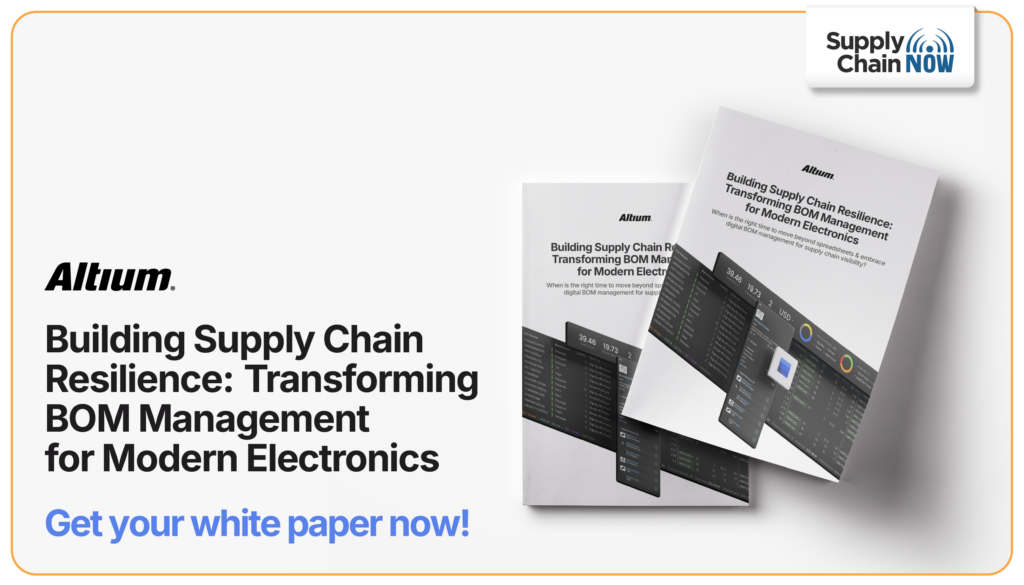
Building Supply Chain Resilience: Transforming BOM Management for Modern Electronics
The whitepaper explores why leading electronics companies are moving beyond spreadsheets to implement dedicated BOM management solutions that strengthen supply chain resilience, reduce costs, and accelerate time-to-market. What’s Inside This Whitepaper? Readiness checklist: When is it time to move away from spreadsheets? (hint: if you’ve had a costly redesign due to component availability, it’s time) Best practices for effective BOM management for electronics teams Key use cases of a BOM management system Overview of Altium BOM Portal ROI calculation examples with real-world savings Key Benefits of Altium BOM Portal Faster BOM completion with enriched supply chain data Data-driven BOM analysis for supply chain risk mitigation Comprehensive part library with full traceability Streamlined collaboration between engineering and procurement Cost savings on every BOM with automated saving opportunities Why Engineers Trust BOM Portal Nowadays, there are so many supply chain disruptions, maybe the PCB boards take weeks to come back. When you have an error there, the real cost is burning those 6-8 weeks. Because you’re using Altium 365 tools, you’re looking at maybe an 80% reduction in time to market. — Brandon Gilles, Founder/CEO, Luxonis
planning
White Papers
April 22, 2026

From Planning to Decision Making

Supply chains are more volatile and interconnected than ever, but many planning processes still rely on disconnected systems, manual analysis, and spreadsheet-based interventions. This white paper explores how network optimization, supported by advances in optimization technology, workflow design, cloud computing, and AI, can help planning teams evaluate cross-functional trade-offs, respond faster to change, and move from static plans to continuous, decision-driven supply chain planning. Inside the White Paper: – Why traditional planning systems and network optimization evolved separately, and why that separation limits decision quality in today’s supply chains. – How network optimization helps evaluate cross-functional trade-offs across sourcing, production, inventory, transportation, fulfillment, service, cost, and capacity. – Why continuous network optimization is different from one-time strategic modeling, and how it can support recurring tactical and operational planning decisions. – How AI and configurable workflows can make optimization more usable for planners without requiring them to become modeling experts. – How planning systems and network optimization can work together in a feedback loop that improves decisions over time. Click here to download