Intro/Outro (00:02):
Welcome to Logistics with Purpose presented by Vector Global Logistics. In partnership with Supply chain. Now we spotlight and celebrate organizations who are dedicated to creating a positive impact. Join us for this behind the scenes glimpse of the origin stories change, making progress and future plans of organizations who are actively making a difference. Our goal isn’t just to entertain you, but to inspire you to go out and change the world. And now here’s today’s episode of Logistics with Purpose.
Enrique Alvarez (00:34):
Good Day and welcome to another exciting episode of Logistics with Purpose. My name’s Enrique Alvarez with Vector Global Logistics, and of course, you’re joining the only podcast focused on supply chain’s, positive impact. I’m here with my co-host and fearless psychic Christie Porter. How are you doing today?
Kristi Porter (00:54):
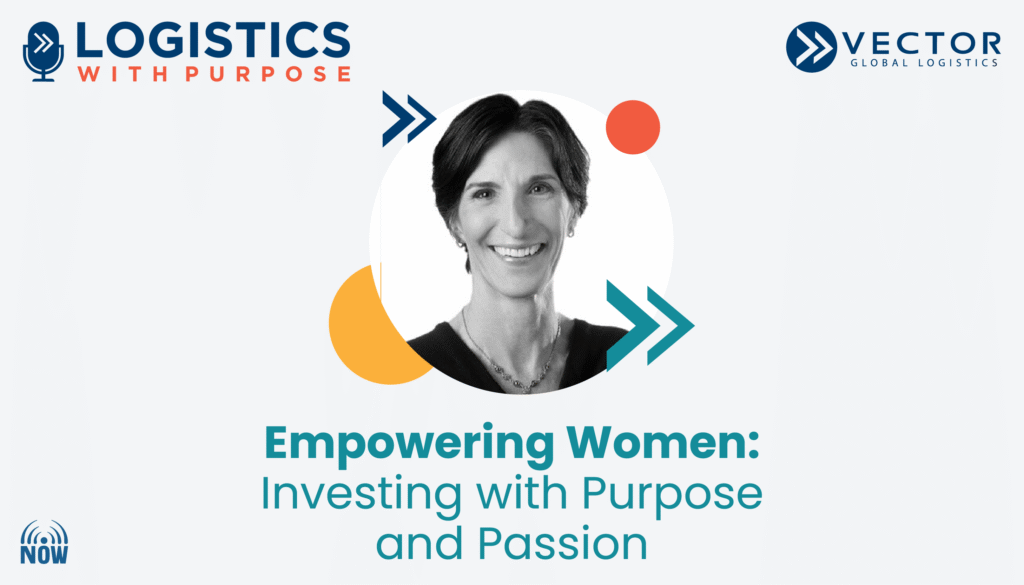
I am good. Yeah, I’m excited to have this conversation. It’s been a good day for me. It’s been a good day for you. So we’re recording this toward the end of our day and looking forward to wrapping it up in a nice boat. And I have been anticipating this conversation for a long time now. And so I’m really delighted to introduce Janine fpo, the co-founder of Invest For Better, a nonprofit that helps women take control of their money and invest in alignment with their values. And I will tell you, she’s also the author of Activate Your Money, and it is a terrific book that is packed with resources. You’ll want to take notes, you’ll want to get it, and this will be a fascinating topic, but along with Activate Your Money and Invest for Better. Janine spent more than 35 years working at the intersection of tech and finance and social impact, which are things we all love talking about here.
(01:49):
So she was at the Bill and Melinda Gates Foundation, Hewlett Packard World Bank, many of the amazing organizations that you know, and that gives you just a little taste of who Janine is and what she’s about. But we’re going to dig in further to her story and her expertise on investing in money and the things that we’re all talking about every day in our lives. Anyway. So Janine, before we get started, I want to ask you a couple of just quick questions and you can respond with the first thing that comes to your mind. Okay? Okay. All right. Favorite book?
Janine Firpo (02:22):
So interestingly, one of my favorite books that I think about a lot is called Stones by the River is a book by a woman named Ursula Hege. And I started reading it because I was interested in what evil was in that book. It basically takes place just before the Nazis take over Germany. And what I learned through reading that book is the greatest evil doesn’t really come from a single person. It comes from some people being complicit and others just going silent or withdrawing
Kristi Porter (02:54):
To
Janine Firpo (02:54):
Allow really bad things to happen. So it was a really formative book for me in a lot
Kristi Porter (02:58):
Of ways. Yeah, sounds like it. Oh, I want to add that to my list. A food or a dish that you love.
Janine Firpo (03:03):
Anything my husband will cook for me.
Kristi Porter (03:06):
Oh, that’s a good answer.
Janine Firpo (03:09):
My husband is the cook in the house. Wow. I think in our chili plus years of marriage, I’ve cooked for him less than 10 times.
Kristi Porter (03:17):
Oh, good for you. Amazing.
Janine Firpo (03:18):
The food is bad. I’m like, this is so great. Thank you so much. That’s incredible.
Kristi Porter (03:25):
That’s a good answer. Where would you love to travel to?
Janine Firpo (03:29):
I just want to go to the same place again and again. I want to go to Italy and the reason is I’ve spent my God, 40 plus years of my life traveling around the world. I’ve been to over 80 countries. I’ve worked in them, visited them, lived in them. And at this point in my life, I just want to go deep in one place. So I’ve done a lot, seen a lot. It’s been amazing. I highly recommend it if you hadn’t haven’t done that. But I’m just at a different place in my life now.
Kristi Porter (03:56):
Fantastic. I will be in Italy in a few months, so I’m looking forward to seeing it for the first time. And this will be a tough one, but who is one woman that you admire? Well, she just
Janine Firpo (04:05):
Passed away. Jane
Kristi Porter (04:07):
Goodall. Jane Goodall.
Janine Firpo (04:09):
I really admire her because I was a biologist at one point in time and I’ve known of her from her very beginnings. And she was just fearless and out there doing things that women didn’t do and she took a very disciplinary approach to her science. She listened attention. She didn’t go in with preconceived notions, and she basically upended what people believed to be true at that time. And then throughout her entire life, she just kept being an amazing woman. And so Jane Goodall for sure.
Kristi Porter (04:42):
Yeah, she left us with a lot to continue thinking about for sure.
Janine Firpo (04:46):
Yeah,
Enrique Alvarez (04:46):
Absolutely. One of the biggest role models probably in the history. Janine, thank you very much for your answers and for sharing some of those answers with us and our audience. Now let’s move on to your upbringing. Tell us a little bit more about your background. Where did you grew up and your childhood?
Janine Firpo (05:02):
So I grew up in the San Francisco Bay area. My family actually goes back here for generations, which is shocking. My father’s family came from Italy in the 18 hundreds and settled in San Francisco and I grew up in the fifties. So my parents were kids of the depression. And when I grew up, I mean money was a huge major issue in my family and in our lives, particularly from my mom. And we struggled a lot when I was young. And then that started to change when I was in high school. My mom started to get into real estate and she started buying and flipping houses in the 1960s, late 1960s, early 1970s, which was just not a thing that woman did. And she trained us and I learned a ton from her. And she started investing in the stock market in the eighties and was doing really well. And she taught me a lot. And I can honestly say that I would not be in the financial position I am in today that hadn’t been for my mom and how fearless she was and how she taught me and what she did to me for me was so meaningful in that regard that I dedicated my book to her.
Kristi Porter (06:09):
I love that. Well, okay, so I have a question, but you have a lot of already I think things to choose from, but is there one specific story that you feel like really touched you that you can look back on and see not just what she did with her money or how she taught you, but a turning point maybe?
Janine Firpo (06:27):
Well, I will tell you a story that I think is kind of remarkable, and it’s not the earliest one, but it’s one I really carry with me. My mom lived until she was 93.
(06:36):
And as she was getting older and she knew her time was coming, actually, she was super open and honest about her money all the time. She would tell us on one day, oh my God, the stock market is so going so great. This is how much money I just made. And then the next day she’s like, ah, I lost all this money. And so I think what really made her stand out is how open she was about it. And she was so open. She told us we knew exactly how much money she had, we knew how much she’d given and supported each of us. She kept spreadsheets to the penny to make sure that none of us got more money than anybody else. And she started divesting of her assets before she even died. And so because of that, the level of trust that existed between my mom and my sister and me was so high that there was never even a question. I mean, my mom put money in our names while she was still alive, and there was never a question that we would touch that money or that we thought of it as our own money until she passed away. And there was never a fight between my sister and I because we knew that my mom was being super equal in every way. And so that was so powerful because when you think about what happens in a lot of families when parents die, I mean it creates risks in the family sometimes that are never amended.
(07:59):
And it’s because of all this secrecy and the lack of transparency. So my mom taught me just be open and talk about this stuff.
Enrique Alvarez (08:05):
Incredible. She sounds like a great person. What was her name? Janine.
Janine Firpo (08:10):
Her name was Kay. Kay ferpa. Catherine Kay was short for Catherine.
Enrique Alvarez (08:14):
Well, thanks for sharing that. And of course, you have an incredible career that spans to the tech world. You just told us that you’ve traveled over 80 countries, but your background is in biology and computer science. You studied at UCLA and University of Florida. What inspire you to kind of shift from science into technology? And then of course, what was the journey that ultimately led you to the work that you’re currently doing?
Janine Firpo (08:39):
So it was a completely weird incident. So I went to it literally, I went to the University of Florida thinking I was going to get a PhD in Biology and Study Wales and Dolphins. That’s what I was going to do. And after the first year there I realized, you know what? I don’t want to be that much of a specialist and I really don’t like the water and I hate those.
Enrique Alvarez (09:02):
Well, that could have been a problem If you want to,
Janine Firpo (09:05):
It’s a good thing to find out earlier, really bad idea. So I was working as a cocktail waitress during the summer and hanging out on the pools by day. And I had a habit of telling anybody I met, what my problems were, because you just never know where insight will come. It’s true. So I was hanging out at the pool. I met this guy who said he was an incoming student in the biology department where I was, and I said, this is my problem. And he looked at me and I swear to God, this was like a scene out of the graduate where that elder man tells Dustin Hoffman Plastics are the future. That’s what this guy did. He looked at me, he said, computers are the future. He said, you should get a minor in computer science. We’re talking 1970, when was it? 19 78, 19 79,
Enrique Alvarez (09:51):
Probably 1979. Perfect timing. Basically
Janine Firpo (09:53):
There weren’t even personal computers. When I first took my computer programming courses to get that minor, I was punching cards on mainframe computers
Kristi Porter (10:01):
That took up entire rooms.
Janine Firpo (10:04):
Something just went off in my brain when he said to get a computer degree. And so that’s what I did. And that taking two coding courses in my graduate program was enough to get me a minor in computer science and enough to get a job in the industry. Wow,
Kristi Porter (10:21):
That’s incredible. What a turn of events
Janine Firpo (10:22):
And the other big shift. So then I started working, my first job was in 1981. I was working in the Silicon Valley. I worked for Apple Computer in the eighties, which was amazing. And I was having this incredibly fun career. I actually left Apple in 1991 because they wouldn’t let me telecommute one day a week. And so I quit and I started telecommuting in 1991 before that was a thing. And I went to work for another company, a startup, and I was a vice president there and I worked for them for about three years. And then in 1995, early 95, I quit because I love to travel and I wanted to go on an extended trip. So I took a five month solo backpacking trip through Sub-Saharan Africa in 1995. And I saw ridiculous amounts of poverty, like crazy, bad poverty, beautiful kids, beautiful people, no opportunity.
(11:15):
And I thought, you know what? I got to do something to change this and I want to work in these countries. And so when I left the states in early 95, I was in something called the CD ROM and multimedia industry. And when I came back five months later, there was this thing called the internet that had come online and everyone I knew was in that. So I jumped off that train and I worked for a while to figure out how could I do my passion. And I ended up building a second career looking at the role that tech and business thinking could play in poverty, international poverty alleviation. And so that’s how I sort of made that huge transition that led to the work I do today.
Kristi Porter (11:58):
Incredible. Very forward thinking. So I’m curious, is there something that specific that stood out to you on your trip in Africa? Is there some memory that you have that kind of changed things for you?
Janine Firpo (12:10):
I have this picture of this little girl. So I started my trip in Ethiopia. I was nervous about taking a trip like this all by myself. And so I thought, I’m going to start in a more comfortable way. So I started in Ethiopia working for Habitats for Humanity and building basically straw and mud housing in the country for a couple of weeks. And while I was doing that, there was a little girl who had come onto the site where we were working, and she was gorgeous. I mean just gorgeous and in tatters. And when I say gorgeous, I mean outside and inside, she was beautiful on the outside and she just had this my heart. I just loved this little girl. And I realized, I started thinking about her growing up and what her reality was going to be. And it was pretty dismal. I mean, as a girl and as a poor person in Africa, she’d never get an education. She would never have the chance to become whatever that being was inside of her that wanted to come out and be, she’d never get a chance to be that. And I realized there were so many other kids like that. There were so many of them that would never have a chance to really let their soul shine. So I wanted to do something about
Kristi Porter (13:29):
That. Yeah, that’s beautiful. Thank you. Another great organization. And then you went on to the Bill and Melinda Gates Foundation. We’ve had the pleasure of having them on this podcast too. Incredible work. I’ve actually been to their headquarters and seen some of their projects in action. So of course being in Seattle and the affiliation with Microsoft, another perfect blending of your experience and your expertise and your passions. So what was that experience like? And then what led you to continue down the financial path?
Janine Firpo (14:02):
So I actually started down the financial path before I even got to Gates Foundation. I went to work for them because I was already on that path and they recruited me to help them. So what happened earlier? So when I first made the shift to working globally, we’re talking mid 1990s, I started out by putting computer labs in different schools in Africa because we thought that’s what needed to happen. But then once I had worked for about four or five years, Hewlett Packard recruited me and I went to work with them for something that they called inclusion was looking at, this was in 2000, how could a big company like Hewlett Packard do good in the world while also doing well financially? And they asked me to go figure out what we could do in the finance area in regard. And I got introduced to something called microfinance. And microfinance for those who don’t know, is the act of giving small amounts of money sometimes as little as $50 primarily to women. It goes to men too, but women do a lot more with it, and it’s for them to build little businesses and help bring them out of poverty. And it was really working, however, and it was reaching about a hundred million people around the world, which sounds amazing,
(15:19):
But McKinsey and Company did a study and said the need was 2.8 billion. Enormous amount of growth was needed there, and yet microfinance was being completely funded by philanthropy
(15:31):
A hundred percent. And it became clear that there was no way, there’s not enough philanthropic capital in the world. In fact, if you can look at all the philanthropic capital in the world, it amounts to between half a percent to one point half percent of the total capital in the world. It is trivially small. And yet we put so much stake in philanthropy. And so people in the industry started saying, what if we could commercialize microfinance? What if we could bring investment capital to this? And what if we could use technology to make it more accessible, better operationally, more efficient? Those inquiries led to a brand new industry called Mobile Money where the mobile phone became the bank for the poor. And there are now several hundred mobile money implementations all over the world, but they’re being funded by investment capital. And what that made me realize is that philanthropy is great, but what our real money is doing matters way, way more in a lot of ways. And it really flipped a switch for me. And so I decided it’s been 20 years now that I was going to figure out how to invest all of my own money starting with my cash right through my real estate in ways that aligned with my values and supported the world I wanted to see. And I’ve really leaned into that instead of really leaning into philanthropy,
Enrique Alvarez (16:52):
I’m guessing that’s how you came up with I of Invest for Better. So let’s talk a little bit about, for a little bit about Invest for Better. What inspired you to start it, which you already told us a little bit about. It probably has some roots in your travel to Africa and the poverty that you saw and this explanation that you gave us. But how does this organization help women gain confidence? Tell us a little bit more about what the organization is and what the idea is and how are you helping women around the world?
Janine Firpo (17:19):
So Invest For Better was started in September of 2021. I co-founded it with another woman who I met while I was writing Activate Your Money, and I started writing Activate Your Money because when I retired, I mean supposedly I’m retired, my husband would tell you and my friends would tell you that I’m not because I work as much as I do. I just don’t get paid for it.
(17:43):
But anyway, when I retired, I was so frustrated that my financial advisors had not helped me get my money where I wanted it to be that I took that money back and I started figuring this out myself, realized that anyone could invest this way even if all you have is a bank account and realized women really wanted this, so did young people. And so I decided to write a book. So while I was writing the book, I met Ellen Remer who was in Boston and putting women into small groups of eight to 20 women and leading them through facilitated conversations about how to invest their money in ways that align with their values. And my goal was after I finished the book to figure out how to get women to use it in book clubs and how to get women to use it together, because I think we really learn well in community and in conversation.
(18:31):
It’s like a woman thing. We like that. And I was in three investment clubs in my life and learned so much about them. And so when I met Ellen, as we started thinking, why would I go do the same thing that she’s doing? Why don’t we just do this together? And so we decided to combine efforts and that’s how Invest For Better came to be. And where we started was the same thing. We have trained over 3000 women now. We put them into small groups and they go through facilitated conversations and learning together over seven courses as about three and a half months curriculum. We also offer free webinars every month, and we’re just creating a community of women learning. We also are sharing our content and curriculum with other people who want to take it and run with it under their own brand because we realize that we can’t do all of this ourselves. We’re willing to share our content with other educators. I’m happy. I just want this knowledge in the world. Invest for better doesn’t have to be the one who does it all. So if any of your listeners are interested in doing that, I’m happy to talk to them. And we’re really trying to catalyze a movement. So we’re also doing things that are going to raise awareness. We’re hoping among millions and millions of women about the power and the potential of their money.
Enrique Alvarez (19:49):
Well, and it’s an incredibly important thing to do. And of course, the more women are aware and the more women are actually supporting, I guess not savvy, but responsible investment practices and aligning value with what they believe it’s their values. And I think the better community becomes and the better the whole world becomes. So thank you so much for sharing that. I was going to ask you, and I’m sure you have tons of different examples of stories that are dear to your heart of women that have really made a difference or they’ve had a change. Can you share maybe a couple of those with us and our audience, someone whose life or perspective changed through your work and your program?
Janine Firpo (20:30):
Sure. But before I do, I just want to make it really clear that although the work we do targets women, Enrique men are more than welcome.
Enrique Alvarez (20:38):
I was starting to feel a little bit discriminated here.
Janine Firpo (20:42):
We are not leaving you guys out. We are not leaving you guys out. In fact, of the things we’re working on is a project called the She Economy, and it’s an idea about what the world would look like if women had been equal partners in the economy for the last 100 years.
Enrique Alvarez (20:57):
This would be so much better world.
Janine Firpo (20:57):
But it’s really about partnership, right? It’s about men and women together, all of us, all of us, all of us, all of us. So in answer to your question though, one of the things that I’ve been doing is I’ve been getting to know a number of women who are part of the finance influencer community. These are people who talk about money on social media platforms, on YouTube who have podcasts, et cetera, like you guys. And some of those women have gone through our courses and it’s changed the way they think about money. These are women who have been building businesses, making money from talking about money, but they’ve been talking about it in traditional ways. And after they got exposed to what we’re doing, they’ve started shifting their own money and they’re starting to incorporate this kind of thinking into what they do. So those are a couple of really for us, very significant examples because of the influence that they’re bringing to this conversation.
Kristi Porter (21:58):
Yeah, it sounds also very in line with your mother’s transparency value as well. So it seems to fit in that way too. And so honoring her legacy that way as well. So I found out about you because I took a course from Dow Janes, I had a course on impact investing. They recommended your book, I read your book, it is dense in the best way possible. You cannot not read it, and you have just dozens of resources at your fingertips. So thank you for putting all of that together. It was certainly an education. First I want to ask you, can you talk about some of the statistics that you mentioned in your courses in your book about women and money and so that people who are unaware also can understand, they probably understand intuitively some of the reasoning for this, but statistics will also help make that clear and then we’ll talk a little bit more about the book.
Janine Firpo (22:51):
Absolutely. So catch this, according to a study that was done a couple years ago, women think globally. Women think they need about $4,100 a month in extra cash before they can invest. That’s over $50,000 a year. So women don’t really get investing. They don’t think that they are investors. They don’t think that they should be investors. If you’ve got $50,000 of extra capital and you have already got your nest egg for emergencies, if you are not investing that money, you are leaving your future on the table. And one of the things that women say, many women will say that one of their biggest regrets around money is that they didn’t get started early enough. So I think that’s really, really important. And I don’t want any woman out there to feel badly that she’s not taking action because we’re trained not to take action. If you look at 90% of the articles that are written for us, they tell us to save our money, spend less, and that investing is scary stuff.
(23:55):
But if you look at the articles written for men, they tell them how to grow their wealth and build their future financial. So we have been told by the media and society that this is not for us. Fortunately, women are starting to stop paying attention to that, particularly younger women. So we’re starting to see more and more women investing and younger women are getting started earlier. We also are going through one of the biggest transfers of wealth this country has ever seen. Estimates of between 80 to $120 trillion are changing hands in the United States over a 20 some year period. It’s already started. There are estimates that by McKinsey company says that by 2030, women will control 34 trillion in the US economy, which is close to 40%. So we are moving more and more into positions of power, and yet we still relinquish our power to somebody else.
(24:55):
We don’t step into it ourselves. And that’s a mistake for us. At some point in our lives, women will be on their own, whether that’s because you’re on your own until you partner up, it’s because you choose singlehood forever. Maybe you’ll get divorced at some point. There’s a lot of divorced women who are really ruining the fact that they never paid attention to money getting the short end of that stick and then they’re in a bad place in their middle age or later years, or we live longer than men right now. And so you’ll be alone then. So starting young, paying attention and really taking control of your money is essential to our long-term, our ability to live the lives we want into our later years. It’s essential.
Kristi Porter (25:43):
Absolutely. Thank you for that. And there are of course a lot of ways you could have disseminated this information, courses speaking, a lot of the things that you’re already doing. Why the book? What was the impetus for that?
Janine Firpo (25:54):
That’s a good question. I was dissuaded from it. People told me, don’t do it. There’s all this other stuff out there. But that is exactly why I did it because I have been an investor for over 40 years and I had to learn everything the hard way. And what I realized is if you look out there, it’s really hard to find the information that you want when it’s all spread all over the place. If you looked at books and content that was written for women, as I said earlier, most of it teaches us all the basics like save your money, get your will, have an insurance policy. But when it comes to investing, a 10th of a book will be about that, and it will only be about the stock market. Like the stock market is the end dollar be all. So what I realized is a lot of women, particularly as they’re getting more money, they’ve never been taught about other investment vehicles.
(26:46):
We’re not really taught what a bond is. We don’t know that we don’t know this lingo. And so I wanted to take basically everything that I’d learned over 40 years and just put it in this book. So you can go to it as a reference. You want to understand how bonds work, what they are. There’s a chapter on that. You want to understand the stock market better. There’s a chapter on that. You’ve heard about angel investing, but you never really did it. There’s a chapter on that, how to find a financial advisor. So it was really from A to Z, all this stuff that you need to know about to become a more informed investor.
Enrique Alvarez (27:20):
Perfect. Yeah, it’s an excellent book. And as you said before, it’s not only for women. I think it has an incredible resources for everyone that reads it. And as Christie was saying, it’s a dense book in a most positive way. One of the things that you recommend and also reference is B Corp. And I wanted to hear your perspective as of where this B Corp movement is going in your mind, and how role does it play in someone’s investment strategy?
Janine Firpo (27:50):
Yeah, so that’s a great question. So I was actually working at Hewlett Packard when the whole B Corp movement started, and the woman who was my manager at that point sat on the board of B Corp and was an advisor to B Corp from the early days. So I really have a lot of respect for what they’ve done, and I think a big part of what B Corp has done is created a different way for people who want to build businesses. So the investor side is one part of it, and I’ll come to that, but there’s also just the aspect of people. You guys are a B Corp, aren’t you?
Enrique Alvarez (28:23):
Yeah, yep.
Janine Firpo (28:24):
Yeah. So it’s from the aspect of people building their businesses in the first place. So if you think about it, you think about it historically, and if you go back to when I was a kid and the way I thought about business, businesses are entities that have a compact with people. We are providing things to people. Unfortunately, when you look at this country and you look at the big companies in this country, it’s no longer a compact with people. It’s a compact with their shareholders and primarily with their bigger shareholders. The people have been left out. So B Corps are a way to go back to what business really is about and the values that business should really be espousing in my view. And it’s a way for investors when they want to invest in businesses, it’s a credential. It is a thing that they can look at to know that the people behind this business have more that they’re doing than just trying to maximize return for shareholders that they actually care about more than that as they’re growing
Enrique Alvarez (29:22):
Those business. Absolutely. And when you consider all the stakeholders around a company in a business and an industry, I feel like the companies are more successful themself. And so it’s a smart business strategy if you ask me. And I think that you’ve mentioned that on your book as well.
Janine Firpo (29:37):
It is, absolutely. And we’re seeing that even now, even with a lot of going on politically, companies are still recognizing that success requires diversity. Success requires thinking about more than just your investors. It requires more.
Kristi Porter (29:53):
Yeah, absolutely. I also want to go back to you mentioned the investor better circles, small groups where women come together, learn, share experiences, and take action toward investing and purpose. As you know, I’m actually in one of the groups, I finished the book, I was like, oh, that sounds really cool. I wonder when the next one is. And I went on the website and you were registering at that moment. So I was able to take advantage of it immediately and we’re a few weeks in at this point. So tell us, you mentioned this a little bit earlier, but I’d love you to expand on the power of these circles, why it’s a good fit for women and what these communities do together and kind of some of the outcomes.
Janine Firpo (30:33):
So I think why it’s good for women, I mean, one of the things that we ask, so we do surveys at the end of these courses actually sometimes during them as well and ask, what was the most valuable part of this? The knowledge and the education is always important, but what was the most valuable part was the opportunity to talk to other women. It’s almost like this is a subject that we’ve all been holding our breath about, and it allows us to just go, this is a safe space where I can talk, I can tell my truth here. I can talk about my worries, I can talk about what’s worked. I can talk about my losses, I can talk about what didn’t work and I’m not going to be made fun of. I’m not going to be judged. I’m going to just be able to say my truth and hear other women’s truths, and that’s going to inform me about how I might want to step forward. I also think the women in the circle have each other’s backs. I mean, they’re there to help and invest for better is there to help. And so I think it’s really about that trust and that community, which is part of what women create.
(31:41):
The book that I wrote had 150 contributors. It was a collaborative effort. So this whole idea of women collaborating, helping, supporting, and being in community I think is a big part of just who we are. And the circles reflect that.
Enrique Alvarez (31:59):
Yeah. Janine, what’s one of the biggest lessons you learned throughout the entire process of not only doing the research, but writing the book and setting everything up the way it’s set up? What have you learned you as a person and then of course you as the person that started this movement?
Janine Firpo (32:15):
I think we make this whole thing too hard. We make it seem really hard and it can be much easier than we think. In fact, one of the women who is going through another circle right now, I just had a conversation with her and she said, we just need to help women understand this is so easy. So that was kind of her thing, which is really different because for most of us it’s like this stuff is so hard and I think it’s not as hard. I also think there’s a lot of stuff that we don’t get told about. So when I was writing the book again, I mean I had 40 some years of investing under my belt when I started writing that book. There’s stuff I learned that I had never heard of before,
(33:03):
Never heard of before. Stuff that was only for really wealthy people. Well, some of the women who I want to reach and who I do reach are really wealthy women, and they don’t know this stuff either a lot of times because their financial advisors aren’t telling them. For example, I didn’t realize that I could be an angel investor, had no idea. And then when I started realizing neither did Serena Williams, so that’s an amazing story. So Serena Williams was at a conference and she heard that of all the venture capital that is invested in this country in a given year, only about 2% of it goes to female CEOs. That’s it. And if you look at black female CEOs, you’re talking about a fraction of 1%. And she was like, oh my God, I got women who look like me, people who look like me need to do something.
(33:53):
So she started Serena Ventures. It’s a venture fund. She’s invested in over 80 companies that are doing things that a lot of when women run companies and start companies, it’s not the same kind of companies that men start. It’s not the same. And so she’s investing in those. She has over 14 unicorns, which means they’re worth over a billion in net worth already. She’s knocking it out of the park. So learning that I could be an angel and learning that I could change that space through, I could be part of that space was something I never knew before I wrote the book either.
Enrique Alvarez (34:28):
Well, and you mentioned, I think a lot of people just make it sound more complicated than what it is. They just don’t want you getting in to what they do. It’s kind of like part of their livelihood. If they’re investment bankers or wealth managers or things like that, the more complex you think it is, the most likely just get into the details. So it’s a really good point. What other, because that’s guessing some of the things that are holding people from investing in particular women and in particular some minorities, like black women as you mentioned. What other things do you think is keeping all this women from investing other than just the fact that it just seems complex and seems too complicated?
Janine Firpo (35:09):
Yeah, I think it’s a time issue. Very much so. I mean, if you think about women, and if I think about the women that I know who are sort of in their 30 to 50 age range, they are balancing jobs, spouses, kids, possibly aging parents, they’re running all of that. So the thought of adding another thing to the list is daunting and overwhelming. So I think time is a big part of it. That’s why it kind of needs to be fun. It’s important that it’s fun and that it’s something where it’s like, oh, I get to go do that thing again. I get to go talk to those women again. I’m excited for that. So I think time is a really big part of the issue. And I think also that we think we have to be perfect. We have to know everything before we can pull the trigger on a thing. So there’s a lot of sayings out there that women are risk averse, but it’s not. They just want to be risk aware. They want to know something before they make a decision. They just want to sometimes know too much. And we need to realize that we can just get started. We can get started small, we can experiment, we can learn, we can actually have fun with this. So I think it feels overwhelming for those reasons.
Kristi Porter (36:24):
Yeah, I will say yes. You just described to me pretty well. Yeah, I think it was in your book that I learned that angel investing, you can have as little as a thousand dollars or something, which again, it sounds like this super elusive thing that I could never participate in. So that was eyeopening. I know for a long time I was exactly as you described. I wasn’t investing because I wanted to do impact investing, but it didn’t know how so. So I just didn’t do anything. And so yeah, I would say that all definitely rings true for me and possibly others listening as well. And both you and Dow, Jane and our invest for Better Circle and everybody is just talking about just take one step. It doesn’t have to be perfect now you can invest in all kinds of things and then start to, it’s kind of like the products that you buy for yourself. If you want to buy better products at home, then you replace when something wears out and you can do the same thing and not just refurnish your closet or your bedroom or anything like that. And you can just start small. So those are all really good reminders for me.
Janine Firpo (37:27):
No, I was just going to say, and she economy that I mentioned earlier, when we kick off this campaign, it’s going to have a hundred day challenge and every week we’ll give women a series of actions that they can choose from to start taking to get more control of their money. And we’re going to start with things as simple as go have a conversation about money. And so I think this idea of let’s just give bite-sized opportunities that women can take hold of and do is really important. And so that’s going to be part of this campaign.
Kristi Porter (37:56):
I love that. I can’t wait to see it.
Enrique Alvarez (37:58):
Something I tell my kids very often is just, you don’t have to and you just mention it yourself. Christie, also, Janine, you don’t have to see the whole streak is you just have to make that first step, but take the first step. But that’s usually the hardest step to take. So doing things like the ones that you’re describing right now, it’s definitely going to make that first step at least feel less risky or threatening. And hopefully once you give one or two, then the rest is easy right
Kristi Porter (38:24):
Next. Exactly. I think that’s also, you have to find the right teacher. We don’t all resonate with the same teachers as well. So it was another kind of big impact for me over the last year that I’ve been learning a lot more about finance and investing where I could find teachers that it actually didn’t sound like a foreign language they were speaking. It sounded very, so it was something that I could easily grasp and understand. And I remember setting up my IRA and being like, oh my gosh, why did I wait so long to do this? Just I did it in a few steps, but I didn’t know how and they walked me through it and it was really great. I want to also go back to, you mentioned earlier by 2030, women will control about 40% of the wealth in the United States. Huge change. That’s a lot of power, a lot of day-to-day investments that add up over time, a lot of just decision-making power. So how do you see, we’ve certainly seen a shift toward impact investing. Do you feel like that will continue? I feel like of course there’s sometimes more spotlight on it, sometimes less. Do you feel like that will also come into play as we see those changes?
Janine Firpo (39:31):
I very much do, and I believe that because I think it’s Melinda Gates who said something to the effect of when women control the money, everything changes. And it’s true. So just think about it like this and those terms impact investing or whatever it may feel like. What is that exactly? I call it values aligned investing. That’s how I refer to it. And so this is really about how does the money you’re putting out in the world actually align with who you are as a person and all the things you do and the ways that you show up in the world. So if you are a mom, and I’ve talked to a lot of moms and you’re worried every day that your kid goes to school because you’re wondering if there’s going to be some sort of gun incident there. My husband is a high school teacher. He has been in two different schools where they have had gun incidents. Two, one happened in Seattle once and one happened here in the Bay Area. So it’s like this has gotten crazy, but if you look at your portfolio, you’re probably invested in the gun
Kristi Porter (40:31):
Industry.
Janine Firpo (40:33):
It’s like, how does that work? You’re worried every morning when your kid goes to school and yet you’re supporting the very thing that’s helping you have that problem. And maybe you love guns. Okay, so that may not be your personal value, but there are choices that you can make regardless of what your values are. There are some you can invest in. If you’re Catholic and you want to have your Catholic values reflected in how you invest, there are funds. If you’re Muslim, there are funds. If you want clean water, there are funds to uplift other women. I mean, there are funds and ways that you can invest across your different asset classes with your cash, with your bonds, with your stocks, with private investing, et cetera, that are more in line with who and what you are. And I think that really, really matters to women and I think it matters to men too.
Kristi Porter (41:30):
Yeah. Well, before I ask my last question, can you, so again, this kind of, if you’re listening and want to start, where are a couple of places that people can start to figure out where they’re currently invested and may not know or research companies or funds that they’re aware of?
Janine Firpo (41:48):
So one of my favorite tools is a tool called As You Sow, invest your values. And if you just put that into your browser or your AI platform or whatever it is that you use these days and look that up, you will find a website that you can go to and you can put your As You Sow just as funds. So if you’re invested in companies as a different tool, but as you sow, you can put in your stock ticker the name of, I would not use the name of the stock because you have to have a one-to-one comparison. Just use the ticker, which is the five letter symbol that describes that particular investment. And you can find out all kinds of things about that. How is it doing in terms of fossil fuels and deforestation and is it supporting women? And so there are seven different criteria that it looks at and gives a grade for each of them. And you can see what you’re invested in is actually what it’s doing in the world. And then you can use that same tool to find things that you like better to make that process easy. One of the things that I did with my book is every chapter in the book ends with a take action section and tells you how to actually do things. Then there’s a website called Activate your money.net that you can go in and find each chapter and download spreadsheets,
(43:10):
Letters, tools, watch videos, all kinds of stuff. There’s an Activate Your Money YouTube channel, and I actually have made some videos that tell you how to really get used Morningstar to really get smart about what’s in your portfolio and then how to you use as you sow to understand the value side. Perfect. So you can go watch all of that stuff
Kristi Porter (43:30):
Too. Yes. And what is the banking one? Mighty something?
Janine Firpo (43:33):
Mighty deposits,
Kristi Porter (43:34):
Mighty Deposits. If you want to check out your bank and what they’re investing in, that was when I learned in the past two weeks,
Enrique Alvarez (43:42):
We’re going to try to put as many links as we possibly can to.
Kristi Porter (43:46):
And of course a lot are on her website already. Yes,
Enrique Alvarez (43:48):
To the interview when we post it.
Kristi Porter (43:50):
Yes. And then finally for me, what are a couple of changes that you’d like to see across the board in the financial space? We’ve talked about the over complication and just people not feeling that they can make an impact or feeling excluded from the conversation. So just broadly, what are a couple of changes that you’d like to see?
Janine Firpo (44:09):
I’d like to see more women in different positions of the financial sector. So right now, men overwhelm in terms of financial advisors. Men really overwhelm in terms of who is managing investment funds in the public markets. They overwhelm in terms of the amount of who gets the money from the venture capital, as we already said. So I’d like to see more and more women really move into all of those areas. And then the other thing that I’m increasingly worried about, I mean one of the things that we need to be aware of is that it was only 51 years ago, 1974, that women got the right to get a loan on their own. Prior to that time, they had to have a man sign and stuff as ridiculous as a woman whose husband died had to have her 17-year-old son sign documents so that she could get access to capital. This is insane, and I want everybody to keep their eyes open because some of those rules are being changed. So not to say we’re going to go back to that, but if the safeguards and the rails are not there to enable us to have equal opportunity, then we can find that some of that goes away. So
(45:25):
We just need to be aware.
Enrique Alvarez (45:27):
Thank you. Yeah, thank you so much. Very, very powerful comments you’ve made today, and I’m sure our audience is keeping track and trying to take notes almost as much as I have been. Looking ahead, what does the future hold for Invest for Better? What do you want to see? What do you expect coming in the next years? And of course, how can our listeners connect with you and learn more about Invest for Better?
Janine Firpo (45:51):
Sure. So I touched on some of the things we just are finishing going through our strategy work for 2026. And I think where we’re really going to put a lot of effort next year is really looking for these partners who want to take what we’re doing and share it. So we think we’re at a point where we have some really powerful content and we really want to share that with others who want to use it. So for example, women who are financial advisors or coaches or have groups that they bring together and want to start having conversations about money, they can run a circle themselves and we’ll give them everything they need to do that. Or somebody who’s educating in this space and would love to have values alignment included into what they’re doing, we will share and help them do that in a way that matches what they teach and how they teach.
(46:41):
The other thing that I mentioned is the SHE Economy. So that will be coming in the next couple of months. So keep your eyes for that, but it’s going to be a big campaign that we’re hoping we’ll reach tens of millions of women and get them to start thinking very differently about the power and the potential of their money, and we’ll actually offer them opportunities to take act. So that’s another big effort that we have and that’s less about invest for better, and it’s really more about raising up all of the amazing women and organizations and men who are doing work around empowering women financially and helping women step into their real power.
Kristi Porter (47:19):
Fantastic. Thank you so much for all of this. Again, I know we went through some resources. There are definitely go to the website. There are so many more. Whether you’re looking for banking institutions and investing platforms, want to know about a specific subject, it is all there on her website. So I encourage everyone to go check that out and take a step soon. That helps you align your money with your values. That’s what this is all about. Janine, thank you so much. This was a terrific conversation. I have enjoyed all of our offline conversations, so I’m delighted to have you on here and expose you to our audience and help more people learn to take control of their money and feel more empowered by the decisions that they make. And of course, to our audience, thank you so much for joining us. We deeply appreciate you spending time with us. And if you liked this conversation, then subscribe because we will have another terrific conversation in two weeks. Thanks everybody.
Janine Firpo (48:13):
Thank you so much, both of you.