[00:00:00] Rick McDonald: I think one of the challenges leaders have at the moment is how to sort and sift what to go after with their limited time, their limited resources, both people and financial. And I, I chalk that up to digital fluency of leaders and our, our need to really kind of plus up our capability in the space. I’m not suggesting anybody needs to become a coder, but at the same point in time, gotta understand the technology, what problems it solves, what problems it doesn’t.
[00:00:24] Rick McDonald: And, uh, and, and leverage that your organization.
[00:00:28] Voiceover: Welcome to Supply Chain Now the number one voice of supply chain. Join us as we share critical news, key insights, and real supply chain leadership from across the globe. One conversation at a time.
[00:00:42] Scott W. Luton: Hey, good morning, good afternoon, good evening, wherever you may be.
[00:00:46] Scott W. Luton: Scott Luton and the one and only Wiley Jones here with you on Supply Chain Now. Hey Wiley, how you doing today?
[00:00:52] Wiley Jones: I am doing really well. How are you, Scott?
[00:00:54] Scott W. Luton: Outstanding. I’m doing fantastic. We are enjoying some cool but brisk weather here in metro Atlanta. We knew the cold snow was coming back to get us.
[00:01:03] Scott W. Luton: Wiley. What is the weather on the West coast?
[00:01:06] Wiley Jones: The weather on the West coast is the same it feels like every single day of the year, which I cannot complain about. It’s great. I think I, it’s gotten to a point where, I don’t know the last time I even checked the weather. I can’t even tell you what temperature it is outside.
[00:01:21] Wiley Jones: It’s like the Truman Show, right?
[00:01:22] Scott W. Luton: Okay. Yes.
[00:01:23] Wiley Jones: California’s a bit like the Truman Show. You know, you kind of, you show up every day and you’re like, wow, what a lovely day. You step outside and smell the grass. It’s great.
[00:01:30] Scott W. Luton: Wiley, I tell you what, we’re gonna have to have a follow up conversation around that today.
[00:01:35] Scott W. Luton: We continue a popular news series for 2026, enterprise Unleashed, powered by Wiley and all of her friends at DOSS Now throughout the year. This series is gonna focus on real leadership conversations with folks that have developed quite a track record for truly unleashing the power of the enterprise, and they’re still doing it liberating their people, their operations, their performance from old fashioned technologies like spreadsheets and approaches from the past.
[00:02:05] Scott W. Luton: You’re gonna hear stories and perspective from innovative individuals that have led transformative change, all to help you drive real targeted outcomes driven change. In your own organization. And Wiley, I’m excited ’cause today we’ve got one of my faves outstanding leader joining us where we’re gonna dive not only into what’s going on now and how leaders and organizations are using AI and other cool tech, but what’s coming next.
[00:02:30] Scott W. Luton: So, Wiley. It is a pleasure to collaborate with you and the DOSS team on this endeavor of ours. Of course, y’all have been on the move growing left and right. Are you ready for today’s episode, Wiley?
[00:02:40] Wiley Jones: I’m ready to rock and I prepared, I’m not gonna bury the lead, but I prepared by taking a very good cleanup exercise with some of the.
[00:02:50] Wiley Jones: Company, the featured company’s products. So I was doing my homework this morning, cleaning up some stain.
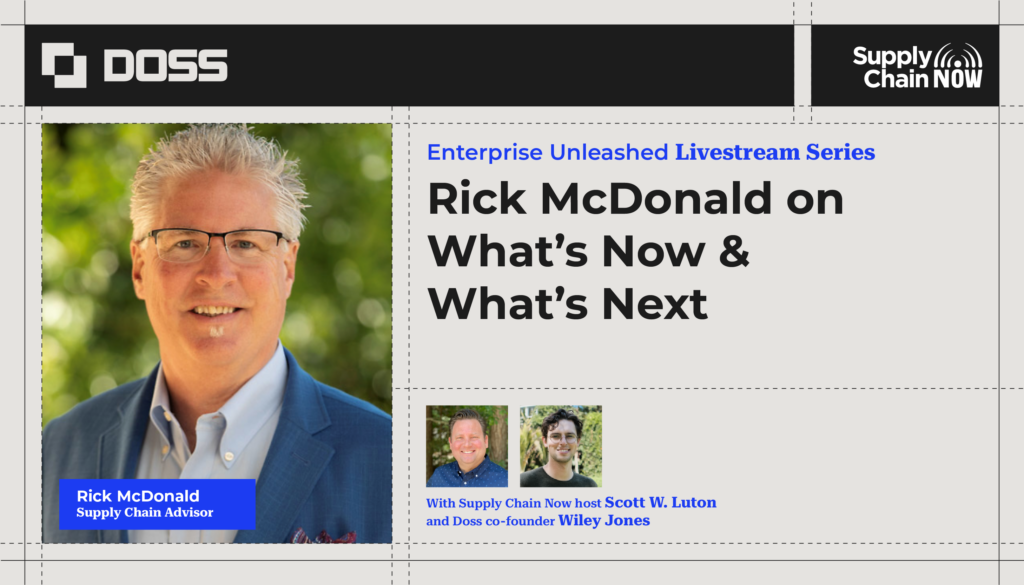
[00:02:56] Scott W. Luton: Oh wow. Elle Wiley. That’s some good foreshadowing there. I wanna introduce our guest speaker here today to joining me and Wiley Rick McDonald. The retired chief supply chain officer for the Clorox company, a $7.1 billion global consumer packaged goods company.
[00:03:11] Scott W. Luton: That’s what Wiley was talking about folks. Now, currently, he advises supply chain tech founders and CEOs on strategy development, customer acquisition, focused messaging. And great network introductions. Now, Rick has extensive experience leading through crisis get this, including the COVID-19 pandemic, US hyperinflation, ludicrous inflation maybe, and a five month long cyber attack in 2023.
[00:03:36] Scott W. Luton: All endured by Clorox. He sits on lots of esteem boards, has collected countless leadership awards and recognition over the years. Way too many to list here. But for today’s conversation in particular, Rick’s experience and insights and leading the digital transformation of the Clorox supply chain folks, they’re gonna be intriguing.
[00:03:54] Scott W. Luton: So join me in welcoming great friend of the show, Rick McDonald. Hey. Hey Rick. How you doing today,
[00:04:01] Rick McDonald: Scott? I’m doing great. I’m doing great. Thanks for having me back and, uh, Wiley, good to see you.
[00:04:05] Scott W. Luton: Likewise. We know Rick, we always enjoy when you stop by and I’ll tell you what to get you and Wiley together in one conversation, two of the most brilliant minds in global supply chain, at least according to me.
[00:04:17] Scott W. Luton: I wish we had five hours, but we’re gonna jump right in and get started. So today, Rick and Wiley, of course, it’s St. Patrick’s Day here and there’s big celebrations. All around the place, right? All around the country and beyond. And I wanna ask you both, and Rick, I’m gonna start with you. What has been one of your favorite St.
[00:04:36] Scott W. Luton: Patrick’s Day traditions or memories? Rick, tell us more.
[00:04:41] Rick McDonald: Well, you know, Scott, I’m, I’m a bit of a foodie, and while St. Patrick’s Day and St. Patrick are not necessarily known for food, I’m gonna go with the tradition of corn, beef, and cabbage and Guinness Beer. I just. That’s just a great combination and, uh, we’ll be, we’ll be enjoying some of that tonight.
[00:04:59] Scott W. Luton: Oh, I, that, that, that sounds delicious. I, now I am starving for all of that, Rick. So add, set one more plate at McDonald, uh, household. And Wiley, how about for you tradition or memory for St. Patrick’s Day? Your thoughts?
[00:05:13] Wiley Jones: It’s a little unfair because St. Patrick’s Day is now my wedding anniversary. And so it was not intentional.
[00:05:21] Wiley Jones: It was just that, you know, my wife and I, we got married a few years ago and did a, you know, courthouse wedding and we didn’t realize when we were doing it, we’re like, oh wait, we just got married on St. Patrick’s Day. And so yeah. Now my, that is my St. Patrick’s Day every year now.
[00:05:34] Scott W. Luton: Well, and you know what?
[00:05:34] Scott W. Luton: That better be your answer. Uh, so
[00:05:37] Wiley Jones: Yeah, exactly. That’s my answer. I, I, you know.
[00:05:40] Scott W. Luton: Well hey, that just means everybody else, a lot more folks celebrate with y’all. And of course y’all have a lot to celebrate with the new edition that came, I guess last year. Uh, Wiley, if I’ve got that right.
[00:05:50] Wiley Jones: That’s right.
[00:05:50] Scott W. Luton: Alright, Wiley and Rick, we got a great conversation teed up here today and I wanna do this, Rick, for folks that may have missed any of your keynote, and I know you do a lot of speaking at events and, and supply chain shows, you name it.
[00:06:02] Scott W. Luton: For folks that missed any of that, unpack your background a little bit. Let’s start with though. What might be a surprising answer? What got you into supply chain in the first place, Rick?
[00:06:14] Rick McDonald: Yeah. You know, it started fairly early, kind of in my teen years. There’s a statistic that says one in eight Americans worked for McDonald’s.
[00:06:21] Scott W. Luton: Hmm.
[00:06:22] Rick McDonald: That was my first job. And uh, you know, I followed that up with working on an assembly line in a metal fabrication plant. And then after I graduated from Georgia Tech, I didn’t really know exactly what I wanted to do, but my first gig was at Frito-Lay and that. That really cemented my, uh, my love for the supply chain and kind of carried on through to my time at Clorox as a, i, I guess I’ll call it a passion.
[00:06:45] Rick McDonald: It was my, it was my job, but it was also my passion and, you know, my, my hobby at the times, what I loved about it was sort of the immediacy of the feedback. The, you know, getting better from day to day. The people involved. Uh, you were doing something together as a team and then you got to see the product that you made in, in some retail store near you.
[00:07:02] Rick McDonald: So I just, I loved all that.
[00:07:03] Scott W. Luton: Mm, I do too, Rick. I do too. Now really quick, Wiley, I’m gonna see if we fall into the statistics there. Rick mentioned one of eight works at McDonald’s. I worked, my first job was Winn-Dixie. I never worked at McDonald’s. Wiley. Did you ever work at McDonald’s?
[00:07:18] Wiley Jones: I did not.
[00:07:19] Scott W. Luton: Okay, let’s see here.
[00:07:19] Scott W. Luton: My rough math and Rick, you’re Georgia Tech. Math may have to correct me, but we’re one for three, so that’s really close. No, no, no. That’s better than the one of one of eight. We’ll see. We’ll see. Let me ask you this, Rick, ’cause I want, I wanna share some perspective around. The Clorox company’s infrastructure and its footprint to give folks some context there, because you know, it’s one of the most beloved companies in the world, but it’s also, it’s pretty sizable.
[00:07:46] Scott W. Luton: Tell us, we’re gonna talk about your accomplishments there in just a second, but tell us a little bit about the supply chain organization at the Clorox company.
[00:07:53] Rick McDonald: Yeah, yeah, for sure. You know, $7.1 billion Global company, consumer packaged goods, notable brands including, you know, disinfecting wipes and Pine Saw Kingsford, charcoal, fresh Dip, cat Lit, glad trash bags, Burt’s Bees, just a number of great products that, uh, we know would love here in the us.
[00:08:10] Rick McDonald: They, a bunch of brands outside the us. The company had, uh, 9,000 people, 6,000 of them were in the supply chain working in. One of the 35 manufacturing plants, or 50 plus distribution centers, 140 something external manufacturers, contract manufacturers and products manufactured in 25 countries and sold in more than a hundred.
[00:08:31] Rick McDonald: So it was, uh, it was just a great, uh, a great remit. $4 billion, underspend, and uh, just a lot of, a lot of terrific people,
[00:08:40] Scott W. Luton: man. Okay. Wiley, really quick before we talked about accomplishments. He got me with Kings for charcoal. I used a bag of that last weekend and we had two, two grills going as we had some baby back ribs going on in here in Georgia.
[00:08:51] Scott W. Luton: Wiley, is that one of your favorite Clorox company products?
[00:08:56] Wiley Jones: It is. Kingsford Charcoal has a special place in my heart and so does BIR Bees, and now, more recently, so do all the stain removing products. So it’s all, I’m all of it. I’m a power user.
[00:09:09] Scott W. Luton: So that goes back. Thank you.
[00:09:10] Rick McDonald: Great.
[00:09:11] Scott W. Luton: To that new edition we were talking about.
[00:09:13] Scott W. Luton: Good stuff. W. Okay. But, but I, I also don’t wanna walk past 6,000 supply chain professionals at their Clorox company. You heard those other numbers from Rick. That is no small feat to get all the products we know and love and trust to our homes when we need it, uh, and when, when we expect it and all. So, but Rick, to make all that happen, and we’d be here all day, maybe talking about what you and the team were able to accomplish, what were some of your favorite moments, Rick?
[00:09:40] Rick McDonald: Let me give you three things real quick. First of all, we were able to build a culture where safety was the most important thing that we did every single day. And we never talked about the numbers that much. It was always about the people who were operating safely and then those who who were injured.
[00:09:57] Rick McDonald: But for those who were into OSHA recordable rate, we were running at an OSHA recordable rate of less than 0.5, which is pretty spectacular. And, uh, we’re very proud of the culture that allowed that to. Allowed that to exist. I’d say the second thing is around leadership development. We, uh, we work at Georgia Tech.
[00:10:12] Rick McDonald: We built an executive education program two weeks in residency. We graduated almost 500 Clorox leaders across all disciplines and functions during a seven year run with, uh, with Georgia Tech. And then last but not least, COVID was remarkable for a lot of different reasons, but one of the things I’m most proud of is the way my team stuck together.
[00:10:32] Rick McDonald: And when I say my team, I’m talking about all 6,000 people around the world. Lots of questions, not very many answers. It was just really a cauldron of uncertainty. And, uh, the leaders in the plants, our associates in the plants. They made it happen day after day after day, and we figured out a way to keep our people safe and healthy and keep our plants growing.
[00:10:51] Scott W. Luton: I love that. And while before I turn it over to you, there was one moment, Rick, that we talked about during the, the deepest Rowes of COVID where I think one of your, uh, supply chain team members were interviewed by a big outfit and they, they beamed with pride. I’m not gonna get the the exact quote right, but they relished getting up in the morning and going, you know, serving that noble mission, helping folks fight.
[00:11:13] Scott W. Luton: The pandemic and that was a beautiful moment. So Rick, good stuff there. Wiley culture, leadership, development and that, that, uh, stick sticktoitiveness, you know, sticking together as a team. There’s some of those themes is what we talked about in the previous episode of Enterprise Unleashed. But where are we going next with the one only Rick McDonald.
[00:11:35] Wiley Jones: I have a. A, a suspicion that we’re gonna talk a lot about culture throughout this series, even though it’s supposed to be a show about technology and, you know, and the enterprise. So I’m really curious, Rick, as, as we kind of rewind the clock, let’s say five years or so, you know, maybe the end of the pandemic, so to speak, to now, what do you think has really fundamentally changed in the supply chain organizations, and especially as you said, the, the remit up to the leaders?
[00:12:04] Wiley Jones: As a result of some of the technology changes, especially that you’ve seen over the years, but what’s new, what’s different, what’s changed in the last five years and how are you thinking about this as you’re advising folks going forward?
[00:12:15] Rick McDonald: Oof. This is only an hour show, right?
[00:12:17] Wiley Jones: Yeah, yeah. I’ll put you, I’m an clock.
[00:12:19] Wiley Jones: There you go.
[00:12:21] Rick McDonald: Let me, uh, let me give you my top four, and there are many others besides this, but I, I want to give you my, my top four thoughts around this. First of all, operational excellence is still very, very important, but, mm-hmm. What is taking the, um, sort of the feature role now is predictive intelligence.
[00:12:38] Scott W. Luton: Mm-hmm.
[00:12:38] Rick McDonald: And being able to get out in front of things and understanding what is the data telling you. And to do that, there are all sorts of steps preceding that, including, you know, capturing the data, sorting and sifting it, gaining the insights, knowing what to do with those insights. That’s number one.
[00:12:53] Rick McDonald: Number two is we go from episodic planning. Two more real time on demand, continuous planning, demand signal, inventory plans, supply plans, those can all now be done in real time. And, uh, in order to keep up with the speed of the consumer, you gotta be, you gotta be moved in that direction if you’re not already there.
[00:13:11] Voiceover: Mm.
[00:13:11] Rick McDonald: I would say we’re moving from experience driven decisions to data-driven decisions, and not that data wasn’t used before, but. There was always sort of that secret sauce of somebody’s intelligence or a problem they’d solve 10 years before that they could apply those learnings today.
[00:13:28] Scott W. Luton: Mm-hmm.
[00:13:28] Rick McDonald: Still important.
[00:13:29] Rick McDonald: However, with so much more data available, the precision of the timeliness of those decisions can be accelerated. And then last but not least, is the human side of things, managing teams. And the thing that I’m focused on right now with a lot of, uh, folks that I talk with is sort of this intersection of.
[00:13:46] Rick McDonald: Talent and technology.
[00:13:48] Scott W. Luton: Mm-hmm.
[00:13:48] Rick McDonald: And, uh, you know, technology has been in play for some time now, but never like it is today, and never evolving and advancing as quickly as it is today. And that’s a, that’s a real challenge for a lot of leaders.
[00:13:58] Scott W. Luton: Mm-hmm. Wiley, your reaction to that?
[00:14:02] Wiley Jones: I’m so curious about the point you’re talking about around the talent and technology.
[00:14:06] Wiley Jones: I don’t, I feel like I don’t hear enough people specifically hitting on this point. Are you talking about this more so in the, uh, aspect of re-skilling talent development? Teaching building process so that people can leverage these technologies. Are you thinking about it from a recruiting and personnel development?
[00:14:23] Wiley Jones: Where do you see this plugging in and the, you know, the symbiosis with advances in technology and the modernization of a workforce to better leverage it?
[00:14:31] Rick McDonald: Hmm. Yeah. It’s, it’s yes and yes, and plus,
[00:14:34] Wiley Jones: yes,
[00:14:35] Rick McDonald: it’s everything from the digital fluency of the leaders to the. The recruiting profile. You gotta be recruiting tomorrow’s talent today, and you can’t do that with antiquated job descriptions and, and thinking and technology.
[00:14:49] Rick McDonald: It’s the upskilling and reskilling of your associates. It’s a change management. Hmm. How do you get into this gear and, and how do you make it work for you? It’s, it’s a very comprehensive talent. You know, when I say that one word I’m really talking about all of it, all the way from
[00:15:05] Wiley Jones: Yeah.
[00:15:05] Rick McDonald: You know, leadership mindset and capability to associate skillset.
[00:15:09] Wiley Jones: Yeah, that, that’s fascinating. Did I’m, I’m gonna say I’m curious a lot in this conversation, so apologies in advance. It
[00:15:17] Scott W. Luton: does, Rick. He says that a lot.
[00:15:19] Wiley Jones: You can edit it out, Scott, I promise. Oh wait, this is a live stream. Nevermind. Uh, so I’m curious about the point you’re describing here, which is, it’s so deep into the associate level, folks throughout every, you know, facet of the supply chain, all the way up to the senior most leaders.
[00:15:34] Wiley Jones: Where are you seeing the cultural impact of this? Especially as you’re talking about these pragmatic, practical, daily workflows around making, processing and planning more continuous. Are these things that are coming from top level organization team members? Is this stuff that’s coming inside the organization?
[00:15:52] Wiley Jones: How are you finding that these new ideas are being circulated in the company, and how do you build a culture with an openness to try this when, as you were talking about even at the beginning. Safety quality, things that are mission critical are also maybe sometimes at odds with letting an AI tool go in and do the thinking for people.
[00:16:12] Wiley Jones: How do you think about balancing that and where are you seeing all these ideas come from right now?
[00:16:17] Rick McDonald: I mean, the ideas are coming from lots of places, and I think one of the challenges leaders have at the moment is how to sort and sift what to go after with their limited time, their limited resources, both people and financial.
[00:16:27] Scott W. Luton: Mm-hmm.
[00:16:27] Rick McDonald: And that is one of the biggest challenges right now. And I, I chalk that up to digital fluency of leaders and our, our need to really kind of plus up our capability in this space. I’m not suggesting anybody needs to become a coder.
[00:16:40] Scott W. Luton: Yep.
[00:16:40] Rick McDonald: But at the same point in time, you gotta understand the technology.
[00:16:43] Rick McDonald: What problems it solves, what problems it doesn’t, and, uh, and, and leverage that your organization and these ideas are coming from every place, including the board saying to the CEO, we need ai.
[00:16:56] Voiceover: Yep.
[00:16:56] Rick McDonald: CEO turns somebody and says, we need ai, and then somebody runs and does ai and that may or may not be the solution that’s necessary for that problem, and it may or may not be the most pressing problem that organization has to solve.
[00:17:09] Rick McDonald: So I find that. There’s a lot of confusion over this, and that’s leading to some false starts, and there’s some projects that are not delivering their ROI and some frustration and some headwinds.
[00:17:19] Wiley Jones: Yeah. Especially as you’re going and you’re advising folks on, you know, on the leadership side, where are you going to look for that trusted?
[00:17:30] Wiley Jones: Counterpart in the market as you’re trying to do the sifting and sorting of what’s real, what’s not real. Not asking you to put out an ad for anything, but more so just saying how are you thinking about getting calibrated when it feels like it’s so hard to keep up right now with what is state of the art?
[00:17:47] Wiley Jones: Where are be best practices being distilled from this is something that I struggle with on a daily basis as we’re running our own company. How are you thinking about this? Especially with, you know, these very large, you know, multinational, the $7 billion footprint organizations. Where are they going and turning to for their insights around where to distill these best practices?
[00:18:06] Voiceover: Hmm.
[00:18:07] Rick McDonald: Well, I think different companies are doing it different ways, and those that are more externally focused, you know, they’re ending up at a variety of supply chain shows worldwide. They’re listening to podcasts like Supply Chain Now. They’re doing a lot of talking with individuals in their ecosphere, whether that’s other chief supply chain officers in my case or others in industry, uh, leveraging consultants.
[00:18:29] Rick McDonald: I subscribe to a number of daily emails.
[00:18:31] Scott W. Luton: Mm-hmm.
[00:18:32] Rick McDonald: Don’t read ’em all, but from various groups, and I’ll see a hot topic there and I can, I can triangulate what I’m hearing from multiple sources. Plus my experience of leading the transformation, the digital transformation of Clorox supply chain, and have a pretty good idea of where things are going and, and how it’s being paced and where some of the pitfalls are in, uh, in the progress.
[00:18:51] Scott W. Luton: Yep. Hey, really quick, Wiley. I would just add to that the event thing that Rick mentioned, whether it’s Modex or Manifest or a Gartner or you name it, there’s a slew of really quality supply chain programs and getting out and networking and gathering market intel. And you may not find. What you’re looking for at those events, but they usually put you on a path to connect the dots long after the event.
[00:19:14] Scott W. Luton: And while I would just add, and we had a little fun with what you, one of your reframes there that you’re curious, but practical curiosity. I’m telling you, we’ve all probably know some leaders that really are truly, they wake up in the morning curious, but others. Are more kind of stuck in a status quo and they have it really developed that really valuable and outcome producing curiosity.
[00:19:37] Scott W. Luton: That’s really, really important. But Wiley, I think you’re gonna ask Rick next, we’re gonna talk about one of our favorite things, and that’s the beautiful human factor. Wiley, what, what, I think you’re gonna pose a question there where, uh, humans are still outperforming machines, huh?
[00:19:52] Wiley Jones: Yeah, that’s what I was about to get to.
[00:19:54] Wiley Jones: So I think the thing that we’ve talked a lot about here is this need for this symbiosis. Where are you seeing organizations still turn to their team members to make judgements? And we talked about continuous planning. There’s a lot of predictive insights and capabilities possible with large amounts of data and high quality data.
[00:20:14] Wiley Jones: Where are we still turning to high quality human beings time and time again?
[00:20:19] Rick McDonald: Yeah, this is, uh, a really interesting and fast evolving topic. And that is, you know, where do humans really outcompete, outperform, you know, machine learning and all the various forms of artificial intelligence. And I, it’s showing up in three places, one where experience does matter when some seat time really helps make a better decision.
[00:20:40] Rick McDonald: Number two is around. Sort of intuition. Machine learning is not super great with intuition.
[00:20:46] Voiceover: Mm-hmm.
[00:20:47] Rick McDonald: I think the third thing is where there’s context required, whether it’s around ethics or morality or integrity or maybe even, you know, some profit motive choices.
[00:20:55] Voiceover: Yeah.
[00:20:55] Rick McDonald: And there, there are probably three things that I would, I would highlight there.
[00:20:59] Rick McDonald: The first one is uncertain situations. I mean, take this, the situation we have right now with this geopolitical disruption and the hormones straight. There’s just not a lot of seat time for what to do when the hor moves straight, closes,
[00:21:13] Scott W. Luton: right?
[00:21:13] Rick McDonald: And so humans are gonna be better adept at sorting through that.
[00:21:16] Rick McDonald: Now, some of the baseline context and baseline data can be gathered, machine learning, but the humans are gonna have to play there. The second thing is, you know, anything around ethics and value-based decision making, and the last one was around leadership and team motivation.
[00:21:30] Voiceover: Yeah.
[00:21:30] Rick McDonald: You know, nobody’s running up to their laptop and asking chat GP to mo, uh, motivate them to do much of anything.
[00:21:36] Rick McDonald: And so the human beings involved have to. They have to inspire, they have to create, they have to drive that curiosity. They have to encourage the organization when times are tough. And that is best done by a, by a person.
[00:21:50] Scott W. Luton: Yeah. Wiley, before I move forward and, ’cause I’m gonna go down this, this human factor string a little bit further, react to that, you know, here during March Madness, right?
[00:22:00] Scott W. Luton: We had March Madness about to kick off tonight or tomorrow, and as he was talking about some of those scenarios where humans. Certainly still have a unique superpower. I would argue to one of his points, you’re not gonna find AI coaches on the sidelines leading their teams into the March Madness, at least not this year.
[00:22:18] Scott W. Luton: Who knows next year? Who knows? But Wiley react to where he sees those human superpowers still alive and well and thriving.
[00:22:26] Wiley Jones: Yeah. It still comes down to leadership. Exactly what you’re describing, Rick. I can’t imagine a 6,000 person supply chain organization, what you’re describing to Clark’s company, waking up in the morning and feeling energized and ready to go out and help the world if they’re being led through a daily brief by, uh, a machine that really is just calculating out the best way to do this, the passion that comes from people and the, the reasons they do what they do, I think are part of the.
[00:22:56] Wiley Jones: Part of the purpose of all this, I think what exactly what you’re hitting on is, is really the thing that I spend a ton of time thinking about for our own organization and then our customers and people we partner with.
[00:23:04] Scott W. Luton: Hmm. Well said. But I wanna go down a little further, uh, Rick and, and kind of build on what you and Wiley were talking about a minute ago, because, you know.
[00:23:13] Scott W. Luton: A, as y’all both have kind of mentioned maybe a couple of times, one of the biggest challenges with AI isn’t the technology. It’s of course the people. It’s how we adopt, how we adjust, how we tackle our fears, how we get out of our uncomfort zone, how do we see how it makes our day easier? And hopefully not harder, right?
[00:23:29] Scott W. Luton: We gotta overcome a lot of that and that’s just to use like the basic AI stuff, much less some of the cool things we’re we’re headed towards in the coming days and weeks and months. I want to ask you, Rick, how do leaders help their team see AI as a tool that elevates them rather than threatens them?
[00:23:49] Rick McDonald: Yeah, it’s a really great question, Scott. And of course, you know, there are multiple studies that say as much as half of. People involved in, in roles in companies are fearful that AI’s gonna take their jobs. So this is a very real thing.
[00:24:01] Scott W. Luton: Yeah.
[00:24:01] Rick McDonald: It starts with something I mentioned before, that’s the leader’s digital fluency.
[00:24:06] Rick McDonald: If you’re gonna install some technology, you gotta be able to explain it. You gotta be able to understand, you gotta be able to make it real for people who are not as familiar. And that includes positioning AI as something that is decision support. Not decision replacement. I think that’s a really important thing, is decision support.
[00:24:24] Rick McDonald: The second thing is everybody always wants to know right after that, after you tell ’em the what, it’s the well, what’s in it for me? And that is the place where you’ve gotta be as transparent as you can as soon as you can about the impact on the individuals that will be working with or maybe not working with this, uh, this new technology.
[00:24:42] Rick McDonald: The what’s in it for me? The third thing is investing in upskilling and reskilling. Always valuable, but I think never more than now. And by the way, with people going to work for multiple companies over their careers and it projected to be that way for the coming future, that makes them a more valuable employee no matter where they go.
[00:25:01] Scott W. Luton: Mm.
[00:25:01] Rick McDonald: And then the last thing is change management. And this is. So underappreciated and underinvested, it is one of the key reasons why a lot of these digital initiatives are not going well and they’re not delivering the, uh, desired results.
[00:25:15] Scott W. Luton: Yeah.
[00:25:15] Rick McDonald: Um, you know, we think we know what change management is until we actually do some study and some work in that space, then we find out how much we don’t know.
[00:25:22] Rick McDonald: So that’s, that’s the fourth thing I’d say about this.
[00:25:25] Scott W. Luton: Outstanding. I’m gonna, I’m gonna pose a follow up question to Rick and then Wiley, I’m gonna get your comments on what he shared here. Because you touched on change management and Rick and Wiley, we’ve seen all sorts of change management in our journeys.
[00:25:38] Scott W. Luton: We talked about it pre-show, post-show over that delicious adult beverage. As Rick was talking about earlier, what does good change management look like? Rick?
[00:25:49] Rick McDonald: Well, you know, first of all, it’s recognizing that, and, you know, this is a, this is a little bit of a tired phrase, but, you know, change is not natural for human beings.
[00:25:56] Voiceover: Mm-hmm.
[00:25:56] Rick McDonald: But, but more than that, as a leader, you’re trying to manage the chaos that this change is going to create, especially transformative change. And so the preparation of your people is key. That positioning, what is it? What are you doing? Why are you doing it? What are the outcomes it’s gonna drive?
[00:26:12] Rick McDonald: What’s the best way for them to engage and acknowledging. The things that they’re going to feel, they’re gonna feel concerned. Some angst, some people will feel excitement, but a lot of ’em are gonna be more on the less optimistic side of, of the change curves. That’s number one. Number two is you’ve gotta identify your cohorts.
[00:26:31] Rick McDonald: This was something that we didn’t do a great job in the first digital implementation to Clorox. We put in a Gartner top right box planning tool, and we thought we’d done some really great change management. We hadn’t, and what we hadn’t done was identify the. At least three groups of people at our organization on this end.
[00:26:48] Rick McDonald: You’ve got the, the folks who are, they’re just loving it. They can’t wait to get going, right? They are your early adopters and you have to celebrate them and load them up with resources so they can go and kind of show the way into the, into the new cave. On the other end, you got folks who you have to coach or coach out.
[00:27:05] Scott W. Luton: Mm,
[00:27:05] Rick McDonald: they, they just are not going to get there unless there’s some intense coaching, and if they can’t get there, they need to go work for somebody else. And in the middle. You got a whole group of people who are kinda wait and see some optimistically, some pessimistically. So you gotta, you gotta sort that out and then deliver messages to each of those groups that are tailored for them.
[00:27:23] Rick McDonald: And then the last thing I’d say is leaders have to walk the talk you, you cannot put a planning system in like a ccue or something like that, and then show up with your favorite pivot.
[00:27:33] Scott W. Luton: Yep.
[00:27:33] Rick McDonald: That just doesn’t work. And, uh, people pick that up very, very quickly. If leaders are not either digitally fluent, adept to the capability, explaining it well, or don’t walk the talk once it’s implemented.
[00:27:44] Scott W. Luton: Yep. Oh man. We, we kinda have a whole series on your last response, Wiley, before I pose it, one more question to Rick before I pass the baton to you. React to what we just heard in those last two questions and responses from Rick.
[00:27:57] Wiley Jones: Man, the first thing is, is you stole all my great thoughts here,
[00:28:00] Scott W. Luton: Rick. Um,
[00:28:02] Wiley Jones: I have nothing left to say I’m speechless.
[00:28:03] Wiley Jones: No. The, the, the point I think that’s so key that you’re making is that it seems more important than ever that leaders are leading the way instead of just doing the things that they’ve done before. And it’s what you talked about this, these periods of transformative chain, that the leaders have to be the tip of the spear and guiding the organization through that.
[00:28:24] Wiley Jones: We see that a ton right now, and I, I think. It’s just been really, really impressive to see how these really massive companies are actually, a lot of them are becoming the early adopters themselves. Yes. The leaders side of these companies. A
[00:28:36] Rick McDonald: hundred percent.
[00:28:37] Wiley Jones: And that’s just been really exciting to me to see that.
[00:28:39] Rick McDonald: Yeah,
[00:28:40] Scott W. Luton: well said Wiley and folks. The Fearless Frontline is that yellow book that sits over my left shoulder and that’s written by Ray Atia. One of my favorite folks I worked with in my entire career, and one of his overpowering mantras through his whole career was that. An overwhelming majority of folks that show up at the office or the factor wherever, each and every day, they want to be very successful.
[00:29:04] Scott W. Luton: And, and it goes back to what Rick was talking about, right? Kind of those that don’t, the very few that don’t, right? We gotta come up with a different plan for, but man, folks want to be successful. They want to con contribute. And I would argue that a majority of folks, even in this. These crazy times right now, they really are willing to learn technology.
[00:29:24] Scott W. Luton: It just takes, it takes hands-on effective leadership that can help them bridge those knowledge gaps. That’s for all of us, including myself, for sure.
[00:29:33] Rick McDonald: Hey Scott, just one, one quick interjection there. You know this, this whole thing, and it may go back to what Wiley asked sort of earlier on, like where does all this come from?
[00:29:41] Rick McDonald: One of the things that leading companies are doing is they are making this one of their strategic planks in their five-year plan. Mm. They are not just sort of hoping and guessing it is in their strategic plan. And honestly, if it’s, and the leaders are committed to that, and if it’s not, what you have there is just what’s called a really expensive hobby.
[00:30:00] Rick McDonald: You’re gonna be dabbling in technology and, uh, that will not play out well at all for organizations who don’t. Put it in their plan, commit to it, then figure out how to drive the roadmap.
[00:30:10] Scott W. Luton: Hmm. Well said Rick. Alright, well one quick, Wiley, I’m stealing your thunder. I’m trying not to, I promise you. But really quick, Rick, the skills for the next generation supply chain professionals in an AI enabled and an AI empowered world, give me, what’s your short list?
[00:30:27] Rick McDonald: Well, you know, not only do you have to be an opera operational expert, a leader development, a strategy person, a coach, an enterprise thinker, but you’ve also gotta now be a lot better with your data and analytics literacy.
[00:30:39] Scott W. Luton: Mm-hmm.
[00:30:39] Rick McDonald: So modern supply chains and all the iot devices are just generating a ton of data and it’s real time.
[00:30:46] Rick McDonald: And so what are you gonna do to capture that and sort and sift it? Have the right prompts and ask the right questions so you can interpret those insights. That’s number one. Data and analytics literacy. The second one, and I’ve said this a couple times, is digital fluency of the leaders. This is just, it’s a non-negotiable, and if you’re not there, you gotta get there and you gotta get there quickly.
[00:31:06] Rick McDonald: And the last one is the end-to-end orchestration aspect, including me. A lot of us were very focused on excellence in each supply chain. Subfunction. And the ability to orchestrate across the supply chain was not nearly as great as it is now. And if you’re gonna operate at the speed of the consumer, you’ve gotta be into orchestration across the entire supply chain.
[00:31:29] Scott W. Luton: Hmm. Well said, Rick. Digital fluency. Folks, if you take anything away from this conversation, you better take that one, especially if you’re charged with leading people that, again, want to learn, want to accomplish, want to contribute. Wiley, I think next. We’re going to one of the most important sessions of the whole conversation, right?
[00:31:47] Scott W. Luton: Stall versus scale. Where are we going with Rick?
[00:31:51] Wiley Jones: Yeah. So something we talked a lot about in previous discussions is why do some of these pilots turn into massively impactful, successful programs and why do some of them stall off? Yeah, and I think something that you talked about, Rick, that I thought was so interesting is around change management.
[00:32:10] Wiley Jones: We hear this all the time. I see this from a first person point of view very regularly, being able to build that case study inside of the organization. What are some things that you’ve seen as very successful? And then also some red flags and warning signals when pilots aren’t going well or when programs might not be going the right direction.
[00:32:28] Wiley Jones: How do you see, uh, organizations set these up for success and sometimes for failure?
[00:32:33] Rick McDonald: We, we’ve touched on a few things in this space previously, but let me hit on a couple of, a couple of new ones there. There’s the lead from the front, and what I mentioned just a minute ago was having this digital agenda, this transformation agenda, insisting from the top down that this is the direction we’re going.
[00:32:50] Rick McDonald: This is not the time to have over collaboration or kind of group think on this.
[00:32:56] Scott W. Luton: Yeah.
[00:32:56] Rick McDonald: So it’s, it’s leading from the front. The second thing is. The technology has to solve the problems you have.
[00:33:01] Wiley Jones: Mm-hmm.
[00:33:02] Rick McDonald: And, you know, all of our inboxes and every conference we go to, there are a million solutions, but you may not have those problems.
[00:33:09] Wiley Jones: Right.
[00:33:09] Rick McDonald: And by the way, the technology that’s being proposed may not solve your problem. And so that’s where the digital fluency comes back into being able to match problem with solution and then, you know, get to change management. And maybe a show started with that. But that’s arguably way more important than the technology itself.
[00:33:25] Rick McDonald: And it is so under invested and organizations have. As they have streamlined themselves, many of them have taken out any kind of change management capability whatsoever. And it’s gonna have to be part of this, um, part of this digital transformation for any company to be successful. And I think the red flags are when you are not clear on what your business case is.
[00:33:48] Rick McDonald: Mm-hmm. We’re, you’re on the problem you’re trying to solve. You, you need to pick things early on, especially as you’re trying to build credibility and trust in your own organization. Pick something that’s gonna be a winner. And there are lots of them. There are lots of them. Whether it’s, you know, really heavy keyboard, lots of data, lots of repetitive tasks, lots of repetitive decisions, those are ideal candidates for early adoption.
[00:34:09] Rick McDonald: There are a number of places where you could just deliver a better ROI, whether it’s warehouse orchestration. I know you’ve had Keith Moore and auto schedule on before Scott or Kennay with Mike Landry of the man supply planning space. Pick something that works and you know is gonna solve, solve your problem.
[00:34:25] Rick McDonald: And I think those are the real. The real red flags when you see that that hasn’t happened, you know it’s not gonna go well.
[00:34:30] Scott W. Luton: Mm-hmm.
[00:34:31] Wiley Jones: Yeah, that makes a ton of sense. The thing that I, I have kind of considered from what you’re describing, and it maps super well to stuff that I’ve heard similar advice in the past is.
[00:34:41] Wiley Jones: When you have this really cool enabling technology and it’s this awesome hammer and you go around as an organization and start looking for nails, so, you know, wave the red flag. Like, all right guys, you know, let, let’s take a step back and be like, what are we trying to actually accomplish here? What hurts inside of the company?
[00:34:54] Wiley Jones: What do we want to improve? Let’s work backwards from the world we want to build towards, and not the fun, new, cool tools in our hands.
[00:35:02] Rick McDonald: Mm-hmm. Yeah. That, that’s it. You know, I, um, I’ve been on stage a lot, as Scott noted over the past year and a half, and by far and away the most. Asked for talk is the mindset, skillset, tool set, and change management of digital transformations.
[00:35:16] Rick McDonald: And invariably, when I ask audiences about halfway through, what do they think of when they think about digital transformations? And they get ’em to yell out almost every single time. Somebody will name a piece of technology. They’ll name some software, they’ll name some gear. They will not talk about the leadership mindset.
[00:35:33] Rick McDonald: They will not talk about the upskilling or reskilling and the change management necessary. It’s, it is, it’s really difficult when you get overly focused with that new shiny thing you bought. And by the way, when you, when you buy that and you put it into play and you don’t do those other things, you will not get anywhere near the value that you, uh, you thought you were gonna get.
[00:35:52] Wiley Jones: Yeah. Yeah. The way I describe this a lot to the partners that we work with as a, we’re going into an expedition into the jungle. And it doesn’t matter how great this new machete you have is you’re still going into the jungle and you have to have the courage and, and the team set up so that they’re ready to go through that almost reformation inside of their own organization.
[00:36:14] Scott W. Luton: That’s right.
[00:36:14] Rick McDonald: Yeah. Lovely.
[00:36:15] Scott W. Luton: Well said. Hey, really quick, uh, as we continue, uh, down this path, I think you’re gonna be asking Rick about how AI changes the C-S-C-O-O. But really quick, I wonder, I’m doing a test this year. I got AI driven brackets and I’ve got human driven brackets. I’ve got a hundred of each.
[00:36:33] Scott W. Luton: So we’re gonna see where all the performance goes and the breakdown. Who knows, next year I might be making, letting Ai. Handle all of those, uh, those top-notch critical conversations and decisions we’ll see. While, what do you think, who’s gonna win out?
[00:36:46] Wiley Jones: I don’t know. Computers are really good at low probability things like the bracket, but this might be one of those things from an intuition standpoint where, you know, it could be what Rick said.
[00:36:56] Wiley Jones: I’m not sure. We’ll see. But the, uh, yeah, the, the question I think, you know, kind of where I wanna close off some of this discussion from our side is. We talked a lot about the organization and you mentioned a couple pieces around digital fluency for the leaders. Introspecting a little bit more. What are the leaders for this next decade and the coming decades on the supply chain management side and you know, chief supply chain officers, what are they going to need to look for in themselves and where are they gonna have to grow to lead these large companies through these next very what likely will be very turbulent times where we have extremely large amounts of change in the world?
[00:37:32] Wiley Jones: What are they gonna have to be thinking about for themselves?
[00:37:35] Rick McDonald: Yeah, let me start with this one. And this might be a little bit controversial for my friends in it, but, um, the chief supply chain officer’s gotta own the supply chain digital strategy. They’ve gotta own the inventory of the problems they need to solve, they gotta own the inventory of understanding the potential solutions.
[00:37:52] Rick McDonald: And this is, I, and I repeat, this is not your CIO or CTO’s activity. It’s, in my opinion, it’s your responsibility as a supply chain leader. To understand all that, your strategy, your technology, and the problems it will solve. And if you’re like me, you might have to wrestle this away from your CIO, but we ended up in a very good place with a very good relationship going arm in arm down this digital transcript transformation path.
[00:38:18] Rick McDonald: But that’s number one. You gotta own your digital supply chain Strategy number two is. It’s going from, as I mentioned a minute ago, from this sub functional management kind of sub function at a time to overall orchestration, finding tools that help you get that end-to-end visibility, that end-to-end speed, that ability to gather those insights and respond and react to them quickly.
[00:38:41] Rick McDonald: Artificial intelligence, intelligence decision making, so. This, this comes with, you know, sort of the advertisement of trust, but verify. I think we’ve all gotta be in that mode because AI does lie,
[00:38:53] Scott W. Luton: right?
[00:38:54] Rick McDonald: But at the same point in time, it is so far superior on so many things in terms of capturing that data and making decisions within the constraints that you set.
[00:39:03] Wiley Jones: Mm-hmm.
[00:39:04] Rick McDonald: Especially as we get into agentic ai. And then the last thing I’d say about this is kind of that again, back to the intersection of talent and technology. You can’t do this without. People, and you shouldn’t do this without your people. And so that bringing those things together, whether you’re redesign the organization, you’re thinking about different workflows.
[00:39:24] Wiley Jones: Yeah.
[00:39:24] Rick McDonald: You’ve got an org chart that’s got agents, managing agents. What does that look like in the new, as we go forward here? That those are gonna be the, the four things I think chief supply chain officers will have to adjust to.
[00:39:34] Wiley Jones: Yeah.
[00:39:35] Scott W. Luton: W you wanna react to that? That’s quite a four, four item list there.
[00:39:39] Wiley Jones: The first one especially, I think is really radical.
[00:39:42] Wiley Jones: Not to say that I. I completely agree. I don’t, I, I don’t disagree with that even slightly, but it is, I think, a, a pretty radical point of view that people in industry maybe don’t share as much. And the thing that you’re describing around that the supply chain officers and people who run those functions need to have control over their own it destiny.
[00:40:04] Wiley Jones: Because the information model of the supply chain, it’s downstream of the real world thing. As opposed to going the other direction and saying, how do we take this information model that we have and make it work for what our company does and what our business and our supply chain do. We actually need to go the other direction and say, here is how the real world works.
[00:40:21] Wiley Jones: How do we build a strategy from an IT point of view around what that company is? Yeah, and I think that’s, that is such a fundamental inversion. It feels like that’s actually a pretty big departure from a way a lot of companies have structured their organizations lately, so that I’m so enthused to hear you say that.
[00:40:36] Scott W. Luton: Yeah, I am too.
[00:40:37] Rick McDonald: Well, I appreciate that. And just one, one comment to, to add onto that for me, the eyeopener was sort of circa 2017 18 when I was talking to my friends in it. And this is, listen, you cannot do this without them. So this is not an us and them thing. This is a we. But I was talking to ’em about technology that would solve our demand planning issues at at Clorox.
[00:40:58] Rick McDonald: I got all sorts of replies that didn’t really reflect the problems I needed to solve and the solutions that were gonna solve those problems. And I think it’s unfair to expect them to be expert in all the technologies across the functions of an enterprise, whether it’s marketing or sales, or r and d or supply chain,
[00:41:16] Wiley Jones: right?
[00:41:17] Rick McDonald: Supply chain. Folks need to own that. They need to own that for themselves and craft those capabilities so that they best solve those problems. And then. Leverage your IT organization for all their great skills in technology and connectors and resources and cost in cyber. There’s plenty for them to do.
[00:41:35] Rick McDonald: And uh, when you bring those two things together, it turns out to be a pretty powerful combination.
[00:41:40] Wiley Jones: Yeah,
[00:41:41] Scott W. Luton: well said. Rick and Wiley. Okay, we’re gonna have a fast and furious finish. Alright, so let’s see here. Rick, I’ve got two final questions and you’ve been speaking to the first one, I think throughout. I’m gonna ask it anyway because you know, I love closing with some action oriented advice.
[00:41:58] Scott W. Luton: So when you think of what some of your final advice would be for operators out there that are either starting or leading AI transformations today, what would that be? Rick?
[00:42:10] Rick McDonald: Yeah. This recaps a lot of Scott, what you and Wiley and I have been talking about. The first one is. That digital influence, digital fluency thing, there’s no replacement for your knowledge, your curiosity, your adventurousness, your understanding of the technology, the tools, and the problems you have to solve.
[00:42:26] Rick McDonald: The second one is around, this must be done with, with the people in your organization, and it’s up to you to upskill them, re-skill them, train them, coach them, set the technology up in the right way so they see it as. Decision or support versus decision replacement.
[00:42:42] Scott W. Luton: Hmm.
[00:42:42] Rick McDonald: And then last but not least is, is the change management topic.
[00:42:45] Rick McDonald: And we really all have to become expert at this. This is not an HR thing solely. It can certainly be facilitated by that group or maybe others if you have an organizational change management group. But change management is something so powerful in all these transformations, especially when you’re making big pivots.
[00:43:01] Rick McDonald: Like we’ve been talking about today.
[00:43:03] Scott W. Luton: Yes, Rick, man. I’d sign up for an extra hour or three easily. This has been good stuff between you and Wiley of course. And Wiley, I got some tough questions for you because Rick has really, in less than an hour, shared some really been there, done that actionable perspective, uh, with all of us here today.
[00:43:21] Scott W. Luton: What’s been a couple of your key takeaways, Wiley?
[00:43:26] Wiley Jones: It is, it’s really interesting because. The scale of some of the companies that I spend a lot of time with are orders of magnitude smaller than Clorox company and a lot of the companies that, that Rick spends time around. But the problems are exactly the same, and I think a lot of that tells me that, as you know, kind of as a global supply chain community, we’re kind of all in this together right now figuring this out.
[00:43:52] Wiley Jones: And in some senses it’s a little scary, but that also feels pretty nice to know that. It’s a bit of a brave new world, and there’s a lot of really massive opportunity for us to figure this out together as a collective around how do we go and transform our organizations? How do we eliminate waste? How do we improve the end experience for our end consumers?
[00:44:11] Wiley Jones: And it’s what Rick said. How do we move as fast as the consumer, which they’re moving pretty fast nowadays. So every single aspect of this is just really exciting because as a global cohort, we’re kind of all figuring this out. Hmm,
[00:44:24] Scott W. Luton: we are, sometimes it feels like it’s week by week. Sometimes it feels like it’s minute by minute.
[00:44:30] Wiley Jones: Yes.
[00:44:30] Scott W. Luton: But that’s okay. We’re gonna, we’re gonna figure it out. We’re global. Supply chain is a incredibly bright, innovative, and resilient subset of the human population, human society. So I got lots of faith. Hey, really quick, Rick, I’m gonna ask you in a second how folks can connect actually with you. And while we got some, some, some cool DOSS news to share, but.
[00:44:51] Scott W. Luton: I found this this morning. I went rummaging through a, a box in my basement and I came across a couple of tools that used, that I used over 20 years ago when I moved to Atlanta. And I think it illustrates a couple things here. One was this Magellan I just took off. The thing that plugged into my car that got me through, along with my handy dandy map, got me through all Atlanta traffic and beyond, and I use it religiously, along with maybe MapQuest printouts of if y’all remember those directions.
[00:45:19] Rick McDonald: Oh yeah,
[00:45:20] Scott W. Luton: that worked, right? That worked 20 years, 20 plus years ago it worked. Goodness gracious. There is such a better way that most of us watching or listening to this conversation already know. Some folks won’t even know what I’m talking about when I say a GPS device or a Magellan, and that really illustrates, I think, a really important point.
[00:45:38] Scott W. Luton: Not just this conversation, Wiley, but the series we’re, you know, we’re conducting in in conjunction with you. There’s a better way. There is such a better way, and it kind of goes to a core point Rick made. But we gotta choose the right technology that is tackling the problems and delivering the success that is, that’s our organizations are targeting, not just looking to the left and the right grass is greener.
[00:46:02] Scott W. Luton: Hey, lemme do what they’re doing. May not be a good fit. Gotta be targeted. Gotta be targeted. Rick and Wiley, outstanding conversation Rick. And don’t go anywhere, Wiley. We’re gonna get a DOSS update here in a second. Rick, how can folks connect with you, bring you in keynotes, all the great things you do, Rick, how can folks connect with you?
[00:46:20] Rick McDonald: Yeah, thanks for that, Scott. If there’s interest in keynotes or panel conversations or fireside chats, you can hit me up at rickMcDonald@att.net or also on LinkedIn. And then, uh, if you’re in the Atlanta area on April 2nd, I am moderating a panel on behalf of Georgia Tech’s Scheller College of Business.
[00:46:39] Rick McDonald: And the topic is the intersection of talent and technology, and we’ll have three great panelists. It’s gonna be an evening session with a reception after it down on the Georgia Tech campus. So I’d love to see if you’re in town.
[00:46:50] Scott W. Luton: Outstanding. You know, Rick. Wiley doesn’t like leaving that beautiful California weather, but we gotta bring him to Atlanta.
[00:46:57] Rick McDonald: Yes, sir.
[00:46:58] Scott W. Luton: And illuminate a lot of our organizations around here. We’re gonna make that happen. Um, but Rick, good stuff don’t go anywhere just yet. Wiley, y’all got a bunch of things going on and I wanna share a couple of things from the DOSS organization that’s on the move. And this isn’t a very fair question, but if you had to pick one thing that you’re most excited about when it comes to you and the DOSS team, what would that be?
[00:47:20] Scott W. Luton: While.
[00:47:22] Wiley Jones: Yeah, it’s, it’s what Rick said is every day, every week I get to pick my head up and inside of our company, we’re doing fun and exciting things, but even outside of the company, there’s ideas to integrate in and there’s these periods of transformative change and we’re just fortunate enough to be here working on a lot of really fun, hard problems inside of the supply chain on that front.
[00:47:43] Wiley Jones: On a daily basis, so bigger opportunities, larger organizations to work with, bigger impact, more team members. Every single facet of it is, is high and to the right.
[00:47:53] Scott W. Luton: That is outstanding. Folks, if you can’t tell, Rick and Wiley love what they do and they’re really good at it. So I’d invite you to connect with ’em on LinkedIn.
[00:48:01] Scott W. Luton: We’re dropping some links. Y’all gotta connect, keep the conversation going. And by the way, Wiley mentioned they’re expanding left and right. I love these Polaroids. I’m, I’m watching, I I’m creeping on y’all Wiley, on across your socials at DOSS. I love how you welcome each team member with a Polaroid with Million Watt Smiles and folks that are hiring extensively good or DOSS.
[00:48:22] Scott W. Luton: Dot com. And while you’re there, I bet Wiley invites you to book a demo, right? Don’t just, uh, uh, take Wiley’s word for it. I’m sure he wants you to put ’em to the test. See if you’re, if they’re a good fit for what you’re trying to accomplish. And then one more thing, Wiley. ’cause the series continues. You know, Rick Mc McDonald, as he always does, sets the bar, right.
[00:48:44] Scott W. Luton: He sets the bar. But we do have, uh, a great, uh, industry leader joining us April 7th as Zubin Appoo. CEO with WiseTech Global is joining us. That would be a great conversation and we welcome y’all to join us for that. Alright, so again, we’re dropping, we’re trying to make it really easy. Folks. We have dropped Rick’s LinkedIn.
[00:49:06] Scott W. Luton: We have dropped more information about DOSS. You can go to our landing page. You can see all the previous conversations we’ve had with Wiley and, uh, many, many others. And we’ve also dropped the April 7th event. Right. They were gonna make it really easy folks, and we got some other helpful resources right there in the chat.
[00:49:26] Scott W. Luton: Rick and Wiley, this has been an outstanding conversation. Really quick, we know how to connect with Rick Wiley. How can folks connect with you?
[00:49:34] Wiley Jones: Just come and find us on LinkedIn. Uh, DOSS on LinkedIn, and you can connect with me on LinkedIn as well. Just Wiley Jones, I think there aren’t that many of us, fortunately.
[00:49:44] Scott W. Luton: Outstanding. And by the way, protect, protect the ip. There’s a whole different story there, Wiley. We’re gonna have to have you back on.
[00:49:49] Wiley Jones: Oh yeah,
[00:49:50] Scott W. Luton: we’re gonna, we’re gonna, that’s a fascinating story folks. You have to find Wiley Jones on LinkedIn to learn more about that. Alright, so folks, what a great conversation.
[00:49:58] Scott W. Luton: I wanna thank Rick McDonald, the one and only, once again, industry dynamo advisor, two leading companies and more. Rick, thanks so much for being here,
[00:50:06] Rick McDonald: Scott. My pleasure. I appreciate having you back again and uh, while a fun conversation. Thank you for that.
[00:50:10] Wiley Jones: Likewise. Thanks Rick.
[00:50:12] Scott W. Luton: It has been Wiley Jones.
[00:50:14] Scott W. Luton: Thank you. And the DOSS team loved this Enterprise Unleashed series in this conversation and and gurus last month. Man, I can’t wait to what’s next. I really appreciate you being here.
[00:50:24] Wiley Jones: Of course. Thanks, Scott.
[00:50:26] Scott W. Luton: Man to Tricia behind the scenes. Really. Thanks so much to all of our global audience. You’re our North star.
[00:50:32] Scott W. Luton: Come join us on April 7th, but whatever you do, here’s the homework. ’cause Rick and Wi and Wiley, they backed up the truck and delivered lots of options. Take one thing you heard here today from Rick McDonald or Wiley Jones and do something with it. Share it with a team, share it with your boss, share it with your Aunt Sally up in Iowa.
[00:50:50] Scott W. Luton: I don’t care, as long as you do something with it. ’cause it’s all about deeds, not words. I said we’ll continue to drive transformation for our people in our industry. And with all that said, Scott Luton here on behalf of Supply Chain Now Challenge. You. Do good, give forward, be the change that’s needed, and we’ll see next time right back here on Enterprise Unleashed.
[00:51:09] Scott W. Luton: On Supply Chain Now. Thanks everybody.
[00:51:12] Voiceover: Join the Supply Chain Now community. For more supply chain perspectives, news and innovation, check out supplychainnow.com. Subscribe to Supply Chain Now on YouTube and follow and listen to Supply Chain Now wherever you get your podcasts.