Share:

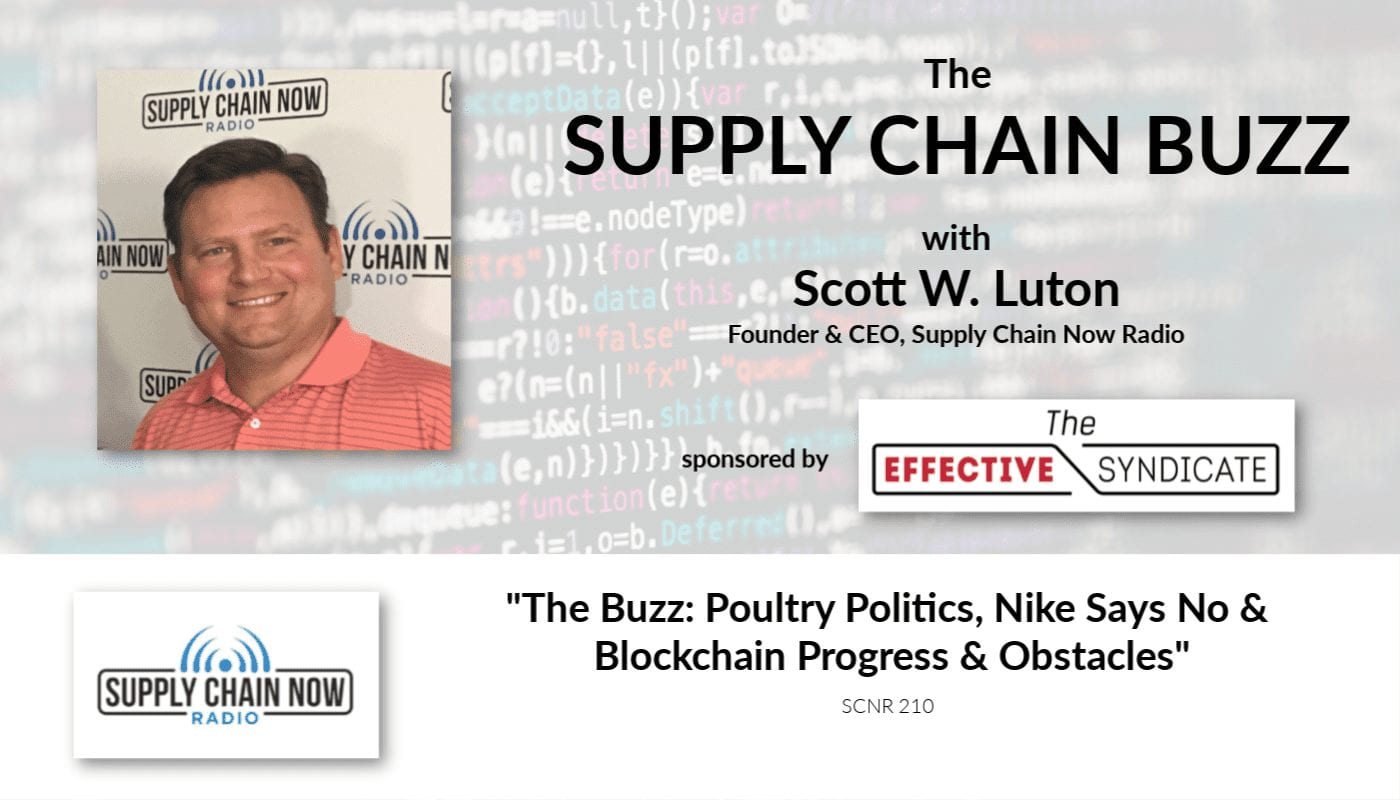
In this episode of the Supply Chain Buzz, Scott Luton discusses the latest topics and top stories in supply chain, in 15 minutes or less!

More Podcast Episodes
Sustainability
play-button-podcast
podcast-blue-microphone
Podcast
November 10, 2025

Survey Results: 2025 Trends and Attitudes Report in Supply Chain and Sustainability

In this episode of Supply Chain Now, host Scott Luton and special guest co-host Maria Villablanca welcome Dr. Dinesh Davè, Professor & Director of Supply Chain Management at Appalachian State University, and Evan Junker, Chief Growth Officer at SPARQ360, to unpack insights from the 2025 Supply Chain Trends and Attitudes Report. The annual study, conducted by Appalachian State and SPARQ360, surveys hundreds of supply chain managers across the U.S. to reveal where leaders are investing, from AI and visibility platforms to sustainability and risk management. Together, the panel discusses how familiarity and adoption of AI are rising, why the “ambition-action gap” still challenges sustainability progress, and what’s driving executives to balance cost efficiency, resilience, and environmental responsibility. They also explore how partnerships, collaboration, and customer-centered priorities are emerging as the new competitive advantage. Packed with practical insights and forward-looking data, this conversation offers a clear snapshot of where supply chain strategy is heading in 2025 and beyond. This episode is hosted by Scott Luton and Maria Villablanca, and produced by Trisha Cordes, Joshua Miranda, and Amanda Luton.   Additional Links & Resources Check out all the great resources and information mentioned during the show: Connect with Dr. Dinesh Davè Learn…
global logistics
play-button-podcast
podcast-blue-microphone
Podcast
April 11, 2024

Navigating Purpose: Innovations in Sustainable Shipping

In this episode of Logistics with Purpose, co-hosts Enrique Alvarez and Nuria Sierra shine a spotlight on organizations dedicated to making a positive impact. Their guest, Christina Aleixendri, shares her journey with bound4blue, a company developing automated wind-assisted propulsion systems for ships. Christina’s story encompasses her transition from wanting to pursue medicine to becoming an engineer, driven by her passion for problem-solving. She delves into the challenges of starting a company and the technological innovations behind bound4blue’s solutions. Listen in and learn more about the importance of purpose-driven work, the impact of regulations on the maritime industry, and the future of sustainable shipping. Learn why Cristina emphasizes the significance of finding purpose in every job, and how you can apply it to your own journey.

Supply Chain Now Radio – Episode-210

Share:

[00:00:04] A good morning Scott Luton is here with you again live on Supply Chain Now Radio. Welcome back to the show. And today’s show, we’re continuing our Supply chain Bus series, a brief weekly look at some of the top news and trends across the global End to end Supply chain community. All in 50 minutes or less. Today’s episode of Supply chain Buzz Supply Chain Now Radio is brought to you by the Effective syndicate and leading coaching and consulting firm that helps companies win by optimizing process and developing winning cultures.


[00:00:38] You can learn more at the effective syndicate dot com. It’s Monday, November 18th. Did you know on this date in 1883, American and Canadian railroads instituted five standard continental time zones, ending the crazy confusion stemming from thousands of local toms on this date in 1963. The first push button telephone goes in the service. And on this date in nineteen ninety three, the North American Free Trade Agreement, a.k.a. NAFTA, is approved by the U.S. House of Representatives. And we’ll see if NAFTA 2.0, also known as a U.S. m.c A, gets approved and ratified soon. Now let’s get to the industry buzz. First today, we are chatting chicken in a report by Josh Zumbrun in The Wall Street Journal. China last week agreed to lift a 4 year old ban on U.S. poultry imports. What might this mean for the U.S. poultry industry? Well, the National Chicken Council, yes, there is a national chicken council said that it estimated that renewed access to China’s market could result in one billion dollars in sales of chicken feet and about 1.2 billion dollars of other chicken products such as leg and breast meat, turkeys and poultry breeding stock. The breakthrough comes amid continued U.S. and China trade negotiations and the lifting of the ban is immediate in the U.S., it’s great news for some of the top chicken producing states such as Georgia, Alabama, North Carolina, Arkansas and Mississippi. It’s also good news from the continued and continuous Chinese and U.S. trade negotiations. In our second store today, let’s talk e-commerce industry behemoth Amazon has been courting more and more big brands for years.


[00:02:30] In a story coming to us from The Wall Street Journal, Nike has chosen to stop selling its clothes and sneakers directly to the e-commerce retailer. This is a big shift in direction for Nike. In 2017, the shoe company had agreed to sell products to Amazon in exchange for stricter controls on the counterfeits. Amongst other things, evidently, Nike has not been satisfied with Amazon’s inability to eliminate counterfeits and a lack of controls, a lack of controls on gray market goods in general. However, Amazon says that it prohibits to sell counterfeits. And the company has invested more than 400 million dollars last year to police its Web sites. It even allows brand owners to delete listings that don’t comply with the counterfeit and gray market goods policy. We’ll see how things continue to play out as identifying and regulating counterfeit products in general seems to get tougher each and every day. In our last story here today, we talk blockchain in a neat story that comes to the buzz from Supply chain diver able to put our finger on the pulse of where things stand when it comes to industry’s application of blockchain. Global technology consulting and advisory firm Gartner has been reviewing a wide variety of blockchain adoption cases as part of their research. Gartner identified three of the biggest hurdles that enterprise level organizations had when it comes to blockchain. First, an inability to get involved parties to smoothly work together.


[00:04:05] Second, clearly identifying the value that technology brings to the table. And thirdly, scalability and maturity of the technology. Despite these early challenges, Gartner expects blockchain to be adopted in a widespread fashion by 2028. In a review of 1063 enterprise companies, Gartner found early blockchain adopter adopters much mostly hail from highly regulated industries like banking and securities, as well as firms from the communications, media and services industries and the manufacturing sector. Last week we covered a practical blockchain application that was being implemented by Hewlett Packard and DHL. It’s led to a combined savings of dollars and time as more more of these use cases proliferate out through the marketplace. We hear the buzz expect blockchain to be seen less as cliche and more as the revolutionizing technology than it is. But what do you think? Break out your crystal balls and tell us what you think will happen with blockchain. You can shoot us a note to Amanda at Supply chain now radio wsj.com. That’s a wrap for today’s episode. Several of the leading Supply chain news stories and trends right here on the Supply chain Buzz on Supply Chain Now Radio. You’ll find links to each of the stories on the show, notes for your convenience, including a few additional resources. Big thanks to today’s sponsor of the Supply chain Buzz. The Effective syndicate be sure to check them out at the effective syndicate dot com. To our listeners. On behalf of the entire Supply Chain Now Radio team.


[00:05:46] Thank you for joining us. And this is Scott Luton wishing you a wonderful and very successful week ahead.