Share:

“I always challenge the ’80 20 rule’ because a lot of people focus on the 80% without knowing what their 100% is.”
– Costas Xyloyiannis, CEO and Co-founder at HICX

“We look at our supply partners as part of an integrated and interdependent network that should ultimately serve our end consumers.”
– Quentin Roach, Senior Vice President, Supply Chain & Chief Procurement Officer, Mondelez International


Many business leaders have added an emphasis on ‘experience’ in their approach to management. There is user experience, customer experience, and – from a procurement and supply chain perspective – a supplier experience. Each one of these needs to be understood and fostered before the associated relationships can live up to their full potential.

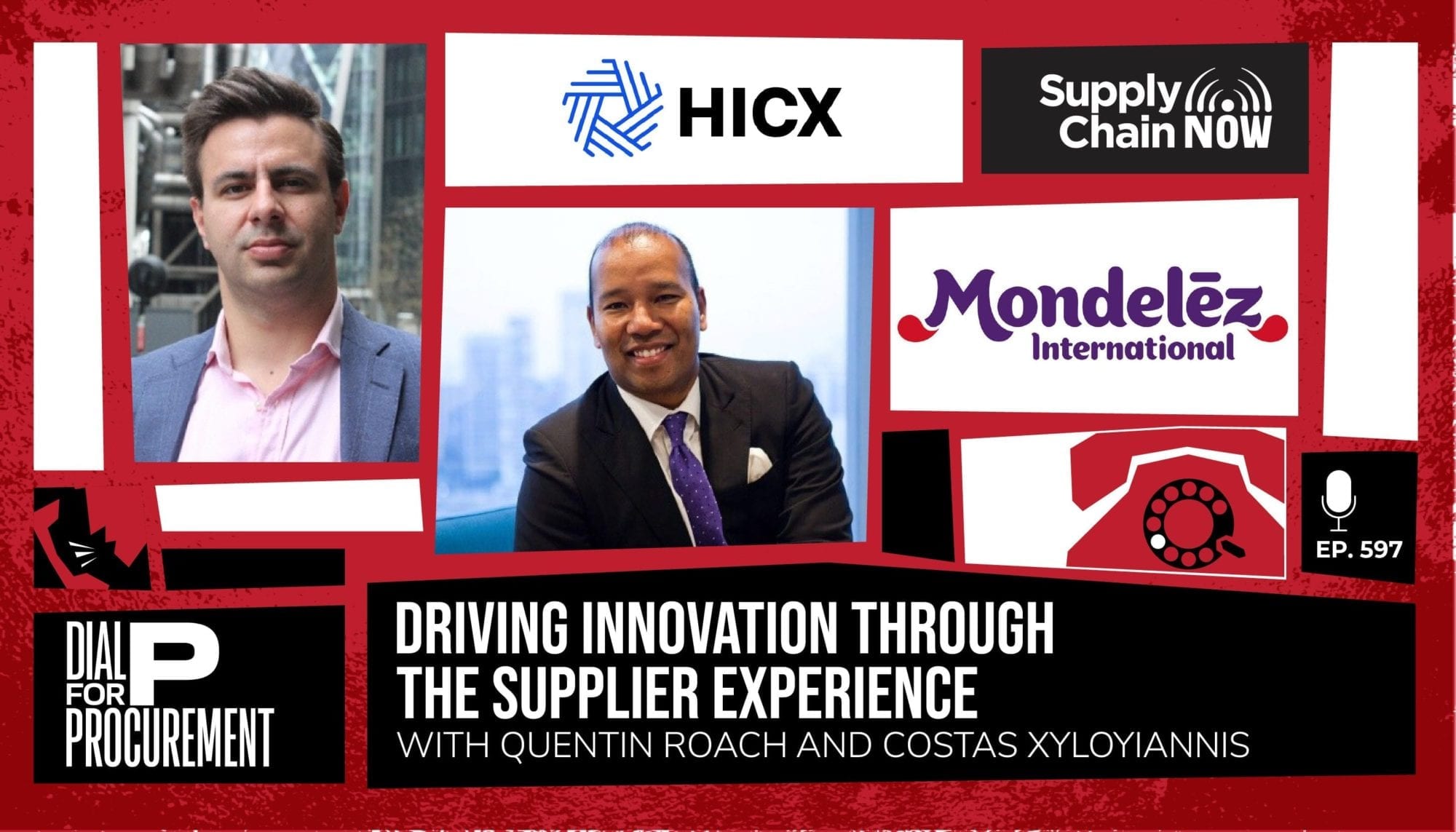
In this episode, based on a Dial P for Procurement livestream, Quentin Roach, Senior Vice President of Supply Chain & Chief Procurement Officer at Mondelez International and Costas Xyloyiannis, CEO and Co-founder at HICX, join Supply Chain Now Co-hosts Kelly Barner and Scott Luton to discuss the supplier experience from both the buy-side and technology provider perspectives.

– Where friction is most likely to exist in the corporate procurement process, how companies can reduce it, and why most procurement teams are probably overthinking what they need to do first

– Whether or not the Pareto Principle (the 80/20 split) is still a valid methods for segmenting the supply base

– How the fast moving consumer goods space (FMCG) was affected by consumer demand changes in 2020, and how Mondelez International’s brands have been able to adapt (Oreo, Wheat Thins, Ritz and more)

More Podcast Episodes
cost
play-button-podcast
podcast-blue-microphone
Podcast
September 8, 2025

From Brownfield to Breakthrough: Evolving Your Operations with Retrofits

In this episode of Supply Chain Now, hosts Scott W. Luton and Deborah Dull welcome Will Mansard and Ahmed Arif of Bastian Solutions for a practical, field-tested conversation on retrofitting brownfield warehouses and the real cost of doing nothing. They frame retrofits as logistical projects first, unpack why so much existing space goes underutilized, and share how to minimize disruption while upgrading live operations. They discuss the playbook that works in the real world: start with discovery and reverse engineering when documentation is thin, build a phased mechanical plan, sequence electrical with quick-connect, preassembled components, and treat controls and software as the heart of the system using emulation and thorough testing. With rules one and two both being “get orders out the door,” they stress contingency planning, speaking the customer’s language, and orchestrating equipment, controls, and software to avoid faults and bottlenecks.   This episode is hosted by Scott Luton and Deborah Dull, and produced by Trisha Cordes, Joshua Miranda, and Amanda Luton.   Additional Links & Resources Check out all the great resources and information mentioned during the show: Learn more about Bastian Solutions Strategy Guide: Consulting Strategies for Warehouse Distribution Operations Learn more about the Hercules Sealing Products…
Digital Transformation
play-button-podcast
podcast-blue-microphone
Podcast
March 25, 2024

Why MRO is the Gold Mine No One is Talking About

Why is it time to treat maintenance, repair and operations (MRO) as a first-class citizen? How can these processes be properly optimized? What makes business leaders hesitate to adopt new technologies? To discuss this, and a whole lot more, not one, but two experts from Verusen joined hosts Scott Luton and Mary Kate Love for this episode of the Supply Chain Now, with Founder and Chief Strategy Officer Paul Noble alongside Senior Manager of Product Management Danny Ramos in the hotseat. Paul has just returned from Las Vegas from the SAP Innovation Days for Supply Chain conference, and kicks things off by highlighting some of the key themes that he and other attendees discussed on the ground. Chief among them is the supply chain tech stack and the ways organizations are seeking to unify systems, and how MRO is being folded into these transformational strategies. This is important, the duo says, because MRO is essential to running businesses effectively. “You can’t produce a product if you’re uncertain of what’s happening,” Paul says succinctly, while also stating that the notion of supply chain being a competitive advantage has been overlooked for too long. Tune in to the full discussion to hear…

Supply Chain Now – Episode-597

Share: