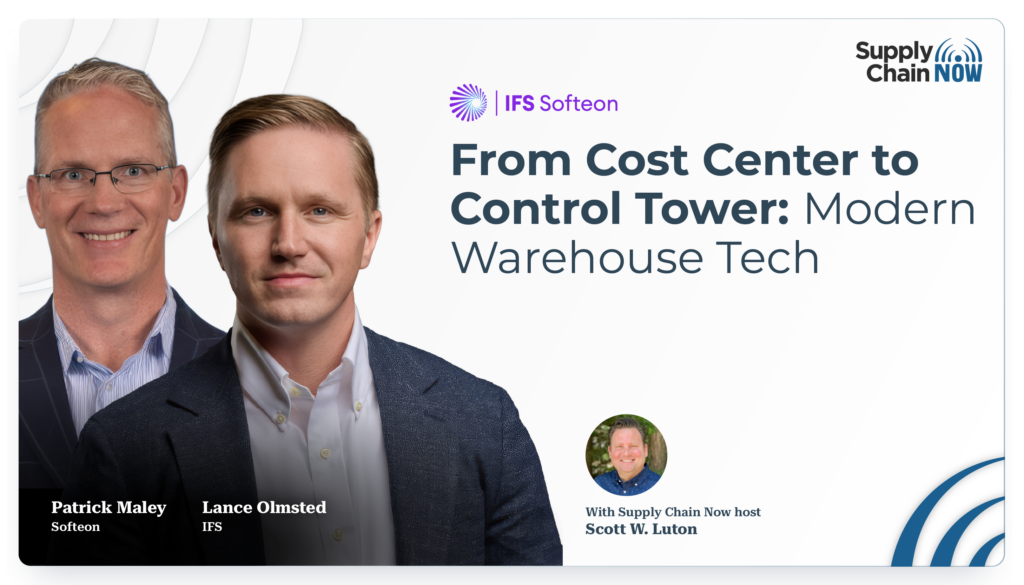
[00:00:00] Patrick Maley: The faster the world moves. More responsive and more flexible your warehouse needs to be. And that became kind of the bottleneck and a pinch point for a lot of supply chain. So it just challenges us all and makes things better and faster. And the warehouse became a real competitive weapon for a lot of companies that saw that ahead of time.
[00:00:20] Voiceover: Welcome to Supply Chain Now the number one voice of supply chain. Join us as we share critical news, key insights, and real supply chain leadership from across the globe, one conversation at a time.
[00:00:32] Scott W. Luton: Hey, good morning, good afternoon, good evening, wherever you may be. Scott Luton with you here on Supply Chain Now.
[00:00:37] Scott W. Luton: Welcome to today’s show folks. I’m looking forward to a terrific conversation. We’ve got teed up here today. We’re gonna be talking with a couple of industry leaders on tremendous opportunities that exist to optimize, truly optimize supply chain performance. We’re gonna be diving deep on a variety of topics to include.
[00:00:54] Scott W. Luton: We’re gonna be exploring how warehouse operations, of course, have become much, much more valuable and strategic. We’re gonna be sharing proven best practices in terms of how to greatly enhance warehouse performance. We’ll even touch on some recent examples of how artificial intelligence is really moving the needle in a practical outcomes driven manner to change how work gets done.
[00:01:14] Scott W. Luton: All that, and much, much more. I’ll tell you what, it’s an incredible time to be a part of the global supply chain industry here in the golden age of supply chain tech. So stick around for a great conversation. It’s gonna offer up tons of actual insights by the truckload. Alright, so I wanna welcome in our wonderful esteemed guest here today, starting with Lance Olmsted, Chief Revenue Officer, M and A Group with IFS.
[00:01:39] Scott W. Luton: Now, in this role, Lance is responsible for driving IFS’s growth through strategic acquisitions. Ensuring seamless integration and designing go-to-market strategies that maximize revenue from acquired companies. Lance’s leadership is informed by a strong background in organizational leadership, including how he honed through these uh, talents through his service in the United States Marine Corps.
[00:02:04] Scott W. Luton: Through a variety of leadership roles in his journey, Lance is well known for building strong relationships with clients, partners, and internal teams to deliver speed of value and certainty of results for everyone involved. I tell you what I’ve also learned, he is a well-known champion for using digital tools to streamline operations and create real time measurable improvements in industrial environments.
[00:02:27] Scott W. Luton: You’ll have to teach me a thing or two about that. Lance, welcome in. How you doing?
[00:02:31] Lance Olmsted: Hey, great Scott. Thanks for having us. Great to be here.
[00:02:34] Scott W. Luton: You bet. Great to see you here today. And you’re joined by Patrick Maley, Chief Revenue Officer with IFS Softeon. So in this role, Patrick is re is responsible for aligning sales, marketing, and customer success strategies to drive customer acquisition, retention, and overall financial performance.
[00:02:52] Scott W. Luton: He brings a 25 year successful history to the table helping. Innovative supply chain software companies grow and more importantly, better serve their customers. A salesperson at heart, he says he began his supply chain career at Manhattan Associates and previously spent time at Red Prairie, AKA Blue Yonder, Conaxis and Blue Jay Solutions, a KAE two open.
[00:03:13] Scott W. Luton: The common thread though, in his career has been his ability to help build a strong team and drive growth by focusing on team culture. Delivering on promise value and creating scalable and effective processes. Hey Patrick, how you doing?
[00:03:27] Patrick Maley: Great to see you, Scott. Good to be here.
[00:03:29] Scott W. Luton: You as well. And don’t gimme too much grief with all your Philadelphia sports teams.
[00:03:33] Scott W. Luton: They’ve been dominating us here lately.
[00:03:36] Patrick Maley: Not always. Not always. You know, we’ve had our lean years. If you go back to the eighties, if you’re old enough for that.
[00:03:41] Scott W. Luton: That’s right. And hey, the lean years make the good years even better. But it’s great to have you here and Lance here, and in one other helpful context, because Patrick and Lance and their teams have been on the move.
[00:03:52] Scott W. Luton: In early March, 2026, IFS the leading provider of industrial AI software. Well, they announced the completion of its acquisition of Softeon, providing enterprises across manufacturing, logistics, and retail access to a new category of supply chain technology. They’re operating, its IFS Softeon and the move brings together IFS is.
[00:04:12] Scott W. Luton: Powerful industrial AI capabilities with soft two’s, 20 plus years of tier one warehouse management, software expertise, support context for today’s conversation. So, Lance, I’ll tell you what, y’all have been on the move. It’s been a busy, successful year already. Huh?
[00:04:28] Lance Olmsted: Absolutely. I think within the m and a space, there’s some really good deals to be made out there and, uh, we’re really proud of the recent acquisition of Softeon.
[00:04:36] Scott W. Luton: Well, we’re gonna learn more about that and all the great things you and Patrick and your teams have been up to. But let’s do this. Let’s start with a fun warmup question because we learned some really interesting things when Lance and Patrick aren’t doing big things in supply chain about where they spend some of their personal time.
[00:04:51] Scott W. Luton: And Lance, I wanna start with you. I’m not sure what assumptions I made coming in, but you surprised me where you spend some of your time when you’re not doing supply chain stuff and it involves racing cars, but not getting tickets. Tell us more.
[00:05:05] Lance Olmsted: Yeah, so I’ve got, uh, you know, I. Dedicated to, to my craft at IFS.
[00:05:10] Lance Olmsted: But when I’m not working and I have a bit of free time with, from my 2-year-old daughter and wife, I, I try to sneak out to the local, uh, racetrack and do some high performance driving, uh, with some friends down in Homestead, Florida.
[00:05:24] Scott W. Luton: Really, you’re the first person in all these episodes that do that in a free time or at least have told me about it.
[00:05:30] Scott W. Luton: And Lance, I’m getting outta my, uh, my expertise zone here, but there’s no drifting involved. It’s straight up racing. Is that right?
[00:05:36] Lance Olmsted: Yeah. Yeah. Just some, some good old, old racing. You gotta put the phone down and, uh, look at the road ahead and, uh, put, put work in the rear view mirror for a, for a couple hours.
[00:05:46] Scott W. Luton: Well, Lance, whenever you’re ready, come on up to 2 85 around Atlanta. Uh, ’cause a lot of folks treat that as a, uh, a racetrack. Good. Former racetrack, for sure. Uh, well, great to see you, Lance and Patrick, a little different for you sharing earlier about your Philadelphia sports team allegiances. But you, you had a, a, a moment with, uh, a Hall of Famer.
[00:06:04] Scott W. Luton: In Atlanta, which of course is um, Matt, uh, Matt Ryan, gosh,
[00:06:10] Patrick Maley: legendary. Matt Ryan.
[00:06:11] Scott W. Luton: Yes. And I was sharing with Patrick beforehand. He dominated my Clemson Tigers when he was at Boston College, and of course he had historic career with the Atlanta Falcons, and I think you coached him to some degree, Patrick.
[00:06:22] Scott W. Luton: That right.
[00:06:23] Patrick Maley: He, he played for a team called the Philadelphia Little Quakers, which is a 73-year-old organization that’s been around for a long time. There’s been a lot of famous little Quakers over the years, and Matt Ryan might be one of the more famous ones. Marvin Harrison, Jr. Is the current, uh, you know, NFL player that that also came through, uh, the little Quakers.
[00:06:42] Patrick Maley: So, and I’m the president of that organization.
[00:06:45] Scott W. Luton: Oh man. Okay. We’re gonna have to have, we’re gonna have to have our supply chain nerd talk sports. We’re gonna resurrect that series. We’re gonna have you back Patrick. But a really quick aside, also, you’ve got what you called NRE show as a pile of kids. I think five kids, you and your wife are recent empty nesters where you can spend the time.
[00:07:00] Patrick Maley: It just happened this last September. Scott, our youngest, went off to college and we looked at each other and said, okay, now what? So we, you know, 20, 26 years of, of raising kids and you know, I mean, going from the days of like not having a moment to spare, to looking at each other on weekends, going, what do you want to do?
[00:07:18] Patrick Maley: What should we do this weekend? So it’s been great. I’m a golfer. I do a lot of those kind of normal, normal dad things. We’re excited and, you know, it’s a, it’s a fun phase of our life and just, just enjoying it right now. I
[00:07:29] Scott W. Luton: love it. Well, uh, look forward to hearing where you spend your time and, and well deserved, but great to have you here, Patrick and Lance and I wanna get down.
[00:07:36] Scott W. Luton: We got a lot to get into here today ’cause as I mentioned, y’all have been busy in this, uh, new Year, 2026. So I wanna start as we get to work here with the bigger picture and we’re gonna tackle. Why warehouses are becoming more and more strategic amongst many other things. And Patrick, I wanna start with you and then we’ll get Lance uh, comment as well.
[00:07:55] Scott W. Luton: You know, for years of course, the Warehouse was seen by many organizations as just a cost center. Why are companies now starting to see warehouse execution as a much bigger strategic lever for supply chain performance?
[00:08:07] Patrick Maley: Yeah, it’s a, it’s a great question. It’s a great place to start. It’s not just recent, right?
[00:08:11] Patrick Maley: It’s been years in, in the making of, you know, the warehouse being, becoming a strategic lever. It’s literally where the rubber meets the road, right? It’s where the plan meets reality in, in the warehouse. And, you know, speed is king, right? I mean, I, I remember back when I started my career, it would be three to five day shipping was kind of like the, the, the topnotch thing.
[00:08:31] Patrick Maley: And then it was two day shipping and one day shipping. Now it’s same day shipping. I mean, all of that means speed, right? So the faster the world moves. More responsive and more flexible your warehouse needs to be. And that became kind of the bottleneck and the pinch point for a lot of supply chain. So that’s what’s happening, right?
[00:08:49] Patrick Maley: I mean, capitalism is, is awesome, right? It just challenges us all and, and makes things better and faster. And the warehouse became a real competitive weapon for, for a lot of companies that, that saw that ahead of time.
[00:09:01] Scott W. Luton: So true. One hour delivery in some cases here lately. And, uh, speed is king. Now, if anyone can relate to that, Lance, my hunch is you can, what would your thoughts be there?
[00:09:12] Lance Olmsted: I, I think, you know, over the years, the, the Warehouse, you know, moved from being a place where you store things to a place where you actually can convert to, to cash. You know, I mean, there’s a huge, uh, balance sheet item with the inventory. And the faster that people can move their inventory, get ’em into the hands of their customers, the better.
[00:09:30] Lance Olmsted: So I think the warehouse represents the brain of the organization. It’s where the, the rubber meets the road. It’s a absolute no-brainer that IFS would want to get into the supply chain space more. Through the acquisition of, of Softeon and unlock that end-to-end supply chain intelligence.
[00:09:47] Scott W. Luton: Yep. Lots of unlock there for sure.
[00:09:49] Scott W. Luton: Uh, Patrick, let’s make, uh, David Bowie and Queen happy. Uh, talking about pressure, pressure, we got big pressures here today. What are you seeing in terms of the biggest pressures that are forcing companies to really rethink how their warehouses operate?
[00:10:04] Patrick Maley: I’ll mention two things. I’m sure Lance may have something to add to it.
[00:10:07] Patrick Maley: The first would be the rise of ai. How to leverage that power, how to make operations faster, more efficient. I mean, the AI ecosystem is exploding. And how do companies take advantage of that? A lot of ’em are kind of deering headlights today. How do we do this? And that’s what we’re doing a lot. A lot of our education with our customers is teaching them how to take advantage of AI to, to make their operations just better.
[00:10:30] Patrick Maley: I mean, the second one is, you know, a little bit more out of the control, but you know, the way that the, the kind of Trump administration is driving quite a bit of change with tariffs. And trying to, you know, relocate manufacturing back to the US or North America, that that’s causing supply chain disruption really around the world about how do I architect my supply chain.
[00:10:47] Patrick Maley: So a lot of our customers are trying to think through that, how to plan through that. There’s a lot of pressure that comes with that about making investments and warehouse locations and warehouse technology and robotics and, you know, what kind of products are gonna be flowing through my warehouse.
[00:11:01] Patrick Maley: Those are two of the biggest that I hear from our customers.
[00:11:03] Scott W. Luton: Hmm. Lance, what would you add to the biggest pressures you’re seeing out there?
[00:11:08] Lance Olmsted: I think it’s, the pressure is the, is collecting the data and getting the signals, the intent signals to make better informed decisions for not only the customers, but also for the the shareholders.
[00:11:18] Lance Olmsted: And so I think when you look at IFS, you take our acquisition of the loops, which is deploying digital workers into the space. You look at the inclusion of our partnership with Boston Dynamics as an example. You look at physical AI with the robotics. Uh, space. Then you look at our industrial AI capabilities, which is that contextual, you know, domain specific intelligence layer within IFS Cloud.
[00:11:41] Lance Olmsted: Bringing all that together with Soft Dion, uh, really sharpens those signals for decision makers and shareholders.
[00:11:48] Scott W. Luton: Hmm. And one of the themes between both of your responses, uh, that is a massive opportunity now is the better we can perform with what’s within our control, the better position we’ll be in for the trade policies and plenty of other things that’s far outside of our control.
[00:12:05] Scott W. Luton: And that’s a massive opportunity for, for organizations right now, Patrick, uh, back to you. So when supply chain leaders. Look at their biggest bottlenecks today. How often does it trace back to one of the big themes of our conversation here today and it’s warehouse execution?
[00:12:23] Patrick Maley: Yeah. It’s funny you say it that way.
[00:12:25] Patrick Maley: Bottlenecks, we always describe the warehouse as kind of the heart of the supply chain. Um, and obviously a bottleneck and a heart would not be a good thing, right? When orders and products are flowing through the warehouse freely and efficiently, everybody’s happy. It’s truly mission critical. Uh, but the warehouse can be the most acute bottleneck in a warehouse.
[00:12:47] Patrick Maley: I mean, that’s, again, that’s physically where products are being shipped. And if you’re not shipping product, you’re not recognizing revenue. That’s our mission, is to keep that warehouse flowing and to be the heart of the supply chain. Um, and we’ll get into more adaptability and, and flexibility type of things, but it can trace back to the warehouse quite often.
[00:13:05] Scott W. Luton: Hmm. You know, Patrick, uh, and for, let get your comments, Lance. Uh, one of the biggest themes probably since we’ve been doing shows here at Supply Chain Now is, you know, when it comes to continuous improvement and technological adv, uh, innovation, all that good stuff, do whatever you wanna do. But to your point, don’t stop orders going out the door.
[00:13:23] Scott W. Luton: Don’t stop orders being shipped up. But Lance, what would you add in terms of how those biggest bottlenecks can often be traced back to, to warehouse performance? Your thoughts?
[00:13:33] Lance Olmsted: No, I think it’s, it’s key that, that everyone in the supply chain understand that the warehouse is the strategic heart of the operation.
[00:13:42] Lance Olmsted: It’s not just where inventory sits, you know, it’s where customer promises are fulfilled. It’s where capital efficiency is deployed, and it’s where real time decisioning, uh, converged to delight the customer. And at the end of the day, IFS and IFS soft are obsessed with customer outcomes and I think the, the warehouse is where the, the magic happens in that regard.
[00:14:03] Scott W. Luton: Hmm. Well that’s a great segue, Lance. Perfect segue because I wanna dive more into that obsession and, and of course this new chapter in the IFS Soft Dion story. And so Lance, uh, I shared earlier IFS and Soft Dion recently joined forces some big news here in early 2026. What was the vision behind bringing these two powerful organizations together, Lance?
[00:14:27] Lance Olmsted: Well, I think, uh, a lot of organizations from our experience are running disconnected, ERP and, and, uh, warehouse execution systems, which creates massive costs, massive blind spots, and I think by bringing soft on into the IFS portfolio of, of solutions for our customers, we’re delivering a unified level of visibility from the boardroom to the warehouse.
[00:14:51] Lance Olmsted: Or truly unlocking that end-to-end supply chain. Intelligence. And so I think, uh, we’re closing that, that gap. We’re really well poised to expound upon it further. You know, you talk to Mark Ion’s, uh, CTO about their vision on where, where the product is going and it, it becomes clear that it’s absolutely turbocharged when you bring it into the IFS ecosystem to, uh, exist within our Nexus Black AI team, the loops agentic platform that we have and, and within our industrial AI platform.
[00:15:22] Lance Olmsted: Mm-hmm.
[00:15:23] Scott W. Luton: And the art of the possible for customers is changing. Uh, and to, to that end, how does combining soft John’s warehouse execution expertise that we referenced earlier with if’s industrial AI and enterprise platform, how does all that change the art of the possible for customers?
[00:15:39] Lance Olmsted: I think a lot of customers, uh, you know, I don’t wanna speak for everybody, but from what I’m seeing, a lot of customers want a.
[00:15:47] Lance Olmsted: Better customer experience. They want to consolidate the number of vendors that they’re working with down to a trusted few and really get strategic with those, with those software providers. And I think it makes sense. You know, there are gonna be a lot of investments made over the next five, 10 years on ag gentech capabilities.
[00:16:03] Lance Olmsted: Customers don’t wanna be throwing money around to, you know, 20 different vendors trying to see what sticks. They wanna have a huge level of focus with, you know, one or two, maybe three. Vendors and, and IFS saw is, is squarely positioned to deliver on that.
[00:16:17] Scott W. Luton: Yep. Really quick, Patrick, the last two points, Lance was talking about the real cost of disconnected systems earlier and now he spoke to the changing art of the possible and, and changing and improving what customers can do.
[00:16:29] Scott W. Luton: Your quick thoughts, Patrick?
[00:16:31] Patrick Maley: Yeah, I mean you, there are two things I I would add to that is, is, you know, it’s flexibility. I mean, take a, a manufacturer for example, that’s been shipping. Wholesale distribution for, for decades now needs to ship direct to consumer, which is a whole different ball game, and they don’t have that capability.
[00:16:48] Patrick Maley: Soft Dion’s, world-class, scalable warehouse platform allows their customers to be able to expand into that, expand their channels, and grow their company and, and really react to what needs to be done in, in today’s market. So that kind of flexibility is king.
[00:17:03] Scott W. Luton: Well, and Patrick, you’re reading my mind ’cause one more question I wanted to put in front of Lance is how these forces are changing that traditional limited WMS or some of the traditional platforms into truly new, powerful, innovative, robust, uh, technologies.
[00:17:19] Scott W. Luton: Your, your thoughts there, Lance?
[00:17:21] Lance Olmsted: Well, I think the, I think the demographics are helping push this change. You know, the, the changing, uh, labor, uh, dynamic, what we’re talking about isn’t replacing workers. There just aren’t enough human workers. And so when you look at IFS Soft Dion and our ability to engage with digital workers.
[00:17:38] Lance Olmsted: Through the loops, our physical workers, alongside the robots, and then the actual human workers that are in the, the warehouse. I think it, it’s going to be very difficult for a company evaluating a warehouse execution system to not strongly consider IFS soft on. And when you look at our agent capabilities and the flexibility that Patrick.
[00:17:59] Lance Olmsted: Mentioned it, it becomes obvious that IFSSON is not a point solution. It goes from, as we said earlier, it goes from the boardroom straight down to the warehouse and you can join up the entire operation.
[00:18:12] Scott W. Luton: Hmm. The value prop just got bigger. Y’all were terrific on your own, but you’re better together. So it’d be interesting to see where, uh, where it goes from here.
[00:18:22] Scott W. Luton: Alright, so Patrick, uh, I want to talk, uh, on one of the things that, that I’d asked you and Lance about in the first part of this fast start we’ve gotten to, and that’s some of the gaps. That we still got a bridge in global supply chain. So Patrick, you know, one of the challenges many companies face is what, as Lance called it out earlier, that disconnect between enterprise planning and, and really what happens in the warehouse sometimes I think we all fool ourselves with how it should work versus how it really works right and down in our facilities.
[00:18:52] Scott W. Luton: Why is this such a persistent problem you think, Patrick?
[00:18:55] Patrick Maley: We’ve been talking about this for decades. So, um, we’re, we’re excited to, to really bring some unique approaches in that regard. But when you think about, you know, planning systems versus a warehouse or execution system, right? The planning system deals in theory, right, where the, the warehouse operates in reality.
[00:19:15] Patrick Maley: Right. Planning system horizons are kind of weeks and months, right, to kind of think that, that kind of term where the warehouse is more minutes and seconds, right? So that, that gap is really where the challenge occurs, right? Because if we know one thing, we know the forecast are going to be wrong, right?
[00:19:32] Patrick Maley: Plans are going to be wrong, and it’s how you react to that, you know, occurrence, whether it’s a late shipment damaged product. Labor, you know, people calling out sick if you had something go on. The ability to react to that is really the key, and that’s been the challenge over the decade for supply chains, bringing planning, planning and execution together.
[00:19:53] Patrick Maley: That’s really the, the source of that, that gap.
[00:19:56] Scott W. Luton: You know, kinda along the lines of what you shared there. Uh, I had a dear friend Dave from Target that back in the day, one of his favorite dad jokes to share was, what was the difference between a perfect forecast and Bigfoot? Well, someone has at least seen Bigfoot, uh, because to your point, it’s so true.
[00:20:11] Scott W. Luton: You know, forecasts are always going to be wrong. Lance, you wanna comment really quick on before I move forward on real time visibility with Patrick? Your comments, Lance?
[00:20:20] Lance Olmsted: It’s an interesting anecdote on Bigfoot in the perfect forecast. And I think what, what we’re talking about is the speed to be agile enough in the minutes and the seconds such that you can respond to those changes.
[00:20:31] Lance Olmsted: And that’s, um, that’s critical, but nothing more to add.
[00:20:34] Scott W. Luton: And as I’ve shared a thousand times, one of my favorite mantras, uh, a food industry magnet, one of the ways he, he ran his organization, one of his mantras was, Hey, gimme good news fast, but give me bad news faster. Right. The more options, the more, more ways you can solve problems and you’re out, they’re outta your blind spot.
[00:20:52] Scott W. Luton: So Patrick, let’s talk about real-time visibility. Talk about things that we’ve been after for years. Of course, I would argue it’s faster and faster becoming table stakes. We still have plenty of work to do. But Patrick, how does real-time visibility help companies make faster and better decisions during disruptions or demand spikes?
[00:21:10] Patrick Maley: Yeah, I, I think when you think about a demand spike or a late inbound truck, or like I said, a labor shortage or damaged products, that that’s just gonna happen, right? That’s natural supply chain. That’s the real world. That’s what happens. The issue isn’t that so much, is it’s the lag between when that happens.
[00:21:28] Patrick Maley: And when do people that need to make that decision actually know about it? And in some cases you can know about it before it actually happens, right? So some, if a, you know, pressure’s building in a certain part of the warehouse, if you know that before it actually pops. You can make better decisions. So it’s really what real-time visibility does is eliminates that lag, right?
[00:21:48] Patrick Maley: Just gives you a better picture of what’s happening in a warehouse, not after the fact. That’s the biggest piece of bringing those two together, and then it really just improves your decision quality. So people in the warehouse have to make a decision when there’s damaged product and they may not make the best decision.
[00:22:05] Patrick Maley: They’ll make a decision to keep things moving. It may not be the best decision, it may not be the most profitable decision. Don’t make a decision. The second piece of that is really improving decision quality, making better and more profitable decisions when you bring these together. So
[00:22:20] Scott W. Luton: you want to learn the news when the genie’s still in the bottle or the toothpaste is still in the tube, right?
[00:22:26] Scott W. Luton: Not after it’s all out.
[00:22:28] Patrick Maley: Yep.
[00:22:28] Scott W. Luton: Uh, and you gotta mess on your hands. Uh, good stuff there, Patrick. So Lance, I wanna dive in a little deeper with you on, uh, this era that I’ve coined for years now, this golden age of supply chain text. Sure. There might be more golden ages, uh, in the years to come to something you shared earlier.
[00:22:45] Scott W. Luton: ’cause it’s amazing how fast times are changing, but it’s pretty remarkable what’s going on now. So, shining a light on the industrial AI in the warehouse. Let’s define it. Let’s make sure everybody’s with us. What is industrial ai lance and how do you envision. It being applied, especially into the warehouse.
[00:23:03] Lance Olmsted: Yeah, that’s a good question. So through my lens, industrial AI through ifs.ai is the contextual domain, specific intelligence layer that orchestrates everything that happens within an enterprise. And our vision at IFS is that AI succeeds and really complicated industries. Not through generic productivity tools.
[00:23:25] Lance Olmsted: You’re not gonna see a chat GPT wrapped agent thing, whatever that is, but rather through contextual, private industry specific data embedded where the work actually happens. It doesn’t take a rocket scientist to sort of see where this is, this is heading, you know, one of the things that really impressed me.
[00:23:46] Lance Olmsted: In the due diligence phase of ION was the differentiated approach they take to helping their customers bring their customers into, uh, their supply chain. And they have a very large customer, ion does. It’s operating several hundred warehouses. And through their modern approach, they reduce client onboarding time from 270 days with their legacy solution to 90 days or less using soft Dion’s, uh, unique approach.
[00:24:13] Lance Olmsted: Well, what happens now when you throw an agent from the loops into that, that mix and start accelerating things further is are we at a point where. We can take the 90 days and compress it down to the nine days or nine minutes. That’s, I think, the really exciting piece of the golden age that we’re in at the moment.
[00:24:32] Scott W. Luton: Lance, I’m with you. I’ll tell you what, uh, Patrick, your quick comments there, uh, all the progress that’s been made saving so much more time and really ramping up that impact value, that return on value, how soon are we gonna be in the nine minute stage from that two 70 days to nine minutes?
[00:24:47] Patrick Maley: Well, I’ll tell you the one, one way to get there is make sure that you have, we have a concept that soft beyond that.
[00:24:52] Patrick Maley: We call the massively observable warehouse, which is a concept that allows all parts of the warehouse to be exposed, uh, in a secure way. To the external ecosystem of AI investment, and that includes what, obviously what IFS is doing and the rest of the world is doing, right. We, we don’t pretend that we’re gonna be able to develop everything in AI that we need.
[00:25:15] Patrick Maley: So we are, you know, making sure that if you’re going to leverage billions and billions of dollars of investment in ai, you gotta be able to access the data. Because that’s really the source of how you’re gonna make better decisions. And so our massively observable warehouse is a very unique approach to, to doing that.
[00:25:30] Patrick Maley: So it’s also being able to be exposed to that, that broader ecosystem.
[00:25:35] Scott W. Luton: New acronym Mo
[00:25:37] Patrick Maley: Mo.
[00:25:37] Scott W. Luton: Massively.
[00:25:38] Patrick Maley: I tried to
[00:25:38] Scott W. Luton: observe.
[00:25:39] Patrick Maley: Yeah, I tried to get that going Scott. It doesn’t. Yeah.
[00:25:43] Scott W. Luton: Hey, we, we just need a Larry and Curly and we’ll figure out the, um, the three students trademarked
[00:25:50] Lance Olmsted: here today.
[00:25:50] Scott W. Luton: There you go, Lance.
[00:25:51] Scott W. Luton: That’s right. Well follow up question to you, uh, and build on what Patrick just shared there. I love practical examples of of ai. Lance, uh, one of y’all said earlier, for a lot of folks, they’re kind of in the fog still, despite how far we’ve come and how practical and powerful that many organizations are applying ai, there’s still lots of business leaders and professionals that are in that fog.
[00:26:13] Scott W. Luton: What do you see some recent examples of how AI can help orchestrate labor, inventory and automation in real time? Lance.
[00:26:21] Lance Olmsted: Yeah, I think one of the, the things that we’re seeing every day within our customer base at IFS is the ability to quickly understand within seconds where, uh, you have talent and where you need to deploy that talent in your, in your business.
[00:26:36] Lance Olmsted: The way that we’re able to upskill that talent through AI is, is really impressive as well. So you, we, we have a human labor shortage, so how can we attract. And retain and engage the, the human talent better. And with ai we’re seeing the ability to do that. As an example, how do you get a new employee up to standard rapidly with ai, we can now scan, as an example, thousands of pages of OEM manuals and allow a new mechanic to quickly query those and get instant access.
[00:27:07] Lance Olmsted: Whereas before, yeah, I was talking to a, a prospect that doesn’t have. IFS yet, and they’re having to go rehire people who’ve retired because the people who retire are the only ones that have the unique information. We’re talking about AI and it seems like a no-brainer, but the reality across the globe is that situations like that persist to this day, and it’s not until that organization recognizes the knowledge gap and closes it with AI solutions, will they be able to grow without?
[00:27:38] Lance Olmsted: Bringing the poor retired guy back off the golf course and dragging him back into the factory on a contract. That’s kinda silly.
[00:27:46] Scott W. Luton: Well, you know, and in a broader sense, when you look at the talent that is out there and wants to be in the warehouse space, it’s a big magnet. They wanna be in the technological, innovative sites, facilities, and warehouses and, and organizations.
[00:28:00] Scott W. Luton: So we’re seeing organizations and and supply chain leaders tackle this workforce challenge that we’ve cited a couple times now in a number of different ways. With technology, including ai,
[00:28:10] Patrick Maley: we run with a theme. That we call enablement. Um, it’s a pretty simple word, but basically we foster the customers enabling their own operation.
[00:28:20] Patrick Maley: Um, so we don’t want our customers to have to rely on us to do everything. So enablement is really big for us now, AI is, is really brought that to a much faster and much more impactful degree. Imagine being able to, and this is what our customers do, being able to use AI to create. An integration to a new robotics pilot you want to try without having to go build something and, and just have that integration done like that with ai.
[00:28:46] Patrick Maley: Just really powerful, really adds a lot of speed, adds a lot of flexibility to what supply chain leaders are able to do.
[00:28:52] Scott W. Luton: And as you said earlier, speed is king. Speed is queen. Speed is a whole royal family. Uh, especially when you can gather that speed and success at the same time. Right? A dear friend of mine used to talk often as he was learning to drive and his, his mentor coach or what have you.
[00:29:10] Scott W. Luton: It doesn’t matter how fast you’re going, if you’re going in the wrong direction, right? It’s how you get in trouble. But when you get speed and success all at the same time, man, it’s amazing. But despite how far we’ve come, Patrick, technology wise, right? ’cause it’s really incredible. It still takes solid execution and operation to make the most of the art of the possible.
[00:29:30] Scott W. Luton: So when organizations Patrick modernize warehouse execution, what kind of operational improvements do they typically see in your experience?
[00:29:38] Patrick Maley: Yeah, I, I think it depends largely on where they’re coming from. And what they’re trying to do. Uh, but typically, you know, we’ll see, you know, there’s productivity gains, right?
[00:29:48] Patrick Maley: You’ll see 15 to 30% in labor productivity gains. You get, you know, a task in or leaving. And better travel paths, just really optimizing the use of labor in a warehouse. Uh, you get faster onboarding of new associates, uh, with guided workflows and you get speed. Uh, one of our, our core markets is three pl.
[00:30:07] Patrick Maley: We’ve got a lot of large global three pls in our customer base, which are really. Have some of the most complex warehouse needs, right? They’re shipping vaccines and they’re shipping shoes, and they’re shipping hard goods and dangerous goods, and, you know, all out of the same facility. Throughput and speed.
[00:30:24] Patrick Maley: The ability for a three PL to onboard new customers faster. Where, you know, a, a typical operation might take two to three months to onboard a new customer. You know, we have customers that onboard several weeks. That obviously lends to being more competitive, driving faster revenue, and just being more customer facing.
[00:30:42] Patrick Maley: So throughput and speed is, is a big one. Um, accuracy and service. You know, going to high picking accuracy, 99.99, picking accuracy, you know, you don’t wanna be shipping the wrong product to the wrong customers. Those are very bad things. Uh, visibility and control. I mean, a lot of the things that we talked about, getting real time visibility into your warehouse and, and those kind of things.
[00:31:04] Patrick Maley: And overall, lowering your cost per order line and lowering your cost structure. So those are typically what we see from a result. You’ll see an emphasis toward one or the other depending on where they’re coming from and what they’re trying to do.
[00:31:16] Scott W. Luton: So Patrick, you shared a couple different, uh, examples there.
[00:31:19] Scott W. Luton: Uh, in terms of outcomes and results, a neighbor in this community is scale, right? So can you share a couple of examples where companies, uh, customers, you name it, if use modern warehouse execution to scale their operations or support brand new business models, initiatives, you name it.
[00:31:38] Patrick Maley: Yeah, I love it. And, and that’s again, one of the things we talk about and we look for customers that are evaluating, looking at warehouse management systems.
[00:31:45] Patrick Maley: That’s the kind of thing that we look for. Uh, I talked about three pls and scaling and being able to, you talk about scale versus adding. One new customer every several months. You crunch that to every several weeks. Hmm. You can really scale what you can do on a year’s basis. Um, we have advanced billing workflows.
[00:32:02] Patrick Maley: The complex nature of a three PL and billing workflow. You know, the ability to scale that and be able to capture all the revenue and all the service that you do, that, that provides a lot of speed. Another great example and think about this is a customer of ours that is a manufacturer of paper products.
[00:32:18] Patrick Maley: They do diapers. Um, and they’ve got 10 plants. They, they use a large ERP as their WMS provider. They wanted to go into a direct to consumer model. They wanted to ship diapers direct to families, and they weren’t able to do it, uh, on that E-R-P-W-M-S. And, you know, they bring in soft Dion to be able to provide that new channel of revenue, that new area of growth, and, and it gives them that level of flexibility.
[00:32:42] Patrick Maley: So that’s what customers are looking for. It’s speed, but it’s also the ability to pivot and change and react. Whatever channel or opportunity comes your way. And that’s where we find a lot of customers raise their hand and say, man, we, we need a new system. We, we can’t do X, Y, or z.
[00:32:57] Lance Olmsted: I think that the trend we’re seeing too is that our customers want.
[00:33:02] Lance Olmsted: More configurable, more personalized solutions being constrained to change to direct cons to consumer model, because your E-R-P-W-M-S doesn’t allow you to, you’re not gonna tolerate that well equally. You know what? What things are IFS soft on going to see in the next six months, years, two years? Their customers where rapid innovation is required to support those customer expectations.
[00:33:26] Lance Olmsted: And when you look at the investments IFS is making with AI for deployed engineers, uh, you look at our, our team led by Creedy, uh, the Nexus Black team as an example, and the way we’re continuing to build her team out of talented Ford deployed engineers to serve as a resource for all the solutions within IFS to grow and evolve as fast as the customer.
[00:33:49] Lance Olmsted: Wants because it’s not good enough anymore to say, we’ll put that on the product roadmap and we’ll deliver that to you in a year. They’re saying, no, the, the strain of horror moves is closed. Now I need a solution today to, to do that. We can do that with our architecture and the talent that we have inside IFS.
[00:34:05] Scott W. Luton: It’s interesting, the, uh, the market used to say, Hey, what have you done for me lately? Right. Is a constant refrain. Now it’s like, what have you done for me today? Kind of to your point, Lance, but Pat Patrick, going back to what you’re sharing, and I got one more question for you. You’ve kind of been speaking to this, but lots of good news there.
[00:34:22] Scott W. Luton: Number one. And I think Lance is in with us here, Patrick, but can we all celebrate as much as I love the customer makes diapers. I’m glad I’m out of the diaper buying phase. Amen. With our three kids, man, I was financing diapers. I’m
[00:34:36] Lance Olmsted: still in it.
[00:34:37] Scott W. Luton: Oh, you’re still well, Lance. Hey, uh, Godspeed to you, my friend.
[00:34:41] Scott W. Luton: More serious. Um, new customers from months. To weeks to being able to tackle it in days that is outstanding. It’s good news for everybody no matter where you sit. Alright, so Patrick, one more and then we’re gonna come down the home stretch with some, some different questions involving your crystal ball, both of y’all.
[00:34:59] Scott W. Luton: You’ve spoken this a little bit, but Patrick, I wanna put a finer point on it. What does success look like six to 12 months after implementing a truly modern, innovative warehouse platform?
[00:35:11] Patrick Maley: Yeah, that’s a gr that’s a great question. I, I would say the first thing I’d like to see, obviously happy customer.
[00:35:16] Patrick Maley: You’ll see, uh, you know, a press release, you know, announcing a go live for a successful project. We actually announced yesterday, uh, source Logistics is a, uh, a large and growing three PL that just went live. And had a great project, and that obviously is a great outcome. That’s what we wanna see beyond that from an operational metrics, you know, we wanna see the productivity gains, you know, not just that kind of go live bump.
[00:35:40] Patrick Maley: We wanna see measurable improvements and throughput and accuracy and all those good things. But the, the number one thing that we like to see. Is our customers taking ownership. That enablement thing I talked about, customers taking ownership and starting to to own their operation, change their workflows, change their UIs without coming to us and telling us, Hey, we created this new workflow without even contacting you guys.
[00:36:02] Patrick Maley: And we tested it, rolled it out, did it ourselves and, and that’s the kind of power that we like to give to our customers. When you think about the normal going live, being, you know, stable, making it work, scaling, you know, the thing that we like to see most is a press release and then we like to see, um, our customers being enabled.
[00:36:20] Scott W. Luton: Patrick. I love it. Lance, I’ll get you a comment on that too, because you know, in this day and age where we have some of the most brilliant people in supply chain, running warehouses, operating warehouses, they become technologically savvy oftentimes. So they don’t wanna have to pick up a phone and go to their partner when they’ve got an idea or wanna run an experiment or wanna make this tweak or other tweak.
[00:36:40] Scott W. Luton: I love this notion of enablement or empowerment. I would call it Lance, your quick comment there.
[00:36:47] Lance Olmsted: Yeah, I think, I think, um, my expectation is that IFS Salton makes it easy for the industries they serve to innovate, and how do we help them co-innovate. There’s a reason Salton has the Gartner Visionary recognition.
[00:37:00] Lance Olmsted: My expectation is that we continue to, to build upon that and help our customers innovate faster than their competition
[00:37:07] Scott W. Luton: outstanding. Everyone throws around this word agility a lot, but that really is definition of operational agility. Love that. Okay. So Patrick, you’re gonna go first in predicting the future.
[00:37:19] Scott W. Luton: If y’all remember, K O’Brien used to have used to have a great segment on his show. Uh, I think it was like end of year 2000 and he would have a punchline, right? Even long after the year 2000. That was such a great show. Anyway, uh, a version of that, when you break out your crystal ball, Patrick, if you look three to five years ahead, how do you see the role of the warehouse continuing to evolve within supply chain?
[00:37:43] Patrick Maley: Uh, it’s only gonna get more competitive. It’s only gonna get faster, and it’s only gonna get more challenging. One of my favorite lines I said earlier is capitalism is great. Uh, we’re gonna see more of the same. We’re gonna see the continued convergence of competitive forces, you know, creating constant change and it’s, it’s only gonna get more challenging for, for customers and, and competitors.
[00:38:05] Patrick Maley: The warehouse is destined really to become an orchestration hub. Our, our CTO, uh, lance reference and earlier, mark ick will, will often talk about, it’s not so much. Through put the warehouse, but it’s more of the flow through a warehouse. How fast can you flow through a warehouse, and that’s everything from replenishment to receiving to put away.
[00:38:24] Patrick Maley: All those things have to flow and orchestrate perfectly. And as you add robotics and you add new types of order types and you know, value added services you might do or kidding, or whatever you’re doing inside your warehouse, all that needs to flow. That’s bringing together demand and inventory, labor, transportation, all those things to satisfy customers.
[00:38:42] Patrick Maley: So this realtime orchestration hub is gonna continue to get more intense, AI driven stuff, clearly is going to, you know, get deeper and deeper into warehouse operations. We see that for sure. And then a final one I’ll comment on, it’s just really the, the human and machine coordination, we see it now, but that’s only gonna grow.
[00:39:00] Patrick Maley: We’ll see more and more human and machine collaboration. So,
[00:39:04] Scott W. Luton: Patrick, well said. I think your, your crystal ball is finely tuned and working a lot better than mine. But, um, you know, I’m also hearing we should be grateful where we are today in terms of complexity and customer expectations because in weeks and months ahead.
[00:39:18] Scott W. Luton: It’s gonna be even a tougher ball game, which really adds to, kind of kidding aside, it adds to the imperative to continue to transform, uh, technologically and, and the partners you choose. You name it. Lance, same, same question. Next three to five years, how do you see things playing out?
[00:39:36] Lance Olmsted: Uh, that’s a good question.
[00:39:36] Lance Olmsted: You know, you always hate to look into the future and get it wrong, but I think from where I’m sitting, I think inbound is finally getting, its its moment in 2026, uh, with robotic depal, you know, AI enabled vision inspection, et cetera. So I think inbound is going to become more and more important, especially in the three PL space.
[00:39:54] Lance Olmsted: I think humanoid robots. They’re gonna move from demos and theory to actual, uh, deployments. We’ll probably see that first in the automotive space, but I imagine this would be followed very quickly and closely by logistics and warehousing. Imagine, you know, unloading trucks, depalletizing, palletizing, et cetera.
[00:40:10] Lance Olmsted: And I think combined with that, I’m seeing more evidence that robots as a service are becoming more viable and that will lower the barrier for some of these people to adopt more advanced. Automation.
[00:40:22] Scott W. Luton: Okay. I think both of y’all have a pretty keen grip on where we’re going. Uh, we’re gonna have y’all back with us.
[00:40:29] Scott W. Luton: I feel smarter. I feel like I, I can make bolder predictions. Now, after, after hearing from you both really quick, we’re gonna get your advice and make sure folks can connect with you, but baseball season is a pun us Patrick and Lance, I want to ask you really quick, Patrick, the Phillies, are they making the playoffs?
[00:40:46] Scott W. Luton: Are they gonna go forward in the playoffs? What’s your quick prediction? Uh.
[00:40:51] Patrick Maley: I don’t know. Like I, you know, it’s, it’s impossible to know a baseball. I don’t think they’re gonna get there this year. Okay. I, I think last year they kind of fizzled out and I think, I think this year they’re gonna struggle a bit.
[00:41:01] Patrick Maley: Uh, they’ve had a lot of change, but, you know, we’ll see.
[00:41:04] Scott W. Luton: We shall see. Hope Springs Eternal comes every spring. Uh, Lance, your big Detroit Tigers fan, are they gonna make a run?
[00:41:12] Lance Olmsted: I, I mean, they’ve got some pretty heavy hitters on the team now. I think Tariq, you know, uh, last two years winning the, the Kai Young Awards.
[00:41:19] Lance Olmsted: I mean yep. Let’s see what he can continue to put, put forward. I, I’m hopeful. Lifelong Tigers, man,
[00:41:24] Scott W. Luton: life, man. Uh, back in the days of Cecil Fielder when he was launching balls over out of Tiger Park right. Hitting the rooftops, that was amazing. But we shall see, and as an Atlanta Braves fan, if we can get over this injury bug, oh my gosh, it’s been painful.
[00:41:39] Scott W. Luton: I’m just glad baseball’s almost here of my favorite times of year. Alright, so let’s get some advice in, and Lance, I’ll start with you here. When you think of practical, been there done that advice, given both of y’all’s all all your work in industry, what advice would you give supply chain leaders who want to turn their warehouse operations into truly a competitive advantage?
[00:41:57] Lance Olmsted: I think they need to challenge conventional wisdom inside their own organization and treat it as much as a technology. Exercise is a culture change exercise and make sure that C-suite leadership is aligned with, with that vision.
[00:42:10] Scott W. Luton: Hmm. Sounds like good advice to me. Patrick, what advice would you offer up?
[00:42:15] Patrick Maley: I would say, uh, if I could get in their minds, I would tell ’em to think about the future. Not, not just today. Don’t optimize for today. The ability to prioritize, um, flexibility over optimizing today. My think is something I would tell everyone. It’s, it’s really how much ambition do you have for the next three to five years?
[00:42:34] Patrick Maley: And people will say, yeah, we got a lot of ambition. We wanna double in size. You gotta think about, okay, what, what are you gonna look like when you double in size and what kind of automation will you have? And that kind of gives them a flavor of, I need to plan for obviously today and, and tomorrow.
[00:42:48] Scott W. Luton: Hmm.
[00:42:49] Scott W. Luton: Like it, uh, Patrick and Lance, and I bet both of y’all welcome conversations with members of our audience who’s looking to not only build for today in the current state, but, but build in a way that it can scale up to meet the demands of next year or next month, you name it, to help make that happen.
[00:43:06] Scott W. Luton: Lance Olmsted, how can folks connect with you?
[00:43:10] Lance Olmsted: Yeah, I’m, I’m fairly active on LinkedIn. That’s probably the easiest place to, to go. Uh, don’t be shy to, to connect with me. Shoot me a message and we can take it from there.
[00:43:18] Scott W. Luton: Outstanding. And Patrick Maley, how can folks connect with you?
[00:43:22] Patrick Maley: Same LinkedIn and also as luck would have it?
[00:43:24] Patrick Maley: I think so today, this week is modex week, and if you still happen to be at Modex listening to this podcast, come by and see us at our booth. It’s gonna be a, it’s, it’s a massive booth. And we’ll also also have a, um, a sponsorship called the Peachtree Social, the back part of the event, LinkedIn and, and Modex, if you happen to be there.
[00:43:45] Scott W. Luton: So folks, if you’re hearing this, uh, during Modex week and you’re one of the 40,000 people they’re expecting to come here to, um, Atlanta, home of the 95 and the 2021 World Series Champs, Patrick, it’s been too long. But, um, anyway, hey, take ’em up. Hit their booth, head out to that, uh, Peachtree Social if you, if I said that right.
[00:44:04] Scott W. Luton: Have the conversations and if you’re not at modex in Atlanta, right. Reach out to them, as I mentioned on LinkedIn. Have the conversation. Find some opportunities to change how, not just you do warehousing different, but do supply chain different as well. What a great conversation. Patrick and Lance, again, congrats on what’s been a very successful year already and it’s only.
[00:44:24] Scott W. Luton: You know, March or early April, by the time we publish this, uh, I wanna thank you both. Lance Olmsted, Chief Revenue Officer, M and A Group with IFS. Lance, thank you so much for being here.
[00:44:35] Lance Olmsted: Thank you. Pleasure.
[00:44:36] Scott W. Luton: Go Tigers. Good luck to them. And the Red Wings. I guess we’re already in hockey season though, right?
[00:44:40] Scott W. Luton: We’re already in a couple months in, is that right? I think so,
[00:44:43] Lance Olmsted: yeah.
[00:44:43] Scott W. Luton: Uh, we’re still waiting to get our hockey team back to Atlanta. We’re unlike Philadelphia and Detroit. We’ve lost a couple of those now. We’ll see if we get one back. Uh, Patrick Maley, Chief Revenue Officer, IFS Softeon, thanks so much for being here, Patrick.
[00:44:57] Patrick Maley: Yeah, it was a pleasure, Scott. Thanks. I
[00:44:59] Scott W. Luton: really enjoyed the conversation. Appreciate how y’all both and your organizations, uh, and your teams are changing the conversation. I look forward to seeing what’s next at Ifs Soft Eon. Hey, to our Supply Chain Now global fam, really hope you enjoyed the conversation as much as I have.
[00:45:15] Scott W. Luton: Thank you for being here with us. But you got homework, right? Patrick and Lance, they say, Hey, bring your easy questions. Bring your tough questions. Reach out, keep the conversation going. But even as important, take one thing they shared here from the good stuff that Lance and and Patrick, uh, shared with us here today, and do something with it, right?
[00:45:33] Scott W. Luton: Deeds, not words. That’s how we’re gonna keep transforming global supply chain and meet the challenges, not just of today, but of tomorrow. You know, with all that said. Scott Luton here, challenging all of our listeners, all of our, those that are watching, listing, viewing. You name it, do good, give forward, be the change that’s needed, and we’ll see next time right back here on Supply Chain Now.
[00:45:51] Scott W. Luton: Thanks everybody.
[00:45:54] Voiceover: Join the Supply Chain Now community. For more supply chain perspectives, news and innovation, check out supplychainnow.com. Subscribe to Supply Chain Now on YouTube and follow and listen to Supply Chain Now wherever you get your
[00:46:06] podcasts.