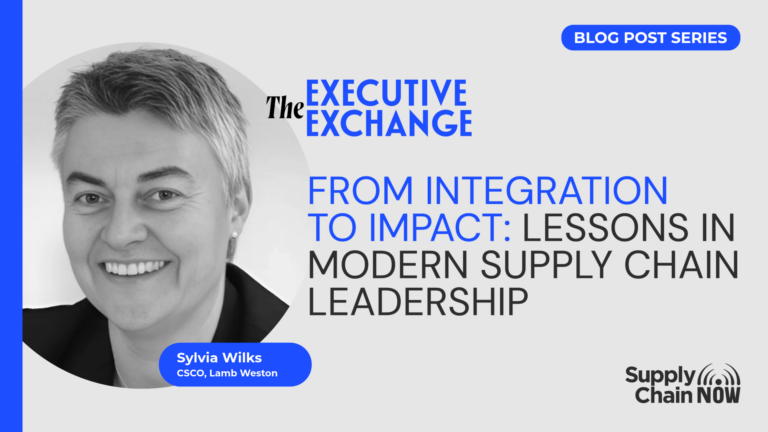
From Integration to Impact: Lessons in Modern Supply Chain Leadership
In a recent conversation, Supply Chain Now’s Scott Luton gained perspective from Sylvia Wilks, Chief Supply Chain Officer at Lamb Weston, who shared a powerful point of view on what it takes to lead in today’s increasingly complex, high-stakes supply chain environment. Her journey, from leading transformative initiatives at Starbucks to shaping global operations at Kimberly-Clark and REI, offers a consistent message: Success in supply chain isn’t just about systems or strategy. It’s about people, integration, and clarity of purpose.
Wilks’ passion for supply chain was sparked during her time at Starbucks, where she led a bold initiative to insource instant coffee production. What began as a business case evolved into a transformative opportunity.
“Seeing the entire chain, from strategy through operations, work seamlessly toward a common goal reinforced how much value organizations unlock when supply chain subfunctions operate collaboratively rather than in silos,” she explained.
The idea of breaking down silos to create an integrated value chain has remained a central theme throughout Wilks’ leadership career.
The Power of People and Integration
Across organizations of all sizes, Wilks sees a common thread: The challenges may be similar, but outcomes depend on how well teams work together.
“My passion has always been about solving problems through people and teamwork,” she shared.
From talent placement to customer service, inventory management to cash flow, the fundamentals of supply chain execution haven’t changed. What has changed is the level of complexity and the need for deeper collaboration. Wilks emphasizes that creating an environment where diverse perspectives are encouraged and ideas are challenged leads to stronger outcomes.
Equally important is the integration of the value chain.
“True end-to-end performance only becomes possible when individuals and functions collaborate seamlessly,” she noted, calling that integration “the true unlock.”
Turning Strategy into Reality
While “end-to-end transformation” has become a popular phrase, Wilks cautions that many leaders underestimate what it takes to make it real. The biggest pitfall? Overcomplicating the plan.
“In reality, progress depends on clear, consistent communication — telling a simple, shared story about why the change is needed,” she said.
She pointed to her time at REI, where the organization faced a significant inventory challenge coming out of the pandemic. The solution wasn’t a complex framework; it was alignment and discipline.
By establishing a “war room” approach with daily check-ins, the team encouraged transparency, accelerated decision-making, and ultimately outperformed their recovery targets. The experience reinforced a key lesson: Shared context and frequent communication can turn even the most challenging situations into opportunities for collaboration and growth.
Start With the Customer
One of the most common disconnects in supply chain organizations, according to Wilks, is the failure to link operational metrics to the customer experience.
““Supply chain organizations most often miss the mark when they fail to start with the customer and work backward,” she explained.
Too often, teams focus on internal KPIs without understanding how customers define success. The solution is straightforward but powerful: Align metrics with what truly matters to the customer. When organizations shift their perspective in this way, operational performance becomes a direct driver of customer value.
AI With Purpose, Not Hype
As supply chains increasingly adopt advanced technologies, Wilks offers a grounded perspective on AI. At Lamb Weston, AI isn’t treated as a buzzword. Instead, it’s a tool for solving specific problems.
“We view AI as an enabler, not a destination,” she said.
The most tangible results have come from focused applications in forecasting, inventory optimization, and cash flow management.
Wilks highlighted three critical enablers:
- Strong data foundations
- Integration with planning and execution processes
- Cross-functional alignment
Looking ahead, the focus is on scaling what works and embedding AI into daily operations, delivering “practical impact consistently.”
Curiosity, Authenticity, and Accountability
Beyond strategy and technology, Wilks emphasized the human side of leadership. Curiosity stands out as a defining trait. “The desire to learn, ask questions, and understand how things truly work is one of the most important capabilities a supply chain leader can have,” she said.
Her leadership philosophy is equally rooted in authenticity and transparency.
“A problem shared is a problem halved,” she noted, underscoring the importance of open communication in driving better outcomes.
She also encourages leaders to aim for excellence over perfection and to follow through on commitments. Accountability, she believes, is foundational to building trust, and trust is the backbone of any high-performing team.
A Leadership Journey of Growth
Drawing inspiration from Irish poet John O’Donohue, Wilks shared a piece of advice that has stayed with her: “May leadership be for you a true adventure of growth.”
It’s a fitting lens for her career and for the broader supply chain profession. As the function continues to evolve, the leaders who will thrive are those who stay curious, prioritize people, and bring clarity to complexity.
Because in the end, the most resilient and effective supply chains aren’t just well-designed. They’re well-led.
Where to Learn More
Connect with Sylvia Wilks here on LinkedIn. To learn more about Lamb Weston, we invite you to visit the company website: https://www.lambweston.com/. You might also be interested in watching Sylvia Wilks & other exceptional senior supply chain leaders share their perspective on a Supply Chain Now livestream from late 2025 that explores the new “Never Normal”: click here.
More Blogs
Planning for Growth in an Era of Constant Change