Intro/Outro (00:00):
Welcome to the Tango Tango podcast, real raw and unfiltered conversations with veterans and those who support them, tune in, be inspired, and walk away stronger.
Lloyd Knight (00:14):
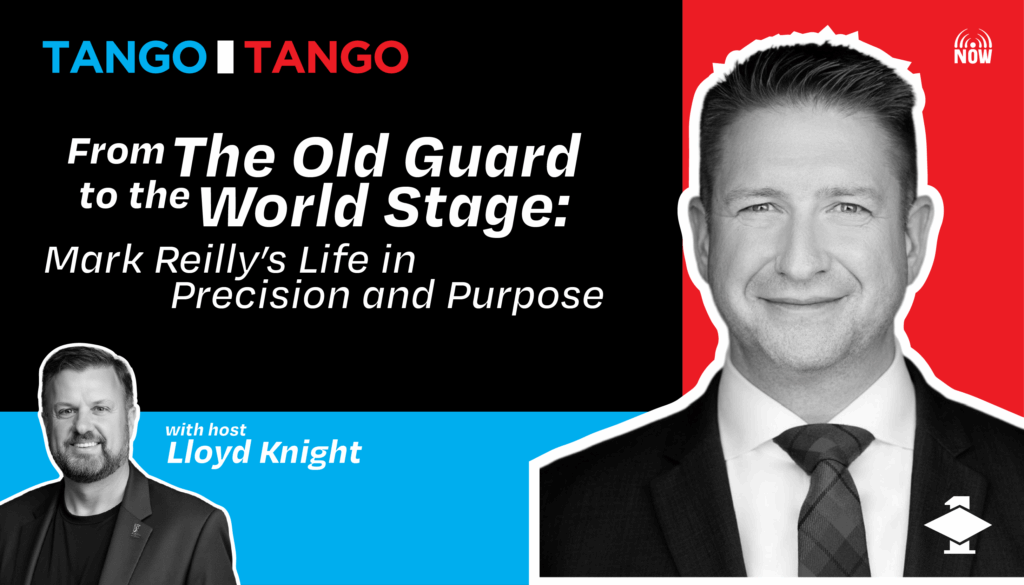
Welcome to the Tango Tango podcast. I’m your host Lloyd Knights. And man, I’m just so excited today I have one of my good friends and one of my newest friends, Mark Riley. Mark is an army veteran. He is CEO of the Washington Tattoo, talented musician. He’s got more titles than the Pope and is wheeling and dealing one of the few people that I know that’s actually busier than me out in the veteran space. So welcome to the Tango Podcast, mark.
Mark Reilly (00:45):
Thanks Lloyd for having me. And likewise, my friend. It’s been an honor and a privilege to get to know you and the work that you’re doing. I’m a huge fan and I love the whole titles thing because that’s similar to you. So I’m trying to play catch up here.
Lloyd Knight (00:57):
Get out of here. So Mark, I’m just fascinated by the career you’ve made, not only in the Army, but your post army career. The Tango Tango Podcast is all about stories, and a lot of our stories are, Hey, how did you get into the military? What’d you do in the military? And then what have you done afterwards? So in reality, a lot of this is a transition podcast. Very well. So I take it going into high school, you were a talented musician in high school?
Mark Reilly (01:31):
Yeah, it was interesting. I grew up in upstate New York. I went to high school in Poughkeepsie and I went to Catholic school, and we didn’t actually have a formal band program, so I was in community music as a kid. Started marching in my first fife and drum corps in the Hudson Valley at the age of six, I was carrying my American flag in my Cub Scout uniform in my first Memorial Day parade as a kid. But yeah, got into high school and I had started taking lessons with a gentleman named Nick Anton Nascio, who was a kind of legendary Yoda figure in the drumming world up in New York. I was 11, he was 75, and I started taking lessons with him. So it was relatively accomplished. Done some things prior to going into high school. And then high school, of course, got more mature with what I wanted to do with my life.
Lloyd Knight (02:15):
So after high school, did you go with the college route or did you go directly into the Army?
Mark Reilly (02:19):
No, great question. So I wasn’t sure what I was going to do. So I actually went to join the Marine Corps, very few people know this, and I got permanently DQ at MEPS for a rash. I broke out with a nervous rash. I was at meps, and so they DQ me and I was like, I don’t know what I’m going to do after high school. And so I ended up meeting a dear friend of mine who’s now passed. His name is Ken Green, his father was the drum sergeant at the West Point Hellcats. So if you go to West Point, there’s a field music group there that plays ly every morning. They march the troops to the mess hall, they march the troops all across the parade ground, and they do the traditional marching music that would’ve happened during the time of George Washington’s army.
(03:02):
So Harold Green’s son was the professor of percussion at a very small state school in Louisiana. It was called Northwestern State University of Louisiana in Nakadis, Louisiana. So this New York kid ends up going to school in Louisiana, and I had a thick, thick New York accent. I was all very much New Yorker like David Letterman had the top 10, top 10 this, and it was the top 10 of why New York was the best city in the world, and it got to like 3, 2, 1, and it was, our city will kick your city’s, you know what? And that was just my mindset at that point. And so when I got to Louisiana and I had this chip on my shoulder and attitude, people were wondering, why was I such a jerk? Why was I such an a-hole? And it was just who I was. I had no concept that I was even being that way, but the way I spoke, the way I came across, and that was a huge learning curve for me.
(03:54):
But I ended up doing five years in undergrad. I was a super senior. It took me a little while to figure things out, but that town of Nakadish is a really special place for me because I started to really learn people are people, and you start to learn that music starts to connect people from all over the world. And if you allow music to connect people, you can have some magical moments just with trust and inspiration and mentorship. And so going out of high school, going to the small state school, I never in a million years thought I’d be in Louisiana, but I absolutely loved it. I fell in love with the culture of Louisiana, the idea of Mardi Gras and going down to beyond the French Quarter, the history behind Louisiana, the food, the history, the culture, the music. I just absolutely fell in love with it.
Lloyd Knight (04:40):
Wow. So after spending that time down there, what was your next step?
Mark Reilly (04:46):
Great question. So I student taught in Plano, Texas. So I was an education major, and so I got a degree in music ed, and you have a semester where you have to go and teach inside the public school system. And I was very fortunate to have the opportunity to teach at Plano East Senior High School and Bowman Middle School in Plano. And these were killer marching band programs attached to Texas football. So I mean, it was like a religion there. So it’s like the football program’s competitive, the marching band program’s got to be competitive. And we were a five a school during a five a state year in the DFW area. And so I got to see kind of under the hood of some of these incredible marching band programs from a technical aspect, a cultural aspect, a leadership aspect, and just some amazing mentors there.
(05:37):
A guy named John Brennan, any of your listeners who know what Drum Corps International is, it’s DCI. It’s kind of the professional marching band world. They have a huge contest tour all summer long every year. But John Brennan was a teacher at the Cavaliers who kind of tucked me under his wing. There’s another gentleman named Evelio Vial who was with Phantom Regiment back in the day. And these two guys just tucked me under their wing and were like, do you hear this? Can you see this? Notice what’s happening here. First Clarinets doing this, first flutes doing Piccolos doing this. Do you hear the trombone? That’s not a ta. It’s AAH or a, and they were talking about these very technical, small, detailed things that as a young percussionist, a drummer, you weren’t paying attention to those details in the brass section or the woodwind section. But it allowed me to really start to understand awareness and how I listen, what I’m listening to, allowing to be coached and learning what the skillset of being coached looked like.
(06:36):
So that was a really powerful tool transitioning from in the classroom to student teaching to apply all of these different topics. So I finish up student teaching. This is around 2000, 2001 ish. Nine 11 happens. A bunch of my friends all joined the military, and I just started getting calls like, Hey, what are you doing? Are you joining up? What are you doing? Are you joining up? And a good friend of mine, Josh Dukes, just kept calling and calling and calling. And I was like, what should I do? What should I do? And I went to the folks who I was student teaching with, and I went, I have this opportunity to serve my country and play music at the old Guard. And they were like, that’s a no-brainer.
(07:18):
You got to go do it. I mean, even if you do it for three years and it’s not your thing, go do it. Go have that experience. And so the old guard, Fife and Drum Corps had a handful of positions that started to rotate out because the positions for that unit are specifically tied to that unit. So basically someone has to get out in order for a slot in that unit to open up. So that was, yeah, it was an incredible experience. I ended up deciding to join the Army, went to basic training January, 2003, but it was a crazy, crazy experience. Never in a million years. My dream was to be a band director and joining the army was not on the cards, and it became one of the most amazing things I’ve ever done.
Lloyd Knight (07:58):
So where’d you do basic training at
Mark Reilly (07:59):
Fort Sill, Oklahoma. Kao? Yeah. I mean, went to school at artillery school, but I was just for basic training. Yeah,
Lloyd Knight (08:08):
Yeah, I know Fort Sill, Oklahoma very well. I went to flight school three times in Altus, and we used to go to Fort Sill for fun. That’s how bad Altus was.
Mark Reilly (08:17):
And your tech school is where? So we do in-house at the old Guard
Lloyd Knight (08:21):
In-house. No kidding.
Mark Reilly (08:22):
Yep. Yeah, you do kind of OJT. So you go to basic, they ship you directly from basic to Fort Meyer, Virginia. And that plays havoc with all the S one folks. All the S one folks want to go crazy because they’re like, wait a minute, how does that work? And so yeah, you go to a Fort Meyer and they put you through a six month training program where you’re learning all the new marching, the music, the drill, there’s a packet. The folder of music you have to memorize is hundreds of pages of the ceremonial pieces, the White House arrivals, because that job is specifically geared where you are the subject matter expert on an army ceremony.
Lloyd Knight (09:00):
So you had this really this illustrious career, and you did very, very well retiring as a sergeant major. But did you fall in love with it right away, or was this something that took you a while to figure it out?
Mark Reilly (09:16):
Let me just say, I did not drink the Kool-Aid immediately. I really actually struggled quite a bit. My first enlistment, I was coming from the Texas band field where you’re, I mean, every little detail of very specific things at the performance level with a high school band may not sound huge to a lot of folks, but I’m going to tell you, this is no knock on college bands, but a lot of those top Texas bands are better than most college bands. I’m not talking your top tier. I’m not talking North Texas or Ohio State. I mean, those are premier, premier college bands, but most of these high school bands are going to be stronger than a lot of these local state schools. And so coming from that kind of program into the old guard was really interesting because there was a lot of retirements happening.
(10:01):
And so there are a lot of folks that were like, Hey, I’m out. My DD two 14. I’m getting ready to go. So peace out. So I joined the old Guard Fife and Drum Corps at a time where there was a lot of leadership change, and that gave me the opportunity to figure myself out again. I probably ran my mouth a little bit too much. I mean, I definitely made some people mad because it was something I was really passionate about. I grew up doing fife and drum as a kid. I had seen the old guard Fife and Drum Corps in 1986 for the first time, and I was like, that’s the mecca of this marching band activity. And so getting to the old guard was really special to have the opportunity to lead. But we were in the middle of culture change and it made me have to grow up quick.
(10:49):
I always joke that you always want to show up to the military with at least a little bit of adult experience. You don’t want the military to teach you totally how to be an adult. That’s not fun sometimes. But yeah, it was a really special time. I was able to be a section leader there. I did music writing for the Old Guard, so I was able to write a lot of music for other groups because once you write for the Old Guard, then your name kind of goes out to other folks that are interested in your music. So in the military tattoo space, if anyone knows the Royal Edinburgh Military Tattoo, there’s a group called the Top Secret Drum Corps out of Basel, Switzerland. They light the sticks on fire and they throw ’em and juggle ’em all around. I was able to perform with that group and write music for them as well while I was in the Old Guard. And so yeah, fast Forward became a group leader, which is an E eight, and was able to lead the drum line for about four and a half ish years, and then was promoted out of that to Sergeant Major and ended up getting to do some policy writing for Army Music. So it was an incredibly humbling career, but yeah, really blessed to have had that career.
Lloyd Knight (11:52):
Just taking aback a little bit, for those who are not familiar with what a tattoo is, it’s not like a tattoo. Can you walk through the listeners and the viewers what a music tattoo is?
Mark Reilly (12:05):
Yeah, absolutely. So if we go back to the 17 and 18 hundreds, your average soldier was not rich enough to own their own watch. So if you look back in the regulations, the NCOs and the officers were allowed to wear a watch. They were issued a watch. And so the reason why we found a lot of this out is in the Old Guard, it’s the oldest active duty infantry regimen. It goes back to 1784, and we have a center of excellence up there on military music history. So the term tattoo comes from a call. So if you think of LY retreat into the color, these are these bugle calls that you hear on military installations all over the place. So LY would’ve been the first call of the day to wake all the troops up. If you think of the last call of the evening, soldiers didn’t have watches.
(12:52):
They would send a drummer, a Bagpiper or a P Fier or a bugler to play these calls to tell the soldiers where to be and when to get there. So Mess Call would call church call. These were all calls played by military music to send the troops to where they needed to go. So tattoo is a Dutch call, meaning do Dun tap toe. It literally translates to turn off the beer taps. So tattoo translates to shut down the beer taps, send everybody back to barracks, and now that term tattoo has turned into an evening military music ceremony that’s celebrated around the world.
Lloyd Knight (13:28):
Yeah, that’s amazing. And one of the things that Mark and I have in common that we’ve bonded is our love of history. And so it’s always cool to get his perspective from the music side of history. So what does The Drum at Five Core at the Old Guard, I know, but most of our listeners and viewers don’t. What do you guys actually do? What do you support? I know it’s more than just funerals and ceremonies at Arlington. What goes into a year for somebody in Drum at five Core at the Old Guard?
Mark Reilly (14:03):
Great question. And just to kind of break it down, so the third US Infantry Regimen is not the Third Infantry Division. So the third US Infantry regimen is a regiment has three battalions. Two of the battalions are based at Fort Meyer, Virginia, which is directly across in the Pentagon. And we are the stewards of Arlington National Cemetery. So that unit, fourth battalion goes into the US Army drill team, the Continental Color Guard, which is the color guard that dresses in the George Washington colonial uniforms. You’ll see them at the All-Star game or the Super Bowl, things of that nature. And then you have the old Guard Fi and drum court. So each of those are part of separate companies. So the Fife and Drum Corps is a company, it’s FDC company underneath the fourth Battalion, inside the 30th Infantry Regiment. And so it’s a huge honor because we get to do the laying of the wreaths at the tomb.
(14:52):
We are, if there’s an old guard wreath laying, we are providing the bugler and the drummer at the tomb of the unknown to honor the fallen, which is, I mean, just gives you chills every time you have the opportunity to be a part of that ceremony. But yeah, a lot of the job is ceremony and outreach. So the face of the Army, we are attached at the hip with Army recruiting. So we will travel a country to do various parades and ceremonies in all. At some point we’ve hit all 50 states, but I mean, each year there’s a strategic outreach that comes out through Trade Off or Army recruiting. And so we’ll support those efforts all year round. The Fife and Drum Corps, actually, we have tabulated, it used to be 300 missions a year. It’s well over 500 missions a year. It’s somewhere between 550 and maybe just shy of 600 missions a year.
(15:45):
What we have is there’s 69 performing members, and what we do is we break all of those groups up into teams that can then go out and do various versions of missions. So a mission could be a trumpet player or a bugler playing taps for a funeral. But then on top of that, you have a small team, which is a 12 person package, and they’ll do various events with the joint chiefs or the chief of staff of the Army. We do a ton of retirement ceremonies, and every month there’s what they call a DA ceremony, which is your department of the Army retirement ceremony, and that’s at Sea Hall Economy Hall in Fort Meyer. But I mean, you’ll see a lot of these folks who want to retire with a special ceremony come up to DC to Fort Meyer to have their retirement ceremony with the Old Guard because you’re wearing the dress blues and it’s dress right dress.
(16:35):
So yeah, there’s about roughly 550 missions that happen annually from presenting the colors to a funeral to a performance for recruiting or going overseas. We did the state arrival for President Trump, the second state arrival with the king that happened this past September. So the unit is really a public facing asset for the Army. And that also allows us to lower down the drawbridge of saying, look, yes, the US military is very powerful, but we also have these cultural assets that are at our disposal where we can talk to kids, we can inspire the next generation, we can connect with collaborators or our NATO partners.
Lloyd Knight (17:12):
And yeah, you’ve played in front of multiple presidents. Can you talk a little bit about that?
Mark Reilly (17:16):
Sure. Yeah. My first president I served under was George W. Bush. I did his second inauguration, was able to do several White House arrivals. One of the most special for me was when Queen Elizabeth II came to the White House. I think she went to the Kentucky Derby. Maybe she had a mint ju up, I’m not sure. But yeah, that state arrival was in the both presidential inaugurations for President Obama was in the inauguration for President Trump the first go round. And then my last one was with President Biden when he was inaugurated. And we are part of the actual inner workings of the operational piece, the rehearsals, the timing, all the different pieces that go into the rehearsal with Secret Service. We’re all in the weeds with all of that. And not only just the inaugurations, but the state funerals. So any of the funerals, president Carter, president Ford, president Reagan, president Bush, when they pass the Old Guard is also the steward of the training of what the details are lying in state at the capitol, the peace back at their home state with their home library, the National Cathedral Joint Base, Andrews. And so all of those components, the Old guard is the steward of how to do all the training for the state funerals. And I was the SME for the Cathedral Joint Team Cathedral for about seven years while I was at the Old Guard.
Lloyd Knight (18:38):
Wow. So Mark and I had met at the Bush Institute, we’re graduates of the Stand to Veteran Leadership Program there. And on our last night, we had the opportunity to spend time with the President Bush and Mrs. Bush. And Mark actually got to sit next to President Bush at dinner, and I know he is absolutely hilarious. The king of one liners. And how fun was that? How did that go?
Mark Reilly (19:06):
It’s funny. So I was looking back on our annual report and I was going through my phone. We were like, which pictures do I choose? And there’s a picture of you, and I think probably 10 minutes after we went downstairs after dinner and it was just like, did that really happened? It was so surreal. And I mean, number one, the people in the VLP program are just such phenomenal human beings. And I think that was such a testament to you and I, and I’m so grateful for our friendship. And then going through it together, it was you just pinch yourself. You hope for opportunities to be able to give back and serve others. And I think that’s how a lot of us got into that program is it can’t be about us. It can’t be about our accolades. I mean, you’re not going to get in there without accolades.
(19:54):
So I mean, you’ve got to do some work, but that evening was so special. President Bush is hilarious. He’s fast. He’s smart. It’s so crazy, and he’s so down to earth, he’s so human. And I think that was what really took me is he was busting my chops about the old guard hats, the big colonial hats that we wear on the White House. And he wouldn’t let it go. He busted my chops the entire day on these crazy hats that we were wearing. So I actually am sending a hat down to President Bush. I do have my old hat that I wore during his arrival, so I’m sending that down to the museum. We’ll see what they do with it. But just as a token of thank you for what he’s done for veterans, it was really, really special.
Lloyd Knight (20:33):
Wow. What a great gift. And speaking of great gifts, you gave me a great gift on the last nights that you gave me your drumsticks, which is really special. I keep it right here. It’s next to me, my home office in every Tango, tango and The Landing Zone podcast. I do. So thank you for that amazing gift. Thank you for the friendship, man. I’m just so excited about our future together, and thanks to the folks at the Bush Institute, we’re running this pretty remarkable program. It’s a multiplier what we went through, so we’re looking forward to that. And President Bush was so funny. It’s so quick and sharp, and my goal was to make ’em both laugh, which I think I did to at some point. But yeah, and so smart was, they’re both up there in years and it was just, wow, he does not get the credit that he deserves for being smart because of multiple things. But wow, some of the stuff he shared on Russia and the banking collapse and on history was just blown away. He was a Rhode Scholar. I think people lose fact of that. So 20 years in the Army, so the 20 years retire as a sergeant major phenomenal. You have this huge success. You’ve grown these international connections and relationships, then it’s time to get out. Why’d you get out at 20? Why didn’t you stay any longer?
Mark Reilly (22:05):
A handful of reasons. And I usually joke like, man, if they’re going to pay me to get out, I’m getting out. That was what I told everybody. So it was interesting. In 2005, I had my first kind of experience with the international military music world, and it blew me away. I was a guest drummer with this group Top Secret, and we went to Australia for a 10 day tour to perform for the Edinburgh military tattoo. And so we were down in Australia for 10 days of performances in Aussie Stadium in front of 40,000 people every night. It was absolutely insane. And there were no American military units. There wasn’t a single one. And it kind of struck me. I just thought that was really strange. And because it was right after President Bush’s second inauguration, a lot of people were asking me about the inauguration, what was it like and blah, blah, blah. And so as soon as they found out that I was not a complete knucklehead, and I could relatively speak, I was getting asked to speak on this with all these newspapers and tv. And I was like, oh my God, I need to be really careful with how I present, what I’m going to present, how I’m going to say what I’m going to say because I’m a US active duty military member
(23:20):
At a military event where there’s no other US military personnel present. So I was able to navigate that. But the CEO of the Edinburgh tattoo, who’s now brigadier, sir Melville Jameson, he’s, he was the event director for all of Queen Elizabeth’s personal and private events. So this guy comes in, he’s got proper Queen’s English, he’s dressed in his tartan and everything else, and he is like, mark, why is there not a proper tattoo in Washington DC? I said, well, there’s a marine one. There’s an army one. He goes, no, no, no, no, a real one. And I didn’t really know what he meant. And he said, bringing in partners, bringing in international relations, bringing in political folks, and all of that. And so that really hit me. And I finished my master’s degree in 2016. And when I finished that master’s, which was in curriculum design, I was on the treadmill on a run doing pt, listening to TD Jakes.
(24:17):
And I was listening to this sermon and it was talking about, and your biggest dream, and do you have enough faith in God to actually pursue your biggest, wildest, craziest dream? And I sat there, as I’m running, I’m like, I think we could do this international tattoo thing. I think we could pull this off. And so I went and I was like, how could I structure this? And I was, how could that possibly be? And I went, wait a minute, S one, S two, S3 S four S five. And I went through all the different folks and I went, who do I know that would be a rockstar at each of these jobs if we were to build out the guts and operational pieces of this tattoo? So very long story short, no joke, like the following Monday, Billy White, who is a sergeant major, who was my boss at the time, he’s like, Hey, mark, let’s go for a run.
(25:08):
I have a business proposal for you. I said, is the word international involved? And I go, he goes, yes it is. And he says, I think we’re talking the same thing. So in 2017 ish, we already started having this idea to build the Washington tattoo. So we went to jag, you got legal, built an ethics agreement, built an conflict of interest statement. What could we do while we’re active to build a glide path from this while we could get out? And so my co-founder is Billy, white Sergeant major retired. He was in for 23 years. And as soon as he got out, I started looking at this going, I could stay another decade. I wasn’t going to get promoted again, I never frocked on Command Sergeant Major, but what I did find in our TDA document was that I was coded as a six Charlie, which is a battalion command sergeant major.
(25:58):
And so before I got out, I said, I’ve got to fix this. So I was able to help my successor pin on as the first ever six Charlie Command Sergeant Major for the fife and drum chord, LA Tricia Fields. And so it was like I wanted to button up this 20 year amazing experience. I think God had this in the plans to go do this other thing that, not to say that it’s bigger than the old guard. It’s like, don’t ever want to bring that up, but it’s adjacent. And then using the relationships that I was able to build through the old guard, we can really take something super, super special and help wounded warriors, gold star families, former POWs, folks who are struggling with PTSD and TBI. So the 20 year thing was almost like it was a given. I knew that almost not five years, but maybe three and a half, four years in advance, I knew I was getting out of 20.
Lloyd Knight (26:51):
Wow. Amazing. I had no idea. You have this business plan that you started working on even before retirement. So now you retire. What is that look like? I mean, was it revenue coming right in? Were you doing Uber? So tell me a little bit about the transition.
Mark Reilly (27:13):
It was not pretty. It was not pretty at all because number one, my wife knew that this was happening the whole time. We still have small kids, so I still have kids that are still going to school. And in the Army music space, military music space, you’re performing every holiday. You’re performing every weekend. You’re out doing these missions all the time. So you’re never really home when the family’s home. That’s not a complaint, but that’s a how do we navigate this? So I still needed to put food on the table. This was not revenue generating yet. And what was funny was I was in charge of budgets. I was in charge of advising for budgets, but I never had to revenue generate. So that was like a, what is that? Oh, you want to be a business owner? Welcome to the Party pal. So I did Boots to Business as part of the transition getting out, I found an A CP mentor.
(28:04):
There’s also score, which was another phenomenal nonprofit that pairs you up with executives that help you kind of learn business. So as I was doing my TAPS classes, I was looking at, I did it twice. I did it one as a, I’m transitioning to get a corporate job. And then I did a second time through where I was going to go entrepreneurial. So I did those not the same time, but I did those within my last two years of getting out. And I ended up doing an internship. I did a skill bridge with Key KeyBank because I knew I had to learn finance. And so at the end of the day, what I ended up doing is I started an MBA program. I didn’t finish it, but I was also doing enterprise level data analytics compliance at KeyBank. And I was underneath a bunch of really, really smart people that were building their governance and compliance structure for the bank.
(28:57):
And so we were getting into legal compliance, data literacy, clean versus dirty data. How does that all work with each other? And if you’re working with a legacy bank and you’re starting to use basically a FinTech model, how do you get a legacy bank to start operating agilely with new technology? It was a very big eyeopener, but as I got out from my skill bridge, I worked for Wells Fargo for about nine months. Again, just a huge learning lesson of just how to operate p and ls. How do you operate and run a true business using the different technical tools from CRMs to project management software? Yeah, it was a butt kicking. It still is it still a butt kicking? But finally, we’re at a place now where the tattoo is generating income where we do have some staff that we’re paying, which is great. And then we’re in the beginning of a hockey stick right now. So we’re going to be hiring some more folks soon.
Lloyd Knight (29:56):
Yeah, that’s outstanding. It’s been fun to get in there and learn about your history and then seeing really the business take off. And I know you had to be agile during the government shutdown. You had a lot of opportunity to hit you all at once. How did that look?
Mark Reilly (30:11):
Yeah, it was crazy. So I hate to say it, but in business, weirdly enough, sometimes chaos breeds opportunity. And because the government shutdown happened, they stood down basically all the ceremonial assets that the US military has except for, I don’t know if they had a 20% threshold that they were still allowed to do. So during the shutdown, all of these military organizations that were hosting a gala or hosting a ceremony or a Veteran’s Day, anything, there were no military assets, no color guards, no bagpipers, no one to play taps, no one to do ceremonial music. And that sounds kind of like silly, that’s not a big deal. But if you’re at an amazing event and you’re trying to create and curate an amazing relationship, it ends up being a big deal because it’s a level of responsibility. It’s a level of class that elevates that event.
(31:03):
And when you see it, you’re like, oh man, that’s great. When you see that it’s not there, it feels empty. There is definitely a hole that’s there. And so during the shutdown, we were getting calls every day and we actually had to start telling people no, because we were just so oversaturated with, we have a color guard out, we have this Color Guard album. So we have a Rolodex of color guards, pre ceremonial, brass band music, fifes and drums, bluegrass music. I mean, it’s like any type of thing that you want. We have a Rolodex of performers that can go do it, but it’s just how fast can we turn it over? And if it’s last minute, which this was, we’re going to get to a point where we exhaust those resources.
Lloyd Knight (31:42):
Wow. Great problem to have though.
Mark Reilly (31:44):
It’s a great problem to have.
Lloyd Knight (31:46):
So hey, let’s talk a little bit about the nonprofit side of the Washington Tattoo. And I know you do music therapy. What does that look like and how did you get into that part of the veteran support?
Mark Reilly (31:58):
No, great question. And I do want to just upfront, there’s a very big difference between clinical music therapy and music wellness. And that’s kind of where we have actually found a pretty large gap that we’ve created a bridge. So we stood up the nonprofit for the Washington Tattoo in 2019. We got our 5 0 1 C3 status, and we were in arts and education nonprofit. That’s what we had planned on being. We were going to do events, we were going to do some music, we’re going to bring work with schools. That was our game plan. And so coming out of COVID, we started to host live events. And the first event that we hosted was right after Governor Youngin lifted the ban and people could actually go and do stuff. And we had 75 people at our first event in Williamsburg, Virginia. And we had military families involved.
(32:44):
We had whole family units there, kids, uncles, because they wanted to get out and do stuff. And it was a free event, or actually I think we had was sponsored. So we ended up having it as folks coming in and learning how to play drums, learning how to play guitar music, that kind of thing. And so that was the first event. And then we started to do some smaller, but growing these events a little larger. And at every single event that we had, vets would just start coming up to our staff and pour their guts out. They would just tell these brutal stories. And it was bad. I don’t want to say who it was or whatever. One gentleman came up to me and was like, I killed him. I killed them all. And it was like, whoa. And it was like he was in that moment back in Vietnam.
(33:31):
And so I got in one knee, he was in a wheelchair wearing his cap, the whole thing. He grabbed my shirt and pulled me close right into his face, and he starts telling me intimate details about this crazy situation where he got ambushed in Vietnam and it was like he was living it in that moment. And so things like that kept happening. And once you hear it or see it, you can’t unknow it. You can’t unsee it. And so a little over two years ago, it was probably about 20, 26 months ago, we pulled the staff together. We’re kind of like, what do we do? Do we just keep doing what we’re doing the way we’re doing it? Or do we decide to do something about this? And everybody went, we have this. We’re allowing these people in a way to heal through music. And I have a background in curriculum design.
(34:18):
So we were able to structure some courses and at the end of the day, we’re going, well, what are we teaching? What is it? How are we measuring it? What are and what’s the so what at the end? And so the nonprofit now is focused on veteran mental health through music wellness. And so the Bush Institute was incredible with really equipping us with relationships. Yes, of course, but the thought process, the idea of evaluation, the idea of innovating, the idea of huge big picture thinking, but then also granular. What is your baseline? How are you measuring 5% better and being okay with that moving the needle 5%? It’s still progress. And so we’ve been able to really lean in on that and codify quite a few things. So it’s been really exciting to move into this space.
Lloyd Knight (35:07):
Yeah, I’m excited to see it because I’m a big proponent in the arts and that face, and it just hasn’t been well done. And then so it’s like all over the place, and I know you, if you’re going to do it, you’re going to do it right. You’re going to have an impact. And so kudos to you. Thank
Mark Reilly (35:27):
You.
Lloyd Knight (35:28):
Hey, let’s turn over 1776. We are at America two 50 this year. So the Washington Tattoo is involved in America two 50. Can you talk a little bit about what you guys are doing to support those initiatives?
Mark Reilly (35:42):
Yeah, absolutely. So it’s interesting. So because we started off with doing events, we have event chops, we have teams that have done White House arrivals, that have done presidential inaugurations, state funerals. And so one of our dreams at the very beginning of standing this up was 2026. We want to be a part of the semi quincentennial of the United States of America, which is the 250th birthday of the us. So we’ve been hunting this designation for quite a while, and we received it last year as so excited. Got some support from Senator Cotton, Senator Kane, Senator Warner, and was really, really powerful. And the America two 50 Commission recognized by Congress has program partners that are out there. And we were one of the earliest program partners to come on board. And what’s been really special is we host a flagship event in DC that brings in over 200 cast members.
(36:34):
Last year we had the Commandant’s own US Marine Drum and Bugle Corps. We had the Navy drill team. Years past, we’ve had the Air Force drill team, we’ve had Highland dancers come from all over the globe, Australia, New Zealand, Canada, Scotland. Of course, we brought a bagpipe rock band in called the Rolling Drones from Glasgow. I mean, it’s a great, great time. It’s a great time. But it inspires the veteran and military community to think about what it means when you come together with your superpowers. If you’re a business analyst, if you’re a compliance person, if you’re a nonprofit expert, if you’re a professional fundraiser, if you’re a behavioral health specialist, we’re synergizing that at this flagship event, and that becomes our biggest marketing tool. So the way that we were able to really bring in the ecosystem of this music wellness is that we use the flagship event as the crowning jewel, but 365 days a year, we are actively engaging with veterans through music.
(37:35):
And so the America two 50 allows us now to really celebrate service by bringing in the veterans that we’ve been working with all year. And we usually have sponsors that come in, they’ll pay for the tickets for them and their family to come and experience it. We take those performers at the America two 50 show, and then we deploy them at the VA hospital in dc. We go to the Fisher House, we go, this year we’re going to be going to Children’s National Hospital. And so we do workshops with these folks at the tattoo in local places in DC like the local va Fisher House and Children’s National Hospital. So the show itself is about two hours long. It’s going to be an arc this year of telling America’s story through music and service. It starts with the Black Eagle Singers. It’s a Native American dance drumming and singing group.
(38:19):
Super excited about that. And I’ll start with the idea of how we as a country, we have people who have been living on the land forever, and how we live on the land and how we share and how we serve is an amazing story. That goes really back to pre 17 six. We get codified and we create the Declaration of Independence, which we get to the constitution, which gives us this idea of an American dream. And so using music and using service, we’re really excited to share the story of America in dc and that’ll be in July, July 17 and 18 this summer in Washington dc
Lloyd Knight (38:55):
I can’t wait to see, man, I’m so pumped. So for our listeners and viewers who want to attend, how do they get tickets?
Mark Reilly (39:03):
So we’re about to launch, we’re looking at February 1st for our ticket launch. We’ll do an early bird prime in the pump starting that week. But yeah, if you go to www.thewashingtontattoo.com, our events page will have updates constantly on that. So social media, same thing. Facebook, if you look up the Washington tattoo.com, Facebook, Instagram, Twitter or X and LinkedIn, even YouTube, all of those, if you look up the Washington tattoo.com, you’ll see all of the events that we have coming up, and there will be more than just a flagship in July. Right now we’re looking, one of our great partners coming on been there has been Glen Ick, Hendricks Gin, and Vinnie. So we’ve got a great partnership with some really fun brands coming on this year is also Jefferson’s Ocean Bourbon. So we’re talking about doing an event in early mid April called Spirits of 76. And so we’re looking to bring folks in if they’re interested in partnering, sponsoring, or being a part of that, we’re going to be doing probably an event per quarter this year in 2026.
Lloyd Knight (40:06):
You do that sponsorship stuff very well. You’ve been trained by a NASCAR driver. You squeezed in nine sponsors in like 15 seconds.
Mark Reilly (40:16):
Tried to. Tried to.
Lloyd Knight (40:18):
That’s really exciting. And hey, we get the Hangout and you and I get to hangout in Scotland along with a Sarah at the Rural Edinborough Tattoo. Man, I am so pumped for that. I bought two bucks on Scotland. So looking forward to that trip to not only to see Scotland and see the tattoo, but hang out with you brother. So really looking forward to that.
Mark Reilly (40:48):
Me too, my friend. It’s going to be really special. So I mean, where we really lean in on is creating super unique experiences for our veterans, and we’ve been able to bring vets to the Mount Batten Festival of Music at London’s Royal Albert Hall. They get to see behind the scenes, the Royal Edinburgh military tattoo. You have to go up inside the castle is 300 Pipers are warming up, and you’re overlooking this ancient city in the top of a volcano where there’s this beautiful castle. And the military history involved is phenomenal. The Enson Swart, which is a pub, the bottom of the castle at the Royal Mile has the Royal Scotch Dragoons Guards Battle honors from Waterloo. So you’re talking like Napoleonic war, you’re looking at these swords and muskets, and you’re just surrounded and oozing with this military history. And so the music allows us to come together, but then we’re learning about the stewardship of military leadership, the artifacts, how we honor those traditions. It’s such an incredible story to be a part of, and just by being a piece of it, to share that with friends and to share that with friends, family, it’s just such a blessing. So I’m really honored to do this with you, my friend.
Lloyd Knight (42:00):
Yeah, I can’t wait. So Mark, thanks for jumping on the Tango. Tango. This is going to air here in late January, but Mark and I are up very early the day after the national championship game, Indiana. So I stayed up late to watch that game. I was pumped afterwards. What a game.
Mark Reilly (42:22):
Incredible game. I mean, Mendoza. Unbelievable. Unbelievable.
Lloyd Knight (42:26):
So I was pretty hyped. I think I got about two hours of sleep last night. I found a little bit ho. So thanks, mark. So I appreciate it. And for all my listeners, be like, mark, be safe. Be kind, and be remarkable.
Intro/Outro (42:43):
The Tango Tango Podcast is produced in partnership with Supply Chain. Now join the Tango Tango community. For more inspiring stories. Follow us on Facebook X and LinkedIn. Subscribe to the Tango Tango YouTube channel, and follow. And listen to Tango, tango wherever you get your podcasts.