

More
December 3, 2021
This Week In Supply Chain Now: November 29th – December 3rd
Stay up to date on all the latest conversations, interviews, and episodes we released this week here at Supply Chain Now! We started this week off with an episode of Supply Chain Now as Scott Luton chats with Lora Cecere and Dr. Madhav Durbha, Vice President of Supply Chain Strategy for Coupa Software. In Monday’s episode of This Week In Business History, Scott Luton talks about the history and development of video games- from the origins of Atari to the companies that are currently dominating the market. On Tuesday, we republished a classic TEKTOK episode with host Karin Bursa. In this episode, Karin shares six strategies for greater supply chain resilience. On Wednesday’s Supply Chain Now episode, Scott had a great conversation with culture expert, author, and speaker Ray Attiyah with Run Improve Grow. Scott and Ray talk about the key points in his new book, Fearless Front Line: The Key to Liberating Leaders to Improve & Grow Their Business. On Thursday, we released another episode of Supply Chain Now with host Scott Luton and special co-host Allison Giddens. Scott and Allison welcome Chad Molen with NIMBL, and Dan Reeve with Esker to the show. On Friday, we released the…
global trade uncertainty
February 19, 2026
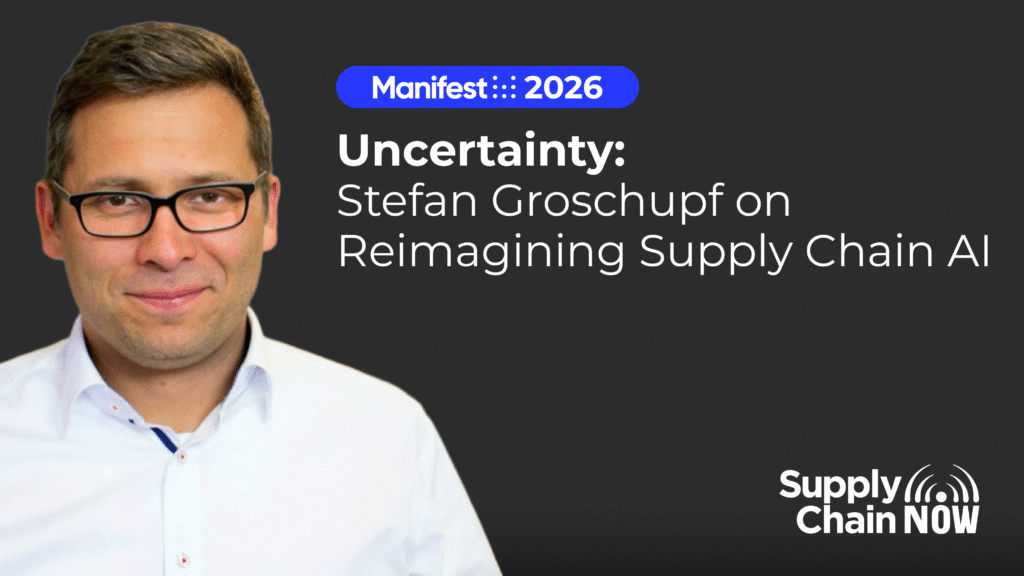
Building for Uncertainty: Stefan Groschupf on Reimagining Supply Chain AI at Manifest 2026
A Legacy Behind the Mission At Manifest 2026 in Las Vegas, Scott Luton sat down with Stefan Groschupf, CEO & Founder of Centrum AI, to discuss how a new generation of technology is being purpose-built for today’s supply chain realities, rather than yesterday’s assumptions. What began with a lighthearted joke about multivitamins quickly turned personal. When Scott quipped that “Centrum” reminded him of a vitamin from the eighties and nineties, Stefan shared the real inspiration behind the name. “My dad… the biggest building he constructed was called Centrum,” he explained. “That was the inspiration. His legacy, a head nod to him.” For Stefan, the company name represents more than branding; it reflects a mission rooted in impact and responsibility. Designing for Today’s Reality “We’re building a new tech platform for the supply chain industry that is really built on the foundation of the reality today,” Stefan said. That reality includes uncertainty, dirty data, data silos, and geopolitical shifts that are reshaping global trade. He offered a simple example: in many ERP systems, a lead time is entered as a fixed number — say 15 days. “That’s of course nonsense,” Stefan noted. “It’s anywhere between nine days and 18 days……