
More
book club
February 2, 2026
First Edition: Between the Lines by Supply Chain Now
At Supply Chain Now, we talk a lot about innovation, resilience, and what’s next for our industry. But behind every great conversation, great idea, and great community is something even more fundamental: curiosity. We read because we’re curious. We read to learn. We read to grow. And sometimes, we read simply because it’s fun! That’s why we created Between the Lines by Supply Chain Now, a space for our community to share what we’re reading, what’s making us think, and what we’re excited to recommend to others. This isn’t a traditional book club where everyone follows the same reading list. Instead, it’s a shared shelf, built by the Supply Chain Now team and our broader community. You’ll find business books and personal development reads alongside novels, memoirs, histories, and unexpected favorites. No required genres. No assigned chapters. Just real people sharing real recommendations. Because great books shape us in different ways. Some help us sharpen our skills. Some challenge how we see the world. Some help us slow down, escape, or recharge. And often, the most meaningful growth comes from reading something we never would have picked up on our own. With Between the Lines, our goal is to create…
veterans
January 12, 2023
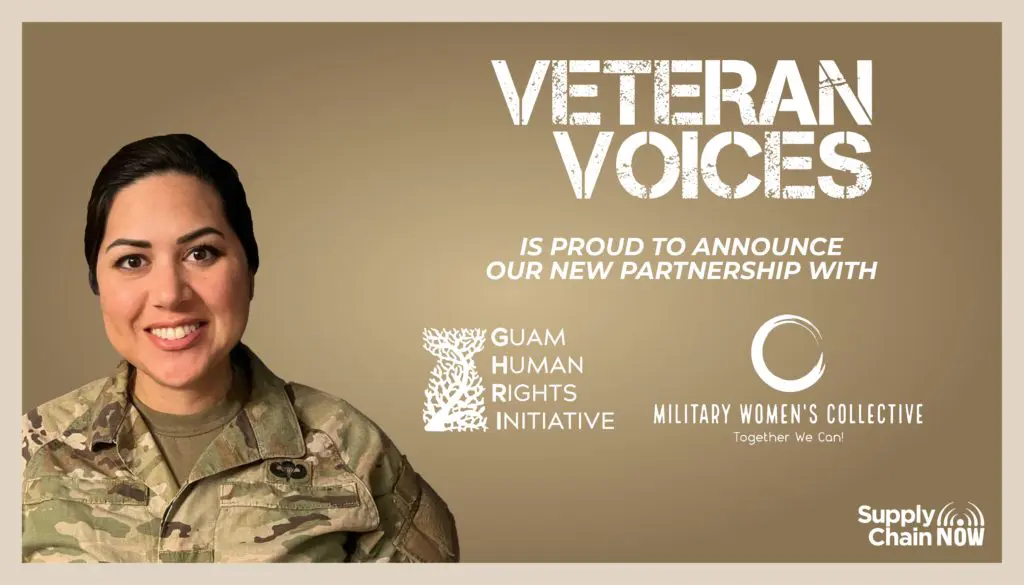
Veteran Voices Launches New Partnership
Supply Chain Now Founder and CEO Scott Luton announced that its “Veteran Voices” podcast will re-launch this year in partnership with two non-profit organizations: The Guam Human Rights Initiative and the Military Women’s Collective. “We’re proud to promote the efforts of these two organizations, as we are all highly aligned in our dedicated mission to serve our veteran community. Both organizations are veteran-led, start-up nonprofits that are doing big things out in the market. They are the perfect partners for ‘Veteran Voices,’” said Luton. As noted on its website, the Guam Human Rights Initiative “is a collaborative research nonprofit seeking to advance human rights on Guam and throughout the Pacific through meaningful and impactful research efforts.” Since its founding in 2021, the Military Women’s Collective is determined “to make an impact in the military nonprofit space by focusing on our women veteran population.” Its mission focuses on empowering homeless and food-insecure women veterans as well as providing coaching, mentorship and support for women veterans who are transitioning out of the military. Mary Kate Soliva, host of “Veteran Voices,” said that she has a special place in her heart for both organizations and the good works they do. She is excited…